MOOCS PRESENTATION
GIFT THAMSANQA LUBISI
201209380
CONTENTS
 HISTORY OF MOOCS
 DIFFERENT TYPES OF MOOCS
 MY FIELD OF INTEREST
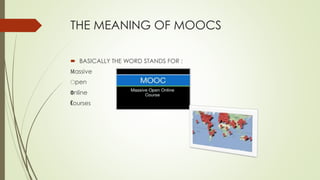
THE MEANING OF MOOCS
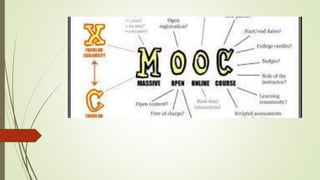
 BASICALLY THE WORD STANDS FOR :
Massive
Open
Online
Courses
HISTORY OF MOOC (precisely)
 In the year 2004 George Siemens together with Stephen Downes made a theory
of connectivism.
 They had a thesis that knowledge is distributed across a network of connections
and thus learning pertain of the ability to construct and transverse those
networks (Downes, 2012).
 Then in the year 2008 the first MOOC presented at the University of Manitoba
with a number of 2200 learners.
 The again in the year 2010, Dave Cormeir captured videos and uploaded those
on youtube. (www.youtube.com)
 During 2011, MOOC was part of preparation skills for new students in college
and a requirement.
 In 2012:
 The Harvard’s first MOOC had 370,000 registed students (Pappano, 2012)
 The Coursera launched from Standford which offers the first xMOOCs (Chen,
2012)
 In 2013 cMOOCs and xMOOCs were too many to count accurately
MOOCS
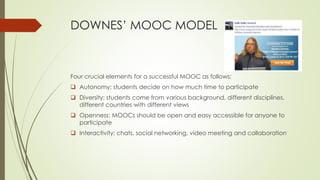
DOWNES’ MOOC MODEL
Four crucial elements for a successful MOOC as follows;
 Autonomy: students decide on how much time to participate
 Diversity: students come from various background, different disciplines,
different countries with different views
 Openness: MOOCs should be open and easy accessible for anyone to
participate
 Interactivity: chats, social networking, video meeting and collaboration
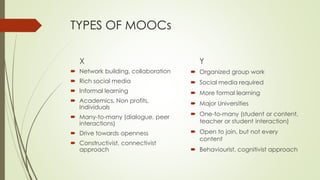
TYPES OF MOOCs
X
 Network building, collaboration
 Rich social media
 Informal learning
 Academics, Non profits,
Individuals
 Many-to-many (dialogue, peer
interactions)
 Drive towards openness
 Constructivist, connectivist
approach
Y
 Organized group work
 Social media required
 More formal learning
 Major Universities
 One-to-many (student or content,
teacher or student interaction)
 Open to join, but not every
content
 Behaviourist, cognitivist approach
TYPE OF MOOC
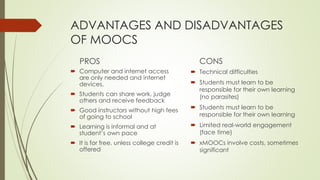
ADVANTAGES AND DISADVANTAGES
OF MOOCS
PROS
 Computer and internet access
are only needed and internet
devices.
 Students can share work, judge
others and receive feedback
 Good instructors without high fees
of going to school
 Learning is informal and at
student’s own pace
 It is for free, unless college credit is
offered
CONS
 Technical difficulties
 Students must learn to be
responsible for their own learning
(no parasites)
 Students must learn to be
responsible for their own learning
 Limited real-world engagement
(face time)
 xMOOCs involve costs, sometimes
significant
PROS AND CONS
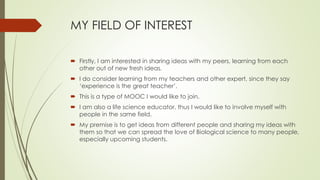
MY FIELD OF INTEREST
 Firstly, I am interested in sharing ideas with my peers, learning from each
other out of new fresh ideas.
 I do consider learning from my teachers and other expert, since they say
‘experience is the great teacher’.
 This is a type of MOOC I would like to join.
 I am also a life science educator, thus I would like to involve myself with
people in the same field.
 My premise is to get ideas from different people and sharing my ideas with
them so that we can spread the love of Biological science to many people,
especially upcoming students.
Reference list
Moocs presentations. Available from:
 http://www.slideshare.net/oerafrica/the-rise-of-moocs
 http://www.slideshare.net/LynGoodnight/multmedia-presentation-
goodnight
 http://www.slideshare.net/Downes/2013-05-06-moose
 http://www.slideshare.net/Downes/education-as-
platform?from_search=11
 http://www.slideshare.net/Downes/how-to-organize-a-
mooc?from_search=9 [accessed in 28/02/2014].
THANK YOU

Moocspresentation 140225074014-phpapp02

  • 1.
  • 2.
    CONTENTS  HISTORY OFMOOCS  DIFFERENT TYPES OF MOOCS  MY FIELD OF INTEREST
  • 3.
    THE MEANING OFMOOCS  BASICALLY THE WORD STANDS FOR : Massive Open Online Courses
  • 4.
    HISTORY OF MOOC(precisely)  In the year 2004 George Siemens together with Stephen Downes made a theory of connectivism.  They had a thesis that knowledge is distributed across a network of connections and thus learning pertain of the ability to construct and transverse those networks (Downes, 2012).  Then in the year 2008 the first MOOC presented at the University of Manitoba with a number of 2200 learners.  The again in the year 2010, Dave Cormeir captured videos and uploaded those on youtube. (www.youtube.com)  During 2011, MOOC was part of preparation skills for new students in college and a requirement.  In 2012:  The Harvard’s first MOOC had 370,000 registed students (Pappano, 2012)  The Coursera launched from Standford which offers the first xMOOCs (Chen, 2012)  In 2013 cMOOCs and xMOOCs were too many to count accurately
  • 5.
  • 6.
    DOWNES’ MOOC MODEL Fourcrucial elements for a successful MOOC as follows;  Autonomy: students decide on how much time to participate  Diversity: students come from various background, different disciplines, different countries with different views  Openness: MOOCs should be open and easy accessible for anyone to participate  Interactivity: chats, social networking, video meeting and collaboration
  • 8.
    TYPES OF MOOCs X Network building, collaboration  Rich social media  Informal learning  Academics, Non profits, Individuals  Many-to-many (dialogue, peer interactions)  Drive towards openness  Constructivist, connectivist approach Y  Organized group work  Social media required  More formal learning  Major Universities  One-to-many (student or content, teacher or student interaction)  Open to join, but not every content  Behaviourist, cognitivist approach
  • 9.
  • 10.
    ADVANTAGES AND DISADVANTAGES OFMOOCS PROS  Computer and internet access are only needed and internet devices.  Students can share work, judge others and receive feedback  Good instructors without high fees of going to school  Learning is informal and at student’s own pace  It is for free, unless college credit is offered CONS  Technical difficulties  Students must learn to be responsible for their own learning (no parasites)  Students must learn to be responsible for their own learning  Limited real-world engagement (face time)  xMOOCs involve costs, sometimes significant
  • 11.
  • 12.
    MY FIELD OFINTEREST  Firstly, I am interested in sharing ideas with my peers, learning from each other out of new fresh ideas.  I do consider learning from my teachers and other expert, since they say ‘experience is the great teacher’.  This is a type of MOOC I would like to join.  I am also a life science educator, thus I would like to involve myself with people in the same field.  My premise is to get ideas from different people and sharing my ideas with them so that we can spread the love of Biological science to many people, especially upcoming students.
  • 13.
    Reference list Moocs presentations.Available from:  http://www.slideshare.net/oerafrica/the-rise-of-moocs  http://www.slideshare.net/LynGoodnight/multmedia-presentation- goodnight  http://www.slideshare.net/Downes/2013-05-06-moose  http://www.slideshare.net/Downes/education-as- platform?from_search=11  http://www.slideshare.net/Downes/how-to-organize-a- mooc?from_search=9 [accessed in 28/02/2014].
  • 14.