Team Members
» Sabbir Ahmed Saikat
ID-13142103001
» Ayatul Ahammed
ID-13142103044
Index
Introduction
Importance
Types of Dimensions
Methods to Perform Reduction
Benefits
What is Dimension Reduction??
Dimension Reduction refers to the process of
converting a set of data having vast dimensions into
data with lesser dimensions ensuring that
it conveys similar information concisely.
Why Dimension Reduction is Important??
These techniques are typically used while
solving machine learning problems to obtain better
features for a classification or regression task.
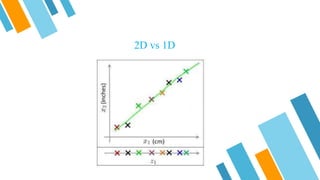
2D vs 1D
Some Methods to Perform Dimension Reduction
»Missing Values
»Low Variance
»Decision Trees
»Random Forest
»High Correlation
Benefits of Dimension Reduction
»It fastens the time required for performing same
computations. Less dimensions leads to less computing.
»It helps in data compressing and reducing the storage space
required.
»It takes care of multi-collinearity that improves the model
performance.
»Reducing the dimensions of data to 2D or 3D may allow us
to plot and visualize it precisely.
»It is helpful in noise removal also and as result of that we
can improve the performance of models.
Dimensionality reduction

Dimensionality reduction

  • 2.
    Team Members » SabbirAhmed Saikat ID-13142103001 » Ayatul Ahammed ID-13142103044
  • 3.
  • 4.
    What is DimensionReduction?? Dimension Reduction refers to the process of converting a set of data having vast dimensions into data with lesser dimensions ensuring that it conveys similar information concisely.
  • 5.
    Why Dimension Reductionis Important?? These techniques are typically used while solving machine learning problems to obtain better features for a classification or regression task.
  • 6.
  • 7.
    Some Methods toPerform Dimension Reduction »Missing Values »Low Variance »Decision Trees »Random Forest »High Correlation
  • 8.
    Benefits of DimensionReduction »It fastens the time required for performing same computations. Less dimensions leads to less computing. »It helps in data compressing and reducing the storage space required. »It takes care of multi-collinearity that improves the model performance. »Reducing the dimensions of data to 2D or 3D may allow us to plot and visualize it precisely. »It is helpful in noise removal also and as result of that we can improve the performance of models.

Editor's Notes

  • #7 Let’s look at the image shown below. It shows 2 dimensions x1 and x2, which are let us say measurements of several object in cm (x1) and inches (x2). Now, if you were to use both these dimensions in machine learning, they will convey similar information and introduce a lot of noise in system, so you are better of just using one dimension. Here we have converted the dimension of data from 2D (from x1 and x2) to 1D (z1), which has made the data relatively easier to explain.
  • #10 There is no global right or wrong answer. It depends on situation to situation. Let me cover a few examples to bring out the spectrum of possibilities. These may not be comprehensive, but would give you a good flavor of what should be done.