Making BIGDATA 
smaller 
Tony Tran
About Me 
● I am from SF 
○ SF Bay Area Machine Learning Meetup 
○ www.sfdatajobs.com 
● Background: 
○ BS/MS CompSci (focus on ML/Vision) 
○ 4 years as Data Engineer in Ad Tech 
○ Currently Consulting
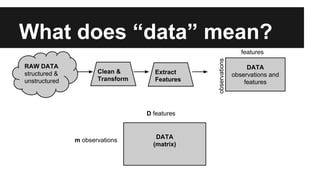
What does “data” mean? 
RAW DATA 
structured & 
unstructured 
Clean & 
Transform 
Extract 
Features 
DATA 
observations and 
features 
observations 
features 
D features 
DATA 
(matrix) 
m observations
What is “Big Data?” 
Big data is an all-encompassing term for any collection of data sets so large 
and complex that it becomes difficult to process them using traditional data 
processing applications -- Wikipedia
What is “Big Data?” 
Big data is an all-encompassing term for any collection of data sets so large 
and complex that it becomes difficult to process them using traditional data 
processing applications -- Wikipedia 
To me, Big Data is when: 
● run out of disc space 
● run into “Out Of Memory” Errors 
● S3 billing triggers your credit company to call you 
● you are willing to go through the pains of setting up a hadoop/spark/etc 
cluster (have you tried configuring your own cluster?)
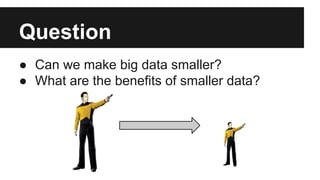
Question 
● Can we make big data smaller? 
● What are the benefits of smaller data?
Question 
● Can we make big data smaller? 
● Benefits of having “small data”: 
○ Reduce storage costs 
○ Reduce computational costs 
○ No more “Out Of Memory” Errors
Ideas for making data small 
● Reduce the number of observations 
○ Only keep observations that are “important” 
○ Remove redundant observations 
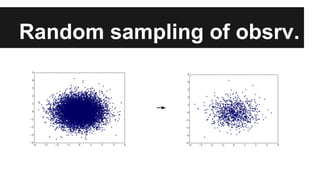
○ Randomly sample 
● Reduce the number of features 
○ removing non-useful features 
○ combining features 
○ something clever
Random sampling of obsrv.
Ideas for making data small 
● Reduce the number of observations 
○ Only keep rows that are “important” 
○ Remove redundant rows 
○ Randomly sample 
● Reduce the number of features 
○ removing non-useful features 
○ combining features 
○ something clever
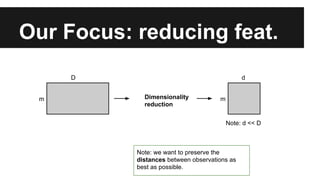
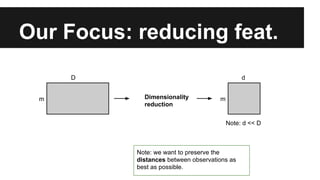
Our Focus: reducing feat. 
m 
D 
m 
d 
Dimensionality 
Reduction 
Note: d << D 
Dimensionality 
reduction 
Note: we want to preserve the 
distances between observations as 
best as possible.
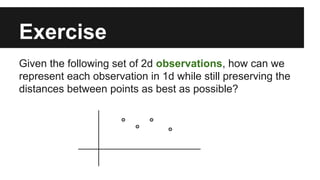
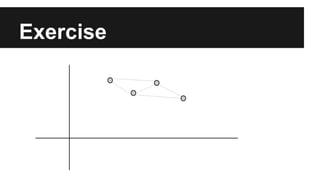
Exercise 
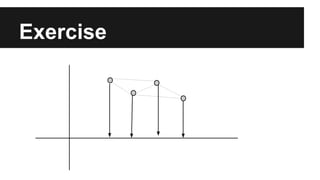
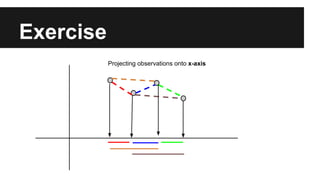
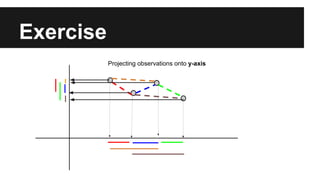
Given the following set of 2d observations, how can we 
represent each observation in 1d while still preserving the 
distances between points as best as possible?
Exercise
Exercise
Exercise 
Projecting observations onto x-axis
Exercise 
Projecting observations onto y-axis
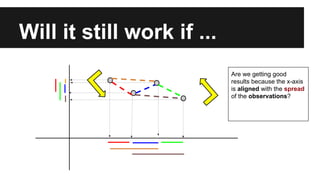
Will it still work if ... 
Are we getting good 
results because the x-axis 
is aligned with the spread 
of the observations?
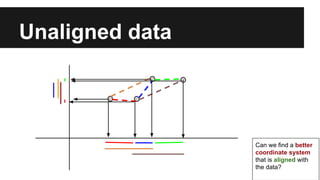
Unaligned data 
Can we find a better 
coordinate system 
that is aligned with 
the data?
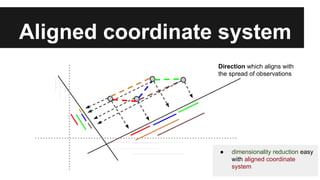
Aligned coordinate system 
Direction which aligns with 
the spread of observations 
● dimensionality reduction easy 
with aligned coordinate 
system
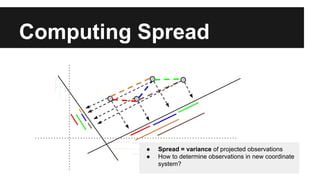
Computing Spread 
● Spread = variance of projected observations 
● How to determine observations in new coordinate 
system?
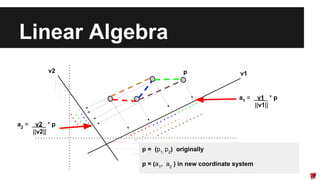
Linear Algebra 
v2 v1 
a1 = v1_ * p 
||v1|| 
p 
a2 = v2_ * p 
||v2|| 
p = (p1, p2) originally 
p = (a1, a2 ) in new coordinate system
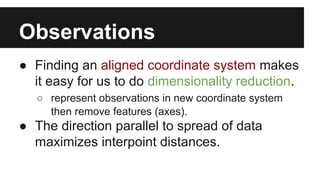
Observations 
● Finding an aligned coordinate system makes 
it easy for us to do dimensionality reduction. 
○ represent observations in new coordinate system 
then remove features (axes). 
● The direction parallel to spread of data 
maximizes interpoint distances.
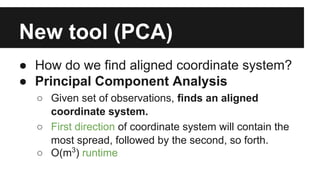
New tool (PCA) 
● How do we find aligned coordinate system? 
Is there a tool already developed for this?
New tool (PCA) 
● How do we find aligned coordinate system? 
● Principal Component Analysis 
○ Given set of observations, finds an aligned 
coordinate system. 
○ First direction of coordinate system will contain the 
most spread, followed by the second, so forth. 
○ O(m3) runtime
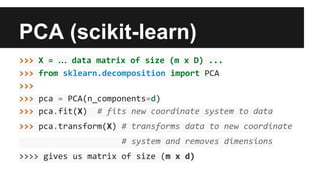
PCA (scikit-learn) 
>>> X = … data matrix of size (m x D) ... 
>>> from sklearn.decomposition import PCA 
>>> 
>>> pca = PCA(n_components=d) 
>>> pca.fit(X) # fits new coordinate system to data 
>>> pca.transform(X) # transforms data to new coordinate 
# system and removes dimensions 
>>>> gives us matrix of size (m x d)
Our Focus: reducing feat. 
m 
D 
m 
d 
Dimensionality 
Reduction 
Note: d << D 
Dimensionality 
reduction 
Note: we want to preserve the 
distances between observations as 
best as possible.
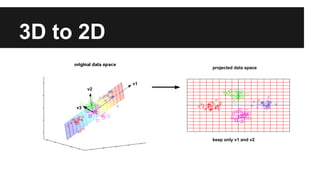
3D to 2D 
v1 
v2 
v3 
projected data space 
keep only v1 and v2
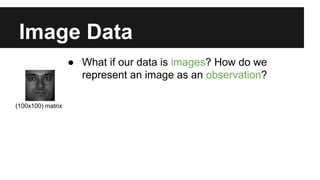
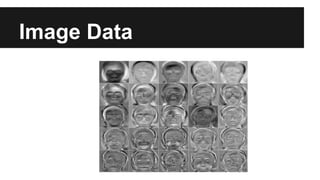
Image Data 
● What if our data is images? How do we 
represent an image as an observation? 
(100x100) matrix
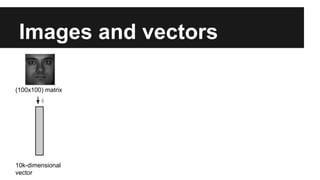
Images and vectors 
(100x100) matrix 
10k-dimensional 
vector
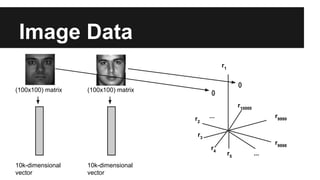
Image Data 
(100x100) matrix 
10k-dimensional 
vector 
(100x100) matrix 
10k-dimensional 
vector 
r3 
r1 
r2 
r4 r5 ... 
r9999 
r9998 
r10000 
...
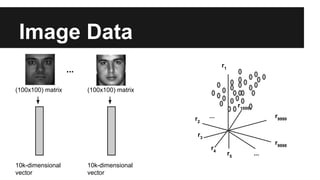
Image Data 
(100x100) matrix 
10k-dimensional 
vector 
(100x100) matrix 
10k-dimensional 
vector 
r3 
r1 
r2 
r4 r5 ... 
r9999 
r9998 
r10000 
... 
...
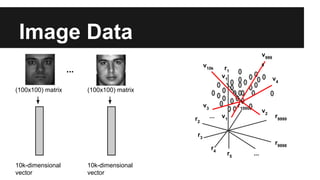
Image Data 
(100x100) matrix 
10k-dimensional 
vector 
(100x100) matrix 
10k-dimensional 
vector 
r3 
r1 
r2 
r4 r5 ... 
r9999 
r9998 
r10000 
... 
... 
v999 
9 
v4 
v2 
v1 
v10k 
v1 
v3
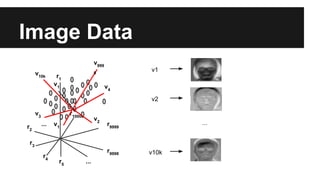
Image Data 
v1 
v2 
v10k 
... 
r3 
r1 
r2 
r4 r5 ... 
r9999 
r9998 
r10000 
... 
v999 
9 
v4 
v2 
v1 
v10k 
v1 
v3
Image Data
Image Data 
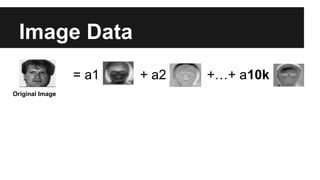
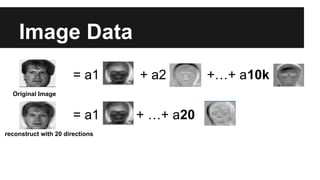
= a1 + a2 +…+ a10k 
Original Image
Image Data 
= a1 + a2 +…+ a10k 
Original Image 
= a1 + …+ a20 
reconstruct with 20 directions
Image Data 
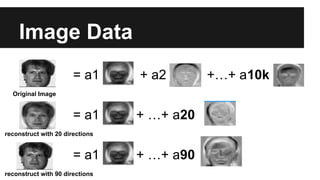
= a1 + a2 +…+ a10k 
Original Image 
= a1 + …+ a20 
reconstruct with 20 directions 
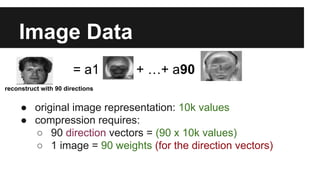
= a1 + …+ a90 
reconstruct with 90 directions
Image Data 
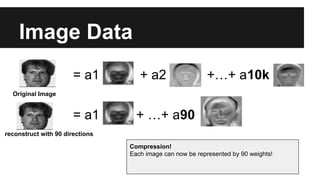
= a1 + a2 +…+ a10k 
Original Image 
= a1 + …+ a90 
reconstruct with 90 directions 
Compression! 
Each image can now be represented by 90 weights!
Image Data 
= a1 + …+ a90 
reconstruct with 90 directions 
● original image representation: 10k values 
● compression requires: 
○ 90 direction vectors = (90 x 10k values) 
○ 1 image = 90 weights (for the direction vectors)
Image Data 
= a1 + …+ a90 
reconstruct with 90 directions 
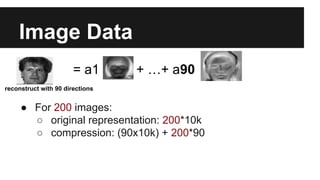
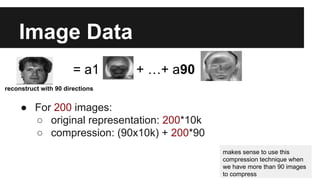
● For 200 images: 
○ original representation: 200*10k 
○ compression: (90x10k) + 200*90
Image Data 
= a1 + …+ a90 
reconstruct with 90 directions 
● For 200 images: 
○ original representation: 200*10k 
○ compression: (90x10k) + 200*90 
makes sense to use this 
compression technique when 
we have more than 90 images 
to compress
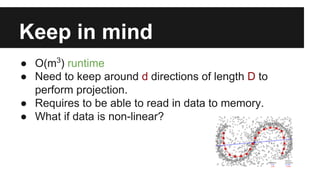
Keep in mind 
● O(m3) runtime 
● Need to keep around d directions of length D to 
perform projection. 
● Requires to be able to read in data to memory. 
● What if data is non-linear?
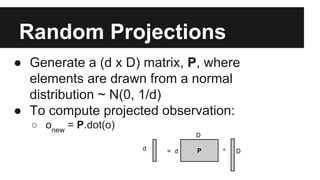
Random Projections 
● Generate a (d x D) matrix, P, where 
elements are drawn from a normal 
distribution ~ N(0, 1/d) 
● To compute projected observation: 
○ onew = P.dot(o) 
D 
d = d P 
* D
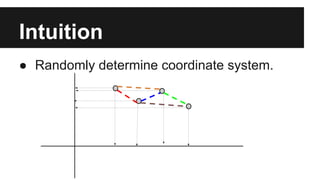
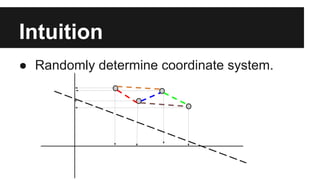
Intuition 
● Randomly determine coordinate system.
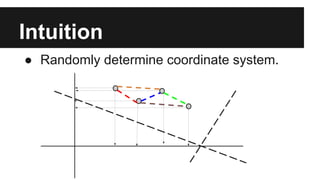
Intuition 
● Randomly determine coordinate system.
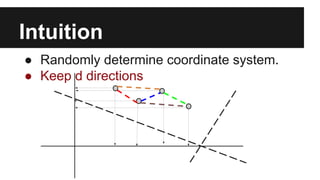
Intuition 
● Randomly determine coordinate system.
Intuition 
● Randomly determine coordinate system. 
● Keep d directions
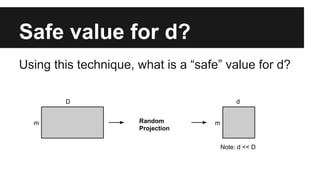
Safe value for d? 
Using this technique, what is a “safe” value for d? 
m 
D 
m 
d 
Dimensionality 
Reduction 
Note: d << D 
Random 
Projection
Safe value for d? 
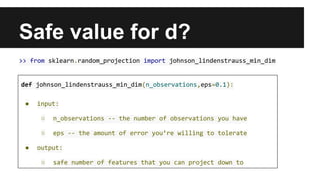
>> from sklearn.random_projection import johnson_lindenstrauss_min_dim 
def johnson_lindenstrauss_min_dim(n_observations,eps=0.1): 
● input: 
○ n_observations -- the number of observations you have 
○ eps -- the amount of error you’re willing to tolerate 
● output: 
○ safe number of features that you can project down to
Mathematical Guarantees 
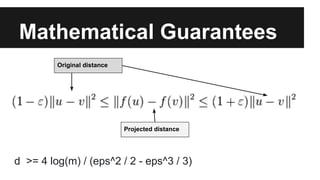
Original distance 
Projected distance 
d >= 4 log(m) / (eps^2 / 2 - eps^3 / 3)
Practical usage 
● High probability that projection will be good, 
but there’s still a chance that it will not be! 
○ Create multiple projections and test guarantees with 
sampled observations.
Comparison 
● PCA 
○ finds aligned coordinate system which maximizes spread. 
○ o(m3) runtime + requires all points to be read into memory. 
○ o(dD) space to store aligned coordinate system for projection. 
● Random Projection 
○ finds random coordinate system 
○ o(dD) runtime and space to construct projection Matrix 
○ Guaranteed with high probability to work
Thank you 
Tony Tran 
tony@sfdatajobs.com 
@quicksorter
References 
● http://www.cs.princeton.edu/~cdecoro/eigenfaces/ 
● http://scikit-learn.org/stable/modules/generated/sklearn. 
decomposition.PCA.html#sklearn.decomposition.PCA 
● http://scikit-learn.org/stable/modules/random_projection. 
html 
● http://blog.yhathq.com/posts/sparse-random-projections. 
html

Making BIG DATA smaller

  • 1.
  • 2.
    About Me ●I am from SF ○ SF Bay Area Machine Learning Meetup ○ www.sfdatajobs.com ● Background: ○ BS/MS CompSci (focus on ML/Vision) ○ 4 years as Data Engineer in Ad Tech ○ Currently Consulting
  • 3.
    What does “data”mean? RAW DATA structured & unstructured Clean & Transform Extract Features DATA observations and features observations features D features DATA (matrix) m observations
  • 4.
    What is “BigData?” Big data is an all-encompassing term for any collection of data sets so large and complex that it becomes difficult to process them using traditional data processing applications -- Wikipedia
  • 5.
    What is “BigData?” Big data is an all-encompassing term for any collection of data sets so large and complex that it becomes difficult to process them using traditional data processing applications -- Wikipedia To me, Big Data is when: ● run out of disc space ● run into “Out Of Memory” Errors ● S3 billing triggers your credit company to call you ● you are willing to go through the pains of setting up a hadoop/spark/etc cluster (have you tried configuring your own cluster?)
  • 6.
    Question ● Canwe make big data smaller? ● What are the benefits of smaller data?
  • 7.
    Question ● Canwe make big data smaller? ● Benefits of having “small data”: ○ Reduce storage costs ○ Reduce computational costs ○ No more “Out Of Memory” Errors
  • 8.
    Ideas for makingdata small ● Reduce the number of observations ○ Only keep observations that are “important” ○ Remove redundant observations ○ Randomly sample ● Reduce the number of features ○ removing non-useful features ○ combining features ○ something clever
  • 9.
  • 10.
    Ideas for makingdata small ● Reduce the number of observations ○ Only keep rows that are “important” ○ Remove redundant rows ○ Randomly sample ● Reduce the number of features ○ removing non-useful features ○ combining features ○ something clever
  • 11.
    Our Focus: reducingfeat. m D m d Dimensionality Reduction Note: d << D Dimensionality reduction Note: we want to preserve the distances between observations as best as possible.
  • 12.
    Exercise Given thefollowing set of 2d observations, how can we represent each observation in 1d while still preserving the distances between points as best as possible?
  • 13.
  • 14.
  • 15.
  • 16.
  • 17.
    Will it stillwork if ... Are we getting good results because the x-axis is aligned with the spread of the observations?
  • 18.
    Unaligned data Canwe find a better coordinate system that is aligned with the data?
  • 19.
    Aligned coordinate system Direction which aligns with the spread of observations ● dimensionality reduction easy with aligned coordinate system
  • 20.
    Computing Spread ●Spread = variance of projected observations ● How to determine observations in new coordinate system?
  • 21.
    Linear Algebra v2v1 a1 = v1_ * p ||v1|| p a2 = v2_ * p ||v2|| p = (p1, p2) originally p = (a1, a2 ) in new coordinate system
  • 22.
    Observations ● Findingan aligned coordinate system makes it easy for us to do dimensionality reduction. ○ represent observations in new coordinate system then remove features (axes). ● The direction parallel to spread of data maximizes interpoint distances.
  • 23.
    New tool (PCA) ● How do we find aligned coordinate system? Is there a tool already developed for this?
  • 24.
    New tool (PCA) ● How do we find aligned coordinate system? ● Principal Component Analysis ○ Given set of observations, finds an aligned coordinate system. ○ First direction of coordinate system will contain the most spread, followed by the second, so forth. ○ O(m3) runtime
  • 25.
    PCA (scikit-learn) >>>X = … data matrix of size (m x D) ... >>> from sklearn.decomposition import PCA >>> >>> pca = PCA(n_components=d) >>> pca.fit(X) # fits new coordinate system to data >>> pca.transform(X) # transforms data to new coordinate # system and removes dimensions >>>> gives us matrix of size (m x d)
  • 26.
    Our Focus: reducingfeat. m D m d Dimensionality Reduction Note: d << D Dimensionality reduction Note: we want to preserve the distances between observations as best as possible.
  • 27.
    3D to 2D v1 v2 v3 projected data space keep only v1 and v2
  • 28.
    Image Data ●What if our data is images? How do we represent an image as an observation? (100x100) matrix
  • 29.
    Images and vectors (100x100) matrix 10k-dimensional vector
  • 30.
    Image Data (100x100)matrix 10k-dimensional vector (100x100) matrix 10k-dimensional vector r3 r1 r2 r4 r5 ... r9999 r9998 r10000 ...
  • 31.
    Image Data (100x100)matrix 10k-dimensional vector (100x100) matrix 10k-dimensional vector r3 r1 r2 r4 r5 ... r9999 r9998 r10000 ... ...
  • 32.
    Image Data (100x100)matrix 10k-dimensional vector (100x100) matrix 10k-dimensional vector r3 r1 r2 r4 r5 ... r9999 r9998 r10000 ... ... v999 9 v4 v2 v1 v10k v1 v3
  • 33.
    Image Data v1 v2 v10k ... r3 r1 r2 r4 r5 ... r9999 r9998 r10000 ... v999 9 v4 v2 v1 v10k v1 v3
  • 34.
  • 35.
    Image Data =a1 + a2 +…+ a10k Original Image
  • 36.
    Image Data =a1 + a2 +…+ a10k Original Image = a1 + …+ a20 reconstruct with 20 directions
  • 37.
    Image Data =a1 + a2 +…+ a10k Original Image = a1 + …+ a20 reconstruct with 20 directions = a1 + …+ a90 reconstruct with 90 directions
  • 38.
    Image Data =a1 + a2 +…+ a10k Original Image = a1 + …+ a90 reconstruct with 90 directions Compression! Each image can now be represented by 90 weights!
  • 39.
    Image Data =a1 + …+ a90 reconstruct with 90 directions ● original image representation: 10k values ● compression requires: ○ 90 direction vectors = (90 x 10k values) ○ 1 image = 90 weights (for the direction vectors)
  • 40.
    Image Data =a1 + …+ a90 reconstruct with 90 directions ● For 200 images: ○ original representation: 200*10k ○ compression: (90x10k) + 200*90
  • 41.
    Image Data =a1 + …+ a90 reconstruct with 90 directions ● For 200 images: ○ original representation: 200*10k ○ compression: (90x10k) + 200*90 makes sense to use this compression technique when we have more than 90 images to compress
  • 42.
    Keep in mind ● O(m3) runtime ● Need to keep around d directions of length D to perform projection. ● Requires to be able to read in data to memory. ● What if data is non-linear?
  • 43.
    Random Projections ●Generate a (d x D) matrix, P, where elements are drawn from a normal distribution ~ N(0, 1/d) ● To compute projected observation: ○ onew = P.dot(o) D d = d P * D
  • 44.
    Intuition ● Randomlydetermine coordinate system.
  • 45.
    Intuition ● Randomlydetermine coordinate system.
  • 46.
    Intuition ● Randomlydetermine coordinate system.
  • 47.
    Intuition ● Randomlydetermine coordinate system. ● Keep d directions
  • 48.
    Safe value ford? Using this technique, what is a “safe” value for d? m D m d Dimensionality Reduction Note: d << D Random Projection
  • 49.
    Safe value ford? >> from sklearn.random_projection import johnson_lindenstrauss_min_dim def johnson_lindenstrauss_min_dim(n_observations,eps=0.1): ● input: ○ n_observations -- the number of observations you have ○ eps -- the amount of error you’re willing to tolerate ● output: ○ safe number of features that you can project down to
  • 50.
    Mathematical Guarantees Originaldistance Projected distance d >= 4 log(m) / (eps^2 / 2 - eps^3 / 3)
  • 51.
    Practical usage ●High probability that projection will be good, but there’s still a chance that it will not be! ○ Create multiple projections and test guarantees with sampled observations.
  • 52.
    Comparison ● PCA ○ finds aligned coordinate system which maximizes spread. ○ o(m3) runtime + requires all points to be read into memory. ○ o(dD) space to store aligned coordinate system for projection. ● Random Projection ○ finds random coordinate system ○ o(dD) runtime and space to construct projection Matrix ○ Guaranteed with high probability to work
  • 53.
    Thank you TonyTran tony@sfdatajobs.com @quicksorter
  • 54.
    References ● http://www.cs.princeton.edu/~cdecoro/eigenfaces/ ● http://scikit-learn.org/stable/modules/generated/sklearn. decomposition.PCA.html#sklearn.decomposition.PCA ● http://scikit-learn.org/stable/modules/random_projection. html ● http://blog.yhathq.com/posts/sparse-random-projections. html