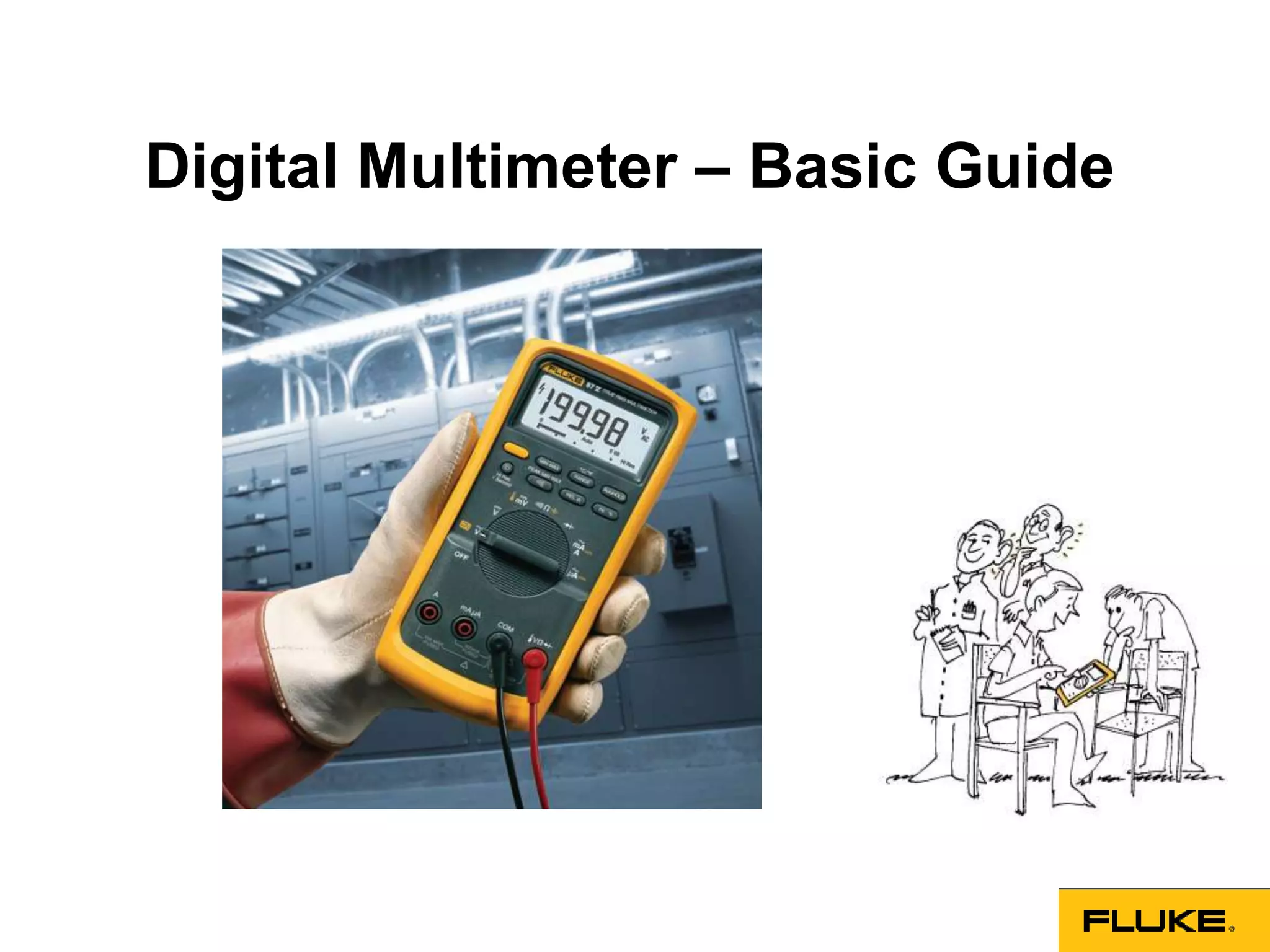
Digital Multimeter – Basic Guide
What is a Digital Multimeter?
       •   A Digital Multi-meter (DMM) is simply an electronic instrument
           that measure electrical parameters.


       •   A DMM measures
            •   AC / DC volts,
            •   AC / DC current
            •   Resistance


       •   DMM may have a variety of special features that are
           designed for a wide number of applications.
            •     Frequency
            •     Temperature
            •     Capacitance
            •     Continuity in circuit
            •     Diode check


http://www.fluke.com/fluke/inen/products/Thermometers.htm
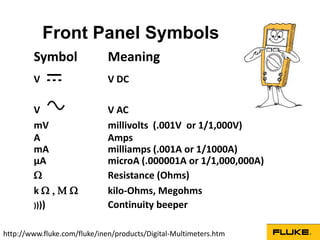
Front Panel Symbols
        Symbol                Meaning
        V                     V DC

        V                     V AC
        mV                    millivolts (.001V or 1/1,000V)
        A                     Amps
        mA                    milliamps (.001A or 1/1000A)
        µA                    microA (.000001A or 1/1,000,000A)
                             Resistance (Ohms)
        k               kilo-Ohms, Megohms
        ))))                  Continuity beeper

http://www.fluke.com/fluke/inen/products/Digital-Multimeters.htm
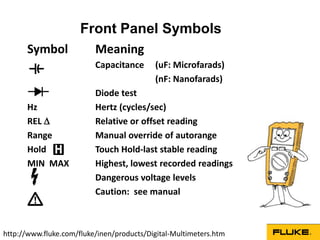
Front Panel Symbols
      Symbol              Meaning
                          Capacitance      (uF: Microfarads)
                                           (nF: Nanofarads)
                          Diode test
      Hz                  Hertz (cycles/sec)
      REL                Relative or offset reading
      Range               Manual override of autorange
      Hold                Touch Hold-last stable reading
      MIN MAX             Highest, lowest recorded readings
                          Dangerous voltage levels
                          Caution: see manual


http://www.fluke.com/fluke/inen/products/Digital-Multimeters.htm
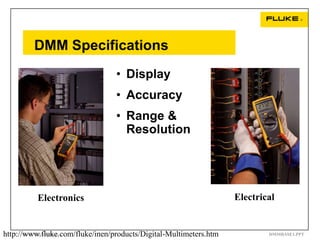
DMM Specifications
                                 • Display
                                 • Accuracy
                                 • Range &
                                   Resolution


          Electronics                                              Electrical


http://www.fluke.com/fluke/inen/products/Digital-Multimeters.htm
    5  Digital Multimeter Basics                                           DMMBASE1.PPT
Understanding DMM Display Specs
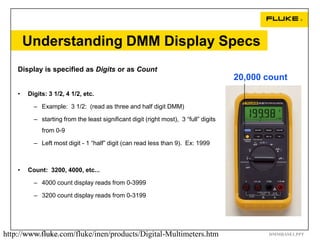
    Display is specified as Digits or as Count
                                                                                      20,000 count
    •   Digits: 3 1/2, 4 1/2, etc.

          – Example: 3 1/2: (read as three and half digit DMM)

          – starting from the least significant digit (right most), 3 “full” digits
             from 0-9

          – Left most digit - 1 “half” digit (can read less than 9). Ex: 1999


    •   Count: 3200, 4000, etc...

          – 4000 count display reads from 0-3999

          – 3200 count display reads from 0-3199


http://www.fluke.com/fluke/inen/products/Digital-Multimeters.htm
    6  Digital Multimeter Basics                                                             DMMBASE1.PPT
Understanding DMM Accuracy Specs
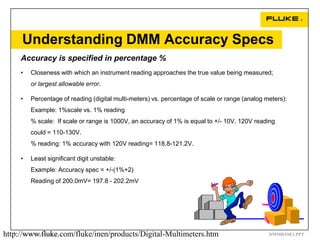
     Accuracy is specified in percentage %
     •   Closeness with which an instrument reading approaches the true value being measured;
         or largest allowable error.

     •   Percentage of reading (digital multi-meters) vs. percentage of scale or range (analog meters):
         Example: 1%scale vs. 1% reading
         % scale: If scale or range is 1000V, an accuracy of 1% is equal to +/- 10V. 120V reading
         could = 110-130V.
         % reading: 1% accuracy with 120V reading= 118.8-121.2V.

     •   Least significant digit unstable:
         Example: Accuracy spec = +/-(1%+2)
         Reading of 200.0mV= 197.8 - 202.2mV


http://www.fluke.com/fluke/inen/products/Digital-Multimeters.htm
    7  Digital Multimeter Basics                                                                DMMBASE1.PPT
Understanding DMM Specs
       Range and Resolution

   •   Resolution is the smallest change in measured value to which the instrument will respond.


   •   As the range increases, the resolution decreases:

            Range:                 Resolution:
           400.0mV                 .1mV   (=1/10 mV)
           4.000V                  .001V (=1mV)
           40.00V                  .01V   (=10mV)
           400.0V                  0.1V   (=100mV)
           1000V                   1V     (=1000mV)


   •   For maximum resolution, choose the lowest possible range.


http://www.fluke.com/fluke/inen/products/Digital-Multimeters.htm
   8   Digital Multimeter Basics                                                       DMMBASE1.PPT
Measurements using Multimeter
    •   Measuring voltage –
        Testing for proper supply voltage is usually the first step when troubleshooting a
        circuit.


        How to make voltage measurements :


    •   Select V~ (ac) or V (dc), as desired.

    •   Plug the black test probe into the COM input jack. Plug the red test
        probe into the V input jack.

    •   If the DMM has manual ranging only, select the highest range so as
        not to overload the input.

    •   Touch the probe tips to the circuit across a load or power source (in
        parallel to the circuit).

    •   View the reading, being sure to note the unit of measurement.


http://www.fluke.com/fluke/inen/products/Digital-Multimeters.htm
Measurements using Multimeter
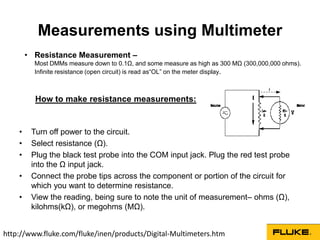
        • Resistance Measurement –
          Most DMMs measure down to 0.1Ω, and some measure as high as 300 MΩ (300,000,000 ohms).
          Infinite resistance (open circuit) is read as“OL” on the meter display.


          How to make resistance measurements:


    •    Turn off power to the circuit.
    •    Select resistance (Ω).
    •    Plug the black test probe into the COM input jack. Plug the red test probe
         into the Ω input jack.
    •    Connect the probe tips across the component or portion of the circuit for
         which you want to determine resistance.
    •    View the reading, being sure to note the unit of measurement– ohms (Ω),
         kilohms(kΩ), or megohms (MΩ).


http://www.fluke.com/fluke/inen/products/Digital-Multimeters.htm
Measurements using Multimeter
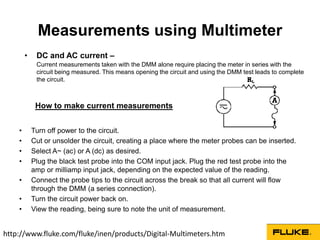
        •    DC and AC current –
             Current measurements taken with the DMM alone require placing the meter in series with the
             circuit being measured. This means opening the circuit and using the DMM test leads to complete
             the circuit.


             How to make current measurements


    •       Turn off power to the circuit.
    •       Cut or unsolder the circuit, creating a place where the meter probes can be inserted.
    •       Select A~ (ac) or A (dc) as desired.
    •       Plug the black test probe into the COM input jack. Plug the red test probe into the
            amp or milliamp input jack, depending on the expected value of the reading.
    •       Connect the probe tips to the circuit across the break so that all current will flow
            through the DMM (a series connection).
    •       Turn the circuit power back on.
    •       View the reading, being sure to note the unit of measurement.


http://www.fluke.com/fluke/inen/products/Digital-Multimeters.htm
True-rms vs. Average-sensing
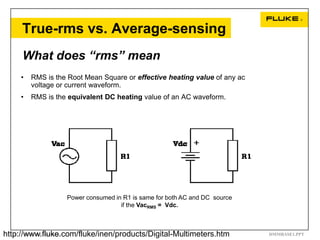
     What does “rms” mean
     •   RMS is the Root Mean Square or effective heating value of any ac
         voltage or current waveform.
     •   RMS is the equivalent DC heating value of an AC waveform.


                   Power consumed in R1 is same for both AC and DC source
                                    if the VacRMS = Vdc.


http://www.fluke.com/fluke/inen/products/Digital-Multimeters.htm
   12  Digital Multimeter Basics                                            DMMBASE1.PPT
True-rms vs. Average-sensing
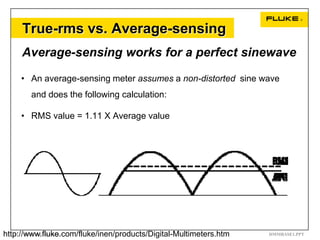
     Average-sensing works for a perfect sinewave

     • An average-sensing meter assumes a non-distorted sine wave
       and does the following calculation:

     • RMS value = 1.11 X Average value


http://www.fluke.com/fluke/inen/products/Digital-Multimeters.htm
   13  Digital Multimeter Basics                                   DMMBASE1.PPT
True-rms vs. Average-sensing
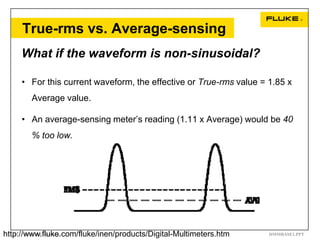
     What if the waveform is non-sinusoidal?

     • For this current waveform, the effective or True-rms value = 1.85 x
        Average value.

     • An average-sensing meter’s reading (1.11 x Average) would be 40
        % too low.


http://www.fluke.com/fluke/inen/products/Digital-Multimeters.htm
   14  Digital Multimeter Basics                                    DMMBASE1.PPT
True-rms vs. Average-sensing
     What if the waveform is non-sinusoidal?
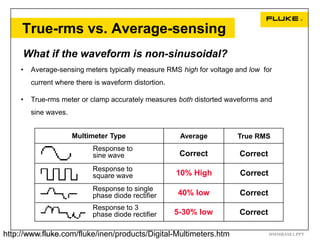
    •   Average-sensing meters typically measure RMS high for voltage and low for
        current where there is waveform distortion.

    •   True-rms meter or clamp accurately measures both distorted waveforms and
        sine waves.


                      Multimeter Type                  Average        True RMS
                           Response to
                           sine wave                   Correct         Correct
                           Response to
                           square wave                10% High         Correct
                           Response to single
                           phase diode rectifier      40% low          Correct
                           Response to 3
                           phase diode rectifier      5-30% low        Correct

http://www.fluke.com/fluke/inen/products/Digital-Multimeters.htm
   15  Digital Multimeter Basics                                                 DMMBASE1.PPT
True-rms vs. Average-sensing
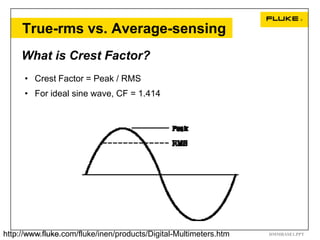
     What is Crest Factor?
      • Crest Factor = Peak / RMS
      • For ideal sine wave, CF = 1.414


http://www.fluke.com/fluke/inen/products/Digital-Multimeters.htm
   16  Digital Multimeter Basics                                   DMMBASE1.PPT
True-rms vs. Average-sensing
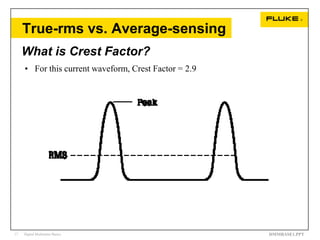
     What is Crest Factor?
     • For this current waveform, Crest Factor = 2.9


17   Digital Multimeter Basics                         DMMBASE1.PPT
True-rms vs. Average-sensing
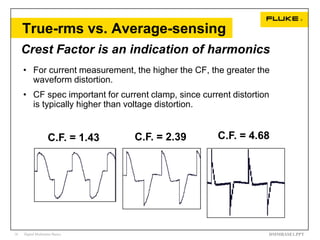
     Crest Factor is an indication of harmonics
     • For current measurement, the higher the CF, the greater the
       waveform distortion.
     • CF spec important for current clamp, since current distortion
       is typically higher than voltage distortion.


                     C.F. = 1.43   C.F. = 2.39        C.F. = 4.68


18   Digital Multimeter Basics                                     DMMBASE1.PPT
True-rms vs. Average-sensing
      Summary
     Minimum specifications for measurements
     on electrical power systems:
     • True RMS
         – Accurate for both linear and non-linear loads
     • Crest Factor 3
         – Accurate for current waveforms with CF not exceeding 3
         – CF=3 at max range; CF=6 at half-range
     • IEC 1010-1 CAT III-600 V
         – Distribution level: power distribution equipment.


http://www.fluke.com/fluke/inen/products/Digital-Multimeters.htm
   19  Digital Multimeter Basics                                    DMMBASE1.PPT
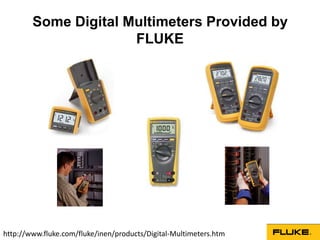
Some Digital Multimeters Provided by
                      FLUKE


http://www.fluke.com/fluke/inen/products/Digital-Multimeters.htm
Why Choose Fluke ?
    • Fluke designs its DMMs to the latest, most demanding safety
      standards.

    • Fluke offers many DMMs with different combinations of features like
      Touch Hold, analog bar graphs, and enhanced resolution.

    • Accessories for high current and temperature measurements are
      available to extend the capabilities of DMMs.


http://www.fluke.com/fluke/inen/products/Digital-Multimeters.htm
• Company Name : Fluke Corporation - India

• Website: http://www.fluke.com/fluke/inen/home/default.htm

• Address: Division of DHR Holding India Pvt. Ltd.
           10th Floor, Sigma
           Hiranandani Business Park, Powai
           Mumbai, Maharashtra 400076

• Contact Number: 1 800 209 9110
Thank You

Digital Multimeters- Basic Guide

  • 1.
  • 2.
    What is aDigital Multimeter? • A Digital Multi-meter (DMM) is simply an electronic instrument that measure electrical parameters. • A DMM measures • AC / DC volts, • AC / DC current • Resistance • DMM may have a variety of special features that are designed for a wide number of applications. • Frequency • Temperature • Capacitance • Continuity in circuit • Diode check http://www.fluke.com/fluke/inen/products/Thermometers.htm
  • 3.
    Front Panel Symbols Symbol Meaning V V DC V V AC mV millivolts (.001V or 1/1,000V) A Amps mA milliamps (.001A or 1/1000A) µA microA (.000001A or 1/1,000,000A)  Resistance (Ohms) k   kilo-Ohms, Megohms )))) Continuity beeper http://www.fluke.com/fluke/inen/products/Digital-Multimeters.htm
  • 4.
    Front Panel Symbols Symbol Meaning Capacitance (uF: Microfarads) (nF: Nanofarads) Diode test Hz Hertz (cycles/sec) REL  Relative or offset reading Range Manual override of autorange Hold Touch Hold-last stable reading MIN MAX Highest, lowest recorded readings Dangerous voltage levels Caution: see manual http://www.fluke.com/fluke/inen/products/Digital-Multimeters.htm
  • 5.
    DMM Specifications • Display • Accuracy • Range & Resolution Electronics Electrical http://www.fluke.com/fluke/inen/products/Digital-Multimeters.htm 5 Digital Multimeter Basics DMMBASE1.PPT
  • 6.
    Understanding DMM DisplaySpecs Display is specified as Digits or as Count 20,000 count • Digits: 3 1/2, 4 1/2, etc. – Example: 3 1/2: (read as three and half digit DMM) – starting from the least significant digit (right most), 3 “full” digits from 0-9 – Left most digit - 1 “half” digit (can read less than 9). Ex: 1999 • Count: 3200, 4000, etc... – 4000 count display reads from 0-3999 – 3200 count display reads from 0-3199 http://www.fluke.com/fluke/inen/products/Digital-Multimeters.htm 6 Digital Multimeter Basics DMMBASE1.PPT
  • 7.
    Understanding DMM AccuracySpecs Accuracy is specified in percentage % • Closeness with which an instrument reading approaches the true value being measured; or largest allowable error. • Percentage of reading (digital multi-meters) vs. percentage of scale or range (analog meters): Example: 1%scale vs. 1% reading % scale: If scale or range is 1000V, an accuracy of 1% is equal to +/- 10V. 120V reading could = 110-130V. % reading: 1% accuracy with 120V reading= 118.8-121.2V. • Least significant digit unstable: Example: Accuracy spec = +/-(1%+2) Reading of 200.0mV= 197.8 - 202.2mV http://www.fluke.com/fluke/inen/products/Digital-Multimeters.htm 7 Digital Multimeter Basics DMMBASE1.PPT
  • 8.
    Understanding DMM Specs Range and Resolution • Resolution is the smallest change in measured value to which the instrument will respond. • As the range increases, the resolution decreases: Range: Resolution: 400.0mV .1mV (=1/10 mV) 4.000V .001V (=1mV) 40.00V .01V (=10mV) 400.0V 0.1V (=100mV) 1000V 1V (=1000mV) • For maximum resolution, choose the lowest possible range. http://www.fluke.com/fluke/inen/products/Digital-Multimeters.htm 8 Digital Multimeter Basics DMMBASE1.PPT
  • 9.
    Measurements using Multimeter • Measuring voltage – Testing for proper supply voltage is usually the first step when troubleshooting a circuit. How to make voltage measurements : • Select V~ (ac) or V (dc), as desired. • Plug the black test probe into the COM input jack. Plug the red test probe into the V input jack. • If the DMM has manual ranging only, select the highest range so as not to overload the input. • Touch the probe tips to the circuit across a load or power source (in parallel to the circuit). • View the reading, being sure to note the unit of measurement. http://www.fluke.com/fluke/inen/products/Digital-Multimeters.htm
  • 10.
    Measurements using Multimeter • Resistance Measurement – Most DMMs measure down to 0.1Ω, and some measure as high as 300 MΩ (300,000,000 ohms). Infinite resistance (open circuit) is read as“OL” on the meter display. How to make resistance measurements: • Turn off power to the circuit. • Select resistance (Ω). • Plug the black test probe into the COM input jack. Plug the red test probe into the Ω input jack. • Connect the probe tips across the component or portion of the circuit for which you want to determine resistance. • View the reading, being sure to note the unit of measurement– ohms (Ω), kilohms(kΩ), or megohms (MΩ). http://www.fluke.com/fluke/inen/products/Digital-Multimeters.htm
  • 11.
    Measurements using Multimeter • DC and AC current – Current measurements taken with the DMM alone require placing the meter in series with the circuit being measured. This means opening the circuit and using the DMM test leads to complete the circuit. How to make current measurements • Turn off power to the circuit. • Cut or unsolder the circuit, creating a place where the meter probes can be inserted. • Select A~ (ac) or A (dc) as desired. • Plug the black test probe into the COM input jack. Plug the red test probe into the amp or milliamp input jack, depending on the expected value of the reading. • Connect the probe tips to the circuit across the break so that all current will flow through the DMM (a series connection). • Turn the circuit power back on. • View the reading, being sure to note the unit of measurement. http://www.fluke.com/fluke/inen/products/Digital-Multimeters.htm
  • 12.
    True-rms vs. Average-sensing What does “rms” mean • RMS is the Root Mean Square or effective heating value of any ac voltage or current waveform. • RMS is the equivalent DC heating value of an AC waveform. Power consumed in R1 is same for both AC and DC source if the VacRMS = Vdc. http://www.fluke.com/fluke/inen/products/Digital-Multimeters.htm 12 Digital Multimeter Basics DMMBASE1.PPT
  • 13.
    True-rms vs. Average-sensing Average-sensing works for a perfect sinewave • An average-sensing meter assumes a non-distorted sine wave and does the following calculation: • RMS value = 1.11 X Average value http://www.fluke.com/fluke/inen/products/Digital-Multimeters.htm 13 Digital Multimeter Basics DMMBASE1.PPT
  • 14.
    True-rms vs. Average-sensing What if the waveform is non-sinusoidal? • For this current waveform, the effective or True-rms value = 1.85 x Average value. • An average-sensing meter’s reading (1.11 x Average) would be 40 % too low. http://www.fluke.com/fluke/inen/products/Digital-Multimeters.htm 14 Digital Multimeter Basics DMMBASE1.PPT
  • 15.
    True-rms vs. Average-sensing What if the waveform is non-sinusoidal? • Average-sensing meters typically measure RMS high for voltage and low for current where there is waveform distortion. • True-rms meter or clamp accurately measures both distorted waveforms and sine waves. Multimeter Type Average True RMS Response to sine wave Correct Correct Response to square wave 10% High Correct Response to single phase diode rectifier 40% low Correct Response to 3 phase diode rectifier 5-30% low Correct http://www.fluke.com/fluke/inen/products/Digital-Multimeters.htm 15 Digital Multimeter Basics DMMBASE1.PPT
  • 16.
    True-rms vs. Average-sensing What is Crest Factor? • Crest Factor = Peak / RMS • For ideal sine wave, CF = 1.414 http://www.fluke.com/fluke/inen/products/Digital-Multimeters.htm 16 Digital Multimeter Basics DMMBASE1.PPT
  • 17.
    True-rms vs. Average-sensing What is Crest Factor? • For this current waveform, Crest Factor = 2.9 17 Digital Multimeter Basics DMMBASE1.PPT
  • 18.
    True-rms vs. Average-sensing Crest Factor is an indication of harmonics • For current measurement, the higher the CF, the greater the waveform distortion. • CF spec important for current clamp, since current distortion is typically higher than voltage distortion. C.F. = 1.43 C.F. = 2.39 C.F. = 4.68 18 Digital Multimeter Basics DMMBASE1.PPT
  • 19.
    True-rms vs. Average-sensing Summary Minimum specifications for measurements on electrical power systems: • True RMS – Accurate for both linear and non-linear loads • Crest Factor 3 – Accurate for current waveforms with CF not exceeding 3 – CF=3 at max range; CF=6 at half-range • IEC 1010-1 CAT III-600 V – Distribution level: power distribution equipment. http://www.fluke.com/fluke/inen/products/Digital-Multimeters.htm 19 Digital Multimeter Basics DMMBASE1.PPT
  • 20.
    Some Digital MultimetersProvided by FLUKE http://www.fluke.com/fluke/inen/products/Digital-Multimeters.htm
  • 21.
    Why Choose Fluke? • Fluke designs its DMMs to the latest, most demanding safety standards. • Fluke offers many DMMs with different combinations of features like Touch Hold, analog bar graphs, and enhanced resolution. • Accessories for high current and temperature measurements are available to extend the capabilities of DMMs. http://www.fluke.com/fluke/inen/products/Digital-Multimeters.htm
  • 22.
    • Company Name: Fluke Corporation - India • Website: http://www.fluke.com/fluke/inen/home/default.htm • Address: Division of DHR Holding India Pvt. Ltd. 10th Floor, Sigma Hiranandani Business Park, Powai Mumbai, Maharashtra 400076 • Contact Number: 1 800 209 9110
  • 23.

Editor's Notes

  • #2 <a href="http://www.fluke.com/fluke/inen/products/Digital-Multimeters.htm" title="Digital Multimeters">Digital Multimeters</a> and <a href="http://www.fluke.com/Fluke/inen/Digital-Multimeters/Fluke-117.htm?PID=55996 " title=“Electrical Multimeters">Electrical Multimeters</a> can be used to measure current, voltage, resistance and other parameters for both Industrial & Laboratory Purposes.