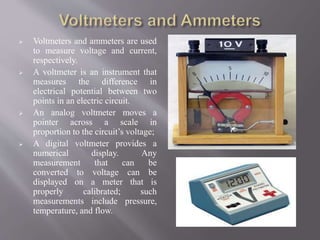
 Voltmeters and ammeters are used
to measure voltage and current,
respectively.
 A voltmeter is an instrument that
measures the difference in
electrical potential between two
points in an electric circuit.
 An analog voltmeter moves a
pointer across a scale in
proportion to the circuit’s voltage;
 A digital voltmeter provides a
numerical display. Any
measurement that can be
converted to voltage can be
displayed on a meter that is
properly calibrated; such
measurements include pressure,
temperature, and flow.
 An ammeter measures the electric current in
a circuit. The name is derived from the name
for the SI unit for electric current, amperes
(A).
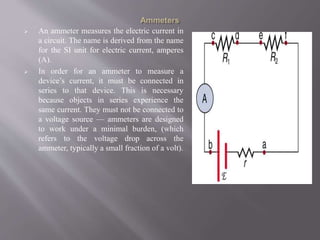
 In order for an ammeter to measure a
device’s current, it must be connected in
series to that device. This is necessary
because objects in series experience the
same current. They must not be connected to
a voltage source — ammeters are designed
to work under a minimal burden, (which
refers to the voltage drop across the
ammeter, typically a small fraction of a volt).
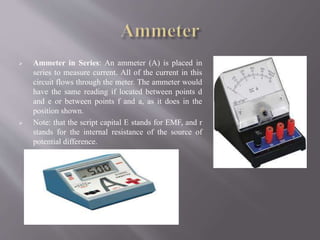
 Ammeter in Series: An ammeter (A) is placed in
series to measure current. All of the current in this
circuit flows through the meter. The ammeter would
have the same reading if located between points d
and e or between points f and a, as it does in the
position shown.
 Note: that the script capital E stands for EMF, and r
stands for the internal resistance of the source of
potential difference.
 Multimeters are very useful test instruments. They are
needed in every kind of robotic activity. Don’t ever
forget to carry this whenever you are going for a
competition.
USE:
 Multimeters can be used as an ammeter, a voltmeter,
an ohmmeter; by operating a multi-position knob on
the meter. They can measure DC as well as AC (but
you shall rarely require measuring an AC quantity in
robotics).
 There are also special functions in a multimeter like
‘Detecting a Short Circuit’, testing transistors and
some have additional features for measuring
capacitance & frequency.
They are available in two types in market:
 Analog Multimeter
 Analogue meters take a little power from the
circuit under test to operate their pointer (a hand
like in a clock to indicate the reading).
 They must have a high sensitivity of at least
20k /V or they may upset the circuit under test
and give an incorrect reading.
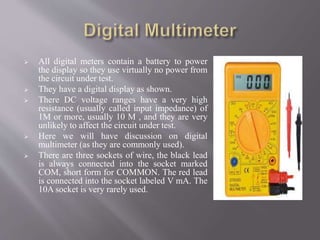
 All digital meters contain a battery to power
the display so they use virtually no power from
the circuit under test.
 They have a digital display as shown.
 There DC voltage ranges have a very high
resistance (usually called input impedance) of
1M or more, usually 10 M , and they are very
unlikely to affect the circuit under test.
 Here we will have discussion on digital
multimeter (as they are commonly used).
 There are three sockets of wire, the black lead
is always connected into the socket marked
COM, short form for COMMON. The red lead
is connected into the socket labeled V mA. The
10A socket is very rarely used.
 Measuring resistance with a multimeter
 To measure the resistance of a component it must not be
connected in a circuit. If you try to measure resistance of
components in a circuit you will obtain false readings (even
if the supply is disconnected) and you may damage the
multimeter.
 The techniques used for each type of meter are very different
so they are treated separately:
1. Set the meter to a resistance range greater than you
expect the resistance to be. Notice that the meter
display shows "off the scale" (usually blank except
for a 1 on the left). Don't worry, this is not a fault, it
is correct - the resistance of air is very high!
2. Touch the meter probes together and check that the
meter reads zero. If it doesn't read zero, turn the
switch to 'Set Zero' if your meter has this and try
again.
3. Put the probes across the component.
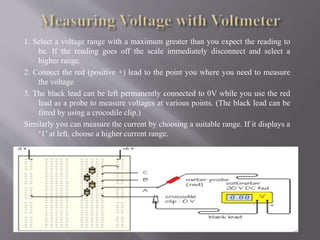
1. Select a voltage range with a maximum greater than you expect the reading to
be. If the reading goes off the scale immediately disconnect and select a
higher range.
2. Connect the red (positive +) lead to the point you where you need to measure
the voltage
3. The black lead can be left permanently connected to 0V while you use the red
lead as a probe to measure voltages at various points. (The black lead can be
fitted by using a crocodile clip.)
Similarly you can measure the current by choosing a suitable range. If it displays a
‘1’ at left, choose a higher current range.
 Digital multimeters have a special setting for
testing a diode, usually labeled with the
diode symbol.
 Connect the red (+) lead to the anode and the
black (-) to the cathode. The diode should
conduct and the meter will diasplay a value
(usually the voltage across the diode in mV,
1000mV = 1V).
 Reverse the connections. The diode should
NOT conduct this way so the meter will
display "off the scale" (usually blank except
for a 1 on the left).
 Set a digital multimeter to diode test and an analogue multimeter to a low
resistance range such as × 10 ohm as described above for testing a diode.
 Test each pair of leads both ways (six tests in total):
 The base-emitter (BE) junction should behave like a diode and conduct
one way only.
 The base-collector (BC) junction should behave like a diode and conduct
one way only.
 The collector-emitter (CE) should not conduct either way.
 NOTE: Conducting in one way simply means it will behave
as a short circuit and
 The diagram shows how the junctions behave in an NPN
transistor. The diodes are reversed in a PNP transistor but the
same test procedure can be used.
 Some multimeters have a 'transistor test' function; please refer
to the instructions supplied with the meter for details.

Eee 326 measurement and instrumentations

  • 2.
     Voltmeters andammeters are used to measure voltage and current, respectively.  A voltmeter is an instrument that measures the difference in electrical potential between two points in an electric circuit.  An analog voltmeter moves a pointer across a scale in proportion to the circuit’s voltage;  A digital voltmeter provides a numerical display. Any measurement that can be converted to voltage can be displayed on a meter that is properly calibrated; such measurements include pressure, temperature, and flow.
  • 3.
     An ammetermeasures the electric current in a circuit. The name is derived from the name for the SI unit for electric current, amperes (A).  In order for an ammeter to measure a device’s current, it must be connected in series to that device. This is necessary because objects in series experience the same current. They must not be connected to a voltage source — ammeters are designed to work under a minimal burden, (which refers to the voltage drop across the ammeter, typically a small fraction of a volt).
  • 4.
     Ammeter inSeries: An ammeter (A) is placed in series to measure current. All of the current in this circuit flows through the meter. The ammeter would have the same reading if located between points d and e or between points f and a, as it does in the position shown.  Note: that the script capital E stands for EMF, and r stands for the internal resistance of the source of potential difference.
  • 5.
     Multimeters arevery useful test instruments. They are needed in every kind of robotic activity. Don’t ever forget to carry this whenever you are going for a competition. USE:  Multimeters can be used as an ammeter, a voltmeter, an ohmmeter; by operating a multi-position knob on the meter. They can measure DC as well as AC (but you shall rarely require measuring an AC quantity in robotics).  There are also special functions in a multimeter like ‘Detecting a Short Circuit’, testing transistors and some have additional features for measuring capacitance & frequency.
  • 6.
    They are availablein two types in market:  Analog Multimeter  Analogue meters take a little power from the circuit under test to operate their pointer (a hand like in a clock to indicate the reading).  They must have a high sensitivity of at least 20k /V or they may upset the circuit under test and give an incorrect reading.
  • 7.
     All digitalmeters contain a battery to power the display so they use virtually no power from the circuit under test.  They have a digital display as shown.  There DC voltage ranges have a very high resistance (usually called input impedance) of 1M or more, usually 10 M , and they are very unlikely to affect the circuit under test.  Here we will have discussion on digital multimeter (as they are commonly used).  There are three sockets of wire, the black lead is always connected into the socket marked COM, short form for COMMON. The red lead is connected into the socket labeled V mA. The 10A socket is very rarely used.
  • 8.
     Measuring resistancewith a multimeter  To measure the resistance of a component it must not be connected in a circuit. If you try to measure resistance of components in a circuit you will obtain false readings (even if the supply is disconnected) and you may damage the multimeter.  The techniques used for each type of meter are very different so they are treated separately:
  • 9.
    1. Set themeter to a resistance range greater than you expect the resistance to be. Notice that the meter display shows "off the scale" (usually blank except for a 1 on the left). Don't worry, this is not a fault, it is correct - the resistance of air is very high! 2. Touch the meter probes together and check that the meter reads zero. If it doesn't read zero, turn the switch to 'Set Zero' if your meter has this and try again. 3. Put the probes across the component.
  • 10.
    1. Select avoltage range with a maximum greater than you expect the reading to be. If the reading goes off the scale immediately disconnect and select a higher range. 2. Connect the red (positive +) lead to the point you where you need to measure the voltage 3. The black lead can be left permanently connected to 0V while you use the red lead as a probe to measure voltages at various points. (The black lead can be fitted by using a crocodile clip.) Similarly you can measure the current by choosing a suitable range. If it displays a ‘1’ at left, choose a higher current range.
  • 11.
     Digital multimetershave a special setting for testing a diode, usually labeled with the diode symbol.  Connect the red (+) lead to the anode and the black (-) to the cathode. The diode should conduct and the meter will diasplay a value (usually the voltage across the diode in mV, 1000mV = 1V).  Reverse the connections. The diode should NOT conduct this way so the meter will display "off the scale" (usually blank except for a 1 on the left).
  • 12.
     Set adigital multimeter to diode test and an analogue multimeter to a low resistance range such as × 10 ohm as described above for testing a diode.  Test each pair of leads both ways (six tests in total):  The base-emitter (BE) junction should behave like a diode and conduct one way only.  The base-collector (BC) junction should behave like a diode and conduct one way only.  The collector-emitter (CE) should not conduct either way.
  • 13.
     NOTE: Conductingin one way simply means it will behave as a short circuit and  The diagram shows how the junctions behave in an NPN transistor. The diodes are reversed in a PNP transistor but the same test procedure can be used.  Some multimeters have a 'transistor test' function; please refer to the instructions supplied with the meter for details.