Digital Marketing
The next level of Marketing 4.0
Digital Marketing: Summary Deck & Ready Reckoner: Prof. Krishanu Datta
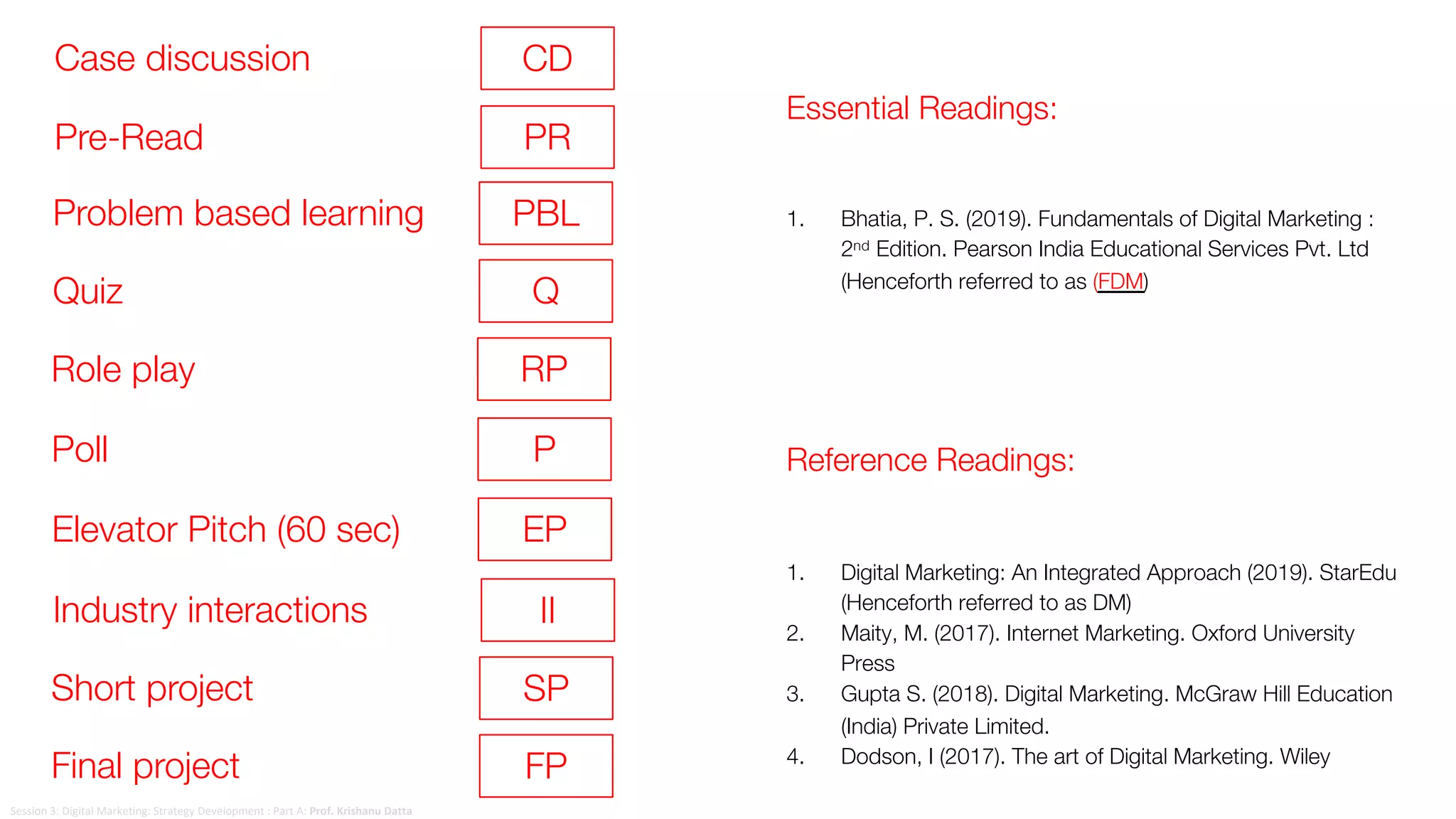
Case discussion CD
Problem based learning PBL
Quiz Q
Role play RP
Poll P
Elevator Pitch (60 sec) EP
Industry interactions II
Short project SP
Final project FP
Essential Readings:
1. Bhatia, P. S. (2019). Fundamentals of Digital Marketing :
2nd Edition. Pearson India Educational Services Pvt. Ltd
(Henceforth referred to as (FDM)
Reference Readings:
1. Digital Marketing: An Integrated Approach (2019). StarEdu
(Henceforth referred to as DM)
2. Maity, M. (2017). Internet Marketing. Oxford University
Press
3. Gupta S. (2018). Digital Marketing. McGraw Hill Education
(India) Private Limited.
4. Dodson, I (2017). The art of Digital Marketing. Wiley
Pre-Read PR
Session 3: Digital Marketing: Strategy Development : Part A: Prof. Krishanu Datta
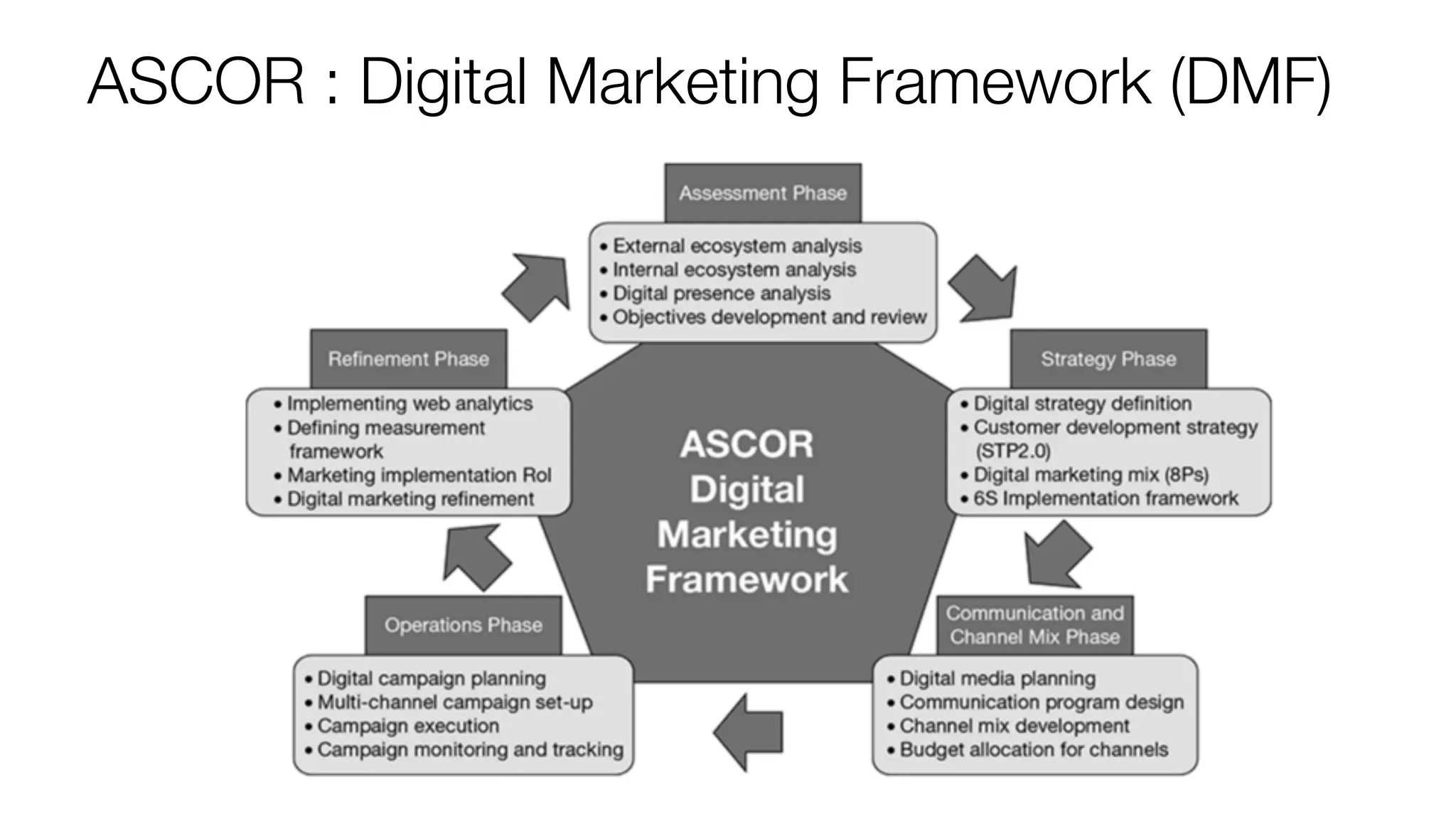
ASCOR : Digital Marketing Framework (DMF)
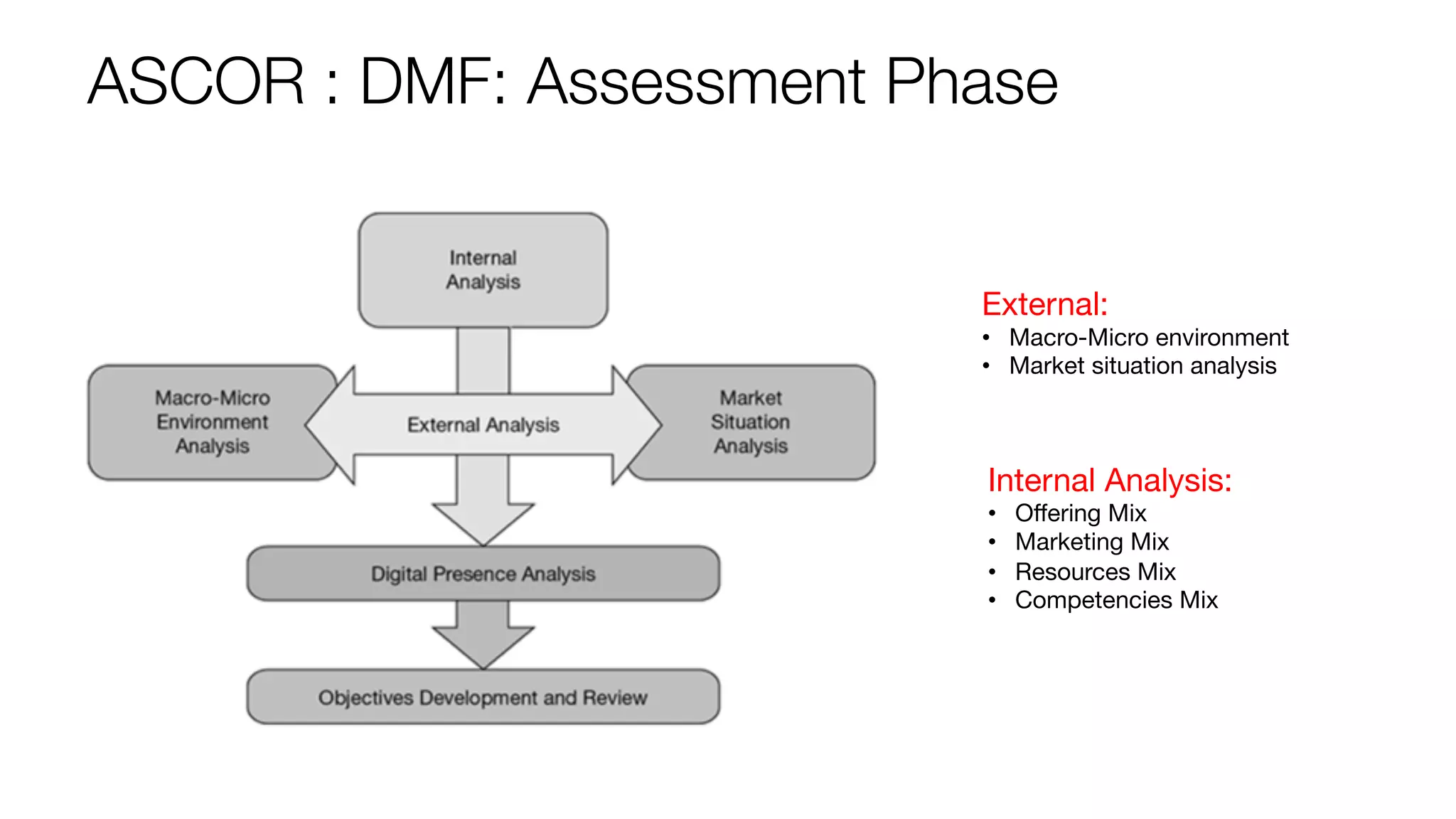
ASCOR : DMF: Assessment Phase
External:
• Macro-Micro environment
• Market situation analysis
Internal Analysis:
• Offering Mix
• Marketing Mix
• Resources Mix
• Competencies Mix
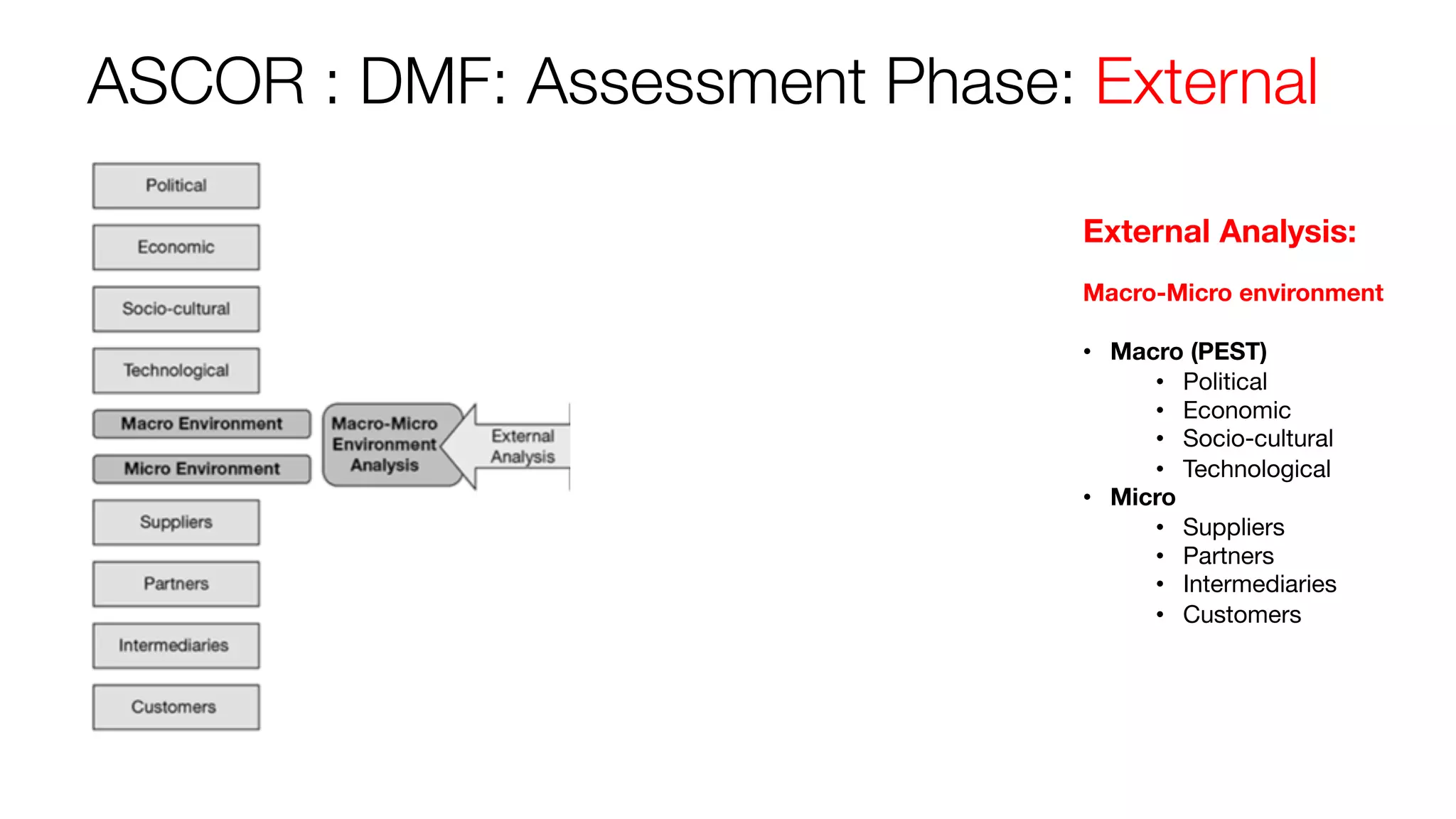
ASCOR : DMF: Assessment Phase: External
External Analysis:
Macro-Micro environment
• Macro (PEST)
• Political
• Economic
• Socio-cultural
• Technological
• Micro
• Suppliers
• Partners
• Intermediaries
• Customers
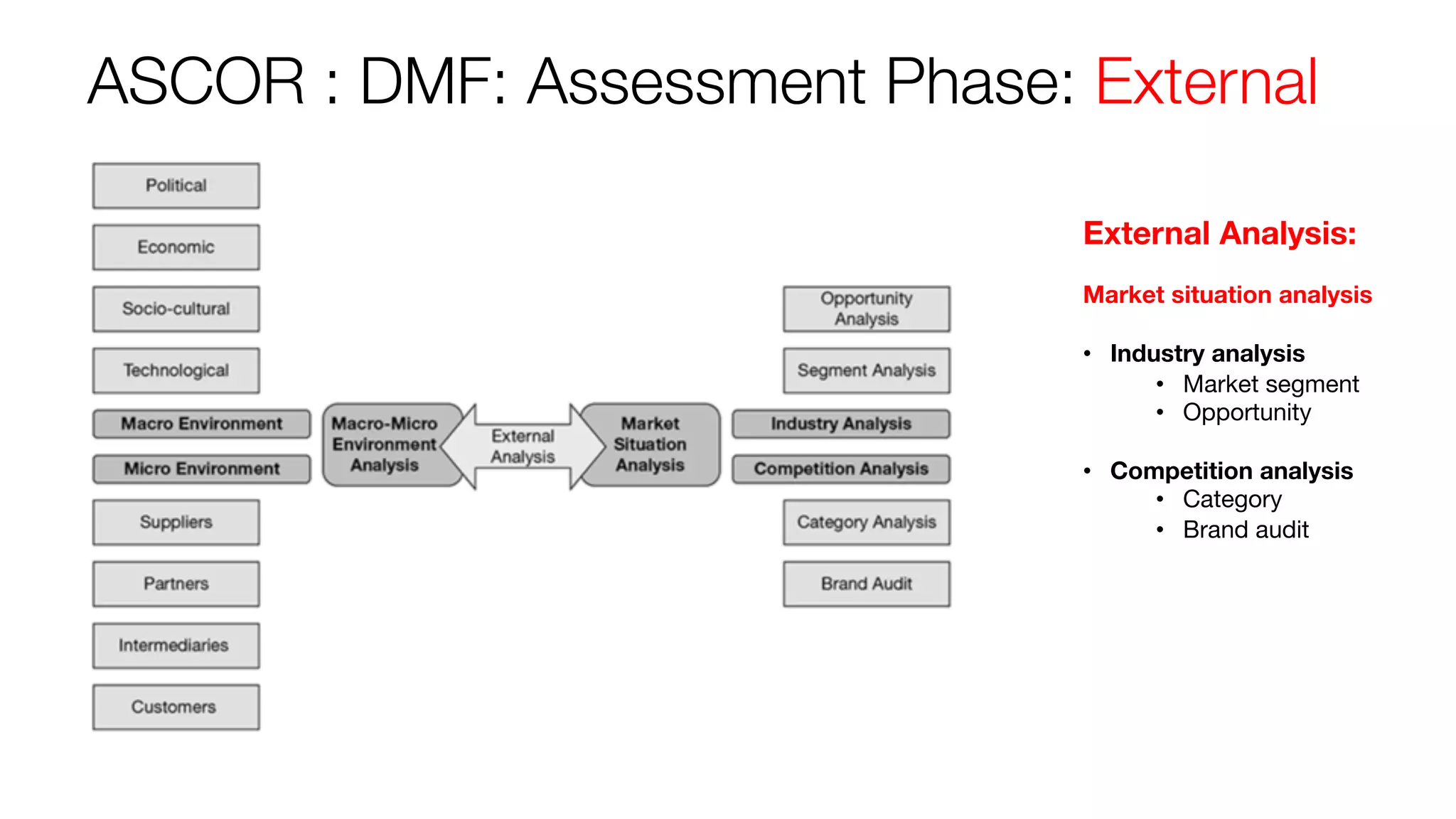
ASCOR : DMF: Assessment Phase: External
External Analysis:
Market situation analysis
• Industry analysis
• Market segment
• Opportunity
• Competition analysis
• Category
• Brand audit
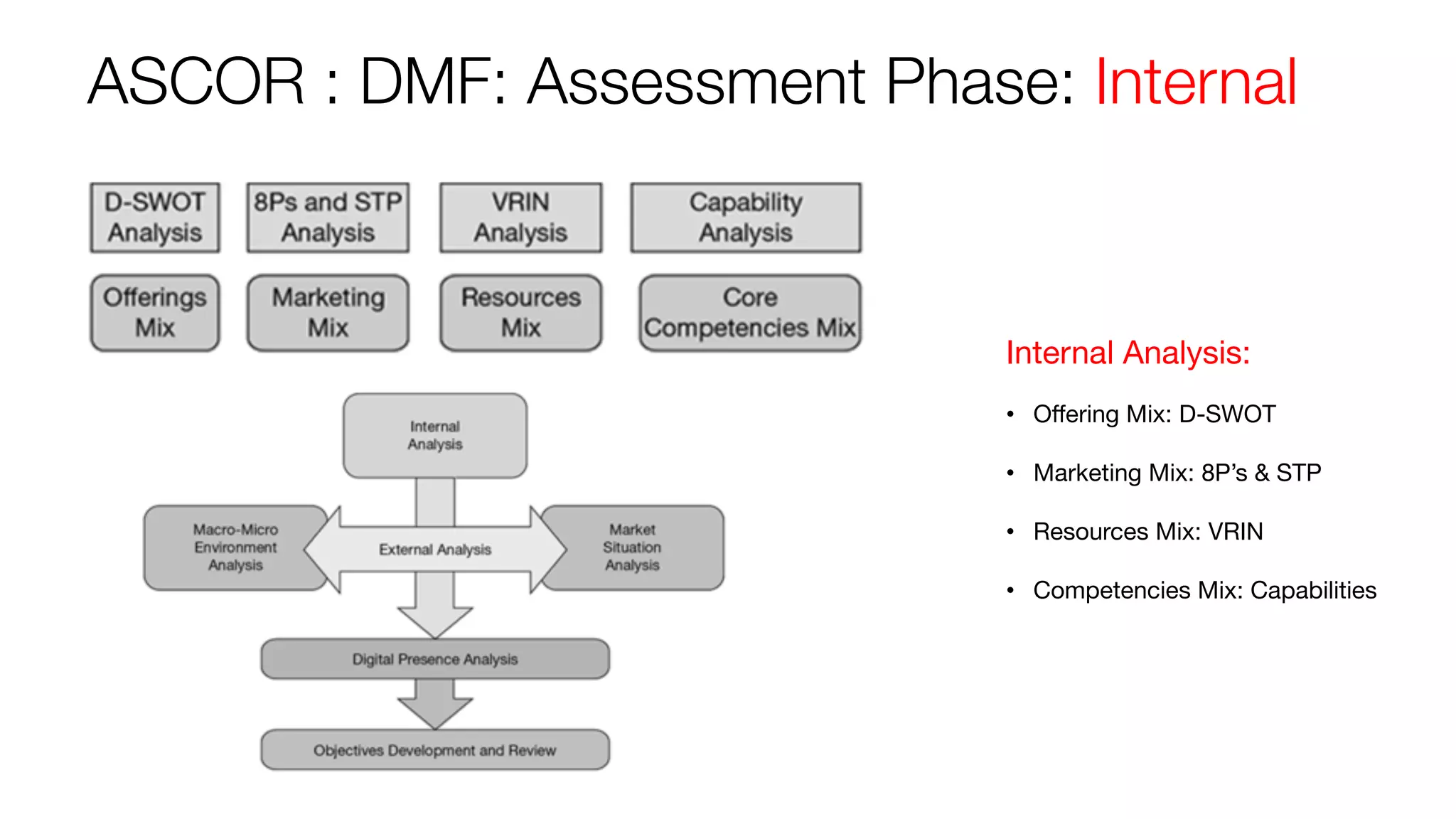
ASCOR : DMF: Assessment Phase: Internal
Internal Analysis:
• Offering Mix: D-SWOT
• Marketing Mix: 8P’s & STP
• Resources Mix: VRIN
• Competencies Mix: Capabilities
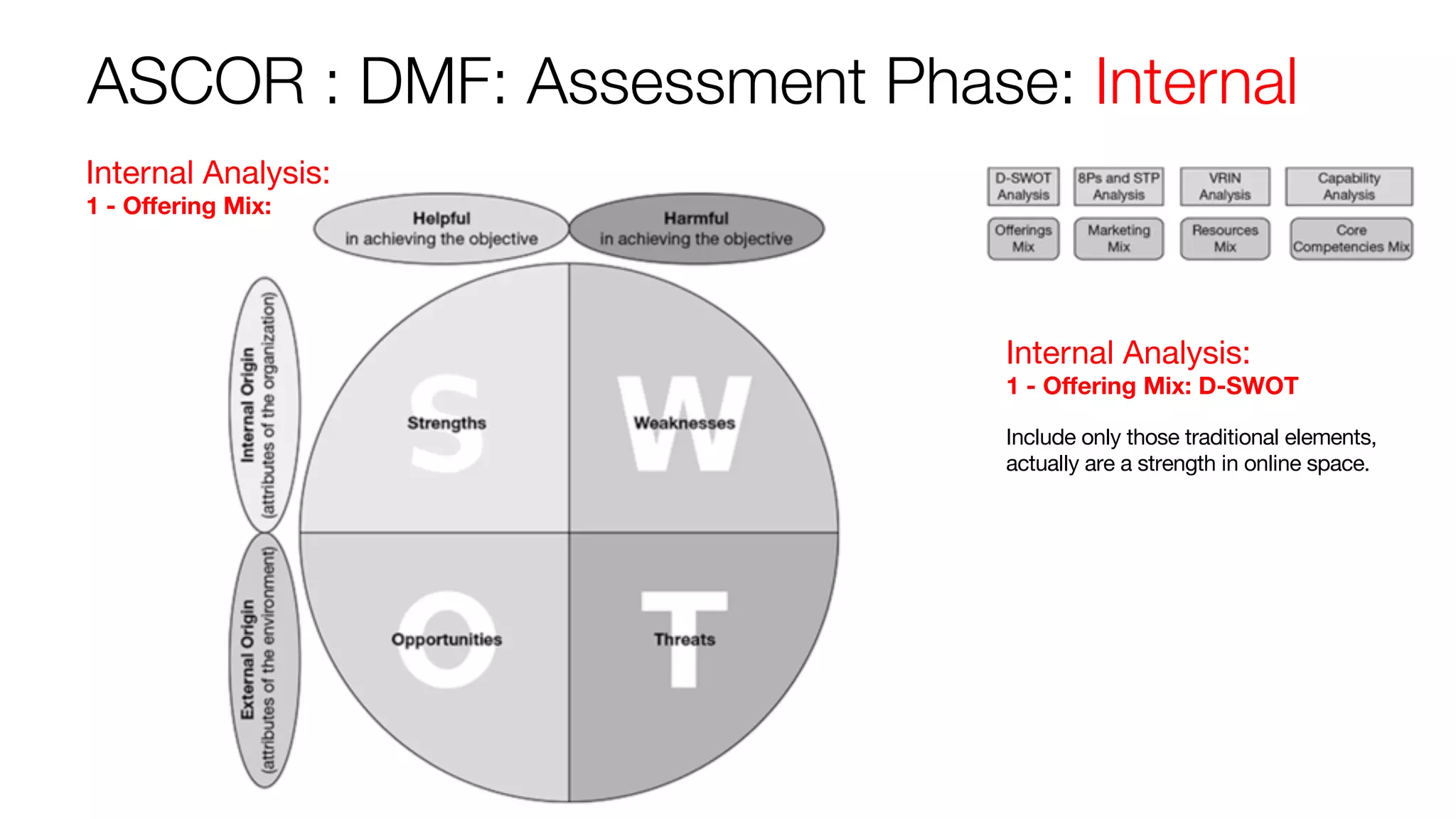
ASCOR : DMF: Assessment Phase: Internal
Internal Analysis:
1 - Offering Mix: D-SWOT
Include only those traditional elements,
actually are a strength in online space.
Internal Analysis:
1 - Offering Mix:
ASCOR : DMF: Assessment Phase: Internal
Internal Analysis:
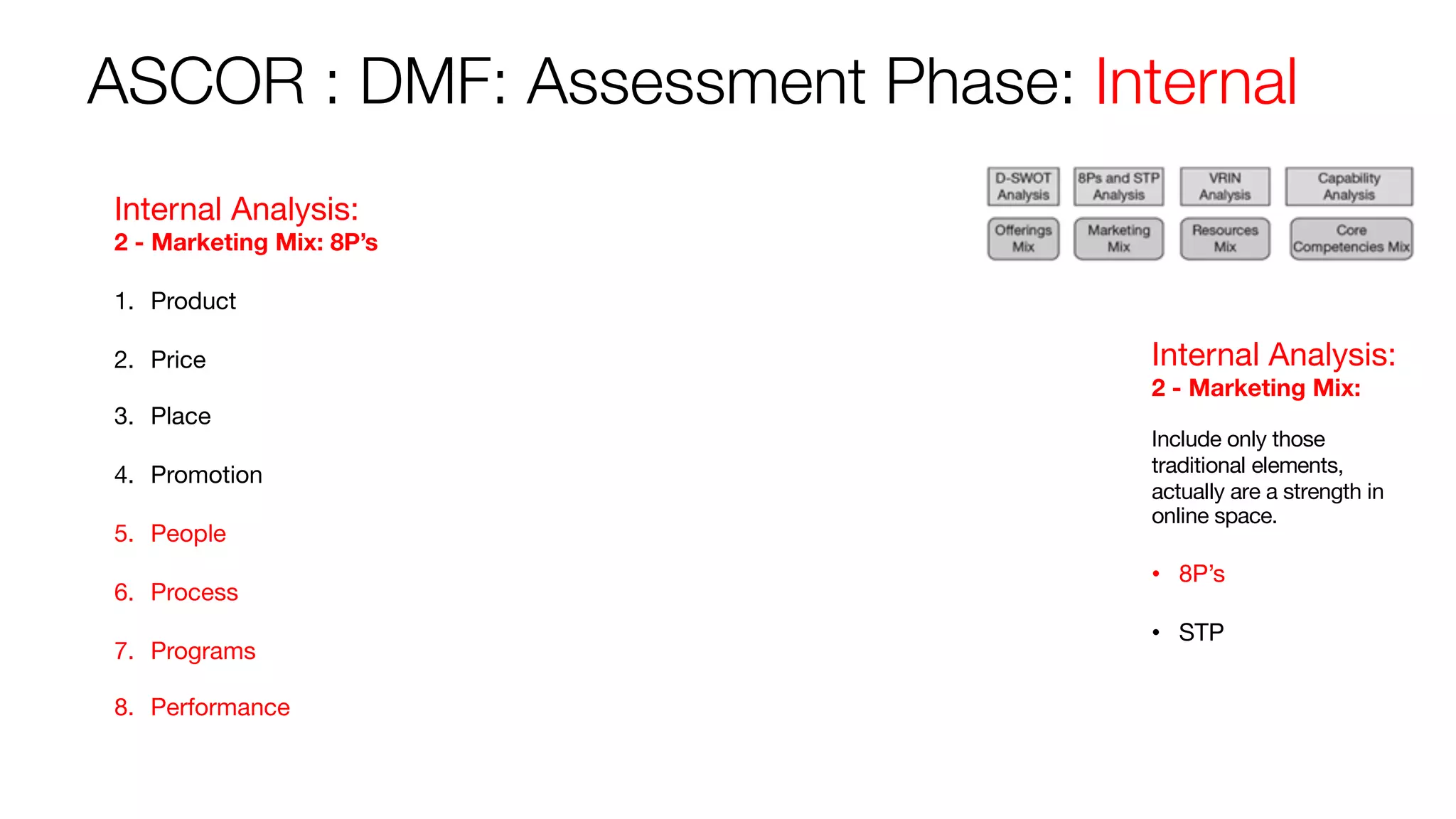
2 - Marketing Mix:
Include only those
traditional elements,
actually are a strength in
online space.
• 8P’s
• STP
Internal Analysis:
2 - Marketing Mix: 8P’s
1. Product
2. Price
3. Place
4. Promotion
5. People
6. Process
7. Programs
8. Performance
ASCOR : DMF: Assessment Phase: Internal
Internal Analysis:
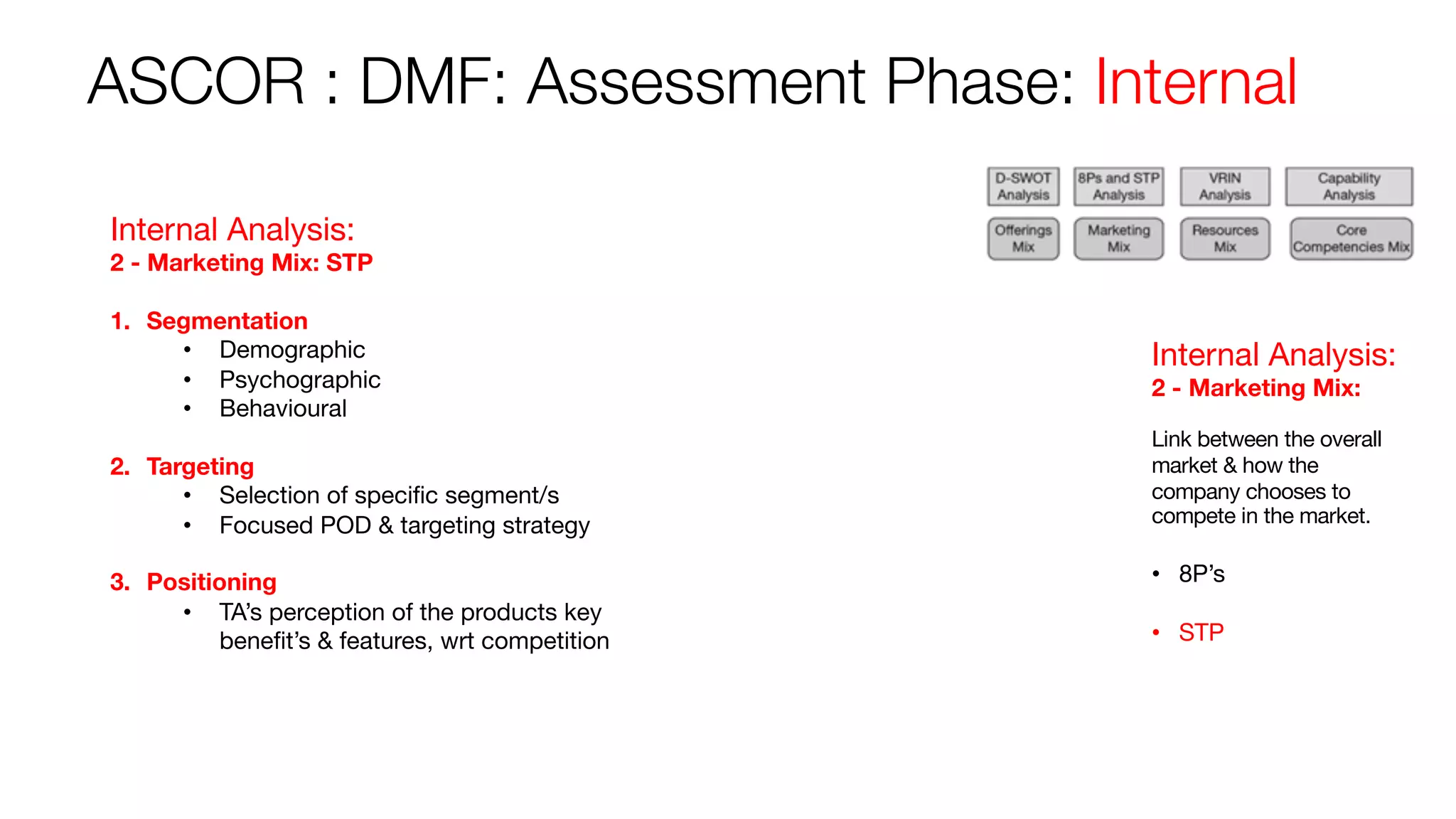
2 - Marketing Mix:
Link between the overall
market & how the
company chooses to
compete in the market.
• 8P’s
• STP
Internal Analysis:
2 - Marketing Mix: STP
1. Segmentation
• Demographic
• Psychographic
• Behavioural
2. Targeting
• Selection of specific segment/s
• Focused POD & targeting strategy
3. Positioning
• TA’s perception of the products key
benefit’s & features, wrt competition
ASCOR : DMF: Assessment Phase: Internal
Internal Analysis:
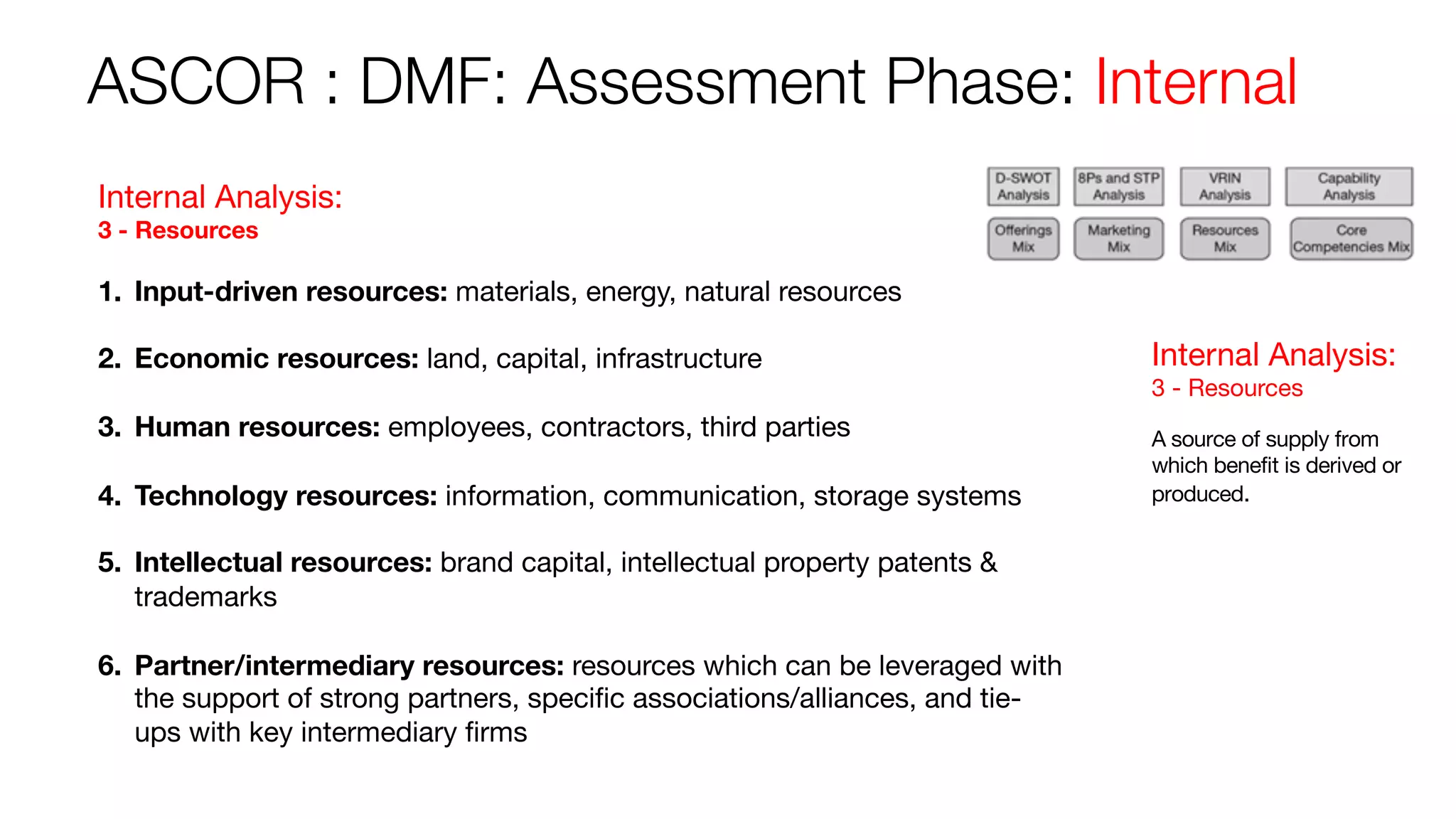
3 - Resources
A source of supply from
which benefit is derived or
produced.
Internal Analysis:
3 - Resources
1. Input-driven resources: materials, energy, natural resources
2. Economic resources: land, capital, infrastructure
3. Human resources: employees, contractors, third parties
4. Technology resources: information, communication, storage systems
5. Intellectual resources: brand capital, intellectual property patents &
trademarks
6. Partner/intermediary resources: resources which can be leveraged with
the support of strong partners, specific associations/alliances, and tie-
ups with key intermediary firms
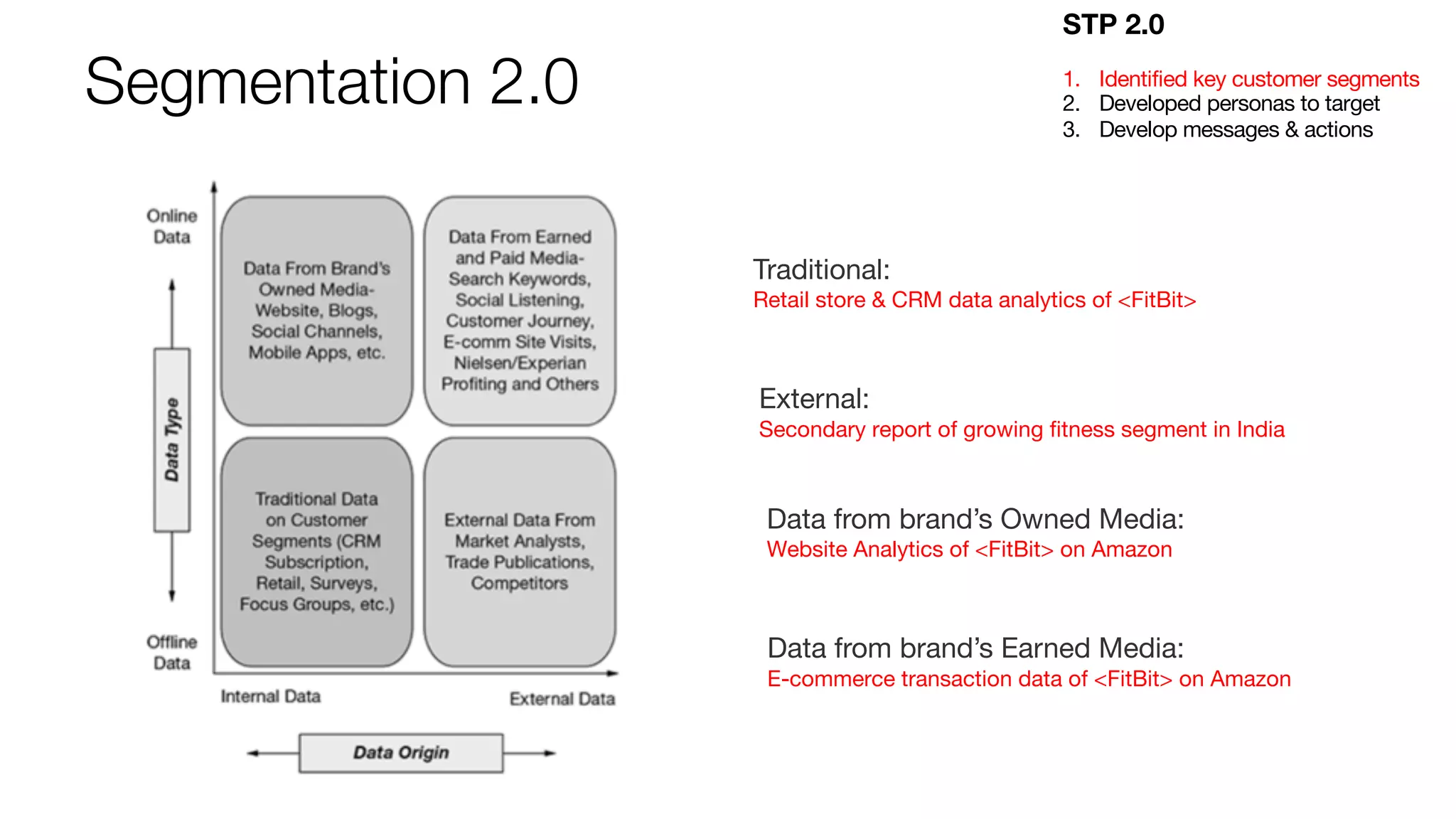
Segmentation 2.0
STP 2.0
1. Identified key customer segments
2. Developed personas to target
3. Develop messages & actions
Traditional:
Retail store & CRM data analytics of <FitBit>
External:
Secondary report of growing fitness segment in India
Data from brand’s Owned Media:
Website Analytics of <FitBit> on Amazon
Data from brand’s Earned Media:
E-commerce transaction data of <FitBit> on Amazon
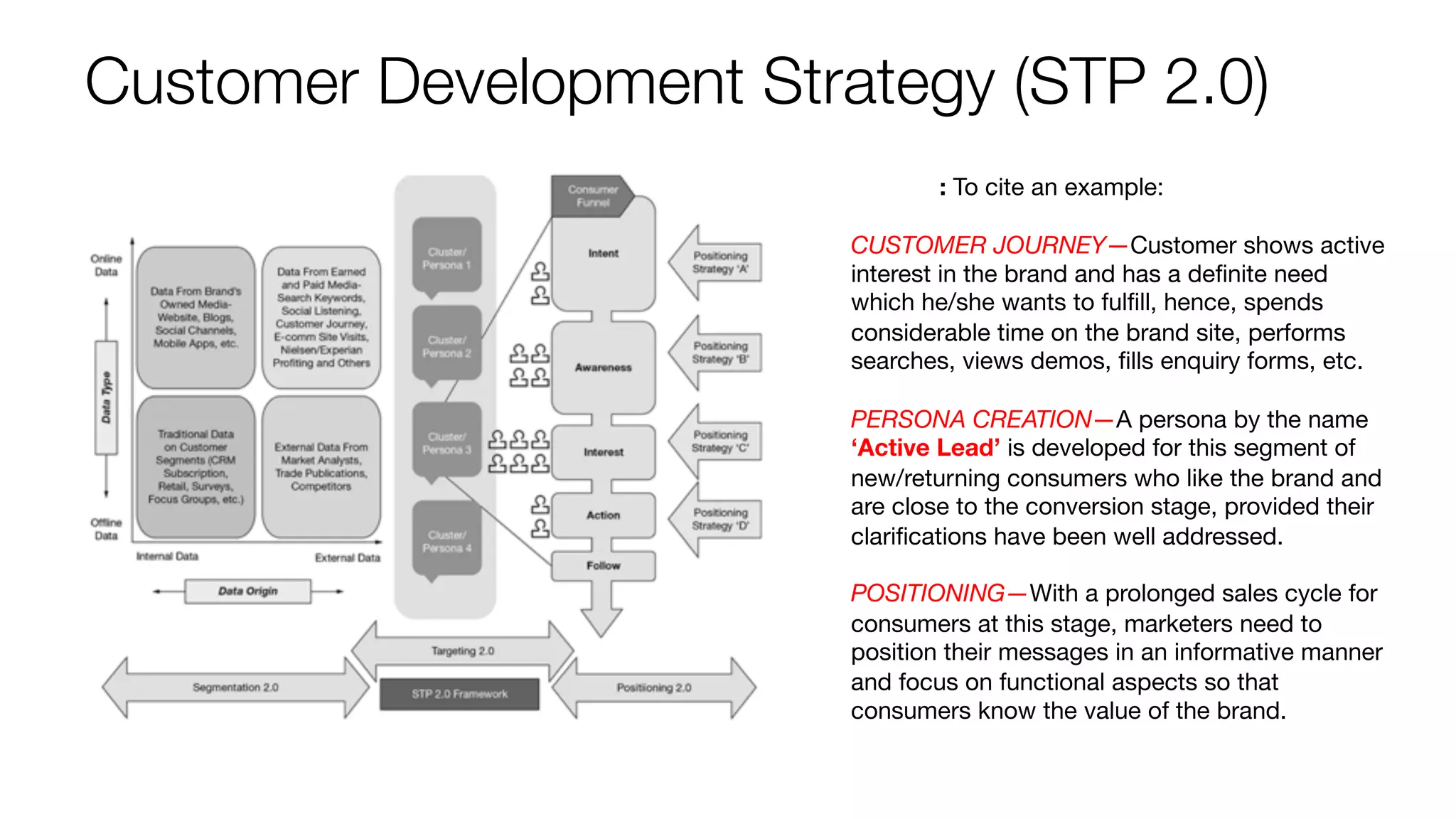
Customer Development Strategy (STP 2.0)
Interest: To cite an example:
CUSTOMER JOURNEY—Customer shows active
interest in the brand and has a definite need
which he/she wants to fulfill, hence, spends
considerable time on the brand site, performs
searches, views demos, fills enquiry forms, etc.
PERSONA CREATION—A persona by the name
‘Active Lead’ is developed for this segment of
new/returning consumers who like the brand and
are close to the conversion stage, provided their
clarifications have been well addressed.
POSITIONING—With a prolonged sales cycle for
consumers at this stage, marketers need to
position their messages in an informative manner
and focus on functional aspects so that
consumers know the value of the brand.
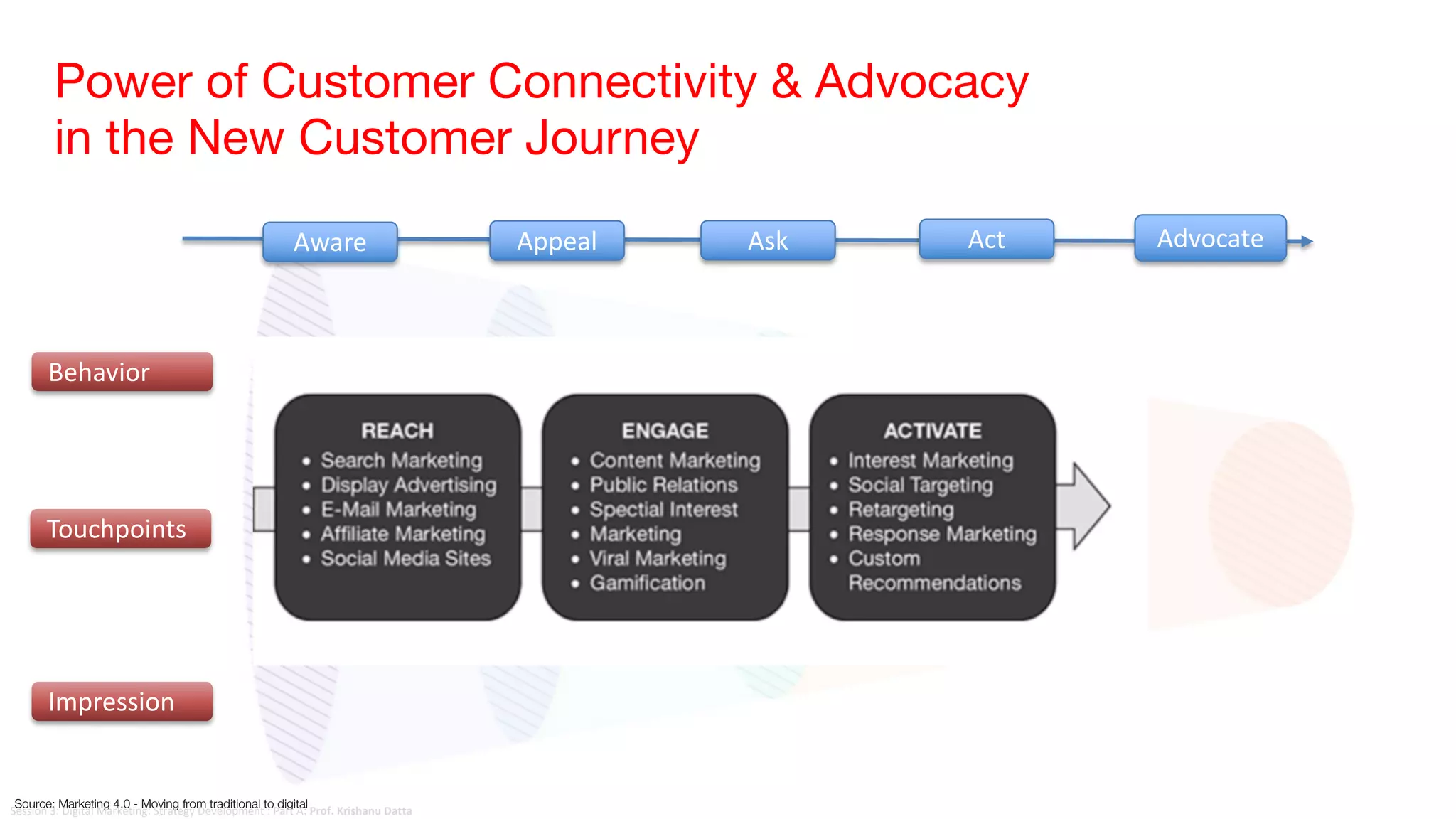
Power of Customer Connectivity & Advocacy
in the New Customer Journey
Touchpoints
Impression
Behavior
Aware Appeal Ask Act Advocate
Source: Marketing 4.0 - Moving from traditional to digital
Session 3: Digital Marketing: Strategy Development : Part A: Prof. Krishanu Datta
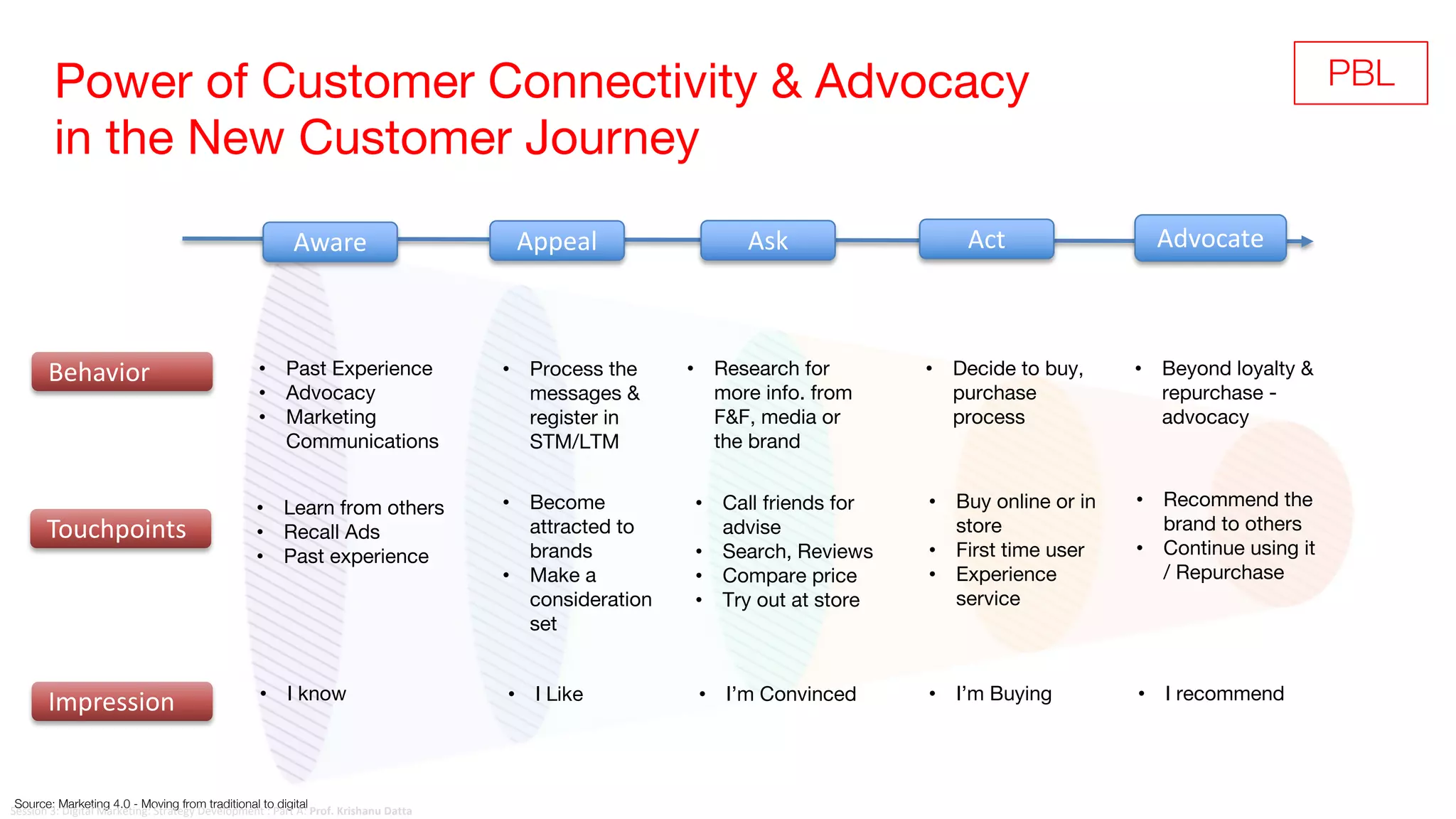
Power of Customer Connectivity & Advocacy
in the New Customer Journey
• Past Experience
• Advocacy
• Marketing
Communications
Touchpoints
Impression
Behavior
Aware Appeal Ask Act Advocate
• Learn from others
• Recall Ads
• Past experience
• I know
• Process the
messages &
register in
STM/LTM
• Become
attracted to
brands
• Make a
consideration
set
• I Like
• Research for
more info. from
F&F, media or
the brand
• Call friends for
advise
• Search, Reviews
• Compare price
• Try out at store
• I’m Convinced
• Decide to buy,
purchase
process
• Buy online or in
store
• First time user
• Experience
service
• I’m Buying
• Beyond loyalty &
repurchase -
advocacy
• Recommend the
brand to others
• Continue using it
/ Repurchase
• I recommend
Source: Marketing 4.0 - Moving from traditional to digital
PBL
Session 3: Digital Marketing: Strategy Development : Part A: Prof. Krishanu Datta
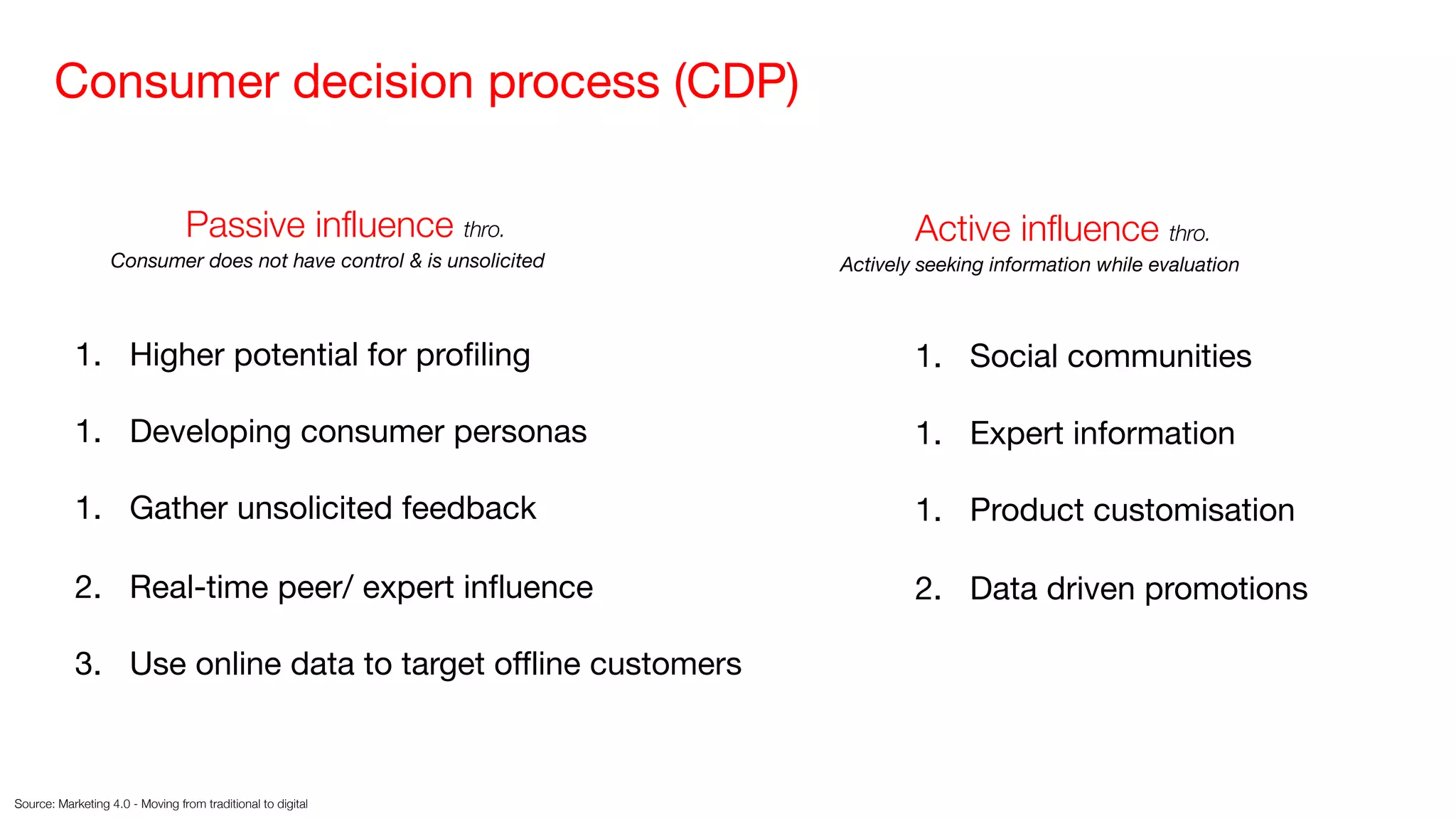
Consumer decision process (CDP)
Source: Marketing 4.0 - Moving from traditional to digital
1. Higher potential for profiling
1. Developing consumer personas
1. Gather unsolicited feedback
2. Real-time peer/ expert influence
3. Use online data to target offline customers
Passive influence thro.
Consumer does not have control & is unsolicited
Active influence thro.
Actively seeking information while evaluation
1. Social communities
1. Expert information
1. Product customisation
2. Data driven promotions
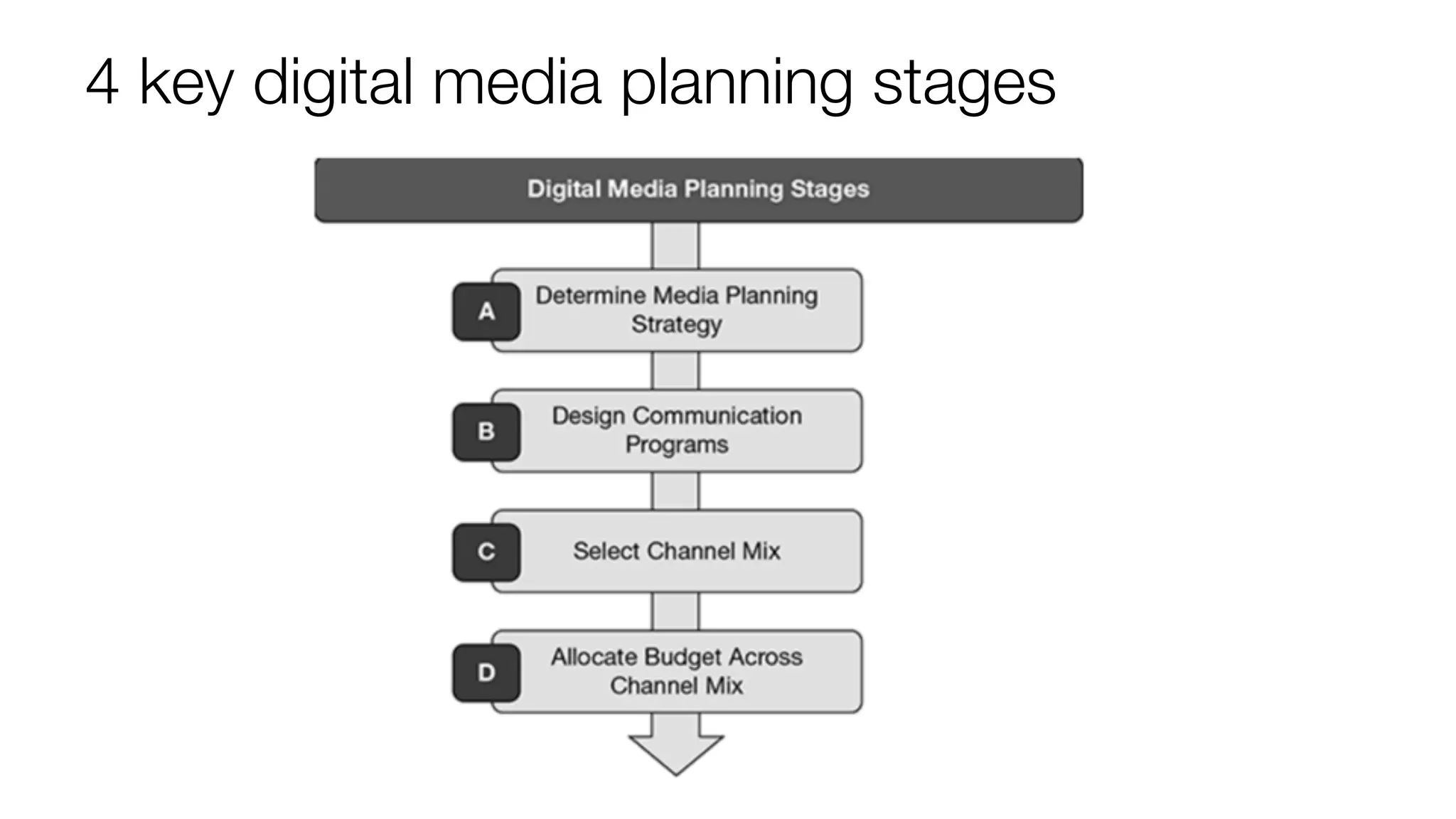
4 key digital media planning stages
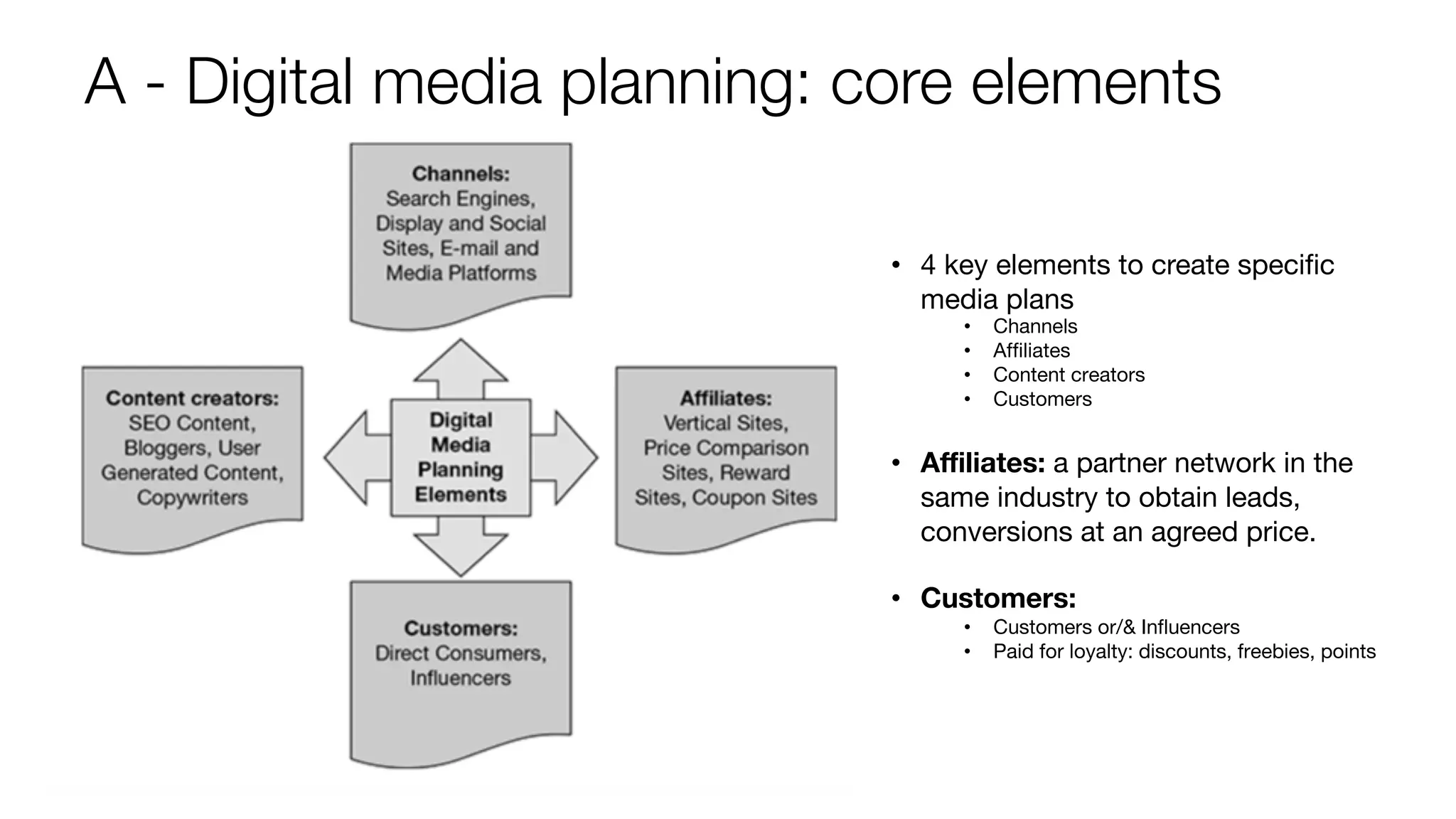
A - Digital media planning: core elements
• 4 key elements to create specific
media plans
• Channels
• Affiliates
• Content creators
• Customers
• Affiliates: a partner network in the
same industry to obtain leads,
conversions at an agreed price.
• Customers:
• Customers or/& Influencers
• Paid for loyalty: discounts, freebies, points
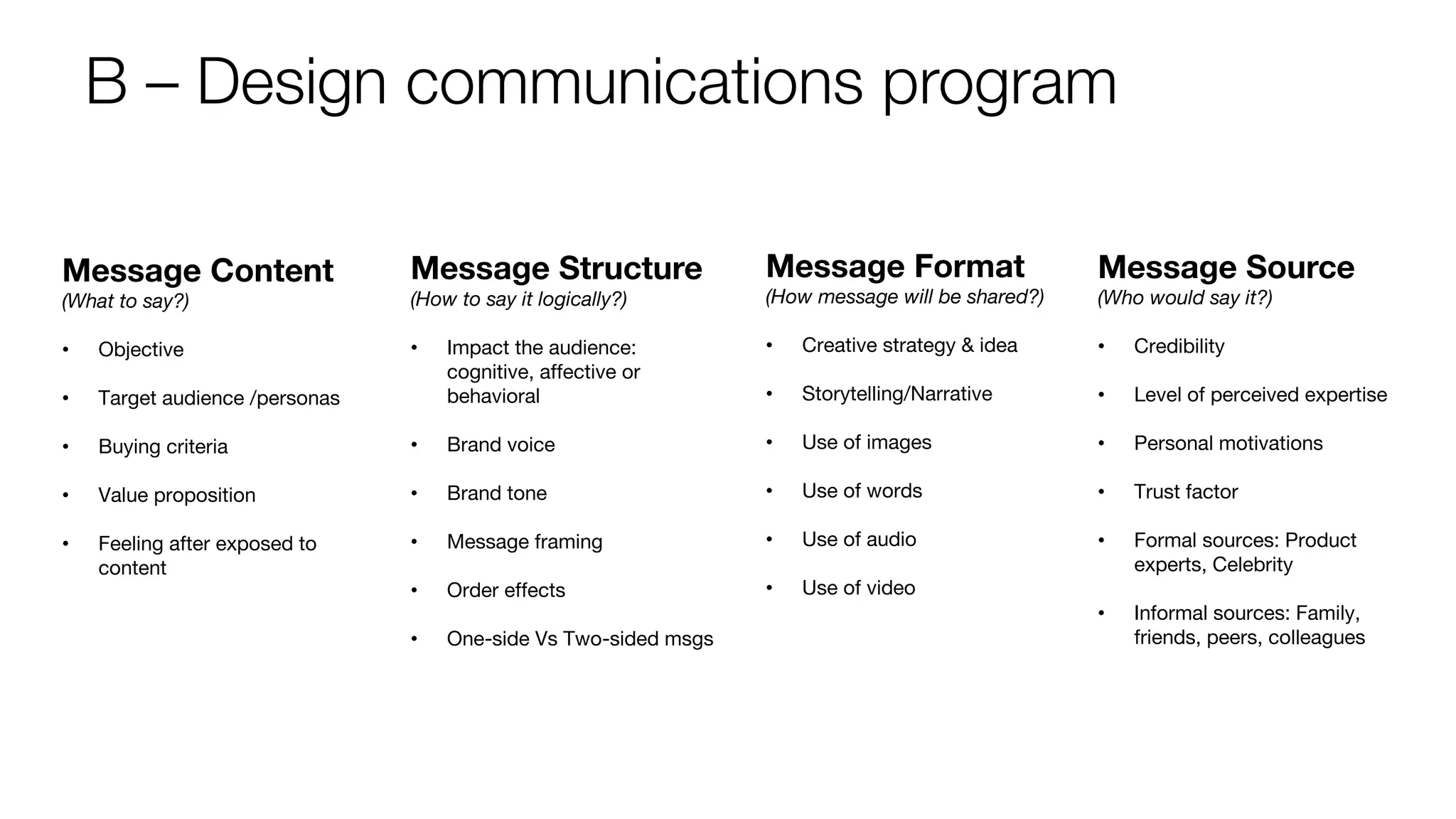
B – Design communications program
Message Content
(What to say?)
• Objective
• Target audience /personas
• Buying criteria
• Value proposition
• Feeling after exposed to
content
Message Structure
(How to say it logically?)
• Impact the audience:
cognitive, affective or
behavioral
• Brand voice
• Brand tone
• Message framing
• Order effects
• One-side Vs Two-sided msgs
Message Format
(How message will be shared?)
• Creative strategy & idea
• Storytelling/Narrative
• Use of images
• Use of words
• Use of audio
• Use of video
Message Source
(Who would say it?)
• Credibility
• Level of perceived expertise
• Personal motivations
• Trust factor
• Formal sources: Product
experts, Celebrity
• Informal sources: Family,
friends, peers, colleagues
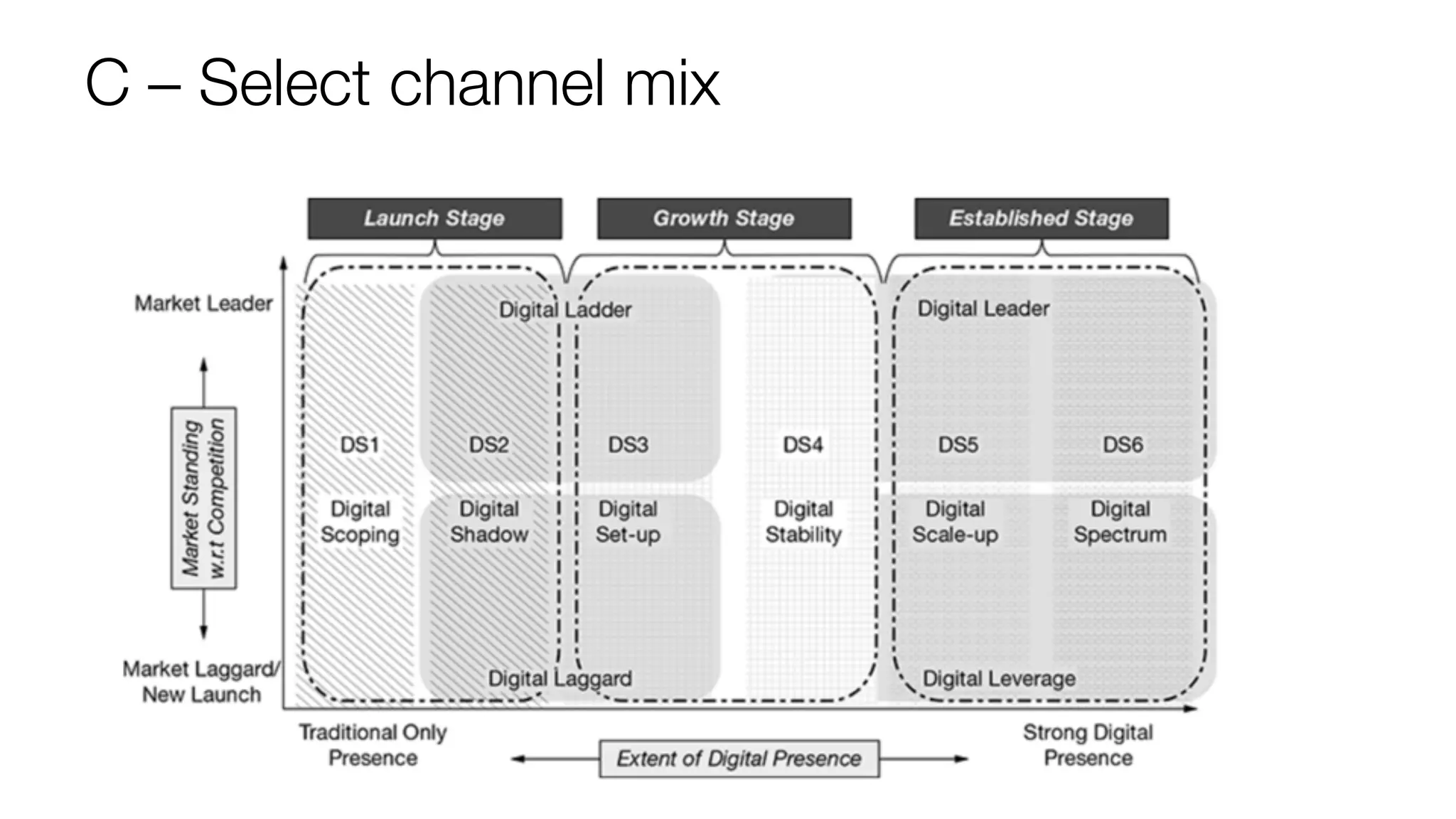
C – Select channel mix
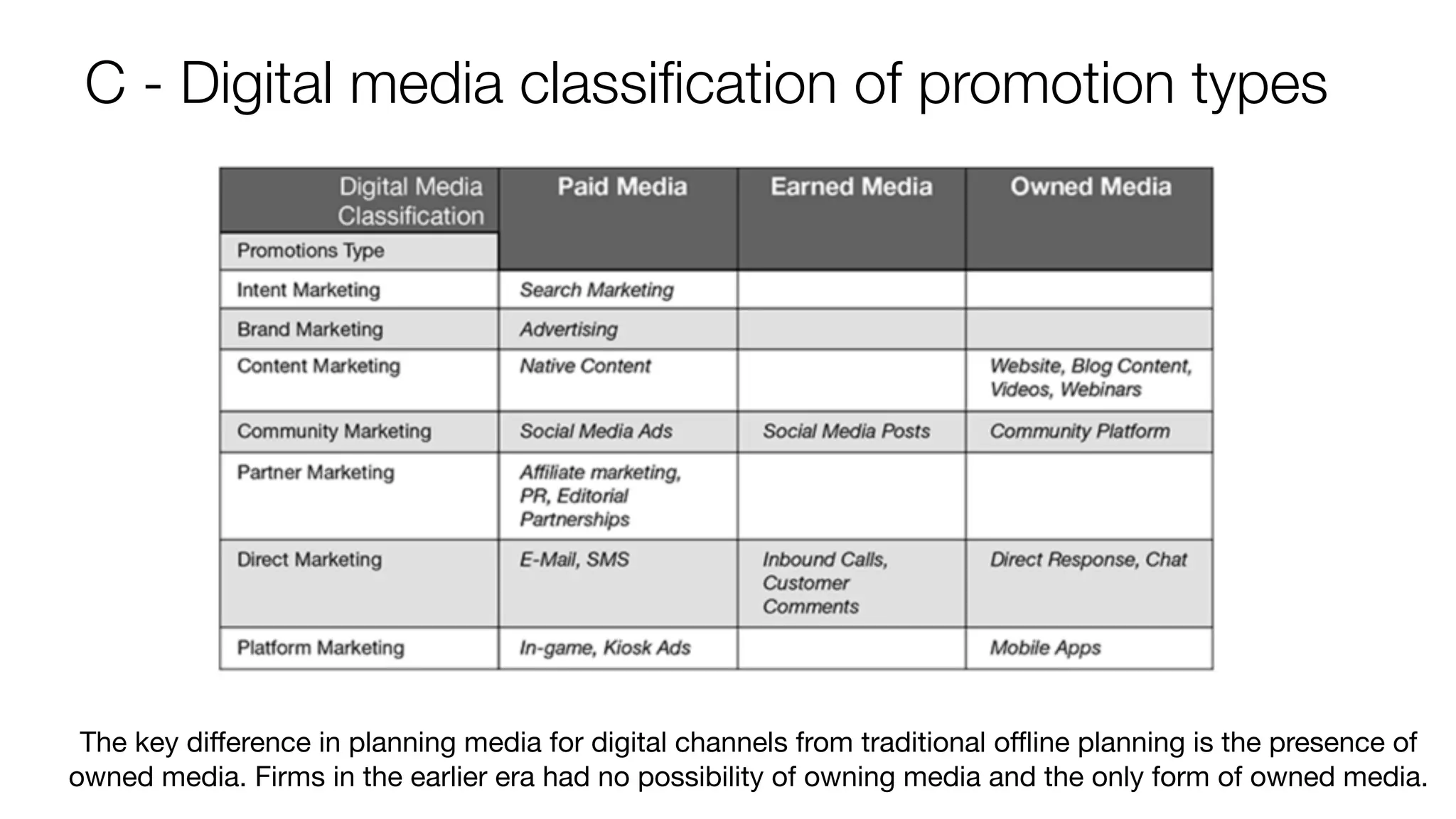
C - Digital media classification of promotion types
The key difference in planning media for digital channels from traditional offline planning is the presence of
owned media. Firms in the earlier era had no possibility of owning media and the only form of owned media.
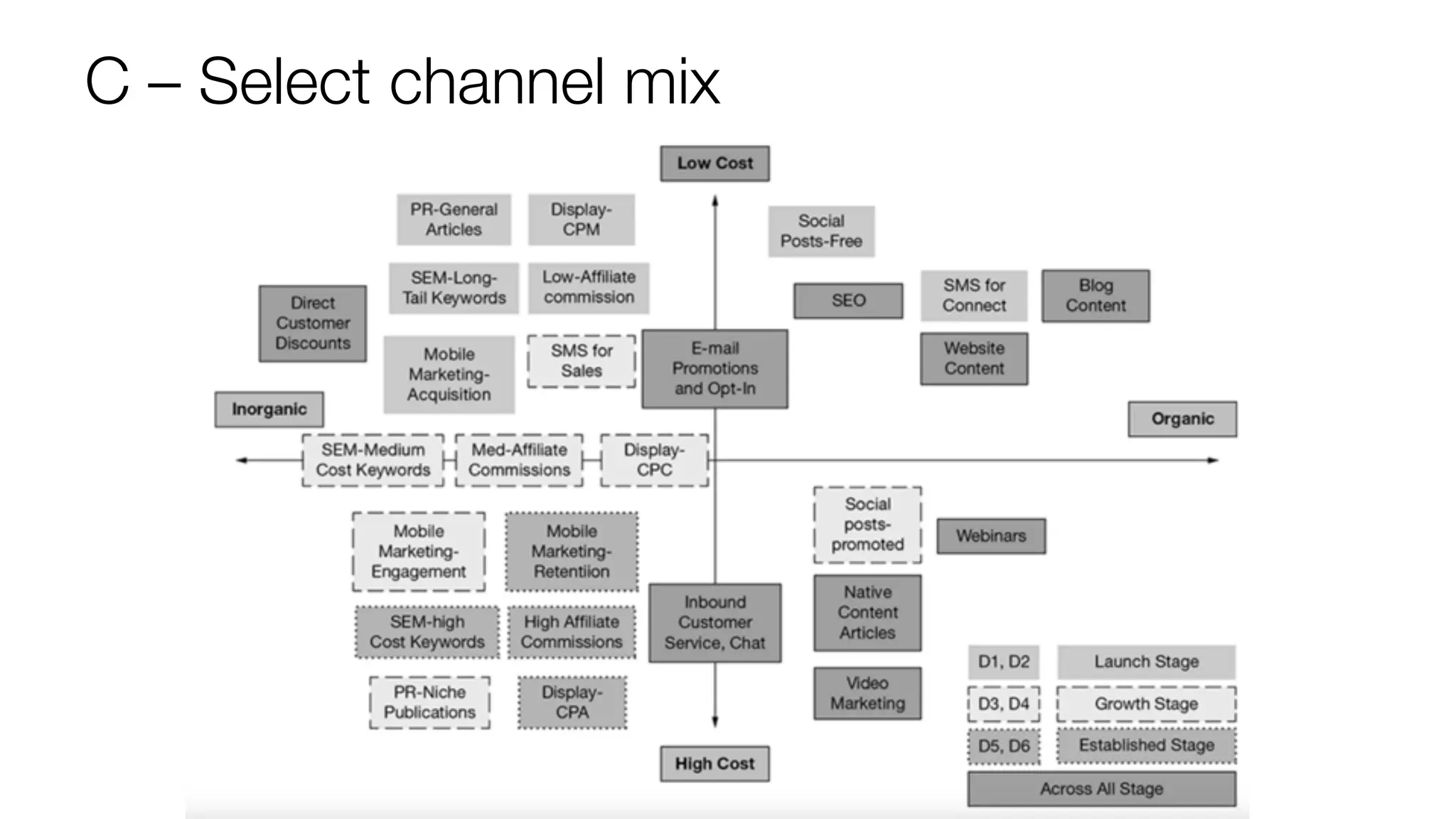
C – Select channel mix
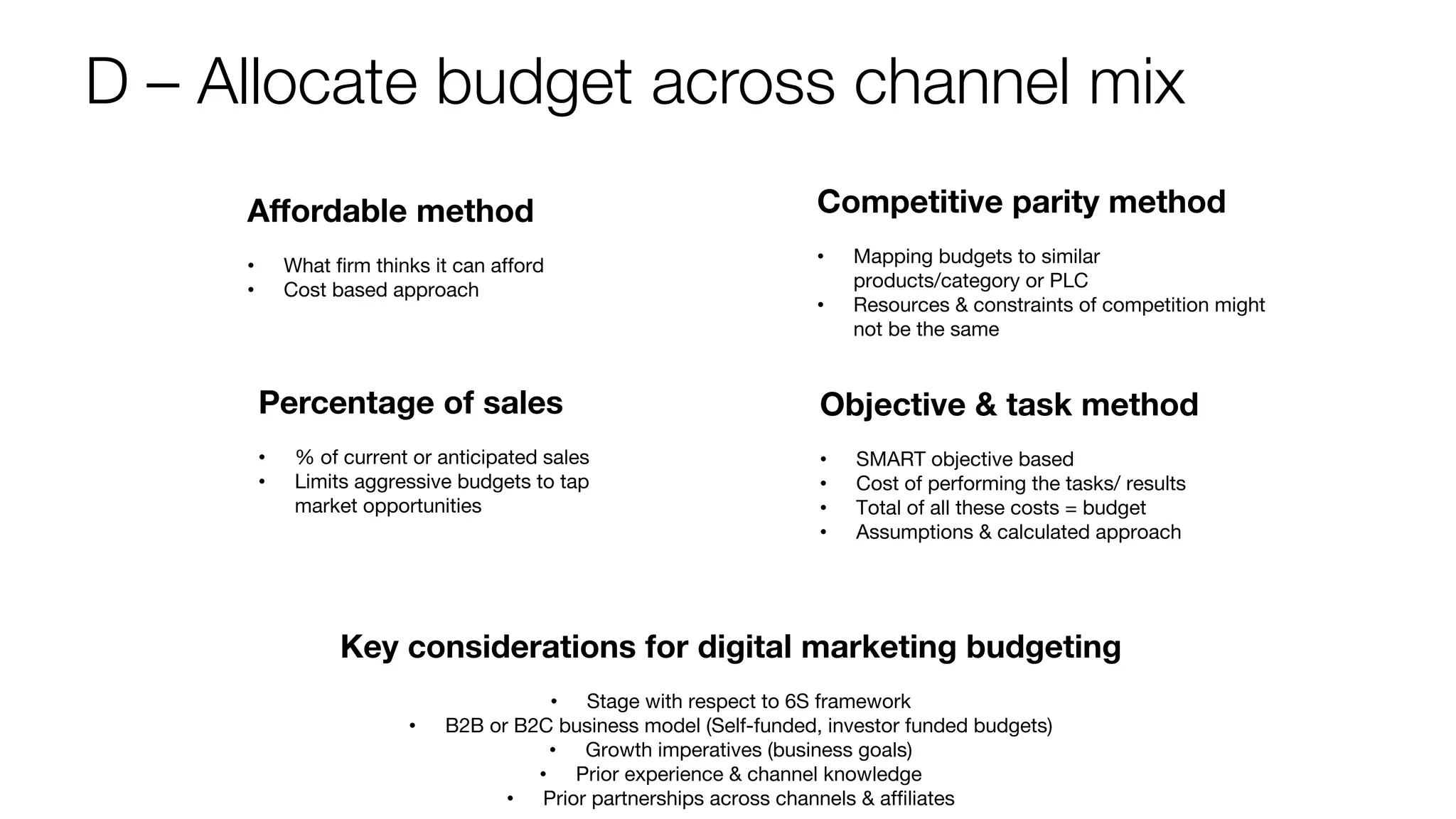
D – Allocate budget across channel mix
Affordable method
• What firm thinks it can afford
• Cost based approach
Percentage of sales
• % of current or anticipated sales
• Limits aggressive budgets to tap
market opportunities
Competitive parity method
• Mapping budgets to similar
products/category or PLC
• Resources & constraints of competition might
not be the same
Objective & task method
• SMART objective based
• Cost of performing the tasks/ results
• Total of all these costs = budget
• Assumptions & calculated approach
Key considerations for digital marketing budgeting
• Stage with respect to 6S framework
• B2B or B2C business model (Self-funded, investor funded budgets)
• Growth imperatives (business goals)
• Prior experience & channel knowledge
• Prior partnerships across channels & affiliates
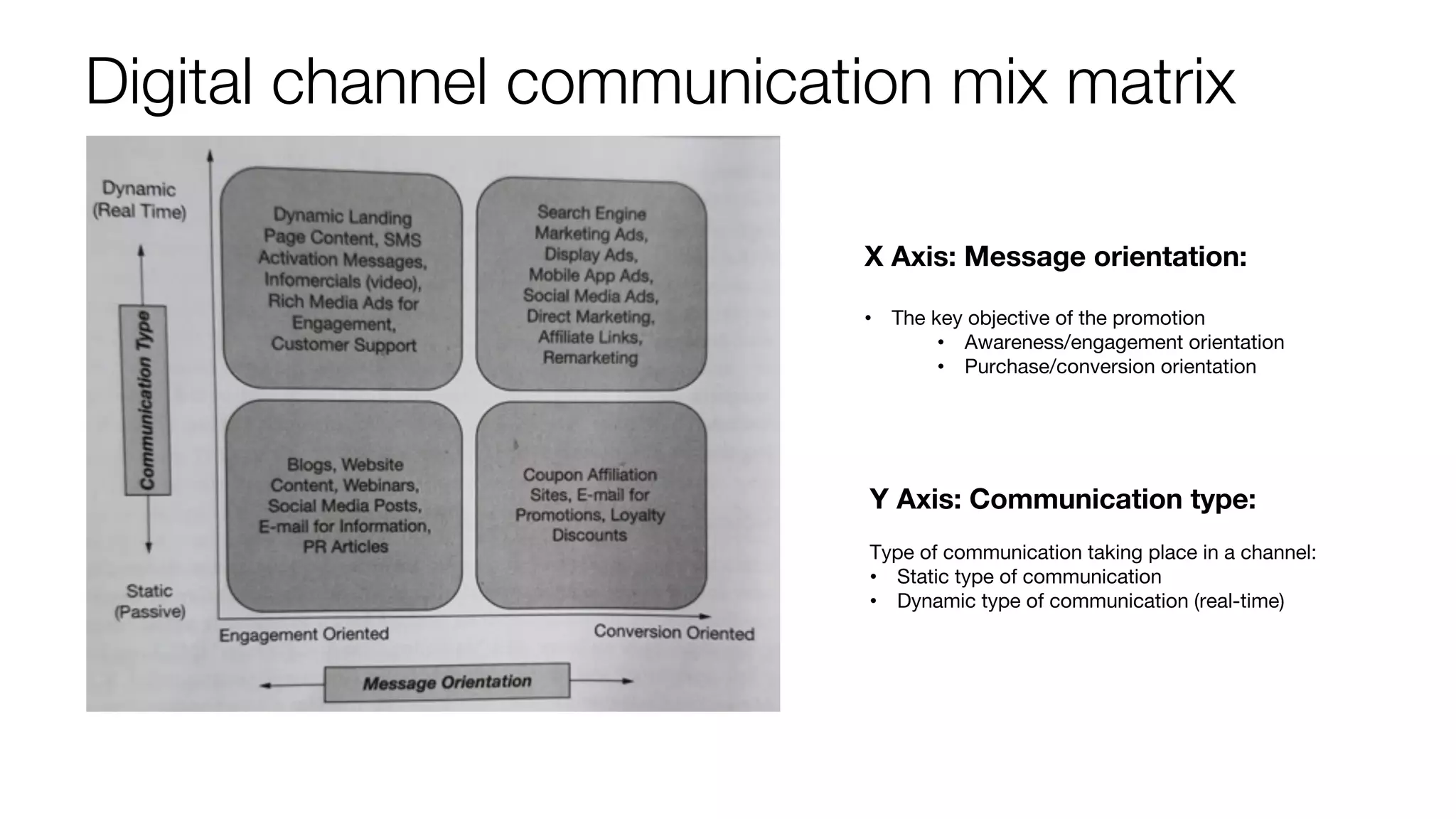
Digital channel communication mix matrix
X Axis: Message orientation:
• The key objective of the promotion
• Awareness/engagement orientation
• Purchase/conversion orientation
Y Axis: Communication type:
Type of communication taking place in a channel:
• Static type of communication
• Dynamic type of communication (real-time)
Video File Location: MSTeams/Files/ClassNotes/DM-Session 10
Website Information Architecture
Video File Location: MSTeams/Files/ClassNotes/DM-Session 10
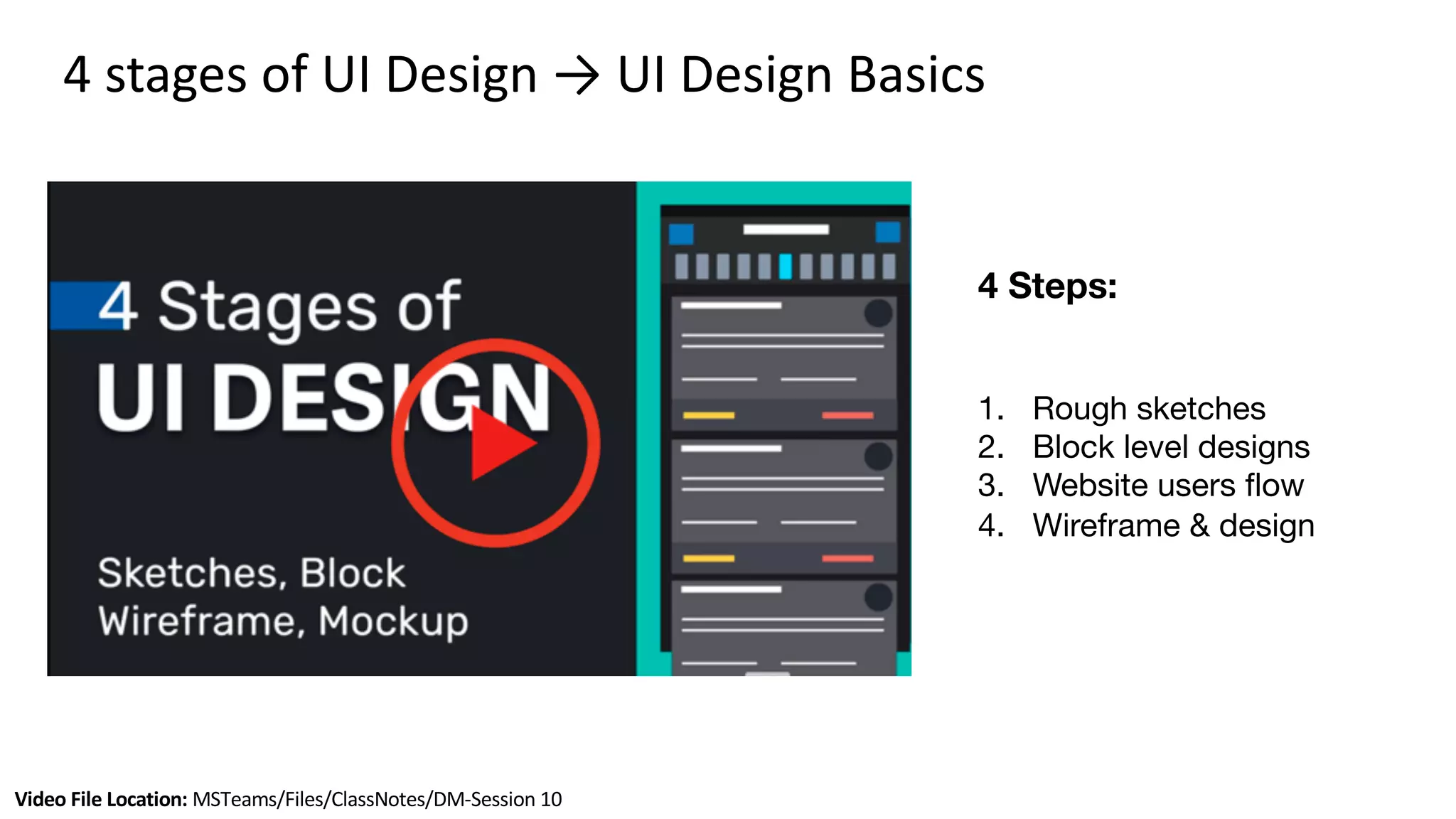
4 stages of UI Design → UI Design Basics
4 Steps:
1. Rough sketches
2. Block level designs
3. Website users flow
4. Wireframe & design
Video File Location: MSTeams/Files/ClassNotes/DM-Session 10
How To Write Perfect Page Titles & Meta Descriptions for SEO
• Page titles
• Meta description
• How it helps SEO
• Examples & use case
00.15 - 08:08
Video File Location: MSTeams/Files/ClassNotes/DM-Session 10
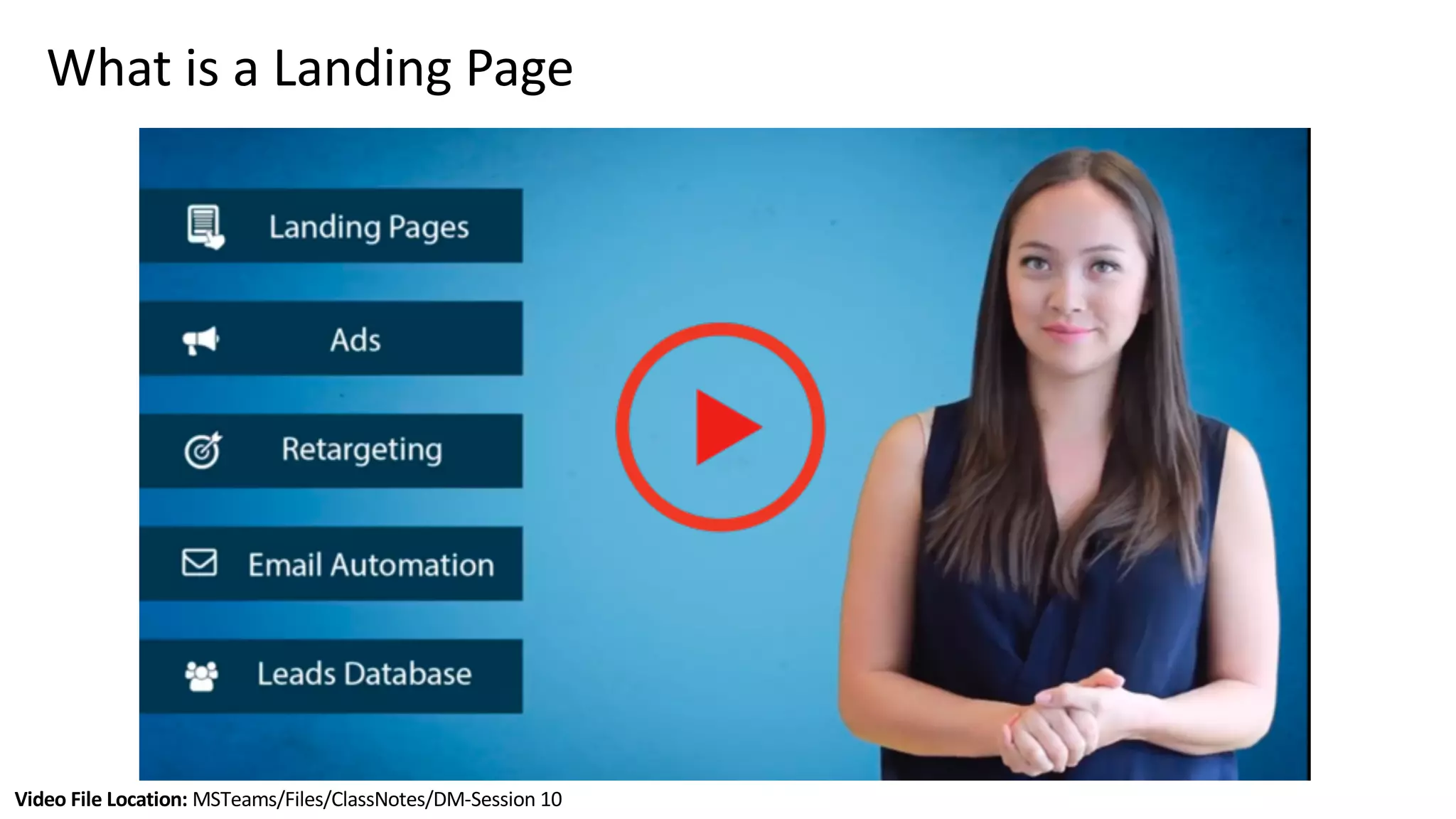
What is a Landing Page
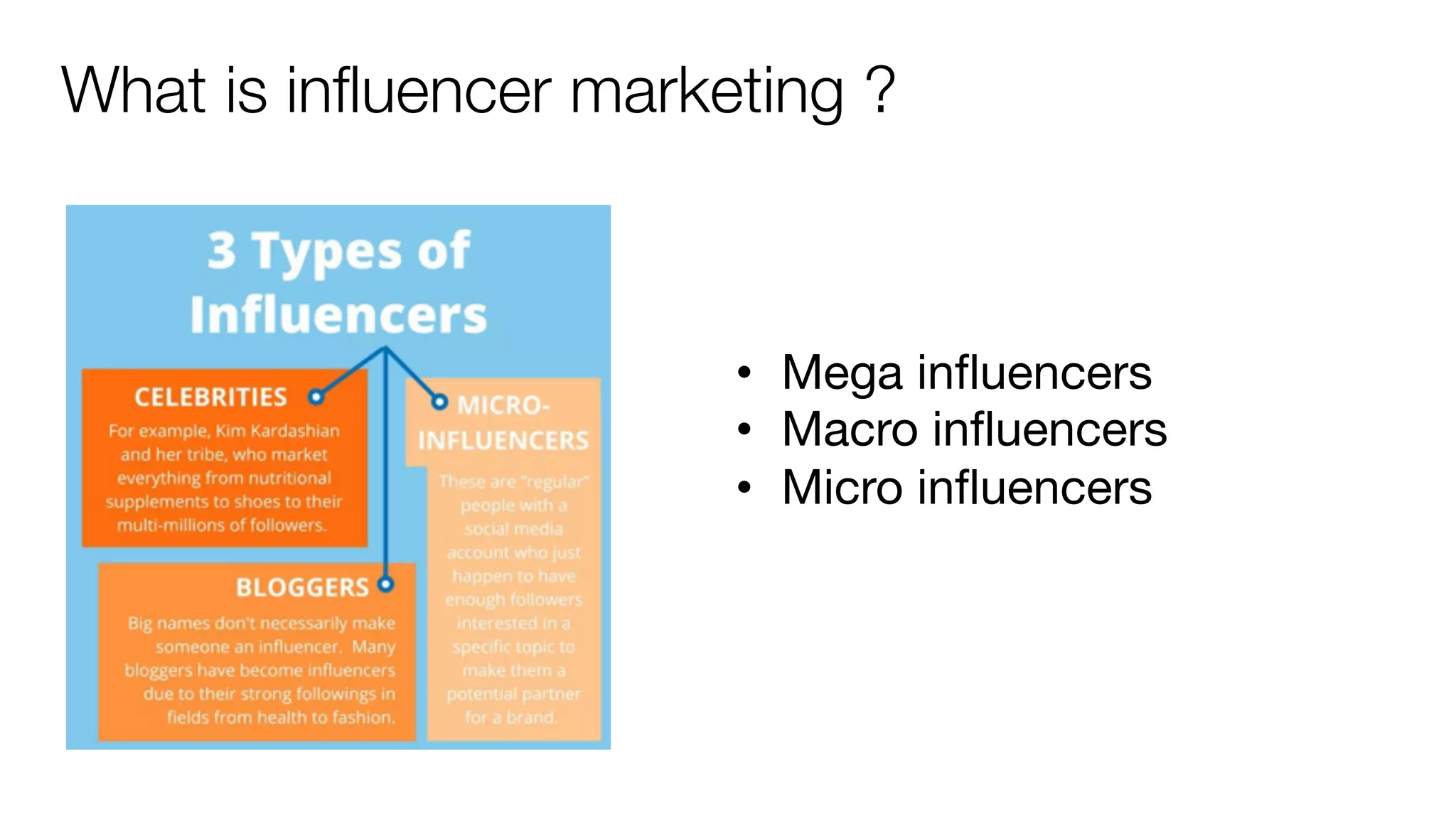
What is influencer marketing ?
• Mega influencers
• Macro influencers
• Micro influencers
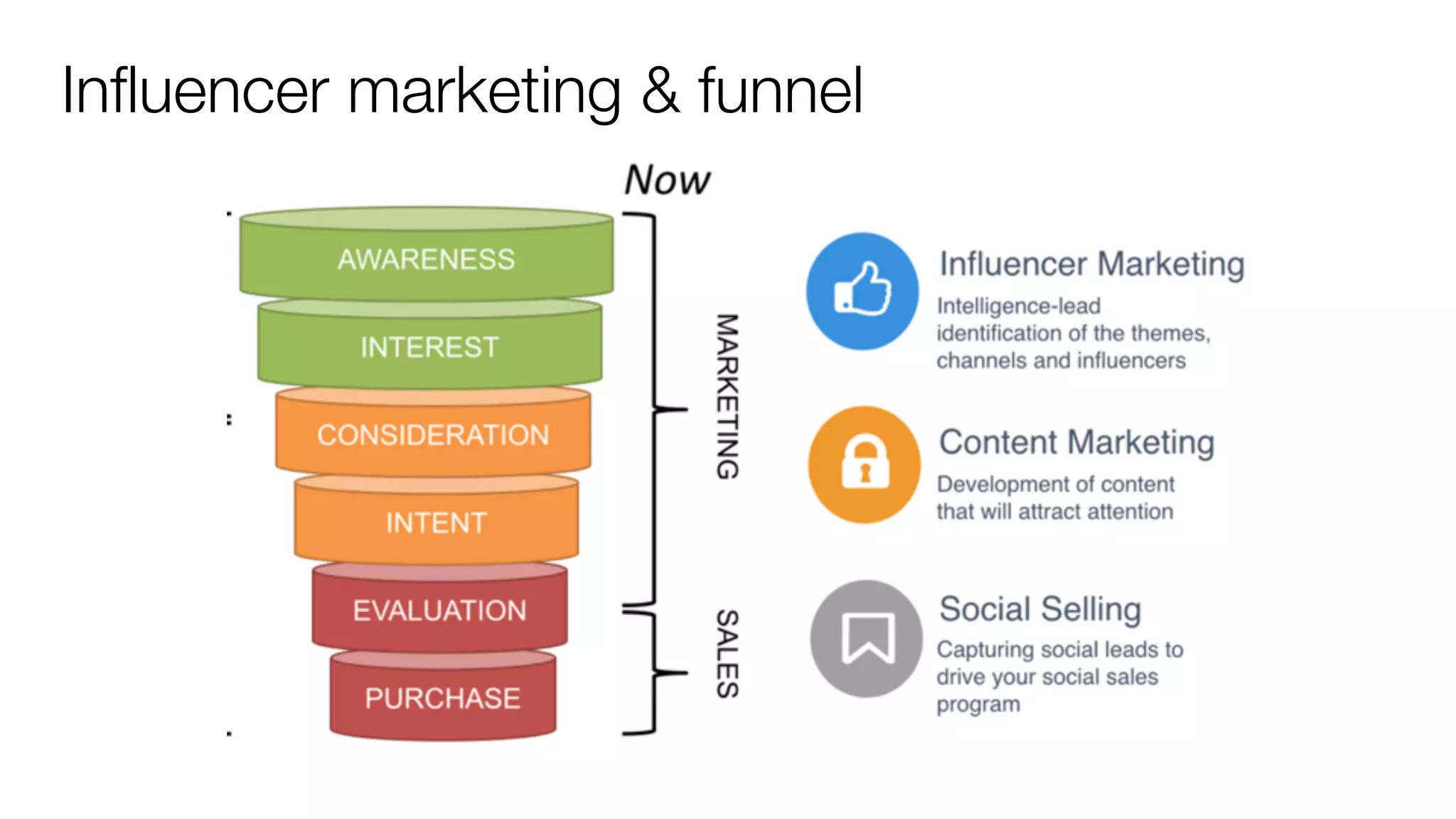
Influencer marketing & funnel
File Location: MSTeams/Files/Class Notes/DM-Session12
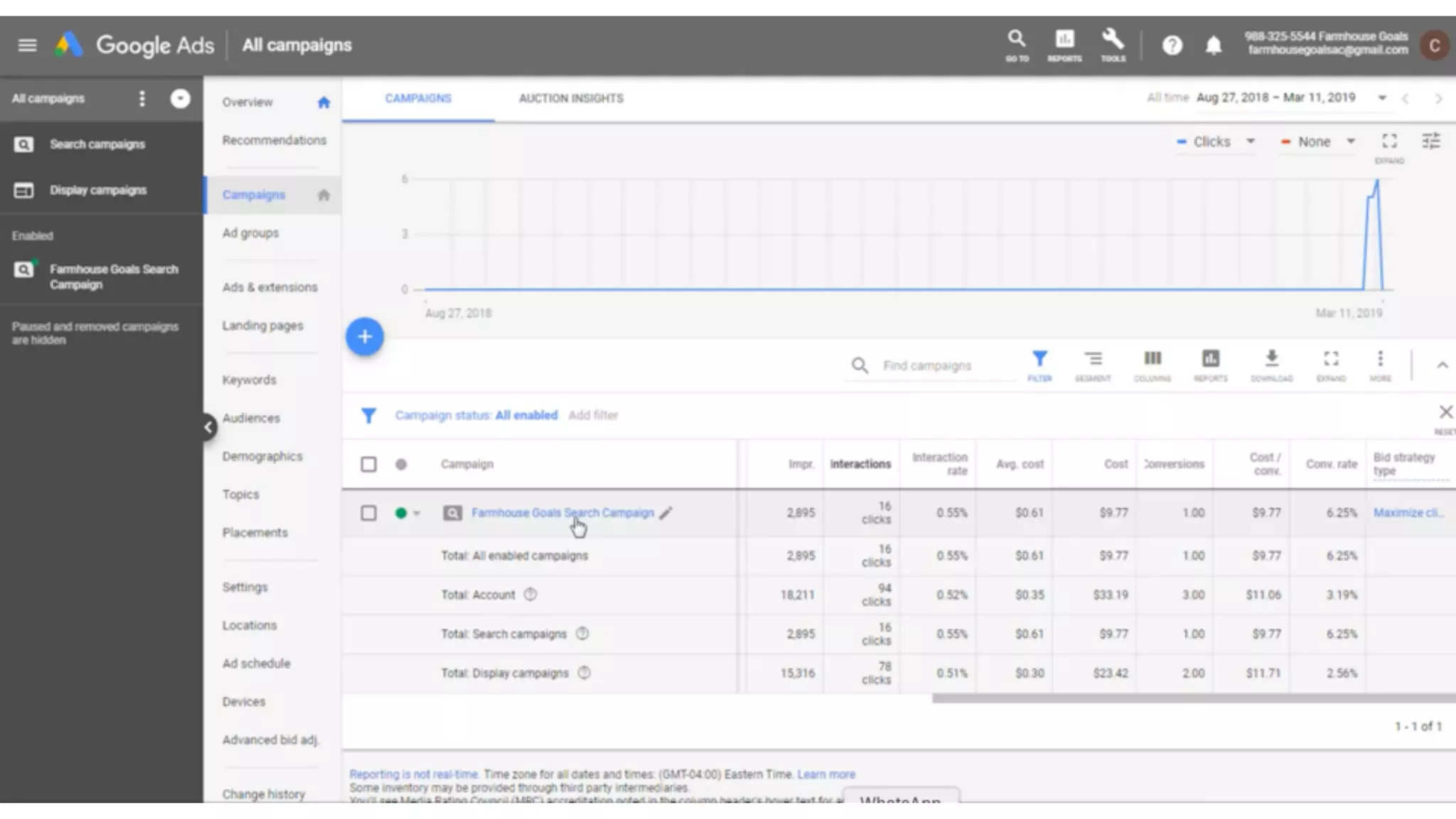
Session 17: Video 3 - How to Start a PPC Campaign
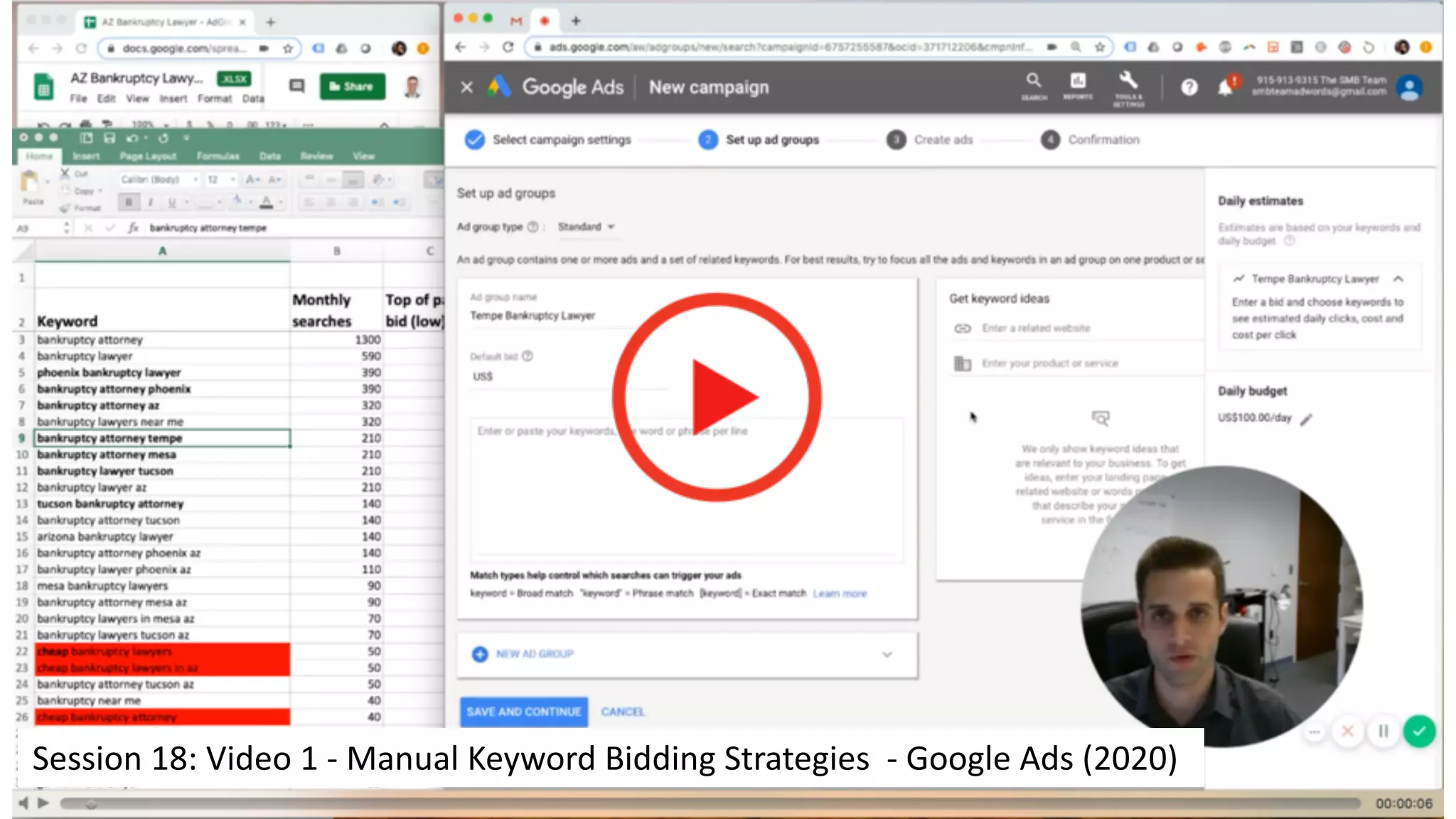
Session 18: Video 1 - Manual Keyword Bidding Strategies - Google Ads (2020)
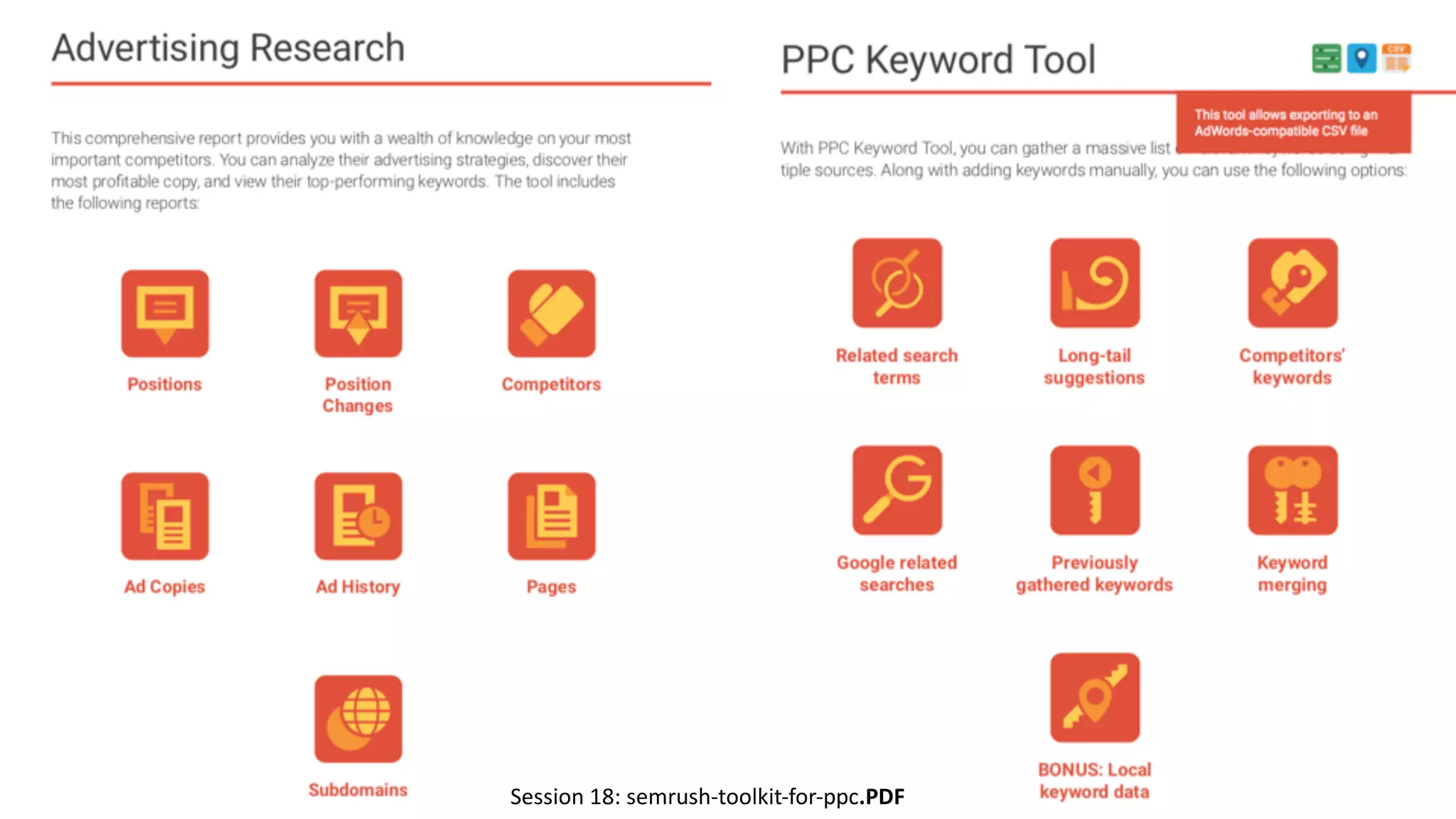
Session 18: semrush-toolkit-for-ppc.PDF
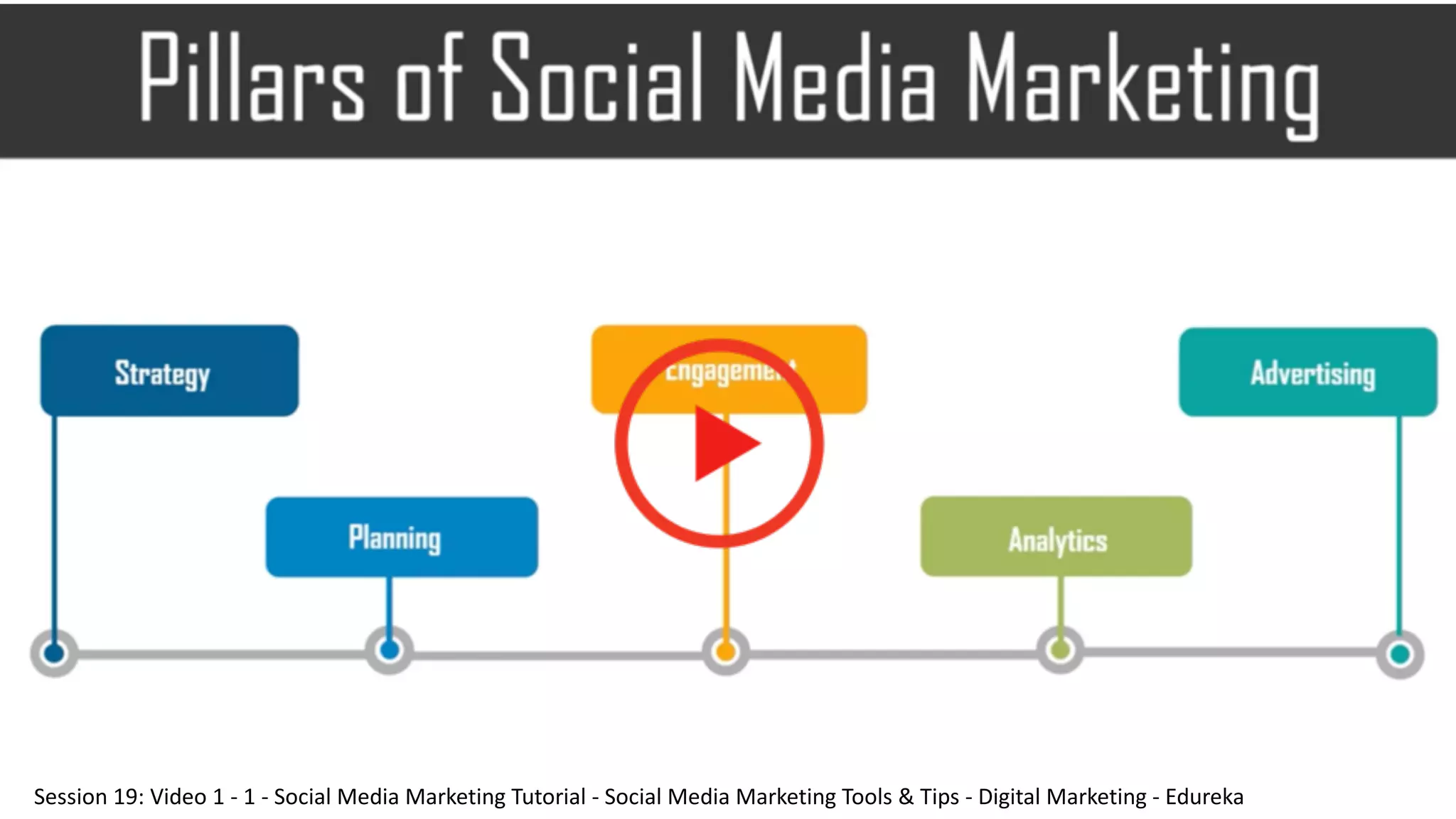
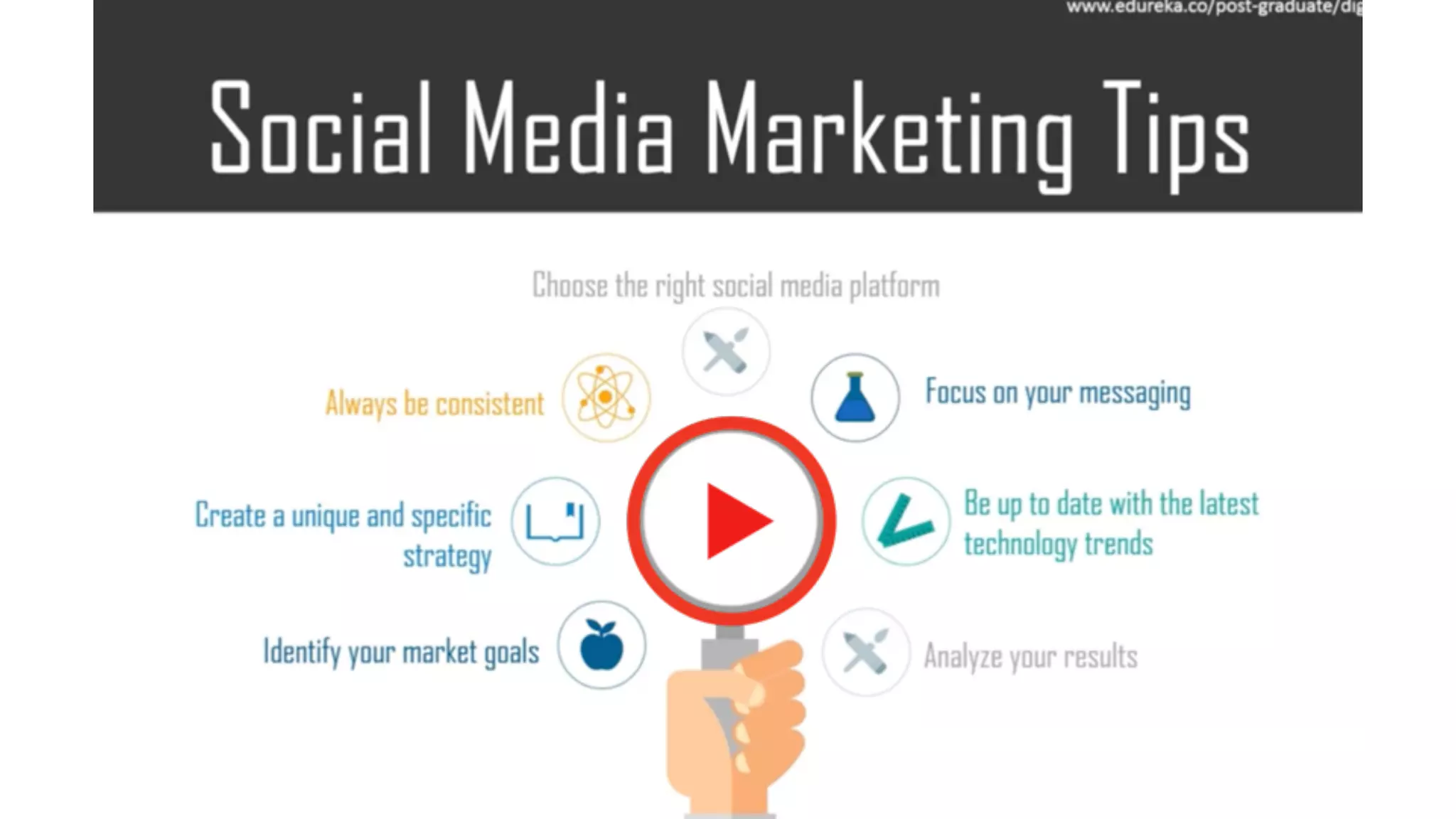
Session 19: Video 1 - 1 - Social Media Marketing Tutorial - Social Media Marketing Tools & Tips - Digital Marketing - Edureka
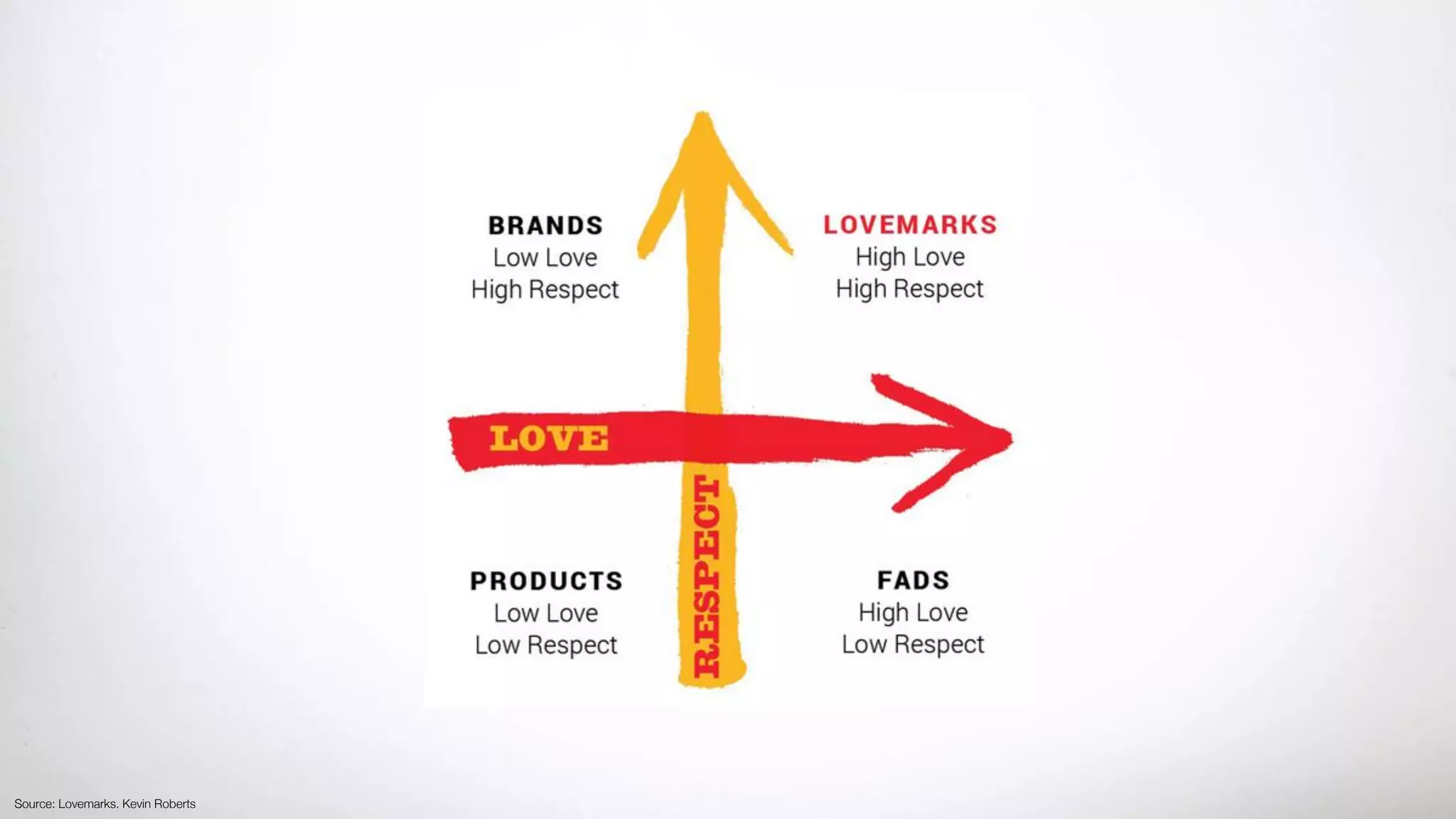
Source: Lovemarks. Kevin Roberts
Prof. Krishanu Datta
Digital Marketing
vf_kdatta@vipsedu.in
Krishanudatta.consultant@gmail.com
______
Krishanu Datta
CEO & Ideas Partner at Communifix Communication Pvt. Ltd.
Brand Strategy I Creative I Digital Marketing I Content I Films & Videos

Digital Marketing Sessions

  • 1.
    Digital Marketing The nextlevel of Marketing 4.0 Digital Marketing: Summary Deck & Ready Reckoner: Prof. Krishanu Datta
  • 2.
    Case discussion CD Problembased learning PBL Quiz Q Role play RP Poll P Elevator Pitch (60 sec) EP Industry interactions II Short project SP Final project FP Essential Readings: 1. Bhatia, P. S. (2019). Fundamentals of Digital Marketing : 2nd Edition. Pearson India Educational Services Pvt. Ltd (Henceforth referred to as (FDM) Reference Readings: 1. Digital Marketing: An Integrated Approach (2019). StarEdu (Henceforth referred to as DM) 2. Maity, M. (2017). Internet Marketing. Oxford University Press 3. Gupta S. (2018). Digital Marketing. McGraw Hill Education (India) Private Limited. 4. Dodson, I (2017). The art of Digital Marketing. Wiley Pre-Read PR Session 3: Digital Marketing: Strategy Development : Part A: Prof. Krishanu Datta
  • 3.
    ASCOR : DigitalMarketing Framework (DMF)
  • 4.
    ASCOR : DMF:Assessment Phase External: • Macro-Micro environment • Market situation analysis Internal Analysis: • Offering Mix • Marketing Mix • Resources Mix • Competencies Mix
  • 5.
    ASCOR : DMF:Assessment Phase: External External Analysis: Macro-Micro environment • Macro (PEST) • Political • Economic • Socio-cultural • Technological • Micro • Suppliers • Partners • Intermediaries • Customers
  • 6.
    ASCOR : DMF:Assessment Phase: External External Analysis: Market situation analysis • Industry analysis • Market segment • Opportunity • Competition analysis • Category • Brand audit
  • 7.
    ASCOR : DMF:Assessment Phase: Internal Internal Analysis: • Offering Mix: D-SWOT • Marketing Mix: 8P’s & STP • Resources Mix: VRIN • Competencies Mix: Capabilities
  • 8.
    ASCOR : DMF:Assessment Phase: Internal Internal Analysis: 1 - Offering Mix: D-SWOT Include only those traditional elements, actually are a strength in online space. Internal Analysis: 1 - Offering Mix:
  • 9.
    ASCOR : DMF:Assessment Phase: Internal Internal Analysis: 2 - Marketing Mix: Include only those traditional elements, actually are a strength in online space. • 8P’s • STP Internal Analysis: 2 - Marketing Mix: 8P’s 1. Product 2. Price 3. Place 4. Promotion 5. People 6. Process 7. Programs 8. Performance
  • 10.
    ASCOR : DMF:Assessment Phase: Internal Internal Analysis: 2 - Marketing Mix: Link between the overall market & how the company chooses to compete in the market. • 8P’s • STP Internal Analysis: 2 - Marketing Mix: STP 1. Segmentation • Demographic • Psychographic • Behavioural 2. Targeting • Selection of specific segment/s • Focused POD & targeting strategy 3. Positioning • TA’s perception of the products key benefit’s & features, wrt competition
  • 11.
    ASCOR : DMF:Assessment Phase: Internal Internal Analysis: 3 - Resources A source of supply from which benefit is derived or produced. Internal Analysis: 3 - Resources 1. Input-driven resources: materials, energy, natural resources 2. Economic resources: land, capital, infrastructure 3. Human resources: employees, contractors, third parties 4. Technology resources: information, communication, storage systems 5. Intellectual resources: brand capital, intellectual property patents & trademarks 6. Partner/intermediary resources: resources which can be leveraged with the support of strong partners, specific associations/alliances, and tie- ups with key intermediary firms
  • 12.
    Segmentation 2.0 STP 2.0 1.Identified key customer segments 2. Developed personas to target 3. Develop messages & actions Traditional: Retail store & CRM data analytics of <FitBit> External: Secondary report of growing fitness segment in India Data from brand’s Owned Media: Website Analytics of <FitBit> on Amazon Data from brand’s Earned Media: E-commerce transaction data of <FitBit> on Amazon
  • 13.
    Customer Development Strategy(STP 2.0) Interest: To cite an example: CUSTOMER JOURNEY—Customer shows active interest in the brand and has a definite need which he/she wants to fulfill, hence, spends considerable time on the brand site, performs searches, views demos, fills enquiry forms, etc. PERSONA CREATION—A persona by the name ‘Active Lead’ is developed for this segment of new/returning consumers who like the brand and are close to the conversion stage, provided their clarifications have been well addressed. POSITIONING—With a prolonged sales cycle for consumers at this stage, marketers need to position their messages in an informative manner and focus on functional aspects so that consumers know the value of the brand.
  • 14.
    Power of CustomerConnectivity & Advocacy in the New Customer Journey Touchpoints Impression Behavior Aware Appeal Ask Act Advocate Source: Marketing 4.0 - Moving from traditional to digital Session 3: Digital Marketing: Strategy Development : Part A: Prof. Krishanu Datta
  • 15.
    Power of CustomerConnectivity & Advocacy in the New Customer Journey • Past Experience • Advocacy • Marketing Communications Touchpoints Impression Behavior Aware Appeal Ask Act Advocate • Learn from others • Recall Ads • Past experience • I know • Process the messages & register in STM/LTM • Become attracted to brands • Make a consideration set • I Like • Research for more info. from F&F, media or the brand • Call friends for advise • Search, Reviews • Compare price • Try out at store • I’m Convinced • Decide to buy, purchase process • Buy online or in store • First time user • Experience service • I’m Buying • Beyond loyalty & repurchase - advocacy • Recommend the brand to others • Continue using it / Repurchase • I recommend Source: Marketing 4.0 - Moving from traditional to digital PBL Session 3: Digital Marketing: Strategy Development : Part A: Prof. Krishanu Datta
  • 16.
    Consumer decision process(CDP) Source: Marketing 4.0 - Moving from traditional to digital 1. Higher potential for profiling 1. Developing consumer personas 1. Gather unsolicited feedback 2. Real-time peer/ expert influence 3. Use online data to target offline customers Passive influence thro. Consumer does not have control & is unsolicited Active influence thro. Actively seeking information while evaluation 1. Social communities 1. Expert information 1. Product customisation 2. Data driven promotions
  • 17.
    4 key digitalmedia planning stages
  • 18.
    A - Digitalmedia planning: core elements • 4 key elements to create specific media plans • Channels • Affiliates • Content creators • Customers • Affiliates: a partner network in the same industry to obtain leads, conversions at an agreed price. • Customers: • Customers or/& Influencers • Paid for loyalty: discounts, freebies, points
  • 19.
    B – Designcommunications program Message Content (What to say?) • Objective • Target audience /personas • Buying criteria • Value proposition • Feeling after exposed to content Message Structure (How to say it logically?) • Impact the audience: cognitive, affective or behavioral • Brand voice • Brand tone • Message framing • Order effects • One-side Vs Two-sided msgs Message Format (How message will be shared?) • Creative strategy & idea • Storytelling/Narrative • Use of images • Use of words • Use of audio • Use of video Message Source (Who would say it?) • Credibility • Level of perceived expertise • Personal motivations • Trust factor • Formal sources: Product experts, Celebrity • Informal sources: Family, friends, peers, colleagues
  • 20.
    C – Selectchannel mix
  • 21.
    C - Digitalmedia classification of promotion types The key difference in planning media for digital channels from traditional offline planning is the presence of owned media. Firms in the earlier era had no possibility of owning media and the only form of owned media.
  • 22.
    C – Selectchannel mix
  • 23.
    D – Allocatebudget across channel mix Affordable method • What firm thinks it can afford • Cost based approach Percentage of sales • % of current or anticipated sales • Limits aggressive budgets to tap market opportunities Competitive parity method • Mapping budgets to similar products/category or PLC • Resources & constraints of competition might not be the same Objective & task method • SMART objective based • Cost of performing the tasks/ results • Total of all these costs = budget • Assumptions & calculated approach Key considerations for digital marketing budgeting • Stage with respect to 6S framework • B2B or B2C business model (Self-funded, investor funded budgets) • Growth imperatives (business goals) • Prior experience & channel knowledge • Prior partnerships across channels & affiliates
  • 24.
    Digital channel communicationmix matrix X Axis: Message orientation: • The key objective of the promotion • Awareness/engagement orientation • Purchase/conversion orientation Y Axis: Communication type: Type of communication taking place in a channel: • Static type of communication • Dynamic type of communication (real-time)
  • 25.
    Video File Location:MSTeams/Files/ClassNotes/DM-Session 10 Website Information Architecture
  • 26.
    Video File Location:MSTeams/Files/ClassNotes/DM-Session 10 4 stages of UI Design → UI Design Basics 4 Steps: 1. Rough sketches 2. Block level designs 3. Website users flow 4. Wireframe & design
  • 27.
    Video File Location:MSTeams/Files/ClassNotes/DM-Session 10 How To Write Perfect Page Titles & Meta Descriptions for SEO • Page titles • Meta description • How it helps SEO • Examples & use case 00.15 - 08:08
  • 28.
    Video File Location:MSTeams/Files/ClassNotes/DM-Session 10 What is a Landing Page
  • 29.
    What is influencermarketing ?
  • 30.
    What is influencermarketing ? • Mega influencers • Macro influencers • Micro influencers
  • 31.
  • 32.
  • 44.
    Session 17: Video3 - How to Start a PPC Campaign
  • 45.
    Session 18: Video1 - Manual Keyword Bidding Strategies - Google Ads (2020)
  • 46.
  • 47.
    Session 19: Video1 - 1 - Social Media Marketing Tutorial - Social Media Marketing Tools & Tips - Digital Marketing - Edureka
  • 49.
  • 50.
    Prof. Krishanu Datta DigitalMarketing vf_kdatta@vipsedu.in Krishanudatta.consultant@gmail.com ______ Krishanu Datta CEO & Ideas Partner at Communifix Communication Pvt. Ltd. Brand Strategy I Creative I Digital Marketing I Content I Films & Videos