Fall 2011


            Naughty or Nice?
             Ethical concerns with
                        technology
2

                              Ethical concerns?

What is ethics, anyway?
• Ethics is two things
  – Ethics refers to well based standards of right
    and wrong that prescribe what humans
    ought to do, usually in terms of rights,
    obligations, benefits to society, fairness, or
    specific virtues.
  – Ethics refers to the study and development
    of one’s ethical standards.
     • What is Ethics?
3

                            Ethics in Education?

National Education Assocation:
  – Commitment to the Student
  – The educator strives to help each student realize
    his or her potential as a worthy and effective
    member of society. The educator therefore works
    to stimulate the spirit of inquiry, the acquisition of
    knowledge and understanding, and the thoughtful
    formulation of worthy goals.
  – Commitment to the Profession
  – The education profession is vested by the public
    with a trust and responsibility requiring the
    highest ideals of professional service.
     • NEA Code of Ethics
4

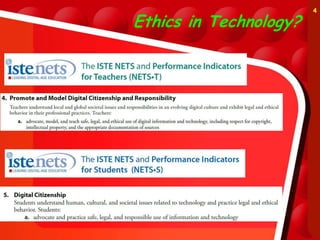
Ethics in Technology?
5

                               Ethics for librarians?


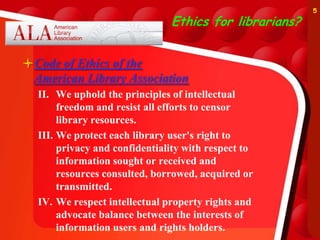
Code of Ethics of the
 American Library Association
  II. We uphold the principles of intellectual
       freedom and resist all efforts to censor
       library resources.
  III. We protect each library user's right to
       privacy and confidentiality with respect to
       information sought or received and
       resources consulted, borrowed, acquired or
       transmitted.
  IV. We respect intellectual property rights and
       advocate balance between the interests of
       information users and rights holders.
6

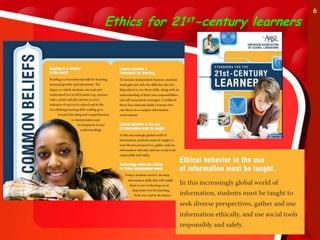
Ethics for 21st-century learners
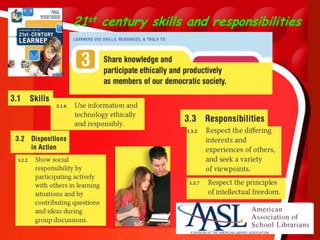
21st century skills and responsibilities
8

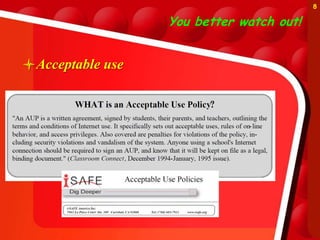
                  You better watch out!


Acceptable use
9


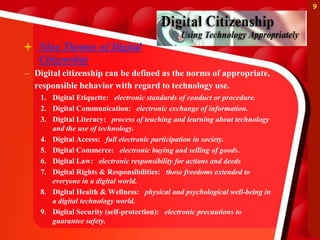
 Nine Themes of Digital
  Citizenship
– Digital citizenship can be defined as the norms of appropriate,
  responsible behavior with regard to technology use.
    1. Digital Etiquette: electronic standards of conduct or procedure.
    2. Digital Communication: electronic exchange of information.
    3. Digital Literacy: process of teaching and learning about technology
       and the use of technology.
    4. Digital Access: full electronic participation in society.
    5. Digital Commerce: electronic buying and selling of goods.
    6. Digital Law: electronic responsibility for actions and deeds
    7. Digital Rights & Responsibilities: those freedoms extended to
       everyone in a digital world.
    8. Digital Health & Wellness: physical and psychological well-being in
       a digital technology world.
    9. Digital Security (self-protection): electronic precautions to
       guarantee safety.
10


                                                           KY Guidelines

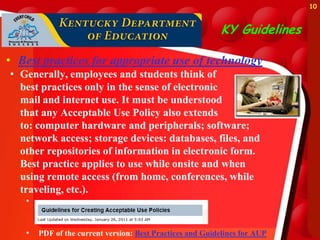
• Best practices for appropriate use of technology
• Generally, employees and students think of
  best practices only in the sense of electronic
  mail and internet use. It must be understood
  that any Acceptable Use Policy also extends
  to: computer hardware and peripherals; software;
  network access; storage devices: databases, files, and
  other repositories of information in electronic form.
  Best practice applies to use while onsite and when
  using remote access (from home, conferences, while
  traveling, etc.).
   •


   •   PDF of the current version: Best Practices and Guidelines for AUP
11

                            3 aspects of acceptable use


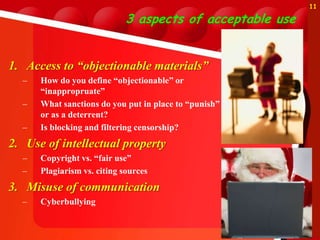
1. Access to “objectionable materials”
  –   How do you define “objectionable” or
      “inappropruate”
  –   What sanctions do you put in place to “punish”
      or as a deterrent?
  –   Is blocking and filtering censorship?
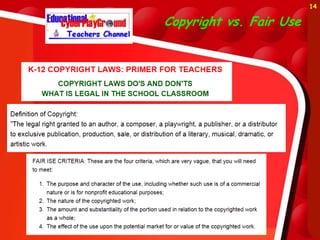
2. Use of intellectual property
  –   Copyright vs. “fair use”
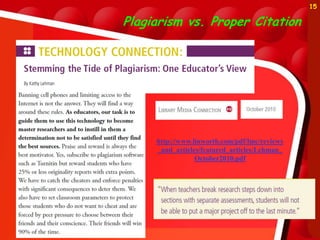
  –   Plagiarism vs. citing sources
3. Misuse of communication
  –   Cyberbullying
12

                                           Internet filtering


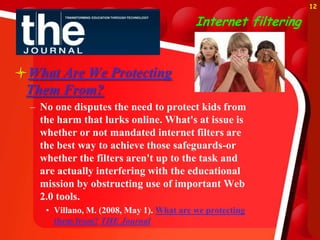
What Are We Protecting
 Them From?
  – No one disputes the need to protect kids from
    the harm that lurks online. What's at issue is
    whether or not mandated internet filters are
    the best way to achieve those safeguards-or
    whether the filters aren't up to the task and
    are actually interfering with the educational
    mission by obstructing use of important Web
    2.0 tools.
     • Villano, M. (2008, May 1). What are we protecting
       them from? THE Journal
13

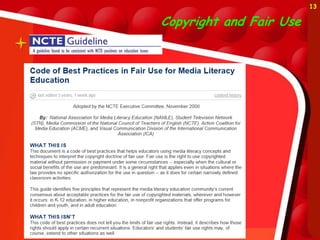
    Copyright and Fair Use

14

Copyright vs. Fair Use
15

Plagiarism vs. Proper Citation


     http://www.linworth.com/pdf/lmc/reviews
     _and_articles/featured_articles/Lehman_
                 October2010.pdf
16

                                                                       Cyberbullying
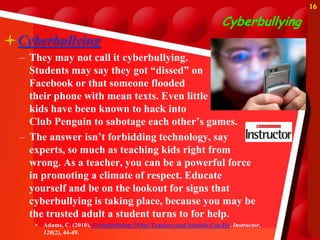
Cyberbullying
  – They may not call it cyberbullying.
    Students may say they got “dissed” on
    Facebook or that someone flooded
    their phone with mean texts. Even little
    kids have been known to hack into
    Club Penguin to sabotage each other’s games.
  – The answer isn’t forbidding technology, say
    experts, so much as teaching kids right from
    wrong. As a teacher, you can be a powerful force
    in promoting a climate of respect. Educate
    yourself and be on the lookout for signs that
    cyberbullying is taking place, because you may be
    the trusted adult a student turns to for help.
     • Adams, C. (2010). Cyberbullying: What Teachers and Schools Can Do. Instructor,
       120(2), 44-49.
17

Some internet safety organizations
18

A Resource from the Feds
19

                                           A Kentucky resource

Internet Safety
  – The Internet is a wonderful tool which puts the world and all
    its information at our fingertips. Much of this information
    has been available for a long time through public library
    access or other means. Indeed, many of these sites have been
    in operation for a number of years. However, this ease of
    access is paving the way for massive growth in Internet-
    based crime such as identity theft and predators. However,
    most of these sites also provide an opt-out feature for you to
    remove or manage what information is available, though it
    may take some clicking around to locate it. The Kentucky
    Center for School Safety has compiled information on a
    number of them and provides a Protecting Your Personal
    Information: Opt Out procedures flier.
  – NEW! Make Facebook more private-Video
20


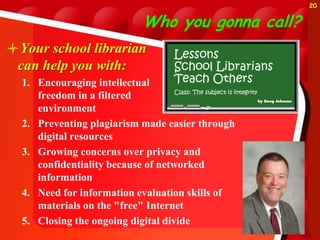
                          Who you gonna call?
Your school librarian
 can help you with:
  1. Encouraging intellectual
     freedom in a filtered
     environment
  2. Preventing plagiarism made easier through
     digital resources
  3. Growing concerns over privacy and
     confidentiality because of networked
     information
  4. Need for information evaluation skills of
     materials on the "free" Internet
  5. Closing the ongoing digital divide
21


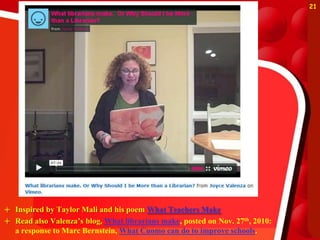
 Inspired by Taylor Mali and his poem What Teachers Make
 Read also Valenza’s blog, What librarians make, posted on Nov. 27th, 2010:
  a response to Marc Bernstein, What Cuomo can do to improve schools.
22


Have a safe holiday!

Naughty or nice: Ethical concerns with technology

  • 1.
    Fall 2011 Naughty or Nice? Ethical concerns with technology
  • 2.
    2 Ethical concerns? What is ethics, anyway? • Ethics is two things – Ethics refers to well based standards of right and wrong that prescribe what humans ought to do, usually in terms of rights, obligations, benefits to society, fairness, or specific virtues. – Ethics refers to the study and development of one’s ethical standards. • What is Ethics?
  • 3.
    3 Ethics in Education? National Education Assocation: – Commitment to the Student – The educator strives to help each student realize his or her potential as a worthy and effective member of society. The educator therefore works to stimulate the spirit of inquiry, the acquisition of knowledge and understanding, and the thoughtful formulation of worthy goals. – Commitment to the Profession – The education profession is vested by the public with a trust and responsibility requiring the highest ideals of professional service. • NEA Code of Ethics
  • 4.
  • 5.
    5 Ethics for librarians? Code of Ethics of the American Library Association II. We uphold the principles of intellectual freedom and resist all efforts to censor library resources. III. We protect each library user's right to privacy and confidentiality with respect to information sought or received and resources consulted, borrowed, acquired or transmitted. IV. We respect intellectual property rights and advocate balance between the interests of information users and rights holders.
  • 6.
  • 7.
    21st century skillsand responsibilities
  • 8.
    8 You better watch out! Acceptable use
  • 9.
    9  Nine Themesof Digital Citizenship – Digital citizenship can be defined as the norms of appropriate, responsible behavior with regard to technology use. 1. Digital Etiquette: electronic standards of conduct or procedure. 2. Digital Communication: electronic exchange of information. 3. Digital Literacy: process of teaching and learning about technology and the use of technology. 4. Digital Access: full electronic participation in society. 5. Digital Commerce: electronic buying and selling of goods. 6. Digital Law: electronic responsibility for actions and deeds 7. Digital Rights & Responsibilities: those freedoms extended to everyone in a digital world. 8. Digital Health & Wellness: physical and psychological well-being in a digital technology world. 9. Digital Security (self-protection): electronic precautions to guarantee safety.
  • 10.
    10 KY Guidelines • Best practices for appropriate use of technology • Generally, employees and students think of best practices only in the sense of electronic mail and internet use. It must be understood that any Acceptable Use Policy also extends to: computer hardware and peripherals; software; network access; storage devices: databases, files, and other repositories of information in electronic form. Best practice applies to use while onsite and when using remote access (from home, conferences, while traveling, etc.). • • PDF of the current version: Best Practices and Guidelines for AUP
  • 11.
    11 3 aspects of acceptable use 1. Access to “objectionable materials” – How do you define “objectionable” or “inappropruate” – What sanctions do you put in place to “punish” or as a deterrent? – Is blocking and filtering censorship? 2. Use of intellectual property – Copyright vs. “fair use” – Plagiarism vs. citing sources 3. Misuse of communication – Cyberbullying
  • 12.
    12 Internet filtering What Are We Protecting Them From? – No one disputes the need to protect kids from the harm that lurks online. What's at issue is whether or not mandated internet filters are the best way to achieve those safeguards-or whether the filters aren't up to the task and are actually interfering with the educational mission by obstructing use of important Web 2.0 tools. • Villano, M. (2008, May 1). What are we protecting them from? THE Journal
  • 13.
    13 Copyright and Fair Use 
  • 14.
  • 15.
    15 Plagiarism vs. ProperCitation http://www.linworth.com/pdf/lmc/reviews _and_articles/featured_articles/Lehman_ October2010.pdf
  • 16.
    16 Cyberbullying Cyberbullying – They may not call it cyberbullying. Students may say they got “dissed” on Facebook or that someone flooded their phone with mean texts. Even little kids have been known to hack into Club Penguin to sabotage each other’s games. – The answer isn’t forbidding technology, say experts, so much as teaching kids right from wrong. As a teacher, you can be a powerful force in promoting a climate of respect. Educate yourself and be on the lookout for signs that cyberbullying is taking place, because you may be the trusted adult a student turns to for help. • Adams, C. (2010). Cyberbullying: What Teachers and Schools Can Do. Instructor, 120(2), 44-49.
  • 17.
  • 18.
  • 19.
    19 A Kentucky resource Internet Safety – The Internet is a wonderful tool which puts the world and all its information at our fingertips. Much of this information has been available for a long time through public library access or other means. Indeed, many of these sites have been in operation for a number of years. However, this ease of access is paving the way for massive growth in Internet- based crime such as identity theft and predators. However, most of these sites also provide an opt-out feature for you to remove or manage what information is available, though it may take some clicking around to locate it. The Kentucky Center for School Safety has compiled information on a number of them and provides a Protecting Your Personal Information: Opt Out procedures flier. – NEW! Make Facebook more private-Video
  • 20.
    20 Who you gonna call? Your school librarian can help you with: 1. Encouraging intellectual freedom in a filtered environment 2. Preventing plagiarism made easier through digital resources 3. Growing concerns over privacy and confidentiality because of networked information 4. Need for information evaluation skills of materials on the "free" Internet 5. Closing the ongoing digital divide
  • 21.
    21  Inspired byTaylor Mali and his poem What Teachers Make  Read also Valenza’s blog, What librarians make, posted on Nov. 27th, 2010: a response to Marc Bernstein, What Cuomo can do to improve schools.
  • 22.