Digital Audio &
Technology Application
Sampling
Quantization
Digital Recording
Reproduction Process
Disk Based Audio System
By Azmawati Binti Mohd Lazim | azmawati@mmu.edu.my
Learning Objective
• LO1 - To execute audio recording sessions in a
proper studio environment.
• LO2 - To operate the features found in a digital
audio workstation and essentially use it as a tool
for multimedia production.
What is sampling?
which is
taking
'samples'
(or parts)
of an
existing
music-
piece
and using
that to
create a
new music
production.
Real life situation
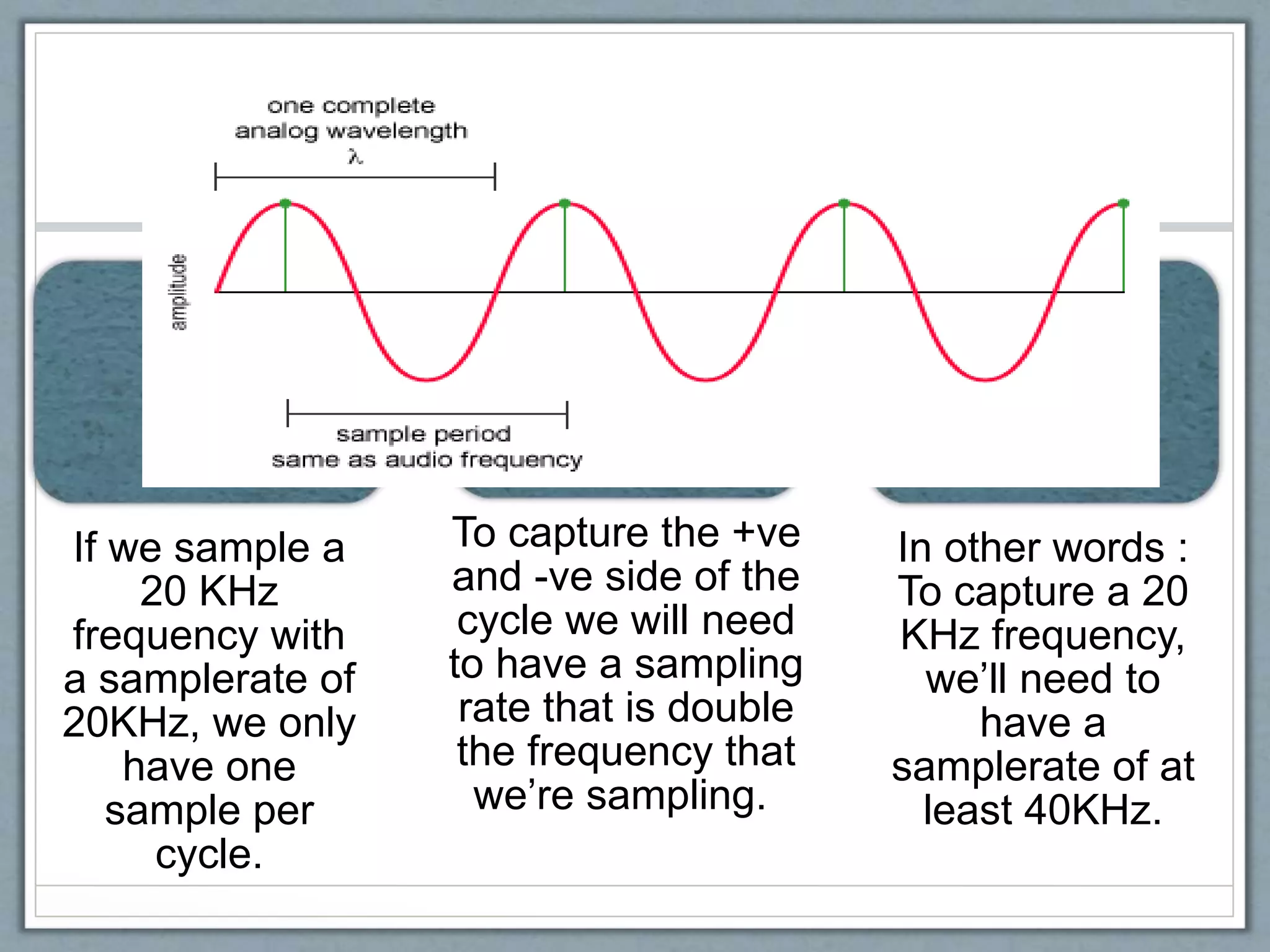
If we sample a
20 KHz
frequency with
a samplerate of
20KHz, we only
have one
sample per
cycle.
To capture the +ve
and -ve side of the
cycle we will need
to have a sampling
rate that is double
the frequency that
we’re sampling.
In other words :
To capture a 20
KHz frequency,
we’ll need to
have a
samplerate of at
least 40KHz.
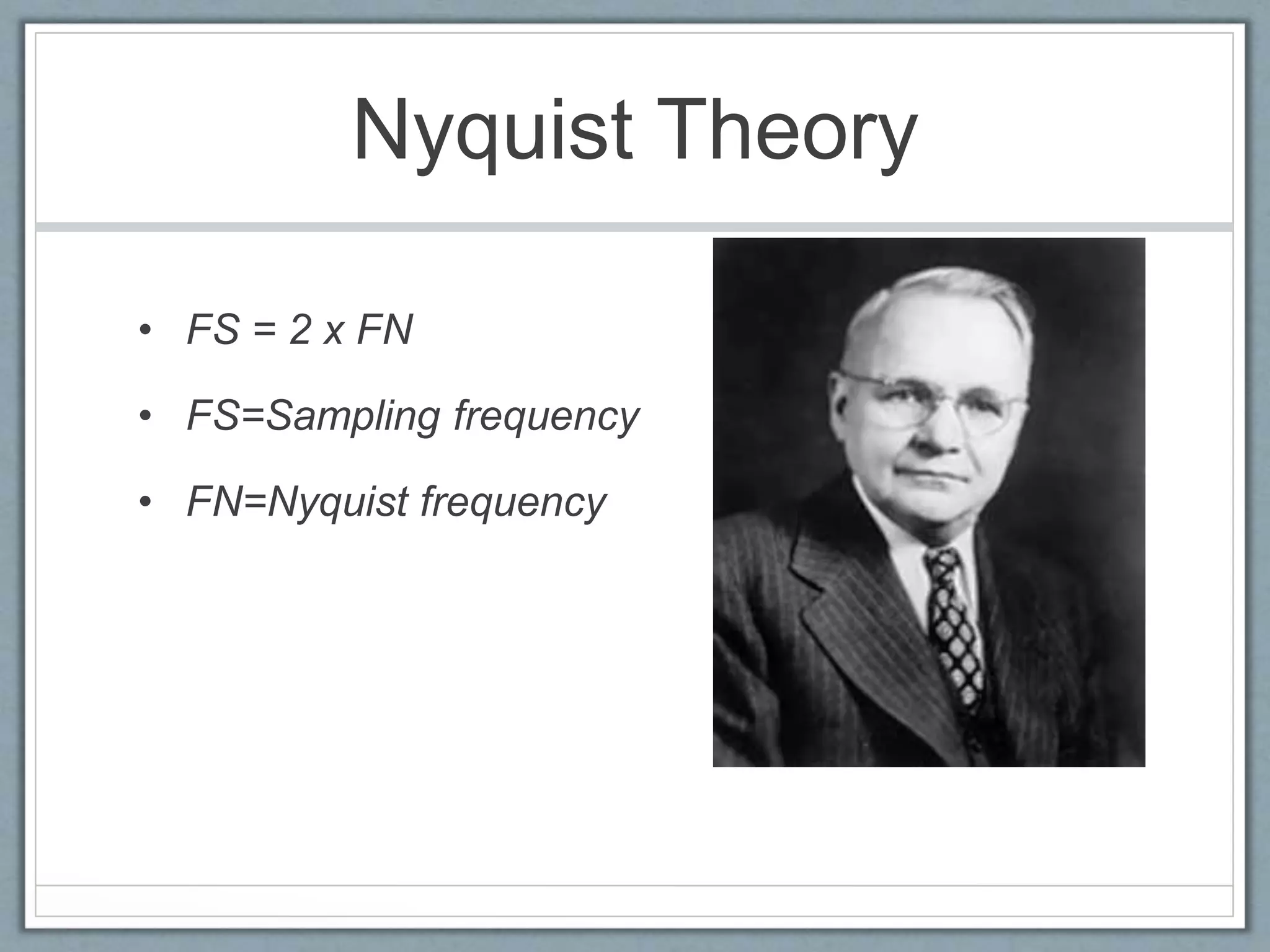
Nyquist Theory
• FS = 2 x FN
• FS=Sampling frequency
• FN=Nyquist frequency
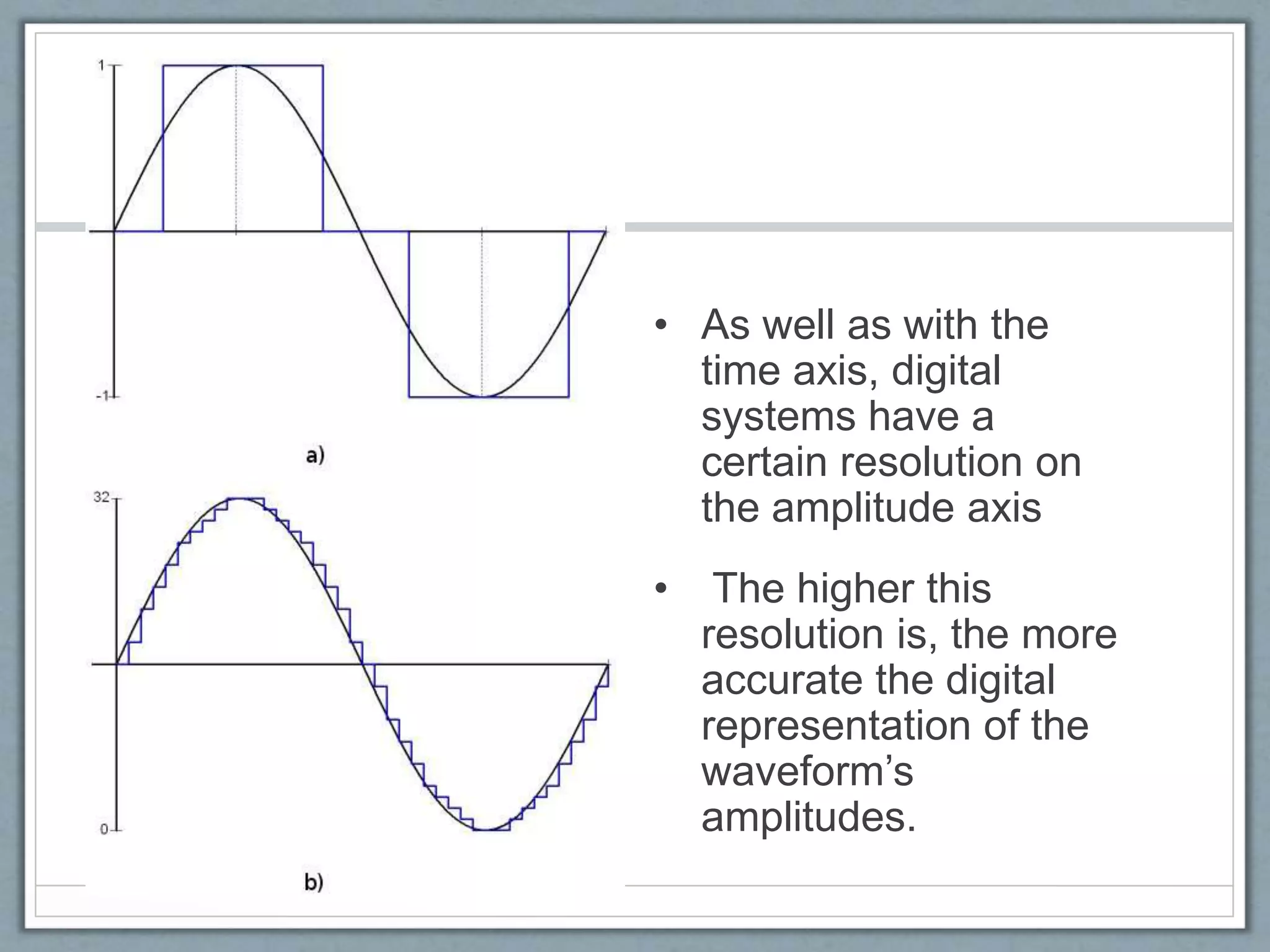
What is quantisation?
Sampling is capturing an amplitude value in time.
This value is captured in a process called
quantisation
• As well as with the
time axis, digital
systems have a
certain resolution on
the amplitude axis
• The higher this
resolution is, the more
accurate the digital
representation of the
waveform’s
amplitudes.
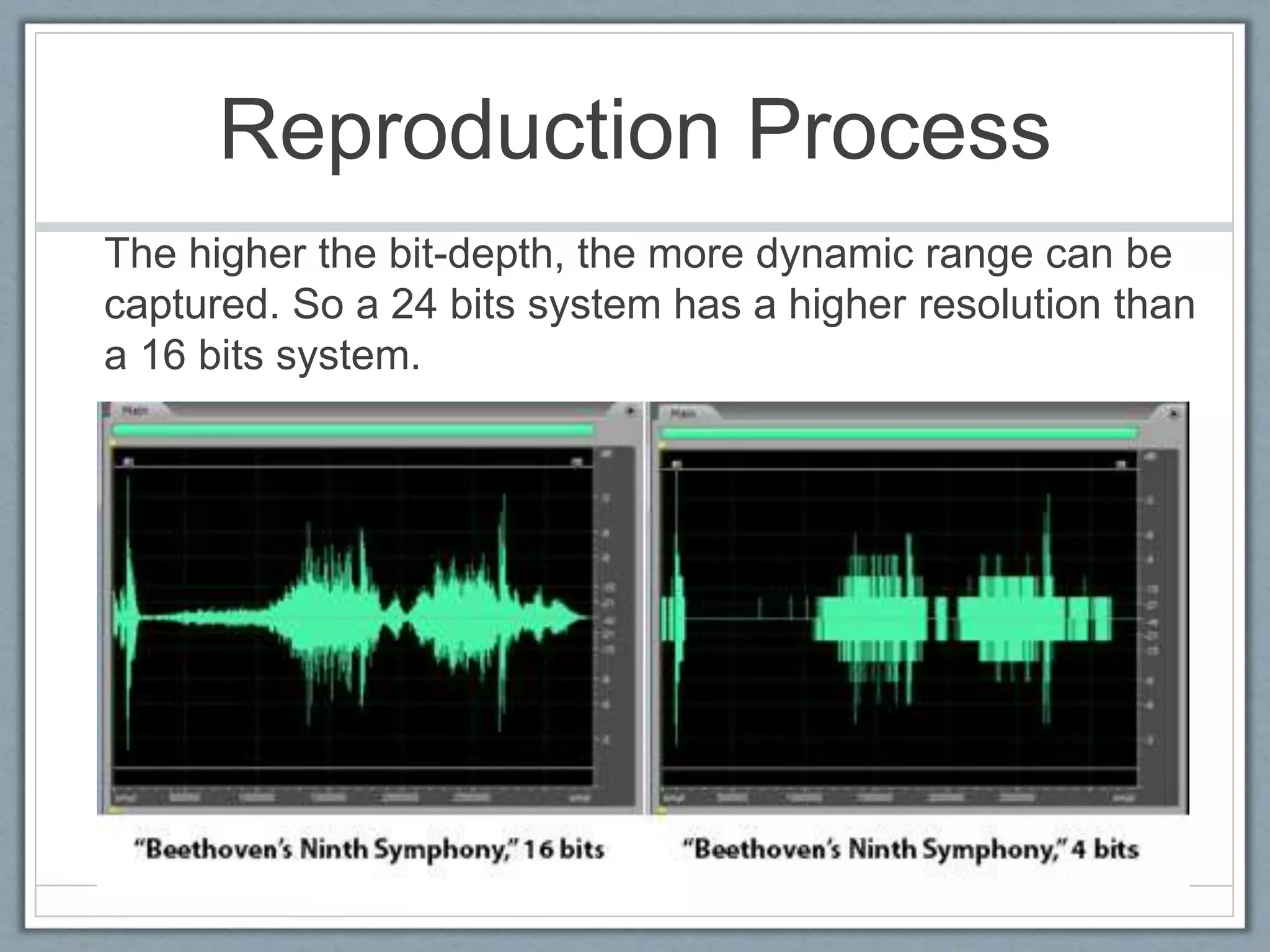
Reproduction Process
The higher the bit-depth, the more dynamic range can be
captured. So a 24 bits system has a higher resolution than
a 16 bits system.
You can imagine that mixing with audio that
has a 24 bit resolution is much easier and
pleasant to mix with since we literally have
more values on the amplitude axis.
Digital Recording
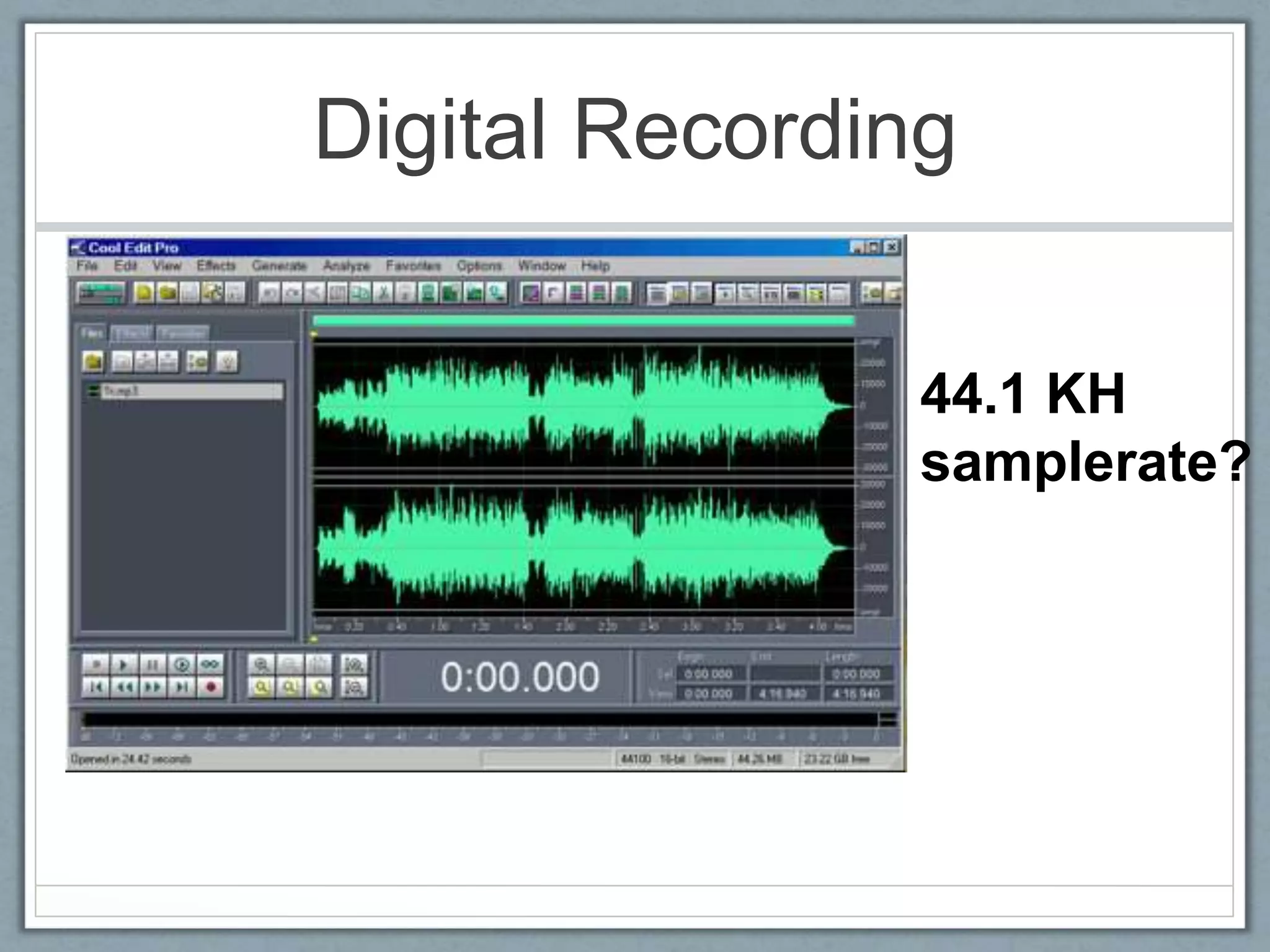
44.1 KH
samplerate?
Disk-based Audio
System
This sample-rate
standard dates
back to the days of
videocasettes.
Digital audio was
stored in the
scans of a
videoframe and a
samplerate of
44.1KHz could fit
in both systems.
It was
mathematically
compatible with
both European
PAL as the
United States
standard NTSC
film systems.
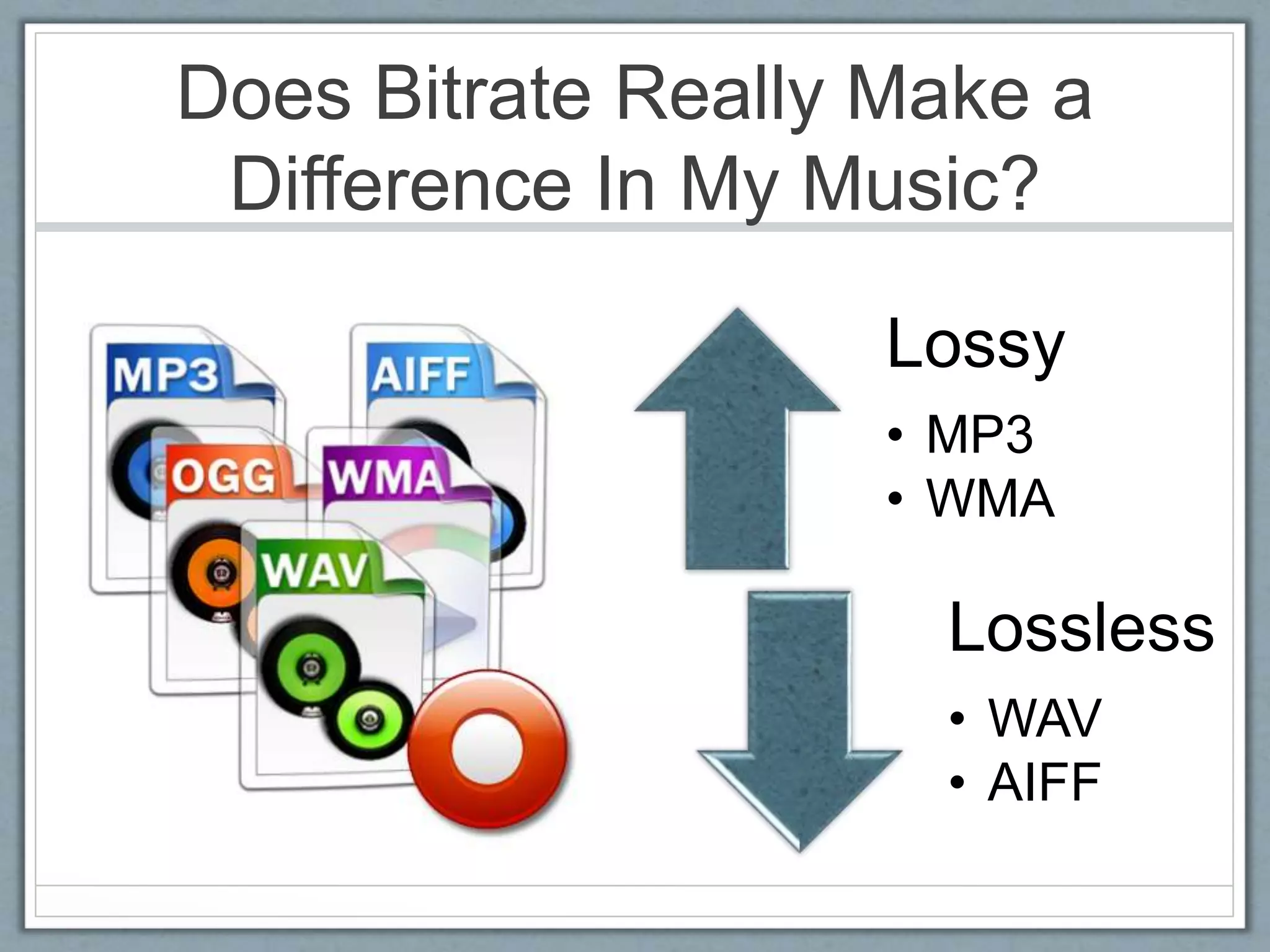
Does Bitrate Really Make a
Difference In My Music?
Lossy
• MP3
• WMA
Lossless
• WAV
• AIFF
Digital Audio Format:
Lossy Format
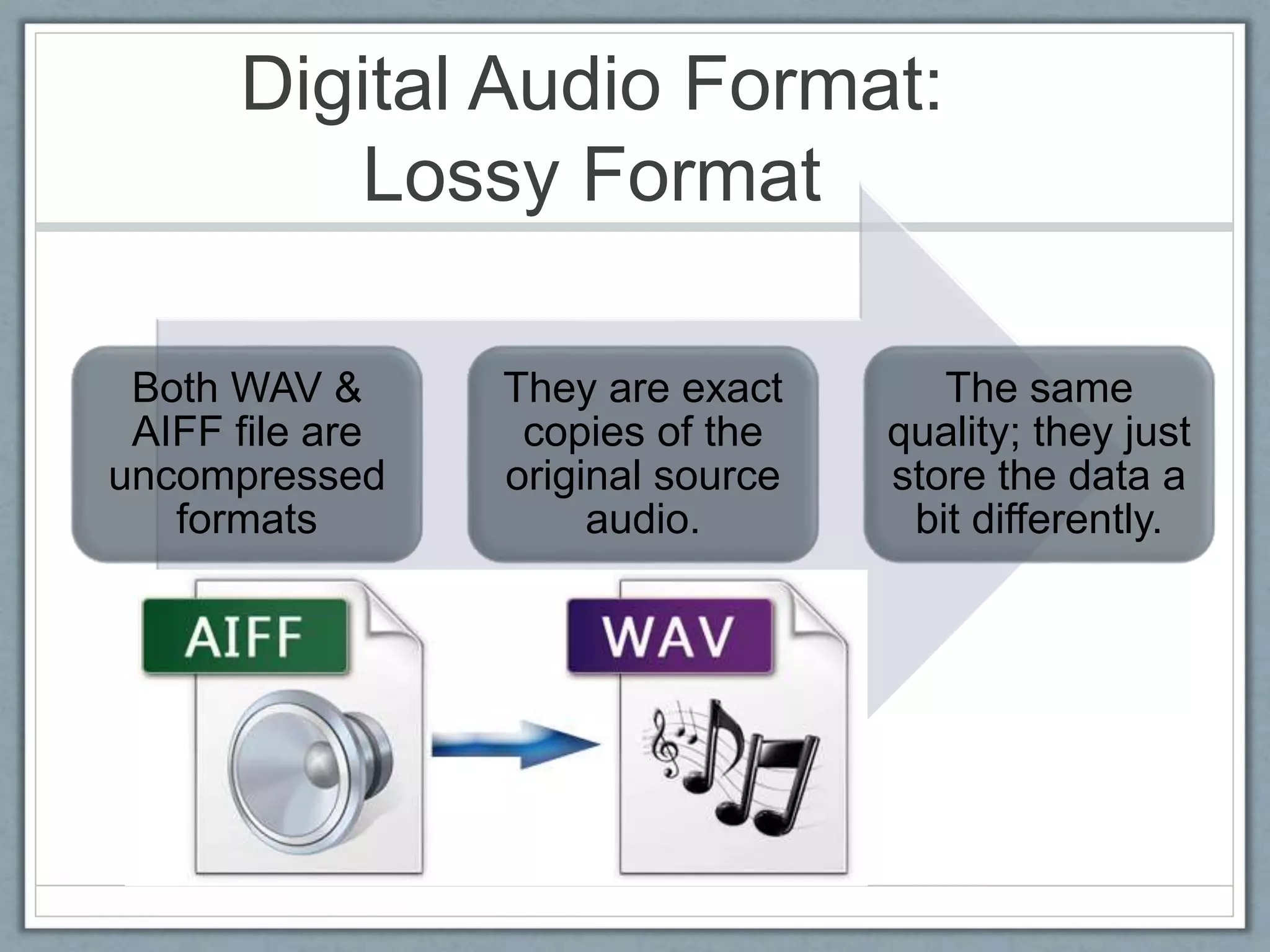
Both WAV &
AIFF file are
uncompressed
formats
They are exact
copies of the
original source
audio.
The same
quality; they just
store the data a
bit differently.
AIFF vs WAV
AIFF is made by
Apple, so you may
see it a bit more
often in Apple
products
WAV is pretty much
universal.
However, since they're uncompressed, they
take up a lot of unnecessary space. Unless
you're editing the audio, you don't need to store
the audio in these formats.
Digital Audio Format:
Lossless Format
MP3, FLAC, MWA
MPEG Audio Layer III, or MP3
for short, is the most common
lossy format around. So much
so that it's become
synonymous with downloaded
music.MP3 isn't the most efficient format of them
all, but its definitely the most well-
supported, making it our #1 choice for lossy
audio.
MP3, FLAC, MWA
FLAC is Free Lossless Audio
Codec with high audio quality and
smaller file size. Therefore, it is
quite popular with storing FLAC files
with less space and better quality
and many people have FLAC files.
The popularity of
Apple devices like
iTunes, iPhone,
iPod, Apple Watch
MP3, FLAC, MWA
Windows Media Audio (WMA)
is an audio data compression
technology developed by
Microsoft. The name can be
used to refer to its audio file
format orits audio codecs. It is a proprietary
technology that forms part of the Windows
Media framework.
Real Life Situation
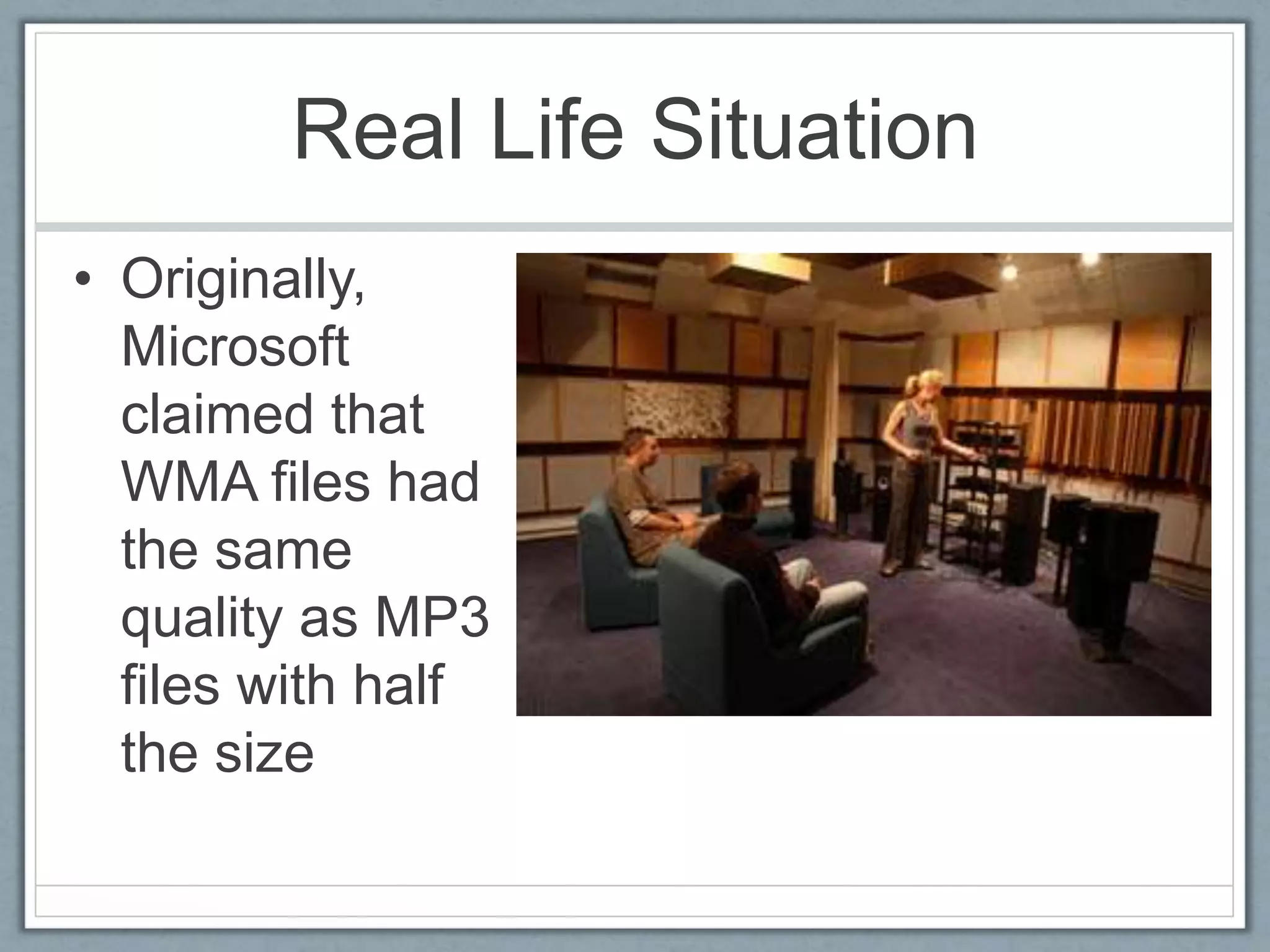
• Originally,
Microsoft
claimed that
WMA files had
the same
quality as MP3
files with half
the size
Real Life Situation
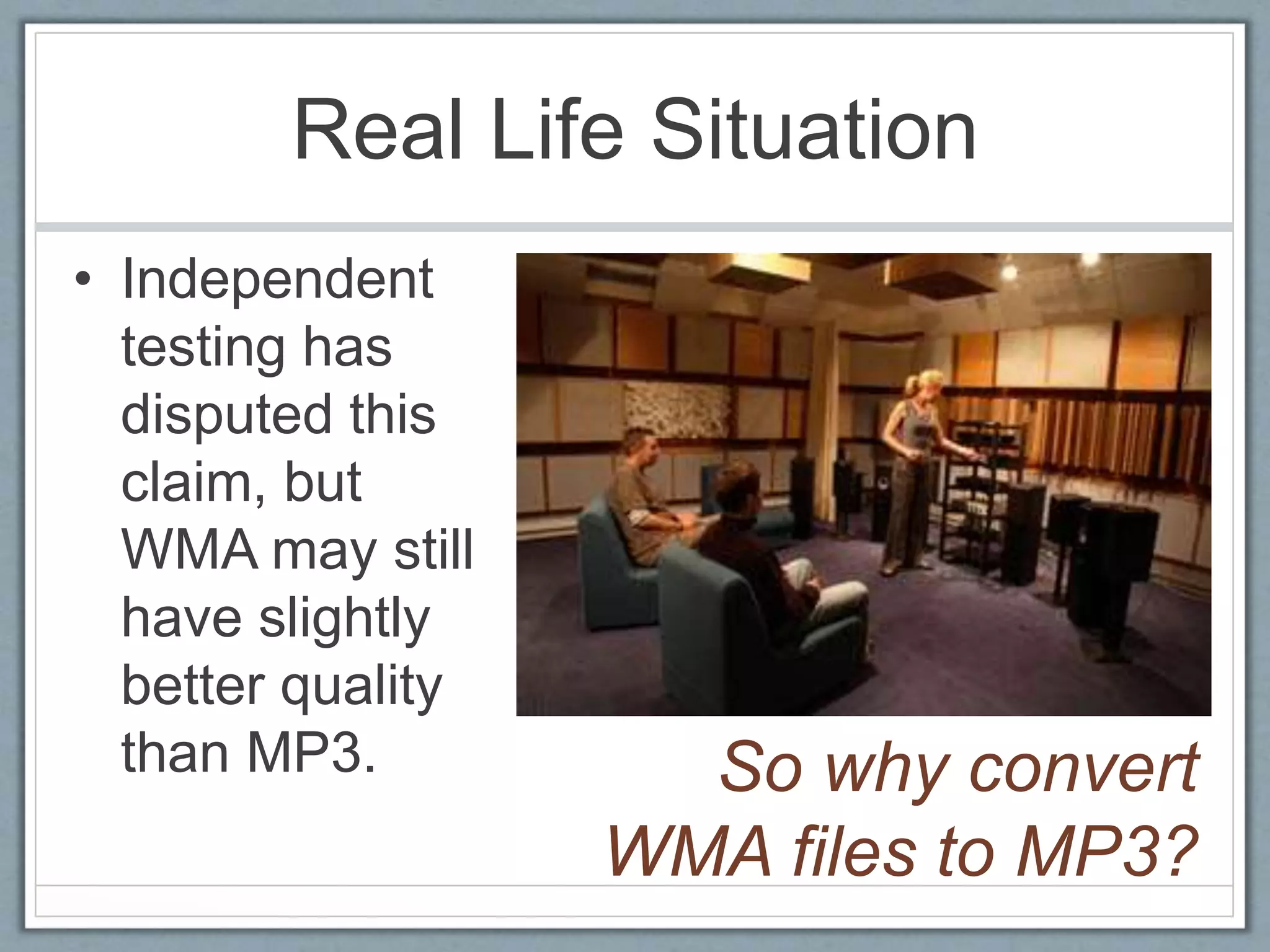
• Independent
testing has
disputed this
claim, but
WMA may still
have slightly
better quality
than MP3. So why convert
WMA files to MP3?
It is about compatibility
• The most important is compatibility.
• Even though WMA is popular in Windows
programs, there are still many multimedia
programs and MP3 players that are incompatible
with this format.
• MP3, on the other hand, is so ubiquitous that
almost any program or device will play it.
• Another reason to convert WMA to MP3 is if the
file will be used on Mac-based software.
• https://www.youtube.com/watch?v=sZ
BjWyyHoO0
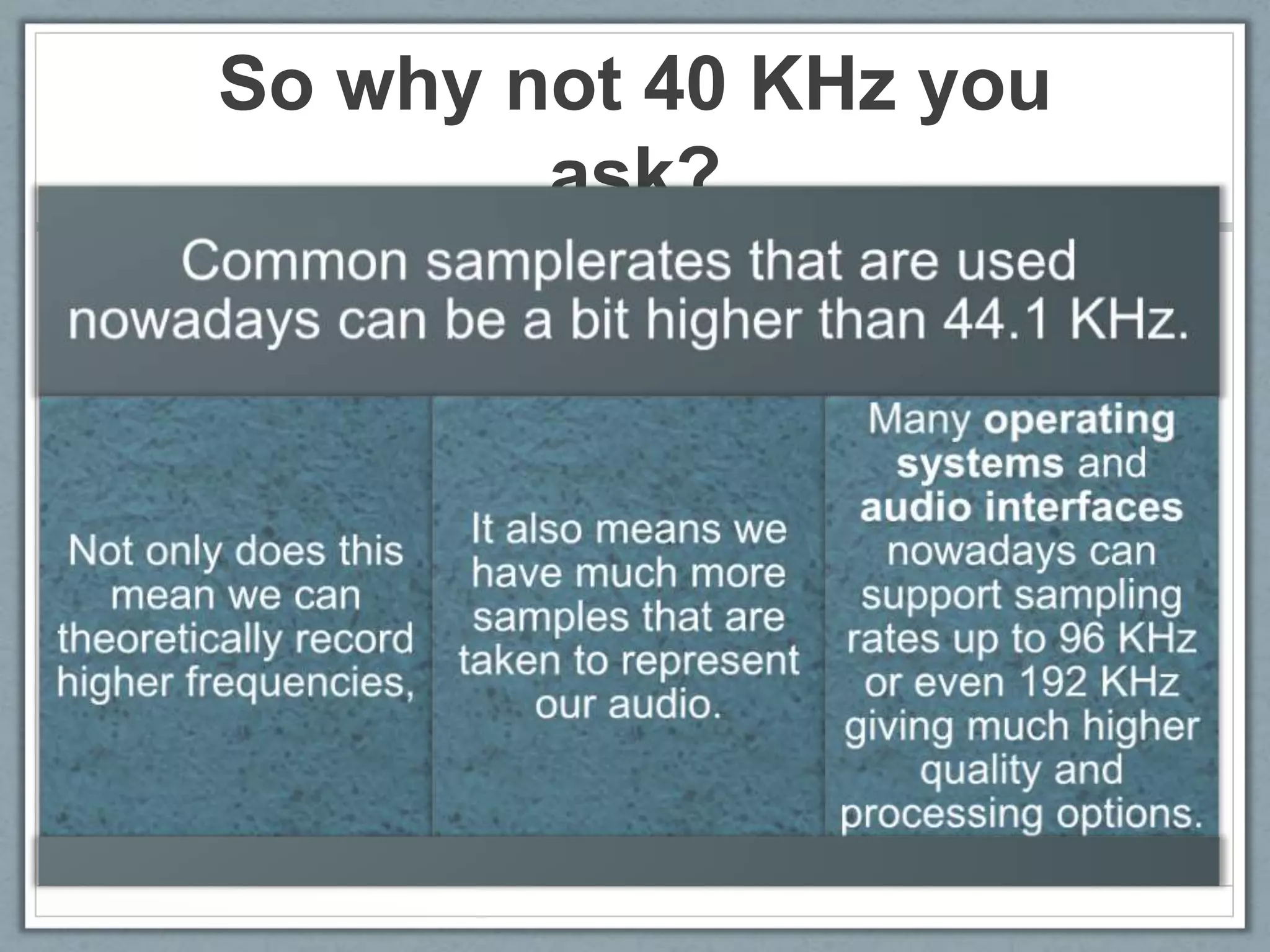
So why not 40 KHz you
ask?
Good Tips!
Working on higher sample-rates.
There’s a number of reasons why we could
chose to work with higher sample-rates and
bit-depths when recording and mixing.
• The first would be the better quality and
more dynamic range given at these higher
sample-rates and bit-depths. This is much
more pleasing to work with during mixing.
KHz for surround material.
Good Tips!
Working on higher sample-rates.
• Processing is much more accurate on higher
resolution material. Equalizing, reverbs, filters, etc.
• All sounds much better on higher sample-rate
material. This is the reason why many plugins use so
called ‘upsampling’ techniques to internally work at
higher samplerates when processing audio.
• When you’re producing sound for DVD’s, which can
handle samplerate’s up to 192 KHz on stereo
material, and 96
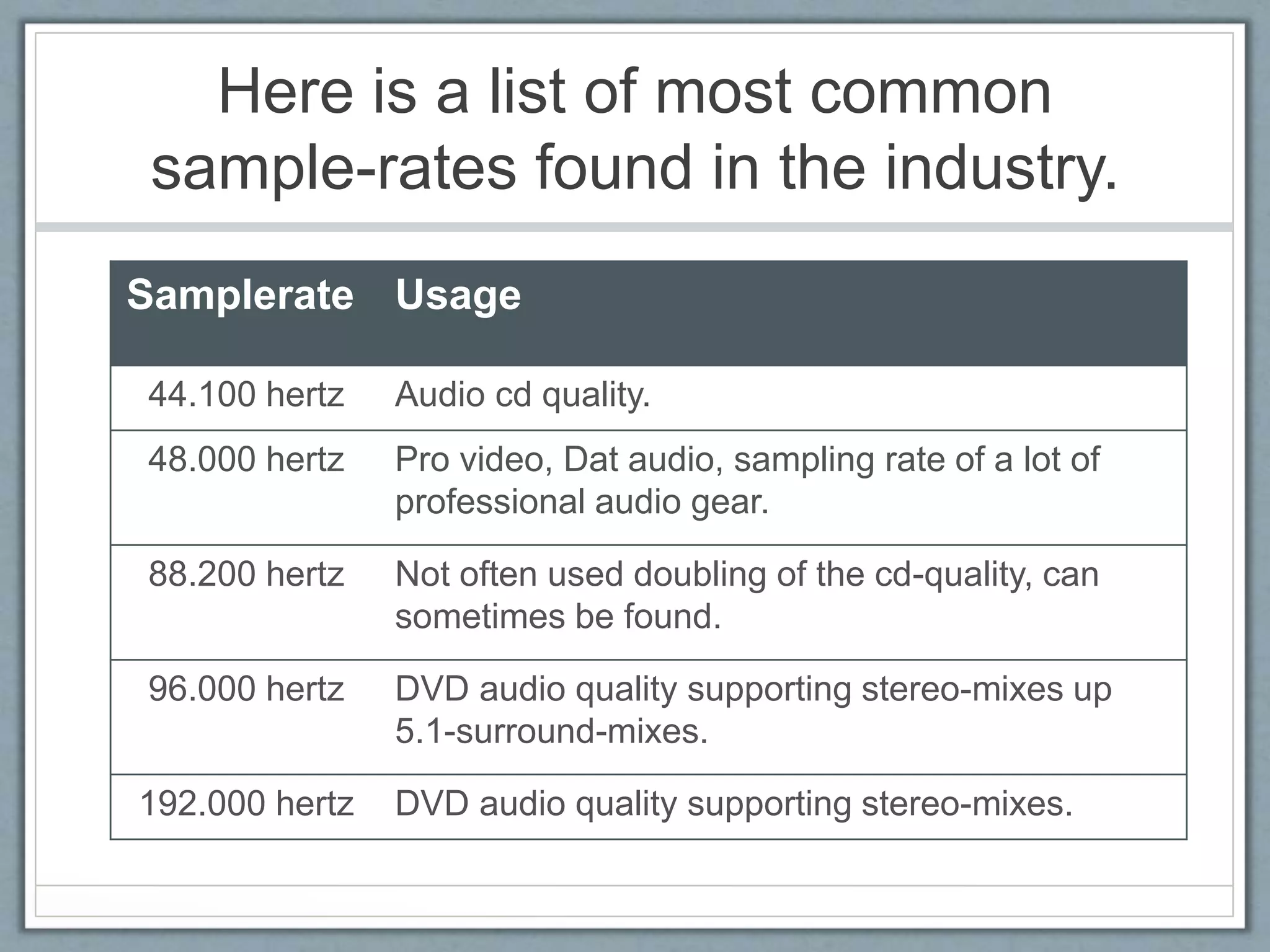
Here is a list of most common
sample-rates found in the industry.
Samplerate Usage
44.100 hertz Audio cd quality.
48.000 hertz Pro video, Dat audio, sampling rate of a lot of
professional audio gear.
88.200 hertz Not often used doubling of the cd-quality, can
sometimes be found.
96.000 hertz DVD audio quality supporting stereo-mixes up
5.1-surround-mixes.
192.000 hertz DVD audio quality supporting stereo-mixes.
References
McGuire, Sam, and Roy Pritts. Audio Sampling: A Practical Guide.
Burlington, MA: Focal Press, 2008.
Thompson, Daniel M. Understanding Audio: Getting the Most out of Your
Project or Professional Recording Studio. Boston: Berklee Press, 2005.
Winer, Ethan. The Audio Expert: Everything You Need to Know about
Audio. Waltham, MA: Focal Press, 2013.
Stanley, R Audio in Media 10th Edition. : Michael Rosenberg 2014
Audio Engineering Society (AES): www.aes.org
Audio Publishers Association (APA): www.audiopub.org
audio-tutorials/season-3-mixing/Episode-7-Digital-Audio-Sample-Rate-Bit-
Depth.html
References
http://audio-converter-software-review.toptenreviews.com/why-convert-
wma-to-mp3-.html
http://lifehacker.com/5927052/whats-the-difference-between-all-these-
audio-formats-and-which-one-should-i-use
http://www.digitalpreservation.gov/formats/fdd/fdd000027.shtml
http://whatis.techtarget.com/fileformat/WMA-Audio-file-in-Microsoft-
Windows-Media-format

Digital audio

  • 1.
    Digital Audio & TechnologyApplication Sampling Quantization Digital Recording Reproduction Process Disk Based Audio System By Azmawati Binti Mohd Lazim | azmawati@mmu.edu.my
  • 2.
    Learning Objective • LO1- To execute audio recording sessions in a proper studio environment. • LO2 - To operate the features found in a digital audio workstation and essentially use it as a tool for multimedia production.
  • 3.
    What is sampling? whichis taking 'samples' (or parts) of an existing music- piece and using that to create a new music production.
  • 5.
    Real life situation Ifwe sample a 20 KHz frequency with a samplerate of 20KHz, we only have one sample per cycle. To capture the +ve and -ve side of the cycle we will need to have a sampling rate that is double the frequency that we’re sampling. In other words : To capture a 20 KHz frequency, we’ll need to have a samplerate of at least 40KHz.
  • 6.
    Nyquist Theory • FS= 2 x FN • FS=Sampling frequency • FN=Nyquist frequency
  • 7.
    What is quantisation? Samplingis capturing an amplitude value in time. This value is captured in a process called quantisation
  • 8.
    • As wellas with the time axis, digital systems have a certain resolution on the amplitude axis • The higher this resolution is, the more accurate the digital representation of the waveform’s amplitudes.
  • 9.
    Reproduction Process The higherthe bit-depth, the more dynamic range can be captured. So a 24 bits system has a higher resolution than a 16 bits system.
  • 10.
    You can imaginethat mixing with audio that has a 24 bit resolution is much easier and pleasant to mix with since we literally have more values on the amplitude axis.
  • 11.
  • 12.
    Disk-based Audio System This sample-rate standarddates back to the days of videocasettes. Digital audio was stored in the scans of a videoframe and a samplerate of 44.1KHz could fit in both systems. It was mathematically compatible with both European PAL as the United States standard NTSC film systems.
  • 13.
    Does Bitrate ReallyMake a Difference In My Music? Lossy • MP3 • WMA Lossless • WAV • AIFF
  • 14.
    Digital Audio Format: LossyFormat Both WAV & AIFF file are uncompressed formats They are exact copies of the original source audio. The same quality; they just store the data a bit differently.
  • 15.
    AIFF vs WAV AIFFis made by Apple, so you may see it a bit more often in Apple products WAV is pretty much universal. However, since they're uncompressed, they take up a lot of unnecessary space. Unless you're editing the audio, you don't need to store the audio in these formats.
  • 16.
  • 17.
    MP3, FLAC, MWA MPEGAudio Layer III, or MP3 for short, is the most common lossy format around. So much so that it's become synonymous with downloaded music.MP3 isn't the most efficient format of them all, but its definitely the most well- supported, making it our #1 choice for lossy audio.
  • 18.
    MP3, FLAC, MWA FLACis Free Lossless Audio Codec with high audio quality and smaller file size. Therefore, it is quite popular with storing FLAC files with less space and better quality and many people have FLAC files. The popularity of Apple devices like iTunes, iPhone, iPod, Apple Watch
  • 19.
    MP3, FLAC, MWA WindowsMedia Audio (WMA) is an audio data compression technology developed by Microsoft. The name can be used to refer to its audio file format orits audio codecs. It is a proprietary technology that forms part of the Windows Media framework.
  • 20.
    Real Life Situation •Originally, Microsoft claimed that WMA files had the same quality as MP3 files with half the size
  • 21.
    Real Life Situation •Independent testing has disputed this claim, but WMA may still have slightly better quality than MP3. So why convert WMA files to MP3?
  • 22.
    It is aboutcompatibility • The most important is compatibility. • Even though WMA is popular in Windows programs, there are still many multimedia programs and MP3 players that are incompatible with this format. • MP3, on the other hand, is so ubiquitous that almost any program or device will play it. • Another reason to convert WMA to MP3 is if the file will be used on Mac-based software.
  • 23.
  • 24.
    So why not40 KHz you ask?
  • 25.
    Good Tips! Working onhigher sample-rates. There’s a number of reasons why we could chose to work with higher sample-rates and bit-depths when recording and mixing. • The first would be the better quality and more dynamic range given at these higher sample-rates and bit-depths. This is much more pleasing to work with during mixing. KHz for surround material.
  • 26.
    Good Tips! Working onhigher sample-rates. • Processing is much more accurate on higher resolution material. Equalizing, reverbs, filters, etc. • All sounds much better on higher sample-rate material. This is the reason why many plugins use so called ‘upsampling’ techniques to internally work at higher samplerates when processing audio. • When you’re producing sound for DVD’s, which can handle samplerate’s up to 192 KHz on stereo material, and 96
  • 27.
    Here is alist of most common sample-rates found in the industry. Samplerate Usage 44.100 hertz Audio cd quality. 48.000 hertz Pro video, Dat audio, sampling rate of a lot of professional audio gear. 88.200 hertz Not often used doubling of the cd-quality, can sometimes be found. 96.000 hertz DVD audio quality supporting stereo-mixes up 5.1-surround-mixes. 192.000 hertz DVD audio quality supporting stereo-mixes.
  • 28.
    References McGuire, Sam, andRoy Pritts. Audio Sampling: A Practical Guide. Burlington, MA: Focal Press, 2008. Thompson, Daniel M. Understanding Audio: Getting the Most out of Your Project or Professional Recording Studio. Boston: Berklee Press, 2005. Winer, Ethan. The Audio Expert: Everything You Need to Know about Audio. Waltham, MA: Focal Press, 2013. Stanley, R Audio in Media 10th Edition. : Michael Rosenberg 2014 Audio Engineering Society (AES): www.aes.org Audio Publishers Association (APA): www.audiopub.org audio-tutorials/season-3-mixing/Episode-7-Digital-Audio-Sample-Rate-Bit- Depth.html
  • 29.

Editor's Notes

  • #13 Digital audio was stored in the scans of a videoframe and a samplerate of 44.1KHz could fit in both systems. The 44.1 KHz samplerate with a 16 bit bit-dept was also adopted as the audio-quality for the standard audio-cd. So this samplerate has been relevant for years, and actually still is!