Digital Sound
What makes it digital?
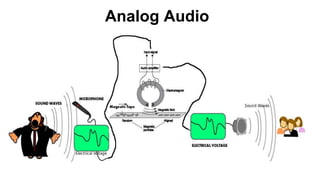
Analog Audio
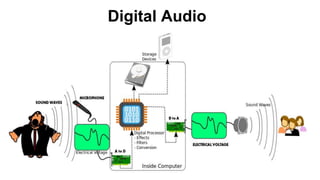
Digital Audio
Digital Recording
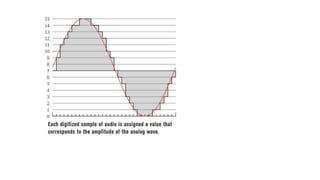
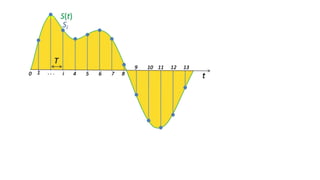
•sampling (1 piece @ a time)
•compression (etc.)
There are two concepts you need to wrap your head
around...
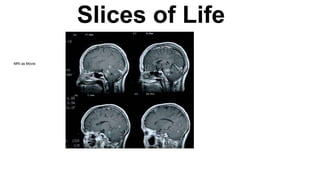
Slices of Life
MRI as Movie
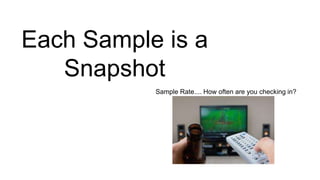
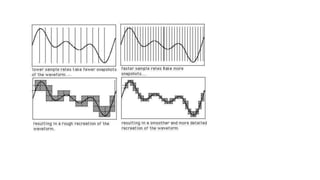
Each Sample is a
Snapshot
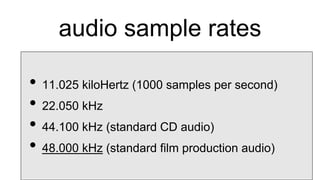
Sample Rate.... How often are you checking in?
audio sample rates
• 11.025 kiloHertz (1000 samples per second)
• 22.050 kHz
• 44.100 kHz (standard CD audio)
• 48.000 kHz (standard film production audio)
Compression
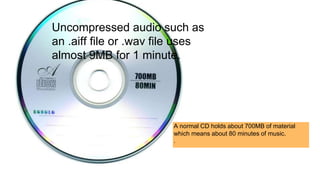
Uncompressed audio such as
an .aiff file or .wav file uses
almost 9MB for 1 minute.
A normal CD holds about 700MB of material
which means about 80 minutes of music.
.
**
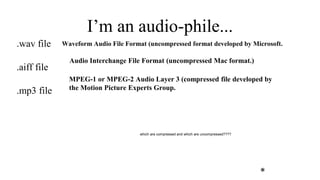
Waveform Audio File Format (uncompressed format developed by Microsoft.
Audio Interchange File Format (uncompressed Mac format.)
I’m an audio-phile...
.wav file
.aiff file
.mp3 file
MPEG-1 or MPEG-2 Audio Layer 3 (compressed file developed by
the Motion Picture Experts Group.
which are compressed and which are uncompressed????
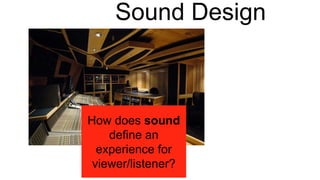
Sound Design
How does sound
define an
experience for
viewer/listener?
Examples
This American Life: “Something for Nothing”
http://www.thisamericanlife.org/radio-archives/episode/62/something-for-nothing
Radiolab: “Words”
http://www.radiolab.org/2010/aug/09/
African Perspectives
What Can Sound Design Do?
● Suggest a mood, evoke a feeling
● Set a pace
● Indicate a location
● Provide story information
● Heighten realism or diminish it
● Draw attention to a detail
● Smooth transitions between shots
or scenes (sound bridge)
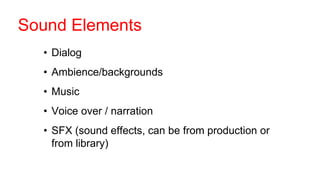
• Dialog
• Ambience/backgrounds
• Music
• Voice over / narration
• SFX (sound effects, can be from production or
from library)
Sound Elements
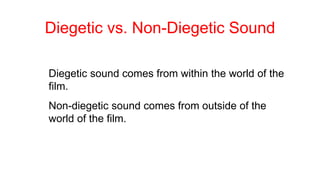
Diegetic vs. Non-Diegetic Sound
Diegetic sound comes from within the world of the
film.
Non-diegetic sound comes from outside of the
world of the film.
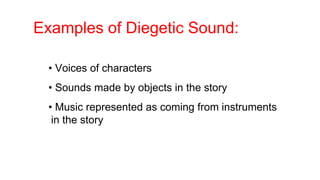
Examples of Diegetic Sound:
• Voices of characters
• Sounds made by objects in the story
• Music represented as coming from instruments
in the story
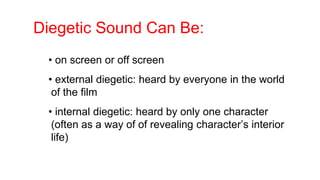
Diegetic Sound Can Be:
• on screen or off screen
• external diegetic: heard by everyone in the world
of the film
• internal diegetic: heard by only one character
(often as a way of of revealing character’s interior
life)
Non-Diegetic Sound
• Narrator’s commentary
• Sound effects created for dramatic impact
• Music that doesn’t come from inside the story (a
score that sets mood)
Speech Can Be:
• External dialogue
• Interior monologue (diegetic voiceover)
• Non-diegetic voiceover – the voice of a
storyteller from outside the world of the story
(more common in documentaries)
Music Can Be:
• Source music (diegetic)
• Score music (non-diegetic)
Noise Can Be:
• Ambience (room tone)
• Hard sound effects – footsteps, door slams
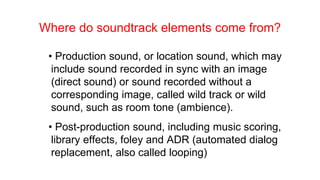
Where do soundtrack elements come from?
• Production sound, or location sound, which may
include sound recorded in sync with an image
(direct sound) or sound recorded without a
corresponding image, called wild track or wild
sound, such as room tone (ambience).
• Post-production sound, including music scoring,
library effects, foley and ADR (automated dialog
replacement, also called looping)
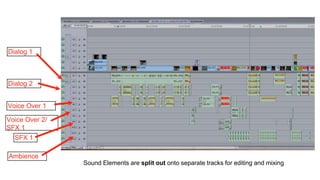
Dialog 1
Dialog 2
Voice Over 1
Voice Over 2/
SFX 1
SFX 1
Ambience
Sound Elements are split out onto separate tracks for editing and mixing
Interactive Feature from V&V website
http://cw.routledge.com/textbooks/97802408115812e/resources.asp
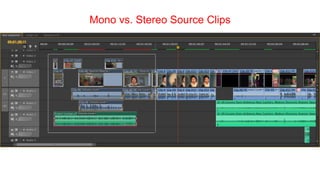
Mono vs. Stereo Source Clips
Steps in Sound Editing & Mixing
Edit Dialog - (show ron alford to re-emphasize how much you cut up
dialog)
Add music and effects
Fill in backgrounds - no sound “holes”
Set levels (https://library.creativecow.net/devis_andrew/audio-editing-basics/1)
Add transitions
Output - stereo, mono, surround
Where to get sound effects
• Production
• Sound Effects Libraries
Example: www.sounddogs.com
• Foley
https://www.youtube.com/watch?v=rpdNPsUnDqU
• ADR (Automatic Dialogue Replacement)
http://www.premiumbeat.com/blog/adr-automated-dialogue-replacement-tips-and-tricks/
(start at 5:48)
Common Music Pitfalls
1. Use music only where it is necessary. Avoid “wall-to-wall” music.
2. Don't try to evoke an emotion that isn’t already there. Support what is
in the dialogue or scene..
3. Too loud!
4. Lyrics tend to fight with dialogue for attention.

160 summer 15_sound_lecture

  • 1.
  • 2.
  • 3.
  • 4.
    Digital Recording •sampling (1piece @ a time) •compression (etc.) There are two concepts you need to wrap your head around...
  • 5.
  • 8.
    Each Sample isa Snapshot Sample Rate.... How often are you checking in?
  • 10.
    audio sample rates •11.025 kiloHertz (1000 samples per second) • 22.050 kHz • 44.100 kHz (standard CD audio) • 48.000 kHz (standard film production audio)
  • 11.
  • 12.
    Uncompressed audio suchas an .aiff file or .wav file uses almost 9MB for 1 minute. A normal CD holds about 700MB of material which means about 80 minutes of music. .
  • 13.
    ** Waveform Audio FileFormat (uncompressed format developed by Microsoft. Audio Interchange File Format (uncompressed Mac format.) I’m an audio-phile... .wav file .aiff file .mp3 file MPEG-1 or MPEG-2 Audio Layer 3 (compressed file developed by the Motion Picture Experts Group. which are compressed and which are uncompressed????
  • 14.
    Sound Design How doessound define an experience for viewer/listener?
  • 15.
    Examples This American Life:“Something for Nothing” http://www.thisamericanlife.org/radio-archives/episode/62/something-for-nothing Radiolab: “Words” http://www.radiolab.org/2010/aug/09/ African Perspectives
  • 16.
    What Can SoundDesign Do? ● Suggest a mood, evoke a feeling ● Set a pace ● Indicate a location ● Provide story information ● Heighten realism or diminish it ● Draw attention to a detail ● Smooth transitions between shots or scenes (sound bridge)
  • 17.
    • Dialog • Ambience/backgrounds •Music • Voice over / narration • SFX (sound effects, can be from production or from library) Sound Elements
  • 18.
    Diegetic vs. Non-DiegeticSound Diegetic sound comes from within the world of the film. Non-diegetic sound comes from outside of the world of the film.
  • 19.
    Examples of DiegeticSound: • Voices of characters • Sounds made by objects in the story • Music represented as coming from instruments in the story
  • 20.
    Diegetic Sound CanBe: • on screen or off screen • external diegetic: heard by everyone in the world of the film • internal diegetic: heard by only one character (often as a way of of revealing character’s interior life)
  • 21.
    Non-Diegetic Sound • Narrator’scommentary • Sound effects created for dramatic impact • Music that doesn’t come from inside the story (a score that sets mood)
  • 22.
    Speech Can Be: •External dialogue • Interior monologue (diegetic voiceover) • Non-diegetic voiceover – the voice of a storyteller from outside the world of the story (more common in documentaries)
  • 23.
    Music Can Be: •Source music (diegetic) • Score music (non-diegetic)
  • 24.
    Noise Can Be: •Ambience (room tone) • Hard sound effects – footsteps, door slams
  • 25.
    Where do soundtrackelements come from? • Production sound, or location sound, which may include sound recorded in sync with an image (direct sound) or sound recorded without a corresponding image, called wild track or wild sound, such as room tone (ambience). • Post-production sound, including music scoring, library effects, foley and ADR (automated dialog replacement, also called looping)
  • 26.
    Dialog 1 Dialog 2 VoiceOver 1 Voice Over 2/ SFX 1 SFX 1 Ambience Sound Elements are split out onto separate tracks for editing and mixing
  • 27.
    Interactive Feature fromV&V website http://cw.routledge.com/textbooks/97802408115812e/resources.asp
  • 28.
    Mono vs. StereoSource Clips
  • 29.
    Steps in SoundEditing & Mixing Edit Dialog - (show ron alford to re-emphasize how much you cut up dialog) Add music and effects Fill in backgrounds - no sound “holes” Set levels (https://library.creativecow.net/devis_andrew/audio-editing-basics/1) Add transitions Output - stereo, mono, surround
  • 30.
    Where to getsound effects • Production • Sound Effects Libraries Example: www.sounddogs.com • Foley https://www.youtube.com/watch?v=rpdNPsUnDqU • ADR (Automatic Dialogue Replacement) http://www.premiumbeat.com/blog/adr-automated-dialogue-replacement-tips-and-tricks/ (start at 5:48)
  • 31.
    Common Music Pitfalls 1.Use music only where it is necessary. Avoid “wall-to-wall” music. 2. Don't try to evoke an emotion that isn’t already there. Support what is in the dialogue or scene.. 3. Too loud! 4. Lyrics tend to fight with dialogue for attention.