DIGITAL AUDIO
MEDIA
By
John Amels, Camille Bauer-Lostaunau, Monica Suresh,
and Pawan Varyani
SAMPLING
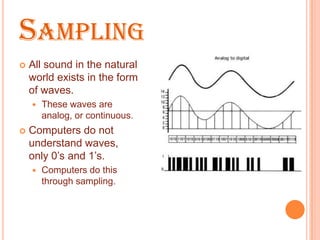
   All sound in the natural
    world exists in the form
    of waves.
       These waves are
        analog, or continuous.
   Computers do not
    understand waves,
    only 0’s and 1’s.
       Computers do this
        through sampling.
SAMPLING CONT.
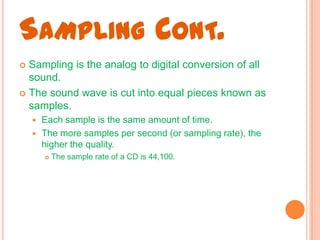
 Sampling is the analog to digital conversion of all
  sound.
 The sound wave is cut into equal pieces known as
  samples.
     Each sample is the same amount of time.
     The more samples per second (or sampling rate), the
      higher the quality.
           The sample rate of a CD is 44,100.
DIGITAL AUDIO PRODUCTION
 Digital Audio Production is the process in which the
  sounds from analog instruments gets recorded and
  mixed into the music we listen to.
 While this was originally done all through analog
  recording methods such as steel wire, tape, and
  vinyl records, computers do most of the work today.
DIGITAL AUDIO PRODUCTION
CONT.
   Professional audio engineers use many different
    types of technology.
     One of the most basic forms of audio production is a
      voice recorder.
     More advanced technologies include mixing boards and
      Digital Audio Workstations.
   A powerful tool that these engineers use is called a
    Musical Instrument Digital Interface (MIDI).
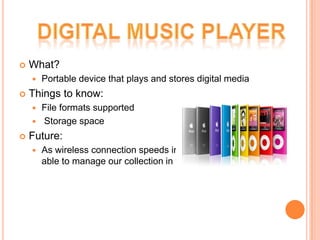
   What?
       Portable device that plays and stores digital media
   Things to know:
     File formats supported
     Storage space

   Future:
       As wireless connection speeds increase, soon we’ll be
        able to manage our collection in the clouds!
   What?
       An audio file that contains a broadcast
   Facts:
      Podcasting allows people to broadcast their message
      to the world
     Available online, example: The Apple Store
     Distributed using RSS technology
     Allows for convenience
DIGITAL AUDIO FORMATS
   Why It Matters?
       If the user understands differences between file formats,
        the users can properly pair digital music services with
        the players, helps consumers get best quality

    Facts:
    Native formats often require lots of bandwidth transmit and
    lots of computer storage, so digital audio compression was
    developed.
    Mp3 is the most recognized digital audio compression
    format.
NON-COMPRESSED FORMAT
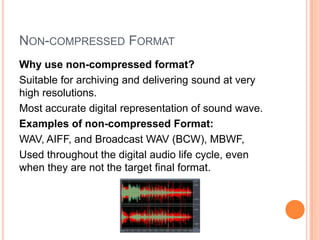
Why use non-compressed format?
Suitable for archiving and delivering sound at very
high resolutions.
Most accurate digital representation of sound wave.
Examples of non-compressed Format:
WAV, AIFF, and Broadcast WAV (BCW), MBWF,
Used throughout the digital audio life cycle, even
when they are not the target final format.
COMPRESSED FORMAT
Why compress?
 To reduce file size  files will download faster, files
will stream over the Internet, more audio may be
stored in a given format
Varies in size and quality depending on:
Sample Rate, Bit depth, Number of channels, Choice
of Audio compression codec, and audio compression
codec settings
Examples of Compressed Formats:
        i.e. Real audio, MP3, Dolby AC3 (DVD Video)
What is it?
Digital Music Software is used to obtain, manage, and
listen to digital music, and to encode music to various
audio formats.
(Definition from Emerge)

              What can you do with it?
               Organize/play digital music, audio,
                and video files
               Sort and arrange them by artist,
                genre, song title, etc.
               Allows users to create a custom
                playlists that can be transferred to
                a CD, iPod, or any other portable
                device
               Many popular media players (i.e.
                iTunes) will provide a music
                download service that users can add
                to their music collections. (Emerge)
Continued…

With media software, you can sync music
with a portable digital music player
through the USB port.

You can either:
 Sync it manually
 Set it for automatic, so the next time you plug
  your device in, it syncs.


  (Emerge)
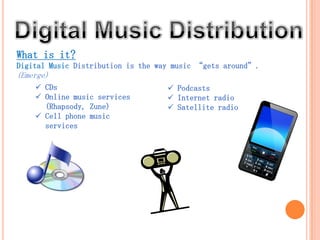
What is it?
Digital Music Distribution is the way music “gets around”.
(Emerge)
     CDs                              Podcasts
     Online music services            Internet radio
      (Rhapsody, Zune)                 Satellite radio
     Cell phone music                 HD radio
      services
Continued…

Subscription:
 Satellite Radio: listener can listen to any to
  the same channels from any location in range
 Napster and Rhapsody charge a monthly fee to
  provide access to free access to millions of
  songs/albums (emerge)

Download:
 iTunes/Amazon: download $0.99/song without
  subscription to site
 Internet radio: similar to FM/AM radio except
  its digitally delivered to your computer online
  and more choices
 Wi-Fi radios: connect to internet using radio
   (emerge)
SUGGESTED CHANGES TO IT 101
 Too many items of homework due on
  the same day
 Homework's due at different times of
  the day, example: 12am, as oppose to
  during class, or before class
CITATIONS
 http://www.planetoftunes.com/digiaudio/daudiofiles.
  html
 http://www.jiscdigitalmedia.ac.uk/audio/advice/unco
  mpressed-audio-file-formats
 http://www.webopedia.com/DidYouKnow/Computer
  _Science/2005/digital_audio_formats.asp
 Emerge

Digital audio formats

  • 1.
    DIGITAL AUDIO MEDIA By John Amels,Camille Bauer-Lostaunau, Monica Suresh, and Pawan Varyani
  • 2.
    SAMPLING  All sound in the natural world exists in the form of waves.  These waves are analog, or continuous.  Computers do not understand waves, only 0’s and 1’s.  Computers do this through sampling.
  • 3.
    SAMPLING CONT.  Samplingis the analog to digital conversion of all sound.  The sound wave is cut into equal pieces known as samples.  Each sample is the same amount of time.  The more samples per second (or sampling rate), the higher the quality.  The sample rate of a CD is 44,100.
  • 4.
    DIGITAL AUDIO PRODUCTION Digital Audio Production is the process in which the sounds from analog instruments gets recorded and mixed into the music we listen to.  While this was originally done all through analog recording methods such as steel wire, tape, and vinyl records, computers do most of the work today.
  • 5.
    DIGITAL AUDIO PRODUCTION CONT.  Professional audio engineers use many different types of technology.  One of the most basic forms of audio production is a voice recorder.  More advanced technologies include mixing boards and Digital Audio Workstations.  A powerful tool that these engineers use is called a Musical Instrument Digital Interface (MIDI).
  • 6.
    What?  Portable device that plays and stores digital media  Things to know:  File formats supported  Storage space  Future:  As wireless connection speeds increase, soon we’ll be able to manage our collection in the clouds!
  • 7.
    What?  An audio file that contains a broadcast  Facts:  Podcasting allows people to broadcast their message to the world  Available online, example: The Apple Store  Distributed using RSS technology  Allows for convenience
  • 8.
    DIGITAL AUDIO FORMATS  Why It Matters?  If the user understands differences between file formats, the users can properly pair digital music services with the players, helps consumers get best quality Facts: Native formats often require lots of bandwidth transmit and lots of computer storage, so digital audio compression was developed. Mp3 is the most recognized digital audio compression format.
  • 9.
    NON-COMPRESSED FORMAT Why usenon-compressed format? Suitable for archiving and delivering sound at very high resolutions. Most accurate digital representation of sound wave. Examples of non-compressed Format: WAV, AIFF, and Broadcast WAV (BCW), MBWF, Used throughout the digital audio life cycle, even when they are not the target final format.
  • 10.
    COMPRESSED FORMAT Why compress? To reduce file size  files will download faster, files will stream over the Internet, more audio may be stored in a given format Varies in size and quality depending on: Sample Rate, Bit depth, Number of channels, Choice of Audio compression codec, and audio compression codec settings Examples of Compressed Formats: i.e. Real audio, MP3, Dolby AC3 (DVD Video)
  • 11.
    What is it? DigitalMusic Software is used to obtain, manage, and listen to digital music, and to encode music to various audio formats. (Definition from Emerge) What can you do with it?  Organize/play digital music, audio, and video files  Sort and arrange them by artist, genre, song title, etc.  Allows users to create a custom playlists that can be transferred to a CD, iPod, or any other portable device  Many popular media players (i.e. iTunes) will provide a music download service that users can add to their music collections. (Emerge)
  • 12.
    Continued… With media software,you can sync music with a portable digital music player through the USB port. You can either:  Sync it manually  Set it for automatic, so the next time you plug your device in, it syncs. (Emerge)
  • 13.
    What is it? DigitalMusic Distribution is the way music “gets around”. (Emerge)  CDs  Podcasts  Online music services  Internet radio (Rhapsody, Zune)  Satellite radio  Cell phone music  HD radio services
  • 14.
    Continued… Subscription:  Satellite Radio:listener can listen to any to the same channels from any location in range  Napster and Rhapsody charge a monthly fee to provide access to free access to millions of songs/albums (emerge) Download:  iTunes/Amazon: download $0.99/song without subscription to site  Internet radio: similar to FM/AM radio except its digitally delivered to your computer online and more choices  Wi-Fi radios: connect to internet using radio (emerge)
  • 15.
    SUGGESTED CHANGES TOIT 101  Too many items of homework due on the same day  Homework's due at different times of the day, example: 12am, as oppose to during class, or before class
  • 16.
    CITATIONS  http://www.planetoftunes.com/digiaudio/daudiofiles. html  http://www.jiscdigitalmedia.ac.uk/audio/advice/unco mpressed-audio-file-formats  http://www.webopedia.com/DidYouKnow/Computer _Science/2005/digital_audio_formats.asp  Emerge