Computers in
our everyday lives
By Keitumetse Mohale
1
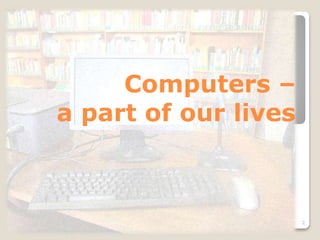
Computers –
a part of our lives
2
Content (1)
 Why we use computers
◦ Efficiency, accuracy and reliability
◦ Communication
 Types of computer systems
◦ Non-portable computers
◦ Portable computers
◦ Mobile computing devices
3
Content (2)
 Categories of users
◦ Casual
◦ SOHO
◦ Power
◦ Mobile
 Convergence
 Test and improve your knowledge
◦ Summary of module
◦ Written module activity
4
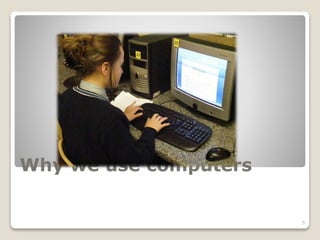
Why we use computers
5
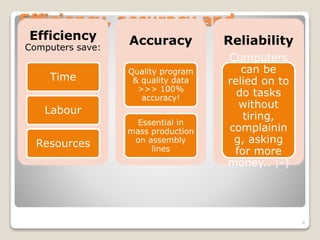
Efficiency, accuracy and
reliabilityEfficiency
Computers save:
Time
Labour
Resources
Accuracy
Quality program
& quality data
>>> 100%
accuracy!
Essential in
mass production
on assembly
lines
Reliability
Computers
can be
relied on to
do tasks
without
tiring,
complainin
g, asking
for more
money.. ;-)
6
Communication
 The efficiency, accuracy and reliability of
computers combined with the ability to
communicate, enable us to
◦ eliminate time and distance as constraints
◦ communicate and share information globally
◦ save on communication costs
◦ interact socially on a bigger scale
7
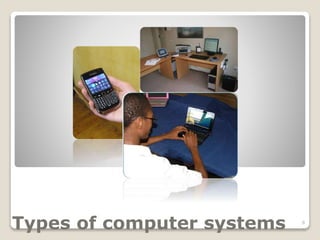
Types of computer systems 8
When comparing computers you should
look at:
 Power – the specs
 Purpose – e.g. servers
 Size – power, purpose vs. portability
 Software – operating systems or ‘platforms’
9
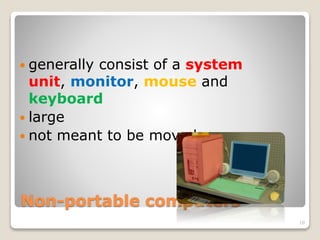
Non-portable computers
 generally consist of a system
unit, monitor, mouse and
keyboard
 large
 not meant to be moved
10
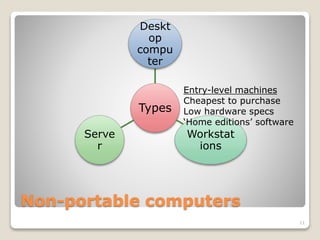
Non-portable computers
Types
Deskt
op
compu
ter
Workstat
ions
Serve
r
11
Entry-level machines
Cheapest to purchase
Low hardware specs
‘Home editions’ software
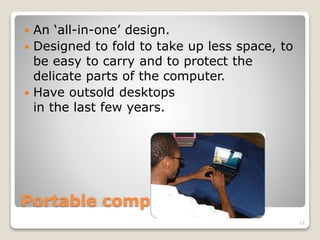
Portable computers
 An ‘all-in-one’ design.
 Designed to fold to take up less space, to
be easy to carry and to protect the
delicate parts of the computer.
 Have outsold desktops
in the last few years.
12
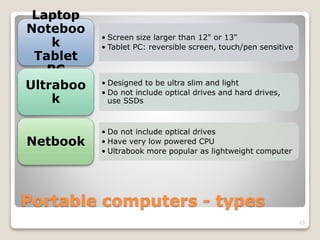
Portable computers - types
• Screen size larger than 12" or 13"
• Tablet PC: reversible screen, touch/pen sensitive
Laptop
Noteboo
k
Tablet
PC
• Designed to be ultra slim and light
• Do not include optical drives and hard drives,
use SSDs
Ultraboo
k
• Do not include optical drives
• Have very low powered CPU
• Ultrabook more popular as lightweight computer
Netbook
13
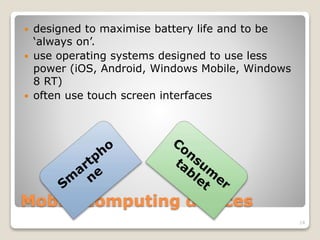
Mobile computing devices
 designed to maximise battery life and to be
‘always on’.
 use operating systems designed to use less
power (iOS, Android, Windows Mobile, Windows
8 RT)
 often use touch screen interfaces
14
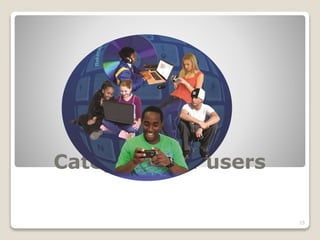
Categories of users
15
Casual or personal user
 limited office tasks
 Internet banking
 e-mail and browsing the Web
 social networking
 Skyping
 viewing and sharing photos
 entertainment: casual gaming,
playing music and watching movies.
16
SOHO (Small Office Home Office)
user
 Category dependent on type of business
 Needs entry-level desktops for admin:
◦ accounting or billing
◦ databases with clients, suppliers, stock,
etc.
◦ electronic document archiving
◦ planning and scheduling, etc.
 Might also need other computer
depending on type of business
17
Power users
18
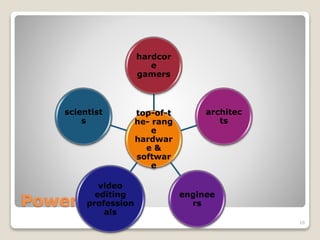
top-of-t
he- rang
e
hardwar
e &
softwar
e
hardcor
e
gamers
architec
ts
enginee
rs
video
editing
profession
als
scientist
s
Mobile users
 Not necessarily a separate category.
Every category of user also use mobile
technology.
 Smartphones or tablets for tasks such
as
◦ browsing and e-mail
◦ playing games
◦ reading books
◦ navigating with GPS
◦ taking quick notes
◦ taking photos and video and
recording sound.
19
Convergence
20
Convergence
the trend where
• separate technologies and functions that
required different devices in the past are
combined into one single device
21
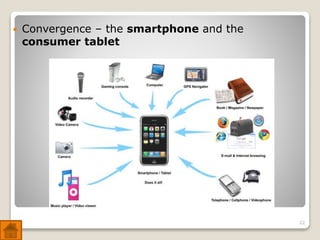
 Convergence – the smartphone and the
consumer tablet
22
Test and improve your
knowledge 23
Summary of module
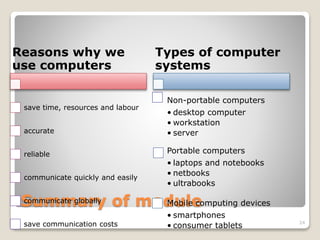
Reasons why we
use computers
save time, resources and labour
accurate
reliable
communicate quickly and easily
communicate globally
save communication costs
Types of computer
systems
Non-portable computers
• desktop computer
• workstation
• server
Portable computers
• laptops and notebooks
• netbooks
• ultrabooks
Mobile computing devices
• smartphones
• consumer tablets 24
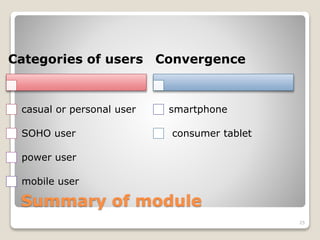
Summary of module
Categories of users
casual or personal user
SOHO user
power user
mobile user
Convergence
smartphone
consumer tablet
25
Written module activity
26

computers in our everyday lives

  • 1.
    Computers in our everydaylives By Keitumetse Mohale 1
  • 2.
    Computers – a partof our lives 2
  • 3.
    Content (1)  Whywe use computers ◦ Efficiency, accuracy and reliability ◦ Communication  Types of computer systems ◦ Non-portable computers ◦ Portable computers ◦ Mobile computing devices 3
  • 4.
    Content (2)  Categoriesof users ◦ Casual ◦ SOHO ◦ Power ◦ Mobile  Convergence  Test and improve your knowledge ◦ Summary of module ◦ Written module activity 4
  • 5.
    Why we usecomputers 5
  • 6.
    Efficiency, accuracy and reliabilityEfficiency Computerssave: Time Labour Resources Accuracy Quality program & quality data >>> 100% accuracy! Essential in mass production on assembly lines Reliability Computers can be relied on to do tasks without tiring, complainin g, asking for more money.. ;-) 6
  • 7.
    Communication  The efficiency,accuracy and reliability of computers combined with the ability to communicate, enable us to ◦ eliminate time and distance as constraints ◦ communicate and share information globally ◦ save on communication costs ◦ interact socially on a bigger scale 7
  • 8.
  • 9.
    When comparing computersyou should look at:  Power – the specs  Purpose – e.g. servers  Size – power, purpose vs. portability  Software – operating systems or ‘platforms’ 9
  • 10.
    Non-portable computers  generallyconsist of a system unit, monitor, mouse and keyboard  large  not meant to be moved 10
  • 11.
  • 12.
    Portable computers  An‘all-in-one’ design.  Designed to fold to take up less space, to be easy to carry and to protect the delicate parts of the computer.  Have outsold desktops in the last few years. 12
  • 13.
    Portable computers -types • Screen size larger than 12" or 13" • Tablet PC: reversible screen, touch/pen sensitive Laptop Noteboo k Tablet PC • Designed to be ultra slim and light • Do not include optical drives and hard drives, use SSDs Ultraboo k • Do not include optical drives • Have very low powered CPU • Ultrabook more popular as lightweight computer Netbook 13
  • 14.
    Mobile computing devices designed to maximise battery life and to be ‘always on’.  use operating systems designed to use less power (iOS, Android, Windows Mobile, Windows 8 RT)  often use touch screen interfaces 14
  • 15.
  • 16.
    Casual or personaluser  limited office tasks  Internet banking  e-mail and browsing the Web  social networking  Skyping  viewing and sharing photos  entertainment: casual gaming, playing music and watching movies. 16
  • 17.
    SOHO (Small OfficeHome Office) user  Category dependent on type of business  Needs entry-level desktops for admin: ◦ accounting or billing ◦ databases with clients, suppliers, stock, etc. ◦ electronic document archiving ◦ planning and scheduling, etc.  Might also need other computer depending on type of business 17
  • 18.
    Power users 18 top-of-t he- rang e hardwar e& softwar e hardcor e gamers architec ts enginee rs video editing profession als scientist s
  • 19.
    Mobile users  Notnecessarily a separate category. Every category of user also use mobile technology.  Smartphones or tablets for tasks such as ◦ browsing and e-mail ◦ playing games ◦ reading books ◦ navigating with GPS ◦ taking quick notes ◦ taking photos and video and recording sound. 19
  • 20.
  • 21.
    Convergence the trend where •separate technologies and functions that required different devices in the past are combined into one single device 21
  • 22.
     Convergence –the smartphone and the consumer tablet 22
  • 23.
    Test and improveyour knowledge 23
  • 24.
    Summary of module Reasonswhy we use computers save time, resources and labour accurate reliable communicate quickly and easily communicate globally save communication costs Types of computer systems Non-portable computers • desktop computer • workstation • server Portable computers • laptops and notebooks • netbooks • ultrabooks Mobile computing devices • smartphones • consumer tablets 24
  • 25.
    Summary of module Categoriesof users casual or personal user SOHO user power user mobile user Convergence smartphone consumer tablet 25
  • 26.