What food
have you
eaten
today?
any substance consumed to provide
nutritional support for an organism.
PHOTOSYNTHESIS
ANIMALS/ HUMANS GET
THEIR FOOD BY:
EATING PLANTS, PLANT PRODUCTS, OR OTHER
ANIMALS
How long does it take for the
body to process food?
?
?
Interpret :
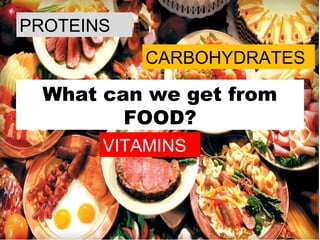
What can we get from
FOOD?
PROTEINS
CARBOHYDRATES
VITAMINS
Nutrition
Process of nourishing the
nutrients.
BUILDINGBLOCKSOFBODY
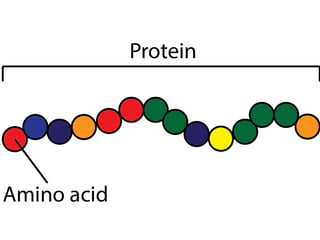
1. The building blocks of proteins:
1. Simple sugars
2. Lipids
3. Amino acids
4. Depends on the
protein
2. Humans obtain energy from:
1. Carbohydrates
2. Vitamins
3. Minerals
4. Antioxidants
5. All of these
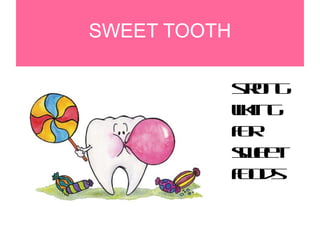
SWEET TOOTH
strong
liking
for
sweet
foods
CARBOHYDRATES
SIMPLE
CARBS
COMPLEX
CARBS
1. SIMPLE CARBS (SUGAR)
Monosaccharides;
A. Glucose
B.
Fructose
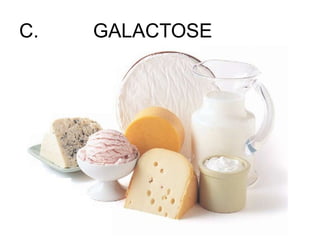
C. GALACTOSE
FRUCTOSE, GLUCOSE AND
GALACTOSE
MONOSACCHARIDES
SIMPLE CARBS
SIMPLE CARBS FOOD TO
AVIOD
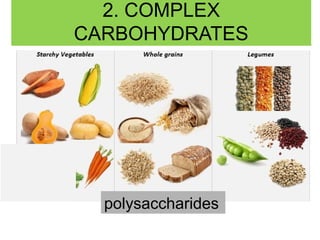
2. COMPLEX
CARBOHYDRATES
polysaccharides
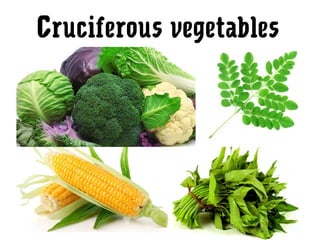
Cruciferous vegetables
COMPLEX CARBS
POLYSACCHARIDES
What food
have you
eaten
today?
“THE MOST IMPORTANT MEAL OF THE DAY”
My
Breakfast
Good
Carbs
(CHECK IF
YES)
Bad Carbs
(CHECK IF
YES)
Vitamins
3. Mom says carrots make you see better.
Any reason why this might be true?
A. No, but they do
contain antioxidants.
B. Yes. Beta carotenes
in carrots are
converted to Vitamin
A.
C. No, it’s just an old
folk belief.
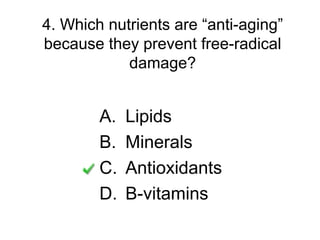
4. Which nutrients are “anti-aging”
because they prevent free-radical
damage?
A. Lipids
B. Minerals
C. Antioxidants
D. B-vitamins
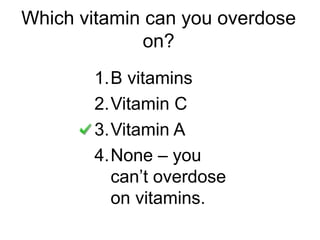
Which vitamin can you overdose
on?
1.B vitamins
2.Vitamin C
3.Vitamin A
4.None – you
can’t overdose
on vitamins.
What are Water-Soluble
Vitamins?
QUIZ
1. Any substance
consumed to provide
nutritional support for
an organism.
QUIZ
2. Process when chlorophyll
traps the solar energy
and converts it to
chemical energy and
prepares its own food.
QUIZ
2. Process of
nourishing the
nutrients.
QUIZ
3. Process of nourishing
the nutrients.
QUIZ
4. BUILDINGBLOCKS
OFBODY
QUIZ
5. The building blocks
of proteins
QUIZ
6. Humans obtain
energy from
QUIZ
7. WE HAVE 3 TYPES
OF CARBOHYDRATES
TRUE
FALSE
QUIZ
8. WE HAVE 3 TYPES
OF CARBOHYDRATES
TRUE
FALSE
QUIZ
9-11 TYPES OF
Monosaccharide
QUIZ
12 COMPLEX
CARBOHYDRATES IS
ALSO CALLED
______________.
13 Which vitamin can you overdose
on?
1.B vitamins
2.Vitamin C
3.Vitamin A
4.None – you
can’t overdose
on vitamins.
14 Which vitamin can you overdose
on?
1.B vitamins
2.Vitamin C
3.Vitamin A
4.None – you
can’t overdose
on vitamins.
15. Squash make you see better. Any
reason why this might be true?
A. No, but they do
contain antioxidants.
B. Yes. Beta carotenes
in carrots are
converted to Vitamin
A.
C. No, it’s just an old
folk belief.
16-20
Why is
proper nutrition
important?
HOMEWORK:
NUTRITION
HUMAN AND ANIMAL
NUTRITION
• is the process of taking in, taking apart and
taking up the nutrients from a food source.
4 STAGES OF FOOD PROCESSING
1. Ingestion
2. Digestion
3. Absorption
4. Egestion
• In
• Down
• Around
• Eject
• Ingestion: Food taken into mouth
• Digestion: Food broken down by teeth
and digestive enzymes
• Absorption: into bloodstream
• Egestion/ Defacation: process of carrying
feces out.
What happens during
digestion?
The organs involved in
the process
The Cell
What happens in digestion?
Cruciferous vegetables
Digestion
break down of food into simpler form for use
by cells.
Digestive System
Obtaining nutrients
The digestive system
Types of digestion
1. Mechanical/Physical digestion
- break down food by chewing
-Mouth and teeth
2. Chemical digestion
- break down food using chemicals
such as enzymes.
- hydrochloric acid and digestive
enzymes
Digestive Organs
• Esophagus
• Stomach
• Small Intestines
• Large Intestines
• Pancreas
• Liver
Name some digestive
organs…..
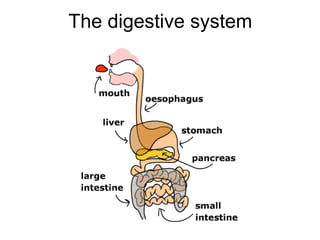
The parts of the digestive system
• The mouth
• The esophagus
• The stomach
• The small intestine
• The large intestine
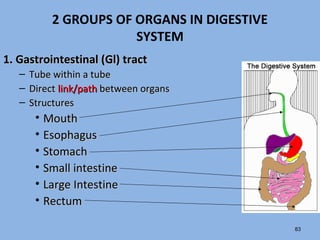
2 GROUPS OF ORGANS IN DIGESTIVE
SYSTEM
1. Gastrointestinal (Gl) tract1. Gastrointestinal (Gl) tract
– Tube within a tubeTube within a tube
– DirectDirect link/pathlink/path between organsbetween organs
– StructuresStructures
• MouthMouth
• EsophagusEsophagus
• StomachStomach
• Small intestineSmall intestine
• Large IntestineLarge Intestine
• RectumRectum
83
2. Accessory Organs The Glands
• Not part of the path
of food, but play a
critical role.
• Include: Liver, gall
bladder, and
pancreas
The parts of the digestive system
• The mouth
• The oesophagus
• The stomach
• The small intestine
• The large intestine
MOUTH
• Teeth mechanically
break down food into
small pieces.
• Tongue mixes food with
saliva (contains amylase,
which helps break down
starch).
• Bolus- product in mouth
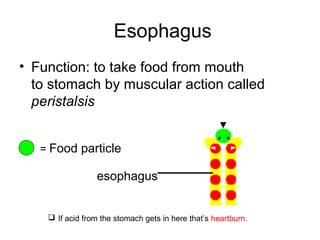
Esophagus
• Function: to take food from mouth
to stomach by muscular action called
peristalsis
= Food particle
esophagus
 If acid from the stomach gets in here that’s heartburn.
Stomach
• Store food (can hold 1 Liter of food
and liquid.)
• Mix food with Digestive juice
(Hydrochloric acid and pepsin)
• Kill bacteria in food
• Product of digestion in stomach is
called CHYME
* After 4 hours, stomach pushes food into
small intestine
Small Intestine
• Small intestines are roughly 7 meters long
• MOST of foods is chemically digested.
• Have a several Digestive juice.
• Absorb digested food into bloodstream
Lining of intestine walls has finger-like projections
called villi, to increase surface area.
The villi are covered in microvilli which further
increases surface area for absorption.
Liver
• The liver makes bile
• Function of bile
– to dissolve fats
– neutralise acid from
the stomach
•filters out toxins and waste
including drugs and alcohol and
poisons.
Gall Bladder
• Stores bile from the
liver, releases it into
the small intestine.
• Fatty diets can cause
gallstones
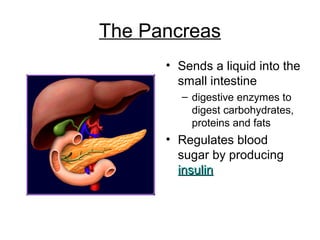
The Pancreas
• Sends a liquid into the
small intestine
– digestive enzymes to
digest carbohydrates,
proteins and fats
• Regulates blood
sugar by producing
insulininsulin
Large Intestine
• About 1.5 meters long
• Accepts what small intestines
don’t absorb
• Absorb water from the waste
food, solidifying the feces
Rectum – The end of the line:
The remains of food and
water is stored in the rectum.
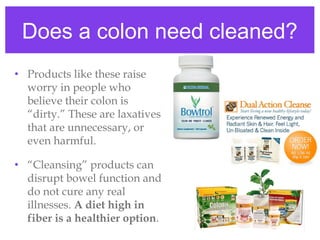
Does a colon need cleaned?
• Products like these raise
worry in people who
believe their colon is
“dirty.” These are laxatives
that are unnecessary, or
even harmful.
• “Cleansing” products can
disrupt bowel function and
do not cure any real
illnesses. A diet high in
fiber is a healthier option.
ANIMAL DIGESTIVE
SYSTEM
2 TYPES OF DIGESTIVE SYSTEM
1. COMPLETE DIGESTIVE SYSTEM
• More complex animals have
one-way digestion.
• Food enters one opening and
waste leaves from another.
• Animals with one-way systems
can eat any time, which is an
advantage
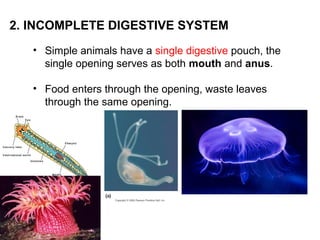
2. INCOMPLETE DIGESTIVE SYSTEM
• Simple animals have a single digestive pouch, the
single opening serves as both mouth and anus.
• Food enters through the opening, waste leaves
through the same opening.
4 MAIN FEEDING MECHANISM
1. Filter feeding
2. Substrate feeding
3. Fluid feeding
4. Bulk feeding
1. Filter feeding
- uses adaptation in feeding food particles from
environment, usually aquatic organism.
-Ex: clams, mussels, whales
2. Substrate feeding
- animals live in or on their food source.
- Ex: leaf miner, maggots, parasite
3. Fluid feeding
- animals suck nutrient-rich fluid from a host
or a source. They have different adaptations in
order to get food.
-Ex: proboscis of mosquitoes, the long
tongue of nectar feeding bats and long beaks of
hummingbirds.
4. Bulk feeding
- animals, such as us humans, take in large
particle sized food
-Ex: tentacles, claws, venomous fangs, large
mandible and teeth which aids in killing prey or
tearing off pieces of meat or vegetation
3 kinds of Digestive system of
animals
• Ruminants Digestive System
• Monogastric Digestive System
• Avian Digestive System
Assessment
Students must attempt all
questions!
Question 1
• (a) What are the functions of the digestive
system
• (b) Name the chemicals that digest food
Question 2
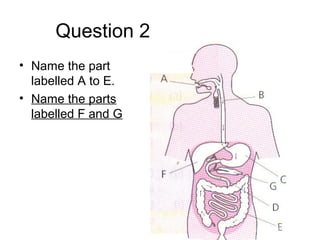
• Name the part
labelled A to E.
• Name the parts
labelled F and G
Question 4
• Follow the food as it
passes through the
digestive tract and
explain the process of
digestion.
Chapter Assessment
1. An enzyme is a biological _____________
2) Taking food into the mouth is known as ____________
3) Explain the difference between physical and chemical digestion.
Give one example of each type.
4) What is the name given to the process whereby food is pushed
along the alimentary canal
5) List the two major functions of the large intestine ?.
6) The oesophagus carries the food from the ________
to the __________

Digestive system

Editor's Notes

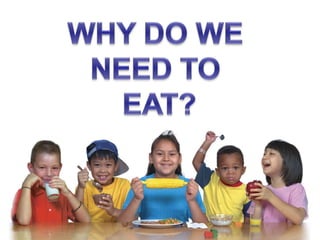
  • #2 What do you see in this picture? what is the most common thing you always do? Yes, to eat. Food is always present in every occasion Food is also an occasion for sharing, or for celebrating simple things. My question is WHY DO WE NEED TO EAT?
  • #3 We need to eat bec It is the basic of human needs We eat to rejuvenate our bodies to build new cells to gain strength and to make our organs healthy.
  • #4 How do you start your day? Breakfast is often described as the most important meal of the day providing US energy for whatever activities lays ahead.
  • #5 Food is the key To Start A Perfect Day
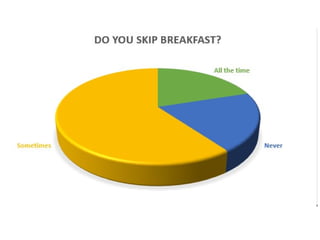
  • #6 Who among you skip his/ her breakfast? What is the reason? Do you always skip meals? How do you feel whenever you skip a meal? Statistics shows that there are 60% of people who sometimes skip bfast 20% Always skip there breakfast And 20% never skip bfast meal. When breakfast is missed children say they’re irritable or feel tired and sluggish. That’s how food affects our lives. It is very important.
  • #7 It is because Food plays a very big and important role in our life. When we say food is : HOW DO WE GET FOOD?
  • #8 Who can discuss What is photosynthesis? We discussed that Plants have a green pigment called? __________ chlorophyll Chlorophyll is found in their leaves. This chlorophyll will trap the solar energy and converts it to chemical energy and prepares its own food. This process is called Photosynthesis.
  • #9 Animals, humans are almost the same the only Difference is Animals cannot speak when they are hungry unlike humans.
  • #10 Stomach 2-4 hrs, small intestine 8-10 hr, colon 10 hrs. 24 hours not to be exact Not a perfect process.
  • #11 Okay so it only shows that price of some food depends on what nutrients you can get from them.
  • #12 We get Essential nutrients, such as And they are being nourish through a process called
  • #13 Food people eat and how our bodies uses it to get energy. is the process of taking in, taking apart and taking up the nutrients from a food source.
  • #14 protein cannot be “stocked” up like fat but must be eaten daily. Protein is the basic nutrient and plays an essential role in carrying cholesterol and preventing heart disease.
  • #15 I have here some questions Who wants to try? Amino acid- protein Human 20 amino acid ( 9 nonessential: body naturally) (11 essential: food rich in protein, meat)
  • #16 We are literally made of protein from our bones to our muscles, arteries and veins, skin, hair, and fingernails. Our heart, brain, liver, kidneys, and lungs are built of tissue made of proteins. When fat and carbohydrates are insufficient, proteins produce the energy we need for life. ( That’s why we don’t stave that much because of hunger) (gutom)
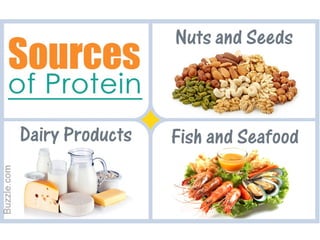
  • #17 When we eat foods that are sources of protein our body breaks down the food proteins into their amino acids and after they are absorbed enzymes in the body recombine them to produce body’s special needs making red blood cells building muscles Proteins help carry the oxygen that reddens our blood. Pregnant women and breastfeeding mothers also need additional protein since they are not only maintaining their own bodies but also providing for the growth of their developing child.
  • #18 Energy- carbohydrates ( rice, bread, cereals, sugar, chocolates)
  • #19 Lets talk about carbs Carbohydrates are a major macronutrient and one of your body’s primary sources of energy. They are made of carbon oxygen and hydrogen. Still, there is a constant weight loss buzz that discourages eating them. ( DIET ) People on their diet tends to say they won’t eat carbs BUT The key is finding the right carbs — not avoiding them altogether.
  • #20 LET US STUDY THIS PICTURE Who wants do differentiate them? The first photo shows that a person who eats these kinds of food tend to grow bigger in size, literally. And then the second photo shows that a person who eats this kind of food is physically fit. It only shows that you are what you eat.
  • #21 Studies shows that : it is from a medical doctor named Mark Hyman. It is true that sugar is very addictive to the point that your taste buds wants to taste sweets once and a while.
  • #22 That’s why we have the term : SWEET TOOTH it is not literally means that your tooth are sweet. It means that you are attached to sweets.
  • #23 And speaking of sweets CARBS are divid
  • #24 Monosaccharides ( single sugar molecule) are classified into 3 First is the Glucose (Mostly found on Blood sugar) raw sugar brown sugar corn syrup and high-fructose corn syrup glucose, fructose, and sucrose fruit juice concentrate
  • #25 HIGH levels of glucose in the blood HARMS your EYES. It can cause conditions such as Diabetes and cataracts over time
  • #26 Also sweet sugar found in biscuits, chocolates and candies. It provides quick energy
  • #27 The next monosaccharide is Fructose: chemical name is levulose Fructose is also called the fruit sugar. Fructose is found in fruits, honey, and human semen. And the last monosaccharide IS :
  • #28 MILK SUGAR Galactose is not normally lactose, which is found in milk, yogurt and other dairy products that has milk content.
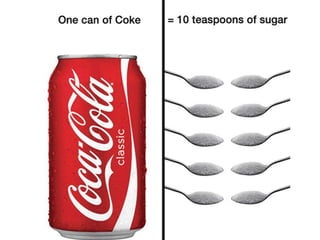
  • #30 ENOUGH WITH SWEETS, I’M A BIT THIRSTY WHO AMONG YOU LOVES TO DRINK SODA? ESPECIALLY COCACOLA? MOST OF US LOVES TO DRINK SODA DURING SNACKS, OR EVEN DURING MEALS BUTTTTTTTTTTT
  • #31 DID YOU NOW THAT IN SO IF YOU DRINK MORE THAN A CAN OF SODA, IMAGINE HOW MANY TEASPOONS OF SUGAR YOU ARE TAKING. THAT’S A LOT
  • #32 Simple Carb Foods to Avoid Try to avoid some of the most common refined sources of simple carbs and look for alternatives to satisfy those sweet cravings: 1. Soda: Choose water flavored with lemon instead. 2. Baked Treats: Satisfy your sweet tooth with fruit. 4. Fruit Juice Concentrate: Always choose 100 percent fruit juice, or, even easier, make your own at home! 5. Breakfast Cereal: Breakfast cereals tend to be loaded with simple carbohydrates.
  • #33 Made up of 3 or more monosaccharides Starch and fiber ( grains, plants) more nutrients than simple carbs, because they are higher in fiber and digest more slowly. This also makes them more filling, which means they’re a good option for weight control. They are also ideal for people with diabetes because they help manage blood sugar. Fiber and starch are the two types of complex carbohydrates. Fiber is especially important because it promotes bowel regularity and helps to control cholesterol. The main sources of dietary fiber include: Fruits vegetables nuts beans whole grains Starch is also found in some of the same foods as fiber whole wheat bread cereal corn oats peas rice
  • #34 Speaking of bowel regularity there are food rich in cellulose Enzyme Humans are unable to digest cellulose because we lack the appropriate enzymes to break it down. aids in the smooth working of the intestinal tract. Eating cellulose foods helps aid healthy digestion and bowel movements. In addition, all foods with cellulose also contain other valuable minerals, proteins and vitamins
  • #35 Now you already have the knowledge about SIMPLE AND COMPLEX CARBS Let’s try to apply it with my question earlier.
  • #37 list what have YOU eaten today and identify if it’s simple or complex carbs by putting check on the table. and present it as recitation.
  • #38 Are you full? Full of knowledge I mean?
  • #39 What vitamins supplements are you familiar with?
  • #40 Those vitamins are important but you don’t have to take a lot of vitamin supplements to be healthy.
  • #41 Who wants to try the next question? Beta carotene is a red-orange pigment found in plants and fruits, especially colorful vegetables. The human body converts beta carotene into vitamin A.
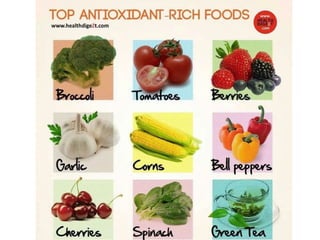
  • #42 Vitamin E, Food suppliments substances that may protect cells from the damage caused by unstable molecules known as free radicals. (CANCER PREVENTION) Adding antioxidant-rich fruits and vegetables to your daily diet will strengthen your ability to fight infection and disease.
  • #43 Helps immune system in cleaning waste from our bodies.
  • #44 YES YOU CAN BE OVERDOSE WITH VITAMINS.
  • #45 Because there are vitamins that are Fat-soluble— vitamins A, D, E and K — dissolve in fat before they are absorbed in the bloodstream to carry out their functions. Excesses of these vitamins are stored in the liver, and are not needed every day in the diet.
  • #46 Water-soluble vitamins are easily destroyed or washed out during food storage or preparation, urine
  • #48 So those are the nutrients that are entering your body everyday. Is there any questins?
  • #49 photosynthesis
  • #50 FOOD
  • #51 nutrition
  • #52 nutrition
  • #53 PROTEINS
  • #54 AMINO ACID
  • #55 CARBOHYDRATES
  • #56 FALSE
  • #57 FALSE
  • #58 CLUCOSE FRUCTOSE GALACTOSE
  • #59 POLYSACCHARIDES
  • #60 3
  • #61 3
  • #62 B
  • #63 At the back of your ¼ answer this question. To sum it up for you : All living things need food and water to live. “good food” Proper nutrition provides the body with nutrients necessary to build, maintain and repair tissues of the body.
  • #64 So if there’s no more questions I want to share this quotation of MOLYER Eating should not be your favorite activity, but something you do to maintain your health. The expression discourages overeating.
  • #66 I’LL GIVE YOU SOME TIPS THAT YOU CAN APPLY TO ACHIEVE A HEALTHY BODY.
  • #68 So for your homework you’ll going to make a food plan. You’ll going to plan your meals for tomorrow. track your eating habits, thoughts, feelings and symptoms, make healthy changes and move toward your fitness goals.
  • #71 Animals, humans ( the same) Difference bet. Animals cannot speak
  • #72 The rhyme In, Down, Around, And, Eject is just an aid for the students to remember. The stage will come into the slide first then the rhyme. Make sure that the students know the difference between egestion and excretion. The website link is an animation of a dinosaur showing 3 of the stages of digestion which the students really enjoy. It is well worth showing to the students.
  • #73 An overview of the digestive process.
  • #75 The food shown in this meal is bound for your body cells. The larger food particles must be broken down by the digestive system
  • #76 Enzymes (corn rich in cellulose) Humans are unable to digest cellulose because we lack the appropriate enzymes to break it down. While cellulose is not digestible, it is the fiber that aids in the smooth working of the intestinal tract. Eating cellulose foods helps aid healthy digestion and bowel movements. In addition, all foods with cellulose also contain other valuable minerals, proteins and vitamins
  • #78 The digestive system is a group of organs working together to break down food into tiny molecules. Digestion of food is important so that we can obtain energy from our food.
  • #79 Topic : 1A2 : Digestion ; sub-topics: Major parts and functions of the digestive system teeth, types and function 1A3 Enzymes; Sub-topics: Enzyme action
  • #80 Food is broken up physically by the teeth and chemically by digestive enzymes. Mouth: Physical and chemical digestion Physical digestion begins in the mouth where the food is chewed and broken down into smaller pieces by the teeth. There are four types of teeth – Incisors, Canines, Premolars and Molars. Chemical digestion also occurs in the mouth with chemicals called enzymes that chemically break down the food.
  • #81 Enzymes ( Acids)
  • #82 Ask class to reiterate what an organ is and to in groups appoint a reporter and name some digestive organs Ask class to discuss what they think are the main functions of each major part. These suggestions will be discussed throughout the remainder of the lesson
  • #84 passage way of food from mouth to rectum
  • #85 Enzymes, digestive juices
  • #87 Mechanical – teeth Chemical- Saliva
  • #88 Epiglottis, ( open- breathe , close food ) Brain (not yet ready)
  • #89 Peristalsis is a muscular action seen in the animation which show the food particle going down the oesophagus Oesophagus: Passes food to the stomach by peristalsis After being chewed and swallowed, food passes through the esophagus a long tube that runs from the mouth to the stomach. The muscles in the wall of the oesophagus start to push the mushy bolus down into the stomach by waves called peristalsis. Peristalsis gives us the capability of being able to eat or drink even when we’re upside-down.
  • #90 The stomach acts as a food blender. The walls squeezes in and out to mix the food with juice, which makes the food like a mushy soup called chyme. Stomach: Physical and chemical digestion Once in the stomach, which is essentially a mixing and holding area, protein digestion begins. The food is churned and drenched in a very strong acid called Hydrochloric Acid. Partly digested food mixed with stomach acid is called chyme.
  • #91 The first part of the small intestine is called the duodenum. The duodenum produces a range of digestive enzymes to break down starch, proteins and fats that are in food. The longest part of the small intestine is called the ileum. Villi- hair( absorbs nutrients to the bloodstream) Small Intestine (6 Meters Long): Chemical digestion and the absorption of nutrients into the blood After being further digestied in the stomach, food enters the small intestine. The first part of the small intestine is called the duodenum, the next part is the jejunum and the third and final part of the small intestine is called the ileum. In the small intestine, bile (produced in the liver and stored in the gall bladder), pancreatic enzymes, and other digestive enzymes produced by the inner wall of the small intestine further assist with the breakdown of food
  • #93 Bile ( dissolves fats produced by liver) is a liquid made in the liver, which is sent into the small intestine. Liver: Produces Bile (for the digestion of fats)
  • #94 ( stores excess bile from the liver) Explain to students that removing the stones typically means removing the gallbladder, but that the body eventually adjusts to not having the bile stored.
  • #95 Ask student where do they think the pancreas lies? The point it out being yellow in this diagram. Pancreas: Contains digestive enzymes Insulin is a hormone made by the pancreas that allows your body to use sugar (glucose) from carbohydrates in the food that you eat for energy or to store
  • #96 Bacteria present in the large intestine feed on unabsorbed nutrients, and produce several vitamins. Large intestine: Absorption of water from the food remains. After passing through the small intestine, food enters the large intestine. In the large intestine, some of the water and electrolytes (chemicals like sodium) are removed from the food. Many microbes (bacteria like Bacteroides, Lactobacillus acidophilus, Escherichia coli, and Klebsiella) in the large intestine help in the digestion process.
  • #97 Solid waste is then stored in the rectum until it is excreted via the anus. Help your kids identify and locate the major parts of the digestive system including the mouth, eosophagus, stomach, liver, pancreas, small intestine and large intestine, and know their functions. Our Digestive System for Kids image below is a great way to explain digestion to kids. The next time your kids eat a healthy snack you should help them follow along the map of where their food travels from mouth to toilet (always a fun topic in our house).
  • #101 These organisms must finish digesting before eating again.
  • #110 This is lesson - An assessment.