Animal Nutrition and Digestion
Nutritional requirements
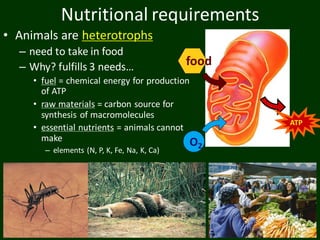
• Animals are heterotrophs
– need to take in food
– Why? fulfills 3 needs…
• fuel = chemical energy for production
of ATP
• raw materials = carbon source for
synthesis of macromolecules
• essential nutrients = animals cannot
make
– elements (N, P, K, Fe, Na, K, Ca)
O2
food
ATP
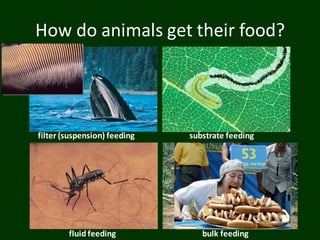
How do animals get their food?
filter (suspension) feeding substrate feeding
fluid feeding bulk feeding
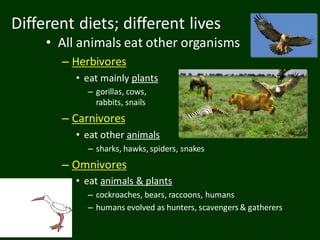
Different diets; different lives
• All animals eat other organisms
– Herbivores
• eat mainly plants
– gorillas, cows,
rabbits, snails
– Carnivores
• eat other animals
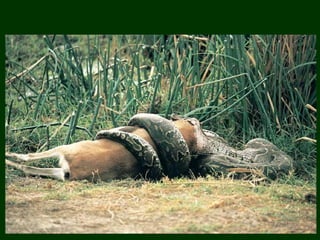
– sharks, hawks, spiders, snakes
– Omnivores
• eat animals & plants
– cockroaches, bears, raccoons, humans
– humans evolved as hunters, scavengers & gatherers
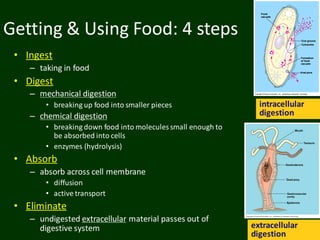
Getting & Using Food: 4 steps
• Ingest
– taking in food
• Digest
– mechanical digestion
• breaking up food into smaller pieces
– chemical digestion
• breaking down food into molecules small enough to
be absorbed into cells
• enzymes (hydrolysis)
• Absorb
– absorb across cell membrane
• diffusion
• active transport
• Eliminate
– undigested extracellular material passes out of
digestive system
intracellular
digestion
extracellular
digestion
Digestive systems
Everybody’s got one!
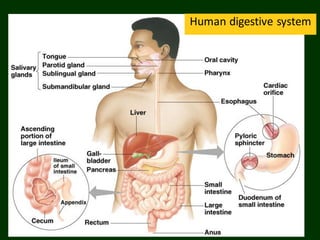
Human digestive system
Common Processes & Structures in the
Human Digestive System
• Movement & Control
– peristalsis
• process that pushes food along by rhythmic waves of
smooth muscle contraction in walls of digestive system
– sphincters
• muscular ring-like valves, regulate the passage of
material between sections of digestive system
• Accessory glands
– salivary glands, pancreas, liver & gall bladder
• secrete digestive juices (enzymes & fluid)
Ingestion
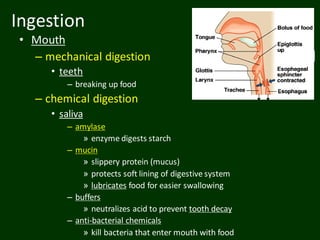
• Mouth
– mechanical digestion
• teeth
– breaking up food
– chemical digestion
• saliva
– amylase
» enzyme digests starch
– mucin
» slippery protein (mucus)
» protects soft lining of digestive system
» lubricates food for easier swallowing
– buffers
» neutralizes acid to prevent tooth decay
– anti-bacterial chemicals
» kill bacteria that enter mouth with food
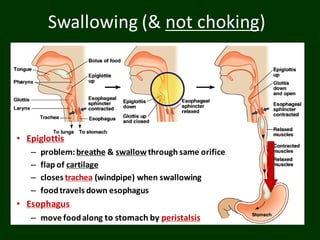
Swallowing (& not choking)
• Epiglottis
– problem:breathe & swallowthrough same orifice
– flap of cartilage
– closes trachea (windpipe) when swallowing
– foodtravels down esophagus
• Esophagus
– move foodalong to stomach by peristalsis
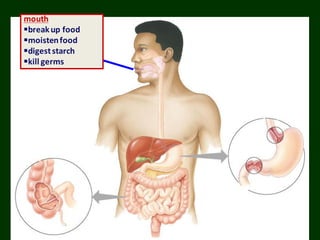
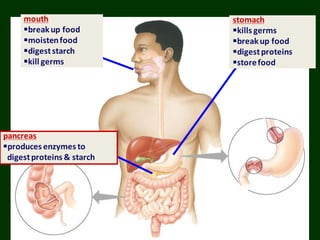
mouth
breakup food
moistenfood
digeststarch
kill germs
Stomach
• Functions
– food storage
• can stretch to fit ~2L food
– disinfect food
• HCl = pH 2
–kills bacteria
–breaks apart cells
– chemical digestion
• pepsin
–enzyme breaks down proteins
–secreted as pepsinogen
»activated by HCl
But the stomach is made out of protein!
What stops the stomachfrom digesting itself?
mucus secreted by stomachcells protects stomach
lining
stomach
kills germs
storefood
breakup food
digestproteins
cardiac
sphincter
pyloric
sphincter
mouth
breakup food
moistenfood
digeststarch
kill germs
Small intestine
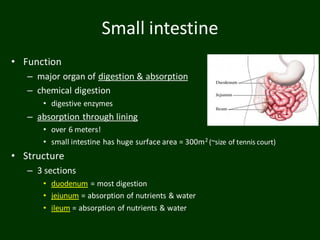
• Function
– major organ of digestion & absorption
– chemical digestion
• digestive enzymes
– absorption through lining
• over 6 meters!
• small intestine has huge surface area = 300m2 (~size of tennis court)
• Structure
– 3 sections
• duodenum = most digestion
• jejunum = absorption of nutrients & water
• ileum = absorption of nutrients & water
Duodenum
• 1st section of small intestines
– acid food from stomach mixes with digestive
juices from accessory glands:
 pancreas
 liver
 gall bladder
Pancreas
• Digestive enzymes
– peptidases
• digests proteins/breaks peptide
bonds
• trypsin, chymotrypsin,
carboxypeptidase
– pancreatic amylase
• digests starch
• Buffers
– reduces acidity
• alkaline solution rich in
bicarbonate (HCO3-)
• buffers acidity of material from
stomach
small intestines
stomach
kills germs
breakup food
digestproteins
storefood
pancreas
produces enzymes to
digestproteins & starch
mouth
breakup food
moistenfood
digeststarch
kill germs
Liver
• Digestive System Functions
– produces bile
• stored in gallbladder until needed
• breaks up fats
– act like detergents to break up fats
CirculatorySystem Connection
bile contains colors fromold
red blood cells collected in
liver =
ironin RBC rusts & makes
feces brown
pancreas
produces enzymes to
digestproteins & starch
stomach
kills germs
breakup food
digestproteins
storefood
liver
produces bile
- storedin gall bladder
breakup fats
mouth
breakup food
moistenfood
digeststarch
kill germs
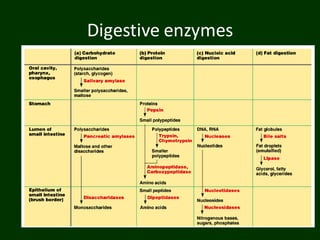
Digestive enzymes
Absorption by Small Intestines
• Absorptionthrough villi & microvilli
– finger-like projections
• increase surface area for absorption
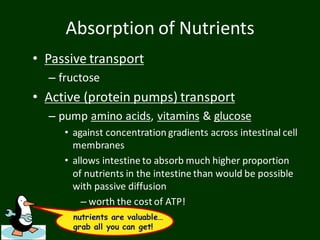
Absorption of Nutrients
• Passive transport
– fructose
• Active (protein pumps) transport
– pump amino acids, vitamins & glucose
• against concentration gradients across intestinal cell
membranes
• allows intestine to absorb much higher proportion
of nutrients in the intestine than would be possible
with passive diffusion
– worth the cost of ATP!
nutrients are valuable…
grab all you can get!
Nutrients from the
digestive system is
absorbed by the blood
stream to be taken to
other parts of the
body
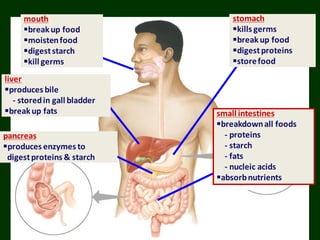
small intestines
breakdownall foods
- proteins
- starch
- fats
- nucleic acids
absorbnutrients
stomach
kills germs
breakup food
digestproteins
storefood
pancreas
produces enzymes to
digestproteins & starch
liver
produces bile
- storedin gall bladder
breakup fats
mouth
breakup food
moistenfood
digeststarch
kill germs
Large intestines (colon)
• Function
– re-absorb water
• use ~9 liters of water every
day in digestive juices
• > 90% of water reabsorbed
– not enough water absorbed
back to body
» diarrhea
– too much water absorbed back to body
» constipation
Flora of large intestines
• Living in the large intestine is a rich
flora of harmless, helpful bacteria
– Escherichia coli (E. coli)
• a favorite research organism
– bacteria produce vitamins
• vitamin K; biotin, folic acid & other B vitamins
– generate gases
• by-product of bacterial
metabolism
• methane, hydrogen sulfide
You’ve got
company!
Rectum
• Last section of colon (large intestines)
– eliminate feces
• undigested materials
– extracellular waste
» mainly cellulose from plants
» roughage or fiber
• salts
• masses of bacteria
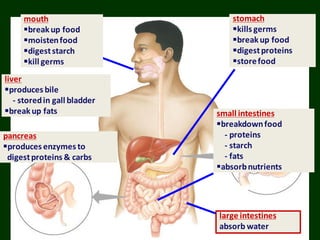
appendix
stomach
kills germs
breakup food
digestproteins
storefood
small intestines
breakdownfood
- proteins
- starch
- fats
absorbnutrients
pancreas
produces enzymes to
digestproteins & carbs
liver
produces bile
- storedin gall bladder
breakup fats
large intestines
absorb water
mouth
breakup food
moistenfood
digeststarch
kill germs
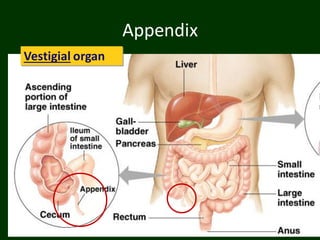
Appendix
Vestigial organ

Life-Science-ppt in animals veterinary.pdf

  • 1.
  • 2.
    Nutritional requirements • Animalsare heterotrophs – need to take in food – Why? fulfills 3 needs… • fuel = chemical energy for production of ATP • raw materials = carbon source for synthesis of macromolecules • essential nutrients = animals cannot make – elements (N, P, K, Fe, Na, K, Ca) O2 food ATP
  • 3.
    How do animalsget their food? filter (suspension) feeding substrate feeding fluid feeding bulk feeding
  • 5.
    Different diets; differentlives • All animals eat other organisms – Herbivores • eat mainly plants – gorillas, cows, rabbits, snails – Carnivores • eat other animals – sharks, hawks, spiders, snakes – Omnivores • eat animals & plants – cockroaches, bears, raccoons, humans – humans evolved as hunters, scavengers & gatherers
  • 6.
    Getting & UsingFood: 4 steps • Ingest – taking in food • Digest – mechanical digestion • breaking up food into smaller pieces – chemical digestion • breaking down food into molecules small enough to be absorbed into cells • enzymes (hydrolysis) • Absorb – absorb across cell membrane • diffusion • active transport • Eliminate – undigested extracellular material passes out of digestive system intracellular digestion extracellular digestion
  • 7.
  • 8.
  • 9.
    Common Processes &Structures in the Human Digestive System • Movement & Control – peristalsis • process that pushes food along by rhythmic waves of smooth muscle contraction in walls of digestive system – sphincters • muscular ring-like valves, regulate the passage of material between sections of digestive system • Accessory glands – salivary glands, pancreas, liver & gall bladder • secrete digestive juices (enzymes & fluid)
  • 10.
    Ingestion • Mouth – mechanicaldigestion • teeth – breaking up food – chemical digestion • saliva – amylase » enzyme digests starch – mucin » slippery protein (mucus) » protects soft lining of digestive system » lubricates food for easier swallowing – buffers » neutralizes acid to prevent tooth decay – anti-bacterial chemicals » kill bacteria that enter mouth with food
  • 11.
    Swallowing (& notchoking) • Epiglottis – problem:breathe & swallowthrough same orifice – flap of cartilage – closes trachea (windpipe) when swallowing – foodtravels down esophagus • Esophagus – move foodalong to stomach by peristalsis
  • 12.
  • 13.
    Stomach • Functions – foodstorage • can stretch to fit ~2L food – disinfect food • HCl = pH 2 –kills bacteria –breaks apart cells – chemical digestion • pepsin –enzyme breaks down proteins –secreted as pepsinogen »activated by HCl But the stomach is made out of protein! What stops the stomachfrom digesting itself? mucus secreted by stomachcells protects stomach lining
  • 14.
  • 15.
    Small intestine • Function –major organ of digestion & absorption – chemical digestion • digestive enzymes – absorption through lining • over 6 meters! • small intestine has huge surface area = 300m2 (~size of tennis court) • Structure – 3 sections • duodenum = most digestion • jejunum = absorption of nutrients & water • ileum = absorption of nutrients & water
  • 16.
    Duodenum • 1st sectionof small intestines – acid food from stomach mixes with digestive juices from accessory glands:  pancreas  liver  gall bladder
  • 17.
    Pancreas • Digestive enzymes –peptidases • digests proteins/breaks peptide bonds • trypsin, chymotrypsin, carboxypeptidase – pancreatic amylase • digests starch • Buffers – reduces acidity • alkaline solution rich in bicarbonate (HCO3-) • buffers acidity of material from stomach small intestines
  • 18.
    stomach kills germs breakup food digestproteins storefood pancreas producesenzymes to digestproteins & starch mouth breakup food moistenfood digeststarch kill germs
  • 19.
    Liver • Digestive SystemFunctions – produces bile • stored in gallbladder until needed • breaks up fats – act like detergents to break up fats CirculatorySystem Connection bile contains colors fromold red blood cells collected in liver = ironin RBC rusts & makes feces brown
  • 20.
    pancreas produces enzymes to digestproteins& starch stomach kills germs breakup food digestproteins storefood liver produces bile - storedin gall bladder breakup fats mouth breakup food moistenfood digeststarch kill germs
  • 21.
  • 22.
    Absorption by SmallIntestines • Absorptionthrough villi & microvilli – finger-like projections • increase surface area for absorption
  • 23.
    Absorption of Nutrients •Passive transport – fructose • Active (protein pumps) transport – pump amino acids, vitamins & glucose • against concentration gradients across intestinal cell membranes • allows intestine to absorb much higher proportion of nutrients in the intestine than would be possible with passive diffusion – worth the cost of ATP! nutrients are valuable… grab all you can get!
  • 24.
    Nutrients from the digestivesystem is absorbed by the blood stream to be taken to other parts of the body
  • 25.
    small intestines breakdownall foods -proteins - starch - fats - nucleic acids absorbnutrients stomach kills germs breakup food digestproteins storefood pancreas produces enzymes to digestproteins & starch liver produces bile - storedin gall bladder breakup fats mouth breakup food moistenfood digeststarch kill germs
  • 26.
    Large intestines (colon) •Function – re-absorb water • use ~9 liters of water every day in digestive juices • > 90% of water reabsorbed – not enough water absorbed back to body » diarrhea – too much water absorbed back to body » constipation
  • 27.
    Flora of largeintestines • Living in the large intestine is a rich flora of harmless, helpful bacteria – Escherichia coli (E. coli) • a favorite research organism – bacteria produce vitamins • vitamin K; biotin, folic acid & other B vitamins – generate gases • by-product of bacterial metabolism • methane, hydrogen sulfide You’ve got company!
  • 28.
    Rectum • Last sectionof colon (large intestines) – eliminate feces • undigested materials – extracellular waste » mainly cellulose from plants » roughage or fiber • salts • masses of bacteria appendix
  • 29.
    stomach kills germs breakup food digestproteins storefood smallintestines breakdownfood - proteins - starch - fats absorbnutrients pancreas produces enzymes to digestproteins & carbs liver produces bile - storedin gall bladder breakup fats large intestines absorb water mouth breakup food moistenfood digeststarch kill germs
  • 30.