ETHOGRAM
ETHOLOGY
• Ethology is the study of animal behavior.
• Examine biological roots and meanings of
animal actions.
• The first step in the observation process is to
construct an ethogram.
ETHOGRAM
• Catalogue of typical behavioral patterns of a
species.
• A qualitative description of an animal’s normal
behavior becomes quantitative data.
• A tool to measure animal’s behavior.
Importance of Observation
• Initially, questions about animal behavior come
from observations.
• You must understand your study animal before
you can begin testing ideas.
• Patience and attention.
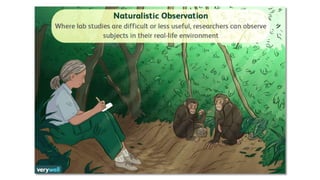
Watching v/s Observing
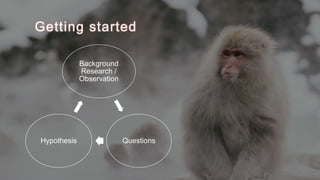
Getting started
Background
Research /
Observation
Questions
Hypothesis
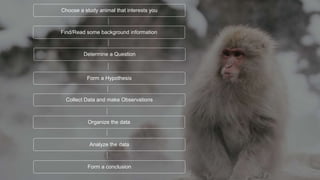
Choose a study animal that interests you
Find/Read some background information
Determine a Question
Form a Hypothesis
Collect Data and make Observations
Organize the data
Analyze the data
Form a conclusion
Observation sampling techniques:
• ad libitum (L. "at pleasure")
• Focal-animal sampling
• Scan (instantaneous) sampling
• One-zero sampling
How to construct an ethogram
• Descriptions should be clear, concise, objective
and complete.
• Empirical descriptions.
• Describe specific parameters.
• Be specific and concise.
• Note down the action patterns.
Time Budget
• Often involve “behaviors” -- groups of action
patterns.
• Using one of the observational techniques
mentioned earlier, measure the amount of time
spent on a series of behaviors.
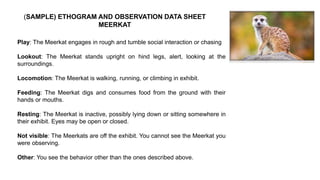
(SAMPLE) ETHOGRAM AND OBSERVATION DATA SHEET
MEERKAT
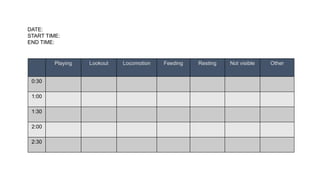
Play: The Meerkat engages in rough and tumble social interaction or chasing
Lookout: The Meerkat stands upright on hind legs, alert, looking at the
surroundings.
Locomotion: The Meerkat is walking, running, or climbing in exhibit.
Feeding: The Meerkat digs and consumes food from the ground with their
hands or mouths.
Resting: The Meerkat is inactive, possibly lying down or sitting somewhere in
their exhibit. Eyes may be open or closed.
Not visible: The Meerkats are off the exhibit. You cannot see the Meerkat you
were observing.
Other: You see the behavior other than the ones described above.
DATE:
START TIME:
END TIME:
Playing Lookout Locomotion Feeding Resting Not visible Other
0:30
1:00
1:30
2:00
2:30
Ethogram_PPT.pptx
Ethogram_PPT.pptx

Ethogram_PPT.pptx

  • 1.
  • 2.
    ETHOLOGY • Ethology isthe study of animal behavior. • Examine biological roots and meanings of animal actions. • The first step in the observation process is to construct an ethogram.
  • 3.
    ETHOGRAM • Catalogue oftypical behavioral patterns of a species. • A qualitative description of an animal’s normal behavior becomes quantitative data. • A tool to measure animal’s behavior.
  • 4.
    Importance of Observation •Initially, questions about animal behavior come from observations. • You must understand your study animal before you can begin testing ideas. • Patience and attention.
  • 5.
  • 7.
  • 8.
    Choose a studyanimal that interests you Find/Read some background information Determine a Question Form a Hypothesis Collect Data and make Observations Organize the data Analyze the data Form a conclusion
  • 9.
    Observation sampling techniques: •ad libitum (L. "at pleasure") • Focal-animal sampling • Scan (instantaneous) sampling • One-zero sampling
  • 10.
    How to constructan ethogram • Descriptions should be clear, concise, objective and complete. • Empirical descriptions. • Describe specific parameters. • Be specific and concise. • Note down the action patterns.
  • 11.
    Time Budget • Ofteninvolve “behaviors” -- groups of action patterns. • Using one of the observational techniques mentioned earlier, measure the amount of time spent on a series of behaviors.
  • 12.
    (SAMPLE) ETHOGRAM ANDOBSERVATION DATA SHEET MEERKAT Play: The Meerkat engages in rough and tumble social interaction or chasing Lookout: The Meerkat stands upright on hind legs, alert, looking at the surroundings. Locomotion: The Meerkat is walking, running, or climbing in exhibit. Feeding: The Meerkat digs and consumes food from the ground with their hands or mouths. Resting: The Meerkat is inactive, possibly lying down or sitting somewhere in their exhibit. Eyes may be open or closed. Not visible: The Meerkats are off the exhibit. You cannot see the Meerkat you were observing. Other: You see the behavior other than the ones described above.
  • 13.
    DATE: START TIME: END TIME: PlayingLookout Locomotion Feeding Resting Not visible Other 0:30 1:00 1:30 2:00 2:30