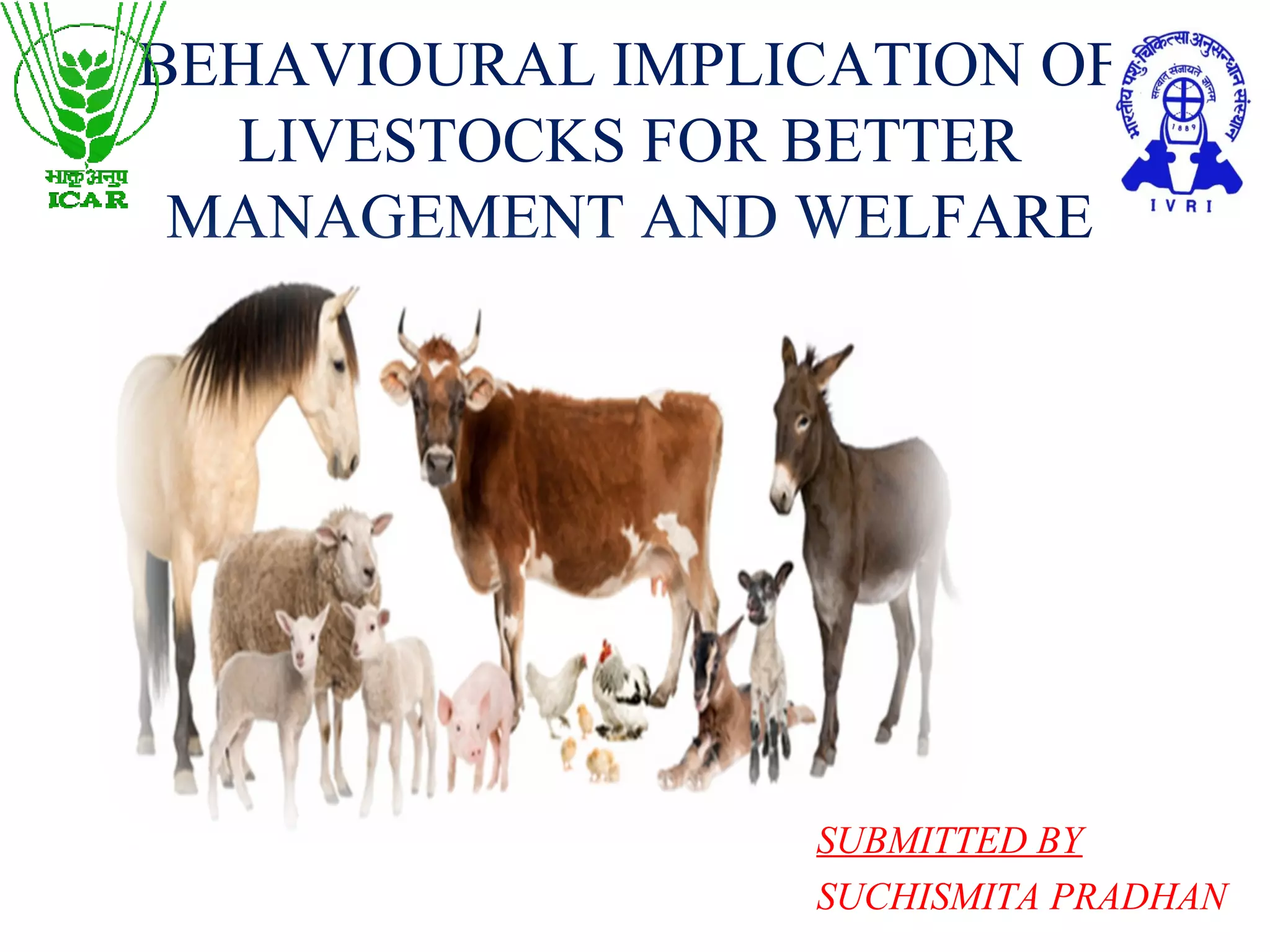
BEHAVIOURAL IMPLICATION OF
LIVESTOCKS FOR BETTER
MANAGEMENT AND WELFARE
SUBMITTED BY
SUCHISMITA PRADHAN
Behaviour
Behavioural pattern
Types of behaviour
Social , Agonistic , Ingestive ,Body care ,Thermoregulatory behaviour
Reproductive behaviour
Abnormal behaviour ( causes and their control )
Animal welfare (5 freedom )
Welfare issues and legislation
Behaviour and welfare relationship
How to improve welfare through behaviour
Conclusion
PREVIEW
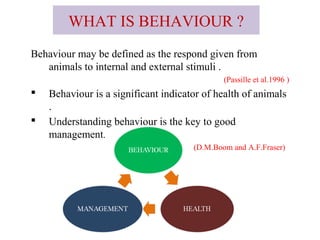
Behaviour may be defined as the respond given from
animals to internal and external stimuli .
(Passille et al.1996 )
 Behaviour is a significant indicator of health of animals
.
 Understanding behaviour is the key to good
management.
(D.M.Boom and A.F.Fraser)
WHAT IS BEHAVIOUR ?
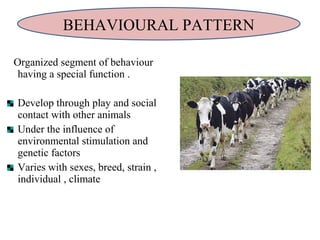
Organized segment of behaviour
having a special function .
Develop through play and social
contact with other animals
Under the influence of
environmental stimulation and
genetic factors
Varies with sexes, breed, strain ,
individual , climate
BEHAVIOURAL PATTERN
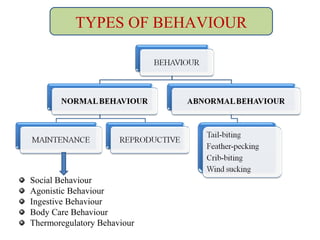
Social Behaviour
Agonistic Behaviour
Ingestive Behaviour
Body Care Behaviour
Thermoregulatory Behaviour
TYPES OF BEHAVIOUR
SOCIAL BEHAVIOUR
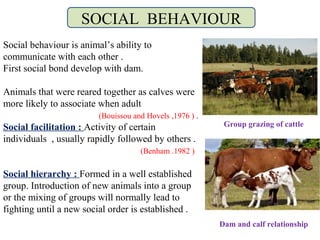
Group grazing of cattle
Dam and calf relationship
Social behaviour is animal’s ability to
communicate with each other .
First social bond develop with dam.
Animals that were reared together as calves were
more likely to associate when adult
(Bouissou and Hovels ,1976 ) .
Social facilitation : Activity of certain
individuals , usually rapidly followed by others .
(Benham .1982 )
Social hierarchy : Formed in a well established
group. Introduction of new animals into a group
or the mixing of groups will normally lead to
fighting until a new social order is established .
SOCIAL BEHAVIOUR
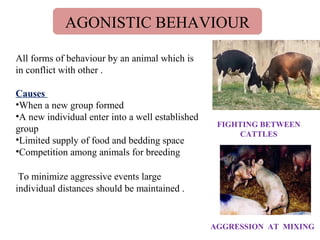
AGGRESSION AT MIXING
FIGHTING BETWEEN
CATTLES
All forms of behaviour by an animal which is
in conflict with other .
Causes
•When a new group formed
•A new individual enter into a well established
group
•Limited supply of food and bedding space
•Competition among animals for breeding
To minimize aggressive events large
individual distances should be maintained .
AGONISTIC BEHAVIOUR
BROWSING IN GOAT
GRAZING IN SHEEP
Animal fed in stalls spend very little time
feeding compared with free ranging animals of
same species .But they eat many meals of short
duration [ Vasilatos and Wangsness (1980)]
When daily max. Temperature >25˚c night
grazing varies from 0-70% of total grazing
time.
ROOTING IN PIG
INGESTIVE BEHAVIOUR
Different Components of Feeding
Behaviour in Livestock
 Rumination is about 15-20
times ,but duration of each
period may last from few min
to 1hr .
 Animal have an appetite for
energy .
 Water requirement
Cow =38-42 lit ,Buffalo =65 lit ,
Sheep = 3-6 lit , pig =8lit
GRAZING TIME OF DIFFERENT
ANIMAL
Source :Domestic animal behaviour and welfare
(D.M. Broom and A .F. Fraser )
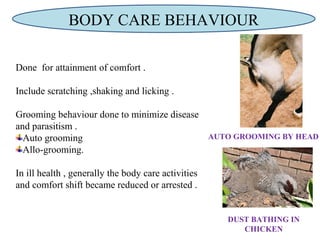
DUST BATHING IN
CHICKEN
AUTO GROOMING BY HEAD
Done for attainment of comfort .
Include scratching ,shaking and licking .
Grooming behaviour done to minimize disease
and parasitism .
Auto grooming
Allo-grooming.
In ill health , generally the body care activities
and comfort shift became reduced or arrested .
BODY CARE BEHAVIOUR
THERMOREGULATORY BEHAVIOUR
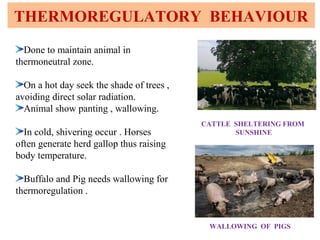
CATTLE SHELTERING FROM
SUNSHINE
WALLOWING OF PIGS
Done to maintain animal in
thermoneutral zone.
On a hot day seek the shade of trees ,
avoiding direct solar radiation.
Animal show panting , wallowing.
In cold, shivering occur . Horses
often generate herd gallop thus raising
body temperature.
Buffalo and Pig needs wallowing for
thermoregulation .
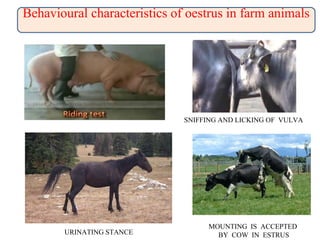
COW Restless behaviour, raises and twitches tail ;arches
back and stretches ,bellowing ,mounts or stands to
be mounted , vulva sniffed by other cows
SHEEP ewe seeks out ram and associates closely with it
GOAT rapid tail waving; poor appetite for 1 day
HORSE Urinating stance.
PIG Sow stands for ‘riding test’ , pricking of ears .
FEMALE SEXUAL BEHAVIOUR
OESTRUS BEHAVIOUR
REPRODUCTIVE BEHAVIOUR
[Source ; D.M.Broom and Fraser ]
URINATING STANCE
MOUNTING IS ACCEPTED
BY COW IN ESTRUS
SNIFFING AND LICKING OF VULVA
Behavioural characteristics of oestrus in farm animals
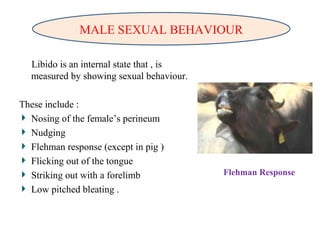
Libido is an internal state that , is
measured by showing sexual behaviour.
These include :
Nosing of the female’s perineum
Nudging
Flehman response (except in pig )
Flicking out of the tongue
Striking out with a forelimb
Low pitched bleating .
Flehman Response
MALE SEXUAL BEHAVIOUR
ABNORMAL BEHAVIOUR
Also known as anomalous behaviour ,behavioural
aberrations repeated .
Stereotypy is a relatively in-variate sequence of
movements that has no obvious purpose .
Indicate poor welfare .
EXAMPLE
Tail-biting (pigs)
Tongue rolling and inter-suckling in calves
Crib-biting and sucking by horses [ Brion (1964) ]
Feather pecking and head shaking in hen [ Levy (1944) ]
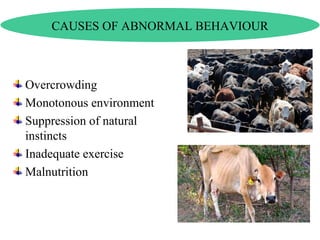
CAUSES OF ABNORMAL BEHAVIOUR
Overcrowding
Monotonous environment
Suppression of natural
instincts
Inadequate exercise
Malnutrition
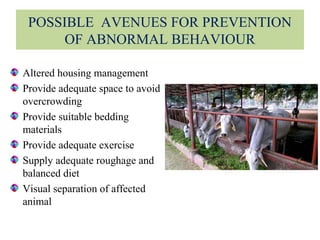
POSSIBLE AVENUES FOR PREVENTION
OF ABNORMAL BEHAVIOUR
Altered housing management
Provide adequate space to avoid
overcrowding
Provide suitable bedding
materials
Provide adequate exercise
Supply adequate roughage and
balanced diet
Visual separation of affected
animal
What is Animal Welfare?
World Organisation for Animal Health defines
animal welfare as “how an animal is coping with
the conditions in which it lives.’’
An animal is in a good state of welfare
if it is healthy, comfortable, well nourished, safe,
able to express innate behaviour, and if it is not
suffering from unpleasant states such as pain, fear,
and distress.
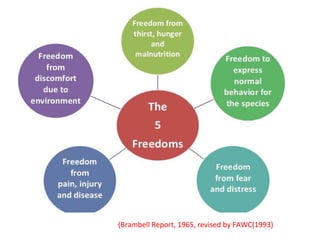
(Brambell Report, 1965, revised by FAWC(1993)
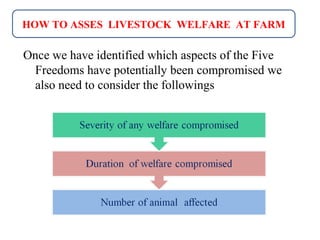
Once we have identified which aspects of the Five
Freedoms have potentially been compromised we
also need to consider the followings
HOW TO ASSES LIVESTOCK WELFARE AT FARM
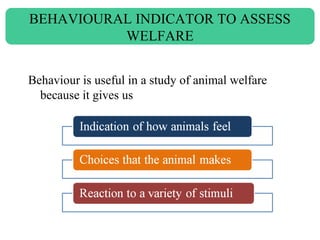
Behaviour is useful in a study of animal welfare
because it gives us
BEHAVIOURAL INDICATOR TO ASSESS
WELFARE
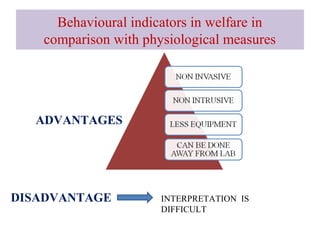
Behavioural indicators in welfare in
comparison with physiological measures
DISADVANTAGE
ADVANTAGES
INTERPRETATION IS
DIFFICULT
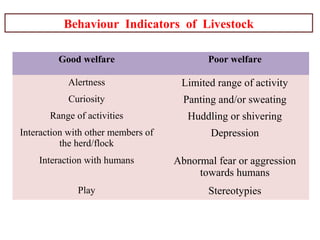
Good welfare Poor welfare
Alertness Limited range of activity
Curiosity Panting and/or sweating
Range of activities Huddling or shivering
Interaction with other members of
the herd/flock
Depression
Interaction with humans Abnormal fear or aggression
towards humans
Play Stereotypies
Behaviour Indicators of Livestock
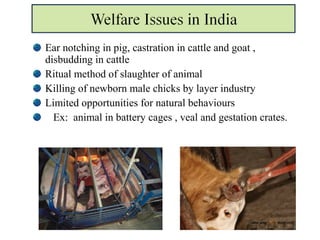
Ear notching in pig, castration in cattle and goat ,
disbudding in cattle
Ritual method of slaughter of animal
Killing of newborn male chicks by layer industry
Limited opportunities for natural behaviours
Ex: animal in battery cages , veal and gestation crates.
Cont...
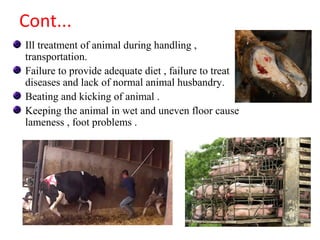
Ill treatment of animal during handling ,
transportation.
Failure to provide adequate diet , failure to treat
diseases and lack of normal animal husbandry.
Beating and kicking of animal .
Keeping the animal in wet and uneven floor cause
lameness , foot problems .
GOVERMENT ANIMAL WELFARE ORGANIZATION
NON GOVERMENT ORGANIZATION
IMPLICATION OF BEHAVIOUR FOR
LIVESTOCK MANAGEMENT
• As we know that the animal welfare focus on ,let the animal
express naturally, the various behavioral activities give
indication about managemental status of farm .
• Reproductive behaviour sometime get compromised due to
limited space or change in climate (heat stress), during this
period proper management of animal should be taken care.
• If animal is not behaving normally that also indicates
something problem with management which needs to be
investigated.
• Abnormal behavior reflects poor welfare therefore, ways to
sort out the managemental conditions needs to be improved.
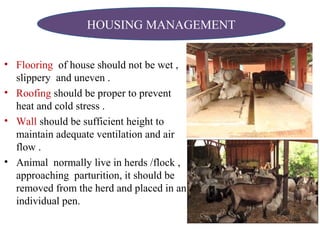
• Flooring of house should not be wet ,
slippery and uneven .
• Roofing should be proper to prevent
heat and cold stress .
• Wall should be sufficient height to
maintain adequate ventilation and air
flow .
• Animal normally live in herds /flock ,
approaching parturition, it should be
removed from the herd and placed in an
individual pen.
HOUSING MANAGEMENT
Cont….
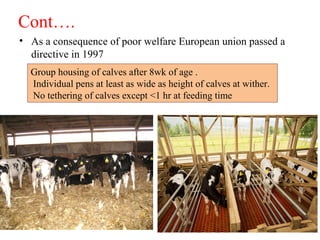
• As a consequence of poor welfare European union passed a
directive in 1997
Group housing of calves after 8wk of age .
Individual pens at least as wide as height of calves at wither.
No tethering of calves except <1 hr at feeding time
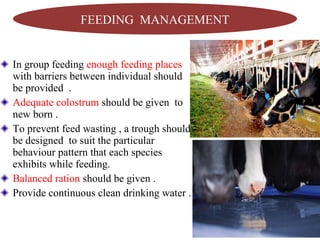
In group feeding enough feeding places
with barriers between individual should
be provided .
Adequate colostrum should be given to
new born .
To prevent feed wasting , a trough should
be designed to suit the particular
behaviour pattern that each species
exhibits while feeding.
Balanced ration should be given .
Provide continuous clean drinking water .
FEEDING MANAGEMENT
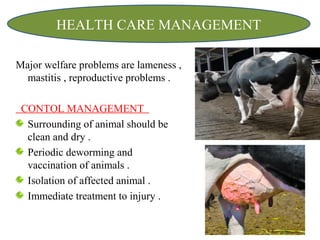
Major welfare problems are lameness ,
mastitis , reproductive problems .
CONTOL MANAGEMENT
Surrounding of animal should be
clean and dry .
Periodic deworming and
vaccination of animals .
Isolation of affected animal .
Immediate treatment to injury .
HEALTH CARE MANAGEMENT
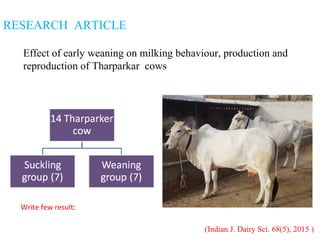
Effect of early weaning on milking behaviour, production and
reproduction of Tharparkar cows
(Indian J. Dairy Sci. 68(5), 2015 )
RESEARCH ARTICLE
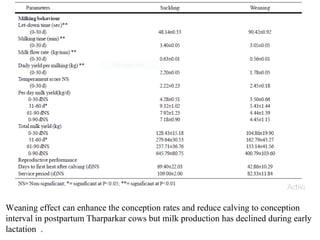
Write few result:
Weaning effect can enhance the conception rates and reduce calving to conception
interval in postpartum Tharparkar cows but milk production has declined during early
lactation .
Behavioural activities are often used as indicators of welfare.
We can use behavioural indicators to recognise whether the
livestock is in poor or good state of welfare.
Monitoring behavioural activities of livestock can be helpful
to livestock producers by identifying the problems and further
implementation of potential solutions for better livestock
management and welfare.
CONCLUSION
ANIMAL BEHAVIOUR AND WELFARE

ANIMAL BEHAVIOUR AND WELFARE

  • 1.
    BEHAVIOURAL IMPLICATION OF LIVESTOCKSFOR BETTER MANAGEMENT AND WELFARE SUBMITTED BY SUCHISMITA PRADHAN
  • 2.
    Behaviour Behavioural pattern Types ofbehaviour Social , Agonistic , Ingestive ,Body care ,Thermoregulatory behaviour Reproductive behaviour Abnormal behaviour ( causes and their control ) Animal welfare (5 freedom ) Welfare issues and legislation Behaviour and welfare relationship How to improve welfare through behaviour Conclusion PREVIEW
  • 3.
    Behaviour may bedefined as the respond given from animals to internal and external stimuli . (Passille et al.1996 )  Behaviour is a significant indicator of health of animals .  Understanding behaviour is the key to good management. (D.M.Boom and A.F.Fraser) WHAT IS BEHAVIOUR ?
  • 4.
    Organized segment ofbehaviour having a special function . Develop through play and social contact with other animals Under the influence of environmental stimulation and genetic factors Varies with sexes, breed, strain , individual , climate BEHAVIOURAL PATTERN
  • 5.
    Social Behaviour Agonistic Behaviour IngestiveBehaviour Body Care Behaviour Thermoregulatory Behaviour TYPES OF BEHAVIOUR
  • 6.
    SOCIAL BEHAVIOUR Group grazingof cattle Dam and calf relationship Social behaviour is animal’s ability to communicate with each other . First social bond develop with dam. Animals that were reared together as calves were more likely to associate when adult (Bouissou and Hovels ,1976 ) . Social facilitation : Activity of certain individuals , usually rapidly followed by others . (Benham .1982 ) Social hierarchy : Formed in a well established group. Introduction of new animals into a group or the mixing of groups will normally lead to fighting until a new social order is established . SOCIAL BEHAVIOUR
  • 7.
    AGGRESSION AT MIXING FIGHTINGBETWEEN CATTLES All forms of behaviour by an animal which is in conflict with other . Causes •When a new group formed •A new individual enter into a well established group •Limited supply of food and bedding space •Competition among animals for breeding To minimize aggressive events large individual distances should be maintained . AGONISTIC BEHAVIOUR
  • 8.
    BROWSING IN GOAT GRAZINGIN SHEEP Animal fed in stalls spend very little time feeding compared with free ranging animals of same species .But they eat many meals of short duration [ Vasilatos and Wangsness (1980)] When daily max. Temperature >25˚c night grazing varies from 0-70% of total grazing time. ROOTING IN PIG INGESTIVE BEHAVIOUR
  • 9.
    Different Components ofFeeding Behaviour in Livestock  Rumination is about 15-20 times ,but duration of each period may last from few min to 1hr .  Animal have an appetite for energy .  Water requirement Cow =38-42 lit ,Buffalo =65 lit , Sheep = 3-6 lit , pig =8lit GRAZING TIME OF DIFFERENT ANIMAL Source :Domestic animal behaviour and welfare (D.M. Broom and A .F. Fraser )
  • 10.
    DUST BATHING IN CHICKEN AUTOGROOMING BY HEAD Done for attainment of comfort . Include scratching ,shaking and licking . Grooming behaviour done to minimize disease and parasitism . Auto grooming Allo-grooming. In ill health , generally the body care activities and comfort shift became reduced or arrested . BODY CARE BEHAVIOUR
  • 11.
    THERMOREGULATORY BEHAVIOUR CATTLE SHELTERINGFROM SUNSHINE WALLOWING OF PIGS Done to maintain animal in thermoneutral zone. On a hot day seek the shade of trees , avoiding direct solar radiation. Animal show panting , wallowing. In cold, shivering occur . Horses often generate herd gallop thus raising body temperature. Buffalo and Pig needs wallowing for thermoregulation .
  • 12.
    COW Restless behaviour,raises and twitches tail ;arches back and stretches ,bellowing ,mounts or stands to be mounted , vulva sniffed by other cows SHEEP ewe seeks out ram and associates closely with it GOAT rapid tail waving; poor appetite for 1 day HORSE Urinating stance. PIG Sow stands for ‘riding test’ , pricking of ears . FEMALE SEXUAL BEHAVIOUR OESTRUS BEHAVIOUR REPRODUCTIVE BEHAVIOUR [Source ; D.M.Broom and Fraser ]
  • 13.
    URINATING STANCE MOUNTING ISACCEPTED BY COW IN ESTRUS SNIFFING AND LICKING OF VULVA Behavioural characteristics of oestrus in farm animals
  • 14.
    Libido is aninternal state that , is measured by showing sexual behaviour. These include : Nosing of the female’s perineum Nudging Flehman response (except in pig ) Flicking out of the tongue Striking out with a forelimb Low pitched bleating . Flehman Response MALE SEXUAL BEHAVIOUR
  • 15.
    ABNORMAL BEHAVIOUR Also knownas anomalous behaviour ,behavioural aberrations repeated . Stereotypy is a relatively in-variate sequence of movements that has no obvious purpose . Indicate poor welfare . EXAMPLE Tail-biting (pigs) Tongue rolling and inter-suckling in calves Crib-biting and sucking by horses [ Brion (1964) ] Feather pecking and head shaking in hen [ Levy (1944) ]
  • 16.
    CAUSES OF ABNORMALBEHAVIOUR Overcrowding Monotonous environment Suppression of natural instincts Inadequate exercise Malnutrition
  • 17.
    POSSIBLE AVENUES FORPREVENTION OF ABNORMAL BEHAVIOUR Altered housing management Provide adequate space to avoid overcrowding Provide suitable bedding materials Provide adequate exercise Supply adequate roughage and balanced diet Visual separation of affected animal
  • 18.
    What is AnimalWelfare? What is Animal Welfare? World Organisation for Animal Health defines animal welfare as “how an animal is coping with the conditions in which it lives.’’ An animal is in a good state of welfare if it is healthy, comfortable, well nourished, safe, able to express innate behaviour, and if it is not suffering from unpleasant states such as pain, fear, and distress.
  • 19.
    (Brambell Report, 1965,revised by FAWC(1993)
  • 20.
    Once we haveidentified which aspects of the Five Freedoms have potentially been compromised we also need to consider the followings HOW TO ASSES LIVESTOCK WELFARE AT FARM
  • 21.
    Behaviour is usefulin a study of animal welfare because it gives us BEHAVIOURAL INDICATOR TO ASSESS WELFARE
  • 22.
    Behavioural indicators inwelfare in comparison with physiological measures DISADVANTAGE ADVANTAGES INTERPRETATION IS DIFFICULT
  • 23.
    Good welfare Poorwelfare Alertness Limited range of activity Curiosity Panting and/or sweating Range of activities Huddling or shivering Interaction with other members of the herd/flock Depression Interaction with humans Abnormal fear or aggression towards humans Play Stereotypies Behaviour Indicators of Livestock
  • 24.
    Ear notching inpig, castration in cattle and goat , disbudding in cattle Ritual method of slaughter of animal Killing of newborn male chicks by layer industry Limited opportunities for natural behaviours Ex: animal in battery cages , veal and gestation crates.
  • 25.
    Cont... Ill treatment ofanimal during handling , transportation. Failure to provide adequate diet , failure to treat diseases and lack of normal animal husbandry. Beating and kicking of animal . Keeping the animal in wet and uneven floor cause lameness , foot problems .
  • 26.
  • 27.
  • 28.
    IMPLICATION OF BEHAVIOURFOR LIVESTOCK MANAGEMENT • As we know that the animal welfare focus on ,let the animal express naturally, the various behavioral activities give indication about managemental status of farm . • Reproductive behaviour sometime get compromised due to limited space or change in climate (heat stress), during this period proper management of animal should be taken care. • If animal is not behaving normally that also indicates something problem with management which needs to be investigated. • Abnormal behavior reflects poor welfare therefore, ways to sort out the managemental conditions needs to be improved.
  • 29.
    • Flooring ofhouse should not be wet , slippery and uneven . • Roofing should be proper to prevent heat and cold stress . • Wall should be sufficient height to maintain adequate ventilation and air flow . • Animal normally live in herds /flock , approaching parturition, it should be removed from the herd and placed in an individual pen. HOUSING MANAGEMENT
  • 30.
    Cont…. • As aconsequence of poor welfare European union passed a directive in 1997 Group housing of calves after 8wk of age . Individual pens at least as wide as height of calves at wither. No tethering of calves except <1 hr at feeding time
  • 31.
    In group feedingenough feeding places with barriers between individual should be provided . Adequate colostrum should be given to new born . To prevent feed wasting , a trough should be designed to suit the particular behaviour pattern that each species exhibits while feeding. Balanced ration should be given . Provide continuous clean drinking water . FEEDING MANAGEMENT
  • 32.
    Major welfare problemsare lameness , mastitis , reproductive problems . CONTOL MANAGEMENT Surrounding of animal should be clean and dry . Periodic deworming and vaccination of animals . Isolation of affected animal . Immediate treatment to injury . HEALTH CARE MANAGEMENT
  • 33.
    Effect of earlyweaning on milking behaviour, production and reproduction of Tharparkar cows (Indian J. Dairy Sci. 68(5), 2015 ) RESEARCH ARTICLE Write few result:
  • 34.
    Weaning effect canenhance the conception rates and reduce calving to conception interval in postpartum Tharparkar cows but milk production has declined during early lactation .
  • 35.
    Behavioural activities areoften used as indicators of welfare. We can use behavioural indicators to recognise whether the livestock is in poor or good state of welfare. Monitoring behavioural activities of livestock can be helpful to livestock producers by identifying the problems and further implementation of potential solutions for better livestock management and welfare. CONCLUSION