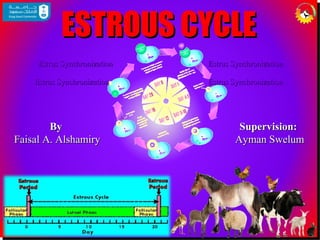
ESTROUS CYCLEESTROUS CYCLE
ByBy
Faisal A. AlshamiryFaisal A. Alshamiry
Supervision:Supervision:
Ayman SwelumAyman Swelum
Estrus SynchronizationEstrus Synchronization Estrus SynchronizationEstrus Synchronization
Estrus SynchronizationEstrus SynchronizationEstrus SynchronizationEstrus Synchronization
DEFINITIONS:
ESTROUS CYCLE: Reproductive cycle of
female, generally defined as period from one
estrus to the next.
 Two phases:
 Follicular Phase
 Luteal phase
DEFINITIONS :
 ESTRUS: Period of sexual receptivity.
• Commonly referred to as “Heat”
 ANESTRUS: Period when female does not
experience cycles
• Occurs during pregnancy, etc.
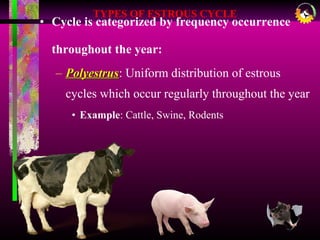
• Cycle is categorized by frequency occurrence
throughout the year:
– PolyestrusPolyestrus: Uniform distribution of estrous
cycles which occur regularly throughout the year
• Example: Cattle, Swine, Rodents
TYPES OF ESTROUS CYCLE
• Seasonally polyestrus:
– Cycles occur only during certain times of the
year
• Long-day breeders:
– Cycle when day length increases
Example: Mare
• Short-day breeders:
– Begin to cycle as day length decreases
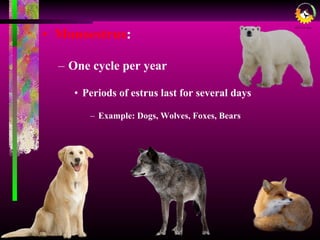
• Monoestrus:
– One cycle per year
• Periods of estrus last for several days
– Example: Dogs, Wolves, Foxes, Bears
PHASES OF ESTROUS CYCLEPHASES OF ESTROUS CYCLE
• FOLLICULAR PHASE:
– Short phase - only 20% of cycle
– Period from regression of corpus luteum to
ovulation
– Preovulatory follicle
– Dominant hormone is estradiol
PHASES OF ESTROUS CYCLEPHASES OF ESTROUS CYCLE
• LUTEAL PHASE:
– Long phase - 80% of cycle
– Period from ovulation to corpus luteum regression
– Corpora lutea
– Dominant hormone is progesterone
– Follicle continue to grow and regress during this
phase
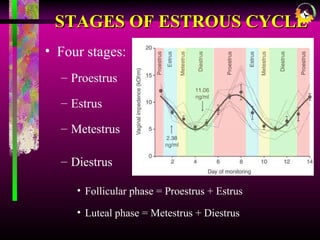
STAGES OF ESTROUS CYCLESTAGES OF ESTROUS CYCLE
• Four stages:
– Proestrus
– Estrus
– Metestrus
– Diestrus
• Follicular phase = Proestrus + Estrus
• Luteal phase = Metestrus + Diestrus
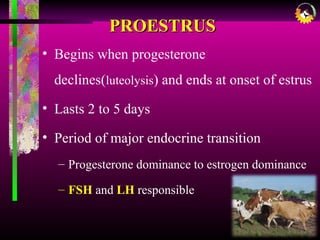
PROESTRUSPROESTRUS
• Begins when progesterone
declines(luteolysis) and ends at onset of estrus
• Lasts 2 to 5 days
• Period of major endocrine transition
– Progesterone dominance to estrogen dominance
– FSH and LH responsible
ProestrusProestrus
“Building Up”
– Ovarian follicle, with enclosed ovum, increase in size
– Estrogens absorbed from the follicles into
blood stream stimulate increased vascularity
and cell growth of tubular genitalia, in
preparation for estrus and pregnancy
EstrusEstrus
• Period of sexual receptivity
• Large increase in estrogen
– stimulates release of LHRHLHRH
• FSHFSH decreases due to estrogen and inhibin
– During or shortly after estrus, ovulation
occurs due to major surge in LHLH
– LHLH levels increase due to LHRHLHRH
– Estrus stops once ovulation occurs.
MetestrusMetestrus
• Corpus Luteum predominant
• ↑↑Increase in progesterone, ↆↆ decrease in estrogen
• Endometrial lining thickens and uterine
muscles show increased development.
DiestrusDiestrus
• Relatively short period of time between
estrous cycles during the breeding season
of polyestrous animals
– No reproductive activity
• CL is fully functional*
• High levels of progesterone
• End with luteolysis
• 10 to 14 days (Depending on the species of
animal(
Prolonged Diestrus
*corpora lutea
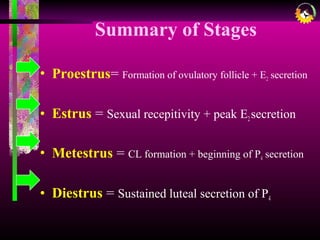
Summary of Stages
• Proestrus= Formation of ovulatory follicle + E2 secretion
• Estrus = Sexual recepitivity + peak E2secretion
• Metestrus = CL formation + beginning of P4 secretion
• Diestrus = Sustained luteal secretion of P4
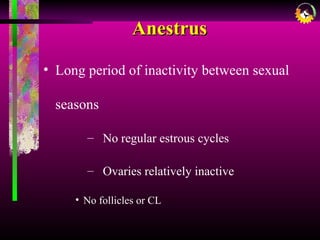
AnestrusAnestrus
• Long period of inactivity between sexual
seasons
– No regular estrous cycles
– Ovaries relatively inactive
• No follicles or CL
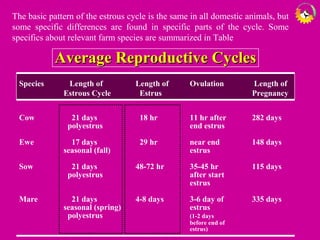
Average Reproductive CyclesAverage Reproductive Cycles
Species Length of Length of Ovulation Length of
Estrous Cycle Estrus Pregnancy
Cow 21 days 18 hr 11 hr after 282 days
polyestrus end estrus
Ewe 17 days 29 hr near end 148 days
seasonal (fall) estrus
Sow 21 days 48-72 hr 35-45 hr 115 days
polyestrus after start
estrus
Mare 21 days 4-8 days 3-6 day of 335 days
seasonal (spring) estrus
polyestrus (1-2 days
before end of
estrus)
The basic pattern of the estrous cycle is the same in all domestic animals, but
some specific differences are found in specific parts of the cycle. Some
specifics about relevant farm species are summarized in Table
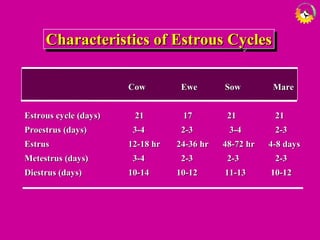
Characteristics of Estrous CyclesCharacteristics of Estrous CyclesCharacteristics of Estrous CyclesCharacteristics of Estrous Cycles
CowCow EweEwe SowSow MareMare
Estrous cycle (days)Estrous cycle (days) 2121 1717 2121 2121
Proestrus (days)Proestrus (days) 3-43-4 2-32-3 3-43-4 2-32-3
EstrusEstrus 12-18 hr12-18 hr 24-36 hr24-36 hr 48-72 hr48-72 hr 4-8 days4-8 days
Metestrus (days)Metestrus (days) 3-43-4 2-32-3 2-32-3 2-32-3
Diestrus (days)Diestrus (days) 10-1410-14 10-1210-12 11-1311-13 10-1210-12
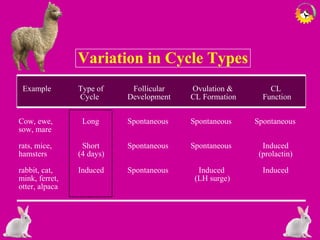
Variation in Cycle Types
Example Type of Follicular Ovulation & CL
Cycle Development CL Formation Function
Cow, ewe, Long Spontaneous Spontaneous Spontaneous
sow, mare
rats, mice, Short Spontaneous Spontaneous Induced
hamsters (4 days) (prolactin)
rabbit, cat, Induced Spontaneous Induced Induced
mink, ferret, (LH surge)
otter, alpaca
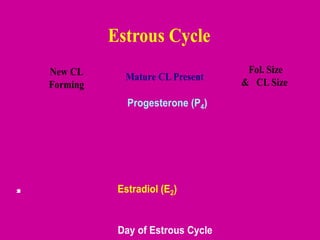
Estrous Cycle
HormoneLevel
Progesterone (P4)
Estradiol (E2)
Day of Estrous Cycle
New CL
Forming
Mature CL Present
Fol. Size
& CL Size
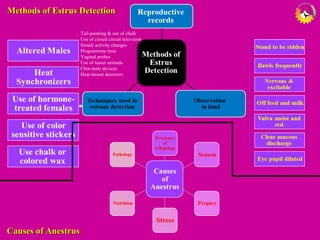
Methods of Estrus DetectionMethods of Estrus Detection
Causes of AnestrusCauses of Anestrus
Tail-painting & use of chalk
Use of closed circuit television
female activity changes
Progesterone tests
Vaginal probes
Use of teaser animals
Chin-male devices
Heat-mount detectors
Atresia
CL
CA
Ovulation
CL
Days Relative to the Gonadotropin Surge
0 1 2 3 4 5 6 7 8-1- 2- 3- 4- 5- 6-7
LH
FSH
PGF2α
Estradiol
Progesterone
Metestrus DiestrusProestrusDiestrus Estrus
11
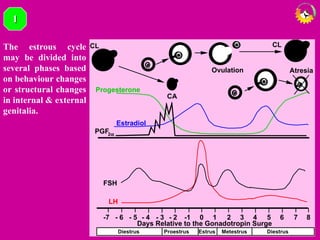
The estrous cycle
may be divided into
several phases based
on behaviour changes
or structural changes
in internal & external
genitalia.
Atresia
CL
CA
Ovulation
CL
Days Relative to the Gonadotropin Surge
0 1 2 3 4 5 6 7 8-1- 2- 3- 4- 5- 6-7
LH
FSH
PGF2α
Estradiol
Progesterone
Metestrus DiestrusProestrusDiestrus Estrus
Follicular Phase
ProestrusProestrus
• Follicle enlarges
• Estrogen increases
• Vascularity of the female
reproductive tract
increases
• Endometrial glands begin
to grow
• Estrogen levels peak
22
EstrusEstrus
• Allows male to mount
• Estrogen decreases
• LH surge occurs
• Ovulation 24-48 h after
surge of LH
• Uterine motility high
with contractions moving
toward oviduct
• Sperm transport is
optimal
• Cervical mucus volume
increases
Follicular Phase33
Atresia
CL
CA
Ovulation
CL
Days Relative to the Gonadotropin Surge
0 1 2 3 4 5 6 7 8-1- 2- 3- 4- 5- 6-7
LH
FSH
PGF2α
Estradiol
Progesterone
Metestrus DiestrusProestrusDiestrus Estrus
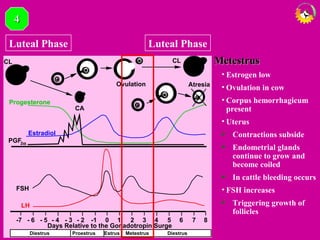
Luteal PhaseLuteal Phase
MetestrusMetestrus
• Estrogen low
• Ovulation in cow
• Corpus hemorrhagicum
present
• Uterus
 Contractions subside
 Endometrial glands
continue to grow and
become coiled
 In cattle bleeding occurs
• FSH increases
 Triggering growth of
follicles
44
Atresia
CL
CA
Ovulation
CL
Days Relative to the Gonadotropin Surge
0 1 2 3 4 5 6 7 8-1- 2- 3- 4- 5- 6-7
LH
FSH
PGF2α
Estradiol
Progesterone
Metestrus DiestrusProestrusDiestrus Estrus
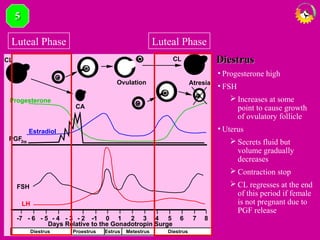
Luteal PhaseLuteal Phase
DiestrusDiestrus
• Progesterone high
• FSH
 Increases at some
point to cause growth
of ovulatory follicle
• Uterus
 Secrets fluid but
volume gradually
decreases
 Contraction stop
 CL regresses at the end
of this period if female
is not pregnant due to
PGF release
55
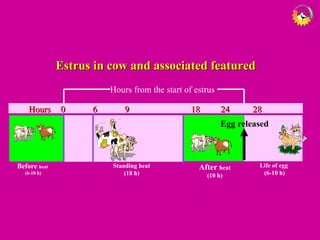
Before heat
(6-10 h)
Hours from the start of estrus
HoursHours 00 66 99 1818 2424 2828
Egg released
Life of egg
(6-10 h)
Standing heat
(18 h)
After heat
(10 h)
Estrus in cow and associated featuredEstrus in cow and associated featured
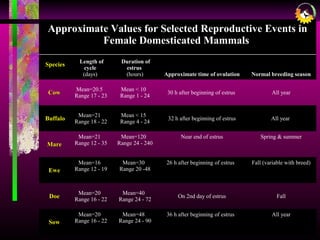
Approximate Values for Selected Reproductive Events in
Female Domesticated Mammals
SpeciesSpecies Length of
cycle
(days)
Duration of
estrus
(hours) Approximate time of ovulation Normal breeding season
CowCow
Mean=20.5
Range 17 - 23
Mean < 10
Range 1 - 24
30 h after beginning of estrus All year
BuffaloBuffalo
Mean=21
Range 18 - 22
Mean < 15
Range 4 - 24
32 h after beginning of estrus All year
MareMare
Mean=21
Range 12 - 35
Mean=120
Range 24 - 240
Near end of estrus Spring & summer
EweEwe
Mean=16
Range 12 - 19
Mean=30
Range 20 -48
26 h after beginning of estrus Fall (variable with breed)
DoeDoe
Mean=20
Range 16 - 22
Mean=40
Range 24 - 72
On 2nd day of estrus Fall
SowSow
Mean=20
Range 16 - 22
Mean=48
Range 24 - 90
36 h after beginning of estrus All year
Presentation on ESTROUS CYCLE

Presentation on ESTROUS CYCLE

  • 1.
    ESTROUS CYCLEESTROUS CYCLE ByBy FaisalA. AlshamiryFaisal A. Alshamiry Supervision:Supervision: Ayman SwelumAyman Swelum Estrus SynchronizationEstrus Synchronization Estrus SynchronizationEstrus Synchronization Estrus SynchronizationEstrus SynchronizationEstrus SynchronizationEstrus Synchronization
  • 2.
    DEFINITIONS: ESTROUS CYCLE: Reproductivecycle of female, generally defined as period from one estrus to the next.  Two phases:  Follicular Phase  Luteal phase
  • 3.
    DEFINITIONS :  ESTRUS:Period of sexual receptivity. • Commonly referred to as “Heat”  ANESTRUS: Period when female does not experience cycles • Occurs during pregnancy, etc.
  • 4.
    • Cycle iscategorized by frequency occurrence throughout the year: – PolyestrusPolyestrus: Uniform distribution of estrous cycles which occur regularly throughout the year • Example: Cattle, Swine, Rodents TYPES OF ESTROUS CYCLE
  • 5.
    • Seasonally polyestrus: –Cycles occur only during certain times of the year • Long-day breeders: – Cycle when day length increases Example: Mare • Short-day breeders: – Begin to cycle as day length decreases
  • 6.
    • Monoestrus: – Onecycle per year • Periods of estrus last for several days – Example: Dogs, Wolves, Foxes, Bears
  • 7.
    PHASES OF ESTROUSCYCLEPHASES OF ESTROUS CYCLE • FOLLICULAR PHASE: – Short phase - only 20% of cycle – Period from regression of corpus luteum to ovulation – Preovulatory follicle – Dominant hormone is estradiol
  • 8.
    PHASES OF ESTROUSCYCLEPHASES OF ESTROUS CYCLE • LUTEAL PHASE: – Long phase - 80% of cycle – Period from ovulation to corpus luteum regression – Corpora lutea – Dominant hormone is progesterone – Follicle continue to grow and regress during this phase
  • 9.
    STAGES OF ESTROUSCYCLESTAGES OF ESTROUS CYCLE • Four stages: – Proestrus – Estrus – Metestrus – Diestrus • Follicular phase = Proestrus + Estrus • Luteal phase = Metestrus + Diestrus
  • 10.
    PROESTRUSPROESTRUS • Begins whenprogesterone declines(luteolysis) and ends at onset of estrus • Lasts 2 to 5 days • Period of major endocrine transition – Progesterone dominance to estrogen dominance – FSH and LH responsible
  • 11.
    ProestrusProestrus “Building Up” – Ovarianfollicle, with enclosed ovum, increase in size – Estrogens absorbed from the follicles into blood stream stimulate increased vascularity and cell growth of tubular genitalia, in preparation for estrus and pregnancy
  • 12.
    EstrusEstrus • Period ofsexual receptivity • Large increase in estrogen – stimulates release of LHRHLHRH • FSHFSH decreases due to estrogen and inhibin – During or shortly after estrus, ovulation occurs due to major surge in LHLH – LHLH levels increase due to LHRHLHRH – Estrus stops once ovulation occurs.
  • 13.
    MetestrusMetestrus • Corpus Luteumpredominant • ↑↑Increase in progesterone, ↆↆ decrease in estrogen • Endometrial lining thickens and uterine muscles show increased development.
  • 14.
    DiestrusDiestrus • Relatively shortperiod of time between estrous cycles during the breeding season of polyestrous animals – No reproductive activity
  • 15.
    • CL isfully functional* • High levels of progesterone • End with luteolysis • 10 to 14 days (Depending on the species of animal( Prolonged Diestrus *corpora lutea
  • 16.
    Summary of Stages •Proestrus= Formation of ovulatory follicle + E2 secretion • Estrus = Sexual recepitivity + peak E2secretion • Metestrus = CL formation + beginning of P4 secretion • Diestrus = Sustained luteal secretion of P4
  • 17.
    AnestrusAnestrus • Long periodof inactivity between sexual seasons – No regular estrous cycles – Ovaries relatively inactive • No follicles or CL
  • 18.
    Average Reproductive CyclesAverageReproductive Cycles Species Length of Length of Ovulation Length of Estrous Cycle Estrus Pregnancy Cow 21 days 18 hr 11 hr after 282 days polyestrus end estrus Ewe 17 days 29 hr near end 148 days seasonal (fall) estrus Sow 21 days 48-72 hr 35-45 hr 115 days polyestrus after start estrus Mare 21 days 4-8 days 3-6 day of 335 days seasonal (spring) estrus polyestrus (1-2 days before end of estrus) The basic pattern of the estrous cycle is the same in all domestic animals, but some specific differences are found in specific parts of the cycle. Some specifics about relevant farm species are summarized in Table
  • 19.
    Characteristics of EstrousCyclesCharacteristics of Estrous CyclesCharacteristics of Estrous CyclesCharacteristics of Estrous Cycles CowCow EweEwe SowSow MareMare Estrous cycle (days)Estrous cycle (days) 2121 1717 2121 2121 Proestrus (days)Proestrus (days) 3-43-4 2-32-3 3-43-4 2-32-3 EstrusEstrus 12-18 hr12-18 hr 24-36 hr24-36 hr 48-72 hr48-72 hr 4-8 days4-8 days Metestrus (days)Metestrus (days) 3-43-4 2-32-3 2-32-3 2-32-3 Diestrus (days)Diestrus (days) 10-1410-14 10-1210-12 11-1311-13 10-1210-12
  • 20.
    Variation in CycleTypes Example Type of Follicular Ovulation & CL Cycle Development CL Formation Function Cow, ewe, Long Spontaneous Spontaneous Spontaneous sow, mare rats, mice, Short Spontaneous Spontaneous Induced hamsters (4 days) (prolactin) rabbit, cat, Induced Spontaneous Induced Induced mink, ferret, (LH surge) otter, alpaca
  • 21.
    Estrous Cycle HormoneLevel Progesterone (P4) Estradiol(E2) Day of Estrous Cycle New CL Forming Mature CL Present Fol. Size & CL Size
  • 22.
    Methods of EstrusDetectionMethods of Estrus Detection Causes of AnestrusCauses of Anestrus Tail-painting & use of chalk Use of closed circuit television female activity changes Progesterone tests Vaginal probes Use of teaser animals Chin-male devices Heat-mount detectors
  • 23.
    Atresia CL CA Ovulation CL Days Relative tothe Gonadotropin Surge 0 1 2 3 4 5 6 7 8-1- 2- 3- 4- 5- 6-7 LH FSH PGF2α Estradiol Progesterone Metestrus DiestrusProestrusDiestrus Estrus 11 The estrous cycle may be divided into several phases based on behaviour changes or structural changes in internal & external genitalia.
  • 24.
    Atresia CL CA Ovulation CL Days Relative tothe Gonadotropin Surge 0 1 2 3 4 5 6 7 8-1- 2- 3- 4- 5- 6-7 LH FSH PGF2α Estradiol Progesterone Metestrus DiestrusProestrusDiestrus Estrus Follicular Phase ProestrusProestrus • Follicle enlarges • Estrogen increases • Vascularity of the female reproductive tract increases • Endometrial glands begin to grow • Estrogen levels peak 22
  • 25.
    EstrusEstrus • Allows maleto mount • Estrogen decreases • LH surge occurs • Ovulation 24-48 h after surge of LH • Uterine motility high with contractions moving toward oviduct • Sperm transport is optimal • Cervical mucus volume increases Follicular Phase33
  • 26.
    Atresia CL CA Ovulation CL Days Relative tothe Gonadotropin Surge 0 1 2 3 4 5 6 7 8-1- 2- 3- 4- 5- 6-7 LH FSH PGF2α Estradiol Progesterone Metestrus DiestrusProestrusDiestrus Estrus Luteal PhaseLuteal Phase MetestrusMetestrus • Estrogen low • Ovulation in cow • Corpus hemorrhagicum present • Uterus  Contractions subside  Endometrial glands continue to grow and become coiled  In cattle bleeding occurs • FSH increases  Triggering growth of follicles 44
  • 27.
    Atresia CL CA Ovulation CL Days Relative tothe Gonadotropin Surge 0 1 2 3 4 5 6 7 8-1- 2- 3- 4- 5- 6-7 LH FSH PGF2α Estradiol Progesterone Metestrus DiestrusProestrusDiestrus Estrus Luteal PhaseLuteal Phase DiestrusDiestrus • Progesterone high • FSH  Increases at some point to cause growth of ovulatory follicle • Uterus  Secrets fluid but volume gradually decreases  Contraction stop  CL regresses at the end of this period if female is not pregnant due to PGF release 55
  • 28.
    Before heat (6-10 h) Hoursfrom the start of estrus HoursHours 00 66 99 1818 2424 2828 Egg released Life of egg (6-10 h) Standing heat (18 h) After heat (10 h) Estrus in cow and associated featuredEstrus in cow and associated featured
  • 29.
    Approximate Values forSelected Reproductive Events in Female Domesticated Mammals SpeciesSpecies Length of cycle (days) Duration of estrus (hours) Approximate time of ovulation Normal breeding season CowCow Mean=20.5 Range 17 - 23 Mean < 10 Range 1 - 24 30 h after beginning of estrus All year BuffaloBuffalo Mean=21 Range 18 - 22 Mean < 15 Range 4 - 24 32 h after beginning of estrus All year MareMare Mean=21 Range 12 - 35 Mean=120 Range 24 - 240 Near end of estrus Spring & summer EweEwe Mean=16 Range 12 - 19 Mean=30 Range 20 -48 26 h after beginning of estrus Fall (variable with breed) DoeDoe Mean=20 Range 16 - 22 Mean=40 Range 24 - 72 On 2nd day of estrus Fall SowSow Mean=20 Range 16 - 22 Mean=48 Range 24 - 90 36 h after beginning of estrus All year