Chapter 11- 3
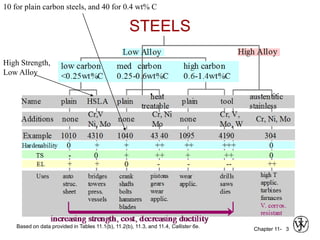
Based on data provided in Tables 11.1(b), 11.2(b), 11.3, and 11.4, Callister 6e.
STEELS
High Strength,
Low Alloy
10 for plain carbon steels, and 40 for 0.4 wt% C
Chapter 11- 4
NonFerrous
Alloys
• Cu Alloys
Brass : Zn is subst. impurity
(costume jewelry, coins,
corrosion resistant)
Bronze : Sn, Al, Si, Ni are
subst. impurity
(bushings, landing
gear)
Cu-Be :
precip. hardened
for strength
• Al Alloys
-lower : 2.7g/cm 3
-Cu, Mg, Si, Mn, Zn additions
-solid sol. or precip.
strengthened (struct.
aircraft parts
& packaging)
• Mg Alloys
-very low : 1.7g/cm 3
-ignites easily
-aircraft, missles
• Refractory metals
-high melting T
-Nb, Mo, W, Ta
• Noble metals
-Ag, Au, Pt
-oxid./corr. resistant
• Ti Alloys
-lower : 4.5g/cm 3
vs 7.9 for steel
-reactive at high T
-space applic.
Based on discussion and data provided in Section 11.3, Callister 6e.
NONFERROUS ALLOYS
Chapter 11- 5
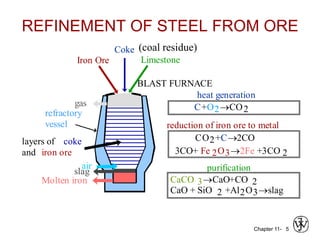
Iron Ore
Coke
Limestone
3CO+ Fe 2O32Fe +3CO 2
C+O2CO2
CO2+C2CO
CaCO 3CaO+CO 2
CaO + SiO 2 +Al2O3slag
purification
reduction of iron ore to metal
heat generation
Molten iron
BLAST FURNACE
slag
air
layers of coke
and iron ore
gas
refractory
vessel
REFINEMENT OF STEEL FROM ORE
(coal residue)
Chapter 11- 6
Ao Ad
force
die
blank
force
• Forging
(wrenches, crankshafts)
FORMING
• Drawing
(rods, wire, tubing)
often at
elev. T
• Rolling
(I-beams, rails)
• Extrusion
(rods, tubing)
Adapted from
Fig. 11.7,
Callister 6e.
tensile
force
Ao
Ad
die
die
METAL FABRICATION METHODS-I
Chapter 11- 7
• Hot working
--recrystallization
--less energy to deform
--oxidation: poor finish
--lower strength
• Cold working
-- no recrystallization
-- more energy to deform
-- no oxidation: good finish
-- higher strength
• Cold worked microstructures
--generally are very anisotropic!
--Forged --Fracture resistant!
Reprinted w/ permission from R.W. Hertzberg, "Deformation and Fracture Mechanics of Engineering Materials",
(4th ed.), John Wiley and Sons, Inc., 1996. (a) Fig. 10.5, p. 410 (micrograph courtesy of G. Vander Voort, Car Tech
Corp.); (b) Fig. 10.6(b), p. 411 (Orig. source: J.F. Peck and D.A. Thomas,
Trans. Metall. Soc. AIME, 1961, p. 1240); (c) Fig. 10.10, p. 415 (Orig. source: A.J. McEvily, Jr.
and R.H. Bush, Trans. ASM 55, 1962, p. 654.)
(a) (b) (c)
--Swaged
FORMING TEMPERATURE
Chapter 11-
plaster
die formed
around wax
prototype
8
CASTING
• Sand Casting
(large parts, e.g.,
auto engine blocks)
• Investment Casting
(low volume, complex shapes
e.g., jewelry, turbine blades)
• Die Casting
(high volume, low T alloys)
• Continuous Casting
(simple slab shapes)
METAL FABRICATION METHODS-II
Chapter 11- 9
CASTING
FORMING JOINING
• Powder Processing
(materials w/low ductility)
• Welding
(when one large part is
impractical)
• Heat affected zone:
(region in which the
microstructure has been
changed).
Adapted from Fig.
11.8, Callister 6e.
(Fig. 11.8 from Iron
Castings
Handbook, C.F.
Walton and T.J.
Opar (Ed.), 1981.)
piece 1 piece 2
fused base metal
filler metal (melted)
base metal (melted)
unaffected
unaffected
heat affected zone
METAL FABRICATION METHODS-III
Chapter 11- 10
Annealing: Heat to Tanneal, then cool slowly.
Based on discussion in Section 11.7, Callister 6e.
THERMAL PROCESSING OF METALS
Chapter 11- 10
Based on discussion in Section 11.7, Callister 6e.
THERMAL PROCESSING OF METALS
Chapter 11- 11
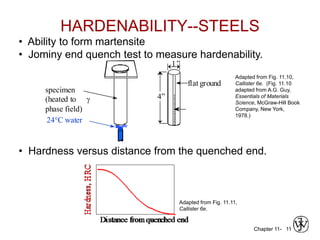
• Ability to form martensite
• Jominy end quench test to measure hardenability.
• Hardness versus distance from the quenched end.
24°C water
specimen
(heated to 
phase field)
flat ground
4”
1”
Adapted from Fig. 11.10,
Callister 6e. (Fig. 11.10
adapted from A.G. Guy,
Essentials of Materials
Science, McGraw-Hill Book
Company, New York,
1978.)
Adapted from Fig. 11.11,
Callister 6e.
HARDENABILITY--STEELS
Chapter 11- 12
• The cooling rate varies with position.
Adapted from Fig. 11.12, Callister 6e.
(Fig. 11.12 adapted from H. Boyer (Ed.)
Atlas of Isothermal Transformation and
Cooling Transformation Diagrams,
American Society for Metals, 1977, p.
376.)
WHY HARDNESS CHANGES W/POSITION
Chapter 11- 13
• Jominy end quench
results, C = 0.4wt%C
• "Alloy Steels"
(4140, 4340, 5140, 8640)
--contain Ni, Cr, Mo
(0.2 to 2wt%)
--these elements shift
the "nose".
--martensite is easier
to form.
Adapted from Fig. 11.13, Callister 6e.
(Fig. 11.13 adapted from figure furnished
courtesy Republic Steel Corporation.)
HARDENABILITY VS ALLOY CONTENT
Chapter 11- 14
• Effect of quenching medium:
Medium
air
oil
water
Severity of Quench
small
moderate
large
Hardness
small
moderate
large
• Effect of geometry:
When surface-to-volume ratio increases:
--cooling rate increases
--hardness increases
Position
center
surface
Cooling rate
small
large
Hardness
small
large
QUENCHING MEDIUM & GEOMETRY
Chapter 11- 15
• Ex: Round bar, 1040 steel, water quenched, 2" diam.
Adapted from Fig. 11.18, Callister 6e.
PREDICTING HARDNESS PROFILES

Steels And Their Composition

  • 1.
    Chapter 11- 3 Basedon data provided in Tables 11.1(b), 11.2(b), 11.3, and 11.4, Callister 6e. STEELS High Strength, Low Alloy 10 for plain carbon steels, and 40 for 0.4 wt% C
  • 2.
    Chapter 11- 4 NonFerrous Alloys •Cu Alloys Brass : Zn is subst. impurity (costume jewelry, coins, corrosion resistant) Bronze : Sn, Al, Si, Ni are subst. impurity (bushings, landing gear) Cu-Be : precip. hardened for strength • Al Alloys -lower : 2.7g/cm 3 -Cu, Mg, Si, Mn, Zn additions -solid sol. or precip. strengthened (struct. aircraft parts & packaging) • Mg Alloys -very low : 1.7g/cm 3 -ignites easily -aircraft, missles • Refractory metals -high melting T -Nb, Mo, W, Ta • Noble metals -Ag, Au, Pt -oxid./corr. resistant • Ti Alloys -lower : 4.5g/cm 3 vs 7.9 for steel -reactive at high T -space applic. Based on discussion and data provided in Section 11.3, Callister 6e. NONFERROUS ALLOYS
  • 3.
    Chapter 11- 5 IronOre Coke Limestone 3CO+ Fe 2O32Fe +3CO 2 C+O2CO2 CO2+C2CO CaCO 3CaO+CO 2 CaO + SiO 2 +Al2O3slag purification reduction of iron ore to metal heat generation Molten iron BLAST FURNACE slag air layers of coke and iron ore gas refractory vessel REFINEMENT OF STEEL FROM ORE (coal residue)
  • 4.
    Chapter 11- 6 AoAd force die blank force • Forging (wrenches, crankshafts) FORMING • Drawing (rods, wire, tubing) often at elev. T • Rolling (I-beams, rails) • Extrusion (rods, tubing) Adapted from Fig. 11.7, Callister 6e. tensile force Ao Ad die die METAL FABRICATION METHODS-I
  • 5.
    Chapter 11- 7 •Hot working --recrystallization --less energy to deform --oxidation: poor finish --lower strength • Cold working -- no recrystallization -- more energy to deform -- no oxidation: good finish -- higher strength • Cold worked microstructures --generally are very anisotropic! --Forged --Fracture resistant! Reprinted w/ permission from R.W. Hertzberg, "Deformation and Fracture Mechanics of Engineering Materials", (4th ed.), John Wiley and Sons, Inc., 1996. (a) Fig. 10.5, p. 410 (micrograph courtesy of G. Vander Voort, Car Tech Corp.); (b) Fig. 10.6(b), p. 411 (Orig. source: J.F. Peck and D.A. Thomas, Trans. Metall. Soc. AIME, 1961, p. 1240); (c) Fig. 10.10, p. 415 (Orig. source: A.J. McEvily, Jr. and R.H. Bush, Trans. ASM 55, 1962, p. 654.) (a) (b) (c) --Swaged FORMING TEMPERATURE
  • 6.
    Chapter 11- plaster die formed aroundwax prototype 8 CASTING • Sand Casting (large parts, e.g., auto engine blocks) • Investment Casting (low volume, complex shapes e.g., jewelry, turbine blades) • Die Casting (high volume, low T alloys) • Continuous Casting (simple slab shapes) METAL FABRICATION METHODS-II
  • 7.
    Chapter 11- 9 CASTING FORMINGJOINING • Powder Processing (materials w/low ductility) • Welding (when one large part is impractical) • Heat affected zone: (region in which the microstructure has been changed). Adapted from Fig. 11.8, Callister 6e. (Fig. 11.8 from Iron Castings Handbook, C.F. Walton and T.J. Opar (Ed.), 1981.) piece 1 piece 2 fused base metal filler metal (melted) base metal (melted) unaffected unaffected heat affected zone METAL FABRICATION METHODS-III
  • 8.
    Chapter 11- 10 Annealing:Heat to Tanneal, then cool slowly. Based on discussion in Section 11.7, Callister 6e. THERMAL PROCESSING OF METALS
  • 9.
    Chapter 11- 10 Basedon discussion in Section 11.7, Callister 6e. THERMAL PROCESSING OF METALS
  • 10.
    Chapter 11- 11 •Ability to form martensite • Jominy end quench test to measure hardenability. • Hardness versus distance from the quenched end. 24°C water specimen (heated to  phase field) flat ground 4” 1” Adapted from Fig. 11.10, Callister 6e. (Fig. 11.10 adapted from A.G. Guy, Essentials of Materials Science, McGraw-Hill Book Company, New York, 1978.) Adapted from Fig. 11.11, Callister 6e. HARDENABILITY--STEELS
  • 11.
    Chapter 11- 12 •The cooling rate varies with position. Adapted from Fig. 11.12, Callister 6e. (Fig. 11.12 adapted from H. Boyer (Ed.) Atlas of Isothermal Transformation and Cooling Transformation Diagrams, American Society for Metals, 1977, p. 376.) WHY HARDNESS CHANGES W/POSITION
  • 12.
    Chapter 11- 13 •Jominy end quench results, C = 0.4wt%C • "Alloy Steels" (4140, 4340, 5140, 8640) --contain Ni, Cr, Mo (0.2 to 2wt%) --these elements shift the "nose". --martensite is easier to form. Adapted from Fig. 11.13, Callister 6e. (Fig. 11.13 adapted from figure furnished courtesy Republic Steel Corporation.) HARDENABILITY VS ALLOY CONTENT
  • 13.
    Chapter 11- 14 •Effect of quenching medium: Medium air oil water Severity of Quench small moderate large Hardness small moderate large • Effect of geometry: When surface-to-volume ratio increases: --cooling rate increases --hardness increases Position center surface Cooling rate small large Hardness small large QUENCHING MEDIUM & GEOMETRY
  • 14.
    Chapter 11- 15 •Ex: Round bar, 1040 steel, water quenched, 2" diam. Adapted from Fig. 11.18, Callister 6e. PREDICTING HARDNESS PROFILES