Powerpoint Templates 
Page 1 
Diffusion 
Material Science Presentation 
by Group 5
Powerpoint Templates 
Page 2 
Topics Covered 
 What is Diffusion? 
•Interdiffusion 
•Self-diffusion 
 Diffusion Mechanisms 
 Vacancy Diffusion 
 Interstitial Diffusion 
 Mathematics of Diffusion (Fick’s Laws) 
• Steady-State Diffusion 
• Non Steady-State Diffusion 
 Factors affecting Diffusion 
• Diffusing Species 
• Host Solid 
• Temperature 
• Microstructure
Powerpoint Templates 
Page 3 
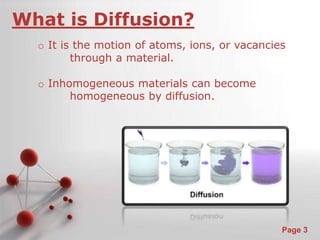
What is Diffusion? 
o It is the motion of atoms, ions, or vacancies 
through a material. 
o Inhomogeneous materials can become 
homogeneous by diffusion.
Interdiffusion and Self-diffusion 
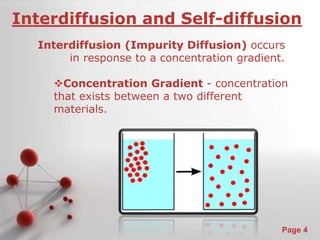
Interdiffusion (Impurity Diffusion) occurs 
in response to a concentration gradient. 
Concentration Gradient - concentration 
that exists between a two different 
materials. 
Powerpoint Templates 
Page 4
Interdiffusion and Self-diffusion 
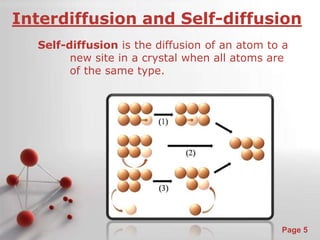
Self-diffusion is the diffusion of an atom to a 
new site in a crystal when all atoms are 
of the same type. 
Powerpoint Templates 
Page 5
Powerpoint Templates 
Page 6 
Diffusion Mechanisms 
1) Vacancy Diffusion 
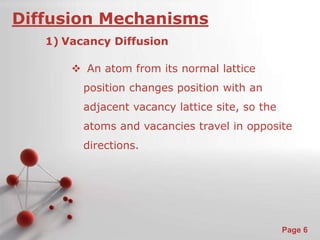
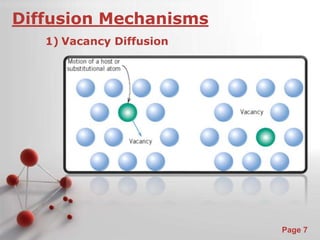
 An atom from its normal lattice 
position changes position with an 
adjacent vacancy lattice site, so the 
atoms and vacancies travel in opposite 
directions.
Powerpoint Templates 
Page 7 
Diffusion Mechanisms 
1) Vacancy Diffusion
Powerpoint Templates 
Page 8 
Diffusion Mechanisms 
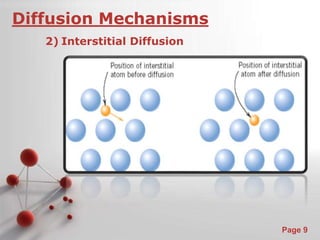
2) Interstitial Diffusion 
 Atoms move from one interstitial site to 
another vacant interstitial site. 
 Interstitial diffusion is generally faster 
than vacancy diffusion because bonding 
of interstitials to the surrounding atoms 
is normally weaker and there are many 
more interstitial sites than vacancy sites 
to jump to. 
 Requires small impurity atoms (e.g. C, 
H, O) to fit into interstices in host.
Powerpoint Templates 
Page 9 
Diffusion Mechanisms 
2) Interstitial Diffusion
Powerpoint Templates 
Page 10 
Other mechanisms which are quite rare but nonetheless 
important in semiconductors are: 
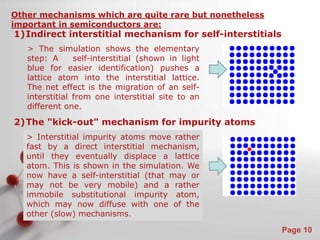
1)Indirect interstitial mechanism for self-interstitials 
> The simulation shows the elementary 
step: A self-interstitial (shown in light 
blue for easier identification) pushes a 
lattice atom into the interstitial lattice. 
The net effect is the migration of an self-interstitial 
from one interstitial site to an 
different one. 
2)The "kick-out" mechanism for impurity atoms 
> Interstitial impurity atoms move rather 
fast by a direct interstitial mechanism, 
until they eventually displace a lattice 
atom. This is shown in the simulation. We 
now have a self-interstitial (that may or 
may not be very mobile) and a rather 
immobile substitutional impurity atom, 
which may now diffuse with one of the 
other (slow) mechanisms.
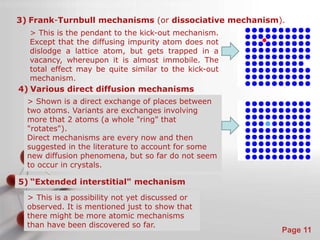
3) Frank-Turnbull mechanisms (or dissociative mechanism). 
5) “Extended interstitial" mechanism 
Powerpoint Templates 
Page 11 
> This is the pendant to the kick-out mechanism. 
Except that the diffusing impurity atom does not 
dislodge a lattice atom, but gets trapped in a 
vacancy, whereupon it is almost immobile. The 
total effect may be quite similar to the kick-out 
mechanism. 
4) Various direct diffusion mechanisms 
> Shown is a direct exchange of places between 
two atoms. Variants are exchanges involving 
more that 2 atoms (a whole "ring" that 
"rotates"). 
Direct mechanisms are every now and then 
suggested in the literature to account for some 
new diffusion phenomena, but so far do not seem 
to occur in crystals. 
> This is a possibility not yet discussed or 
observed. It is mentioned just to show that 
there might be more atomic mechanisms 
than have been discovered so far.
dC 
Powerpoint Templates 
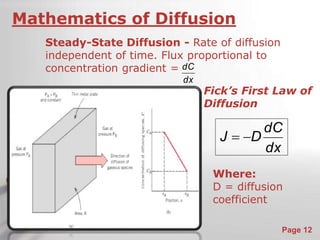
Fick’s First Law of 
Diffusion 
dC 
Page 12 
Mathematics of Diffusion 
Steady-State Diffusion - Rate of diffusion 
independent of time. Flux proportional to 
concentration gradient = 
dx 
dx 
J  D 
Where: 
D = diffusion 
coefficient
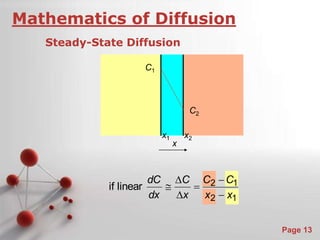
C C 
C 
dC 
 
 
if linear 2 1 
Powerpoint Templates 
Page 13 
Mathematics of Diffusion 
Steady-State Diffusion 
C1 
C2 
x 
C1 
C2 
x1 x2 
x x 
2 1 
x 
dx 
 
 
 

C1 = 0.44 g/cm3 
Powerpoint Templates 
Page 14 
Mathematics of Diffusion 
Steady-State Diffusion 
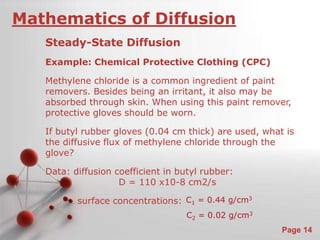
Example: Chemical Protective Clothing (CPC) 
Methylene chloride is a common ingredient of paint 
removers. Besides being an irritant, it also may be 
absorbed through skin. When using this paint remover, 
protective gloves should be worn. 
If butyl rubber gloves (0.04 cm thick) are used, what is 
the diffusive flux of methylene chloride through the 
glove? 
Data: diffusion coefficient in butyl rubber: 
D = 110 x10-8 cm2/s 
surface concentrations: 
C2 = 0.02 g/cm3
2 
C C 
D 
dC 
 
- 2 1 
C1 = 0.44 g/cm3 
Data: 
(0.02 g/cm  
0.44 g/cm ) 
C1 
skin paint 
remover 
(110 x 10 cm /s) 2 
Powerpoint Templates 
x x 
g 
Page 15 
Mathematics of Diffusion 
Steady-State Diffusion 
Example: Chemical Protective Clothing (CPC) 
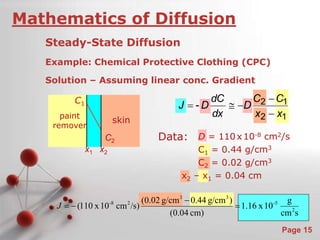
Solution – Assuming linear conc. Gradient 
D 
tb 
6 
 
2 1 
dx 
J D 
 
   
cm s 
1.16 x 10 
(0.04 cm) 
-5 
3 3 
-8 2  
J   
C2 
x1 x2 
D = 110x10-8 cm2/s 
C2 = 0.02 g/cm3 
x2 – x1 = 0.04 cm
Powerpoint Templates 
Page 16 
Mathematics of Diffusion 
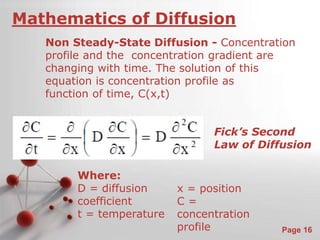
Non Steady-State Diffusion - Concentration 
profile and the concentration gradient are 
changing with time. The solution of this 
equation is concentration profile as 
function of time, C(x,t) 
Fick’s Second 
Law of Diffusion 
Where: 
D = diffusion 
coefficient 
t = temperature 
x = position 
C = 
concentration 
profile
Non Steady-State Diffusion 
Powerpoint Templates 
Page 17 
Mathematics of Diffusion 
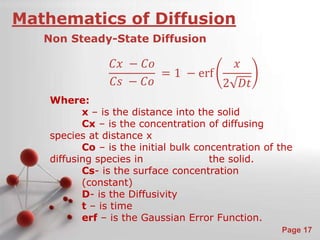
퐶푥 − 퐶표 
퐶푠 − 퐶표 
= 1 − erf 
푥 
2 퐷푡 
Where: 
x – is the distance into the solid 
Cx – is the concentration of diffusing 
species at distance x 
Co – is the initial bulk concentration of the 
diffusing species in the solid. 
Cs- is the surface concentration 
(constant) 
D- is the Diffusivity 
t – is time 
erf – is the Gaussian Error Function.
Powerpoint Templates 
Page 18 
Mathematics of Diffusion 
Non Steady-State Diffusion 
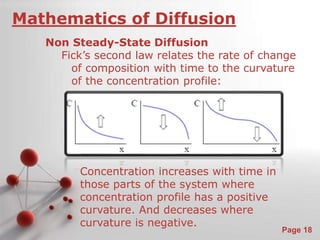
Fick’s second law relates the rate of change 
of composition with time to the curvature 
of the concentration profile: 
Concentration increases with time in 
those parts of the system where 
concentration profile has a positive 
curvature. And decreases where 
curvature is negative.
Powerpoint Templates 
Page 19 
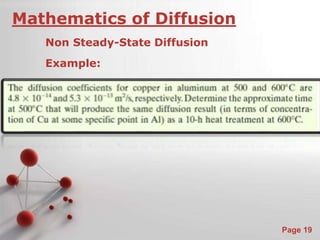
Mathematics of Diffusion 
Non Steady-State Diffusion 
Example:
Powerpoint Templates 
Page 20 
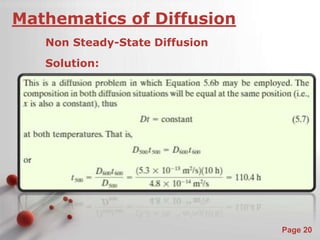
Mathematics of Diffusion 
Non Steady-State Diffusion 
Solution:
Powerpoint Templates 
Page 21 
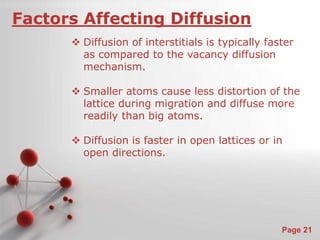
Factors Affecting Diffusion 
 Diffusion of interstitials is typically faster 
as compared to the vacancy diffusion 
mechanism. 
 Smaller atoms cause less distortion of the 
lattice during migration and diffuse more 
readily than big atoms. 
 Diffusion is faster in open lattices or in 
open directions.
Powerpoint Templates 
Page 22 
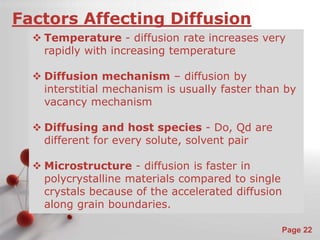
Factors Affecting Diffusion 
 Temperature - diffusion rate increases very 
rapidly with increasing temperature 
 Diffusion mechanism – diffusion by 
interstitial mechanism is usually faster than by 
vacancy mechanism 
 Diffusing and host species - Do, Qd are 
different for every solute, solvent pair 
 Microstructure - diffusion is faster in 
polycrystalline materials compared to single 
crystals because of the accelerated diffusion 
along grain boundaries.
Powerpoint Templates 
Page 23 
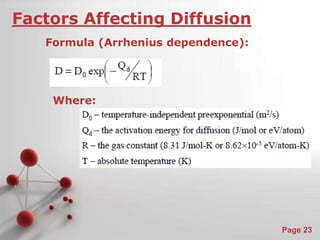
Factors Affecting Diffusion 
Formula (Arrhenius dependence): 
Where:

Diffusion report

  • 1.
    Powerpoint Templates Page1 Diffusion Material Science Presentation by Group 5
  • 2.
    Powerpoint Templates Page2 Topics Covered  What is Diffusion? •Interdiffusion •Self-diffusion  Diffusion Mechanisms  Vacancy Diffusion  Interstitial Diffusion  Mathematics of Diffusion (Fick’s Laws) • Steady-State Diffusion • Non Steady-State Diffusion  Factors affecting Diffusion • Diffusing Species • Host Solid • Temperature • Microstructure
  • 3.
    Powerpoint Templates Page3 What is Diffusion? o It is the motion of atoms, ions, or vacancies through a material. o Inhomogeneous materials can become homogeneous by diffusion.
  • 4.
    Interdiffusion and Self-diffusion Interdiffusion (Impurity Diffusion) occurs in response to a concentration gradient. Concentration Gradient - concentration that exists between a two different materials. Powerpoint Templates Page 4
  • 5.
    Interdiffusion and Self-diffusion Self-diffusion is the diffusion of an atom to a new site in a crystal when all atoms are of the same type. Powerpoint Templates Page 5
  • 6.
    Powerpoint Templates Page6 Diffusion Mechanisms 1) Vacancy Diffusion  An atom from its normal lattice position changes position with an adjacent vacancy lattice site, so the atoms and vacancies travel in opposite directions.
  • 7.
    Powerpoint Templates Page7 Diffusion Mechanisms 1) Vacancy Diffusion
  • 8.
    Powerpoint Templates Page8 Diffusion Mechanisms 2) Interstitial Diffusion  Atoms move from one interstitial site to another vacant interstitial site.  Interstitial diffusion is generally faster than vacancy diffusion because bonding of interstitials to the surrounding atoms is normally weaker and there are many more interstitial sites than vacancy sites to jump to.  Requires small impurity atoms (e.g. C, H, O) to fit into interstices in host.
  • 9.
    Powerpoint Templates Page9 Diffusion Mechanisms 2) Interstitial Diffusion
  • 10.
    Powerpoint Templates Page10 Other mechanisms which are quite rare but nonetheless important in semiconductors are: 1)Indirect interstitial mechanism for self-interstitials > The simulation shows the elementary step: A self-interstitial (shown in light blue for easier identification) pushes a lattice atom into the interstitial lattice. The net effect is the migration of an self-interstitial from one interstitial site to an different one. 2)The "kick-out" mechanism for impurity atoms > Interstitial impurity atoms move rather fast by a direct interstitial mechanism, until they eventually displace a lattice atom. This is shown in the simulation. We now have a self-interstitial (that may or may not be very mobile) and a rather immobile substitutional impurity atom, which may now diffuse with one of the other (slow) mechanisms.
  • 11.
    3) Frank-Turnbull mechanisms(or dissociative mechanism). 5) “Extended interstitial" mechanism Powerpoint Templates Page 11 > This is the pendant to the kick-out mechanism. Except that the diffusing impurity atom does not dislodge a lattice atom, but gets trapped in a vacancy, whereupon it is almost immobile. The total effect may be quite similar to the kick-out mechanism. 4) Various direct diffusion mechanisms > Shown is a direct exchange of places between two atoms. Variants are exchanges involving more that 2 atoms (a whole "ring" that "rotates"). Direct mechanisms are every now and then suggested in the literature to account for some new diffusion phenomena, but so far do not seem to occur in crystals. > This is a possibility not yet discussed or observed. It is mentioned just to show that there might be more atomic mechanisms than have been discovered so far.
  • 12.
    dC Powerpoint Templates Fick’s First Law of Diffusion dC Page 12 Mathematics of Diffusion Steady-State Diffusion - Rate of diffusion independent of time. Flux proportional to concentration gradient = dx dx J  D Where: D = diffusion coefficient
  • 13.
    C C C dC   if linear 2 1 Powerpoint Templates Page 13 Mathematics of Diffusion Steady-State Diffusion C1 C2 x C1 C2 x1 x2 x x 2 1 x dx    
  • 14.
    C1 = 0.44g/cm3 Powerpoint Templates Page 14 Mathematics of Diffusion Steady-State Diffusion Example: Chemical Protective Clothing (CPC) Methylene chloride is a common ingredient of paint removers. Besides being an irritant, it also may be absorbed through skin. When using this paint remover, protective gloves should be worn. If butyl rubber gloves (0.04 cm thick) are used, what is the diffusive flux of methylene chloride through the glove? Data: diffusion coefficient in butyl rubber: D = 110 x10-8 cm2/s surface concentrations: C2 = 0.02 g/cm3
  • 15.
    2 C C D dC  - 2 1 C1 = 0.44 g/cm3 Data: (0.02 g/cm  0.44 g/cm ) C1 skin paint remover (110 x 10 cm /s) 2 Powerpoint Templates x x g Page 15 Mathematics of Diffusion Steady-State Diffusion Example: Chemical Protective Clothing (CPC) Solution – Assuming linear conc. Gradient D tb 6  2 1 dx J D     cm s 1.16 x 10 (0.04 cm) -5 3 3 -8 2  J   C2 x1 x2 D = 110x10-8 cm2/s C2 = 0.02 g/cm3 x2 – x1 = 0.04 cm
  • 16.
    Powerpoint Templates Page16 Mathematics of Diffusion Non Steady-State Diffusion - Concentration profile and the concentration gradient are changing with time. The solution of this equation is concentration profile as function of time, C(x,t) Fick’s Second Law of Diffusion Where: D = diffusion coefficient t = temperature x = position C = concentration profile
  • 17.
    Non Steady-State Diffusion Powerpoint Templates Page 17 Mathematics of Diffusion 퐶푥 − 퐶표 퐶푠 − 퐶표 = 1 − erf 푥 2 퐷푡 Where: x – is the distance into the solid Cx – is the concentration of diffusing species at distance x Co – is the initial bulk concentration of the diffusing species in the solid. Cs- is the surface concentration (constant) D- is the Diffusivity t – is time erf – is the Gaussian Error Function.
  • 18.
    Powerpoint Templates Page18 Mathematics of Diffusion Non Steady-State Diffusion Fick’s second law relates the rate of change of composition with time to the curvature of the concentration profile: Concentration increases with time in those parts of the system where concentration profile has a positive curvature. And decreases where curvature is negative.
  • 19.
    Powerpoint Templates Page19 Mathematics of Diffusion Non Steady-State Diffusion Example:
  • 20.
    Powerpoint Templates Page20 Mathematics of Diffusion Non Steady-State Diffusion Solution:
  • 21.
    Powerpoint Templates Page21 Factors Affecting Diffusion  Diffusion of interstitials is typically faster as compared to the vacancy diffusion mechanism.  Smaller atoms cause less distortion of the lattice during migration and diffuse more readily than big atoms.  Diffusion is faster in open lattices or in open directions.
  • 22.
    Powerpoint Templates Page22 Factors Affecting Diffusion  Temperature - diffusion rate increases very rapidly with increasing temperature  Diffusion mechanism – diffusion by interstitial mechanism is usually faster than by vacancy mechanism  Diffusing and host species - Do, Qd are different for every solute, solvent pair  Microstructure - diffusion is faster in polycrystalline materials compared to single crystals because of the accelerated diffusion along grain boundaries.
  • 23.
    Powerpoint Templates Page23 Factors Affecting Diffusion Formula (Arrhenius dependence): Where: