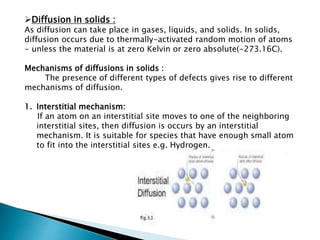
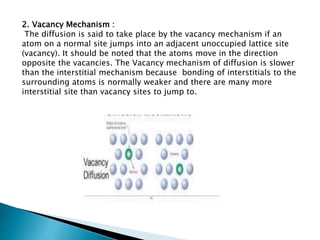


This document discusses diffusion in solids. It defines diffusion as the tendency of molecules, atoms, or ions to distribute evenly in space due to random kinetic motion. Diffusion occurs due to concentration gradients and stops when concentrations equalize. In solids, diffusion results from thermally-activated random atomic motion. There are two mechanisms - interstitial, where small atoms fit between others, and vacancy, where atoms jump into vacant sites. Examples given are carbon diffusion in steel via the interstitial mechanism, salt dissolving in water as a solid-liquid diffusion example, and dust particles suspended in air as a solid-gas diffusion example.


