1.) Definition
2.) Historical Prespective
3.) Introduction
4.) Properties
5.) Advantage
6.) Disadvantage
7.) Mechanism of drug release
8.) Approaches to development of implant
9.) Evaluation
10.) Conclusion
 An Implant is a single unit drug delivery system
that has been designed to deliver a drug moiety at a
therapeutically desired rate ,over a prolonged period
of time.
 Such systems are most commonly used for
sustained parenteral administration ,including ocular
ad subcutaneous drug delivery.
 1861 ,Development of subcutaneously
implantable drug pellet .
 Accidental discovery of controlled drug
permeation characteristics of silicon elastomers.
 Very small capsule shaped implant containing
thyroid hormone powder released hormone
steadily for long time.
 They are normally about 2-3 mm in diameter and
are prepared in an aspectic manner to be sterile.
 These are developed with a view to transmit
drugs and fluids into the blood stream without the
repeated insertion of needles.
 Implants are very small pellets composed of drug
substance only without excipients.
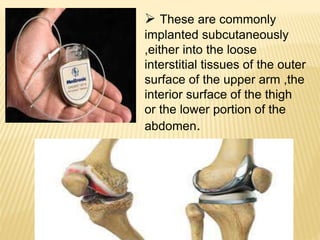
 These are commonly
implanted subcutaneously
,either into the loose
interstitial tissues of the outer
surface of the upper arm ,the
interior surface of the thigh
or the lower portion of the
abdomen.
1. Drug release should approach zero-order
kinetics.
2. Should be
• Biocompatible
• Non-toxic
• Non-mutagenic
• Non-immunogeic
• Non –carinogenic
3. Should posses high drug to polymer ratio.
4. Be free of drug leakage .
5. The rate of drug release can be regulated by the
shape and size of implant ,as well as polymer
blend.
6. Be easily sterilizable.
 Improved drug delivery
 Potential for controlled
release
 Potential for
intermittent release
 Convenience
 Compliance
 Flexibility
 Commercial
 Invasive
 Termination
 Danger of device failure
 Limited to potent drugs
 Possibility of adverse reaction
 Biocompatibility issues
A.) Diffusion controlled release
B.) Diffusion controlled systems
1.)Reservoir (Membrane system)
2.) Matrix (Monolithic System)
(a.) System with dissolved Drug
(b.) System with dispersed Drug
C.) Swelling controlled system
D.) Chemically controlled system
1.) Polymer dissolution and bioerodible system
2.) Pendent chain system
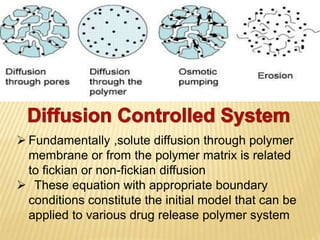
 Fundamentally ,solute diffusion through polymer
membrane or from the polymer matrix is related
to fickian or non-fickian diffusion
 These equation with appropriate boundary
conditions constitute the initial model that can be
applied to various drug release polymer system
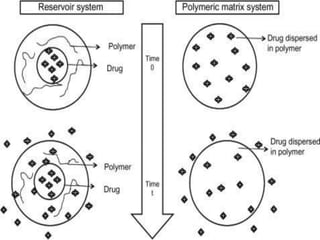
Reservoir (Membrane)
System
Matrix (Monolithic)
System
 In this system the drug
is enclosed in relatively
large quantities in a
permeable synthetic
membrane and is placed in
contact with a fluid at
constant temperature
 In this system matrix
devices usually contain
drug or bioactive agents
incorporated either as a
solution or as dispersion in
the polymer phase
 In this system the drug is dissolved in the polymer
below its solubility limit either by preparing a drug
polymer solution ,casting in a desirable geometric
form ad evaporating the solvent ,or soaking the
polymer in a drug solution.
This model adopts the following assumption –
1) Drug is uniformly dispersed in the matrix
2) Particle size is much smaller in comparison to
the polymer film thickness
3.) Diffusent concentration at the interface is
always zero.
4.) Polymer volume does not change .
5.) Boundary effect is negligible.
 In most of the formulation matrix undergoes
considerable swelling when placed in contact with
thermodynamically compatible liquid (Water for
hydrophilic and organic solvent for other polymers)
 As a result ,a considerable increase in drug
diffusion occurs through the relaxing gel-like phase.
Polymer dissolution
and bioerodible
system
Pendant Chain System
Polymer dissolution
process depends on
geometric shape of the
material and therefore
surface kinetics and the
expected functional
expression of the dissolution
 Modeling of pendent
drug delivery system is
not based on diffusion
equation ,but rather on
the kinetics of the
reaction that leads to
removal of pendent
1.) Diffusion controlled implantable therapeutic
system
(A.)Membrane permeation controlled system using
(a.) Nonporus membranes
(b.) Microporous membrane
(c.) Semipermeable membranes
(B.)Matrix diffusion controlled system using
(a.) Lipophilic polymers
(b.) Hydrophilic or sweallable polymers
(c.) Porous Polymers
(C.) Microreservoir dissolution controlled system using
(a.) Hydrophilic reservoir /Lipophilic matrix
(b.)Lipophilic reservoir /Hydrophilic matrix
2.) Activated controlled release system
(A.) Osmotic pressure activated system
(B.) Vapour pressure activated system
(C.) Magnetically activated system
(D.) Ultrasound activated system
(E.) Hydrolysis activated system
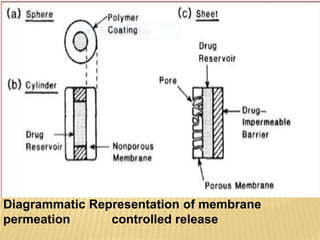
(A.) Membrane Permeation Controlled System-
 In this system the drug reservoir is encapsulated
within a compartment totally enclosed by a rate –
controlling polymeric membrane
Diagrammatic Representation of membrane
permeation controlled release
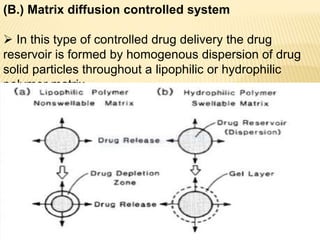
(B.) Matrix diffusion controlled system
 In this type of controlled drug delivery the drug
reservoir is formed by homogenous dispersion of drug
solid particles throughout a lipophilic or hydrophilic
polymer matrix .
(C.)Microreservoir dissolution controlled system
 In this type of controlled drug delivery ,the drug
reservoir ,which is a suspension of drug crystals in an
aqueous solution of water –miscible polymer ,forms a
homogenous dispersion of millions of discrete ,unleable
,microscopic drug reservoir in a polymer matrix.
ex- Syncro-Mate-C implant
(A.) Osmotic pressure activated system
 In this type of controlled drug delivery ,the drug
reservoir ,which is a solution formulation ,is
contained within semi-permiable housing.
 The drug is releasesd in the solution form at the
controlled ,constant rate under an osmotic pressure
gradient .
Ex – Alzet osmotic pump
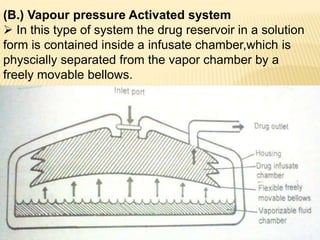
(B.) Vapour pressure Activated system
 In this type of system the drug reservoir in a solution
form is contained inside a infusate chamber,which is
physcially separated from the vapor chamber by a
freely movable bellows.
(C.) Magnetically Activated
system
 Macromolecular drugs such
as peptides have been known
to release only at a relatively
low rate from a polymeric drug
delivery device.
 This low release rate has
been improved by
incorporating a magnetism
triggered mechanism into the
polymeric drug delivery device
(D.) Ultrasound Activated system
 Ultrasonic wave can also be utilized as an energy
source to facilitate the release of drug at a higher rate
from polymeric drug delivery device containing a
bioerodable polymer matrix
(E.) Hydrolysis Activated System
 This type of implantable therapeutic system is
fabricated by dispersing a loading dose of solid drug in
micronizied form,homogeneously throughout a polymer
matrix made from bioerodibable or biodegradable
polymer ,which is then molded into a pellet or bead
shaped implant.
 Immunogenicity, Antigenicity and toxicity
 Drug Uniformity
 Drug release profile
 Storage Stability
 Implantable devices possess many advantages for
drug delivery .
 Both types of biodegradable and non-
biodegradable polymer have been used to construct
implant.
 Implantable system has been always limited by
invasive nature due to toxic and allergic manifestation
of polymer .
 Implantable devices ,which are free from toxicity
,immunogenicity ,irratability and host-implant
reactions ,safe and effective ,will be more popular
because of improved patient compliance and
predictable and controlled performance.
Implants & inserts ppt

Implants & inserts ppt

  • 2.
    1.) Definition 2.) HistoricalPrespective 3.) Introduction 4.) Properties 5.) Advantage 6.) Disadvantage 7.) Mechanism of drug release 8.) Approaches to development of implant 9.) Evaluation 10.) Conclusion
  • 3.
     An Implantis a single unit drug delivery system that has been designed to deliver a drug moiety at a therapeutically desired rate ,over a prolonged period of time.  Such systems are most commonly used for sustained parenteral administration ,including ocular ad subcutaneous drug delivery.
  • 4.
     1861 ,Developmentof subcutaneously implantable drug pellet .  Accidental discovery of controlled drug permeation characteristics of silicon elastomers.  Very small capsule shaped implant containing thyroid hormone powder released hormone steadily for long time.
  • 5.
     They arenormally about 2-3 mm in diameter and are prepared in an aspectic manner to be sterile.  These are developed with a view to transmit drugs and fluids into the blood stream without the repeated insertion of needles.  Implants are very small pellets composed of drug substance only without excipients.
  • 6.
     These arecommonly implanted subcutaneously ,either into the loose interstitial tissues of the outer surface of the upper arm ,the interior surface of the thigh or the lower portion of the abdomen.
  • 7.
    1. Drug releaseshould approach zero-order kinetics. 2. Should be • Biocompatible • Non-toxic • Non-mutagenic • Non-immunogeic • Non –carinogenic 3. Should posses high drug to polymer ratio. 4. Be free of drug leakage . 5. The rate of drug release can be regulated by the shape and size of implant ,as well as polymer blend. 6. Be easily sterilizable.
  • 8.
     Improved drugdelivery  Potential for controlled release  Potential for intermittent release  Convenience  Compliance  Flexibility  Commercial
  • 9.
     Invasive  Termination Danger of device failure  Limited to potent drugs  Possibility of adverse reaction  Biocompatibility issues
  • 10.
    A.) Diffusion controlledrelease B.) Diffusion controlled systems 1.)Reservoir (Membrane system) 2.) Matrix (Monolithic System) (a.) System with dissolved Drug (b.) System with dispersed Drug C.) Swelling controlled system D.) Chemically controlled system 1.) Polymer dissolution and bioerodible system 2.) Pendent chain system
  • 11.
     Fundamentally ,solutediffusion through polymer membrane or from the polymer matrix is related to fickian or non-fickian diffusion  These equation with appropriate boundary conditions constitute the initial model that can be applied to various drug release polymer system
  • 12.
    Reservoir (Membrane) System Matrix (Monolithic) System In this system the drug is enclosed in relatively large quantities in a permeable synthetic membrane and is placed in contact with a fluid at constant temperature  In this system matrix devices usually contain drug or bioactive agents incorporated either as a solution or as dispersion in the polymer phase
  • 14.
     In thissystem the drug is dissolved in the polymer below its solubility limit either by preparing a drug polymer solution ,casting in a desirable geometric form ad evaporating the solvent ,or soaking the polymer in a drug solution. This model adopts the following assumption – 1) Drug is uniformly dispersed in the matrix 2) Particle size is much smaller in comparison to the polymer film thickness
  • 15.
    3.) Diffusent concentrationat the interface is always zero. 4.) Polymer volume does not change . 5.) Boundary effect is negligible.
  • 16.
     In mostof the formulation matrix undergoes considerable swelling when placed in contact with thermodynamically compatible liquid (Water for hydrophilic and organic solvent for other polymers)  As a result ,a considerable increase in drug diffusion occurs through the relaxing gel-like phase.
  • 17.
    Polymer dissolution and bioerodible system PendantChain System Polymer dissolution process depends on geometric shape of the material and therefore surface kinetics and the expected functional expression of the dissolution  Modeling of pendent drug delivery system is not based on diffusion equation ,but rather on the kinetics of the reaction that leads to removal of pendent
  • 18.
    1.) Diffusion controlledimplantable therapeutic system (A.)Membrane permeation controlled system using (a.) Nonporus membranes (b.) Microporous membrane (c.) Semipermeable membranes (B.)Matrix diffusion controlled system using (a.) Lipophilic polymers (b.) Hydrophilic or sweallable polymers (c.) Porous Polymers (C.) Microreservoir dissolution controlled system using (a.) Hydrophilic reservoir /Lipophilic matrix (b.)Lipophilic reservoir /Hydrophilic matrix
  • 19.
    2.) Activated controlledrelease system (A.) Osmotic pressure activated system (B.) Vapour pressure activated system (C.) Magnetically activated system (D.) Ultrasound activated system (E.) Hydrolysis activated system (A.) Membrane Permeation Controlled System-  In this system the drug reservoir is encapsulated within a compartment totally enclosed by a rate – controlling polymeric membrane
  • 20.
    Diagrammatic Representation ofmembrane permeation controlled release
  • 21.
    (B.) Matrix diffusioncontrolled system  In this type of controlled drug delivery the drug reservoir is formed by homogenous dispersion of drug solid particles throughout a lipophilic or hydrophilic polymer matrix .
  • 22.
    (C.)Microreservoir dissolution controlledsystem  In this type of controlled drug delivery ,the drug reservoir ,which is a suspension of drug crystals in an aqueous solution of water –miscible polymer ,forms a homogenous dispersion of millions of discrete ,unleable ,microscopic drug reservoir in a polymer matrix. ex- Syncro-Mate-C implant
  • 23.
    (A.) Osmotic pressureactivated system  In this type of controlled drug delivery ,the drug reservoir ,which is a solution formulation ,is contained within semi-permiable housing.  The drug is releasesd in the solution form at the controlled ,constant rate under an osmotic pressure gradient . Ex – Alzet osmotic pump
  • 25.
    (B.) Vapour pressureActivated system  In this type of system the drug reservoir in a solution form is contained inside a infusate chamber,which is physcially separated from the vapor chamber by a freely movable bellows.
  • 26.
    (C.) Magnetically Activated system Macromolecular drugs such as peptides have been known to release only at a relatively low rate from a polymeric drug delivery device.  This low release rate has been improved by incorporating a magnetism triggered mechanism into the polymeric drug delivery device
  • 27.
    (D.) Ultrasound Activatedsystem  Ultrasonic wave can also be utilized as an energy source to facilitate the release of drug at a higher rate from polymeric drug delivery device containing a bioerodable polymer matrix (E.) Hydrolysis Activated System  This type of implantable therapeutic system is fabricated by dispersing a loading dose of solid drug in micronizied form,homogeneously throughout a polymer matrix made from bioerodibable or biodegradable polymer ,which is then molded into a pellet or bead shaped implant.
  • 28.
     Immunogenicity, Antigenicityand toxicity  Drug Uniformity  Drug release profile  Storage Stability
  • 29.
     Implantable devicespossess many advantages for drug delivery .  Both types of biodegradable and non- biodegradable polymer have been used to construct implant.  Implantable system has been always limited by invasive nature due to toxic and allergic manifestation of polymer .  Implantable devices ,which are free from toxicity ,immunogenicity ,irratability and host-implant reactions ,safe and effective ,will be more popular because of improved patient compliance and predictable and controlled performance.