Human Values
Mrs.V.SrirengaNachiyar,
AP (SG)/ECE
Ramco Institute of Technology
Rajapalayam
Human values
• Human values play a vital role in the
society, as they form the foundation for
human beings to lead a better life.
• There are different factors which affect human
values in the life of an individual and the
society. Value education starts from Families
and it is continuous at Schools/Colleges with
the help of educators. Because of this, families,
teachers and educational programs are crucial
to value education.
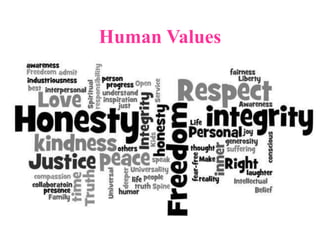
• Human values includes honesty, discipline,
fairness, love, peace, justice, care for one another
and being mindful of the environment.
• Values: Intrinsic principles that govern
relationships
• Morals: intrinsic principles that govern
community living.
• Ethics: Policy of living in the society.
Human Values
Moral
• Moral: The word moral is defined as
concerned with the principles of right and
wrong behavior and a lesson can be derived
from a story or experience
• The word ‘moral’ is a derivative for the Latin
word ‘mores’ meaning “conventions or
practice”.
Values
• Values describes individual or personal
standards of what is valuable or important.
• “Try not to become a person of success, but
rather try to become a person of value.”
-- Albert Einstein
Ethics
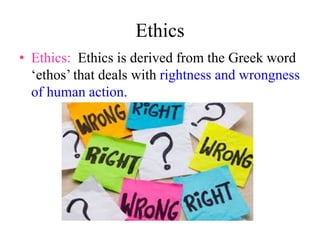
• Ethics: Ethics is derived from the Greek word
‘ethos’ that deals with rightness and wrongness
of human action.
Introduction
• Profession:
- Profession is a disciplined group of
individuals who adhere to ethical standards.
- Special knowledge and skill
- A type of job that requires special
training and that brings a fairly high status
Cont…
• Professional:
Relates to any work that a person does for
an occupation, especially work which requires a
special skill or training.
• Engineering:
The branch of science and technology
concerned with the design, building and use of
engines, machines and structures.
Cont…
• Engineering Ethics:
Engineering ethics is the study of moral
values, issues and decisions involved in
engineering practice.
Why study Engineering Ethics?
• Engineering ethics should be studied because it
is important, both in contributing to safe and
useful technological products to the society.
• The aim is to increase one’s ability to deal
effectively with more complexity in
engineering.
• The study of Engineering ethics strengthens
one’s ability to reason clearly and carefully
about moral questions.
Cont…
• Ethics:
 The science of ideal human character or
the science of moral duty.
 Derived from the greek word “ethos”,
which means study of good and bad
character.
 Determine the values in human conduct.
Cont…
• Ethics refers to the most important values and
beliefs of an individual and/or a society.
• These beliefs helps to shape the character of
the people in the society and teach the people
what is good and bad.
• In ethics, the focus is to study and apply the
principles and practices universally.
Cont…
• Some of the universally accepted ethical
principles are
Honesty
Integrity
Fulfilling commitments
Open minded
Willing to admit mistakes
Both caring and compassionate (kindly)
Cont…
Having respect for human dignity (Self-
respect)
Being accountable (responsible, answerable)
for one’s decision and their consequences
Cont…
• Morals:
 The word moral is defined as concerned
with the principles of right and wrong behavior
and a lesson can be derived from a story or
experience
 We can learn from our past experience
Morals are the welfare principles enunciated
(pronounced, said, voiced) by the wise people,
based on their experience and wisdom.
Cont…
• Morals were modified, edited or changed or
evolved to suit the geography of the region,
rulers and in accordance with development of
knowledge in science and technology and with
time.
• Morality is concerned with principles and
practices of morals such as
 What ought or ought not to be done in a
given situation?
Cont…
 What is right or wrong about the handling of a
situation?
 What is good or bad about the people, policies
and ideals (principles or standards) involved?
Examples: Honesty, respect for others, loyalty,
responsibility for personal actions, generosity and
kindness are all examples of moral values. They
are defined as the ideals and principles that guide
how people act.
Cont…
• Morality:
Morality is understanding the distinction
between rights and wrong and living according
to that understanding and ethics is the
philosophy of how that morality guides
individual and group behavior
Difference between Moral and Ethics
MORAL:
• Refers only to personal behavior.
• Refers to any aspect of human action.
• Social conventions about right or wrong conduct.
ETHICS:
• Involves defining, analyzing, evaluating and
resolving moral problems and developing moral
criteria to guide human behavior.
• Critical reflection on what one does and why one
does it.
• Refers only to professional behavior.
Cont…
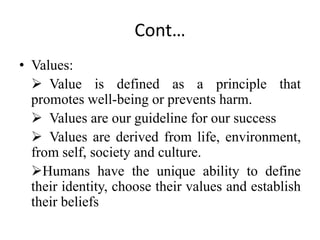
• Values:
 Value is defined as a principle that
promotes well-being or prevents harm.
 Values are our guideline for our success
 Values are derived from life, environment,
from self, society and culture.
Humans have the unique ability to define
their identity, choose their values and establish
their beliefs
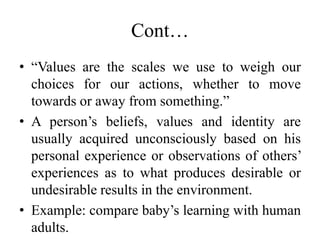
Cont…
• “Values are the scales we use to weigh our
choices for our actions, whether to move
towards or away from something.”
• A person’s beliefs, values and identity are
usually acquired unconsciously based on his
personal experience or observations of others’
experiences as to what produces desirable or
undesirable results in the environment.
• Example: compare baby’s learning with human
adults.
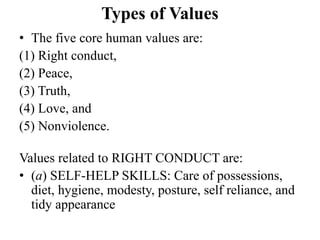
Types of Values
• The five core human values are:
(1) Right conduct,
(2) Peace,
(3) Truth,
(4) Love, and
(5) Nonviolence.
Values related to RIGHT CONDUCT are:
• (a) SELF-HELP SKILLS: Care of possessions,
diet, hygiene, modesty, posture, self reliance, and
tidy appearance
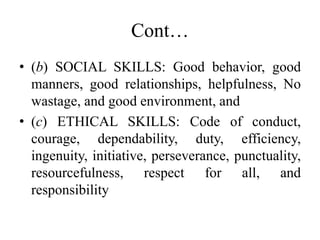
Cont…
• (b) SOCIAL SKILLS: Good behavior, good
manners, good relationships, helpfulness, No
wastage, and good environment, and
• (c) ETHICAL SKILLS: Code of conduct,
courage, dependability, duty, efficiency,
ingenuity, initiative, perseverance, punctuality,
resourcefulness, respect for all, and
responsibility
Cont…
• Values related to PEACE are: Attention,
calmness, concentration, contentment, dignity,
discipline, equality, equanimity, faithfulness,
focus, gratitude, happiness, harmony, humility,
inner silence, optimism, patience, reflection,
satisfaction, self-acceptance, self-confidence,
self-control, self-discipline, self-esteem, self-
respect, sense control, tolerance, and
understanding
Cont…
• Values related to TRUTH are: Accuracy,
curiosity, discernment, fairness, fearlessness,
honesty, integrity (unity of thought, word, and
deed), intuition, justice, optimism, purity, quest
for knowledge, reason, self-analysis, sincerity,
sprit of enquiry, synthesis, trust, truthfulness
and determination.
Cont…
• Values related to LOVE are: Acceptance,
affection, care, compassion, consideration,
dedication, devotion, empathy, forbearance,
forgiveness, friendship, generosity, gentleness,
humanness, interdependence, kindness,
patience, patriotism, reverence, sacrifice,
selflessness, service, sharing, sympathy,
thoughtfulness, tolerance and trust
Cont…
• Values related to NON-VIOLENCE are:
(a) PSYCHOLOGICAL: Benevolence (kindness),
compassion, concern for others, consideration,
forbearance (patience), forgiveness, manners,
happiness, loyalty, morality, and universal love
(b) SOCIAL: Appreciation of other cultures and
religions, brotherhood, care of environment,
citizenship, equality, harmlessness, national
awareness, perseverance, respect for property, and
social justice.
HONESTY
• Honesty is a virtue, and it is exhibited in two
aspects namely,
(a) Truthfulness and
(b) Trustworthiness.
• Truthfulness is to face the responsibilities upon
telling truth. One should keep one’s word or
promise.
• But trustworthiness is maintaining integrity
and taking responsibility for personal
performance.
Honesty is mirrored in many ways. The common
reflections are:
(a) Beliefs (intellectual honesty).
(b) Communication (writing and speech).
(c) Decisions (ideas, discretion).
(d) Actions (means, timing, place, and the
goals) and
(e) Intended and unintended results
achieved.
Some of the actions of an engineer that
leads to dishonesty are:
• 1. Lying: Honesty implies avoidance of lying.
An engineer may communicate wrong or
distorted test results intentionally or otherwise.
It is giving wrong information to the right
people.
• 2. Deliberate deception: An engineer may
judge or decide on matters one is not familiar
or with insufficient data or proof, to impress
upon the customers or employers. This is a self
deceit.
• 3. Withholding the information: It means
hiding the facts during communication to
one’s superior or subordinate, intentionally or
otherwise.
• 4. Not seeking the truth: Some engineers
accept the information or data, without
applying their mind and seeking the truth.
• 5. Not maintaining confidentiality: It is giving
right information to wrong people. The
engineers should keep information of their
customers/clients or of their employers
confidential and should not discuss them with
others.
• 6. Giving professional judgment under the
influence of extraneous factors such as personal
benefits and prejudice. The laws, experience,
social welfare, and even conscience are given a
go-bye by such actions. Certainly this is a higher-
order crime.
• 7. Adequate Promotion of Dissemination of
Information: For eg: in situations like earthquake,
tsunami, fire hazard, infectious diseases. Affected
people in such areas must receive the
information well in advance to avoid disaster.
Failing to develop the dissemination of such
information is also false and dishonest.
COURAGE
• Courage is the tendency to accept and face
risks and difficult tasks in rational ways. Self-
confidence is the basic requirement to nurture
courage. Courage is classified into three types,
based on the types of risks, namely
• (a) Physical courage,
• (b) Social courage, and
• (c) Intellectual courage.
• In physical courage, the thrust is on the
adequacy of the physical strength, including
the muscle power and armaments.
• The social courage involves the decisions and
actions to change the order, based on the
conviction for or against certain social
behaviours. This requires leadership abilities,
including empathy and sacrifice, to mobilize
and motivate the followers, for the social
cause.
• The intellectual courage is inculcated in people
through acquired knowledge, experience,
games, tactics, education, and training
• One should perform Strengths, Weakness,
Opportunities, and Threat (SWOT) analysis.
Calculate (estimate) the risks, compare with
one’s strengths, and anticipate the end results,
while taking decisions and before getting into
action.
• Learning from the past helps.
• Facing the criticism, owning responsibility,
and accepting the mistakes or errors when
committed and exposed are the expressions of
courage.
• The courageous people own and have shown the
following characteristics, in their professions:
• (a) Perseverance (sustained hard work),
• (b) Experimentation (preparedness to face the
challenges, that is,
• unexpected or unintended results),
• (c) Involvement (attitude, clear and firm resolve
to act), and
• (d) Commitment (willing to get into action and to
reach the desired
• goals by any alternative but ethical means).
VALUING TIME
• Time is rare resource. Once it is spent, it is lost
for ever. It can not be either stored or
recovered.
• The proverbs, ‘Time and tide wait for nobody’
and ‘Procrastination is the thief of time’ amply
illustrate this point.
COOPERATION
• Co-operation is a team-spirit present with
every individual engaged in engineering.
• Co-operation is activity between two persons
or sectors that aims at integration of operations
(synergy), while not sacrificing the autonomy
of either party.
• Willingness to understand others, think and act
together and putting this into practice, is
cooperation.
• The impediments to successful cooperation are:
• 1. Clash of ego of individuals.
• 2. Lack of leadership and motivation.
• 3. Conflicts of interests, based on region, religion,
language, and caste.
• 4. Ignorance and lack of interest. By careful
planning, motivation, leadership,
• fostering and rewarding team work,
professionalism and humanism beyond
• the ‘divides’, training on appreciation to
different cultures, mutual
• understanding ‘cooperation’ can be developed
and also sustained.

Ge6075 professional ethics in engineering unit i

  • 1.
    Human Values Mrs.V.SrirengaNachiyar, AP (SG)/ECE RamcoInstitute of Technology Rajapalayam
  • 2.
    Human values • Humanvalues play a vital role in the society, as they form the foundation for human beings to lead a better life. • There are different factors which affect human values in the life of an individual and the society. Value education starts from Families and it is continuous at Schools/Colleges with the help of educators. Because of this, families, teachers and educational programs are crucial to value education.
  • 3.
    • Human valuesincludes honesty, discipline, fairness, love, peace, justice, care for one another and being mindful of the environment. • Values: Intrinsic principles that govern relationships • Morals: intrinsic principles that govern community living. • Ethics: Policy of living in the society.
  • 4.
  • 5.
    Moral • Moral: Theword moral is defined as concerned with the principles of right and wrong behavior and a lesson can be derived from a story or experience • The word ‘moral’ is a derivative for the Latin word ‘mores’ meaning “conventions or practice”.
  • 6.
    Values • Values describesindividual or personal standards of what is valuable or important. • “Try not to become a person of success, but rather try to become a person of value.” -- Albert Einstein
  • 7.
    Ethics • Ethics: Ethicsis derived from the Greek word ‘ethos’ that deals with rightness and wrongness of human action.
  • 8.
    Introduction • Profession: - Professionis a disciplined group of individuals who adhere to ethical standards. - Special knowledge and skill - A type of job that requires special training and that brings a fairly high status
  • 9.
    Cont… • Professional: Relates toany work that a person does for an occupation, especially work which requires a special skill or training. • Engineering: The branch of science and technology concerned with the design, building and use of engines, machines and structures.
  • 10.
    Cont… • Engineering Ethics: Engineeringethics is the study of moral values, issues and decisions involved in engineering practice.
  • 11.
    Why study EngineeringEthics? • Engineering ethics should be studied because it is important, both in contributing to safe and useful technological products to the society. • The aim is to increase one’s ability to deal effectively with more complexity in engineering. • The study of Engineering ethics strengthens one’s ability to reason clearly and carefully about moral questions.
  • 12.
    Cont… • Ethics:  Thescience of ideal human character or the science of moral duty.  Derived from the greek word “ethos”, which means study of good and bad character.  Determine the values in human conduct.
  • 13.
    Cont… • Ethics refersto the most important values and beliefs of an individual and/or a society. • These beliefs helps to shape the character of the people in the society and teach the people what is good and bad. • In ethics, the focus is to study and apply the principles and practices universally.
  • 14.
    Cont… • Some ofthe universally accepted ethical principles are Honesty Integrity Fulfilling commitments Open minded Willing to admit mistakes Both caring and compassionate (kindly)
  • 15.
    Cont… Having respect forhuman dignity (Self- respect) Being accountable (responsible, answerable) for one’s decision and their consequences
  • 16.
    Cont… • Morals:  Theword moral is defined as concerned with the principles of right and wrong behavior and a lesson can be derived from a story or experience  We can learn from our past experience Morals are the welfare principles enunciated (pronounced, said, voiced) by the wise people, based on their experience and wisdom.
  • 17.
    Cont… • Morals weremodified, edited or changed or evolved to suit the geography of the region, rulers and in accordance with development of knowledge in science and technology and with time. • Morality is concerned with principles and practices of morals such as  What ought or ought not to be done in a given situation?
  • 18.
    Cont…  What isright or wrong about the handling of a situation?  What is good or bad about the people, policies and ideals (principles or standards) involved? Examples: Honesty, respect for others, loyalty, responsibility for personal actions, generosity and kindness are all examples of moral values. They are defined as the ideals and principles that guide how people act.
  • 19.
    Cont… • Morality: Morality isunderstanding the distinction between rights and wrong and living according to that understanding and ethics is the philosophy of how that morality guides individual and group behavior
  • 20.
    Difference between Moraland Ethics MORAL: • Refers only to personal behavior. • Refers to any aspect of human action. • Social conventions about right or wrong conduct. ETHICS: • Involves defining, analyzing, evaluating and resolving moral problems and developing moral criteria to guide human behavior. • Critical reflection on what one does and why one does it. • Refers only to professional behavior.
  • 21.
    Cont… • Values:  Valueis defined as a principle that promotes well-being or prevents harm.  Values are our guideline for our success  Values are derived from life, environment, from self, society and culture. Humans have the unique ability to define their identity, choose their values and establish their beliefs
  • 22.
    Cont… • “Values arethe scales we use to weigh our choices for our actions, whether to move towards or away from something.” • A person’s beliefs, values and identity are usually acquired unconsciously based on his personal experience or observations of others’ experiences as to what produces desirable or undesirable results in the environment. • Example: compare baby’s learning with human adults.
  • 23.
    Types of Values •The five core human values are: (1) Right conduct, (2) Peace, (3) Truth, (4) Love, and (5) Nonviolence. Values related to RIGHT CONDUCT are: • (a) SELF-HELP SKILLS: Care of possessions, diet, hygiene, modesty, posture, self reliance, and tidy appearance
  • 24.
    Cont… • (b) SOCIALSKILLS: Good behavior, good manners, good relationships, helpfulness, No wastage, and good environment, and • (c) ETHICAL SKILLS: Code of conduct, courage, dependability, duty, efficiency, ingenuity, initiative, perseverance, punctuality, resourcefulness, respect for all, and responsibility
  • 25.
    Cont… • Values relatedto PEACE are: Attention, calmness, concentration, contentment, dignity, discipline, equality, equanimity, faithfulness, focus, gratitude, happiness, harmony, humility, inner silence, optimism, patience, reflection, satisfaction, self-acceptance, self-confidence, self-control, self-discipline, self-esteem, self- respect, sense control, tolerance, and understanding
  • 26.
    Cont… • Values relatedto TRUTH are: Accuracy, curiosity, discernment, fairness, fearlessness, honesty, integrity (unity of thought, word, and deed), intuition, justice, optimism, purity, quest for knowledge, reason, self-analysis, sincerity, sprit of enquiry, synthesis, trust, truthfulness and determination.
  • 27.
    Cont… • Values relatedto LOVE are: Acceptance, affection, care, compassion, consideration, dedication, devotion, empathy, forbearance, forgiveness, friendship, generosity, gentleness, humanness, interdependence, kindness, patience, patriotism, reverence, sacrifice, selflessness, service, sharing, sympathy, thoughtfulness, tolerance and trust
  • 28.
    Cont… • Values relatedto NON-VIOLENCE are: (a) PSYCHOLOGICAL: Benevolence (kindness), compassion, concern for others, consideration, forbearance (patience), forgiveness, manners, happiness, loyalty, morality, and universal love (b) SOCIAL: Appreciation of other cultures and religions, brotherhood, care of environment, citizenship, equality, harmlessness, national awareness, perseverance, respect for property, and social justice.
  • 29.
    HONESTY • Honesty isa virtue, and it is exhibited in two aspects namely, (a) Truthfulness and (b) Trustworthiness. • Truthfulness is to face the responsibilities upon telling truth. One should keep one’s word or promise. • But trustworthiness is maintaining integrity and taking responsibility for personal performance.
  • 30.
    Honesty is mirroredin many ways. The common reflections are: (a) Beliefs (intellectual honesty). (b) Communication (writing and speech). (c) Decisions (ideas, discretion). (d) Actions (means, timing, place, and the goals) and (e) Intended and unintended results achieved.
  • 31.
    Some of theactions of an engineer that leads to dishonesty are: • 1. Lying: Honesty implies avoidance of lying. An engineer may communicate wrong or distorted test results intentionally or otherwise. It is giving wrong information to the right people. • 2. Deliberate deception: An engineer may judge or decide on matters one is not familiar or with insufficient data or proof, to impress upon the customers or employers. This is a self deceit.
  • 32.
    • 3. Withholdingthe information: It means hiding the facts during communication to one’s superior or subordinate, intentionally or otherwise. • 4. Not seeking the truth: Some engineers accept the information or data, without applying their mind and seeking the truth. • 5. Not maintaining confidentiality: It is giving right information to wrong people. The engineers should keep information of their customers/clients or of their employers confidential and should not discuss them with others.
  • 33.
    • 6. Givingprofessional judgment under the influence of extraneous factors such as personal benefits and prejudice. The laws, experience, social welfare, and even conscience are given a go-bye by such actions. Certainly this is a higher- order crime. • 7. Adequate Promotion of Dissemination of Information: For eg: in situations like earthquake, tsunami, fire hazard, infectious diseases. Affected people in such areas must receive the information well in advance to avoid disaster. Failing to develop the dissemination of such information is also false and dishonest.
  • 34.
    COURAGE • Courage isthe tendency to accept and face risks and difficult tasks in rational ways. Self- confidence is the basic requirement to nurture courage. Courage is classified into three types, based on the types of risks, namely • (a) Physical courage, • (b) Social courage, and • (c) Intellectual courage.
  • 35.
    • In physicalcourage, the thrust is on the adequacy of the physical strength, including the muscle power and armaments. • The social courage involves the decisions and actions to change the order, based on the conviction for or against certain social behaviours. This requires leadership abilities, including empathy and sacrifice, to mobilize and motivate the followers, for the social cause. • The intellectual courage is inculcated in people through acquired knowledge, experience, games, tactics, education, and training
  • 36.
    • One shouldperform Strengths, Weakness, Opportunities, and Threat (SWOT) analysis. Calculate (estimate) the risks, compare with one’s strengths, and anticipate the end results, while taking decisions and before getting into action. • Learning from the past helps. • Facing the criticism, owning responsibility, and accepting the mistakes or errors when committed and exposed are the expressions of courage.
  • 37.
    • The courageouspeople own and have shown the following characteristics, in their professions: • (a) Perseverance (sustained hard work), • (b) Experimentation (preparedness to face the challenges, that is, • unexpected or unintended results), • (c) Involvement (attitude, clear and firm resolve to act), and • (d) Commitment (willing to get into action and to reach the desired • goals by any alternative but ethical means).
  • 38.
    VALUING TIME • Timeis rare resource. Once it is spent, it is lost for ever. It can not be either stored or recovered. • The proverbs, ‘Time and tide wait for nobody’ and ‘Procrastination is the thief of time’ amply illustrate this point.
  • 39.
    COOPERATION • Co-operation isa team-spirit present with every individual engaged in engineering. • Co-operation is activity between two persons or sectors that aims at integration of operations (synergy), while not sacrificing the autonomy of either party. • Willingness to understand others, think and act together and putting this into practice, is cooperation.
  • 40.
    • The impedimentsto successful cooperation are: • 1. Clash of ego of individuals. • 2. Lack of leadership and motivation. • 3. Conflicts of interests, based on region, religion, language, and caste. • 4. Ignorance and lack of interest. By careful planning, motivation, leadership, • fostering and rewarding team work, professionalism and humanism beyond • the ‘divides’, training on appreciation to different cultures, mutual • understanding ‘cooperation’ can be developed and also sustained.