 Presented By : Kh Waqas Yousaf
 Roll. No # 08
 Presented To : Dr. Jahanzab Khan
 Subject : NeoTectonics
 Session : 2019-2021
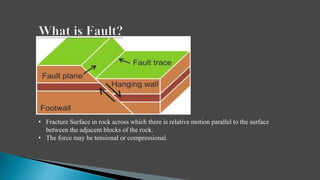
• Fracture Surface in rock across which there is relative motion parallel to the surface
between the adjacent blocks of the rock.
• The force may be tensional or compressional.
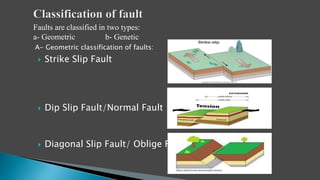
 Strike Slip Fault
 Dip Slip Fault/Normal Fault
 Diagonal Slip Fault/ Oblige Fault
Faults are classified in two types:
a- Geometric b- Genetic
A- Geometric classification of faults:
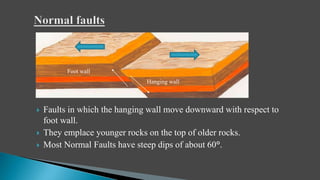
 Faults in which the hanging wall move downward with respect to
foot wall.
 They emplace younger rocks on the top of older rocks.
 Most Normal Faults have steep dips of about 60°.
Hanging wall
Foot wall
 Normal fault exits at all level in the crust.
 The surface features of faults vary with the shape of the
fault, the depth at which movement on the fault occurred.
 At shallow level, normal faults develop cataclastic rocks,
slickensides, and slickenside lineations.
 At deeper structural levels, normal fault develop feature
associated with ductile deformation, including mylonitic
textures which may be present in shear zones tens to
hundreds of meters in thickness.
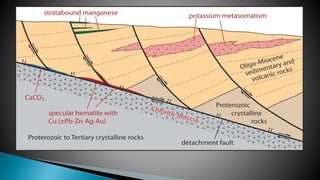
Detachment fault.
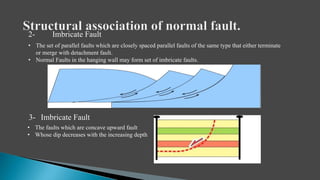
2- Imbricate Fault
• The set of parallel faults which are closely spaced parallel faults of the same type that either terminate
or merge with detachment fault.
• Normal Faults in the hanging wall may form set of imbricate faults.
3- Imbricate Fault
• The faults which are concave upward fault
• Whose dip decreases with the increasing depth
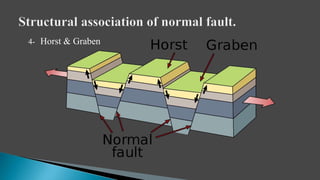
4- Horst & Graben
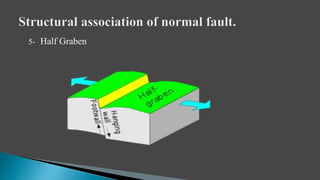
5- Half Graben
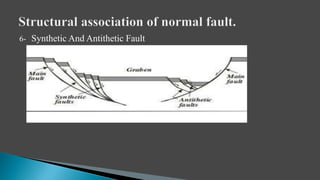
6- Synthetic And Antithetic Fault
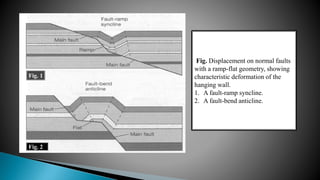
 Displacement on ideal normal faults is parallel to the dip of
the fault surface.
 If the strike of the fault varies, however, rigid movement o
the HW block relative to the FW block cannot everywhere be
down the dip of the fault.(Fig.1&2).
 Movement on normal fault can be either nonrotational or
rotational, depending on whether the orientation of the fault
block remain constant or changes as a result of faulting.
Fig. Displacement on normal faults
with a ramp-flat geometry, showing
characteristic deformation of the
hanging wall.
1. A fault-ramp syncline.
2. A fault-bend anticline.
fFig. 1
Fig. 2

Normal fault

  • 1.
     Presented By: Kh Waqas Yousaf  Roll. No # 08  Presented To : Dr. Jahanzab Khan  Subject : NeoTectonics  Session : 2019-2021
  • 2.
    • Fracture Surfacein rock across which there is relative motion parallel to the surface between the adjacent blocks of the rock. • The force may be tensional or compressional.
  • 3.
     Strike SlipFault  Dip Slip Fault/Normal Fault  Diagonal Slip Fault/ Oblige Fault Faults are classified in two types: a- Geometric b- Genetic A- Geometric classification of faults:
  • 4.
     Faults inwhich the hanging wall move downward with respect to foot wall.  They emplace younger rocks on the top of older rocks.  Most Normal Faults have steep dips of about 60°. Hanging wall Foot wall
  • 5.
     Normal faultexits at all level in the crust.  The surface features of faults vary with the shape of the fault, the depth at which movement on the fault occurred.  At shallow level, normal faults develop cataclastic rocks, slickensides, and slickenside lineations.  At deeper structural levels, normal fault develop feature associated with ductile deformation, including mylonitic textures which may be present in shear zones tens to hundreds of meters in thickness.
  • 6.
  • 8.
    2- Imbricate Fault •The set of parallel faults which are closely spaced parallel faults of the same type that either terminate or merge with detachment fault. • Normal Faults in the hanging wall may form set of imbricate faults. 3- Imbricate Fault • The faults which are concave upward fault • Whose dip decreases with the increasing depth
  • 9.
    4- Horst &Graben
  • 10.
  • 11.
    6- Synthetic AndAntithetic Fault
  • 12.
     Displacement onideal normal faults is parallel to the dip of the fault surface.  If the strike of the fault varies, however, rigid movement o the HW block relative to the FW block cannot everywhere be down the dip of the fault.(Fig.1&2).  Movement on normal fault can be either nonrotational or rotational, depending on whether the orientation of the fault block remain constant or changes as a result of faulting.
  • 13.
    Fig. Displacement onnormal faults with a ramp-flat geometry, showing characteristic deformation of the hanging wall. 1. A fault-ramp syncline. 2. A fault-bend anticline. fFig. 1 Fig. 2