Conceptual
Framing of the
Landscape
Approach
Amity Doolittle
Senior Research Scientist and Lecturer
Yale School of Forestry and Environmental
Studies
New Haven, Connecticut USA
25 April 2016
Outline
1. Define landscape
2. Define landscape approach
3. Define scale of landscape approach
1. Starting Point for Shared Understanding
2. Goals of Land Use Dialogue
1. Social Learning and Adaptive
Management
2. Challenges
http://mongabay-
images.s3.amazonaws.com
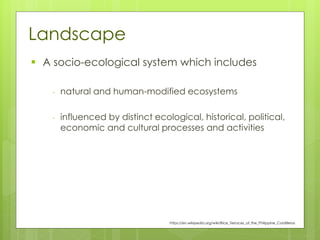
Landscape
▪ A socio-ecological system which includes
- natural and human-modified ecosystems
- influenced by distinct ecological, historical, political,
economic and cultural processes and activities
https://en.wikipedia.org/wiki/Rice_Terraces_of_the_Philippine_Cordilleras
Landscape approach
▪ Conceptual approach to understanding land
use that recognizes there are often competing
interests of different stakeholders
Source: http://peoplefoodandnature.org/blog/understanding-the-relationship-between-forests-and-agriculture-the-need-for-a-landscape-approach/
1. Aims to reconcile
competing social,
economic and
environmental objectives
through national and local
level actions
- equitably address land-
use trade-offs
- enhance carbon-
intensive landscape
management
Landscape approach
http://www.desdemonadespair.net/2011/09/brazils-
atlantic-forest-stores-less.html
Landscape approach
2. Aims to ensure the realization of local level
needs and action (i.e. the interests of different
stakeholders)
3. Moves away from the often unsustainable
sectoral approach to land management
http://inr.oregonstate.edu/
4. Encourages collaboration
with industry within global
commodity supply chains to
improved land use
governance
- reducing carbon emissions
and pressure on natural
resources
Landscape approach
http://dinheirorural.com.br/secao/agrone
gocios/novas-garras-da-klabin
Scale of landscape approach
▪ Is defined by local
stakeholders:
- small enough to
maintain a degree of
manageability
- large enough to be
able to deliver
multiple functions to
stakeholders with
different interests.
Source: http://www.ridingbrazil.com/sj-farm-stays.html
Scale of landscape approach
▪ The boundaries are set by
stakeholders and may
correspond to:
- natural boundaries
- distinct land features
- socially defined areas
- indigenous territories
- jurisdictional and administrative
boundaries
Starting Point
▪ Shared understanding of
various stakeholder
perspectives
- Conflicts over resources
in landscapes are
exacerbated by
misunderstanding of the
perspectives and
motivations of other
stakeholders’
management or claims
on resources
http://rsb.org/activities-and-projects/smallholder-program-in-brazil/
Starting Point
Shared understanding
of:
▪ Spatial relationships
within the landscape
between different
land uses and land
users
Starting Point
▪ Shared understanding of institutional or
policy context
- Include an understanding the relationships
and power dynamics between institutions
Source: http://www.slideshare.net/CIFOR/assessing-future-impacts-of-land-use-policies-in-brazil
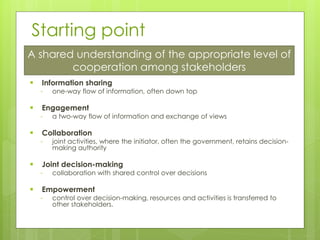
Starting point
▪ Information sharing
- one-way flow of information, often down top
▪ Engagement
- a two-way flow of information and exchange of views
▪ Collaboration
- joint activities, where the initiator, often the government, retains decision-
making authority
▪ Joint decision-making
- collaboration with shared control over decisions
▪ Empowerment
- control over decision-making, resources and activities is transferred to
other stakeholders.
A shared understanding of the appropriate level of
cooperation among stakeholders
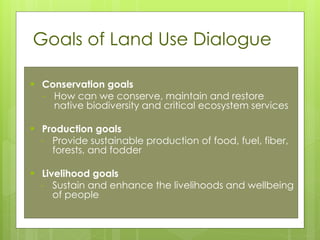
Goals of Land Use Dialogue
▪ Conservation goals
- How can we conserve, maintain and restore
native biodiversity and critical ecosystem services
▪ Production goals
- Provide sustainable production of food, fuel, fiber,
forests, and fodder
▪ Livelihood goals
- Sustain and enhance the livelihoods and wellbeing
of people
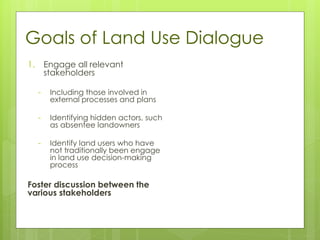
Goals of Land Use Dialogue
1. Engage all relevant
stakeholders
- Including those involved in
external processes and plans
- Identifying hidden actors, such
as absentee landowners
- Identify land users who have
not traditionally been engage
in land use decision-making
process
Foster discussion between the
various stakeholders
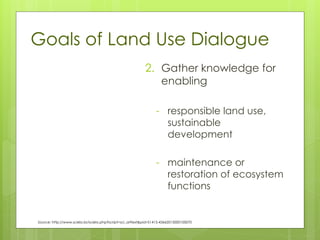
Goals of Land Use Dialogue
2. Gather knowledge for
enabling
- responsible land use,
sustainable
development
- maintenance or
restoration of ecosystem
functions
Source: http://www.scielo.br/scielo.php?script=sci_arttext&pid=S1415-43662015000100070
Goals of Land Use Dialogue
3. Support improved land
use governance and
inclusive development
and responsive to
climate change
- Set objectives and
develop local ideas
and activities that
integrate public and
private interests
Goals of Land Use Dialogue
4. Identify level of openness
by different stakeholder
groups to engage in
collaborative landscapes
management
- Develop support from
corporate initiatives within
global commodity supply
5. Develop an understanding of the relationship
between forest and agricultural sectors
ecosystem functions
Goals of Land Use Dialogue
http://www.worldbank.org/en/news/infographic/2016/03/16/forests-create-jobs-infographic
Goals of Land Use Dialogue
- intensification of forestry
and farming
- conservation and
restoration of ecosystem
services
http://www.natgeocreative.com/photography/1372586
6. Address the challenges of competing
demands for land and water use
Social learning and adaptive
management
▪ Focus on idea generation,
implementation, monitoring
and reassessing
- Is a new paradigm for
collaboration possible?
▪ Support the translation and
diffusion of new knowledge and
practices
Social learning and
adaptive management
▪ Stimulate adaptive social learning by
- involving actors at multiple levels—local
to global
- international actors amplify the impact of
national organizations and institutions
Challenges
▪ How can we move beyond the conceptual level towards
managing at the landscape scale for multiple objectives?
http://sdgs.peoplefoodandnature.org/
Challenges
1. How can we integrate public and private needs into
the landscape and foster public-private partnerships?
2. How can we reconcile the sometimes-competing
objectives of economic development and
environmental sustainability?
3. How do we move across institutional boundaries that
traditionally hinder integration?
4. How do we measure success (or failure) and define
whether a landscape is being managed
“sustainably”?
Sources
▪ The Sustainable Landscapes Books
http://www.commonland.com/_doc/GCPLittleSustainableLBDEC15_228876964.pdf
▪ Sayer, Jeffrey, Terry Sunderland, Jaboury Ghazoul, Jean-Laurent Pfund, Douglas Sheil, Erik
Meijaard, Michelle Venter et al. "Ten principles for a landscape approach to reconciling
agriculture, conservation, and other competing land uses." Proceedings of the National
Academy of Sciences110, no. 21 (2013): 8349-8356.
▪ DeFries, R., and C. Rosenzweig. "Toward a whole-landscape approach for sustainable land use
in the tropics." Proceedings of the National Academy of Sciences 107, no. 46 (2010): 19627-
19632.
▪ Frost, Peter, Bruce Campbell, Gabriel Medina, and Leonard Usongo. "Landscape-scale
approaches for integrated natural resource management in tropical forest
landscapes." Ecology and Society 11, no. 2 (2006): Articel-30.
▪ Cumming, Graeme S., Per Olsson, F. S. Chapin III, and C. S. Holling. "Resilience,
experimentation, and scale mismatches in social-ecological landscapes." Landscape
Ecology 28, no. 6 (2013): 1139-1150.
▪ Outcome Statement of the 2015 Global Landscapes Forum
http://www.landscapes.org/publication/2015-global-landscapes-forum-outcome-statement/
▪ Landscapes Measures Center http://landscapemeasures.info/?p=74
▪ Assessing future impacts of land use policies in Brazil. Presentation at the Global Landscapes
Forum 2015, in Paris, France alongside COP21 http://www.slideshare.net/CIFOR/assessing-
future-impacts-of-land-use-policies-in-brazil

Conceptual_framing_of_the_landscape_approach.pdf

  • 1.
    Conceptual Framing of the Landscape Approach AmityDoolittle Senior Research Scientist and Lecturer Yale School of Forestry and Environmental Studies New Haven, Connecticut USA 25 April 2016
  • 2.
    Outline 1. Define landscape 2.Define landscape approach 3. Define scale of landscape approach 1. Starting Point for Shared Understanding 2. Goals of Land Use Dialogue 1. Social Learning and Adaptive Management 2. Challenges http://mongabay- images.s3.amazonaws.com
  • 3.
    Landscape ▪ A socio-ecologicalsystem which includes - natural and human-modified ecosystems - influenced by distinct ecological, historical, political, economic and cultural processes and activities https://en.wikipedia.org/wiki/Rice_Terraces_of_the_Philippine_Cordilleras
  • 4.
    Landscape approach ▪ Conceptualapproach to understanding land use that recognizes there are often competing interests of different stakeholders Source: http://peoplefoodandnature.org/blog/understanding-the-relationship-between-forests-and-agriculture-the-need-for-a-landscape-approach/
  • 5.
    1. Aims toreconcile competing social, economic and environmental objectives through national and local level actions - equitably address land- use trade-offs - enhance carbon- intensive landscape management Landscape approach http://www.desdemonadespair.net/2011/09/brazils- atlantic-forest-stores-less.html
  • 6.
    Landscape approach 2. Aimsto ensure the realization of local level needs and action (i.e. the interests of different stakeholders) 3. Moves away from the often unsustainable sectoral approach to land management http://inr.oregonstate.edu/
  • 7.
    4. Encourages collaboration withindustry within global commodity supply chains to improved land use governance - reducing carbon emissions and pressure on natural resources Landscape approach http://dinheirorural.com.br/secao/agrone gocios/novas-garras-da-klabin
  • 8.
    Scale of landscapeapproach ▪ Is defined by local stakeholders: - small enough to maintain a degree of manageability - large enough to be able to deliver multiple functions to stakeholders with different interests. Source: http://www.ridingbrazil.com/sj-farm-stays.html
  • 9.
    Scale of landscapeapproach ▪ The boundaries are set by stakeholders and may correspond to: - natural boundaries - distinct land features - socially defined areas - indigenous territories - jurisdictional and administrative boundaries
  • 10.
    Starting Point ▪ Sharedunderstanding of various stakeholder perspectives - Conflicts over resources in landscapes are exacerbated by misunderstanding of the perspectives and motivations of other stakeholders’ management or claims on resources http://rsb.org/activities-and-projects/smallholder-program-in-brazil/
  • 11.
    Starting Point Shared understanding of: ▪Spatial relationships within the landscape between different land uses and land users
  • 12.
    Starting Point ▪ Sharedunderstanding of institutional or policy context - Include an understanding the relationships and power dynamics between institutions Source: http://www.slideshare.net/CIFOR/assessing-future-impacts-of-land-use-policies-in-brazil
  • 13.
    Starting point ▪ Informationsharing - one-way flow of information, often down top ▪ Engagement - a two-way flow of information and exchange of views ▪ Collaboration - joint activities, where the initiator, often the government, retains decision- making authority ▪ Joint decision-making - collaboration with shared control over decisions ▪ Empowerment - control over decision-making, resources and activities is transferred to other stakeholders. A shared understanding of the appropriate level of cooperation among stakeholders
  • 14.
    Goals of LandUse Dialogue ▪ Conservation goals - How can we conserve, maintain and restore native biodiversity and critical ecosystem services ▪ Production goals - Provide sustainable production of food, fuel, fiber, forests, and fodder ▪ Livelihood goals - Sustain and enhance the livelihoods and wellbeing of people
  • 15.
    Goals of LandUse Dialogue 1. Engage all relevant stakeholders - Including those involved in external processes and plans - Identifying hidden actors, such as absentee landowners - Identify land users who have not traditionally been engage in land use decision-making process Foster discussion between the various stakeholders
  • 16.
    Goals of LandUse Dialogue 2. Gather knowledge for enabling - responsible land use, sustainable development - maintenance or restoration of ecosystem functions Source: http://www.scielo.br/scielo.php?script=sci_arttext&pid=S1415-43662015000100070
  • 17.
    Goals of LandUse Dialogue 3. Support improved land use governance and inclusive development and responsive to climate change - Set objectives and develop local ideas and activities that integrate public and private interests
  • 18.
    Goals of LandUse Dialogue 4. Identify level of openness by different stakeholder groups to engage in collaborative landscapes management - Develop support from corporate initiatives within global commodity supply
  • 19.
    5. Develop anunderstanding of the relationship between forest and agricultural sectors ecosystem functions Goals of Land Use Dialogue http://www.worldbank.org/en/news/infographic/2016/03/16/forests-create-jobs-infographic
  • 20.
    Goals of LandUse Dialogue - intensification of forestry and farming - conservation and restoration of ecosystem services http://www.natgeocreative.com/photography/1372586 6. Address the challenges of competing demands for land and water use
  • 21.
    Social learning andadaptive management ▪ Focus on idea generation, implementation, monitoring and reassessing - Is a new paradigm for collaboration possible? ▪ Support the translation and diffusion of new knowledge and practices
  • 22.
    Social learning and adaptivemanagement ▪ Stimulate adaptive social learning by - involving actors at multiple levels—local to global - international actors amplify the impact of national organizations and institutions
  • 23.
    Challenges ▪ How canwe move beyond the conceptual level towards managing at the landscape scale for multiple objectives? http://sdgs.peoplefoodandnature.org/
  • 24.
    Challenges 1. How canwe integrate public and private needs into the landscape and foster public-private partnerships? 2. How can we reconcile the sometimes-competing objectives of economic development and environmental sustainability? 3. How do we move across institutional boundaries that traditionally hinder integration? 4. How do we measure success (or failure) and define whether a landscape is being managed “sustainably”?
  • 25.
    Sources ▪ The SustainableLandscapes Books http://www.commonland.com/_doc/GCPLittleSustainableLBDEC15_228876964.pdf ▪ Sayer, Jeffrey, Terry Sunderland, Jaboury Ghazoul, Jean-Laurent Pfund, Douglas Sheil, Erik Meijaard, Michelle Venter et al. "Ten principles for a landscape approach to reconciling agriculture, conservation, and other competing land uses." Proceedings of the National Academy of Sciences110, no. 21 (2013): 8349-8356. ▪ DeFries, R., and C. Rosenzweig. "Toward a whole-landscape approach for sustainable land use in the tropics." Proceedings of the National Academy of Sciences 107, no. 46 (2010): 19627- 19632. ▪ Frost, Peter, Bruce Campbell, Gabriel Medina, and Leonard Usongo. "Landscape-scale approaches for integrated natural resource management in tropical forest landscapes." Ecology and Society 11, no. 2 (2006): Articel-30. ▪ Cumming, Graeme S., Per Olsson, F. S. Chapin III, and C. S. Holling. "Resilience, experimentation, and scale mismatches in social-ecological landscapes." Landscape Ecology 28, no. 6 (2013): 1139-1150. ▪ Outcome Statement of the 2015 Global Landscapes Forum http://www.landscapes.org/publication/2015-global-landscapes-forum-outcome-statement/ ▪ Landscapes Measures Center http://landscapemeasures.info/?p=74 ▪ Assessing future impacts of land use policies in Brazil. Presentation at the Global Landscapes Forum 2015, in Paris, France alongside COP21 http://www.slideshare.net/CIFOR/assessing- future-impacts-of-land-use-policies-in-brazil