STRESS
STRESS= ??
STRESS Occurs ???
S = P  R
S=P  R
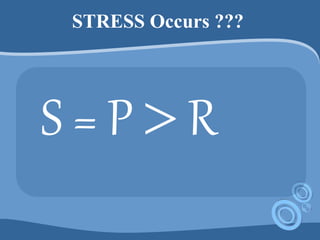
• Stress occurs when the pressure
is greater than the resource.
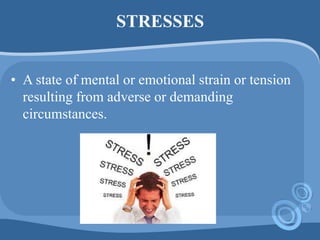
STRESSES
• A state of mental or emotional strain or tension
resulting from adverse or demanding
circumstances.
STRESSOR
• A stressor is a chemical or biological agent,
environmental condition, external stimulus
or an event that causes stress to an organism.
An event that triggers the stress response
may include: environmental stressors (hypo
or hyper-thermal temperatures, elevated
sound levels, over-illumination,
overcrowding).
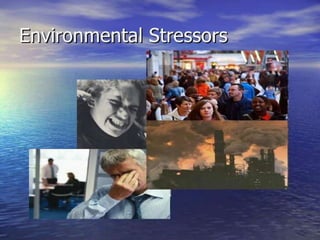
ENVIRONMENTAL STRESSORS
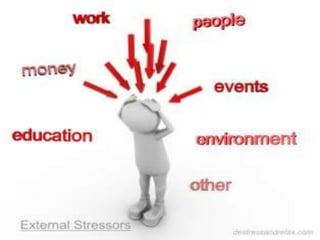
• Stressors that are found in our surroundings
are called environmental stressors.
Everyday life is full of environmental
stressors that cause minor irritations. If you
use an alarm clock to wake up, the loud
noise from your alarm is an environmental
stressor. Extreme temperatures are also
environmental stressors and can lead to
discomfort.
ENVIRONMENTAL STRESSORS
• Other common environmental stressors include:
• Noise
• Crowding
• Air quality
• Colours
• Tornadoes and other natural disasters
• War and other manmade disasters
• Light
• Insects
ENVIRONMENTAL STRESSORS
• Environmental stress refers to physical, chemical, and
biological constraints on the productivity of species and on
the development of ecosystems. When the exposure to
environmental stressors increases or decreases in intensity,
ecological responses result. Stressors can be natural
environmental factors, or they may result from the activities
of humans. Some environmental stressors exert a relatively
local influence, while others are regional or global in their
scope. Stressors are challenges to the integrity of
ecosystems and to the quality of the environment.
ENVIRONMENTAL STRESSORS
• Species and ecosystems have some capacity to
tolerate changes in the intensity of environmental
stressors. This is known as resistance, but there are
limits to this attribute, which represent thresholds
of tolerance. When these thresholds are exceeded
by further increases in the intensity of
environmental stress, substantial ecological changes
are caused.
ENVIRONMENTAL STRESSORS
• Recent research has linked extreme temperatures, crowding,
and noise with increased levels of discomfort and
aggression. Studies have also shown that crime rates are
higher during those hot summer days. Different colours can
raise or lower your stress levels. For example, green is often
associated with life and growth and is known to reduce
tension and anxiety. Exposure to light can improve your
mood and decrease fatigue, while prolonged exposure to
darkness can interfere with sleep patterns and lead to
symptoms of depression.
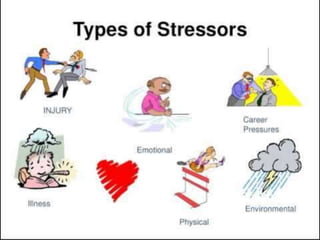
Environmental stressors can be grouped into
the following categories:
• Physical Stress
• Wildfires
• Pollution
• Thermal Stress
• Radiation Stress
• Climatic Stress
• Biological Stress
CATEGORIES
• Physical stress refers to brief but intense exposures
to kinetic energy. This is a type of ecological
disturbance because of its acute, episodic nature.
Examples include volcanic eruptions, windstorms,
and explosions.
• Wildfire is also a disturbance, during which much
of the biomass of an ecosystem is combusted, and
the dominant species may be killed.
CATEGORIES
• Pollution occurs when chemicals are present in
concentrations large enough to affect organisms and thereby
cause ecological changes. Toxic pollution can be caused by
gases such as sulfur dioxide and ozone, by elements such as
arsenic, lead, and mercury, and by pesticides such as DDT.
Inputs of nutrients such as phosphate and nitrate can
influence productivity and other ecological processes,
causing a type of pollution known as eutrophication.
CATEGORIES
• Thermal stress occurs when releases of heat influence
ecosystems, as happens in the vicinity of natural hot-water
vents on the ocean floor, and near industrial discharges of
heated water.
• Radiation stress is associated with excessive loads of
ionizing energy. This can occur on mountain tops where
there are intense exposures to ultraviolet radiation, and in
places where there are exposures to radioactive materials.
CATEGORIES
• Climatic stress is associated with excessive or
insufficient regimes of temperature, moisture, solar
radiation, and combinations of these. Tundra and
deserts are examples of climatically stressed
ecosystems, while tropical rainforests occur under a
relatively benign climatic regime.
• Biological stresses are associated with the diverse
interactions that occur among organisms of the
same or different species.
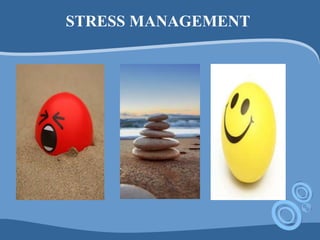
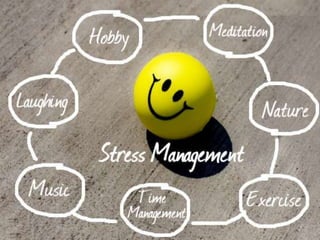
STRESS MANAGEMENT
Environmental stressors

Environmental stressors

  • 2.
  • 3.
  • 4.
    S=P  R •Stress occurs when the pressure is greater than the resource.
  • 5.
    STRESSES • A stateof mental or emotional strain or tension resulting from adverse or demanding circumstances.
  • 6.
    STRESSOR • A stressoris a chemical or biological agent, environmental condition, external stimulus or an event that causes stress to an organism. An event that triggers the stress response may include: environmental stressors (hypo or hyper-thermal temperatures, elevated sound levels, over-illumination, overcrowding).
  • 7.
    ENVIRONMENTAL STRESSORS • Stressorsthat are found in our surroundings are called environmental stressors. Everyday life is full of environmental stressors that cause minor irritations. If you use an alarm clock to wake up, the loud noise from your alarm is an environmental stressor. Extreme temperatures are also environmental stressors and can lead to discomfort.
  • 8.
    ENVIRONMENTAL STRESSORS • Othercommon environmental stressors include: • Noise • Crowding • Air quality • Colours • Tornadoes and other natural disasters • War and other manmade disasters • Light • Insects
  • 10.
    ENVIRONMENTAL STRESSORS • Environmentalstress refers to physical, chemical, and biological constraints on the productivity of species and on the development of ecosystems. When the exposure to environmental stressors increases or decreases in intensity, ecological responses result. Stressors can be natural environmental factors, or they may result from the activities of humans. Some environmental stressors exert a relatively local influence, while others are regional or global in their scope. Stressors are challenges to the integrity of ecosystems and to the quality of the environment.
  • 11.
    ENVIRONMENTAL STRESSORS • Speciesand ecosystems have some capacity to tolerate changes in the intensity of environmental stressors. This is known as resistance, but there are limits to this attribute, which represent thresholds of tolerance. When these thresholds are exceeded by further increases in the intensity of environmental stress, substantial ecological changes are caused.
  • 13.
    ENVIRONMENTAL STRESSORS • Recentresearch has linked extreme temperatures, crowding, and noise with increased levels of discomfort and aggression. Studies have also shown that crime rates are higher during those hot summer days. Different colours can raise or lower your stress levels. For example, green is often associated with life and growth and is known to reduce tension and anxiety. Exposure to light can improve your mood and decrease fatigue, while prolonged exposure to darkness can interfere with sleep patterns and lead to symptoms of depression.
  • 14.
    Environmental stressors canbe grouped into the following categories: • Physical Stress • Wildfires • Pollution • Thermal Stress • Radiation Stress • Climatic Stress • Biological Stress
  • 15.
    CATEGORIES • Physical stressrefers to brief but intense exposures to kinetic energy. This is a type of ecological disturbance because of its acute, episodic nature. Examples include volcanic eruptions, windstorms, and explosions. • Wildfire is also a disturbance, during which much of the biomass of an ecosystem is combusted, and the dominant species may be killed.
  • 16.
    CATEGORIES • Pollution occurswhen chemicals are present in concentrations large enough to affect organisms and thereby cause ecological changes. Toxic pollution can be caused by gases such as sulfur dioxide and ozone, by elements such as arsenic, lead, and mercury, and by pesticides such as DDT. Inputs of nutrients such as phosphate and nitrate can influence productivity and other ecological processes, causing a type of pollution known as eutrophication.
  • 17.
    CATEGORIES • Thermal stressoccurs when releases of heat influence ecosystems, as happens in the vicinity of natural hot-water vents on the ocean floor, and near industrial discharges of heated water. • Radiation stress is associated with excessive loads of ionizing energy. This can occur on mountain tops where there are intense exposures to ultraviolet radiation, and in places where there are exposures to radioactive materials.
  • 18.
    CATEGORIES • Climatic stressis associated with excessive or insufficient regimes of temperature, moisture, solar radiation, and combinations of these. Tundra and deserts are examples of climatically stressed ecosystems, while tropical rainforests occur under a relatively benign climatic regime. • Biological stresses are associated with the diverse interactions that occur among organisms of the same or different species.
  • 20.