
ORGANISATION BEHAVIOUR
Relationship between Organization
behaviour and the Individual
Presented by :-
Sumit Munje
Swapnil Khule
Seema Kumari
Ashish Nalawade
Prashant Maharana
ORGANISATIONAL BEHAVIOUR
 How people – as individuals and as group – act
within organizations.
 It strives to identify way in which people can act more
effectively.
 It is scientific discipline in which large number of
research studies and conceptual development are
constantly adding to its knowledge base.
 It’s also an applied science, in that information about
effective practices in one organization is being
extended to many others.
ORGANISATION BEHAVIOUR
“Organisation Behaviour is concerned with the
study of what people do in an organisation and
how that behaviour affects the performance of the
organisation.”
(Stephen Robbins)
ORGANISATION BEHAVIOUR
“Organisation Behaviour is to understand,
predicting and controlling human behaviour at
work.”
(Fred Luthans)
ORGANISATION BEHAVIOUR
“Organisation Behaviour is subset of management
activity concern with understanding, predicting
and influencing individual behaviour in
organisational setting.”
(Callahan)
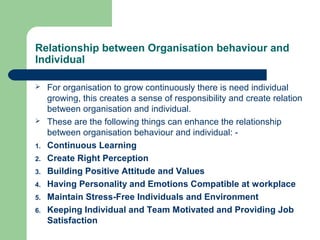
Relationship between Organisation behaviour and
Individual
 For organisation to grow continuously there is need individual
growing, this creates a sense of responsibility and create relation
between organisation and individual.
 These are the following things can enhance the relationship
between organisation behaviour and individual: -
1. Continuous Learning
2. Create Right Perception
3. Building Positive Attitude and Values
4. Having Personality and Emotions Compatible at workplace
5. Maintain Stress-Free Individuals and Environment
6. Keeping Individual and Team Motivated and Providing Job
Satisfaction
1. CONTINUOUS LEARNING
 Learning is any permanent change in behaviour, resulting from
experience.
 Need to promote that behaviour, which are functional.
 Need to discourage that behaviour, which are detrimental.
 It creates a bond between the organization and employee.
2. CREATE RIGHT PERCEPTION
 Select, organise & interpret input from sensory receptors.
 OB helps to create right perception for working effectively with
people.
 This creates right perceptual sense in the people.
3. BUILDING POSITIVE ATTITUDES AND VALUES
 Attitudes are lasting evaluations of people, groups, objects or issues.
 Positive attitudes for effective relationship.
 Values are: Specific mode of conduct
OR end state of existence is personally
OR socially preferable to an opposite
OR adverse mode of conduct
OR end state of existence
 Values are the base of attitudes and behaviour.
4. PERSONALITY AND EMOTIONS COMPATIBLE AT
WORKPLACE
 Personality is unique and relatively stable patterns of behaviour,
thoughts and feelings.
 Full potential of individual can be utilised.
 Emotions are reactions consisting of subjective cognitive states,
physiological reactions and expressive behaviours.
 An understanding about emotions helps for self – development of
individuals.
5. MAINTAINING STRESS-FREE INDIVIDUALS AND
ENVIRONMENT
 Stress is dynamic action in which an individual confronted with
Opportunity, constraint or demand related to what he or she
desires and for which outcome perceived to both uncertain and
important. With growing competition and survival and excellence
become tougher
 Stress is the managerial discomfort of modern era.
 OB helps the individual in reducing stress level and manages
environment and makes it comfortable.
6. KEEPING INDIVIDUALS AND TEAMS MOTIVATE AND
PROVIDING JOB SATISFACTION
 Motivation is the most important intangible resource of the
Organisation.
 Motivation is internal process that activates, guides and maintains
behaviour over time.
 Job satisfaction is general attitude towards one’s job.
 It depends on difference between amount of rewards workers receive
and amount they believe they should receive.
 OB helps the team in getting motivated and provides job satisfaction
to the employees.
Thank You !


Difference between OB and individual

  • 1.
  • 2.
    Relationship between Organization behaviourand the Individual Presented by :- Sumit Munje Swapnil Khule Seema Kumari Ashish Nalawade Prashant Maharana
  • 3.
    ORGANISATIONAL BEHAVIOUR  Howpeople – as individuals and as group – act within organizations.  It strives to identify way in which people can act more effectively.  It is scientific discipline in which large number of research studies and conceptual development are constantly adding to its knowledge base.  It’s also an applied science, in that information about effective practices in one organization is being extended to many others.
  • 4.
    ORGANISATION BEHAVIOUR “Organisation Behaviouris concerned with the study of what people do in an organisation and how that behaviour affects the performance of the organisation.” (Stephen Robbins)
  • 5.
    ORGANISATION BEHAVIOUR “Organisation Behaviouris to understand, predicting and controlling human behaviour at work.” (Fred Luthans)
  • 6.
    ORGANISATION BEHAVIOUR “Organisation Behaviouris subset of management activity concern with understanding, predicting and influencing individual behaviour in organisational setting.” (Callahan)
  • 7.
    Relationship between Organisationbehaviour and Individual  For organisation to grow continuously there is need individual growing, this creates a sense of responsibility and create relation between organisation and individual.  These are the following things can enhance the relationship between organisation behaviour and individual: - 1. Continuous Learning 2. Create Right Perception 3. Building Positive Attitude and Values 4. Having Personality and Emotions Compatible at workplace 5. Maintain Stress-Free Individuals and Environment 6. Keeping Individual and Team Motivated and Providing Job Satisfaction
  • 8.
    1. CONTINUOUS LEARNING Learning is any permanent change in behaviour, resulting from experience.  Need to promote that behaviour, which are functional.  Need to discourage that behaviour, which are detrimental.  It creates a bond between the organization and employee.
  • 9.
    2. CREATE RIGHTPERCEPTION  Select, organise & interpret input from sensory receptors.  OB helps to create right perception for working effectively with people.  This creates right perceptual sense in the people.
  • 10.
    3. BUILDING POSITIVEATTITUDES AND VALUES  Attitudes are lasting evaluations of people, groups, objects or issues.  Positive attitudes for effective relationship.  Values are: Specific mode of conduct OR end state of existence is personally OR socially preferable to an opposite OR adverse mode of conduct OR end state of existence  Values are the base of attitudes and behaviour.
  • 11.
    4. PERSONALITY ANDEMOTIONS COMPATIBLE AT WORKPLACE  Personality is unique and relatively stable patterns of behaviour, thoughts and feelings.  Full potential of individual can be utilised.  Emotions are reactions consisting of subjective cognitive states, physiological reactions and expressive behaviours.  An understanding about emotions helps for self – development of individuals.
  • 12.
    5. MAINTAINING STRESS-FREEINDIVIDUALS AND ENVIRONMENT  Stress is dynamic action in which an individual confronted with Opportunity, constraint or demand related to what he or she desires and for which outcome perceived to both uncertain and important. With growing competition and survival and excellence become tougher  Stress is the managerial discomfort of modern era.  OB helps the individual in reducing stress level and manages environment and makes it comfortable.
  • 13.
    6. KEEPING INDIVIDUALSAND TEAMS MOTIVATE AND PROVIDING JOB SATISFACTION  Motivation is the most important intangible resource of the Organisation.  Motivation is internal process that activates, guides and maintains behaviour over time.  Job satisfaction is general attitude towards one’s job.  It depends on difference between amount of rewards workers receive and amount they believe they should receive.  OB helps the team in getting motivated and provides job satisfaction to the employees.
  • 14.

Editor's Notes

  • #3 Relationship between Organizational behavior and the Individual
  • #4 INTRO AND MEANING DEF Organisation behavior is the studuy of knowledge about
  • #5 Organisation Behaviour is concerned with the study of what people do in an organisation and how that behaviour affects the performance of the organisation
  • #6 Organisation Behaviour is to understand, predicting and controlling human behaviour at work.
  • #7 Organisation Behaviour is subset of management activity concern with understanding, predicting and influencing individual behaviour in organisational setting.
  • #8 The study of Organisational Behaviour involves:
  • #9 The study of Organisational Behaviour involves:
  • #10 The study of Organisational Behaviour involves:
  • #11 The study of Organisational Behaviour involves:
  • #12 The study of Organisational Behaviour involves:
  • #13 The study of Organisational Behaviour involves:
  • #14 The study of Organisational Behaviour involves: