BY KAPILESHWAR KUMAR
World population facts
In 1801, when the first complete world census was carried
out, the world’s population was 1 billion. China had 295
million people, India 131 million, Russia 33 million, France
27 million, Ottoman Empire 21 million, Germany 14
million, Spain 11 million, Britain 10 million, Ireland and the
USA 5 million.
World population landmarks:








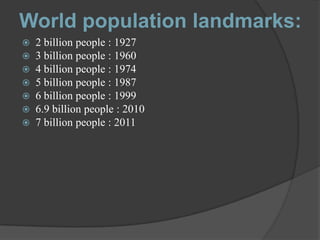
2 billion people : 1927
3 billion people : 1960
4 billion people : 1974
5 billion people : 1987
6 billion people : 1999
6.9 billion people : 2010
7 billion people : 2011
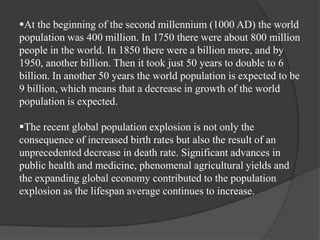
At the beginning of the second millennium (1000 AD) the world
population was 400 million. In 1750 there were about 800 million
people in the world. In 1850 there were a billion more, and by
1950, another billion. Then it took just 50 years to double to 6
billion. In another 50 years the world population is expected to be
9 billion, which means that a decrease in growth of the world
population is expected.
The recent global population explosion is not only the
consequence of increased birth rates but also the result of an
unprecedented decrease in death rate. Significant advances in
public health and medicine, phenomenal agricultural yields and
the expanding global economy contributed to the population
explosion as the lifespan average continues to increase.
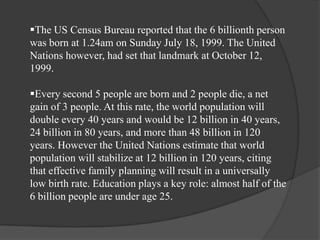
The US Census Bureau reported that the 6 billionth person
was born at 1.24am on Sunday July 18, 1999. The United
Nations however, had set that landmark at October 12,
1999.
Every second 5 people are born and 2 people die, a net
gain of 3 people. At this rate, the world population will
double every 40 years and would be 12 billion in 40 years,
24 billion in 80 years, and more than 48 billion in 120
years. However the United Nations estimate that world
population will stabilize at 12 billion in 120 years, citing
that effective family planning will result in a universally
low birth rate. Education plays a key role: almost half of the
6 billion people are under age 25.
Only one in ten people lived in cities in 1900. By 1994 the
figure had grown to one of every two people, creating
megalopolis of millions to tens of millions inhabitants. More
than 400 cities have a population of more than a million people.
Managing such large cities, and better management of the
planet’s resources, could become the most difficult problem of
this century.
In spite of the population increase and desertification, famines
have actually become less frequent in the past 200 years. The
famines in Africa seen on TV are due to the political strife and
civil wars (see conflicts between countries) that disorganize the
economy, paralyze transportation, and prevent emergency food
drops. In fact, out of the 40 poorest and hungriest nations on
earth, 36 actually export food to richer countries.
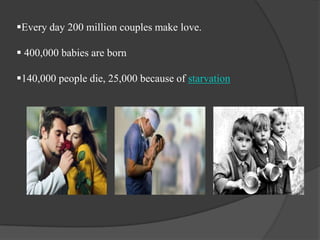
Every day 200 million couples make love.
 400,000 babies are born

140,000 people die, 25,000 because of starvation
Population Growth


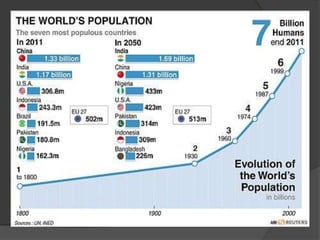
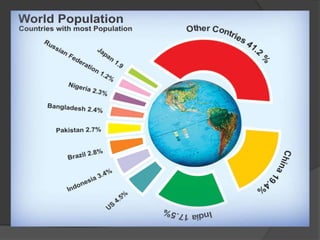
As in July 2010, China has a population of 1.3 billion; India 1.2
billion, USA 307 million. Britain has a population of 61 million,
Russia 141 million, France 62 million, Germany 82 million.



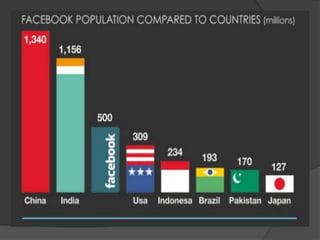
If Facebook was a country

it would be the 3rd largest country in the world, with more 500
million registered profiles… which is almost 100 million less
than the number of registered users on.
THANK YOU!!

Did you know

  • 1.
  • 2.
    World population facts In1801, when the first complete world census was carried out, the world’s population was 1 billion. China had 295 million people, India 131 million, Russia 33 million, France 27 million, Ottoman Empire 21 million, Germany 14 million, Spain 11 million, Britain 10 million, Ireland and the USA 5 million.
  • 3.
    World population landmarks:        2billion people : 1927 3 billion people : 1960 4 billion people : 1974 5 billion people : 1987 6 billion people : 1999 6.9 billion people : 2010 7 billion people : 2011
  • 5.
    At the beginningof the second millennium (1000 AD) the world population was 400 million. In 1750 there were about 800 million people in the world. In 1850 there were a billion more, and by 1950, another billion. Then it took just 50 years to double to 6 billion. In another 50 years the world population is expected to be 9 billion, which means that a decrease in growth of the world population is expected. The recent global population explosion is not only the consequence of increased birth rates but also the result of an unprecedented decrease in death rate. Significant advances in public health and medicine, phenomenal agricultural yields and the expanding global economy contributed to the population explosion as the lifespan average continues to increase.
  • 6.
    The US CensusBureau reported that the 6 billionth person was born at 1.24am on Sunday July 18, 1999. The United Nations however, had set that landmark at October 12, 1999. Every second 5 people are born and 2 people die, a net gain of 3 people. At this rate, the world population will double every 40 years and would be 12 billion in 40 years, 24 billion in 80 years, and more than 48 billion in 120 years. However the United Nations estimate that world population will stabilize at 12 billion in 120 years, citing that effective family planning will result in a universally low birth rate. Education plays a key role: almost half of the 6 billion people are under age 25.
  • 7.
    Only one inten people lived in cities in 1900. By 1994 the figure had grown to one of every two people, creating megalopolis of millions to tens of millions inhabitants. More than 400 cities have a population of more than a million people. Managing such large cities, and better management of the planet’s resources, could become the most difficult problem of this century. In spite of the population increase and desertification, famines have actually become less frequent in the past 200 years. The famines in Africa seen on TV are due to the political strife and civil wars (see conflicts between countries) that disorganize the economy, paralyze transportation, and prevent emergency food drops. In fact, out of the 40 poorest and hungriest nations on earth, 36 actually export food to richer countries.
  • 9.
    Every day 200million couples make love.  400,000 babies are born 140,000 people die, 25,000 because of starvation
  • 10.
    Population Growth  As inJuly 2010, China has a population of 1.3 billion; India 1.2 billion, USA 307 million. Britain has a population of 61 million, Russia 141 million, France 62 million, Germany 82 million.  If Facebook was a country it would be the 3rd largest country in the world, with more 500 million registered profiles… which is almost 100 million less than the number of registered users on.
  • 12.