LEVELS OF DICTION
Jo I. Bartolata
Bicol University
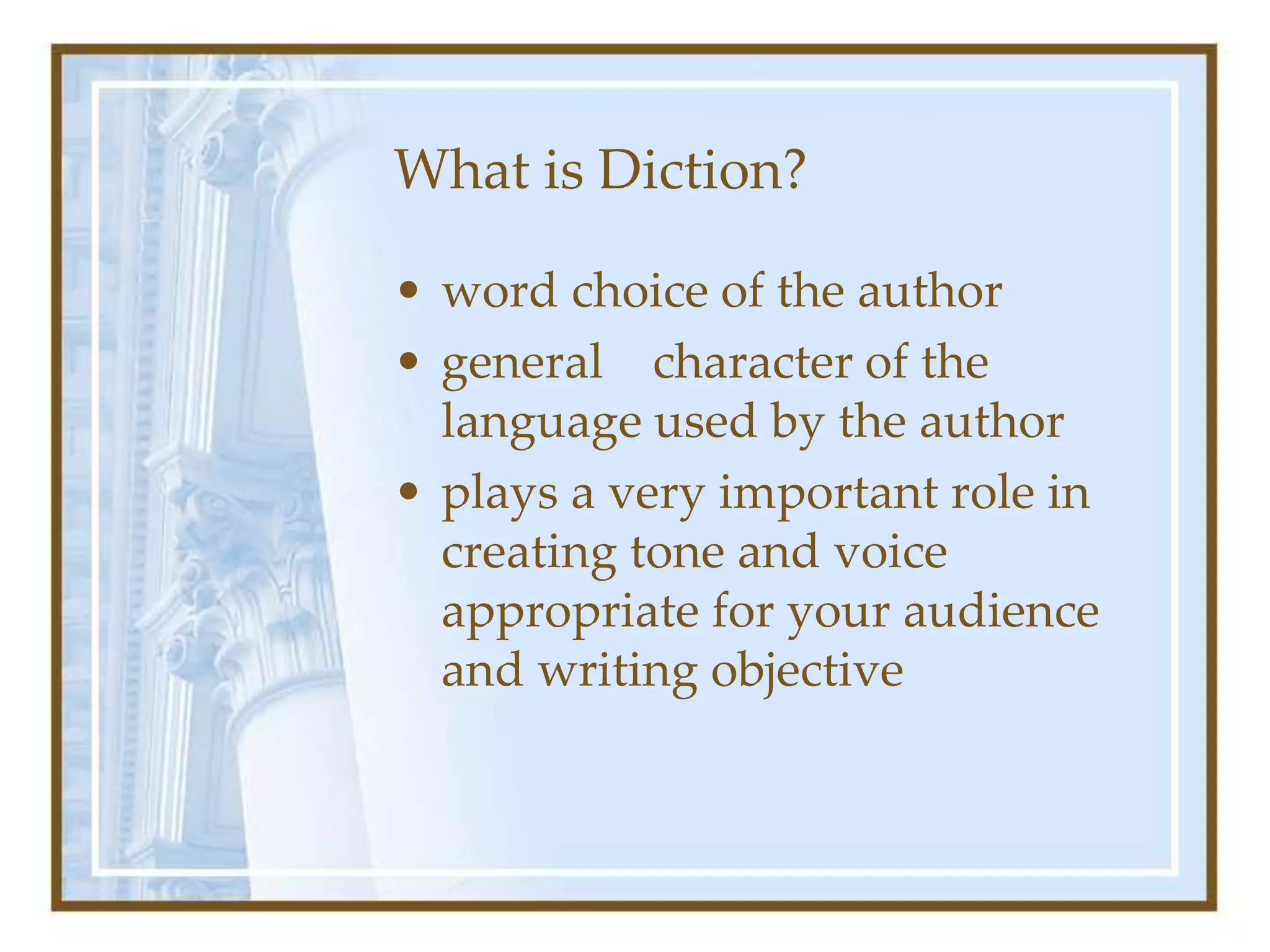
What is Diction?
• word choice of the author
• general character of the
language used by the author
• plays a very important role in
creating tone and voice
appropriate for your audience
and writing objective
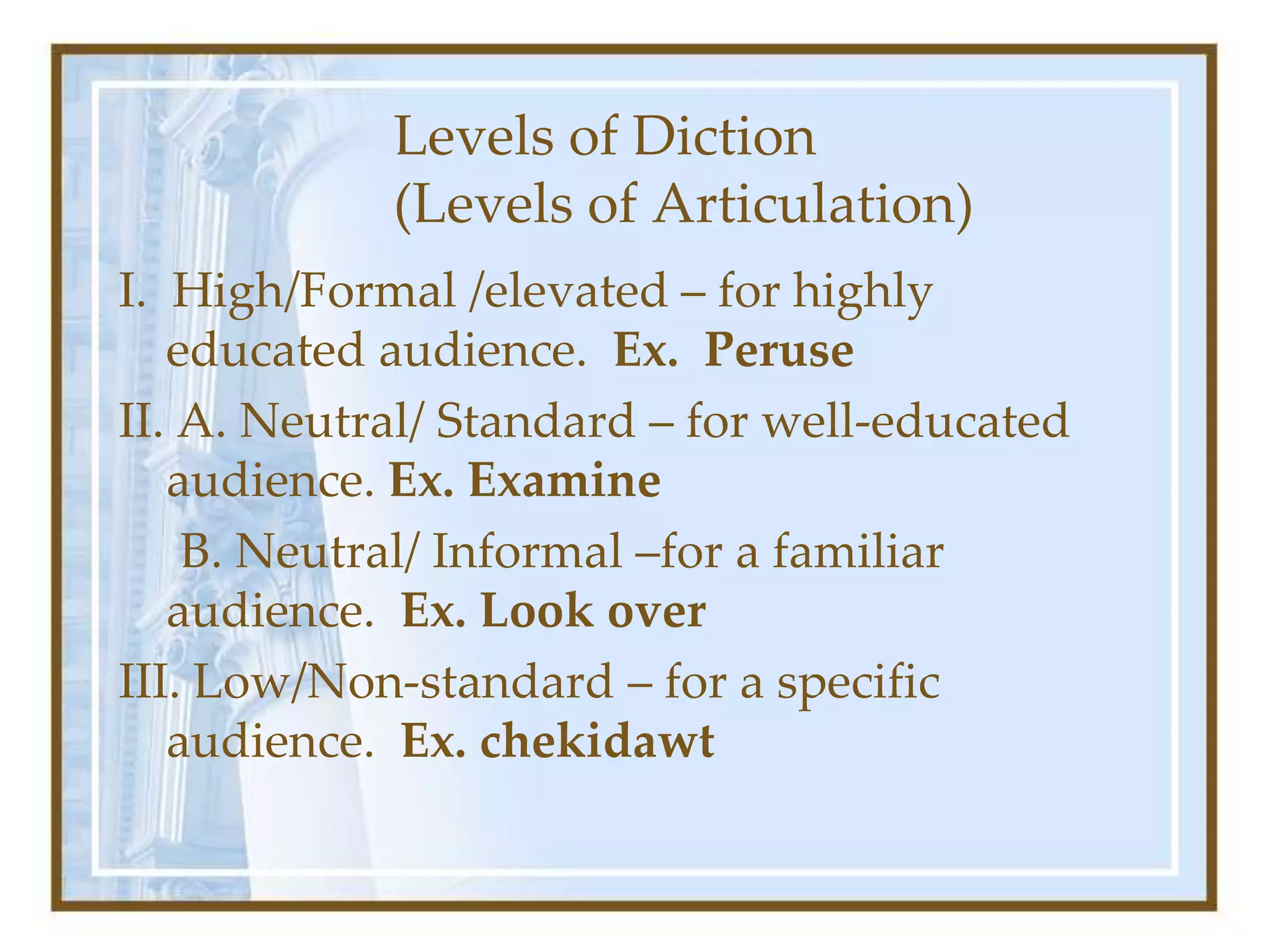
Levels of Diction
(Levels of Articulation)
I. High/Formal /elevated – for highly
educated audience. Ex. Peruse
II. A. Neutral/ Standard – for well-educated
audience. Ex. Examine
B. Neutral/ Informal –for a familiar
audience. Ex. Look over
III. Low/Non-standard – for a specific
audience. Ex. chekidawt
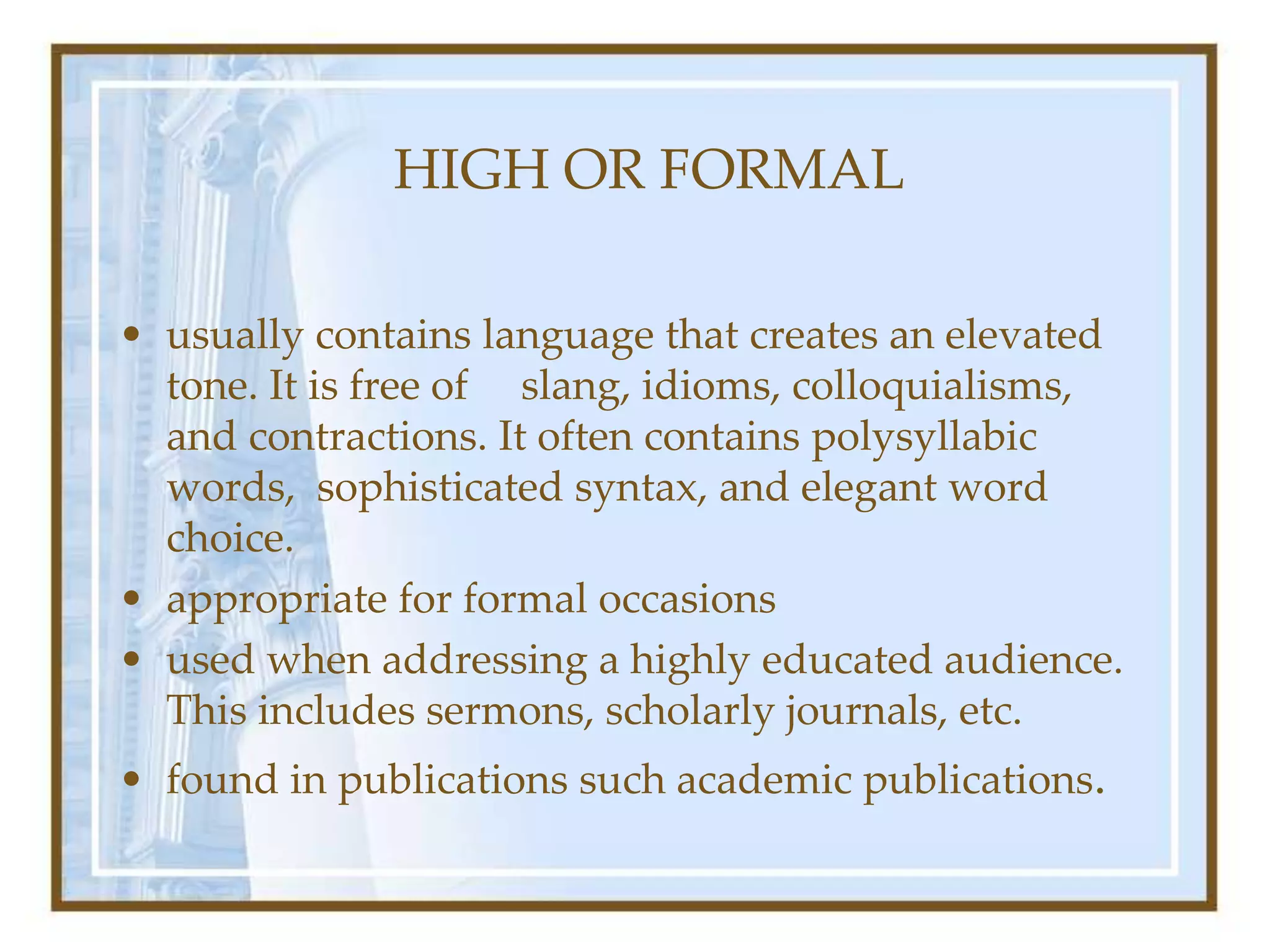
HIGH OR FORMAL
• usually contains language that creates an elevated
tone. It is free of slang, idioms, colloquialisms,
and contractions. It often contains polysyllabic
words, sophisticated syntax, and elegant word
choice.
• appropriate for formal occasions
• used when addressing a highly educated audience.
This includes sermons, scholarly journals, etc.
• found in publications such academic publications.
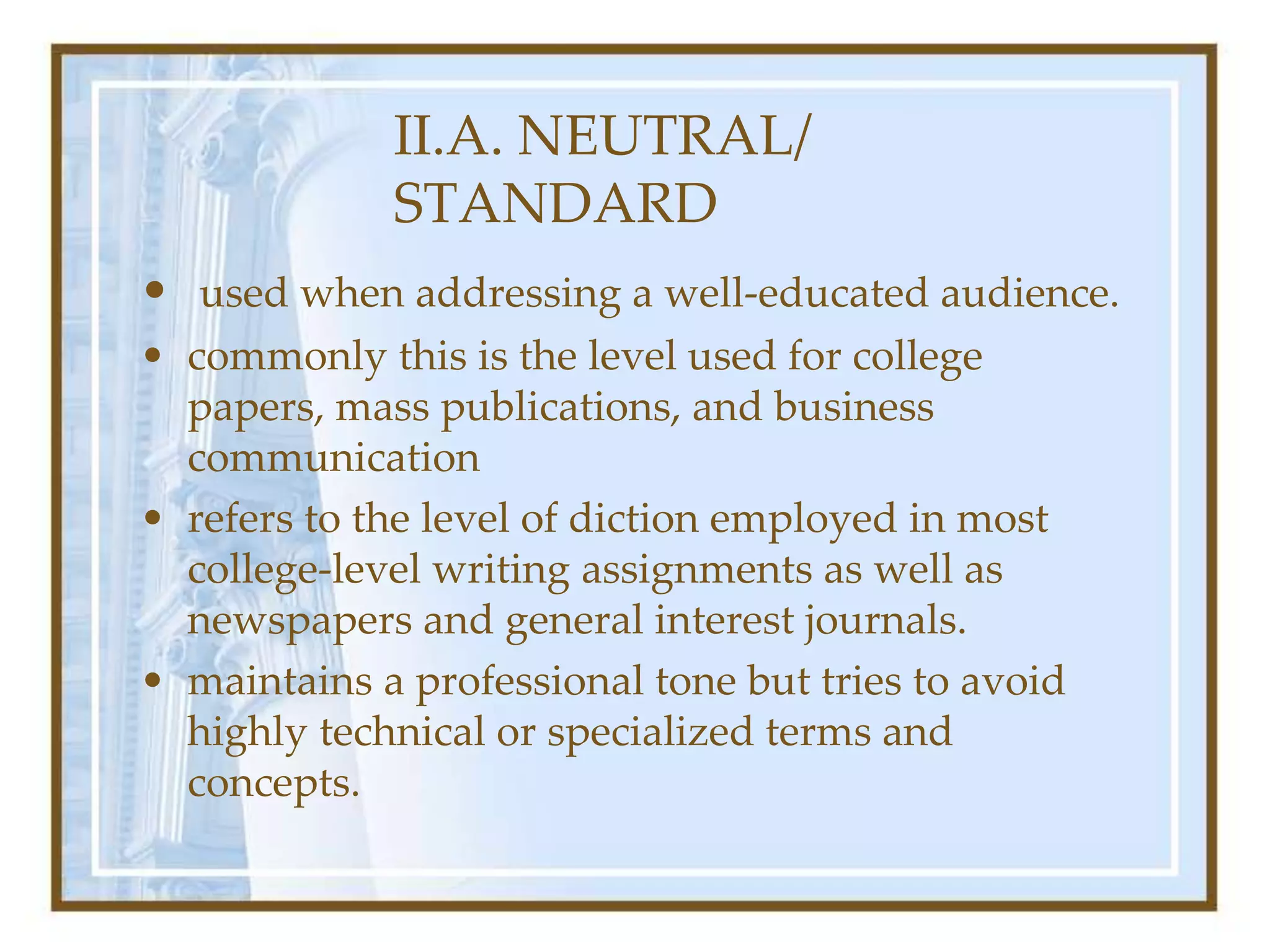
II.A. NEUTRAL/
STANDARD
• used when addressing a well-educated audience.
• commonly this is the level used for college
papers, mass publications, and business
communication
• refers to the level of diction employed in most
college-level writing assignments as well as
newspapers and general interest journals.
• maintains a professional tone but tries to avoid
highly technical or specialized terms and
concepts.
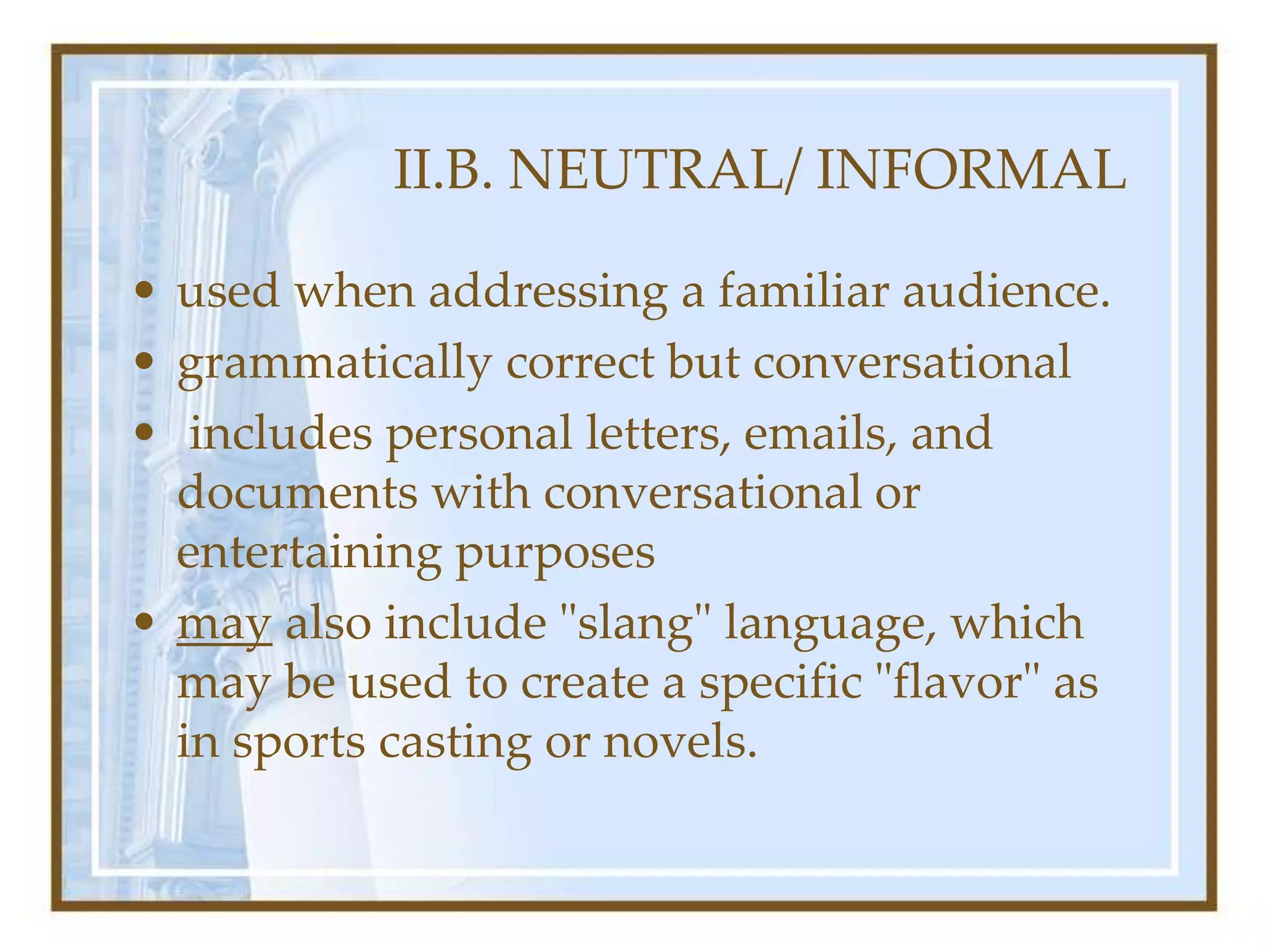
II.B. NEUTRAL/ INFORMAL
• used when addressing a familiar audience.
• grammatically correct but conversational
• includes personal letters, emails, and
documents with conversational or
entertaining purposes
• may also include "slang" language, which
may be used to create a specific "flavor" as
in sports casting or novels.
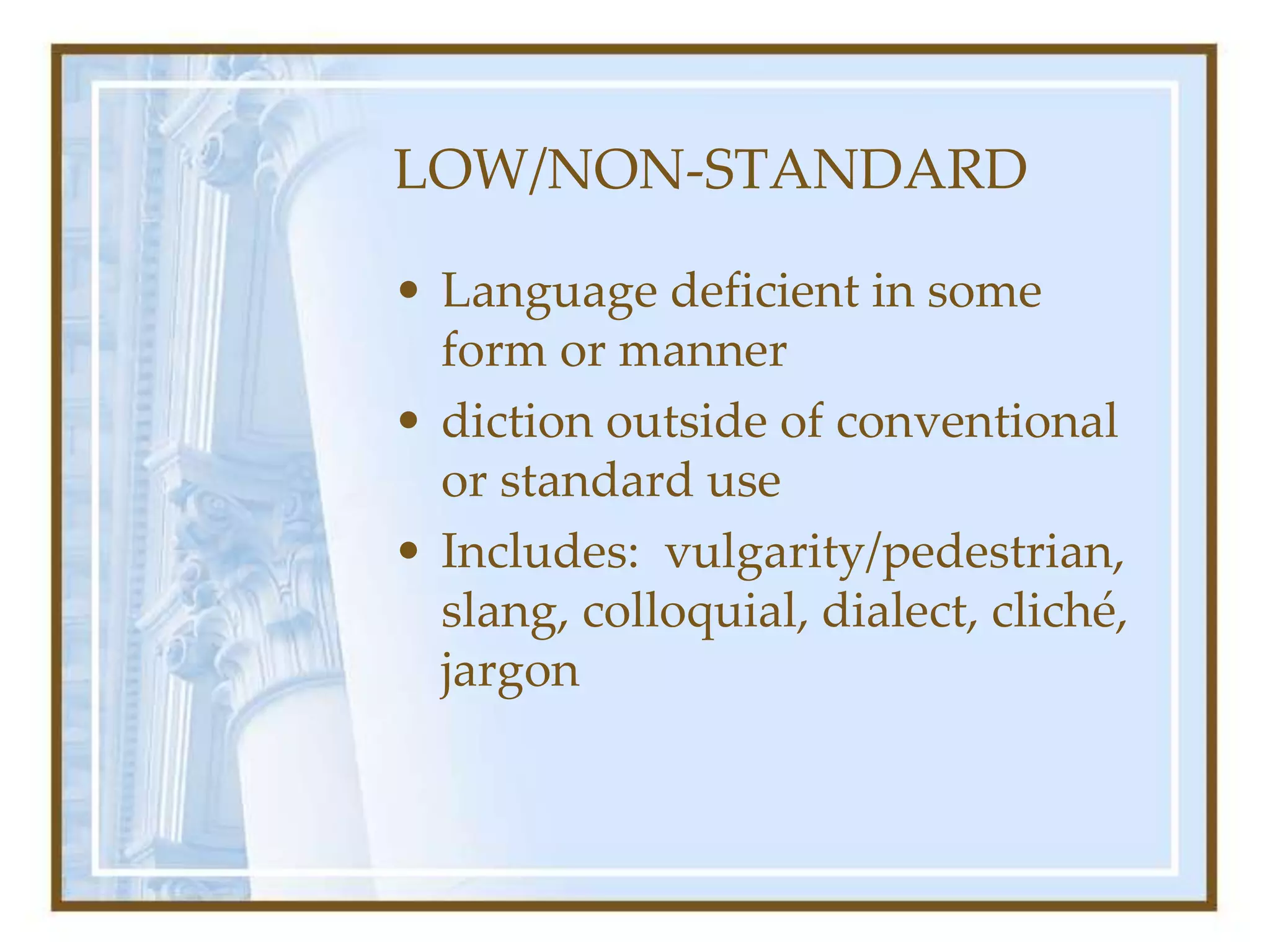
LOW/NON-STANDARD
• Language deficient in some
form or manner
• diction outside of conventional
or standard use
• Includes: vulgarity/pedestrian,
slang, colloquial, dialect, cliché,
jargon
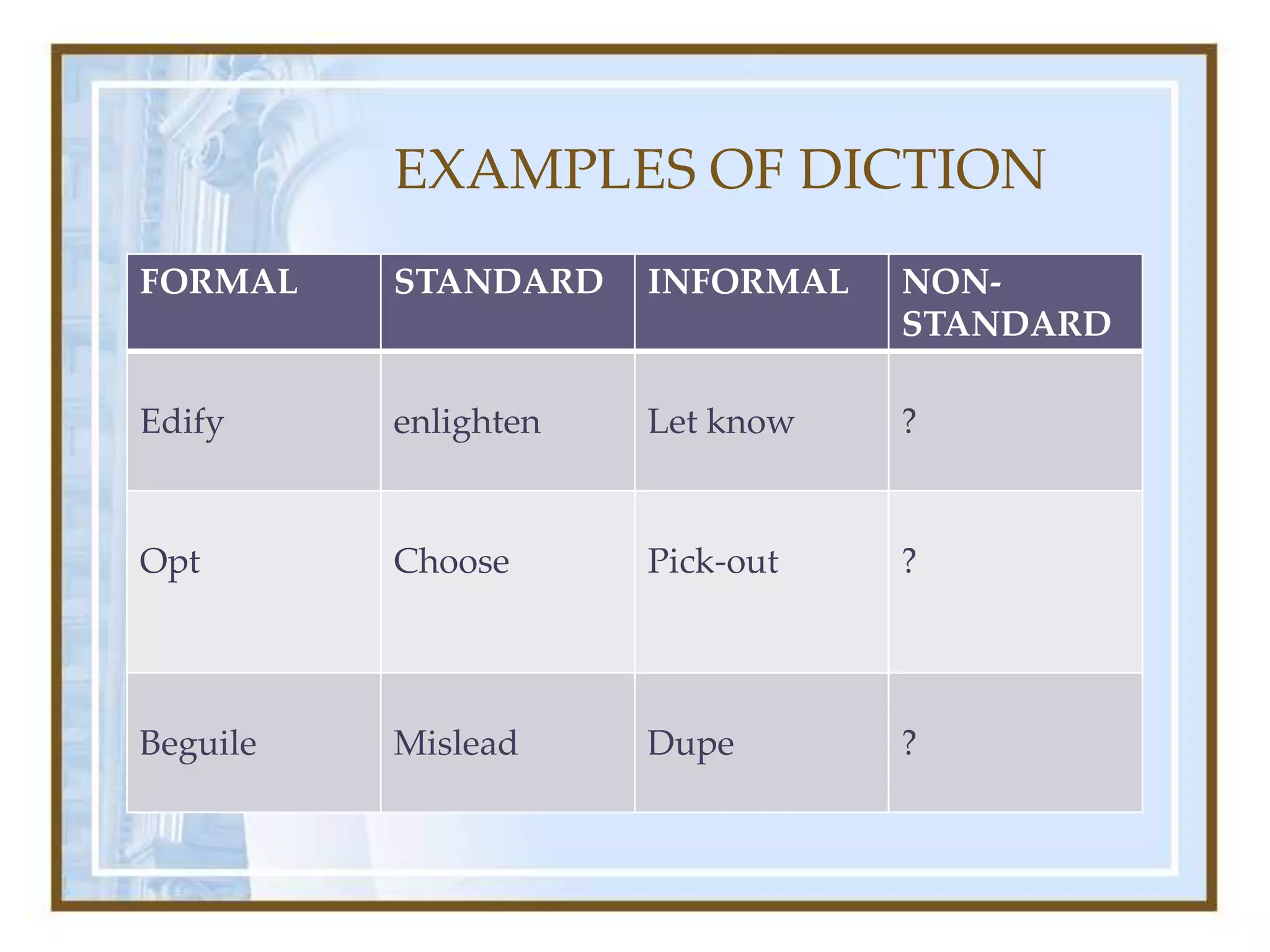
EXAMPLES OF DICTION
FORMAL STANDARD INFORMAL NON-
STANDARD
Edify enlighten Let know ?
Opt Choose Pick-out ?
Beguile Mislead Dupe ?
TYPES OF DICTION
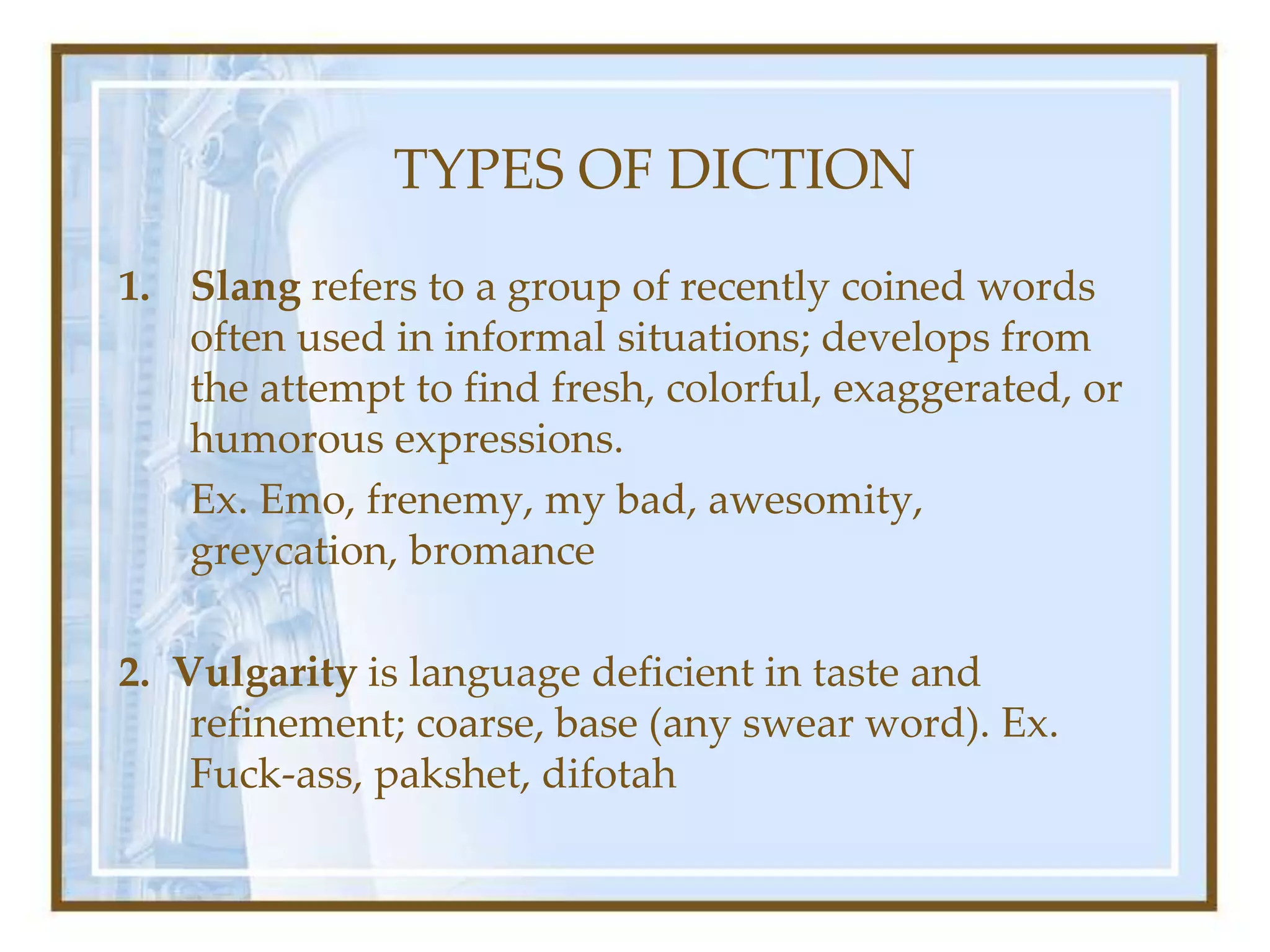
1. Slang refers to a group of recently coined words
often used in informal situations; develops from
the attempt to find fresh, colorful, exaggerated, or
humorous expressions.
Ex. Emo, frenemy, my bad, awesomity,
greycation, bromance
2. Vulgarity is language deficient in taste and
refinement; coarse, base (any swear word). Ex.
Fuck-ass, pakshet, difotah
TYPES OF DICTION
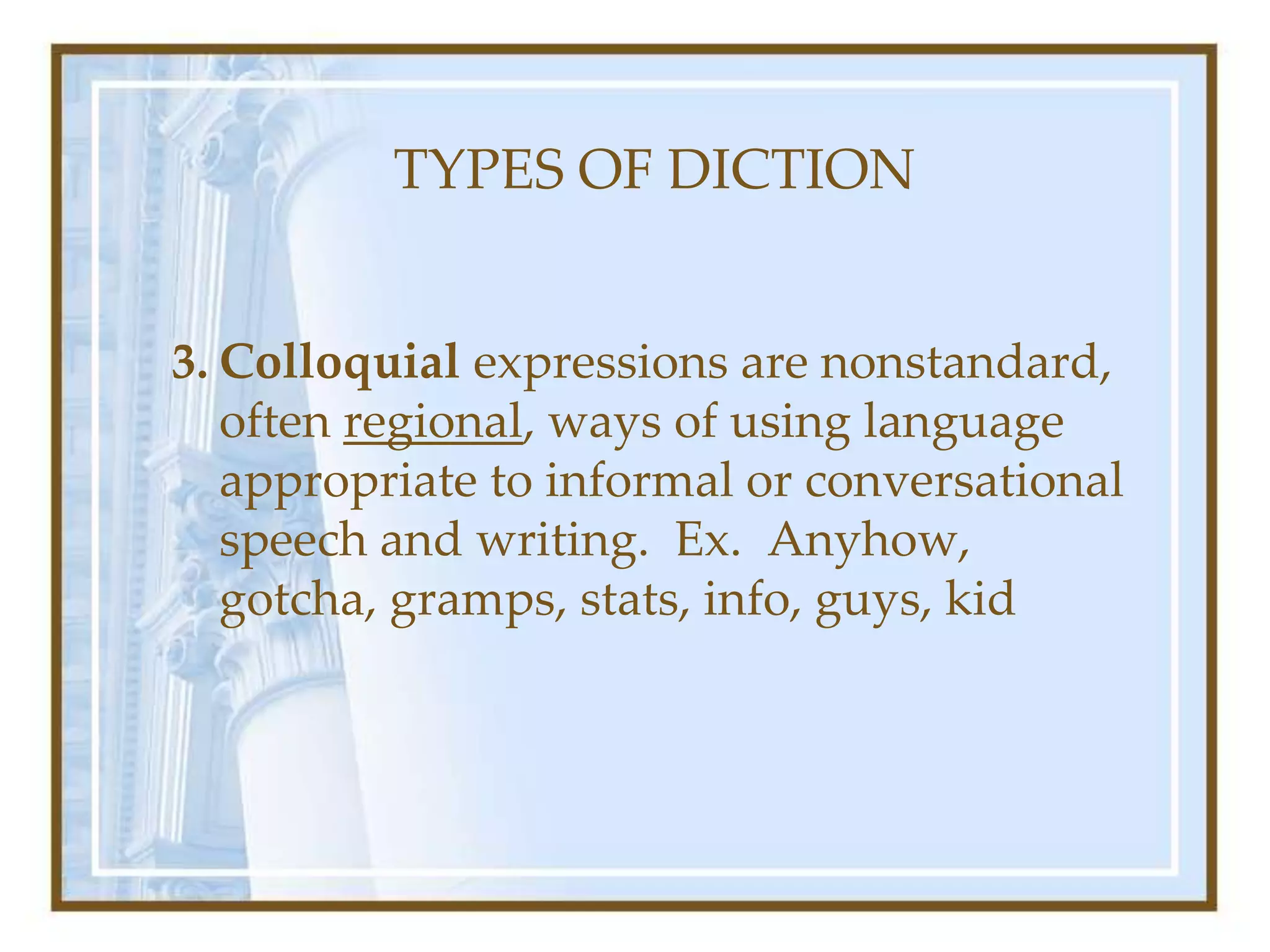
3. Colloquial expressions are nonstandard,
often regional, ways of using language
appropriate to informal or conversational
speech and writing. Ex. Anyhow,
gotcha, gramps, stats, info, guys, kid
TYPES OF DICTION
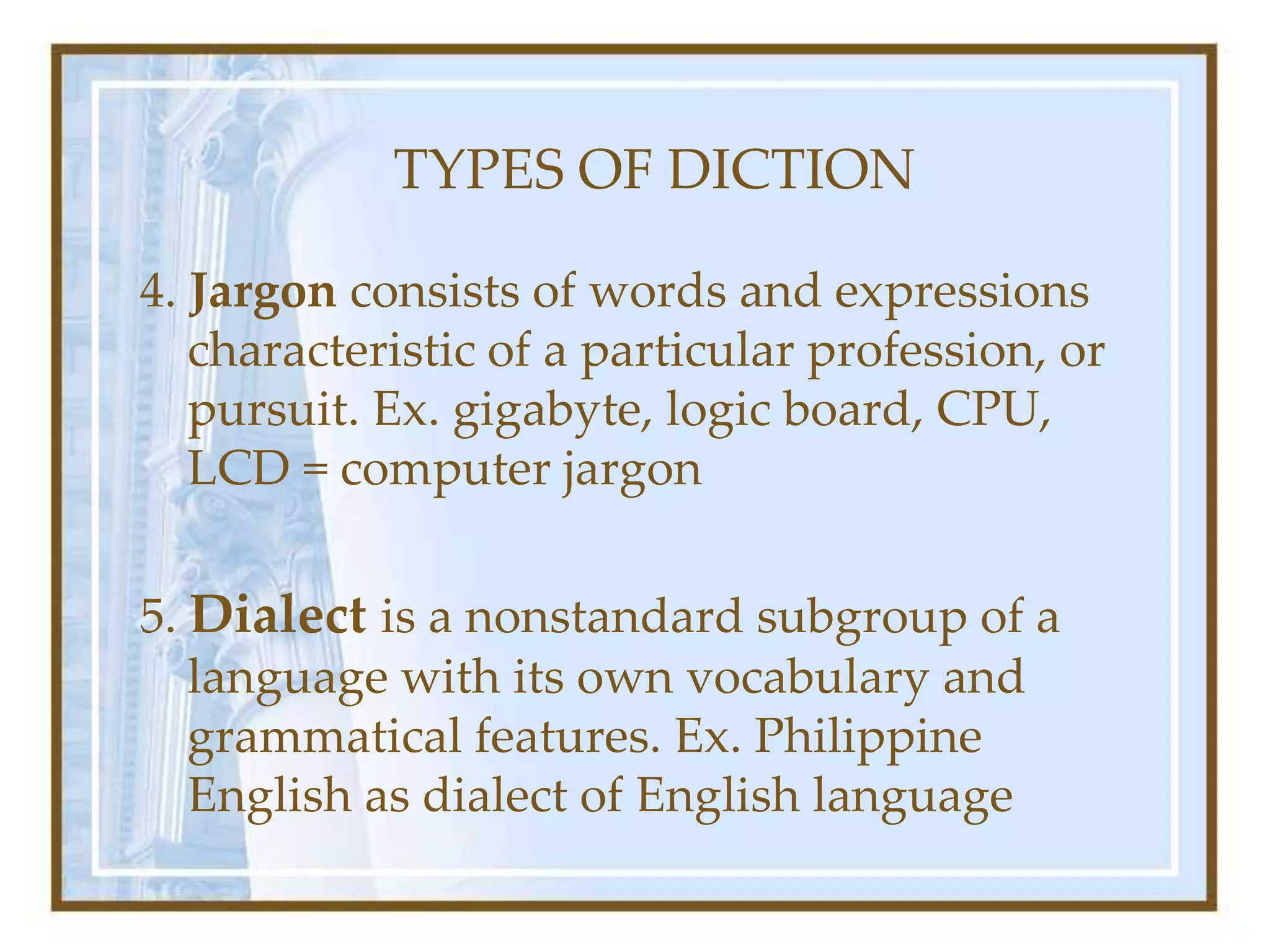
4. Jargon consists of words and expressions
characteristic of a particular profession, or
pursuit. Ex. gigabyte, logic board, CPU,
LCD = computer jargon
5. Dialect is a nonstandard subgroup of a
language with its own vocabulary and
grammatical features. Ex. Philippine
English as dialect of English language
TYPES OF DICTION
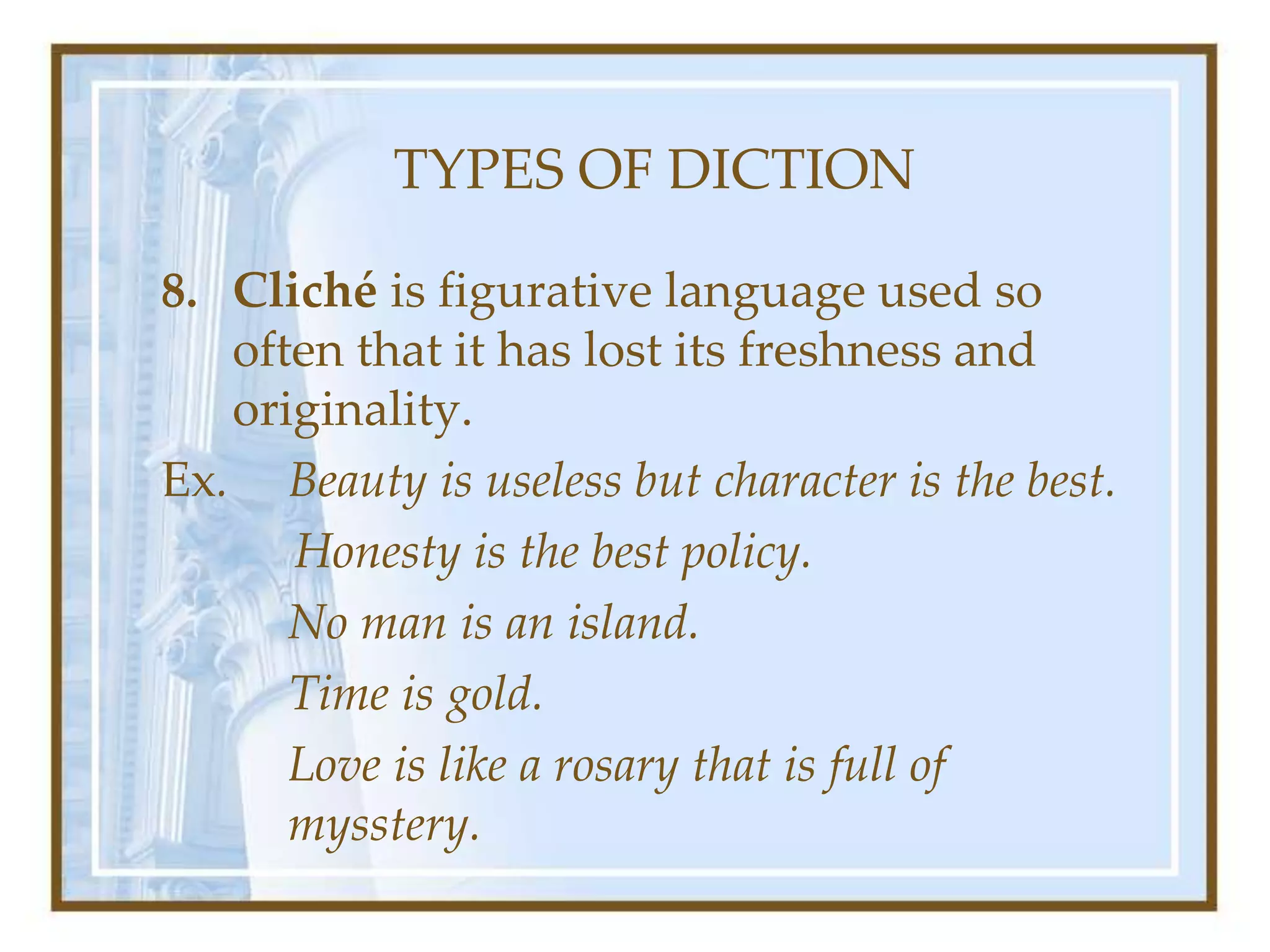
8. Cliché is figurative language used so
often that it has lost its freshness and
originality.
Ex. Beauty is useless but character is the best.
Honesty is the best policy.
No man is an island.
Time is gold.
Love is like a rosary that is full of
mysstery.
TYPES OF DICTION
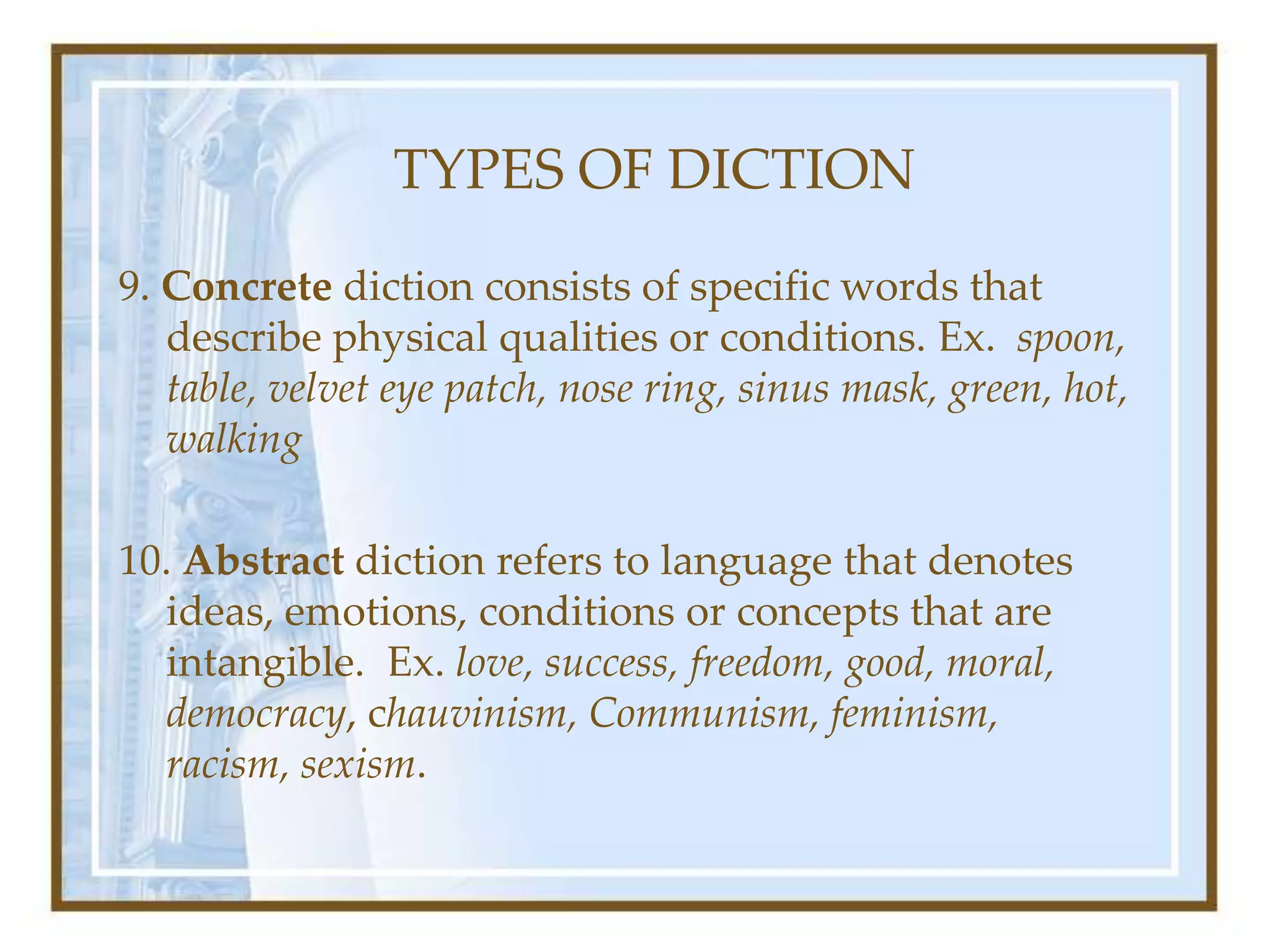
9. Concrete diction consists of specific words that
describe physical qualities or conditions. Ex. spoon,
table, velvet eye patch, nose ring, sinus mask, green, hot,
walking
10. Abstract diction refers to language that denotes
ideas, emotions, conditions or concepts that are
intangible. Ex. love, success, freedom, good, moral,
democracy, chauvinism, Communism, feminism,
racism, sexism.
TYPES OF DICTION
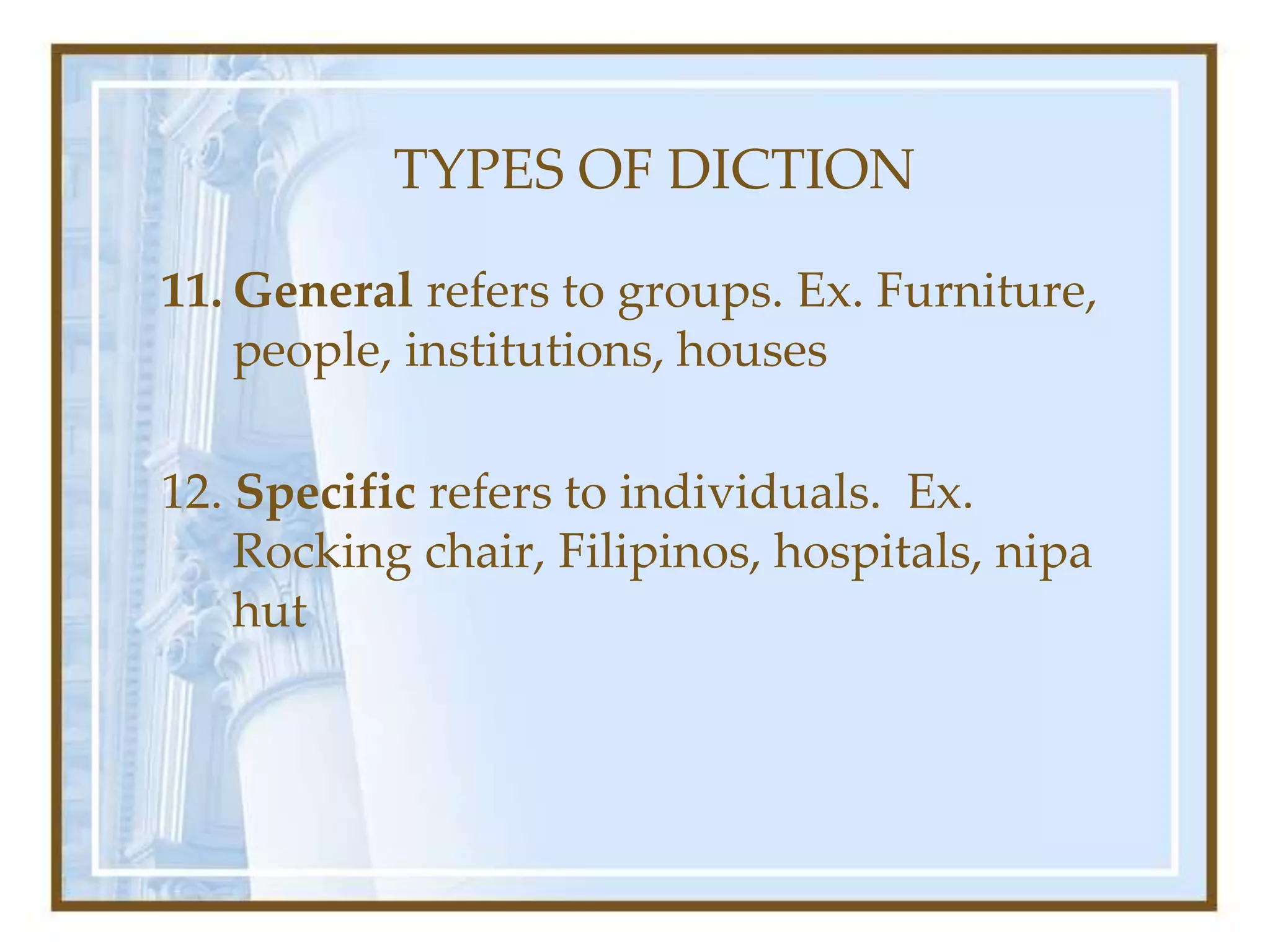
11. General refers to groups. Ex. Furniture,
people, institutions, houses
12. Specific refers to individuals. Ex.
Rocking chair, Filipinos, hospitals, nipa
hut
TYPES OF DICTION
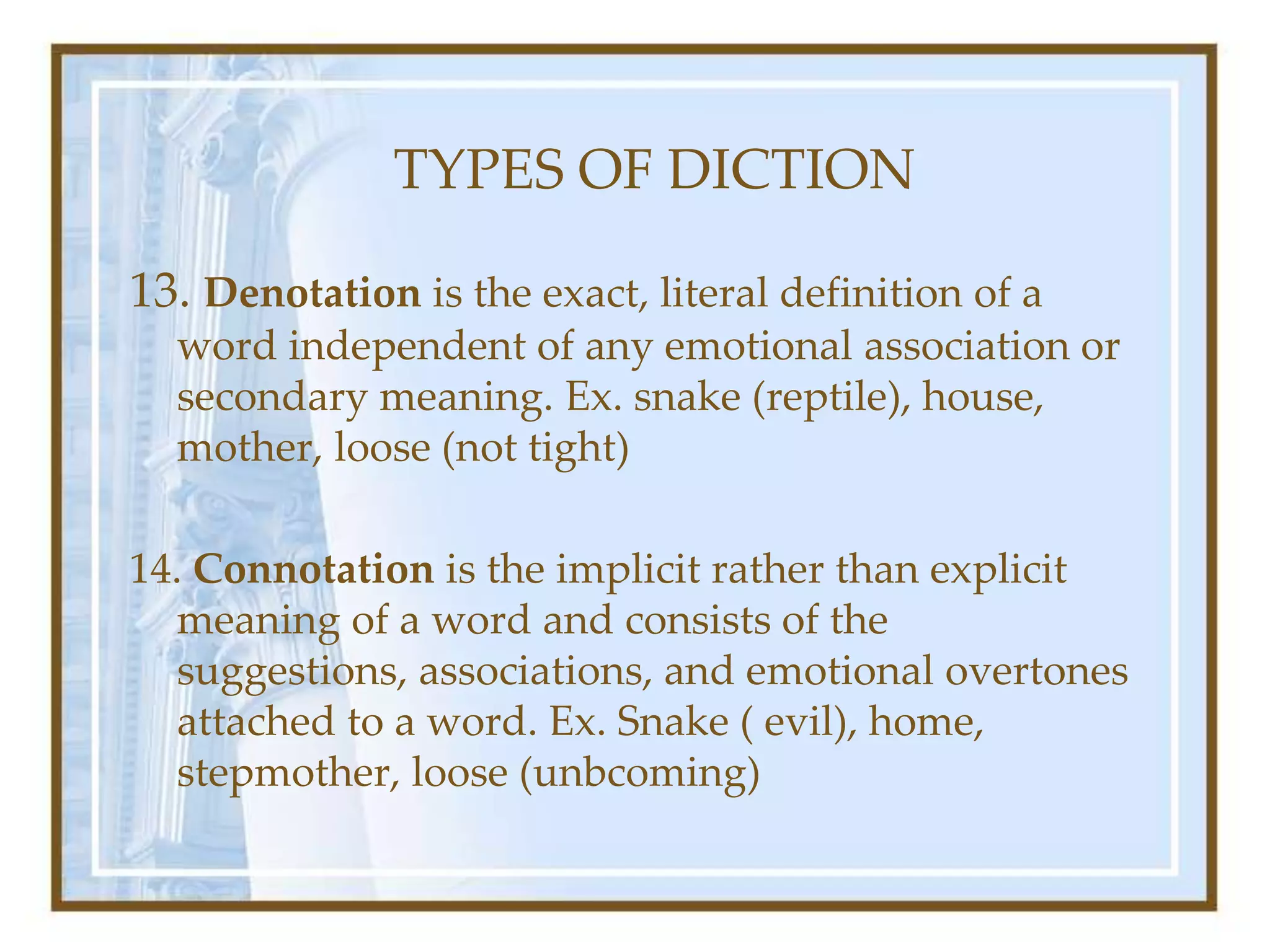
13. Denotation is the exact, literal definition of a
word independent of any emotional association or
secondary meaning. Ex. snake (reptile), house,
mother, loose (not tight)
14. Connotation is the implicit rather than explicit
meaning of a word and consists of the
suggestions, associations, and emotional overtones
attached to a word. Ex. Snake ( evil), home,
stepmother, loose (unbcoming)
TYPES OF DICTION
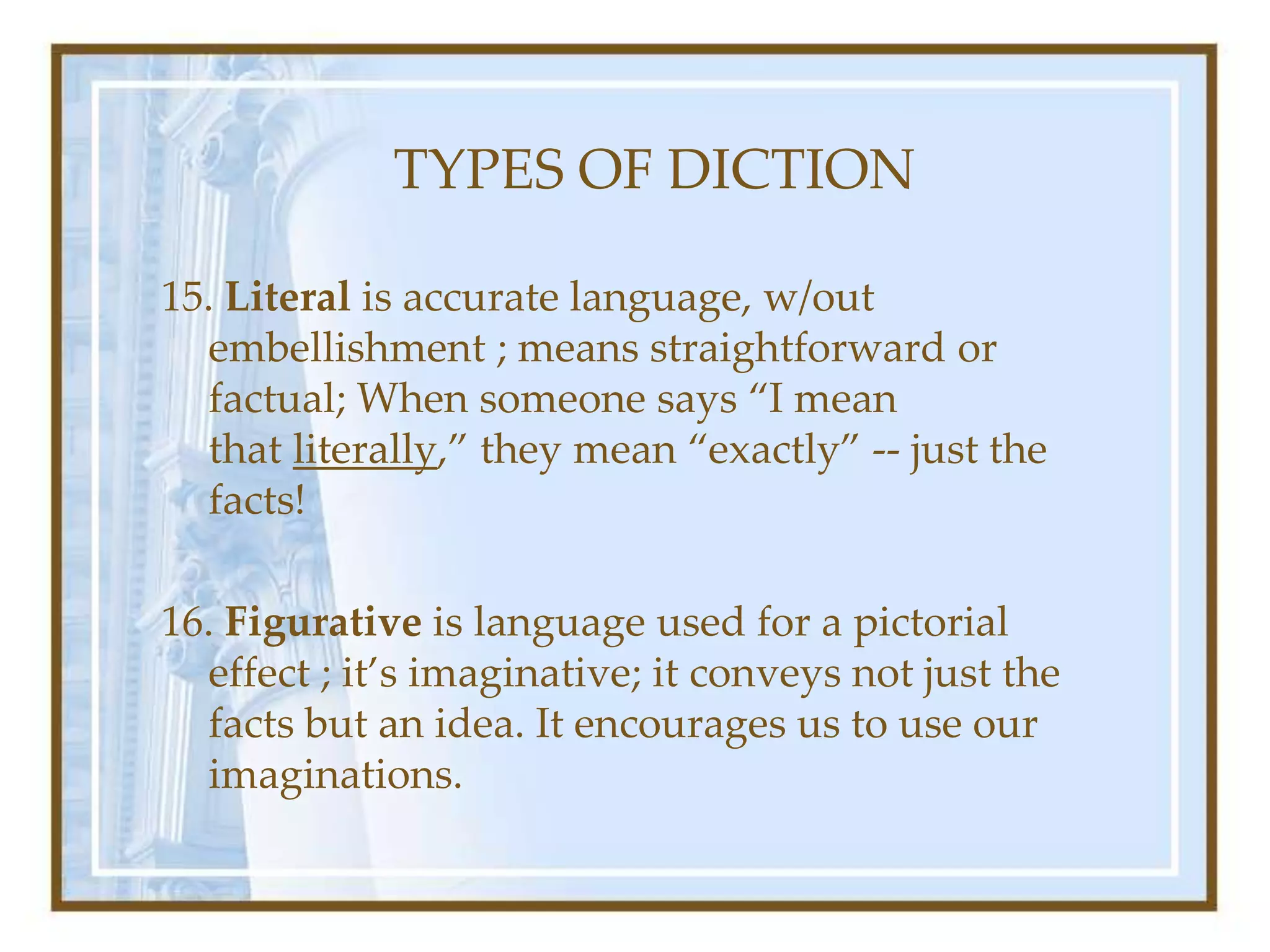
15. Literal is accurate language, w/out
embellishment ; means straightforward or
factual; When someone says “I mean
that literally,” they mean “exactly” -- just the
facts!
16. Figurative is language used for a pictorial
effect ; it’s imaginative; it conveys not just the
facts but an idea. It encourages us to use our
imaginations.
CHOOSING THE LEVEL
First, decide for whom you're writing.
Because you are writing for a certain audience,
they will have particular expectations about the
level of diction you will choose. Choose the level
most appropriate for your audience (in collegiate
writing, standard level diction is used most
often).
CHOOSING THE LEVEL
• Second, determine your purpose.
Some possible purposes may be to inform, to
persuade, to illustrate, to analyze, or to entertain.
For each of these purposes, you may choose to use
a different level of diction.
Sources:
http://simple.wiktionary.org/wiki/Category:Colloqu
ial
http://grammar.ccc.commnet.edu/grammar/compos
ition/abstract.htm
http://www.etap.org/demo/englishhs/instruction5.h
tml
http://www.limcollege.edu/Using_Appropriate_Dic
tion.pdf
http://writingcenter.byu.edu/handouts/style/diction
.htm

Levels & Types of Diction

  • 1.
    LEVELS OF DICTION JoI. Bartolata Bicol University
  • 2.
    What is Diction? •word choice of the author • general character of the language used by the author • plays a very important role in creating tone and voice appropriate for your audience and writing objective
  • 3.
    Levels of Diction (Levelsof Articulation) I. High/Formal /elevated – for highly educated audience. Ex. Peruse II. A. Neutral/ Standard – for well-educated audience. Ex. Examine B. Neutral/ Informal –for a familiar audience. Ex. Look over III. Low/Non-standard – for a specific audience. Ex. chekidawt
  • 4.
    HIGH OR FORMAL •usually contains language that creates an elevated tone. It is free of slang, idioms, colloquialisms, and contractions. It often contains polysyllabic words, sophisticated syntax, and elegant word choice. • appropriate for formal occasions • used when addressing a highly educated audience. This includes sermons, scholarly journals, etc. • found in publications such academic publications.
  • 5.
    II.A. NEUTRAL/ STANDARD • usedwhen addressing a well-educated audience. • commonly this is the level used for college papers, mass publications, and business communication • refers to the level of diction employed in most college-level writing assignments as well as newspapers and general interest journals. • maintains a professional tone but tries to avoid highly technical or specialized terms and concepts.
  • 6.
    II.B. NEUTRAL/ INFORMAL •used when addressing a familiar audience. • grammatically correct but conversational • includes personal letters, emails, and documents with conversational or entertaining purposes • may also include "slang" language, which may be used to create a specific "flavor" as in sports casting or novels.
  • 7.
    LOW/NON-STANDARD • Language deficientin some form or manner • diction outside of conventional or standard use • Includes: vulgarity/pedestrian, slang, colloquial, dialect, cliché, jargon
  • 8.
    EXAMPLES OF DICTION FORMALSTANDARD INFORMAL NON- STANDARD Edify enlighten Let know ? Opt Choose Pick-out ? Beguile Mislead Dupe ?
  • 9.
    TYPES OF DICTION 1.Slang refers to a group of recently coined words often used in informal situations; develops from the attempt to find fresh, colorful, exaggerated, or humorous expressions. Ex. Emo, frenemy, my bad, awesomity, greycation, bromance 2. Vulgarity is language deficient in taste and refinement; coarse, base (any swear word). Ex. Fuck-ass, pakshet, difotah
  • 10.
    TYPES OF DICTION 3.Colloquial expressions are nonstandard, often regional, ways of using language appropriate to informal or conversational speech and writing. Ex. Anyhow, gotcha, gramps, stats, info, guys, kid
  • 11.
    TYPES OF DICTION 4.Jargon consists of words and expressions characteristic of a particular profession, or pursuit. Ex. gigabyte, logic board, CPU, LCD = computer jargon 5. Dialect is a nonstandard subgroup of a language with its own vocabulary and grammatical features. Ex. Philippine English as dialect of English language
  • 12.
    TYPES OF DICTION 8.Cliché is figurative language used so often that it has lost its freshness and originality. Ex. Beauty is useless but character is the best. Honesty is the best policy. No man is an island. Time is gold. Love is like a rosary that is full of mysstery.
  • 13.
    TYPES OF DICTION 9.Concrete diction consists of specific words that describe physical qualities or conditions. Ex. spoon, table, velvet eye patch, nose ring, sinus mask, green, hot, walking 10. Abstract diction refers to language that denotes ideas, emotions, conditions or concepts that are intangible. Ex. love, success, freedom, good, moral, democracy, chauvinism, Communism, feminism, racism, sexism.
  • 14.
    TYPES OF DICTION 11.General refers to groups. Ex. Furniture, people, institutions, houses 12. Specific refers to individuals. Ex. Rocking chair, Filipinos, hospitals, nipa hut
  • 15.
    TYPES OF DICTION 13.Denotation is the exact, literal definition of a word independent of any emotional association or secondary meaning. Ex. snake (reptile), house, mother, loose (not tight) 14. Connotation is the implicit rather than explicit meaning of a word and consists of the suggestions, associations, and emotional overtones attached to a word. Ex. Snake ( evil), home, stepmother, loose (unbcoming)
  • 16.
    TYPES OF DICTION 15.Literal is accurate language, w/out embellishment ; means straightforward or factual; When someone says “I mean that literally,” they mean “exactly” -- just the facts! 16. Figurative is language used for a pictorial effect ; it’s imaginative; it conveys not just the facts but an idea. It encourages us to use our imaginations.
  • 17.
    CHOOSING THE LEVEL First,decide for whom you're writing. Because you are writing for a certain audience, they will have particular expectations about the level of diction you will choose. Choose the level most appropriate for your audience (in collegiate writing, standard level diction is used most often).
  • 18.
    CHOOSING THE LEVEL •Second, determine your purpose. Some possible purposes may be to inform, to persuade, to illustrate, to analyze, or to entertain. For each of these purposes, you may choose to use a different level of diction.
  • 19.