Figures of
Speech
In all walks of life, everything can be
expressed literally and figuratively.
So now…
What is the difference between…
Literal
and
Figurative
language?
Literal means…
• The actual, dictionary meaning of a
word; language that means what it
appears to mean
• Avoiding exaggeration, metaphor,
or embellishment
• Conforming to the most obvious
meaning of a word, phrase,
sentence, or story
In other words…
–It means exactly what it
says! Word for word.
Example One: The U.S. is a large country.
What does it mean? Exactly what it says!
Example Two: The weather is beautiful today.
What does it mean? Exactly what it says!
In other words…
–Figure it out!
There’s a deeper
meaning hidden
in the words.
Example: Fragrance always
stays in the hand that gives
the rose. -Hada Bejar
• Does it mean you have a
smelly hand? NO!
• What does it mean?
Giving to others is gracious
and the good feeling of
giving stays with you.
So…
Read between the
lines because not
everything is as it
appears.
Ladies and gentlemen,
put your hands together as I proudly present to
you, the essential…
A kiss is a lovely trick
designed by nature to
stop speech when
words become
superfluous.
Ingrid Bergman
Introduction
Figures of
Speech
Authors often uses figures of speech in both
literature and poetry to enhance their
writing.
Figures of speech present ordinary things in
new or unusual way.
They communicate ideas that go beyond the
words usual literal meanings
These are language devices intended to bring
to the reader or to the listener fresh reactions
to a scene or an object
Using figures of speech in language is like
sprinkling condiments over your bland food
so that it tastes better
By the end of this session, you
should be able to:
 Recognize some of
the figures of speech
 Identify figures of
speech in poems
Figures of Resemblance
Simile
Metaphor
Personification
Apostrophe
Antonomasia
Simile Comparing two unlike
things using like or as.
We bear her along like a pearl on a string.
She sways like a pearl.
She hangs like a star.
His temper was as explosive as a volcano.
Patterns in Simile
Verb + like + Noun
As + Adjective + as + Noun
– Friends are like parachutes. If they
aren’t there the first time you need
them, chances are, you won’t be
needing them again.
-James A. Lovell Jr.
– Does this mean that I should jump out of an
airplane with my friend strapped to my back?
Absolutely not!
– Friends are being compared to parachutes using
the word like. (friends = parachutes)
– Friends and parachutes are dissimilar and unlike
each other, yet we have found a way to
relate and compare them.
What is the meaning
of…? • Parachutes must be there for
you the first time you need
them or you will fall to your
death. If they are not there
for you the first time you
need them, you will not need
them again. You’ll be dead!
• Friends are the same way. If
you have a crisis and need
your friend to support you,
but he doesn’t come through,
you don’t really need that
friend for help again.
Metaphor Comparison between two unlike
things that actually have
something important in common
Life is one big roller coaster ride.
The boy is a fish in the water.
He is my knight in shining armor.
–A good laugh is sunshine in a
house. -Thackeray
– Does this mean that a laugh is actually light
from the sun? Absolutely not!
– A good laugh is being compared to sunshine
by saying that it is sunshine.
(laugh = sunshine)
– A good laugh and sunshine are dissimilar and
unlike things being compared to each other.
– Sunshine brings joy and happiness
to people. It brightens up a room,
a house or where ever its rays
strike.
– Laughter does the same thing. It
also brings joy and happiness to
people and brightens up a room,
a house, or where ever it is heard.
What is the meaning
of…?
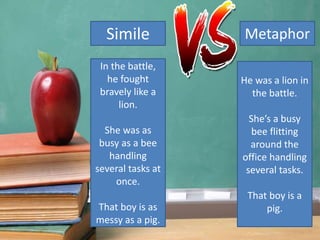
Simile Metaphor
In the battle,
he fought
bravely like a
lion.
She was as
busy as a bee
handling
several tasks at
once.
That boy is as
messy as a pig.
He was a lion in
the battle.
She’s a busy
bee flitting
around the
office handling
several tasks.
That boy is a
pig.
Personification
The sun stretched his golden
arms and greeted everyone
with his kind smile.
The trees were fluttering
and dancing in the breeze
Representing an inanimate object
or an abstract idea as a person and
endowing it with human traits.
• The tree bowed and
waved to me in the wind.
• Does this mean a tree actually
recognized I was there and
acknowledged me by taking a bow and
waving to me? Absolutely not!
• The tree is being given the human
characteristics or actions of waving
and bowing. The tree is being
personified. It now has character.
• Again, unlike or dissimilar things are
being compared. (tree = person)
What is the meaning of this…?
• This simply draws the picture in our
minds that it must be an extremely
windy day for the trees branches to
‘wave’ and the trunk to bend as if it
were ‘bowing.’
• The tree is being given the human
characteristics or actions of waving
and bowing. The tree is being
personified. It now has character.
Apostrophe
“O Liberty, what things are done in thy
name.”
“Come, you spirits that tend on mortal
thoughts.”
-- Macbeth
“Come, let me clutch thee. I have thee
not and yet I see thee still.”
-- Macbeth
The addressing of a usually
absent person or usually
personified thing
• “O western wind, when wilt thou
blow that the small rain down can
rain?”
• “Blue Moon, you saw me
standing alone,Without a dream
in my heart,Without a love on my
own.”
• “Death be not proud, though
some have called thee Mighty and
dreadfull, for, thou art not so,For,
those, whom thou think’st, thou
dost overthrow,Die not, poore
death, nor yet canst thou kill me.”
Antonomasia
Abraham- father of many
David and Jonathan- friends
Apollo- handsome
Cain- murderer
Portia- beauty and brains
Penelope- faithful
Substitution of a title or an epithet for a
proper name. It is also used to convey an
idea taken form history, myths, legends
and the Bible.
Mrs. Cruz is a Penelope. Her husband
has been an OFW for almost ten
almost and no one can accuse her of
even flirting with other men.
Their relationship is like that of David
and Jonathan. They are even closer
than blood brothers.
With looks like that of Apollo, can
you blame the girls for running after
you?
Figures of Sound Effects
Onomatopoeia
Alliteration
Assonance
Onomatopoeia Is a word that sounds like its meaning. It
can also be described as the use of the
word which imitates a sound such as
screech, whirr, sizzle, crunch, bang, zap,
roar, growl, click, snap, crackle and pop.
A snap of a finger.
The camera clicks
smoothly.
The wild bang of a rockstar.
• “Chug, chug, chug. Puff, puff,
puff. Ding-dong, ding-dong. The
little train rumbled over the
tracks.”
• “Brrrrrrriiiiiiiiiiiiiiiiiiinng! An
alarm clock clanged in the dark
and silent room.”
• “I’m getting married in the
morning!
Ding dong! the bells are gonna
chime.”
Alliteration
Don’t drink and drive
If Peter Piper picked a peck of pickled peppers….
But a bit of better butter will make my batter
better.
Six silly swans went swimming in the sea.
Coca Cola, Mickey Mouse, Dunkin Donut, KitKat,
Spongebob Squarepants
Is the repetition of beginning consonant
sounds and frequent recurrence of the
same initial letter or sound. It is derived
from Latin’s “Latira” meaning “letters of
alphabet”
•She sells seashells.
•Walter wondered
where Winnie was.
•Blue baby bonnets
•Nick needed new
notebooks.
•Fred fried frogs.
Assonance
Poetry is old, ancient, goes back far. It is
among the oldest of living things. So old it is
that no man knows how and why the first
poems came. –Early Moon of Carl Sandburg
Describe a high-rise, Well it rises high into
the bright blue sky.
The fat cat had a snack.
Alas! It was a tough nut to crack
The use of words that have the same very
similar vowel sound near other one.
• “Those images that yet
Fresh images beget,
That dolphin-torn, that
gong-tormented sea.”
• “If I bleat when I speak
it’s because I just got . . .
fleeced.”
Figures of
Emphasis
Hyperbole
Anaphora
Hyperbole
I nearly died laughing.
You could have knocked me over with a
feather.
I’ve told you a million times.
My backpack weighs a ton.
It is a major exaggeration or
overstatement. Authors use this figures of
speech to emphasize a point or a humor
• I’m so hungry I could
devour a horse!
• Does this mean I could actually eat an entire
horse or that someone can really run inside your
skull? Of course not!
• Are you tired? It’s because
you keep on running on my
mind.
• A ridiculous image is being painted in our minds
to get the significance and importance of the
point across.
What is the meaning of this…?
• The first obviously means that I
am extremely hungry but in no
way could I eat a 400 pound
horse!
• The second clearly means that
you are in love and you think
everyday about the person who
is the apple of your eye but in no
way the person you will run over
skull!
Hyperbole
can be
funny…!
• Here are a few
humorous
hyperboles:
• “My sister uses so much makeup, she
broke a chisel trying to get it off last
night!” Johnny, Baton Rouge, LA
• “My teacher is so old, they’ve already
nailed the coffin shut.” Michelle S.,
Knoxville, TN
• “I could do this forever.” Ashley Brosseau
• “I don’t believe in courtship. Just love
me now and I will court you forever.”
Anaphora
• Repetition of the same word or phrase
at the beginning of successive clauses
or verses.
• We shall go on to the end. We shall fight with growing
confidence and growing strength in the air. We shall
depend our island.
• I came, I saw, I conquered - Julius
Caesar
• Mad world! Mad kings! Mad
composition! - King John II, William
Shakespeare
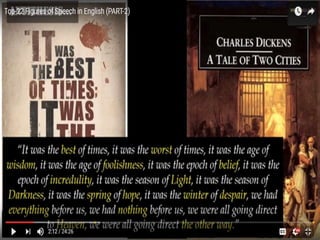
• It was the best of times, it was the
worst of times, it was the age of
wisdom, it was the age of foolishness -
A Tale of Two Cities, Charles Dickens
Irony
Antithesis
Chiasmus
Paradox
Oxymoron
Euphemism
Figures of Parallelism and/or
Contrast
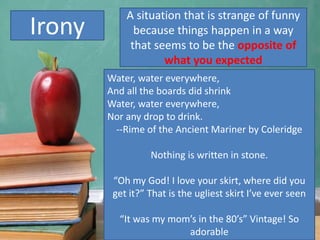
Irony
Water, water everywhere,
And all the boards did shrink
Water, water everywhere,
Nor any drop to drink.
--Rime of the Ancient Mariner by Coleridge
Nothing is written in stone.
“Oh my God! I love your skirt, where did you
get it?” That is the ugliest skirt I’ve ever seen
“It was my mom’s in the 80’s” Vintage! So
adorable
A situation that is strange of funny
because things happen in a way
that seems to be the opposite of
what you expected
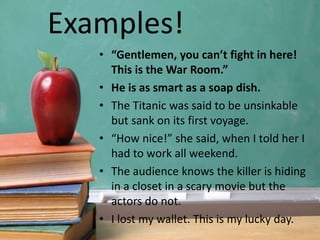
• “Gentlemen, you can’t fight in here!
This is the War Room.”
• He is as smart as a soap dish.
• The Titanic was said to be unsinkable
but sank on its first voyage.
• “How nice!” she said, when I told her I
had to work all weekend.
• The audience knows the killer is hiding
in a closet in a scary movie but the
actors do not.
• I lost my wallet. This is my lucky day.
Examples!
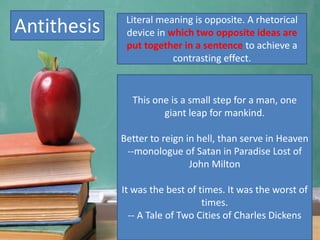
Antithesis
This one is a small step for a man, one
giant leap for mankind.
Better to reign in hell, than serve in Heaven
--monologue of Satan in Paradise Lost of
John Milton
It was the best of times. It was the worst of
times.
-- A Tale of Two Cities of Charles Dickens
Literal meaning is opposite. A rhetorical
device in which two opposite ideas are
put together in a sentence to achieve a
contrasting effect.
Chiasmus A verbal pattern in which the
second half of an expression is
balanced against the first but with
the parts reversed.
• “Nice to see you, to see you, nice!”
• “You forget what you want to remember,
and you remember what you want to
forget.”
• “In the end, the true test is not the
speeches a president delivers; it’s whether
the president delivers on the speeches.”
• One must eat to live, not to live to eat.
• “Never let a fool kiss you or a kiss fool you.”
Paradox • A statement that appears to
contradict itself.
• "War is peace."
• "Freedom is slavery."
• "Ignorance is strength.“
• "Some day you will be old
enough to start reading fairy
tales again.“
• The child is the father of man.
Oxymoron • A figure of speech in which
incongruous or contradictory
terms appear side by side.
• “The best cure for insomnia is to get a
lot of sleep.”
• “A yawn may be defined as a silent
yell.”
• "act naturally," "original copy,“
"found missing," "alone together,"
"peace force," "definite possibility,"
"terribly pleased," "ill health,"
"turn up missing," "jumbo shrimp,"
"alone together," “pretty ugly”
Euphemism • The substitution of an inoffensive term
for one considered offensively explicit. It
is a mild, indirect, or vague term
substituting for a harsh, blunt, or
offensive term.
• 'A little thin on top' instead of 'going
bald'
• 'Homeless' instead of 'bum'
• 'Letting him go' instead of 'firing him'
• 'Passed away' instead of 'died‘
• Get rid of him instead of ‘kill him’
• 'Economical with the truth' instead of
'liar'
Figures of Association
Metonymy
Synecdoche
Metonymy • A FIGURE OF SPEECH in which a part
represents a whole or a whole represents a
part. It is used when a noun is substituted for
another noun.
• The dagger of the United States sliced
Saddam Hussein’s army to pieces.
and
• I pledge my service to the crown.
• Did just a knife alone destroy Sadaam’s
armies? Absolutely not! The knife
represents a part of the whole United
States Armed Forces. (knife = U.S. Armed
Forces)
• Do I pledge my service to just a crown that
sits atop the king’s head? No! The
solitary crown represents a part of the
whole king and kingdom to whom I pledge
my service.
(crown = king and kingdom)
Fragrance always
stays in the hand that
gives the rose. -Hada Bejar
(hand = the whole person who gives)
A part (hand) represents a whole
(person).
We study Shakespeare in our
English class
Shakespeare, the writer’s name is
used when what is meant are his
works.
Synecdoche • A figure of speech in which a part is used to
represent the whole (ABCs for alphabet) or the
whole for a part (“England won the World Cup
in 1966″).
• Wheels - a car
• The police - one
policeman
• Plastic - friends
• Coke - any cola drink
• Army - a soldier
• Give us this day our daily
bread (Taken from the Bible,
bread is only part of food.)
• I bought myself a new set of
wheel for my travel (Set of
wheel is only part of a vehicle)
5. figures of speech ppt

5. figures of speech ppt

  • 1.
    Figures of Speech In allwalks of life, everything can be expressed literally and figuratively.
  • 3.
    So now… What isthe difference between… Literal and Figurative language?
  • 4.
    Literal means… • Theactual, dictionary meaning of a word; language that means what it appears to mean • Avoiding exaggeration, metaphor, or embellishment • Conforming to the most obvious meaning of a word, phrase, sentence, or story
  • 5.
    In other words… –Itmeans exactly what it says! Word for word. Example One: The U.S. is a large country. What does it mean? Exactly what it says! Example Two: The weather is beautiful today. What does it mean? Exactly what it says!
  • 7.
    In other words… –Figureit out! There’s a deeper meaning hidden in the words.
  • 8.
    Example: Fragrance always staysin the hand that gives the rose. -Hada Bejar • Does it mean you have a smelly hand? NO! • What does it mean? Giving to others is gracious and the good feeling of giving stays with you.
  • 9.
    So… Read between the linesbecause not everything is as it appears.
  • 10.
    Ladies and gentlemen, putyour hands together as I proudly present to you, the essential…
  • 11.
    A kiss isa lovely trick designed by nature to stop speech when words become superfluous. Ingrid Bergman
  • 12.
    Introduction Figures of Speech Authors oftenuses figures of speech in both literature and poetry to enhance their writing. Figures of speech present ordinary things in new or unusual way. They communicate ideas that go beyond the words usual literal meanings These are language devices intended to bring to the reader or to the listener fresh reactions to a scene or an object Using figures of speech in language is like sprinkling condiments over your bland food so that it tastes better
  • 13.
    By the endof this session, you should be able to:  Recognize some of the figures of speech  Identify figures of speech in poems
  • 14.
  • 15.
    Simile Comparing twounlike things using like or as. We bear her along like a pearl on a string. She sways like a pearl. She hangs like a star. His temper was as explosive as a volcano. Patterns in Simile Verb + like + Noun As + Adjective + as + Noun
  • 16.
    – Friends arelike parachutes. If they aren’t there the first time you need them, chances are, you won’t be needing them again. -James A. Lovell Jr. – Does this mean that I should jump out of an airplane with my friend strapped to my back? Absolutely not! – Friends are being compared to parachutes using the word like. (friends = parachutes) – Friends and parachutes are dissimilar and unlike each other, yet we have found a way to relate and compare them.
  • 17.
    What is themeaning of…? • Parachutes must be there for you the first time you need them or you will fall to your death. If they are not there for you the first time you need them, you will not need them again. You’ll be dead! • Friends are the same way. If you have a crisis and need your friend to support you, but he doesn’t come through, you don’t really need that friend for help again.
  • 18.
    Metaphor Comparison betweentwo unlike things that actually have something important in common Life is one big roller coaster ride. The boy is a fish in the water. He is my knight in shining armor.
  • 19.
    –A good laughis sunshine in a house. -Thackeray – Does this mean that a laugh is actually light from the sun? Absolutely not! – A good laugh is being compared to sunshine by saying that it is sunshine. (laugh = sunshine) – A good laugh and sunshine are dissimilar and unlike things being compared to each other.
  • 20.
    – Sunshine bringsjoy and happiness to people. It brightens up a room, a house or where ever its rays strike. – Laughter does the same thing. It also brings joy and happiness to people and brightens up a room, a house, or where ever it is heard. What is the meaning of…?
  • 21.
    Simile Metaphor In thebattle, he fought bravely like a lion. She was as busy as a bee handling several tasks at once. That boy is as messy as a pig. He was a lion in the battle. She’s a busy bee flitting around the office handling several tasks. That boy is a pig.
  • 22.
    Personification The sun stretchedhis golden arms and greeted everyone with his kind smile. The trees were fluttering and dancing in the breeze Representing an inanimate object or an abstract idea as a person and endowing it with human traits.
  • 23.
    • The treebowed and waved to me in the wind. • Does this mean a tree actually recognized I was there and acknowledged me by taking a bow and waving to me? Absolutely not! • The tree is being given the human characteristics or actions of waving and bowing. The tree is being personified. It now has character. • Again, unlike or dissimilar things are being compared. (tree = person)
  • 24.
    What is themeaning of this…? • This simply draws the picture in our minds that it must be an extremely windy day for the trees branches to ‘wave’ and the trunk to bend as if it were ‘bowing.’ • The tree is being given the human characteristics or actions of waving and bowing. The tree is being personified. It now has character.
  • 25.
    Apostrophe “O Liberty, whatthings are done in thy name.” “Come, you spirits that tend on mortal thoughts.” -- Macbeth “Come, let me clutch thee. I have thee not and yet I see thee still.” -- Macbeth The addressing of a usually absent person or usually personified thing
  • 26.
    • “O westernwind, when wilt thou blow that the small rain down can rain?” • “Blue Moon, you saw me standing alone,Without a dream in my heart,Without a love on my own.” • “Death be not proud, though some have called thee Mighty and dreadfull, for, thou art not so,For, those, whom thou think’st, thou dost overthrow,Die not, poore death, nor yet canst thou kill me.”
  • 27.
    Antonomasia Abraham- father ofmany David and Jonathan- friends Apollo- handsome Cain- murderer Portia- beauty and brains Penelope- faithful Substitution of a title or an epithet for a proper name. It is also used to convey an idea taken form history, myths, legends and the Bible.
  • 28.
    Mrs. Cruz isa Penelope. Her husband has been an OFW for almost ten almost and no one can accuse her of even flirting with other men. Their relationship is like that of David and Jonathan. They are even closer than blood brothers. With looks like that of Apollo, can you blame the girls for running after you?
  • 29.
    Figures of SoundEffects Onomatopoeia Alliteration Assonance
  • 30.
    Onomatopoeia Is aword that sounds like its meaning. It can also be described as the use of the word which imitates a sound such as screech, whirr, sizzle, crunch, bang, zap, roar, growl, click, snap, crackle and pop. A snap of a finger. The camera clicks smoothly. The wild bang of a rockstar.
  • 31.
    • “Chug, chug,chug. Puff, puff, puff. Ding-dong, ding-dong. The little train rumbled over the tracks.” • “Brrrrrrriiiiiiiiiiiiiiiiiiinng! An alarm clock clanged in the dark and silent room.” • “I’m getting married in the morning! Ding dong! the bells are gonna chime.”
  • 32.
    Alliteration Don’t drink anddrive If Peter Piper picked a peck of pickled peppers…. But a bit of better butter will make my batter better. Six silly swans went swimming in the sea. Coca Cola, Mickey Mouse, Dunkin Donut, KitKat, Spongebob Squarepants Is the repetition of beginning consonant sounds and frequent recurrence of the same initial letter or sound. It is derived from Latin’s “Latira” meaning “letters of alphabet”
  • 33.
    •She sells seashells. •Walterwondered where Winnie was. •Blue baby bonnets •Nick needed new notebooks. •Fred fried frogs.
  • 34.
    Assonance Poetry is old,ancient, goes back far. It is among the oldest of living things. So old it is that no man knows how and why the first poems came. –Early Moon of Carl Sandburg Describe a high-rise, Well it rises high into the bright blue sky. The fat cat had a snack. Alas! It was a tough nut to crack The use of words that have the same very similar vowel sound near other one.
  • 35.
    • “Those imagesthat yet Fresh images beget, That dolphin-torn, that gong-tormented sea.” • “If I bleat when I speak it’s because I just got . . . fleeced.”
  • 36.
  • 37.
    Hyperbole I nearly diedlaughing. You could have knocked me over with a feather. I’ve told you a million times. My backpack weighs a ton. It is a major exaggeration or overstatement. Authors use this figures of speech to emphasize a point or a humor
  • 38.
    • I’m sohungry I could devour a horse! • Does this mean I could actually eat an entire horse or that someone can really run inside your skull? Of course not! • Are you tired? It’s because you keep on running on my mind. • A ridiculous image is being painted in our minds to get the significance and importance of the point across.
  • 39.
    What is themeaning of this…? • The first obviously means that I am extremely hungry but in no way could I eat a 400 pound horse! • The second clearly means that you are in love and you think everyday about the person who is the apple of your eye but in no way the person you will run over skull!
  • 40.
    Hyperbole can be funny…! • Hereare a few humorous hyperboles: • “My sister uses so much makeup, she broke a chisel trying to get it off last night!” Johnny, Baton Rouge, LA • “My teacher is so old, they’ve already nailed the coffin shut.” Michelle S., Knoxville, TN • “I could do this forever.” Ashley Brosseau • “I don’t believe in courtship. Just love me now and I will court you forever.”
  • 41.
    Anaphora • Repetition ofthe same word or phrase at the beginning of successive clauses or verses. • We shall go on to the end. We shall fight with growing confidence and growing strength in the air. We shall depend our island. • I came, I saw, I conquered - Julius Caesar • Mad world! Mad kings! Mad composition! - King John II, William Shakespeare • It was the best of times, it was the worst of times, it was the age of wisdom, it was the age of foolishness - A Tale of Two Cities, Charles Dickens
  • 42.
  • 43.
    Irony Water, water everywhere, Andall the boards did shrink Water, water everywhere, Nor any drop to drink. --Rime of the Ancient Mariner by Coleridge Nothing is written in stone. “Oh my God! I love your skirt, where did you get it?” That is the ugliest skirt I’ve ever seen “It was my mom’s in the 80’s” Vintage! So adorable A situation that is strange of funny because things happen in a way that seems to be the opposite of what you expected
  • 44.
    • “Gentlemen, youcan’t fight in here! This is the War Room.” • He is as smart as a soap dish. • The Titanic was said to be unsinkable but sank on its first voyage. • “How nice!” she said, when I told her I had to work all weekend. • The audience knows the killer is hiding in a closet in a scary movie but the actors do not. • I lost my wallet. This is my lucky day. Examples!
  • 45.
    Antithesis This one isa small step for a man, one giant leap for mankind. Better to reign in hell, than serve in Heaven --monologue of Satan in Paradise Lost of John Milton It was the best of times. It was the worst of times. -- A Tale of Two Cities of Charles Dickens Literal meaning is opposite. A rhetorical device in which two opposite ideas are put together in a sentence to achieve a contrasting effect.
  • 47.
    Chiasmus A verbalpattern in which the second half of an expression is balanced against the first but with the parts reversed. • “Nice to see you, to see you, nice!” • “You forget what you want to remember, and you remember what you want to forget.” • “In the end, the true test is not the speeches a president delivers; it’s whether the president delivers on the speeches.” • One must eat to live, not to live to eat. • “Never let a fool kiss you or a kiss fool you.”
  • 48.
    Paradox • Astatement that appears to contradict itself. • "War is peace." • "Freedom is slavery." • "Ignorance is strength.“ • "Some day you will be old enough to start reading fairy tales again.“ • The child is the father of man.
  • 49.
    Oxymoron • Afigure of speech in which incongruous or contradictory terms appear side by side. • “The best cure for insomnia is to get a lot of sleep.” • “A yawn may be defined as a silent yell.” • "act naturally," "original copy,“ "found missing," "alone together," "peace force," "definite possibility," "terribly pleased," "ill health," "turn up missing," "jumbo shrimp," "alone together," “pretty ugly”
  • 50.
    Euphemism • Thesubstitution of an inoffensive term for one considered offensively explicit. It is a mild, indirect, or vague term substituting for a harsh, blunt, or offensive term. • 'A little thin on top' instead of 'going bald' • 'Homeless' instead of 'bum' • 'Letting him go' instead of 'firing him' • 'Passed away' instead of 'died‘ • Get rid of him instead of ‘kill him’ • 'Economical with the truth' instead of 'liar'
  • 51.
  • 52.
    Metonymy • AFIGURE OF SPEECH in which a part represents a whole or a whole represents a part. It is used when a noun is substituted for another noun. • The dagger of the United States sliced Saddam Hussein’s army to pieces. and • I pledge my service to the crown. • Did just a knife alone destroy Sadaam’s armies? Absolutely not! The knife represents a part of the whole United States Armed Forces. (knife = U.S. Armed Forces) • Do I pledge my service to just a crown that sits atop the king’s head? No! The solitary crown represents a part of the whole king and kingdom to whom I pledge my service. (crown = king and kingdom)
  • 53.
    Fragrance always stays inthe hand that gives the rose. -Hada Bejar (hand = the whole person who gives) A part (hand) represents a whole (person). We study Shakespeare in our English class Shakespeare, the writer’s name is used when what is meant are his works.
  • 54.
    Synecdoche • Afigure of speech in which a part is used to represent the whole (ABCs for alphabet) or the whole for a part (“England won the World Cup in 1966″). • Wheels - a car • The police - one policeman • Plastic - friends • Coke - any cola drink • Army - a soldier
  • 55.
    • Give usthis day our daily bread (Taken from the Bible, bread is only part of food.) • I bought myself a new set of wheel for my travel (Set of wheel is only part of a vehicle)