Foundations of Decision Making
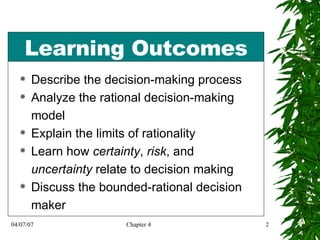
Learning Outcomes Describe the decision-making process Analyze the rational decision-making model Explain the limits of rationality Learn how  certainty ,  risk , and  uncertainty  relate to decision making Discuss the bounded-rational decision maker
Learning Outcomes Identify the two types of decision problems and the two decisions that solve them Learn how  heuristics  affect decision making Identify four decision-making styles Weigh the pros and cons of group decisions Learn three ways to improve group decision making
The Decision-Making Process Identification  of a  Problem Identification  of Decision Criteria Allocation of Weights to Criteria Price Interior Comfort Durability Repair Record …………… Price Interior Comfort Durability Repair Record …………… 10 8 6 4 I need to buy a new car.
Development of  Alternatives Analysis of  Alternatives Ford Jeep Mazda Dodge Audi Isuzu Chevy Selection  of an Alternative Implementation of the Alternative Evaluation of  Decision Effectiveness Price Comfort Durability Repair Record ………… ... The Toyota is the best. Toyota Chevy Isuzu Audi Dodge Mazda Jeep Ford Toyota
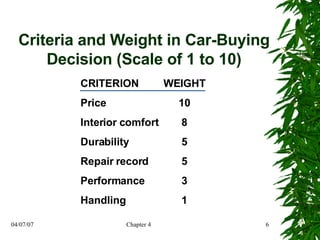
Criteria and Weight in Car-Buying Decision (Scale of 1 to 10) CRITERION WEIGHT Price 10 Interior comfort 8 Durability 5 Repair record 5 Performance 3 Handling 1
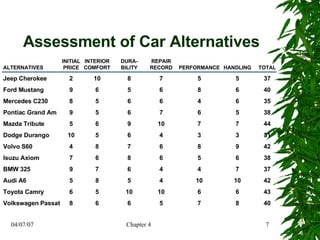
Assessment of Car Alternatives INITIAL INTERIOR DURA- REPAIR ALTERNATIVES PRICE COMFORT BILITY RECORD PERFORMANCE HANDLING TOTAL Jeep Cherokee 2 10 8 7 5 5 37 Ford Mustang 9 6 5 6 8 6 40 Mercedes C230 8 5 6 6 4 6 35 Pontiac Grand Am 9 5 6 7 6 5 38 Mazda Tribute 5 6 9 10 7 7 44 Dodge Durango 10 5 6 4 3 3 31 Volvo S60 4 8 7 6 8 9 42 Isuzu Axiom 7 6 8 6 5 6 38 BMW 325 9 7 6 4 4 7 37 Audi A6 5 8 5 4 10 10 42 Toyota Camry 6 5 10 10 6 6 43 Volkswagen Passat 8 6 6 5 7 8 40
Weighting of Vehicles (Assessment Criteria X Criteria Weight)
Decision-Making (I) Decision-making process A set of eight steps that includes identifying a problem, selecting a solution, and evaluating the effectiveness of the solution Problem A discrepancy between an existing and a desired state of affairs Decision criteria Factors that are relevant in a decision
Decision-Making (II) Decision implementation Putting a decision into action; includes conveying the decision to the persons who will be affected by it and getting their commitment to it
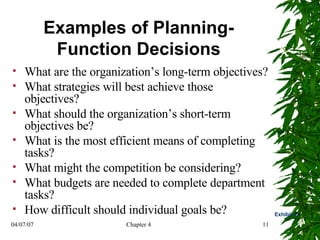
Examples of Planning-Function Decisions What are the organization’s long-term objectives? What strategies will best achieve those objectives?  What should the organization’s short-term objectives be?  What is the most efficient means of completing tasks?  What might the competition be considering? What budgets are needed to complete department tasks? How difficult should individual goals be? Exhibit 4.1
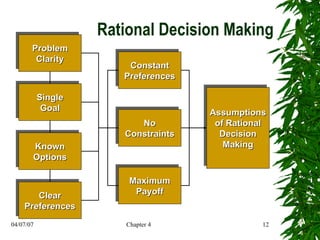
Rational Decision Making Problem Clarity Single Goal Known Options Clear Preferences Constant Preferences No Constraints Maximum Payoff Assumptions of Rational Decision Making
Certainty, Uncertainty & Risk  in DM Environments Certainty : The implication that the outcome of every possible alternative is known. Uncertainty : A condition in which managers do not have full knowledge of the problem they face and cannot determine even a reasonable probability of alternative outcomes Risk : The probability that a particular outcome will result from a decision creativity.
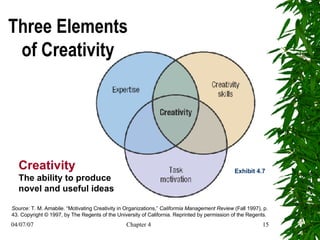
What Is Creative Potential? Expertise Understanding, abilities, knowledge, proficiencies, necessary in the field of creative endeavor. Creative-thinking skills The personality characteristics associated with creativity, the ability to use analogies, as well as the talent to see the familiar in a different light. Intrinsic task motivation The desire to work on something because it’s interesting, involving, exciting, satisfying, or personally challenging.
Three Elements of Creativity Creativity The ability to produce novel and useful ideas Exhibit 4.7 Source:  T. M. Amabile. “Motivating Creativity in Organizations,”  Califormia Management Review  (Fall 1997), p. 43. Copyright © 1997, by The Regents of the University of California. Reprinted by permission of the Regents.
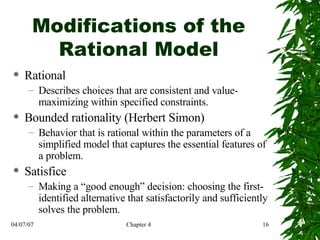
Modifications of the Rational Model Rational Describes choices that are consistent and value-maximizing within specified constraints. Bounded rationality (Herbert Simon) Behavior that is rational within the parameters of a simplified model that captures the essential features of a problem. Satisfice Making a “good enough” decision: choosing the first-identified alternative that satisfactorily and sufficiently solves the problem.
有限理性 (Bounded Rationality)   人們無法處理所有的資訊以達成理性。 建立一個簡單的模型、從問題中萃取出重要特性、不用抓住所有複雜的事項  在簡化或有限理性的模型下,以理性來從事其行為。 滿意的決策而非最佳的決策。
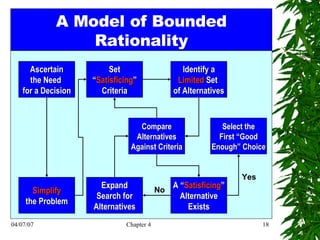
A Model of Bounded Rationality Ascertain the Need  for a Decision Simplify the Problem Set “ Satisficing ” Criteria Identify a Limited  Set  of Alternatives Compare Alternatives Against Criteria Expand Search for Alternatives Select the First “Good Enough” Choice A “ Satisficing ” Alternative Exists Yes No
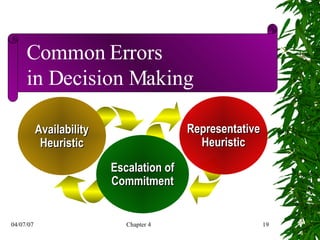
Escalation of Commitment Representative Heuristic Availability Heuristic Common Errors in Decision Making
捷思  (Heuristic)   為了避免資訊過度負荷,我們依賴判斷的捷徑  (judgmental shortcut) ,稱為『捷思』 (heuristic) 。 捷思通常存在兩種型式 可獲性  (availability) 代表性  (representative)
可獲性捷思   (Availability Heuristic) 可獲性 捷思: 人們傾向於將判斷奠基於容易獲得的資訊之上。 以下資訊也可能引發可獲性 捷思: 能引起強烈情緒的訊息, 能觸發活潑想像力的資訊, 或最近才發生,帶給我們深刻印象的事件 後果:高估不可能事件發生的機率。
代表性 捷思   (Representative Heuristic) 代表性捷思:人們根據事件的熟悉度來判斷發生的可能性。 後果:以偏蓋全、刻板印象  (stereotype) 、一成不變等
更加投注  ( Escalation of Commitment ) 決策者會傾向更加投注於一個失敗的行動方向。  儘管有負面資訊,仍更加投注於先前的決策。 意指雖然有負面資訊建議某人要做其他事,但他仍傾向於維持既有的方向。
How Do Problems Differ? Well- Structured Programmed Decisions Poorly Structured Nonprogrammed Decisions
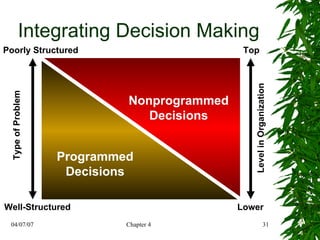
How Do Problems Differ? Well-structured (structured) problems Straightforward, familiar, easily defined problems Poorly structured (unstructured) problems New problems in which information is ambiguous or incomplete
可程式化的決策 (Programmed Decision) 可程式化的決策通常是重覆的、且是例行性的,並有一套清楚的方法以處理此一問題。 A repetitive decision that can be handled by a routine approach
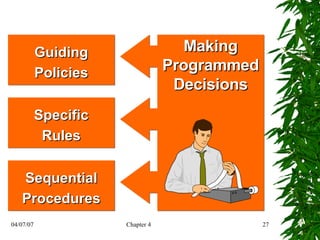
Making Programmed Decisions Guiding Policies Specific Rules Sequential Procedures
政策、規則、與程序  (I) 政策  (policy)   提供了一個管理者往特定方向思考的指引。 規則  (rule)   就是規範管理者該作與不該作的明文規定。 政策  v.s.  規則:政策是決策者作決策時所需參考之準則,而非該作與不該作的規範。  程序  (procedure)   就是一系列相關的步驟,管理者可用來因應結構化的問題。
政策、規則、與程序  (II) 當前我國國防政策的基本理念為「加強全民國防」、「建設現代化國防」、「落實三安政策」及「推動區域安全合作」。本此理念所延伸之軍事政策,現階段強調「整體前瞻、建立制度」;「自立自主、自給自足」;「有效嚇阻、防衛固守」;「完善動員、寓兵於民」;「加強防衛、遏阻戰爭」等作為。 民國八十九年一月二十九日總統令公布之國防法第一章第二條明定: 「中華民國之國防,以發揮整體國力,建立國防武力,達成保衛國家安全,維護世界和平之目的」。
非程式化的決策   (Nonprogrammed Decision) 這些的決策都是獨特而且不會重覆發生的。  Decisions that must be custom-made to solve unique and nonrecurring problems
Integrating Decision Making  Well-Structured Level in Organization  Top Poorly Structured Type of Problem Lower Programmed Decisions Nonprogrammed Decisions
Technology And Decision Making Expert systems Software that acts like an expert in analyzing and solving ill-structured problems Use specialized knowledge about a particular problem area rather than general knowledge  Use qualitative reasoning rather than numerical calculations Perform at a level of competence higher than that of nonexpert humans. Neural networks Software that is designed to imitate the structure of brain cells and connections among them
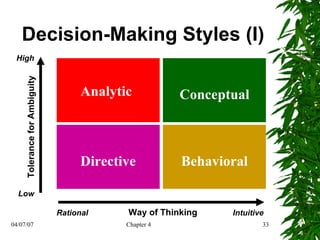
Analytic Conceptual Behavioral Directive Rational Intuitive Way of Thinking High Low Tolerance for Ambiguity Decision-Making Styles (I)
Decision-Making Styles (II) Directive style Characterizes the low tolerance for ambiguity and a rational way of thinking of individuals who are  logical and efficient and typically make fast decisions that focus on the short term. Analytic style Characterizes the high tolerance for ambiguity combined with a rational way of thinking of individuals who  prefer to have complete information before making a decision .
Decision-Making Styles (III) Conceptual style Individuals who tend to be  very broad in outlook , to  look at many alternatives , and to  focus on the long run  and often  look for creative solutions .  Behavioral style Individuals who think intuitively but have a low tolerance for uncertainty; they  work well with others , are  open to suggestions , and are  concerned about the individuals who work for them .
Group Decision Making More information More alternatives Increased acceptance Legitimacy Time-consuming Minority domination Pressures to conform Unclear responsibility Advantages Disadvantages
群體決策的優點  群體決策提供更多完整的資訊 群體決策考量更多的可行方案 群體決策增加對解決方案的接受程度 群體決策會增加合法性
群體決策的缺點  群體決策較 費時 群體決策常造成 少數壟斷   服從的壓力 責任歸屬不明
When Are Groups Most Effective? Creativity Groups tend to be more creative than individuals. Acceptance of the final solution Groups help increase the acceptance of decisions. Effectiveness of group decision making Groups of five to seven members are optimal for decision process speed and quality.
Strengths of Individuals Strengths of Groups Consistent Values Clear Accountability Speed Individual Versus Group Decision Making Increased Acceptance Higher Quality Decisions Input and Diversity
How to Improve Group Decision Making Brainstorming Nominal Group Technique Electronic Meetings
Improving Group Decision Making Brainstorming An idea-generating process that encourages alternatives while withholding criticism Nominal group technique A decision-making technique in which group members are physically present but operate independently Electronic meeting A type of nominal group technique in which participants are linked by computer
National Culture and Decision Making Degree of Risk Decision Style
National Culture and DM –   Examples in Textbook Sweden Japan U.S.A. France Germany

Dicision Making - Business Admintration Class

  • 1.
  • 2.
    Learning Outcomes Describethe decision-making process Analyze the rational decision-making model Explain the limits of rationality Learn how certainty , risk , and uncertainty relate to decision making Discuss the bounded-rational decision maker
  • 3.
    Learning Outcomes Identifythe two types of decision problems and the two decisions that solve them Learn how heuristics affect decision making Identify four decision-making styles Weigh the pros and cons of group decisions Learn three ways to improve group decision making
  • 4.
    The Decision-Making ProcessIdentification of a Problem Identification of Decision Criteria Allocation of Weights to Criteria Price Interior Comfort Durability Repair Record …………… Price Interior Comfort Durability Repair Record …………… 10 8 6 4 I need to buy a new car.
  • 5.
    Development of Alternatives Analysis of Alternatives Ford Jeep Mazda Dodge Audi Isuzu Chevy Selection of an Alternative Implementation of the Alternative Evaluation of Decision Effectiveness Price Comfort Durability Repair Record ………… ... The Toyota is the best. Toyota Chevy Isuzu Audi Dodge Mazda Jeep Ford Toyota
  • 6.
    Criteria and Weightin Car-Buying Decision (Scale of 1 to 10) CRITERION WEIGHT Price 10 Interior comfort 8 Durability 5 Repair record 5 Performance 3 Handling 1
  • 7.
    Assessment of CarAlternatives INITIAL INTERIOR DURA- REPAIR ALTERNATIVES PRICE COMFORT BILITY RECORD PERFORMANCE HANDLING TOTAL Jeep Cherokee 2 10 8 7 5 5 37 Ford Mustang 9 6 5 6 8 6 40 Mercedes C230 8 5 6 6 4 6 35 Pontiac Grand Am 9 5 6 7 6 5 38 Mazda Tribute 5 6 9 10 7 7 44 Dodge Durango 10 5 6 4 3 3 31 Volvo S60 4 8 7 6 8 9 42 Isuzu Axiom 7 6 8 6 5 6 38 BMW 325 9 7 6 4 4 7 37 Audi A6 5 8 5 4 10 10 42 Toyota Camry 6 5 10 10 6 6 43 Volkswagen Passat 8 6 6 5 7 8 40
  • 8.
    Weighting of Vehicles(Assessment Criteria X Criteria Weight)
  • 9.
    Decision-Making (I) Decision-makingprocess A set of eight steps that includes identifying a problem, selecting a solution, and evaluating the effectiveness of the solution Problem A discrepancy between an existing and a desired state of affairs Decision criteria Factors that are relevant in a decision
  • 10.
    Decision-Making (II) Decisionimplementation Putting a decision into action; includes conveying the decision to the persons who will be affected by it and getting their commitment to it
  • 11.
    Examples of Planning-FunctionDecisions What are the organization’s long-term objectives? What strategies will best achieve those objectives? What should the organization’s short-term objectives be? What is the most efficient means of completing tasks? What might the competition be considering? What budgets are needed to complete department tasks? How difficult should individual goals be? Exhibit 4.1
  • 12.
    Rational Decision MakingProblem Clarity Single Goal Known Options Clear Preferences Constant Preferences No Constraints Maximum Payoff Assumptions of Rational Decision Making
  • 13.
    Certainty, Uncertainty &Risk in DM Environments Certainty : The implication that the outcome of every possible alternative is known. Uncertainty : A condition in which managers do not have full knowledge of the problem they face and cannot determine even a reasonable probability of alternative outcomes Risk : The probability that a particular outcome will result from a decision creativity.
  • 14.
    What Is CreativePotential? Expertise Understanding, abilities, knowledge, proficiencies, necessary in the field of creative endeavor. Creative-thinking skills The personality characteristics associated with creativity, the ability to use analogies, as well as the talent to see the familiar in a different light. Intrinsic task motivation The desire to work on something because it’s interesting, involving, exciting, satisfying, or personally challenging.
  • 15.
    Three Elements ofCreativity Creativity The ability to produce novel and useful ideas Exhibit 4.7 Source: T. M. Amabile. “Motivating Creativity in Organizations,” Califormia Management Review (Fall 1997), p. 43. Copyright © 1997, by The Regents of the University of California. Reprinted by permission of the Regents.
  • 16.
    Modifications of theRational Model Rational Describes choices that are consistent and value-maximizing within specified constraints. Bounded rationality (Herbert Simon) Behavior that is rational within the parameters of a simplified model that captures the essential features of a problem. Satisfice Making a “good enough” decision: choosing the first-identified alternative that satisfactorily and sufficiently solves the problem.
  • 17.
    有限理性 (Bounded Rationality) 人們無法處理所有的資訊以達成理性。 建立一個簡單的模型、從問題中萃取出重要特性、不用抓住所有複雜的事項 在簡化或有限理性的模型下,以理性來從事其行為。 滿意的決策而非最佳的決策。
  • 18.
    A Model ofBounded Rationality Ascertain the Need for a Decision Simplify the Problem Set “ Satisficing ” Criteria Identify a Limited Set of Alternatives Compare Alternatives Against Criteria Expand Search for Alternatives Select the First “Good Enough” Choice A “ Satisficing ” Alternative Exists Yes No
  • 19.
    Escalation of CommitmentRepresentative Heuristic Availability Heuristic Common Errors in Decision Making
  • 20.
    捷思 (Heuristic) 為了避免資訊過度負荷,我們依賴判斷的捷徑 (judgmental shortcut) ,稱為『捷思』 (heuristic) 。 捷思通常存在兩種型式 可獲性 (availability) 代表性 (representative)
  • 21.
    可獲性捷思 (Availability Heuristic) 可獲性 捷思: 人們傾向於將判斷奠基於容易獲得的資訊之上。 以下資訊也可能引發可獲性 捷思: 能引起強烈情緒的訊息, 能觸發活潑想像力的資訊, 或最近才發生,帶給我們深刻印象的事件 後果:高估不可能事件發生的機率。
  • 22.
    代表性 捷思 (Representative Heuristic) 代表性捷思:人們根據事件的熟悉度來判斷發生的可能性。 後果:以偏蓋全、刻板印象 (stereotype) 、一成不變等
  • 23.
    更加投注 (Escalation of Commitment ) 決策者會傾向更加投注於一個失敗的行動方向。 儘管有負面資訊,仍更加投注於先前的決策。 意指雖然有負面資訊建議某人要做其他事,但他仍傾向於維持既有的方向。
  • 24.
    How Do ProblemsDiffer? Well- Structured Programmed Decisions Poorly Structured Nonprogrammed Decisions
  • 25.
    How Do ProblemsDiffer? Well-structured (structured) problems Straightforward, familiar, easily defined problems Poorly structured (unstructured) problems New problems in which information is ambiguous or incomplete
  • 26.
    可程式化的決策 (Programmed Decision)可程式化的決策通常是重覆的、且是例行性的,並有一套清楚的方法以處理此一問題。 A repetitive decision that can be handled by a routine approach
  • 27.
    Making Programmed DecisionsGuiding Policies Specific Rules Sequential Procedures
  • 28.
    政策、規則、與程序 (I)政策 (policy) 提供了一個管理者往特定方向思考的指引。 規則 (rule) 就是規範管理者該作與不該作的明文規定。 政策 v.s. 規則:政策是決策者作決策時所需參考之準則,而非該作與不該作的規範。 程序 (procedure) 就是一系列相關的步驟,管理者可用來因應結構化的問題。
  • 29.
    政策、規則、與程序 (II)當前我國國防政策的基本理念為「加強全民國防」、「建設現代化國防」、「落實三安政策」及「推動區域安全合作」。本此理念所延伸之軍事政策,現階段強調「整體前瞻、建立制度」;「自立自主、自給自足」;「有效嚇阻、防衛固守」;「完善動員、寓兵於民」;「加強防衛、遏阻戰爭」等作為。 民國八十九年一月二十九日總統令公布之國防法第一章第二條明定: 「中華民國之國防,以發揮整體國力,建立國防武力,達成保衛國家安全,維護世界和平之目的」。
  • 30.
    非程式化的決策 (Nonprogrammed Decision) 這些的決策都是獨特而且不會重覆發生的。 Decisions that must be custom-made to solve unique and nonrecurring problems
  • 31.
    Integrating Decision Making Well-Structured Level in Organization Top Poorly Structured Type of Problem Lower Programmed Decisions Nonprogrammed Decisions
  • 32.
    Technology And DecisionMaking Expert systems Software that acts like an expert in analyzing and solving ill-structured problems Use specialized knowledge about a particular problem area rather than general knowledge Use qualitative reasoning rather than numerical calculations Perform at a level of competence higher than that of nonexpert humans. Neural networks Software that is designed to imitate the structure of brain cells and connections among them
  • 33.
    Analytic Conceptual BehavioralDirective Rational Intuitive Way of Thinking High Low Tolerance for Ambiguity Decision-Making Styles (I)
  • 34.
    Decision-Making Styles (II)Directive style Characterizes the low tolerance for ambiguity and a rational way of thinking of individuals who are logical and efficient and typically make fast decisions that focus on the short term. Analytic style Characterizes the high tolerance for ambiguity combined with a rational way of thinking of individuals who prefer to have complete information before making a decision .
  • 35.
    Decision-Making Styles (III)Conceptual style Individuals who tend to be very broad in outlook , to look at many alternatives , and to focus on the long run and often look for creative solutions . Behavioral style Individuals who think intuitively but have a low tolerance for uncertainty; they work well with others , are open to suggestions , and are concerned about the individuals who work for them .
  • 36.
    Group Decision MakingMore information More alternatives Increased acceptance Legitimacy Time-consuming Minority domination Pressures to conform Unclear responsibility Advantages Disadvantages
  • 37.
    群體決策的優點 群體決策提供更多完整的資訊群體決策考量更多的可行方案 群體決策增加對解決方案的接受程度 群體決策會增加合法性
  • 38.
    群體決策的缺點 群體決策較費時 群體決策常造成 少數壟斷 服從的壓力 責任歸屬不明
  • 39.
    When Are GroupsMost Effective? Creativity Groups tend to be more creative than individuals. Acceptance of the final solution Groups help increase the acceptance of decisions. Effectiveness of group decision making Groups of five to seven members are optimal for decision process speed and quality.
  • 40.
    Strengths of IndividualsStrengths of Groups Consistent Values Clear Accountability Speed Individual Versus Group Decision Making Increased Acceptance Higher Quality Decisions Input and Diversity
  • 41.
    How to ImproveGroup Decision Making Brainstorming Nominal Group Technique Electronic Meetings
  • 42.
    Improving Group DecisionMaking Brainstorming An idea-generating process that encourages alternatives while withholding criticism Nominal group technique A decision-making technique in which group members are physically present but operate independently Electronic meeting A type of nominal group technique in which participants are linked by computer
  • 43.
    National Culture andDecision Making Degree of Risk Decision Style
  • 44.
    National Culture andDM – Examples in Textbook Sweden Japan U.S.A. France Germany