Administrative Decision MakingAdministrative Decision Making
Classical ModelClassical Model
► Identify the problemIdentify the problem
► Diagnose the problemDiagnose the problem
► Identify all possible alternativesIdentify all possible alternatives
► Evaluate potential consequences of alternativesEvaluate potential consequences of alternatives
► Select theSelect the “best” alternative“best” alternative
► ImplementImplement
► EvaluateEvaluate
Means – end analysisMeans – end analysis
Ideal – comprehensive – maximizing strategyIdeal – comprehensive – maximizing strategy
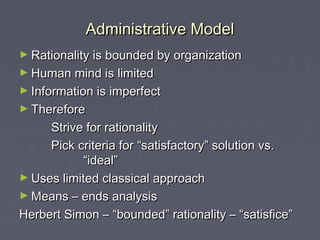
Administrative ModelAdministrative Model
► Rationality is bounded by organizationRationality is bounded by organization
► Human mind is limitedHuman mind is limited
► Information is imperfectInformation is imperfect
► ThereforeTherefore
Strive for rationalityStrive for rationality
Pick criteria forPick criteria for “satisfactory” solution vs.“satisfactory” solution vs.
“ideal”“ideal”
► Uses limited classical approachUses limited classical approach
► Means – ends analysisMeans – ends analysis
Herbert Simon –Herbert Simon – “bounded” rationality – “satisfice”“bounded” rationality – “satisfice”
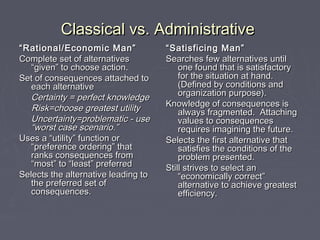
Classical vs. AdministrativeClassical vs. Administrative
““Rational/Economic Man”Rational/Economic Man”
Complete set of alternativesComplete set of alternatives
“given” to choose action.“given” to choose action.
Set of consequences attached toSet of consequences attached to
each alternativeeach alternative
Certainty = perfect knowledgeCertainty = perfect knowledge
Risk=choose greatest utilityRisk=choose greatest utility
Uncertainty=problematic - useUncertainty=problematic - use
“worst case scenario.”“worst case scenario.”
Uses aUses a “utility” function or“utility” function or
“preference ordering” that“preference ordering” that
ranks consequences fromranks consequences from
“most” to “least” preferred“most” to “least” preferred
Selects the alternative leading toSelects the alternative leading to
the preferred set ofthe preferred set of
consequences.consequences.
““Satisficing Man”Satisficing Man”
Searches few alternatives untilSearches few alternatives until
one found that is satisfactoryone found that is satisfactory
for the situation at hand.for the situation at hand.
(Defined by conditions and(Defined by conditions and
organization purpose).organization purpose).
Knowledge of consequences isKnowledge of consequences is
always fragmented. Attachingalways fragmented. Attaching
values to consequencesvalues to consequences
requires imagining the future.requires imagining the future.
Selects the first alternative thatSelects the first alternative that
satisfies the conditions of thesatisfies the conditions of the
problem presented.problem presented.
Still strives to select anStill strives to select an
“economically correct”“economically correct”
alternative to achieve greatestalternative to achieve greatest
efficiency.efficiency.
IncrementalismIncrementalism
► Means – endsMeans – ends analysis inappropriateanalysis inappropriate
► Objectives – alternativesObjectives – alternatives emerge simultaneouslyemerge simultaneously
► Good solutions = agreementGood solutions = agreement
► Reduce options & consider alternatives similar toReduce options & consider alternatives similar to
status-quostatus-quo
► Limit analysis to differences between status-quoLimit analysis to differences between status-quo
and proposed alternativesand proposed alternatives
► Concrete, practical alternatives vs. theoryConcrete, practical alternatives vs. theory
Lindblom – political arena - conservativeLindblom – political arena - conservative
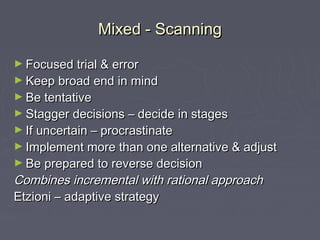
Mixed - ScanningMixed - Scanning
► Focused trial & errorFocused trial & error
► Keep broad end in mindKeep broad end in mind
► Be tentativeBe tentative
► Stagger decisions – decide in stagesStagger decisions – decide in stages
► If uncertain – procrastinateIf uncertain – procrastinate
► Implement more than one alternative & adjustImplement more than one alternative & adjust
► Be prepared to reverse decisionBe prepared to reverse decision
Combines incremental with rational approachCombines incremental with rational approach
Etzioni – adaptive strategyEtzioni – adaptive strategy
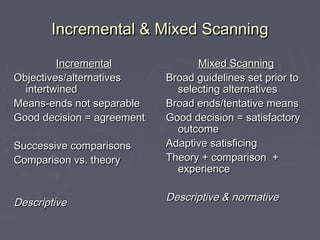
Incremental & Mixed ScanningIncremental & Mixed Scanning
IncrementalIncremental
Objectives/alternativesObjectives/alternatives
intertwinedintertwined
Means-ends not separableMeans-ends not separable
Good decision = agreementGood decision = agreement
Successive comparisonsSuccessive comparisons
Comparison vs. theoryComparison vs. theory
DescriptiveDescriptive
Mixed ScanningMixed Scanning
Broad guidelines set prior toBroad guidelines set prior to
selecting alternativesselecting alternatives
Broad ends/tentative meansBroad ends/tentative means
Good decision = satisfactoryGood decision = satisfactory
outcomeoutcome
Adaptive satisficingAdaptive satisficing
Theory + comparison +Theory + comparison +
experienceexperience
Descriptive & normativeDescriptive & normative
DecisionDecision “irrationality” – Action “rationality”“irrationality” – Action “rationality”
► Rational approach provokes doubt and uncertaintyRational approach provokes doubt and uncertainty
considering conflicting contradictory or incompatible alternatives.considering conflicting contradictory or incompatible alternatives.
► Good management = motivating people, creating aGood management = motivating people, creating a
positive organizational climate, creating social networkspositive organizational climate, creating social networks
and developing powerful organizational ideologies.and developing powerful organizational ideologies.
• Action requires endorsing conclusive/consistentAction requires endorsing conclusive/consistent
organizational ideology and members who displayorganizational ideology and members who display
commitment,commitment, motivation,motivation, andand expectationsexpectations that an actionthat an action
will succeed.will succeed.
• Effective organization action = positive expectations toEffective organization action = positive expectations to
engender motivation and commitment to see actionengender motivation and commitment to see action
through to a successful conclusion.through to a successful conclusion.
• Rational/cognitive processes promote organizationRational/cognitive processes promote organization
structure (standardization) to be efficient.structure (standardization) to be efficient.
• Structure creates inflexibilityStructure creates inflexibility
DecisionDecision “irrationality” – Action “rationality”“irrationality” – Action “rationality”
► Limit to favored alternative. ConsiderLimit to favored alternative. Consider
another only to highlight the advantages ofanother only to highlight the advantages of
the favored alternative. (Reducethe favored alternative. (Reduce
uncertainty)uncertainty)
► Search for positive consequences ofSearch for positive consequences of
favored alternative only. (Createfavored alternative only. (Create
enthusiasm & commitment)enthusiasm & commitment)
► Reformulate predicted positiveReformulate predicted positive
consequences as objectives later.consequences as objectives later.
(Establish positive links)(Establish positive links)
► Based on commitment & enthusiasm.Based on commitment & enthusiasm.
(Participation, collaboration, ideology)(Participation, collaboration, ideology)
““Garbage Can” TheoryGarbage Can” Theory
► Decision-making in atmosphere of high uncertaintyDecision-making in atmosphere of high uncertainty
► Considers inherent organization conflictConsiders inherent organization conflict
► Ambiguous goals agreed upon but notAmbiguous goals agreed upon but not
operationalizedoperationalized
May be many & in conflict – may beMay be many & in conflict – may be
“discovered” or emerge“discovered” or emerge
► Four streams of events:Four streams of events:
Four Independent Event StreamsFour Independent Event Streams
► Problems – may not lead to solution/may not beProblems – may not lead to solution/may not be
solved if solution appliedsolved if solution applied
► Solutions – ideas proposed for adoption – ifSolutions – ideas proposed for adoption – if
attractive can stimulate search for a problemattractive can stimulate search for a problem
► Participants – come & go – problems & solutionsParticipants – come & go – problems & solutions
can changecan change
► ““Choice” opportunities – occasions whenChoice” opportunities – occasions when
organizations expected to make decisionsorganizations expected to make decisions
When all connect – problem solved if solution fitsWhen all connect – problem solved if solution fits
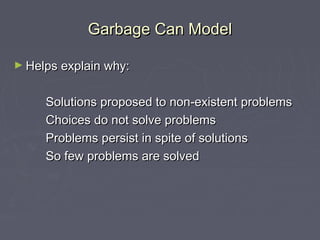
Garbage Can ModelGarbage Can Model
► Helps explain why:Helps explain why:
Solutions proposed to non-existent problemsSolutions proposed to non-existent problems
Choices do not solve problemsChoices do not solve problems
Problems persist in spite of solutionsProblems persist in spite of solutions
So few problems are solvedSo few problems are solved
Role of IntuitionRole of Intuition
►HeuristicHeuristic: a commonsense rule (or set of: a commonsense rule (or set of
rules) intended to increase the probability ofrules) intended to increase the probability of
solving some problemsolving some problem
►IntuitionIntuition: instinctive knowing (without the: instinctive knowing (without the
use of rational processes) hunch, suspicion,use of rational processes) hunch, suspicion,
impression, feeling, belief, notion, opinionimpression, feeling, belief, notion, opinion
an impression that something might be thean impression that something might be the
casecase
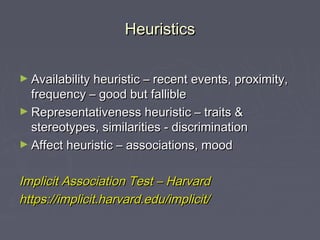
HeuristicsHeuristics
► Availability heuristic – recent events, proximity,Availability heuristic – recent events, proximity,
frequency – good but falliblefrequency – good but fallible
► Representativeness heuristic – traits &Representativeness heuristic – traits &
stereotypes, similarities - discriminationstereotypes, similarities - discrimination
► Affect heuristic – associations, moodAffect heuristic – associations, mood
Implicit Association Test – HarvardImplicit Association Test – Harvard
https://implicit.harvard.edu/implicit/https://implicit.harvard.edu/implicit/

Administrative Decision Making (1)

  • 1.
  • 2.
    Classical ModelClassical Model ►Identify the problemIdentify the problem ► Diagnose the problemDiagnose the problem ► Identify all possible alternativesIdentify all possible alternatives ► Evaluate potential consequences of alternativesEvaluate potential consequences of alternatives ► Select theSelect the “best” alternative“best” alternative ► ImplementImplement ► EvaluateEvaluate Means – end analysisMeans – end analysis Ideal – comprehensive – maximizing strategyIdeal – comprehensive – maximizing strategy
  • 3.
    Administrative ModelAdministrative Model ►Rationality is bounded by organizationRationality is bounded by organization ► Human mind is limitedHuman mind is limited ► Information is imperfectInformation is imperfect ► ThereforeTherefore Strive for rationalityStrive for rationality Pick criteria forPick criteria for “satisfactory” solution vs.“satisfactory” solution vs. “ideal”“ideal” ► Uses limited classical approachUses limited classical approach ► Means – ends analysisMeans – ends analysis Herbert Simon –Herbert Simon – “bounded” rationality – “satisfice”“bounded” rationality – “satisfice”
  • 4.
    Classical vs. AdministrativeClassicalvs. Administrative ““Rational/Economic Man”Rational/Economic Man” Complete set of alternativesComplete set of alternatives “given” to choose action.“given” to choose action. Set of consequences attached toSet of consequences attached to each alternativeeach alternative Certainty = perfect knowledgeCertainty = perfect knowledge Risk=choose greatest utilityRisk=choose greatest utility Uncertainty=problematic - useUncertainty=problematic - use “worst case scenario.”“worst case scenario.” Uses aUses a “utility” function or“utility” function or “preference ordering” that“preference ordering” that ranks consequences fromranks consequences from “most” to “least” preferred“most” to “least” preferred Selects the alternative leading toSelects the alternative leading to the preferred set ofthe preferred set of consequences.consequences. ““Satisficing Man”Satisficing Man” Searches few alternatives untilSearches few alternatives until one found that is satisfactoryone found that is satisfactory for the situation at hand.for the situation at hand. (Defined by conditions and(Defined by conditions and organization purpose).organization purpose). Knowledge of consequences isKnowledge of consequences is always fragmented. Attachingalways fragmented. Attaching values to consequencesvalues to consequences requires imagining the future.requires imagining the future. Selects the first alternative thatSelects the first alternative that satisfies the conditions of thesatisfies the conditions of the problem presented.problem presented. Still strives to select anStill strives to select an “economically correct”“economically correct” alternative to achieve greatestalternative to achieve greatest efficiency.efficiency.
  • 5.
    IncrementalismIncrementalism ► Means –endsMeans – ends analysis inappropriateanalysis inappropriate ► Objectives – alternativesObjectives – alternatives emerge simultaneouslyemerge simultaneously ► Good solutions = agreementGood solutions = agreement ► Reduce options & consider alternatives similar toReduce options & consider alternatives similar to status-quostatus-quo ► Limit analysis to differences between status-quoLimit analysis to differences between status-quo and proposed alternativesand proposed alternatives ► Concrete, practical alternatives vs. theoryConcrete, practical alternatives vs. theory Lindblom – political arena - conservativeLindblom – political arena - conservative
  • 6.
    Mixed - ScanningMixed- Scanning ► Focused trial & errorFocused trial & error ► Keep broad end in mindKeep broad end in mind ► Be tentativeBe tentative ► Stagger decisions – decide in stagesStagger decisions – decide in stages ► If uncertain – procrastinateIf uncertain – procrastinate ► Implement more than one alternative & adjustImplement more than one alternative & adjust ► Be prepared to reverse decisionBe prepared to reverse decision Combines incremental with rational approachCombines incremental with rational approach Etzioni – adaptive strategyEtzioni – adaptive strategy
  • 7.
    Incremental & MixedScanningIncremental & Mixed Scanning IncrementalIncremental Objectives/alternativesObjectives/alternatives intertwinedintertwined Means-ends not separableMeans-ends not separable Good decision = agreementGood decision = agreement Successive comparisonsSuccessive comparisons Comparison vs. theoryComparison vs. theory DescriptiveDescriptive Mixed ScanningMixed Scanning Broad guidelines set prior toBroad guidelines set prior to selecting alternativesselecting alternatives Broad ends/tentative meansBroad ends/tentative means Good decision = satisfactoryGood decision = satisfactory outcomeoutcome Adaptive satisficingAdaptive satisficing Theory + comparison +Theory + comparison + experienceexperience Descriptive & normativeDescriptive & normative
  • 8.
    DecisionDecision “irrationality” –Action “rationality”“irrationality” – Action “rationality” ► Rational approach provokes doubt and uncertaintyRational approach provokes doubt and uncertainty considering conflicting contradictory or incompatible alternatives.considering conflicting contradictory or incompatible alternatives. ► Good management = motivating people, creating aGood management = motivating people, creating a positive organizational climate, creating social networkspositive organizational climate, creating social networks and developing powerful organizational ideologies.and developing powerful organizational ideologies. • Action requires endorsing conclusive/consistentAction requires endorsing conclusive/consistent organizational ideology and members who displayorganizational ideology and members who display commitment,commitment, motivation,motivation, andand expectationsexpectations that an actionthat an action will succeed.will succeed. • Effective organization action = positive expectations toEffective organization action = positive expectations to engender motivation and commitment to see actionengender motivation and commitment to see action through to a successful conclusion.through to a successful conclusion. • Rational/cognitive processes promote organizationRational/cognitive processes promote organization structure (standardization) to be efficient.structure (standardization) to be efficient. • Structure creates inflexibilityStructure creates inflexibility
  • 9.
    DecisionDecision “irrationality” –Action “rationality”“irrationality” – Action “rationality” ► Limit to favored alternative. ConsiderLimit to favored alternative. Consider another only to highlight the advantages ofanother only to highlight the advantages of the favored alternative. (Reducethe favored alternative. (Reduce uncertainty)uncertainty) ► Search for positive consequences ofSearch for positive consequences of favored alternative only. (Createfavored alternative only. (Create enthusiasm & commitment)enthusiasm & commitment) ► Reformulate predicted positiveReformulate predicted positive consequences as objectives later.consequences as objectives later. (Establish positive links)(Establish positive links) ► Based on commitment & enthusiasm.Based on commitment & enthusiasm. (Participation, collaboration, ideology)(Participation, collaboration, ideology)
  • 10.
    ““Garbage Can” TheoryGarbageCan” Theory ► Decision-making in atmosphere of high uncertaintyDecision-making in atmosphere of high uncertainty ► Considers inherent organization conflictConsiders inherent organization conflict ► Ambiguous goals agreed upon but notAmbiguous goals agreed upon but not operationalizedoperationalized May be many & in conflict – may beMay be many & in conflict – may be “discovered” or emerge“discovered” or emerge ► Four streams of events:Four streams of events:
  • 11.
    Four Independent EventStreamsFour Independent Event Streams ► Problems – may not lead to solution/may not beProblems – may not lead to solution/may not be solved if solution appliedsolved if solution applied ► Solutions – ideas proposed for adoption – ifSolutions – ideas proposed for adoption – if attractive can stimulate search for a problemattractive can stimulate search for a problem ► Participants – come & go – problems & solutionsParticipants – come & go – problems & solutions can changecan change ► ““Choice” opportunities – occasions whenChoice” opportunities – occasions when organizations expected to make decisionsorganizations expected to make decisions When all connect – problem solved if solution fitsWhen all connect – problem solved if solution fits
  • 12.
    Garbage Can ModelGarbageCan Model ► Helps explain why:Helps explain why: Solutions proposed to non-existent problemsSolutions proposed to non-existent problems Choices do not solve problemsChoices do not solve problems Problems persist in spite of solutionsProblems persist in spite of solutions So few problems are solvedSo few problems are solved
  • 13.
    Role of IntuitionRoleof Intuition ►HeuristicHeuristic: a commonsense rule (or set of: a commonsense rule (or set of rules) intended to increase the probability ofrules) intended to increase the probability of solving some problemsolving some problem ►IntuitionIntuition: instinctive knowing (without the: instinctive knowing (without the use of rational processes) hunch, suspicion,use of rational processes) hunch, suspicion, impression, feeling, belief, notion, opinionimpression, feeling, belief, notion, opinion an impression that something might be thean impression that something might be the casecase
  • 14.
    HeuristicsHeuristics ► Availability heuristic– recent events, proximity,Availability heuristic – recent events, proximity, frequency – good but falliblefrequency – good but fallible ► Representativeness heuristic – traits &Representativeness heuristic – traits & stereotypes, similarities - discriminationstereotypes, similarities - discrimination ► Affect heuristic – associations, moodAffect heuristic – associations, mood Implicit Association Test – HarvardImplicit Association Test – Harvard https://implicit.harvard.edu/implicit/https://implicit.harvard.edu/implicit/