Ehsan Alirezaei
METHODOLOGY CONSTRUCTION
MANAGING COMPLEXITY
• Decomposition
• Abstraction
• Organization
METHODOLOGY CONSTRUCTION
• Meta model Driven
• It is based on the MAS meta-model adopted by the designer for the
development of a MAS for a specific problem in a specific application Domain.
• Development Process Driven ( famous and widely used for traditional SE).
• It is based on the instantiation of a software development process in which
each phase is carried out using appropriate method fragments
META MODEL DRIVEN (MMD)
1. Using Method Fragments
A. A process specification
B. Deliverables such as AUML/UML diagrams
C. Some preconditions
D. A list of elements
E. Application guide Lines
F. A glossary of terms
G. Describe the context/problem that is behind the methodology
H. Aspects of fragment
USING METHOD FRAGMENTS FOR BUILDING
METHODOLOGY
• choose or define a MAS meta-model
• identify the elements that compose the meta-model
• choose the method fragments
• defining a development process
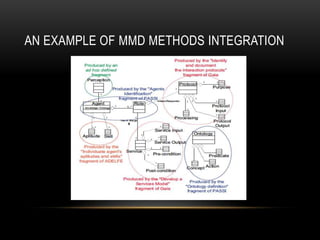
AN EXAMPLE OF MMD METHODS INTEGRATION
PROCESS DRIVEN DEVELOPMENT (PDD)
• PDD complements Use case driven approach
• PDD is particularly useful for large number of different users
• PDD models as-is and to-be business process
BUILDING METHODOLOGY WITH PDD
• To build methodology, the designer must :
• Choose or define a software development process suitable for the specific
problem and for the specific application domain
• Instantiate the development process by selecting, for each phase, suitable
method fragments, chosen from agent-oriented methodologies proposed in the
literature or ad-hoc defined.
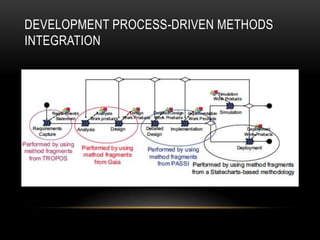
DEVELOPMENT PROCESS-DRIVEN METHODS
INTEGRATION
MMD ADVANTAGES AND DISADVANTAGES
• Advantages :
• Flexibility for the definition of methodologies
• Meta models of the MAS to be developed
• Disadvantages:
• Difficulty of integration of different fragments due to different semantics of
the meta-model concepts;
• Selection and/or definition of the meta-model to adopt for the specific
problem and/or application domain
PDD ADVANTAGES AND DISADVANTAGES
• Advantages:
• Flexibility for the construction of methodologies
• Disadvantages:
• Process rigidity
• Low flexibility of the system meta-model
• Adaptation among the work products
• Choice and definition of the process to instantiate for the specific problem
REFRENCES
• “Using Method Engineering for the Construction of Agent-Oriented Methodologies”,
Giancarlo Fortino, Alfredo Garro, and Wilma Russo
• Foundation for Intelligent Physical Agents (FIPA) Specifications. [http://www.fipa.org].

Methodology construction

  • 1.
  • 2.
    MANAGING COMPLEXITY • Decomposition •Abstraction • Organization
  • 3.
    METHODOLOGY CONSTRUCTION • Metamodel Driven • It is based on the MAS meta-model adopted by the designer for the development of a MAS for a specific problem in a specific application Domain. • Development Process Driven ( famous and widely used for traditional SE). • It is based on the instantiation of a software development process in which each phase is carried out using appropriate method fragments
  • 4.
    META MODEL DRIVEN(MMD) 1. Using Method Fragments A. A process specification B. Deliverables such as AUML/UML diagrams C. Some preconditions D. A list of elements E. Application guide Lines F. A glossary of terms G. Describe the context/problem that is behind the methodology H. Aspects of fragment
  • 5.
    USING METHOD FRAGMENTSFOR BUILDING METHODOLOGY • choose or define a MAS meta-model • identify the elements that compose the meta-model • choose the method fragments • defining a development process
  • 6.
    AN EXAMPLE OFMMD METHODS INTEGRATION
  • 7.
    PROCESS DRIVEN DEVELOPMENT(PDD) • PDD complements Use case driven approach • PDD is particularly useful for large number of different users • PDD models as-is and to-be business process
  • 8.
    BUILDING METHODOLOGY WITHPDD • To build methodology, the designer must : • Choose or define a software development process suitable for the specific problem and for the specific application domain • Instantiate the development process by selecting, for each phase, suitable method fragments, chosen from agent-oriented methodologies proposed in the literature or ad-hoc defined.
  • 9.
  • 10.
    MMD ADVANTAGES ANDDISADVANTAGES • Advantages : • Flexibility for the definition of methodologies • Meta models of the MAS to be developed • Disadvantages: • Difficulty of integration of different fragments due to different semantics of the meta-model concepts; • Selection and/or definition of the meta-model to adopt for the specific problem and/or application domain
  • 11.
    PDD ADVANTAGES ANDDISADVANTAGES • Advantages: • Flexibility for the construction of methodologies • Disadvantages: • Process rigidity • Low flexibility of the system meta-model • Adaptation among the work products • Choice and definition of the process to instantiate for the specific problem
  • 12.
    REFRENCES • “Using MethodEngineering for the Construction of Agent-Oriented Methodologies”, Giancarlo Fortino, Alfredo Garro, and Wilma Russo • Foundation for Intelligent Physical Agents (FIPA) Specifications. [http://www.fipa.org].