DISCOVER . LEARN .
EMPOWER
Experiment no.1 :To Acquaint with various
laboratory equipment's and microscopy
University Institute Of
Agricultural Sciences
BSc Hons Agriculture
Subject Name :Fundamentals of plant
pathology
Code : AGP-110
Course Introduction
The students will be acquainted with the history, importance, symptoms,
etiology, epidemiology, ecology and management of commonly occurring
diseases of field crops. Students will also be able to survey, sample
collection based upon symptomology, isolation, purification and
microscopic identification of different plant pathogens causing diseases in
major field crops. Purification of pathogenic cultures would be helpful in
pathogenicity tests.
Objectives
To understand the basic horticultural disease s and their management.
To impart the knowledge to identify the diseases through symptoms.
Subject Outcome
The students will be able to strengthen their understanding of different
horticultural diseases.
The students will be able to gain knowledge about management of different
diseases
An introduction to Plant Pathology
 What is Plant Pathology?
 Objectives of Plant Pathology
 Disease & Disorder
 Plant Pathogens
 Classification of diseases
 Terminology
What is Plant Pathology?
Phytopathology (Phyton : plant) Greek - Pathos
(suffering) + Logos (study) = The study of the
suffering plant
Plant pathology is that branch of agricultural,
botanical or biological sciences which deals
with the study of:
 cause of the disease
 Resulting losses and
 Control of plant diseases
Objectives of Plant pathology
1. Study of origin, causes or reasons. Study of living, non-
living and other causes of disease or disorder in plants-
Etiology:
2. Study of mechanism of disease development i.e.
processes of infection and colonization of the host by the
pathogen. This phase involves complex host-pathogen
interactions- Pathogenesis
3. study the interaction between the causal agent and the
diseased plants in relation to environmental conditions.
Generally at the population level- Epidemiology
4. Development of management systems of the diseases
land reduction of losses caused by them- Control/
Management.
What is health?
The ability to carry out normal physiological
functions at a acceptable level consistent to
genetic potential.
 Normal physiological functions include:
– Normal call division, differentiation, and development,
– Absorption of water and minerals from the soil and translocation;
– Photosynthesis and translocation of photosynthates;
– Utilization and storage of photosynthates;
– Metabolism of metabolites and synthates;
– Reproduction;
– Storage of reserves for overwintering or reproduction.
Plant pathology is both science
(of Learning and understanding
the nature of disease )
and
Art (of diagnosing and
controlling the disease)
 plant is healthy, or normal, when it
can carry out its physiological
functions to the best of its genetic
potential.
 Any deviation- Disease
 The kinds of cells and tissues that
become affected determine the type
of physiological function that will
be
 For example, infection of roots may
cause roots to rot and make them
unable to absorb water and
nutrients from the soil;
 infection of xylem vessels, interferes
with the translocation of water and
minerals to the crown of the plant;
 infection of the foliage, (leaf spots,
blights, rusts, mildews, mosaics
etc.), interferes with photosynthesis
The Concept of Disease in
Plants
What is a Disease
Stakman & Harrar (1957) defined disease as
physiological disorder or structural abnormality that
is deleterious to the plant or its part or product, that
reduces the economic value of the plant e.g., wilt,
potato blight, Loose smut of wheat, karnal bunt of
wheat
Disease
 Disease –
the process in which a pathogen interferes with one or more
essential plant cell functions
 Marshall Ward (1901): disease represents a condition in which
functions of the plant are not properly discharged.
 Disease is a harmful deviation from normal functioning of
physiological processes. (British Mycological Society, 1950)
 Horsfall & Diamond (1957): Disease can be defined as a
physiological disorder or structural abnormality that is
deleterious or harmful toe the plant or its part or product that
reduces its economic value.
Disease can be defined as the result of interaction between host,
pathogen and environment
How Pathogens affectPlants
There are many ways in which plant disease pathogens can
affect plants
– By utilizing host cell contents
– By killing host or by interfering with its
metabolic processes through their enzymes, toxins etc.
– By weakening the host due t continuous
loss of the nutrients.
– By interfering with the translocation of the food, minerals
land water.
– They can suppress the chlorophyll content.
– They can reduce the leaf area.
– They can curb the movement of solutes and water through the stems.
– They sometimes reduce the water-absorbing capacity of the roots.
– They suppress the translocation of photosynthates away from the
leaves.
– They sometimes promote wasteful use of
the products of photosynthesis as in the formation of galls.
Disease Triangle
Host
Environment
Disease
Pathogen
Conditi
ons for disease
 Host should be susceptible
 Pathogen should be virulent
 Environment should be favourable for the disease
TIME
Environment
Host Pathogen
Time
Human Activity
Disease Tetra-hedron
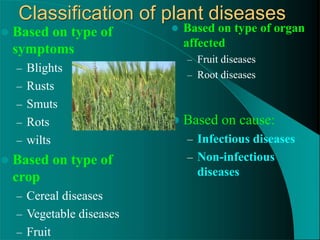
Classification of plant diseases
 Based on type of
symptoms
– Blights
– Rusts
– Smuts
– Rots
– wilts
 Based on type of
crop
– Cereal diseases
– Vegetable diseases
– Fruit
 Based on type of organ
affected
– Fruit diseases
– Root diseases
 Based on cause:
– Infectious diseases
– Non-infectious
diseases
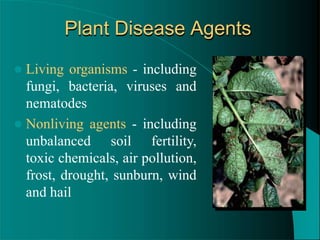
Plant Disease Agents
 Living organisms - including
fungi, bacteria, viruses and
nematodes
 Nonliving agents - including
unbalanced soil fertility,
toxic chemicals, air pollution,
frost, drought, sunburn, wind
and hail
Infectious Plant Disease
Causes
 Fungi
 Bacteria
 Viruses
 Viroids
 Virusoids
 Protozoa
 Nematodes
 Algae
 Parasitic Plants
Non-infectious diseases
(due to abiotic factors
 Environmental stress/ excess
– Temperature e.g. high or low
– Moisture e.g. excess- rotting or Stress-wilt/drying
– Air
– Light e.g. etiolation
 Nutritional imbalance
– Excess
– Deficiency e.g. N deficiency, Zn deficiency
 Disorder:
Abnormal physiological change due to non-parasitic
agent or is a non-parasitic physiological
malfunctioning due to either excess or deficiency in
environmental factors or nutrients.
e.g. Physiological wilt, sun scald, Nutrient deficiency)
Disorder
Iron Deficiency
Scope & Importance of
plant diseases
Scopes & Importance of Plant Diseases
 Plant pathology deals with different aspects of plant
diseases and has wide scope than human pathology
which only deal with only one aspect
 In recent years plant pathologists have begun to
specialize in particular aspect. The field in which
notable advances have been made are:
– Interaction between host and pathogen at
chemical, molecular and genetic level
– Plant virology, chemistry of fungitoxicity
– Disease forecasting
 On practical aspects much advances have
been made in plant protection chemicals;
breeding for disease resistance
 Increased population emphasizes the
application of all possible means to meet the
food requirements
– Expansion of crop area
– Improved methods of cultivation
– Increased use of fertilizers
– Improved varieties
– Increased irrigation
– Crop protection
Importance of Plant Diseases
 Late blight of potato-1841-51 (Irish famine)
 Coffee rust 1867-1870 (Srilanka)
 Downy mildew of grapes (1880s) (France)
 Bengal Famine 1942 (India)
 Bacterial Blight of Rice 1963 (Bihar)
 Southern corn leaf blight -1970 (USA)
Estimated annual losses worldwide
Diseases 14.1%
Insects 10.2%
Weeds 12.2%
Total av. looses 36.5%
Losses are more in developing world
and
less in develop world
Losses
caused by
Plant
Diseases
Terminology
Parasite
 Pathogenicity
 Symptom
 Syndrome
 Host
 Collateral host
 Susceptibility
 Pathogen
 Pathogenesis
 Sign
 Hypersensitivity
 Alternate host
 Resistance
Tolerance
 Parasite
An organism that lives on or in another
organism and obtains food from the second
organism
 Pathogenicity- is the ability of a pathogen to
cause the disease by interfering with one or
more of the essential plant cell functions.
What is Pathogen?
 Any entity that can cause disease in a host
eg. Fungus, Bacteria, virus, Phytoplasma,
Viroids, RLO’s, Parasitic Plants, Nematodes
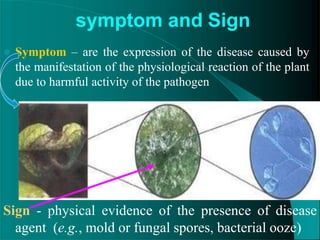
symptom and Sign
 Symptom – are the expression of the disease caused by
the manifestation of the physiological reaction of the plant
due to harmful activity of the pathogen
Sign - physical evidence of the presence of disease
agent (e.g., mold or fungal spores, bacterial ooze)
Syndrome
Defined as sequential appearance of disease
symptoms on a plant during the development
of the disease
or sum total of symptoms exhibited by a
disease
Fleck or necrotic spot Blight
Fungal growth Death of of organ or plant
Facultative Parasite:
usually grows and completes life cycle on dead
material, but can do so on living tissue. Sclerotinia
Facultative Saprophyte:
usually grows and completes life cycle on living
tissue, but can do so on dead material.
Phytophthora infestans
Necrotrophs – kill their host before feeding on the cells
or the cell’s contents and live on dead tissue. Rhizoctonia
Biotrophs – do not kill plant cells. They penetrate the
cell wall and establish a continuous relationship or
move from cell to cell. e.g. Rusts, powdery mildew,
harbour another organism is
 Host: any organism that
called host
 Alternate host: is the host that help in the completion of
the life cycle of the pathogen and its survival, belong to
diff. family
 Collateral host: host of the same family and help in the
survival of the pathogen
 Infection: Establishment of organic relationship between
host and pathogen
 Pathogenesis: Chain of events that takes place during the
development of disease (inoculation to survival of the
pathogen)
 Susceptibility: Inability of the host to resist the attack of
the pathogen

 Tolerance: is a type of defence
that minimises crop losses with out restricting
the disease development.
 Resistance: Ability of the host to resist the attack of the
pathogen
– Horizontal resistance
– Vertical resistance
 Hypersensitivity: is the quick death of the host tissue in
the vicinity of the pathogen
 Disease escape: it is ability of the susceptible host to
avoid the damaging disease stress e.g. unfavorable
 Virulence: It is defined as the degree of
pathogenecity of a particular isolate or race of
the pathogen .
 Aggressiveness: it is the capacity of the
pathogen to invade and colonize the host and to
reproduce on or in it.
 Predisposition: it is the set of conditions that
makes the plant vulnerable to the attack of the
pathogen
Terms describing microbial
habitats related to plants:
 Epiphytic = organisms growing on the surface of photosynthetic
organisms
 Endophyitc= organisms growing inside the host
 Phylloplane = leaf surface
 Phyllosphere = area surrounding the leaf and impacted by it

 Rhizoplane = root surface
 Rhizosphere = area surrounding the root and impacted by it
Plant Pathology- Today & Future
 Molecular Plant Pathology
– Discovery of WM Stanley in 1935 about proteinaceous nature of the
TMV can be considered as beginning
of the molecular Plant
Pathology, though two years later, Bawden and Pierie showed the presence
of small amount of RNA with it.
– Gierrer & Schramm in 1956 – RNA as infectious not protein and also
replicate.
– 1941, Beadle & Tatum showed that one gene code for one enzyme
– 1942, HH Flor- Gene for Gene hypothesis
– 1953, Watson & Crick- DNA in a double
helix form – a major
discovery
– In mid 1960s , TMV studies helped in elucidation of the gentic code
showing that specific base triplet of DNA (and RNA) code for a
certain amino acid.
 In 1970s, study on Agrobacterium tumefaciens T-DNA contain Ti-
Plasmid having many genes, of which two code for growth hormones
leading to tumour formation. Later these plasmids were used as
vector to transfer genes to other organisms including plants.
 Later viruses were also used as vectors in genetic engineering.
 In 1984, Albersheim et al., identified a molecule later called elicitor,
in the cell wall of the Phytophthora megasperma that act as elicitor of
the defence response in its soybean host.
 In 1984, Staskawicz et al., isolated first avirulence gene from
bacterium Pseudomonas syringae pv. glycines
 These studies help in understanding of the host pathogen interaction
and resistance phenomenon.
 In 1986, hrp initially called bacterial hypersensitive response protein
, and thought to have role in hypersensitive reaction of bacterial
infection but later found to have role in transport of protein in
pathogenic bacteria and also the transport of bacteria into plant
cells.
Plant Pathology- Today & Future
 In 1986, Beachy et al., transformed the tobacco plants (Transgenic)
by transferring the cp gene of TMV and impart resistance to TMV
infection- such resistance called as pathogen derived resistance.
 In 1989, Dickman and Kolattukudi, transformed a fungus by
inserting cutinase enzyme coding gene, facilitating direct penetration
of its host thus proving the role of cutinase enzyme in direct
penetration.
 In 1991, Broglie et al., showed that plants transformed with cutinase
gene exhibit enhanced resistance to fungi having chitin in their cell
wall.
 In 1990, Cheim et al., produced a resistant transgenic tobacco with
gene coding for stilbene synthetase, a enzyme that synthesise
phytoalexin.
 In 1992, Johal and Briggs, isolated the first resistance gene (HM-
(avr9) in Cladosporium
1)from corn against Cochliobolus carbonum
De Wit isolated the first avirulence gene
fulvum infecting tomato.
Plant Pathology- Today & Future
 Similarly, advances were also made in the diagnostic and
detection techniques helping in accurate and quick detection
and identification of the pathogens.
– ELISA
– Monoclonal antibodies,
– DNA probes
– PCR based methods
– RFLP
– RT-PCR
– IC/RT-PCR
 In management of diseases
– Cp mediated resistance
– SAR
– Gene silencing
Plant Pathology- Today & Future
Acknowledgements
 I gratefully acknowledge the use of some very
important photographs given in text book “Plant
Pathology” by G N Agrios. This book serves as
one of the important and essential source of
learning of the discipline of plant pathology.
 I also acknowledge the scientists who spent
valuable time in generating information on
various aspects of plant pathology and displayed
the same on internet for use by teachers and
researchers

plant pathology.ppt

  • 1.
    DISCOVER . LEARN. EMPOWER Experiment no.1 :To Acquaint with various laboratory equipment's and microscopy University Institute Of Agricultural Sciences BSc Hons Agriculture Subject Name :Fundamentals of plant pathology Code : AGP-110
  • 2.
    Course Introduction The studentswill be acquainted with the history, importance, symptoms, etiology, epidemiology, ecology and management of commonly occurring diseases of field crops. Students will also be able to survey, sample collection based upon symptomology, isolation, purification and microscopic identification of different plant pathogens causing diseases in major field crops. Purification of pathogenic cultures would be helpful in pathogenicity tests. Objectives To understand the basic horticultural disease s and their management. To impart the knowledge to identify the diseases through symptoms. Subject Outcome The students will be able to strengthen their understanding of different horticultural diseases. The students will be able to gain knowledge about management of different diseases
  • 3.
    An introduction toPlant Pathology  What is Plant Pathology?  Objectives of Plant Pathology  Disease & Disorder  Plant Pathogens  Classification of diseases  Terminology
  • 4.
    What is PlantPathology? Phytopathology (Phyton : plant) Greek - Pathos (suffering) + Logos (study) = The study of the suffering plant Plant pathology is that branch of agricultural, botanical or biological sciences which deals with the study of:  cause of the disease  Resulting losses and  Control of plant diseases
  • 5.
    Objectives of Plantpathology 1. Study of origin, causes or reasons. Study of living, non- living and other causes of disease or disorder in plants- Etiology: 2. Study of mechanism of disease development i.e. processes of infection and colonization of the host by the pathogen. This phase involves complex host-pathogen interactions- Pathogenesis 3. study the interaction between the causal agent and the diseased plants in relation to environmental conditions. Generally at the population level- Epidemiology 4. Development of management systems of the diseases land reduction of losses caused by them- Control/ Management.
  • 6.
    What is health? Theability to carry out normal physiological functions at a acceptable level consistent to genetic potential.  Normal physiological functions include: – Normal call division, differentiation, and development, – Absorption of water and minerals from the soil and translocation; – Photosynthesis and translocation of photosynthates; – Utilization and storage of photosynthates; – Metabolism of metabolites and synthates; – Reproduction; – Storage of reserves for overwintering or reproduction.
  • 7.
    Plant pathology isboth science (of Learning and understanding the nature of disease ) and Art (of diagnosing and controlling the disease)
  • 8.
     plant ishealthy, or normal, when it can carry out its physiological functions to the best of its genetic potential.  Any deviation- Disease  The kinds of cells and tissues that become affected determine the type of physiological function that will be  For example, infection of roots may cause roots to rot and make them unable to absorb water and nutrients from the soil;  infection of xylem vessels, interferes with the translocation of water and minerals to the crown of the plant;  infection of the foliage, (leaf spots, blights, rusts, mildews, mosaics etc.), interferes with photosynthesis The Concept of Disease in Plants
  • 9.
    What is aDisease Stakman & Harrar (1957) defined disease as physiological disorder or structural abnormality that is deleterious to the plant or its part or product, that reduces the economic value of the plant e.g., wilt, potato blight, Loose smut of wheat, karnal bunt of wheat
  • 10.
    Disease  Disease – theprocess in which a pathogen interferes with one or more essential plant cell functions  Marshall Ward (1901): disease represents a condition in which functions of the plant are not properly discharged.  Disease is a harmful deviation from normal functioning of physiological processes. (British Mycological Society, 1950)  Horsfall & Diamond (1957): Disease can be defined as a physiological disorder or structural abnormality that is deleterious or harmful toe the plant or its part or product that reduces its economic value. Disease can be defined as the result of interaction between host, pathogen and environment
  • 11.
    How Pathogens affectPlants Thereare many ways in which plant disease pathogens can affect plants – By utilizing host cell contents – By killing host or by interfering with its metabolic processes through their enzymes, toxins etc. – By weakening the host due t continuous loss of the nutrients. – By interfering with the translocation of the food, minerals land water. – They can suppress the chlorophyll content. – They can reduce the leaf area. – They can curb the movement of solutes and water through the stems. – They sometimes reduce the water-absorbing capacity of the roots. – They suppress the translocation of photosynthates away from the leaves. – They sometimes promote wasteful use of the products of photosynthesis as in the formation of galls.
  • 12.
    Disease Triangle Host Environment Disease Pathogen Conditi ons fordisease  Host should be susceptible  Pathogen should be virulent  Environment should be favourable for the disease TIME
  • 13.
  • 14.
    Classification of plantdiseases  Based on type of symptoms – Blights – Rusts – Smuts – Rots – wilts  Based on type of crop – Cereal diseases – Vegetable diseases – Fruit  Based on type of organ affected – Fruit diseases – Root diseases  Based on cause: – Infectious diseases – Non-infectious diseases
  • 15.
    Plant Disease Agents Living organisms - including fungi, bacteria, viruses and nematodes  Nonliving agents - including unbalanced soil fertility, toxic chemicals, air pollution, frost, drought, sunburn, wind and hail
  • 16.
    Infectious Plant Disease Causes Fungi  Bacteria  Viruses  Viroids  Virusoids  Protozoa  Nematodes  Algae  Parasitic Plants
  • 17.
    Non-infectious diseases (due toabiotic factors  Environmental stress/ excess – Temperature e.g. high or low – Moisture e.g. excess- rotting or Stress-wilt/drying – Air – Light e.g. etiolation  Nutritional imbalance – Excess – Deficiency e.g. N deficiency, Zn deficiency
  • 18.
     Disorder: Abnormal physiologicalchange due to non-parasitic agent or is a non-parasitic physiological malfunctioning due to either excess or deficiency in environmental factors or nutrients. e.g. Physiological wilt, sun scald, Nutrient deficiency) Disorder Iron Deficiency
  • 19.
    Scope & Importanceof plant diseases
  • 20.
    Scopes & Importanceof Plant Diseases  Plant pathology deals with different aspects of plant diseases and has wide scope than human pathology which only deal with only one aspect  In recent years plant pathologists have begun to specialize in particular aspect. The field in which notable advances have been made are: – Interaction between host and pathogen at chemical, molecular and genetic level – Plant virology, chemistry of fungitoxicity – Disease forecasting
  • 21.
     On practicalaspects much advances have been made in plant protection chemicals; breeding for disease resistance  Increased population emphasizes the application of all possible means to meet the food requirements – Expansion of crop area – Improved methods of cultivation – Increased use of fertilizers – Improved varieties – Increased irrigation – Crop protection
  • 22.
    Importance of PlantDiseases  Late blight of potato-1841-51 (Irish famine)  Coffee rust 1867-1870 (Srilanka)  Downy mildew of grapes (1880s) (France)  Bengal Famine 1942 (India)  Bacterial Blight of Rice 1963 (Bihar)  Southern corn leaf blight -1970 (USA)
  • 23.
    Estimated annual lossesworldwide Diseases 14.1% Insects 10.2% Weeds 12.2% Total av. looses 36.5% Losses are more in developing world and less in develop world
  • 24.
  • 26.
    Terminology Parasite  Pathogenicity  Symptom Syndrome  Host  Collateral host  Susceptibility  Pathogen  Pathogenesis  Sign  Hypersensitivity  Alternate host  Resistance Tolerance
  • 27.
     Parasite An organismthat lives on or in another organism and obtains food from the second organism  Pathogenicity- is the ability of a pathogen to cause the disease by interfering with one or more of the essential plant cell functions.
  • 28.
    What is Pathogen? Any entity that can cause disease in a host eg. Fungus, Bacteria, virus, Phytoplasma, Viroids, RLO’s, Parasitic Plants, Nematodes
  • 29.
    symptom and Sign Symptom – are the expression of the disease caused by the manifestation of the physiological reaction of the plant due to harmful activity of the pathogen Sign - physical evidence of the presence of disease agent (e.g., mold or fungal spores, bacterial ooze)
  • 30.
    Syndrome Defined as sequentialappearance of disease symptoms on a plant during the development of the disease or sum total of symptoms exhibited by a disease Fleck or necrotic spot Blight Fungal growth Death of of organ or plant
  • 31.
    Facultative Parasite: usually growsand completes life cycle on dead material, but can do so on living tissue. Sclerotinia Facultative Saprophyte: usually grows and completes life cycle on living tissue, but can do so on dead material. Phytophthora infestans Necrotrophs – kill their host before feeding on the cells or the cell’s contents and live on dead tissue. Rhizoctonia Biotrophs – do not kill plant cells. They penetrate the cell wall and establish a continuous relationship or move from cell to cell. e.g. Rusts, powdery mildew,
  • 32.
    harbour another organismis  Host: any organism that called host  Alternate host: is the host that help in the completion of the life cycle of the pathogen and its survival, belong to diff. family  Collateral host: host of the same family and help in the survival of the pathogen  Infection: Establishment of organic relationship between host and pathogen  Pathogenesis: Chain of events that takes place during the development of disease (inoculation to survival of the pathogen)
  • 33.
     Susceptibility: Inabilityof the host to resist the attack of the pathogen   Tolerance: is a type of defence that minimises crop losses with out restricting the disease development.  Resistance: Ability of the host to resist the attack of the pathogen – Horizontal resistance – Vertical resistance  Hypersensitivity: is the quick death of the host tissue in the vicinity of the pathogen  Disease escape: it is ability of the susceptible host to avoid the damaging disease stress e.g. unfavorable
  • 34.
     Virulence: Itis defined as the degree of pathogenecity of a particular isolate or race of the pathogen .  Aggressiveness: it is the capacity of the pathogen to invade and colonize the host and to reproduce on or in it.  Predisposition: it is the set of conditions that makes the plant vulnerable to the attack of the pathogen
  • 35.
    Terms describing microbial habitatsrelated to plants:  Epiphytic = organisms growing on the surface of photosynthetic organisms  Endophyitc= organisms growing inside the host  Phylloplane = leaf surface  Phyllosphere = area surrounding the leaf and impacted by it   Rhizoplane = root surface  Rhizosphere = area surrounding the root and impacted by it
  • 36.
    Plant Pathology- Today& Future  Molecular Plant Pathology – Discovery of WM Stanley in 1935 about proteinaceous nature of the TMV can be considered as beginning of the molecular Plant Pathology, though two years later, Bawden and Pierie showed the presence of small amount of RNA with it. – Gierrer & Schramm in 1956 – RNA as infectious not protein and also replicate. – 1941, Beadle & Tatum showed that one gene code for one enzyme – 1942, HH Flor- Gene for Gene hypothesis – 1953, Watson & Crick- DNA in a double helix form – a major discovery – In mid 1960s , TMV studies helped in elucidation of the gentic code showing that specific base triplet of DNA (and RNA) code for a certain amino acid.
  • 37.
     In 1970s,study on Agrobacterium tumefaciens T-DNA contain Ti- Plasmid having many genes, of which two code for growth hormones leading to tumour formation. Later these plasmids were used as vector to transfer genes to other organisms including plants.  Later viruses were also used as vectors in genetic engineering.  In 1984, Albersheim et al., identified a molecule later called elicitor, in the cell wall of the Phytophthora megasperma that act as elicitor of the defence response in its soybean host.  In 1984, Staskawicz et al., isolated first avirulence gene from bacterium Pseudomonas syringae pv. glycines  These studies help in understanding of the host pathogen interaction and resistance phenomenon.  In 1986, hrp initially called bacterial hypersensitive response protein , and thought to have role in hypersensitive reaction of bacterial infection but later found to have role in transport of protein in pathogenic bacteria and also the transport of bacteria into plant cells. Plant Pathology- Today & Future
  • 38.
     In 1986,Beachy et al., transformed the tobacco plants (Transgenic) by transferring the cp gene of TMV and impart resistance to TMV infection- such resistance called as pathogen derived resistance.  In 1989, Dickman and Kolattukudi, transformed a fungus by inserting cutinase enzyme coding gene, facilitating direct penetration of its host thus proving the role of cutinase enzyme in direct penetration.  In 1991, Broglie et al., showed that plants transformed with cutinase gene exhibit enhanced resistance to fungi having chitin in their cell wall.  In 1990, Cheim et al., produced a resistant transgenic tobacco with gene coding for stilbene synthetase, a enzyme that synthesise phytoalexin.  In 1992, Johal and Briggs, isolated the first resistance gene (HM- (avr9) in Cladosporium 1)from corn against Cochliobolus carbonum De Wit isolated the first avirulence gene fulvum infecting tomato. Plant Pathology- Today & Future
  • 39.
     Similarly, advanceswere also made in the diagnostic and detection techniques helping in accurate and quick detection and identification of the pathogens. – ELISA – Monoclonal antibodies, – DNA probes – PCR based methods – RFLP – RT-PCR – IC/RT-PCR  In management of diseases – Cp mediated resistance – SAR – Gene silencing Plant Pathology- Today & Future
  • 40.
    Acknowledgements  I gratefullyacknowledge the use of some very important photographs given in text book “Plant Pathology” by G N Agrios. This book serves as one of the important and essential source of learning of the discipline of plant pathology.  I also acknowledge the scientists who spent valuable time in generating information on various aspects of plant pathology and displayed the same on internet for use by teachers and researchers