3          The diagnostic process

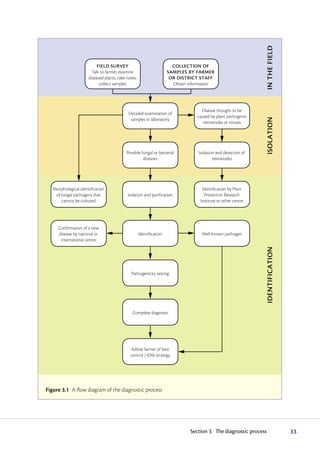
        The main activities involved in the diagnostic process are:
        •	 collecting	diseased	plants	in	the	field
        •	 examining	collected	plants	in	the	laboratory
        •	 pathogenicity	testing
        •	 disease	diagnosis.
        These activities are shown in Figure 3.1.


         3.1      Case studies


        In this section, two case studies are presented to provide an illustrated overview of
        the diagnostic process:
        •	 diagnosing	the	cause	of	pineapple	heart	rot—Phytophthora nicotianae
        •	 surveying	a	complex	disease—ginger	wilt	caused	by	bacterial	and	Fusarium	
           wilts.


32   Diagnostic manual for plant diseases in Vietnam
IN THE FIELD
                          FIELD SURVEY                                  COLLECTION OF
                        Talk to farmer, examine                       SAMPLES BY FARMER
                      diseased plants, take notes,                     OR DISTRICT STAFF
                            collect samples                              Obtain information


                                                                                       Disease thought to be
                                             Detailed examination of
                                                                                     caused by plant pathogenic
                                              samples in laboratory


                                                                                                                   ISOLATION
                                                                                        nematodes or viruses


                                            Possible fungal or bacterial              Isolation and detection of
                                                      diseases                                nematodes


   Morphological identification                                                         Identification by Plant
    of fungal pathogens that                Isolation and purification                   Protection Research
       cannot be cultured                                                              Institute or other centre


     Confirmation of a new
     disease by national or                          Identification                    Well-known pathogen
      international centre


                                              Pathogenicity testing
                                                                                                                   IDENTIFICATION


                                               Complete diagnosis


                                              Advise farmer of best
                                              control / IDM strategy


Figure 3.1 A flow diagram of the diagnostic process


                                                                                 Section 3. The diagnostic process                  33
Diagnostic case study 1

     Diagnosing the cause of pineapple heart rot—Phytophthora nicotianae
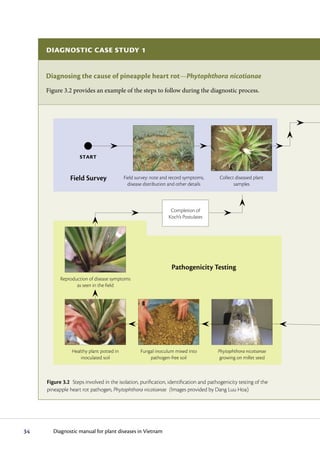
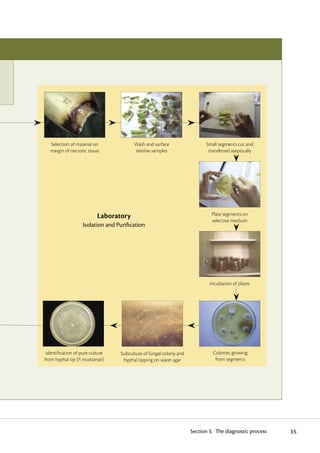
     Figure 3.2 provides an example of the steps to follow during the diagnostic process.


                    START


                Field Survey              Field survey: note and record symptoms,      Collect diseased plant
                                            disease distribution and other details            samples


                                                                 Completion of
                                                                Koch’s Postulates


                                                                 Pathogenicity Testing
           Reproduction of disease symptoms
                  as seen in the field


                Healthy plant potted in           Fungal inoculum mixed into          Phytophthora nicotianae
                    inoculated soil                   pathogen-free soil               growing on millet seed


     Figure 3.2 Steps involved in the isolation, purification, identification and pathogenicity testing of the
     pineapple heart rot pathogen, Phytophthora nicotianae (Images provided by Dang Luu Hoa)


34      Diagnostic manual for plant diseases in Vietnam
Selection of material on              Wash and surface                  Small segments cut and
   margin of necrotic tissue             sterilise samples                  transferred aseptically


                           Laboratory                                         Plate segments on
                                                                              selective medium
                    Isolation and Purification


                                                                             Incubation of plates


 Identification of pure culture    Subculture of fungal colony and            Colonies growing
from hyphal tip (P. nicotianae)     hyphal tipping on water agar               from segments


                                                                     Section 3. The diagnostic process   35
Diagnostic case study 2

     Surveying a complex disease—ginger wilt caused by bacterial and Fusarium wilts

     Introduction
     Ginger wilt was first recorded officially in Quang Nam in 2000. The disease has caused
     severe losses, with many farmers losing 100% of their crop. A preliminary study in 2006
     indicated that bacterial wilt and Fusarium wilt were involved. A systematic survey of
     the disease complex was made in January 2007, as a part of the Australian Centre for
     International Agricultural Research project CP/2002/115, Diseases of crops in the central
     provinces of Vietnam: diagnosis, extension and control (2005–2008).
     The objective was to isolate and identify potential pathogens associated with diseased
     ginger plants, and determine their relative importance. Ten diseased plants were collected
     from each of 10 crops from two districts, Phu Ninh and Tien Phuoc, which are the main
     areas of ginger production in Quang Nam. Crops were selected on an ad hoc basis for
     sampling before inspection.

     In the field
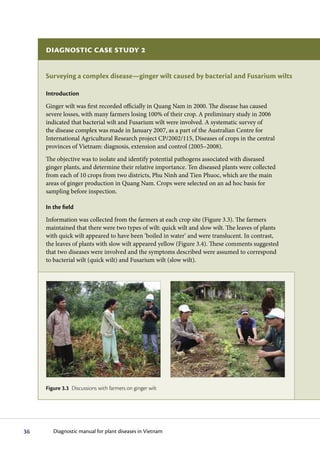
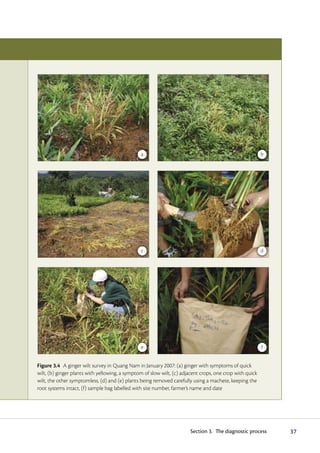
     Information was collected from the farmers at each crop site (Figure 3.3). The farmers
     maintained that there were two types of wilt: quick wilt and slow wilt. The leaves of plants
     with quick wilt appeared to have been ‘boiled in water’ and were translucent. In contrast,
     the leaves of plants with slow wilt appeared yellow (Figure 3.4). These comments suggested
     that two diseases were involved and the symptoms described were assumed to correspond
     to bacterial wilt (quick wilt) and Fusarium wilt (slow wilt).


     Figure 3.3 Discussions with farmers on ginger wilt


36      Diagnostic manual for plant diseases in Vietnam
a                                                         b


                                                c                                                         d


                                                e                                                         f


Figure 3.4 A ginger wilt survey in Quang Nam in January 2007: (a) ginger with symptoms of quick
wilt, (b) ginger plants with yellowing, a symptom of slow wilt, (c) adjacent crops, one crop with quick
wilt, the other symptomless, (d) and (e) plants being removed carefully using a machete, keeping the
root systems intact, (f) sample bag labelled with site number, farmer’s name and date


                                                                       Section 3. The diagnostic process      37
Diagnostic case study 2 (continued)

     In the laboratory
     Specimen preparation
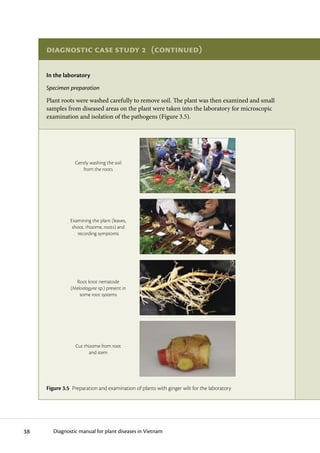
     Plant roots were washed carefully to remove soil. The plant was then examined and small
     samples from diseased areas on the plant were taken into the laboratory for microscopic
     examination and isolation of the pathogens (Figure 3.5).


                  Gently washing the soil
                     from the roots


               Examining the plant (leaves,
                shoot, rhizome, roots) and
                   recording symptoms


                 Root knot nematode
               (Meloidogyne sp.) present in
                   some root systems


                  Cut rhizome from root
                         and stem


     Figure 3.5 Preparation and examination of plants with ginger wilt for the laboratory


38      Diagnostic manual for plant diseases in Vietnam
Isolation of potentially pathogenic organisms from diseased tissue
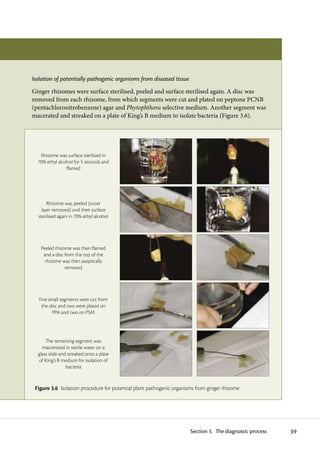
Ginger rhizomes were surface sterilised, peeled and surface sterilised again. A disc was
removed from each rhizome, from which segments were cut and plated on peptone PCNB
(pentachloronitrobenzene) agar and Phytophthora selective medium. Another segment was
macerated and streaked on a plate of King’s B medium to isolate bacteria (Figure 3.6).


   Rhizome was surface sterilised in
  70% ethyl alcohol for 5 seconds and
                flamed


       Rhizome was peeled (outer
    layer removed) and then surface
  sterilised again in 70% ethyl alcohol


   Peeled rhizome was then flamed
    and a disc from the top of the
     rhizome was then aseptically
               removed


   Five small segments were cut from
    the disc and two were plated on
          PPA and two on PSM


      The remaining segment was
    macterated in sterile water on a
  glass slide and streaked onto a plate
   of King’s B medium for isolation of
                 bacteria


 Figure 3.6 Isolation procedure for potential plant pathogenic organisms from ginger rhizome


                                                                      Section 3. The diagnostic process   39
Diagnostic case study 2 (continued)

     Recovery of potential pathogens
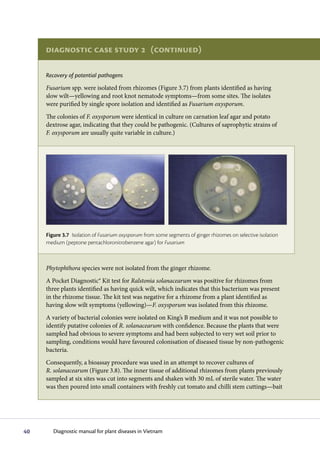
     Fusarium spp. were isolated from rhizomes (Figure 3.7) from plants identified as having
     slow wilt—yellowing and root knot nematode symptoms—from some sites. The isolates
     were purified by single spore isolation and identified as Fusarium oxysporum.
     The colonies of F. oxysporum were identical in culture on carnation leaf agar and potato
     dextrose agar, indicating that they could be pathogenic. (Cultures of saprophytic strains of
     F. oxysporum are usually quite variable in culture.)


     Figure 3.7 Isolation of Fusarium oxysporum from some segments of ginger rhizomes on selective isolation
     medium (peptone pentachloronitrobenzene agar) for Fusarium


     Phytophthora species were not isolated from the ginger rhizome.
     A Pocket Diagnostic® Kit test for Ralstonia solanacearum was positive for rhizomes from
     three plants identified as having quick wilt, which indicates that this bacterium was present
     in the rhizome tissue. The kit test was negative for a rhizome from a plant identified as
     having slow wilt symptoms (yellowing)—F. oxysporum was isolated from this rhizome.
     A variety of bacterial colonies were isolated on King’s B medium and it was not possible to
     identify putative colonies of R. solanacearum with confidence. Because the plants that were
     sampled had obvious to severe symptoms and had been subjected to very wet soil prior to
     sampling, conditions would have favoured colonisation of diseased tissue by non-pathogenic
     bacteria.
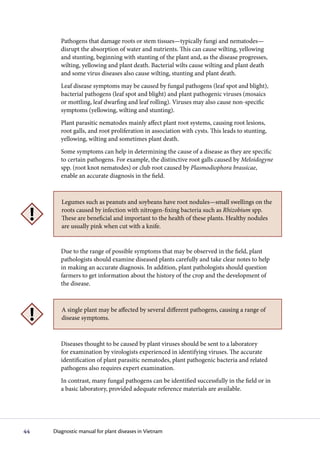
     Consequently, a bioassay procedure was used in an attempt to recover cultures of
     R. solanacearum (Figure 3.8). The inner tissue of additional rhizomes from plants previously
     sampled at six sites was cut into segments and shaken with 30 mL of sterile water. The water
     was then poured into small containers with freshly cut tomato and chilli stem cuttings—bait


40      Diagnostic manual for plant diseases in Vietnam
seedlings—which were kept in a greenhouse at 25–30 °C. Within 4–8 days, some of the
cuttings in the water extracts wilted and some of these showed signs of bacterial ooze.
Control seedlings in sterile water remained healthy.


                                             a                                            b


                                                                    c


                                            d                                  e


Figure 3.8 Bioassay procedure for isolating Ralstonia solanacearum from diseased ginger rhizome:
(a) chilli and tomato cuttings in control (left) and wilted cuttings in water extract from rhizome segments
(right), (b) wilted chilli cutting showing vascular browning, (c) isolation of R. solanacearum from chilli
cutting, (d) and (e) pathogenicity test in bitter melon of bacterium isolated in the bioassay


                                                                        Section 3. The diagnostic process     41
Diagnostic case study 2 (continued)

     A stem section from each wilted bait seedling was macerated in sterile water and streaked
     on King’s B medium. A single colony from this medium was then subcultured for
     purification and also inoculated into the stem of a 6-week-old bitter melon plant, to assess
     virulence. Some of the bitter melon plants showed severe wilting and the isolation process
     was repeated with these stems to obtain pure cultures of R. solanacearum for identification
     at an international reference centre.

     Confirming identification with pathogenicity tests
     Fusarium oxysporum f. sp. zingiberi has been reported widely in many countries as a cause
     of Fusarium wilt of ginger. However, it was essential that the isolates of F. oxysporum from
     ginger from Quang Nam were tested for pathogenicity in local ginger cultivars, to prove
     that they were pathogenic isolates and not saprophytic strains. Therefore, representative
     isolates were grown on millet seed/rice hull medium for use in pathogenicity tests.
     Because R. solanacearum is also known to cause bacterial wilt of ginger, pure cultures of
     R. solanacearum were also tested for pathogenicity to local cultivars of ginger to complete
     Koch’s postulates (criteria used to establish a causal relationship between pathogen and
     a disease).
     For precise identification, pure cultures of R. solanacearum were also sent to an
     international reference laboratory. This species is variable, including a number of races,
     which differ in host range and require different crop rotations for control.
     Samples of Meloidogyne galls were also forwarded to a reference laboratory for precise
     identification of species.

     After proof of pathogenicity is obtained
     Once it was established that wilt pathogens are responsible for the wilt disease on the ginger
     plants, staff developed a supply of pathogen-free ginger rhizomes for planting in small
     demonstration plots using the pathogen-free rhizomes and soil. The soil was deemed to be
     free of the pathogen where crops resistant to bacterial wilt (and root knot nematode) had
     been grown previously. Note that R. solanacearum has a wide host range.
     Although F. oxysporum f. sp. zingiberi only causes disease on ginger, it may persist on roots
     of symptomless non-host plants. Good crop hygiene is important so that soil from diseased
     fields is not introduced into disease-free fields on shoes and digging implements.


42      Diagnostic manual for plant diseases in Vietnam
4         Symptoms of disease

Diagnosis begins with careful observation of all parts of the diseased plant—
foliage, flowers, fruit, stems and roots. It can be difficult to identify the pathogen
responsible because many plant pathogens cannot be identified with the unaided
eye. The visible effects of the pathogen on the plant—symptoms—can help in
determining the type or types of pathogens present. Symptoms of disease may be
caused by:
•	 damage	to	the	plant	tissues
•	 disruption	of	the	normal	physiological	functions	of	the	plant:
   – water and nutrient uptake
   – photosynthesis
   – growth.
Symptoms of disease should be recorded carefully in a field notebook and in
photographs using a digital camera (if possible).


4.1      Common symptoms


Common non-specific symptoms may be caused by many different types of
pathogens. Wilting, yellowing and stunting are common non-specific symptoms
(see wilt pathogen sections). Wilting is commonly caused by vascular wilt
pathogens, root rots and root galls, collar rots, stem rots and by dry soil. These and
many other diseases also cause stunting and yellowing. Therefore, it is important to
examine all parts of the plant—most importantly the roots.


                                                             Section 4. Symptoms of disease   43
Pathogens that damage roots or stem tissues—typically fungi and nematodes—
        disrupt the absorption of water and nutrients. This can cause wilting, yellowing
        and stunting, beginning with stunting of the plant and, as the disease progresses,
        wilting, yellowing and plant death. Bacterial wilts cause wilting and plant death
        and some virus diseases also cause wilting, stunting and plant death.
        Leaf disease symptoms may be caused by fungal pathogens (leaf spot and blight),
        bacterial pathogens (leaf spot and blight) and plant pathogenic viruses (mosaics
        or mottling, leaf dwarfing and leaf rolling). Viruses may also cause non-specific
        symptoms (yellowing, wilting and stunting).
        Plant parasitic nematodes mainly affect plant root systems, causing root lesions,
        root galls, and root proliferation in association with cysts. This leads to stunting,
        yellowing, wilting and sometimes plant death.
        Some symptoms can help in determining the cause of a disease as they are specific
        to certain pathogens. For example, the distinctive root galls caused by Meloidogyne
        spp. (root knot nematodes) or club root caused by Plasmodiophora brassicae,
        enable an accurate diagnosis in the field.


        Legumes such as peanuts and soybeans have root nodules—small swellings on the
        roots caused by infection with nitrogen-fixing bacteria such as Rhizobium spp.
        These are beneficial and important to the health of these plants. Healthy nodules
        are usually pink when cut with a knife.


        Due to the range of possible symptoms that may be observed in the field, plant
        pathologists should examine diseased plants carefully and take clear notes to help
        in making an accurate diagnosis. In addition, plant pathologists should question
        farmers to get information about the history of the crop and the development of
        the disease.


        A single plant may be affected by several different pathogens, causing a range of
        disease symptoms.


        Diseases thought to be caused by plant viruses should be sent to a laboratory
        for examination by virologists experienced in identifying viruses. The accurate
        identification of plant parasitic nematodes, plant pathogenic bacteria and related
        pathogens also requires expert examination.
        In contrast, many fungal pathogens can be identified successfully in the field or in
        a basic laboratory, provided adequate reference materials are available.


44   Diagnostic manual for plant diseases in Vietnam
Seek help if you are not confident in determining the cause of a disease. Do not
guess—the farmer’s income will be affected by your diagnosis and advice.


Plant pathogens are identified as the likely cause of disease in only about half
of plant samples sent to diagnostic laboratories. Plants may be affected by other
factors such as pesticides or environmental stress.


4.2      Diseases of foliage, flowers or fruit


Many fungal pathogens cause diseases of the foliage (leaves, petioles and stems),
flowers or fruit, and usually produce spores from spore-forming structures on
the diseased tissue. The spores are carried by wind or splashed by rain onto
other plants, which spreads the disease. Fungal pathogens can rapidly build up
disease levels and cause epidemics under weather conditions suitable for the
specific pathogen.
The presence of spore-forming structures such as pycnidia or perithecia,
conidiophores or sporangiophores are the basis for morphological identification of
fungal pathogens, and the diagnosis of plant fungal disease.


Use a hand lens to assist with the identification of fungal structures in the field.
However, for accurate identification of spores and spore-forming structures, use a
microscope in the laboratory.


Many fungal pathogens cause spots (lesions) on the leaves, flowers or fruit. Yellow
spots are chlorotic lesions and brown spots are necrotic lesions. Brown spots are
called ‘necrotic’ because the pathogen has caused death, or necrosis, of the tissue.
Fungal pathogens that cause lesions on leaves, flowers and fruit can often be
isolated and grown on culture media.


Saprophytic fungi also grow on diseased plant tissues as secondary colonisers.
For example, saprophytic species of Alternaria and Pestalotia commonly grow on
diseased leaf tissue and form spores on the tissue. These saprophytic species can
lead to an incorrect diagnosis as they are usually visible under the microscope and
grow rapidly on the isolation medium.


                                                           Section 4. Symptoms of disease   45
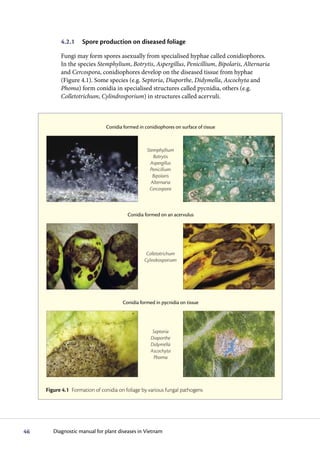
4.2.1     Spore production on diseased foliage

           Fungi may form spores asexually from specialised hyphae called conidiophores.
           In the species Stemphylium, Botrytis, Aspergillus, Penicillium, Bipolaris, Alternaria
           and Cercospora, conidiophores develop on the diseased tissue from hyphae
           (Figure 4.1). Some species (e.g. Septoria, Diaporthe, Didymella, Ascochyta and
           Phoma) form conidia in specialised structures called pycnidia, others (e.g.
           Colletotrichum, Cylindrosporium) in structures called acervuli.


                               Conidia formed in conidiophores on surface of tissue


                                                  Stemphyllium
                                                     Botrytis
                                                    Aspergillus
                                                    Penicillium
                                                     Bipolaris
                                                    Alternaria
                                                   Cercospora


                                         Conidia formed on an acervulus


                                                  Colletotrichum
                                                 Cylindrosporium


                                       Conidia formed in pycnidia on tissue


                                                     Septoria
                                                    Diaporthe
                                                    Didymella
                                                    Ascochyta
                                                     Phoma


     Figure 4.1 Formation of conidia on foliage by various fungal pathogens


46      Diagnostic manual for plant diseases in Vietnam
Some fungal pathogens also produce spores from sexual reproductive structures
on leaves, stalks, stems or fruit. For example, Fusarium graminearum (Gibberella
zeae) forms ascospores in an ascus within perithecia on mature diseased stalks and
cobs of maize. This fungus causes stalk and cob rot of maize.


Perithecia are similar in shape to pycnidia, but pycnidia form conidia and do not
have asci.


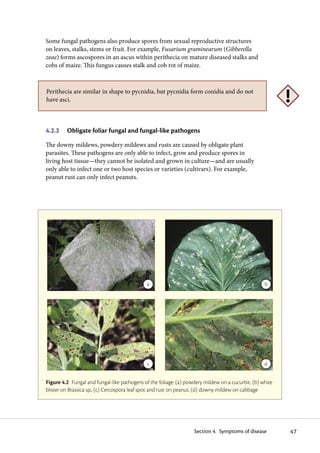
4.2.2    Obligate foliar fungal and fungal-like pathogens

The downy mildews, powdery mildews and rusts are caused by obligate plant
parasites. These pathogens are only able to infect, grow and produce spores in
living host tissue—they cannot be isolated and grown in culture—and are usually
only able to infect one or two host species or varieties (cultivars). For example,
peanut rust can only infect peanuts.


                                             a                                                     b


                                             c                                                     d


Figure 4.2 Fungal and fungal-like pathogens of the foliage: (a) powdery mildew on a cucurbit, (b) white
blister on Brassica sp., (c) Cercospora leaf spot and rust on peanut, (d) downy mildew on cabbage


                                                                   Section 4. Symptoms of disease         47
The symptoms of downy mildews, powdery mildews and rusts are usually obvious
            (Figure 4.2). They absorb nutrients from living plant cells, which commonly leads
            to yellowing of the tissue. Photosynthesis in the leaf tissue is reduced, leading to
            reduced plant growth.

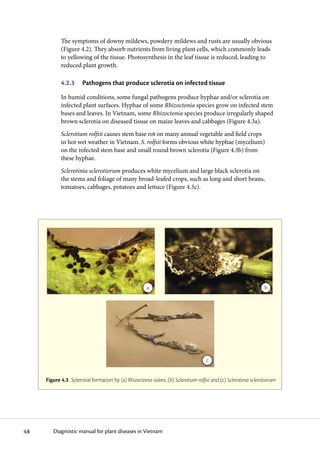
            4.2.3      Pathogens that produce sclerotia on infected tissue

            In humid conditions, some fungal pathogens produce hyphae and/or sclerotia on
            infected plant surfaces. Hyphae of some Rhizoctonia species grow on infected stem
            bases and leaves. In Vietnam, some Rhizoctonia species produce irregularly shaped
            brown sclerotia on diseased tissue on maize leaves and cabbages (Figure 4.3a).
            Sclerotium rolfsii causes stem base rot on many annual vegetable and field crops
            in hot wet weather in Vietnam. S. rolfsii forms obvious white hyphae (mycelium)
            on the infected stem base and small round brown sclerotia (Figure 4.3b) from
            these hyphae.
            Sclerotinia sclerotiorum produces white mycelium and large black sclerotia on
            the stems and foliage of many broad-leafed crops, such as long and short beans,
            tomatoes, cabbages, potatoes and lettuce (Figure 4.3c).


                                                       a                                                         b


                                                                                    c


     Figure 4.3 Sclerotial formation by (a) Rhizoctonia solani, (b) Sclerotium rolfsii and (c) Sclerotinia sclerotiorum


48      Diagnostic manual for plant diseases in Vietnam
4.3      Diseases of roots, crown and stem


Fungal pathogens can cause serious diseases of the roots, crown (base of the stem)
or the stem. Some fungal pathogens only affect seedlings, killing them before or
after emergence; others only affect the feeder rootlets, and some species only affect
the stem (e.g. Sclerotinia sclerotiorum and Sclerotium rolfsii).
Root symptoms may be non-specific. Rots of the feeder rootlets, main roots, crown
or stem disrupt the uptake of water and nutrients, causing stunting and yellowing
of the leaves, wilting and sometimes death of the plant.
Genera that commonly cause these diseases in Vietnam are Phytophthora,
Pythium, Fusarium, Sclerotinia, Sclerotium, Rhizoctonia and Phoma (Figure 4.4).
One root parasite, Plasmodiophora brassicae, which causes club root of crucifers,
is an obligate parasite and cannot be grown on culture media. There are also
Basidiomycota pathogens of the trunk and roots of perennial tree crops (Shivas
and Beasley 2005), which are generally difficult to isolate into pure culture.
Root rot pathogens can be difficult to isolate as there can be many saprophytic
fungi and bacteria in diseased root tissues, which will also grow on isolation
media—commonly overgrowing pathogens.


4.4      References


Shivas R. and Beasley D. 2005. Management of plant pathogen collections.
   Australian Government Department of Agriculture, Fisheries and Forestry. At:
   <http://www.daff.gov.au/planthealth>.


                                                           Section 4. Symptoms of disease   49
c


                                                  a


                                                  b                             d                              e


                                    f                                    g                                     h


     Figure 4.4 Diseases of the crown, roots and stem: (a) club root of crucifers, (b) wilting of crucifers
     (healthy [left] and diseased [right]) caused by club root (Plasmodiophora brassicae), (c) Fusarium wilt
     of asters (note the production of sporodochia on the stem), (d) spear point caused by Rhizoctonia sp.,
     (e) Phytophthora root rot of chilli, (f) Phytophthora root rot of chilli causing severe wilt, (g) Pythium root
     and pod rot of peanuts, (h) perithecia of Gibberella zeae causing stalk rot of maize


50      Diagnostic manual for plant diseases in Vietnam

Plant disease

  • 1.
    3 The diagnostic process The main activities involved in the diagnostic process are: • collecting diseased plants in the field • examining collected plants in the laboratory • pathogenicity testing • disease diagnosis. These activities are shown in Figure 3.1. 3.1 Case studies In this section, two case studies are presented to provide an illustrated overview of the diagnostic process: • diagnosing the cause of pineapple heart rot—Phytophthora nicotianae • surveying a complex disease—ginger wilt caused by bacterial and Fusarium wilts. 32 Diagnostic manual for plant diseases in Vietnam
  • 2.
    IN THE FIELD FIELD SURVEY COLLECTION OF Talk to farmer, examine SAMPLES BY FARMER diseased plants, take notes, OR DISTRICT STAFF collect samples Obtain information Disease thought to be Detailed examination of caused by plant pathogenic samples in laboratory ISOLATION nematodes or viruses Possible fungal or bacterial Isolation and detection of diseases nematodes Morphological identification Identification by Plant of fungal pathogens that Isolation and purification Protection Research cannot be cultured Institute or other centre Confirmation of a new disease by national or Identification Well-known pathogen international centre Pathogenicity testing IDENTIFICATION Complete diagnosis Advise farmer of best control / IDM strategy Figure 3.1 A flow diagram of the diagnostic process Section 3. The diagnostic process 33
  • 3.
    Diagnostic case study1 Diagnosing the cause of pineapple heart rot—Phytophthora nicotianae Figure 3.2 provides an example of the steps to follow during the diagnostic process. START Field Survey Field survey: note and record symptoms, Collect diseased plant disease distribution and other details samples Completion of Koch’s Postulates Pathogenicity Testing Reproduction of disease symptoms as seen in the field Healthy plant potted in Fungal inoculum mixed into Phytophthora nicotianae inoculated soil pathogen-free soil growing on millet seed Figure 3.2 Steps involved in the isolation, purification, identification and pathogenicity testing of the pineapple heart rot pathogen, Phytophthora nicotianae (Images provided by Dang Luu Hoa) 34 Diagnostic manual for plant diseases in Vietnam
  • 4.
    Selection of materialon Wash and surface Small segments cut and margin of necrotic tissue sterilise samples transferred aseptically Laboratory Plate segments on selective medium Isolation and Purification Incubation of plates Identification of pure culture Subculture of fungal colony and Colonies growing from hyphal tip (P. nicotianae) hyphal tipping on water agar from segments Section 3. The diagnostic process 35
  • 5.
    Diagnostic case study2 Surveying a complex disease—ginger wilt caused by bacterial and Fusarium wilts Introduction Ginger wilt was first recorded officially in Quang Nam in 2000. The disease has caused severe losses, with many farmers losing 100% of their crop. A preliminary study in 2006 indicated that bacterial wilt and Fusarium wilt were involved. A systematic survey of the disease complex was made in January 2007, as a part of the Australian Centre for International Agricultural Research project CP/2002/115, Diseases of crops in the central provinces of Vietnam: diagnosis, extension and control (2005–2008). The objective was to isolate and identify potential pathogens associated with diseased ginger plants, and determine their relative importance. Ten diseased plants were collected from each of 10 crops from two districts, Phu Ninh and Tien Phuoc, which are the main areas of ginger production in Quang Nam. Crops were selected on an ad hoc basis for sampling before inspection. In the field Information was collected from the farmers at each crop site (Figure 3.3). The farmers maintained that there were two types of wilt: quick wilt and slow wilt. The leaves of plants with quick wilt appeared to have been ‘boiled in water’ and were translucent. In contrast, the leaves of plants with slow wilt appeared yellow (Figure 3.4). These comments suggested that two diseases were involved and the symptoms described were assumed to correspond to bacterial wilt (quick wilt) and Fusarium wilt (slow wilt). Figure 3.3 Discussions with farmers on ginger wilt 36 Diagnostic manual for plant diseases in Vietnam
  • 6.
    a b c d e f Figure 3.4 A ginger wilt survey in Quang Nam in January 2007: (a) ginger with symptoms of quick wilt, (b) ginger plants with yellowing, a symptom of slow wilt, (c) adjacent crops, one crop with quick wilt, the other symptomless, (d) and (e) plants being removed carefully using a machete, keeping the root systems intact, (f) sample bag labelled with site number, farmer’s name and date Section 3. The diagnostic process 37
  • 7.
    Diagnostic case study2 (continued) In the laboratory Specimen preparation Plant roots were washed carefully to remove soil. The plant was then examined and small samples from diseased areas on the plant were taken into the laboratory for microscopic examination and isolation of the pathogens (Figure 3.5). Gently washing the soil from the roots Examining the plant (leaves, shoot, rhizome, roots) and recording symptoms Root knot nematode (Meloidogyne sp.) present in some root systems Cut rhizome from root and stem Figure 3.5 Preparation and examination of plants with ginger wilt for the laboratory 38 Diagnostic manual for plant diseases in Vietnam
  • 8.
    Isolation of potentiallypathogenic organisms from diseased tissue Ginger rhizomes were surface sterilised, peeled and surface sterilised again. A disc was removed from each rhizome, from which segments were cut and plated on peptone PCNB (pentachloronitrobenzene) agar and Phytophthora selective medium. Another segment was macerated and streaked on a plate of King’s B medium to isolate bacteria (Figure 3.6). Rhizome was surface sterilised in 70% ethyl alcohol for 5 seconds and flamed Rhizome was peeled (outer layer removed) and then surface sterilised again in 70% ethyl alcohol Peeled rhizome was then flamed and a disc from the top of the rhizome was then aseptically removed Five small segments were cut from the disc and two were plated on PPA and two on PSM The remaining segment was macterated in sterile water on a glass slide and streaked onto a plate of King’s B medium for isolation of bacteria Figure 3.6 Isolation procedure for potential plant pathogenic organisms from ginger rhizome Section 3. The diagnostic process 39
  • 9.
    Diagnostic case study2 (continued) Recovery of potential pathogens Fusarium spp. were isolated from rhizomes (Figure 3.7) from plants identified as having slow wilt—yellowing and root knot nematode symptoms—from some sites. The isolates were purified by single spore isolation and identified as Fusarium oxysporum. The colonies of F. oxysporum were identical in culture on carnation leaf agar and potato dextrose agar, indicating that they could be pathogenic. (Cultures of saprophytic strains of F. oxysporum are usually quite variable in culture.) Figure 3.7 Isolation of Fusarium oxysporum from some segments of ginger rhizomes on selective isolation medium (peptone pentachloronitrobenzene agar) for Fusarium Phytophthora species were not isolated from the ginger rhizome. A Pocket Diagnostic® Kit test for Ralstonia solanacearum was positive for rhizomes from three plants identified as having quick wilt, which indicates that this bacterium was present in the rhizome tissue. The kit test was negative for a rhizome from a plant identified as having slow wilt symptoms (yellowing)—F. oxysporum was isolated from this rhizome. A variety of bacterial colonies were isolated on King’s B medium and it was not possible to identify putative colonies of R. solanacearum with confidence. Because the plants that were sampled had obvious to severe symptoms and had been subjected to very wet soil prior to sampling, conditions would have favoured colonisation of diseased tissue by non-pathogenic bacteria. Consequently, a bioassay procedure was used in an attempt to recover cultures of R. solanacearum (Figure 3.8). The inner tissue of additional rhizomes from plants previously sampled at six sites was cut into segments and shaken with 30 mL of sterile water. The water was then poured into small containers with freshly cut tomato and chilli stem cuttings—bait 40 Diagnostic manual for plant diseases in Vietnam
  • 10.
    seedlings—which were keptin a greenhouse at 25–30 °C. Within 4–8 days, some of the cuttings in the water extracts wilted and some of these showed signs of bacterial ooze. Control seedlings in sterile water remained healthy. a b c d e Figure 3.8 Bioassay procedure for isolating Ralstonia solanacearum from diseased ginger rhizome: (a) chilli and tomato cuttings in control (left) and wilted cuttings in water extract from rhizome segments (right), (b) wilted chilli cutting showing vascular browning, (c) isolation of R. solanacearum from chilli cutting, (d) and (e) pathogenicity test in bitter melon of bacterium isolated in the bioassay Section 3. The diagnostic process 41
  • 11.
    Diagnostic case study2 (continued) A stem section from each wilted bait seedling was macerated in sterile water and streaked on King’s B medium. A single colony from this medium was then subcultured for purification and also inoculated into the stem of a 6-week-old bitter melon plant, to assess virulence. Some of the bitter melon plants showed severe wilting and the isolation process was repeated with these stems to obtain pure cultures of R. solanacearum for identification at an international reference centre. Confirming identification with pathogenicity tests Fusarium oxysporum f. sp. zingiberi has been reported widely in many countries as a cause of Fusarium wilt of ginger. However, it was essential that the isolates of F. oxysporum from ginger from Quang Nam were tested for pathogenicity in local ginger cultivars, to prove that they were pathogenic isolates and not saprophytic strains. Therefore, representative isolates were grown on millet seed/rice hull medium for use in pathogenicity tests. Because R. solanacearum is also known to cause bacterial wilt of ginger, pure cultures of R. solanacearum were also tested for pathogenicity to local cultivars of ginger to complete Koch’s postulates (criteria used to establish a causal relationship between pathogen and a disease). For precise identification, pure cultures of R. solanacearum were also sent to an international reference laboratory. This species is variable, including a number of races, which differ in host range and require different crop rotations for control. Samples of Meloidogyne galls were also forwarded to a reference laboratory for precise identification of species. After proof of pathogenicity is obtained Once it was established that wilt pathogens are responsible for the wilt disease on the ginger plants, staff developed a supply of pathogen-free ginger rhizomes for planting in small demonstration plots using the pathogen-free rhizomes and soil. The soil was deemed to be free of the pathogen where crops resistant to bacterial wilt (and root knot nematode) had been grown previously. Note that R. solanacearum has a wide host range. Although F. oxysporum f. sp. zingiberi only causes disease on ginger, it may persist on roots of symptomless non-host plants. Good crop hygiene is important so that soil from diseased fields is not introduced into disease-free fields on shoes and digging implements. 42 Diagnostic manual for plant diseases in Vietnam
  • 12.
    4 Symptoms of disease Diagnosis begins with careful observation of all parts of the diseased plant— foliage, flowers, fruit, stems and roots. It can be difficult to identify the pathogen responsible because many plant pathogens cannot be identified with the unaided eye. The visible effects of the pathogen on the plant—symptoms—can help in determining the type or types of pathogens present. Symptoms of disease may be caused by: • damage to the plant tissues • disruption of the normal physiological functions of the plant: – water and nutrient uptake – photosynthesis – growth. Symptoms of disease should be recorded carefully in a field notebook and in photographs using a digital camera (if possible). 4.1 Common symptoms Common non-specific symptoms may be caused by many different types of pathogens. Wilting, yellowing and stunting are common non-specific symptoms (see wilt pathogen sections). Wilting is commonly caused by vascular wilt pathogens, root rots and root galls, collar rots, stem rots and by dry soil. These and many other diseases also cause stunting and yellowing. Therefore, it is important to examine all parts of the plant—most importantly the roots. Section 4. Symptoms of disease 43
  • 13.
    Pathogens that damageroots or stem tissues—typically fungi and nematodes— disrupt the absorption of water and nutrients. This can cause wilting, yellowing and stunting, beginning with stunting of the plant and, as the disease progresses, wilting, yellowing and plant death. Bacterial wilts cause wilting and plant death and some virus diseases also cause wilting, stunting and plant death. Leaf disease symptoms may be caused by fungal pathogens (leaf spot and blight), bacterial pathogens (leaf spot and blight) and plant pathogenic viruses (mosaics or mottling, leaf dwarfing and leaf rolling). Viruses may also cause non-specific symptoms (yellowing, wilting and stunting). Plant parasitic nematodes mainly affect plant root systems, causing root lesions, root galls, and root proliferation in association with cysts. This leads to stunting, yellowing, wilting and sometimes plant death. Some symptoms can help in determining the cause of a disease as they are specific to certain pathogens. For example, the distinctive root galls caused by Meloidogyne spp. (root knot nematodes) or club root caused by Plasmodiophora brassicae, enable an accurate diagnosis in the field. Legumes such as peanuts and soybeans have root nodules—small swellings on the roots caused by infection with nitrogen-fixing bacteria such as Rhizobium spp. These are beneficial and important to the health of these plants. Healthy nodules are usually pink when cut with a knife. Due to the range of possible symptoms that may be observed in the field, plant pathologists should examine diseased plants carefully and take clear notes to help in making an accurate diagnosis. In addition, plant pathologists should question farmers to get information about the history of the crop and the development of the disease. A single plant may be affected by several different pathogens, causing a range of disease symptoms. Diseases thought to be caused by plant viruses should be sent to a laboratory for examination by virologists experienced in identifying viruses. The accurate identification of plant parasitic nematodes, plant pathogenic bacteria and related pathogens also requires expert examination. In contrast, many fungal pathogens can be identified successfully in the field or in a basic laboratory, provided adequate reference materials are available. 44 Diagnostic manual for plant diseases in Vietnam
  • 14.
    Seek help ifyou are not confident in determining the cause of a disease. Do not guess—the farmer’s income will be affected by your diagnosis and advice. Plant pathogens are identified as the likely cause of disease in only about half of plant samples sent to diagnostic laboratories. Plants may be affected by other factors such as pesticides or environmental stress. 4.2 Diseases of foliage, flowers or fruit Many fungal pathogens cause diseases of the foliage (leaves, petioles and stems), flowers or fruit, and usually produce spores from spore-forming structures on the diseased tissue. The spores are carried by wind or splashed by rain onto other plants, which spreads the disease. Fungal pathogens can rapidly build up disease levels and cause epidemics under weather conditions suitable for the specific pathogen. The presence of spore-forming structures such as pycnidia or perithecia, conidiophores or sporangiophores are the basis for morphological identification of fungal pathogens, and the diagnosis of plant fungal disease. Use a hand lens to assist with the identification of fungal structures in the field. However, for accurate identification of spores and spore-forming structures, use a microscope in the laboratory. Many fungal pathogens cause spots (lesions) on the leaves, flowers or fruit. Yellow spots are chlorotic lesions and brown spots are necrotic lesions. Brown spots are called ‘necrotic’ because the pathogen has caused death, or necrosis, of the tissue. Fungal pathogens that cause lesions on leaves, flowers and fruit can often be isolated and grown on culture media. Saprophytic fungi also grow on diseased plant tissues as secondary colonisers. For example, saprophytic species of Alternaria and Pestalotia commonly grow on diseased leaf tissue and form spores on the tissue. These saprophytic species can lead to an incorrect diagnosis as they are usually visible under the microscope and grow rapidly on the isolation medium. Section 4. Symptoms of disease 45
  • 15.
    4.2.1 Spore production on diseased foliage Fungi may form spores asexually from specialised hyphae called conidiophores. In the species Stemphylium, Botrytis, Aspergillus, Penicillium, Bipolaris, Alternaria and Cercospora, conidiophores develop on the diseased tissue from hyphae (Figure 4.1). Some species (e.g. Septoria, Diaporthe, Didymella, Ascochyta and Phoma) form conidia in specialised structures called pycnidia, others (e.g. Colletotrichum, Cylindrosporium) in structures called acervuli. Conidia formed in conidiophores on surface of tissue Stemphyllium Botrytis Aspergillus Penicillium Bipolaris Alternaria Cercospora Conidia formed on an acervulus Colletotrichum Cylindrosporium Conidia formed in pycnidia on tissue Septoria Diaporthe Didymella Ascochyta Phoma Figure 4.1 Formation of conidia on foliage by various fungal pathogens 46 Diagnostic manual for plant diseases in Vietnam
  • 16.
    Some fungal pathogensalso produce spores from sexual reproductive structures on leaves, stalks, stems or fruit. For example, Fusarium graminearum (Gibberella zeae) forms ascospores in an ascus within perithecia on mature diseased stalks and cobs of maize. This fungus causes stalk and cob rot of maize. Perithecia are similar in shape to pycnidia, but pycnidia form conidia and do not have asci. 4.2.2 Obligate foliar fungal and fungal-like pathogens The downy mildews, powdery mildews and rusts are caused by obligate plant parasites. These pathogens are only able to infect, grow and produce spores in living host tissue—they cannot be isolated and grown in culture—and are usually only able to infect one or two host species or varieties (cultivars). For example, peanut rust can only infect peanuts. a b c d Figure 4.2 Fungal and fungal-like pathogens of the foliage: (a) powdery mildew on a cucurbit, (b) white blister on Brassica sp., (c) Cercospora leaf spot and rust on peanut, (d) downy mildew on cabbage Section 4. Symptoms of disease 47
  • 17.
    The symptoms ofdowny mildews, powdery mildews and rusts are usually obvious (Figure 4.2). They absorb nutrients from living plant cells, which commonly leads to yellowing of the tissue. Photosynthesis in the leaf tissue is reduced, leading to reduced plant growth. 4.2.3 Pathogens that produce sclerotia on infected tissue In humid conditions, some fungal pathogens produce hyphae and/or sclerotia on infected plant surfaces. Hyphae of some Rhizoctonia species grow on infected stem bases and leaves. In Vietnam, some Rhizoctonia species produce irregularly shaped brown sclerotia on diseased tissue on maize leaves and cabbages (Figure 4.3a). Sclerotium rolfsii causes stem base rot on many annual vegetable and field crops in hot wet weather in Vietnam. S. rolfsii forms obvious white hyphae (mycelium) on the infected stem base and small round brown sclerotia (Figure 4.3b) from these hyphae. Sclerotinia sclerotiorum produces white mycelium and large black sclerotia on the stems and foliage of many broad-leafed crops, such as long and short beans, tomatoes, cabbages, potatoes and lettuce (Figure 4.3c). a b c Figure 4.3 Sclerotial formation by (a) Rhizoctonia solani, (b) Sclerotium rolfsii and (c) Sclerotinia sclerotiorum 48 Diagnostic manual for plant diseases in Vietnam
  • 18.
    4.3 Diseases of roots, crown and stem Fungal pathogens can cause serious diseases of the roots, crown (base of the stem) or the stem. Some fungal pathogens only affect seedlings, killing them before or after emergence; others only affect the feeder rootlets, and some species only affect the stem (e.g. Sclerotinia sclerotiorum and Sclerotium rolfsii). Root symptoms may be non-specific. Rots of the feeder rootlets, main roots, crown or stem disrupt the uptake of water and nutrients, causing stunting and yellowing of the leaves, wilting and sometimes death of the plant. Genera that commonly cause these diseases in Vietnam are Phytophthora, Pythium, Fusarium, Sclerotinia, Sclerotium, Rhizoctonia and Phoma (Figure 4.4). One root parasite, Plasmodiophora brassicae, which causes club root of crucifers, is an obligate parasite and cannot be grown on culture media. There are also Basidiomycota pathogens of the trunk and roots of perennial tree crops (Shivas and Beasley 2005), which are generally difficult to isolate into pure culture. Root rot pathogens can be difficult to isolate as there can be many saprophytic fungi and bacteria in diseased root tissues, which will also grow on isolation media—commonly overgrowing pathogens. 4.4 References Shivas R. and Beasley D. 2005. Management of plant pathogen collections. Australian Government Department of Agriculture, Fisheries and Forestry. At: <http://www.daff.gov.au/planthealth>. Section 4. Symptoms of disease 49
  • 19.
    c a b d e f g h Figure 4.4 Diseases of the crown, roots and stem: (a) club root of crucifers, (b) wilting of crucifers (healthy [left] and diseased [right]) caused by club root (Plasmodiophora brassicae), (c) Fusarium wilt of asters (note the production of sporodochia on the stem), (d) spear point caused by Rhizoctonia sp., (e) Phytophthora root rot of chilli, (f) Phytophthora root rot of chilli causing severe wilt, (g) Pythium root and pod rot of peanuts, (h) perithecia of Gibberella zeae causing stalk rot of maize 50 Diagnostic manual for plant diseases in Vietnam