CONTENTS
•INTRODUCTION
•AIMS & OBJECTIVE
•DEFINITION OF DIABETIC RETINOPATHY
•STAGES OF DR
•SYMPTOMS OF DR
•ANALYSIS OF RETINA
•ABNORMILITIES ASSOCIATED WITH EYE
•RELATED WORK
•MORPHOLOGICAL OPERATORS
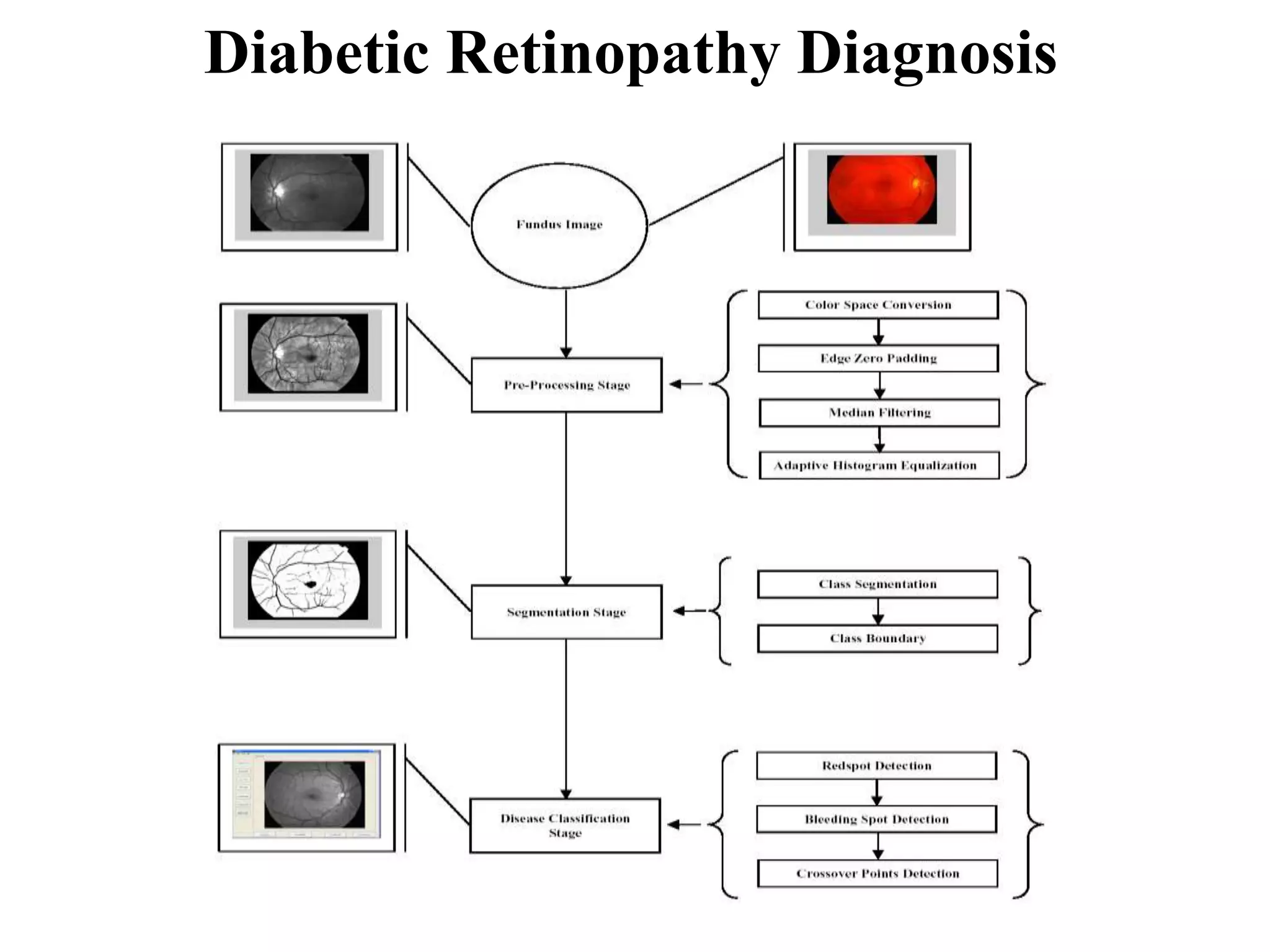
•DIABETIC RETINOPATHY DIAGNOSIS
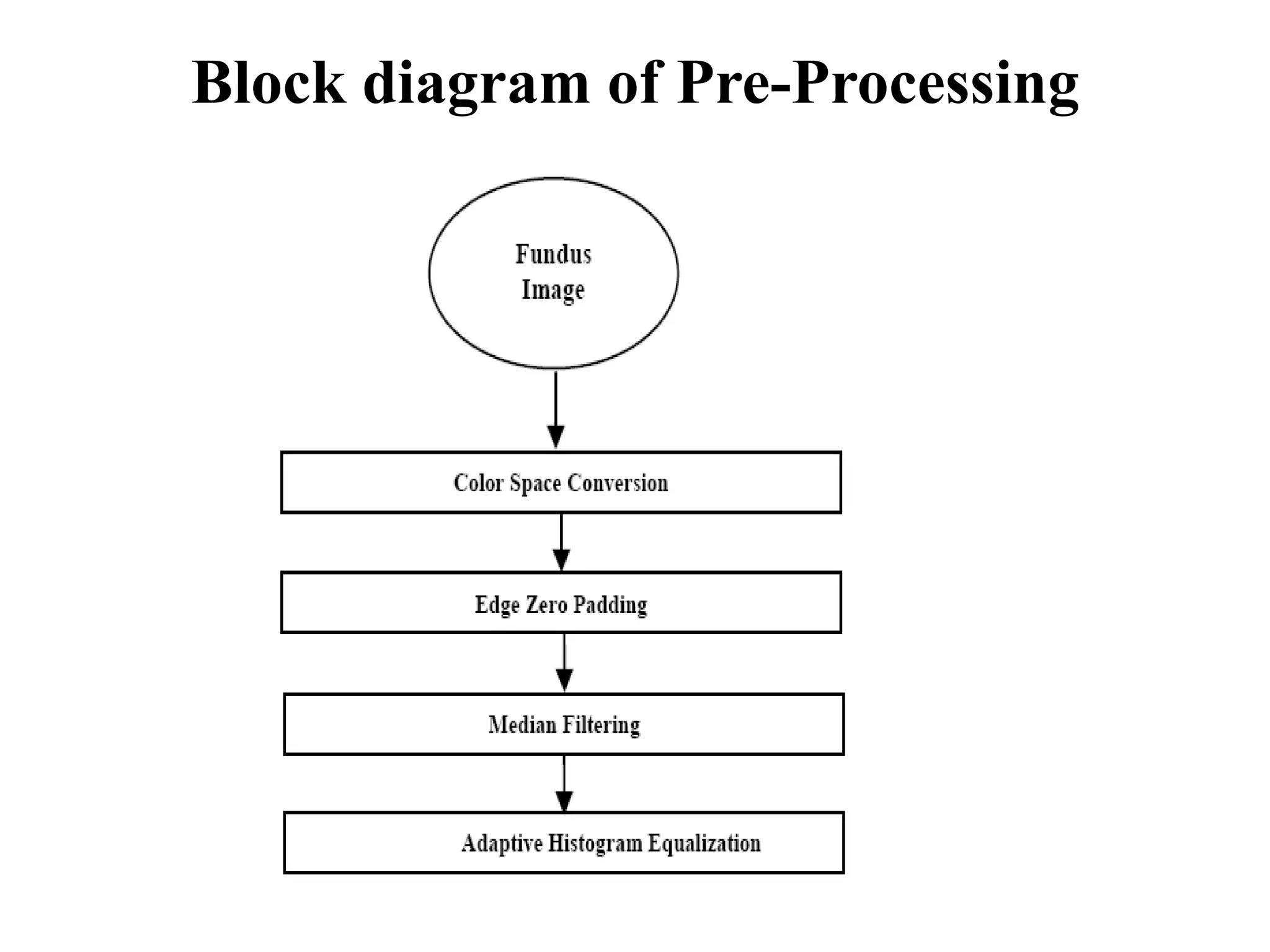
•PRE-PROCESSING STEPS
•PROPOSED METHODOLOGY
•RESULTS
•CONCLUSION
•REFERENCES
Introduction
• The Devastation
– Diabetic retinopathy – 4.1 million US Adults
• National Health Interview Survey and US Census Population
– Glaucoma – 2 million individuals in the US.
• Ophthalmologic images
– Important structures – Blood Vessels
– Help detect and treat Eye Diseases affecting blood
vessels
• Retina vessel map segmentation is very important to
medical applications, such as diabetic retinopathy,
aging related retina analysis etc.
Introduction
• Damaged blood vessels indicate retinal
disease.
Blood clots indicate diabetic retinopathy.
Narrow blood vessels indicate Central Retinal
Artery Occlusion.
• Observation of blood vessels in retinal
images
– Shows presence of disease
– Helps prevent vision loss by early detection
Aims and Objective
• The primary aim of this project is to develop a system
that will be able to identify patients with BDR and
PDR from either colour image or grey level image
obtained from the retina of the patient.
• The secondary aim includes developing a MATLAB
based Graphic User Interface (GUI) tool to be used
by the ophthalmologist in marking fundus images.
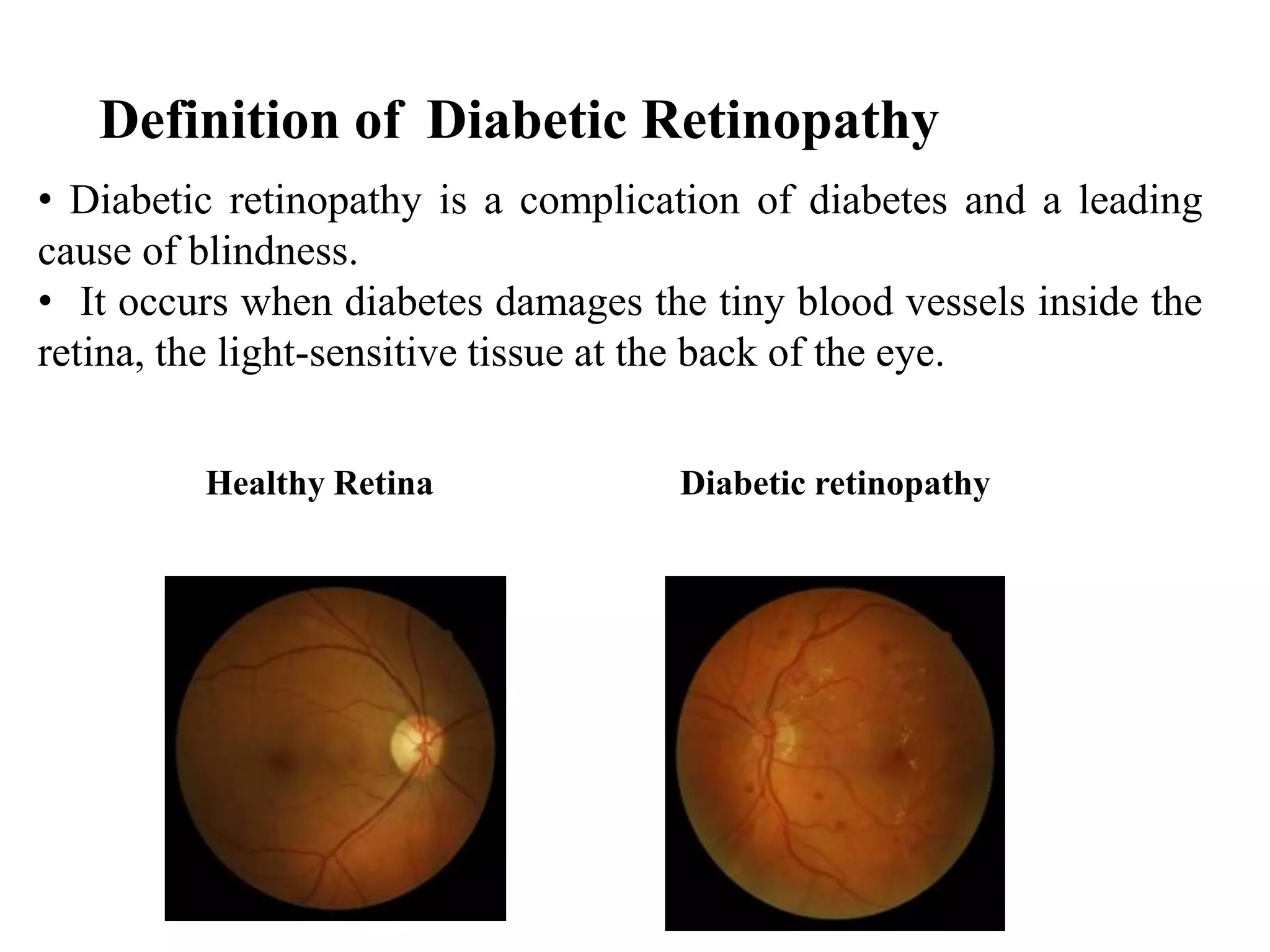
Definition of Diabetic Retinopathy
• Diabetic retinopathy is a complication of diabetes and a leading
cause of blindness.
• It occurs when diabetes damages the tiny blood vessels inside the
retina, the light-sensitive tissue at the back of the eye.
Healthy Retina Diabetic retinopathy
Stages of Diabetic Retinopathy
1. Mild Nonproliferative Retinopathy
2. Moderate Nonproliferative Retinopathy
3. Severe Nonproliferative Retinopathy
4. Proliferative Retinopathy
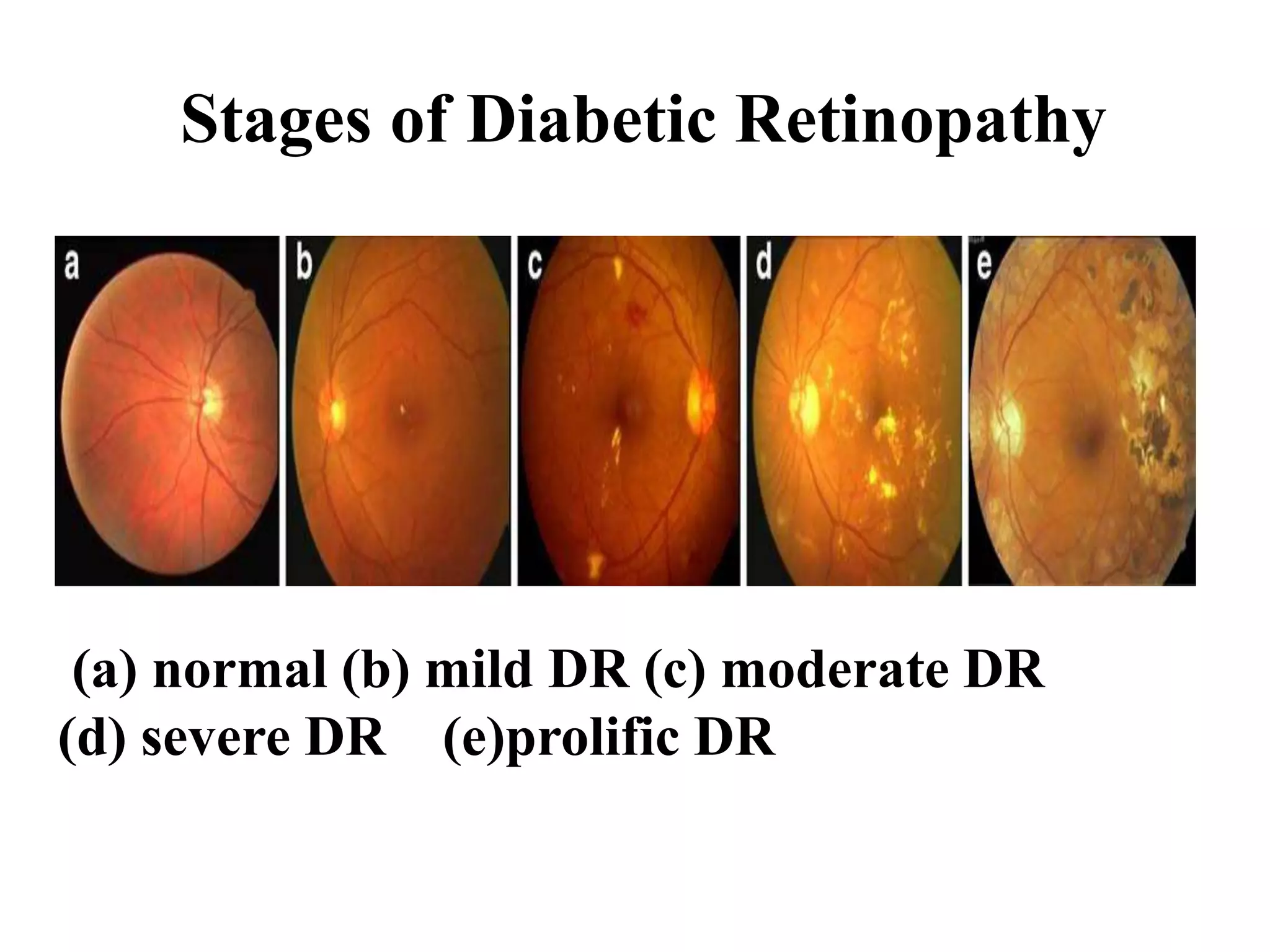
Stages of Diabetic Retinopathy
(a) normal (b) mild DR (c) moderate DR
(d) severe DR (e)prolific DR
Risk & Cause Vision Loss of DR
• All people with diabetes—both type 1 and type 2—are at risk. That's why
everyone with diabetes should get a comprehensive dilated eye exam at
least once a year.
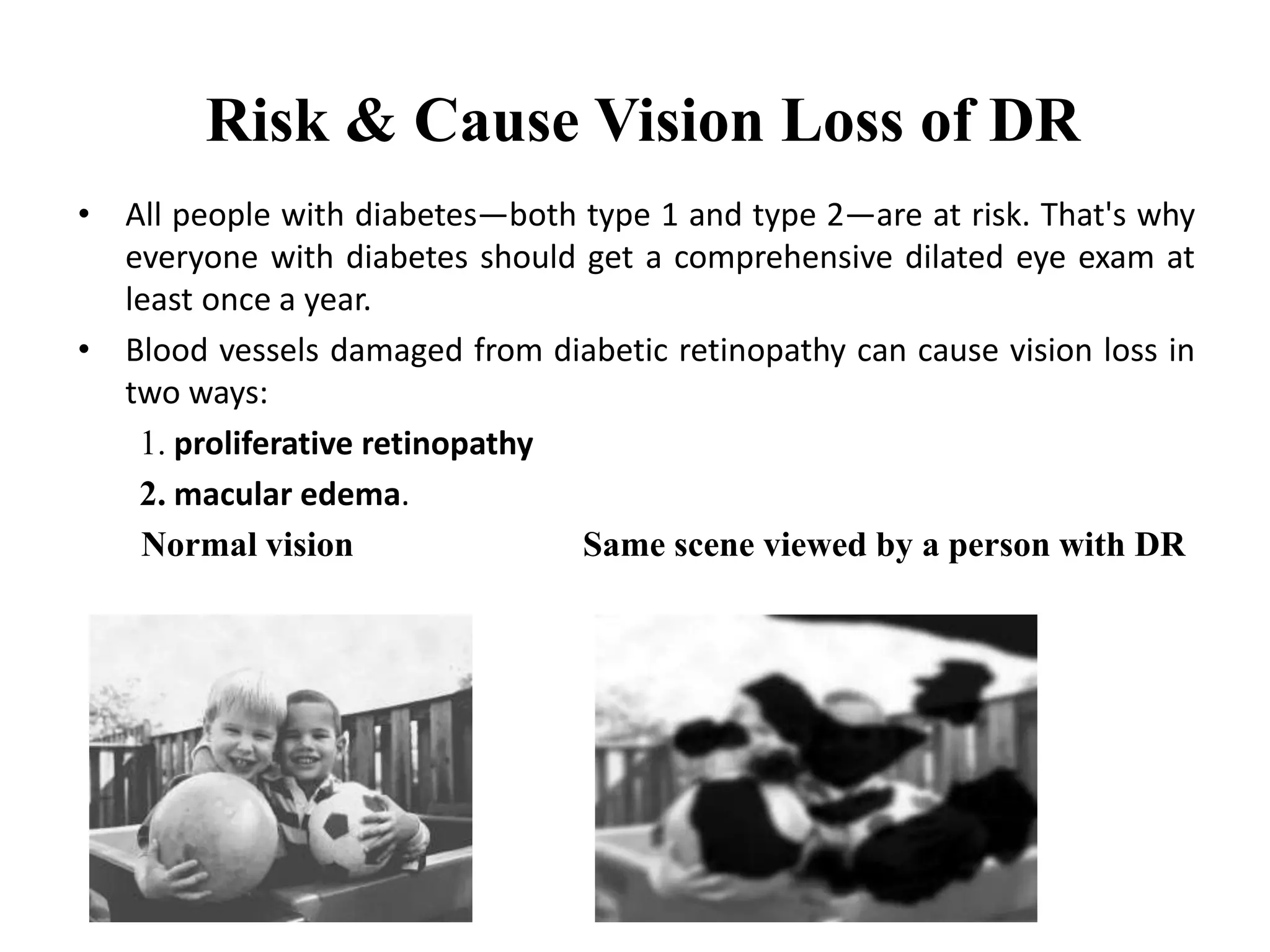
• Blood vessels damaged from diabetic retinopathy can cause vision loss in
two ways:
1. proliferative retinopathy
2. macular edema.
Normal vision Same scene viewed by a person with DR
Diabetic Retinopathy Symptoms
• Blurred vision
• Floaters
• Fluctuating vision
• Distorted vision
• Dark areas in the vision
• Poor night vision
• Impaired color vision
• Partial or total loss of vision
Retinal Diagnostic Tests
•Fundus Photography
•Fluorescein Angiography (FA)
•Optical Coherence Tomography (OCT)
•Ocular Ultrasonography
•Electroretinography (ERG)
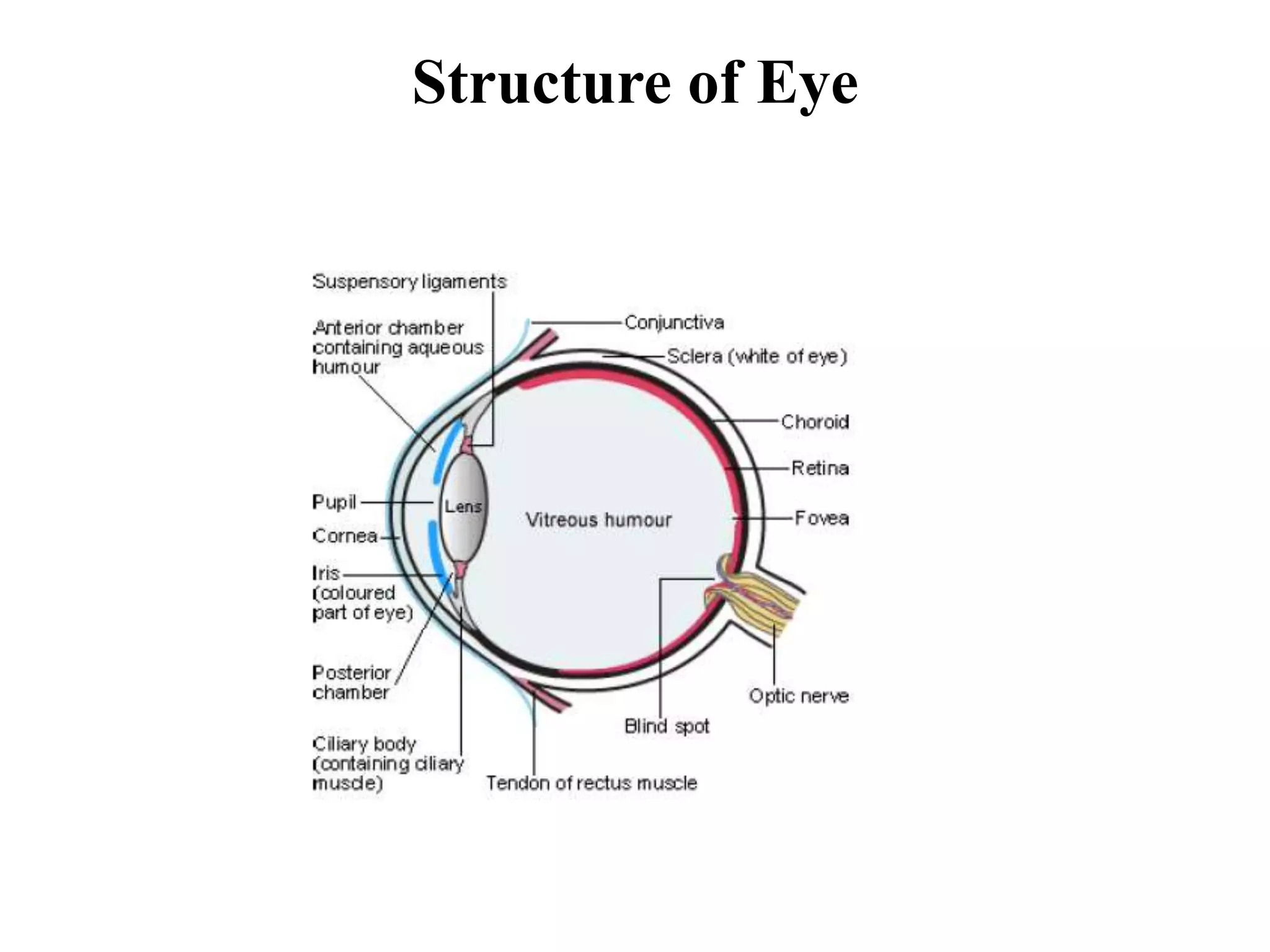
Structure of Eye
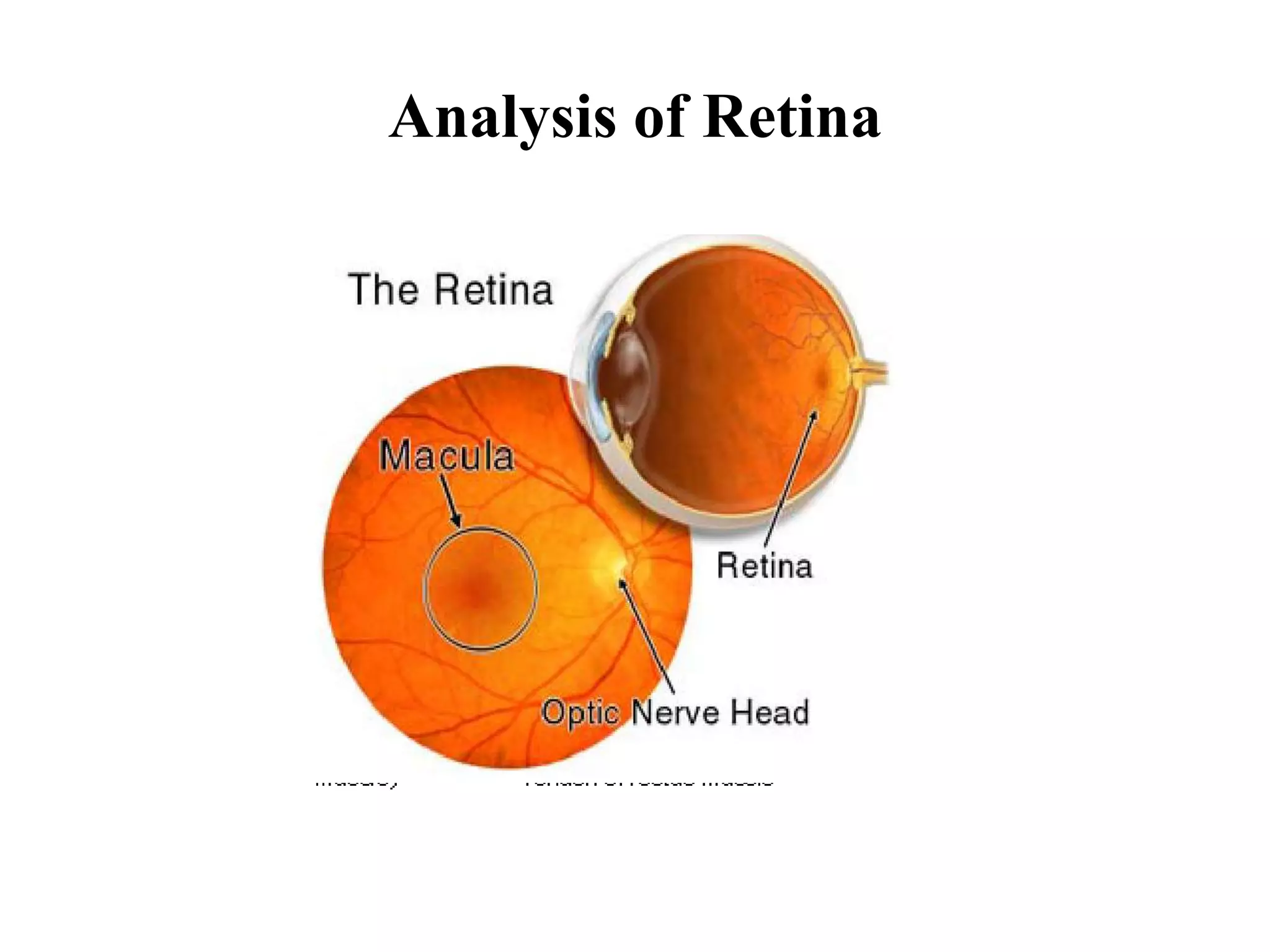
Analysis of Retina
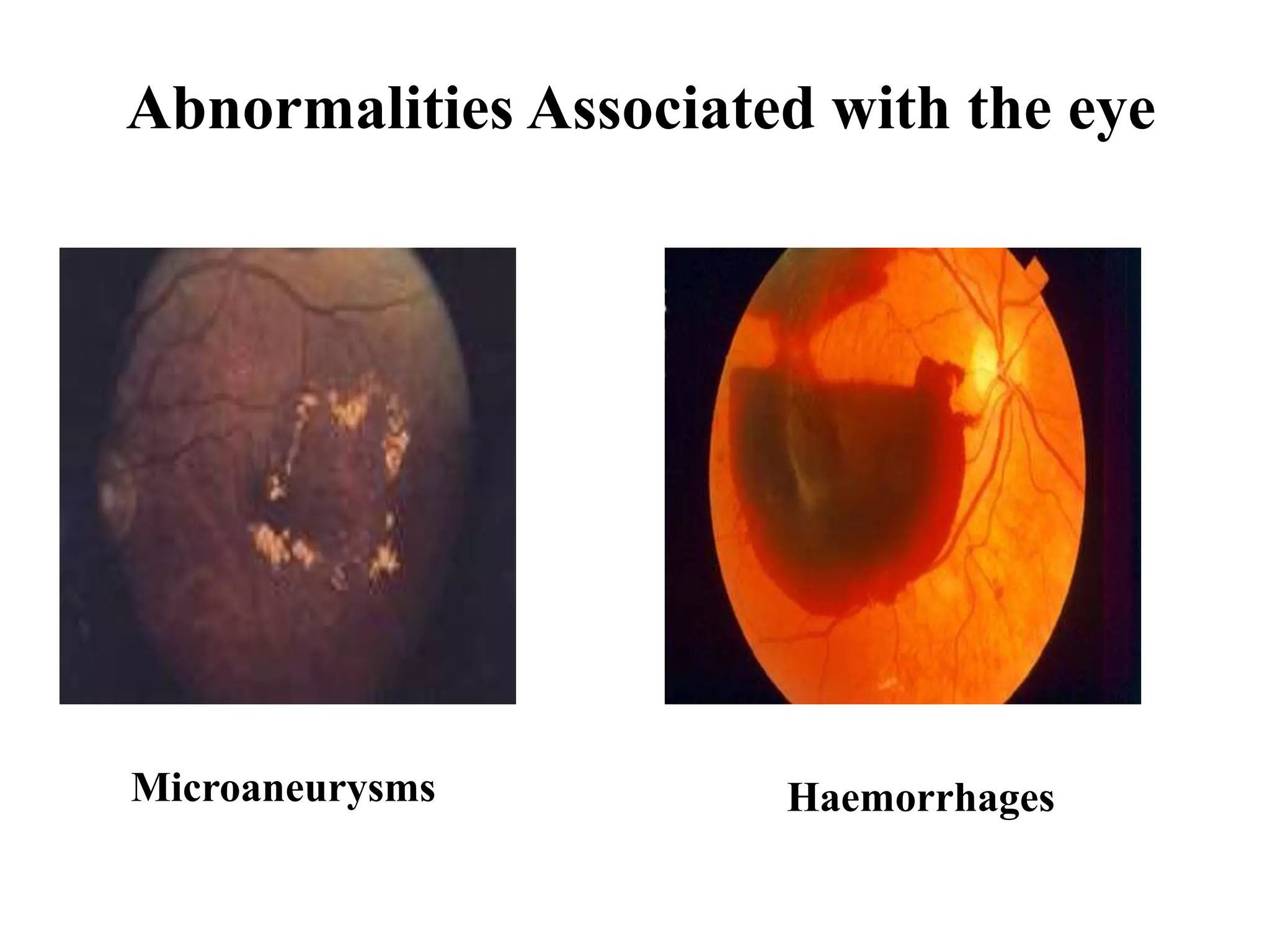
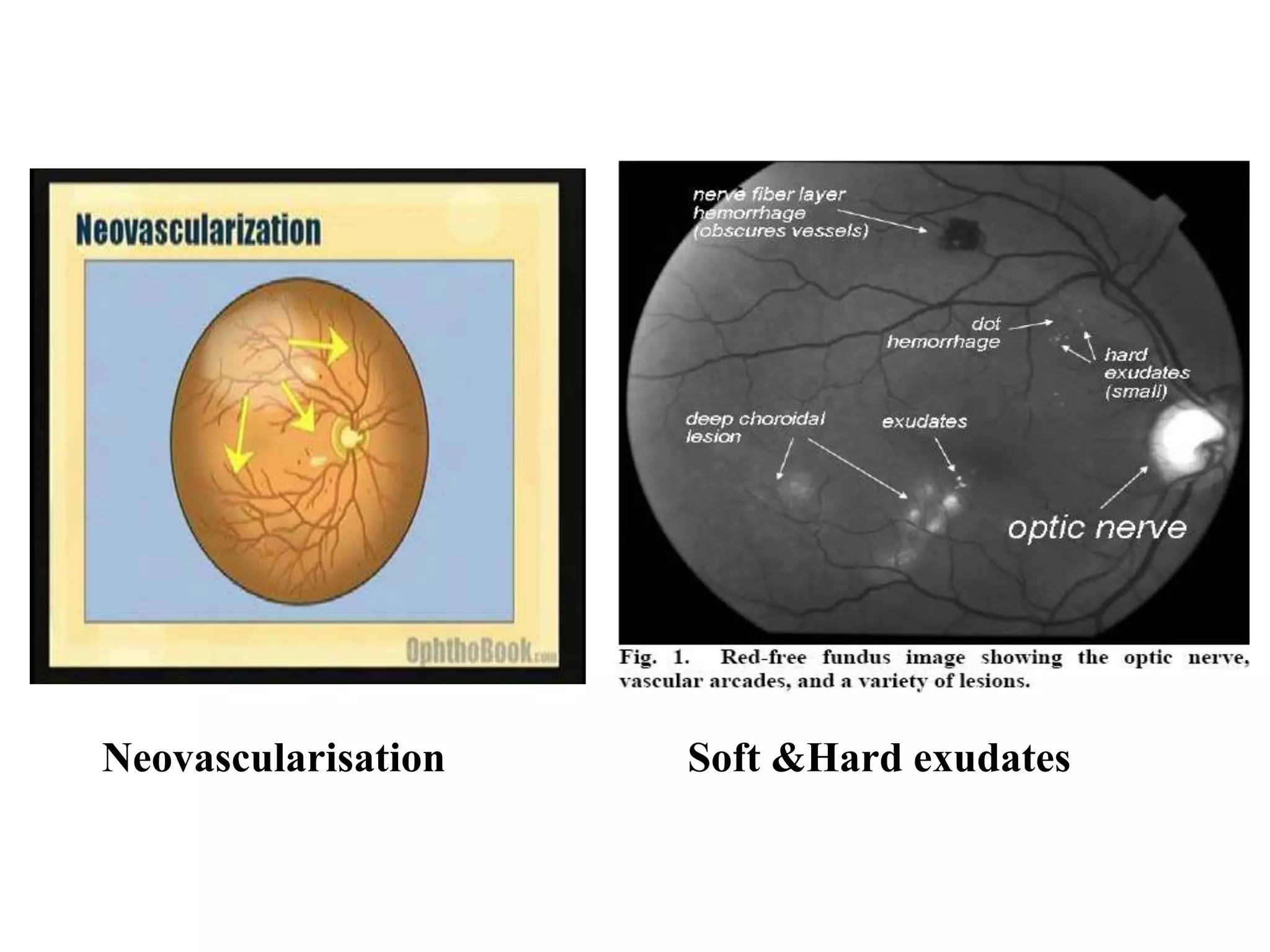
Abnormalities Associated with the eye
Microaneurysms Haemorrhages
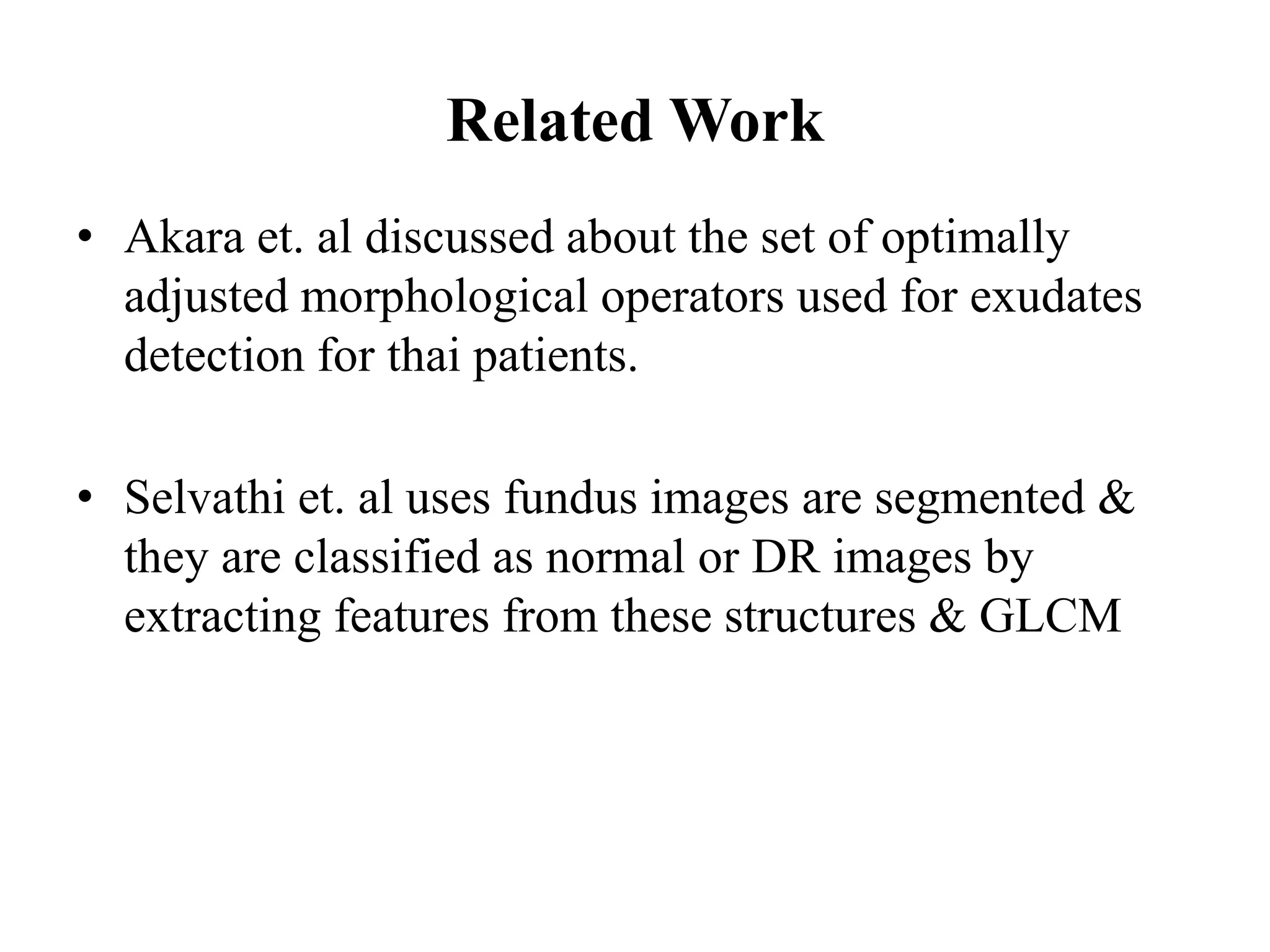
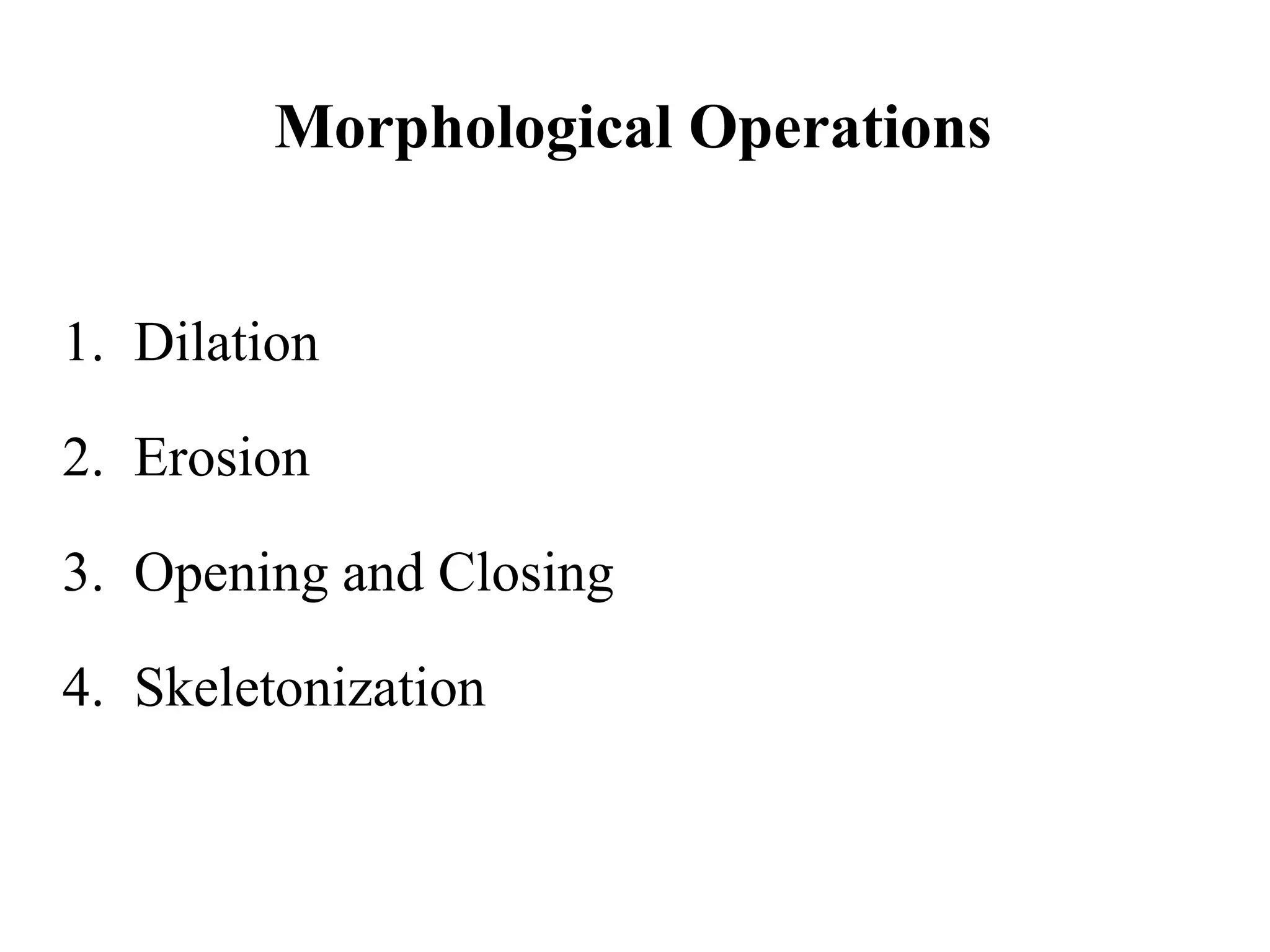
Neovascularisation Soft &Hard exudates
Related Work
• Akara et. al discussed about the set of optimally
adjusted morphological operators used for exudates
detection for thai patients.
• Selvathi et. al uses fundus images are segmented &
they are classified as normal or DR images by
extracting features from these structures & GLCM
Morphological Operations
1. Dilation
2. Erosion
3. Opening and Closing
4. Skeletonization
Diabetic Retinopathy Diagnosis
Block diagram of Pre-Processing
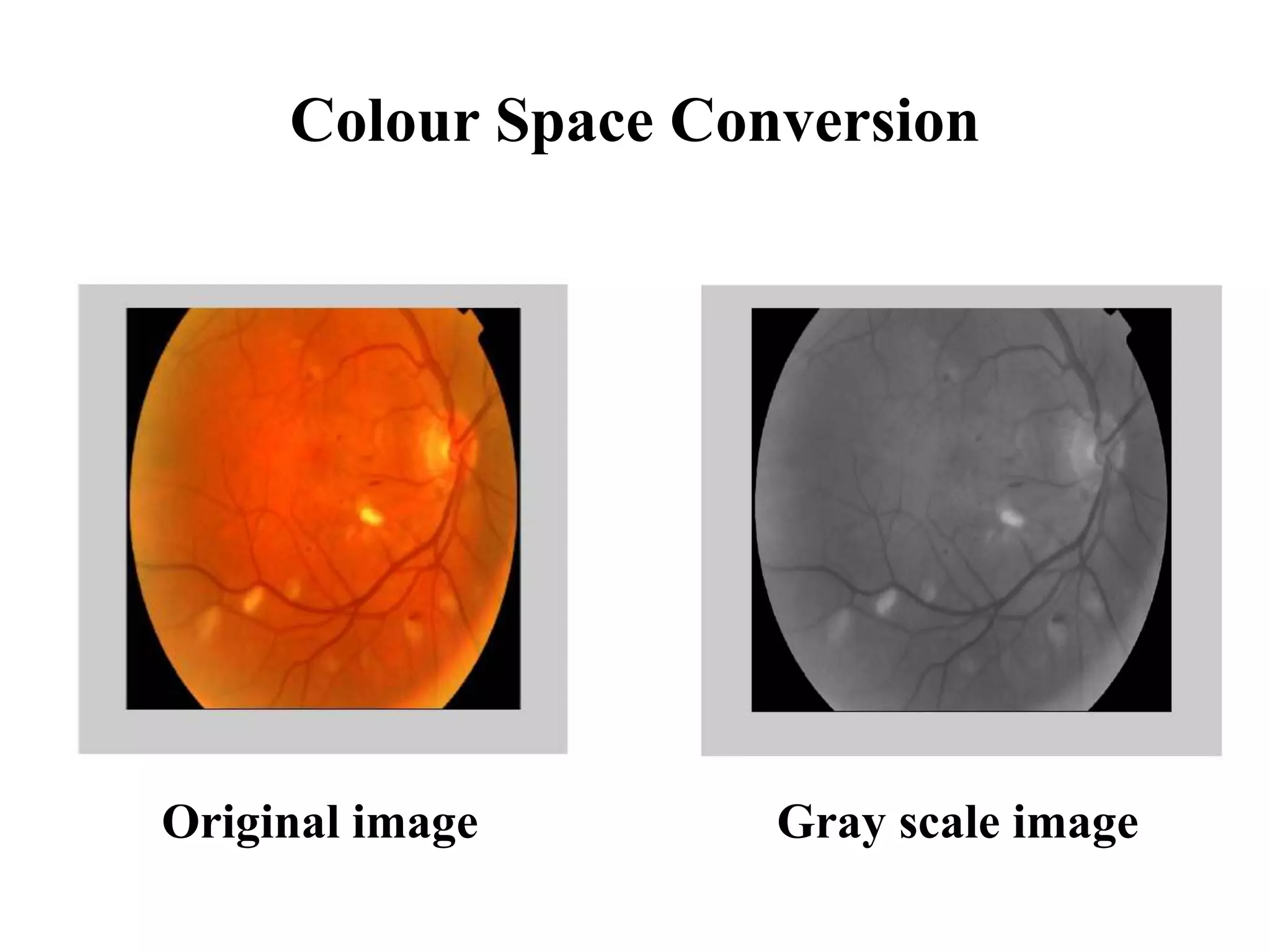
Colour Space Conversion
Original image Gray scale image
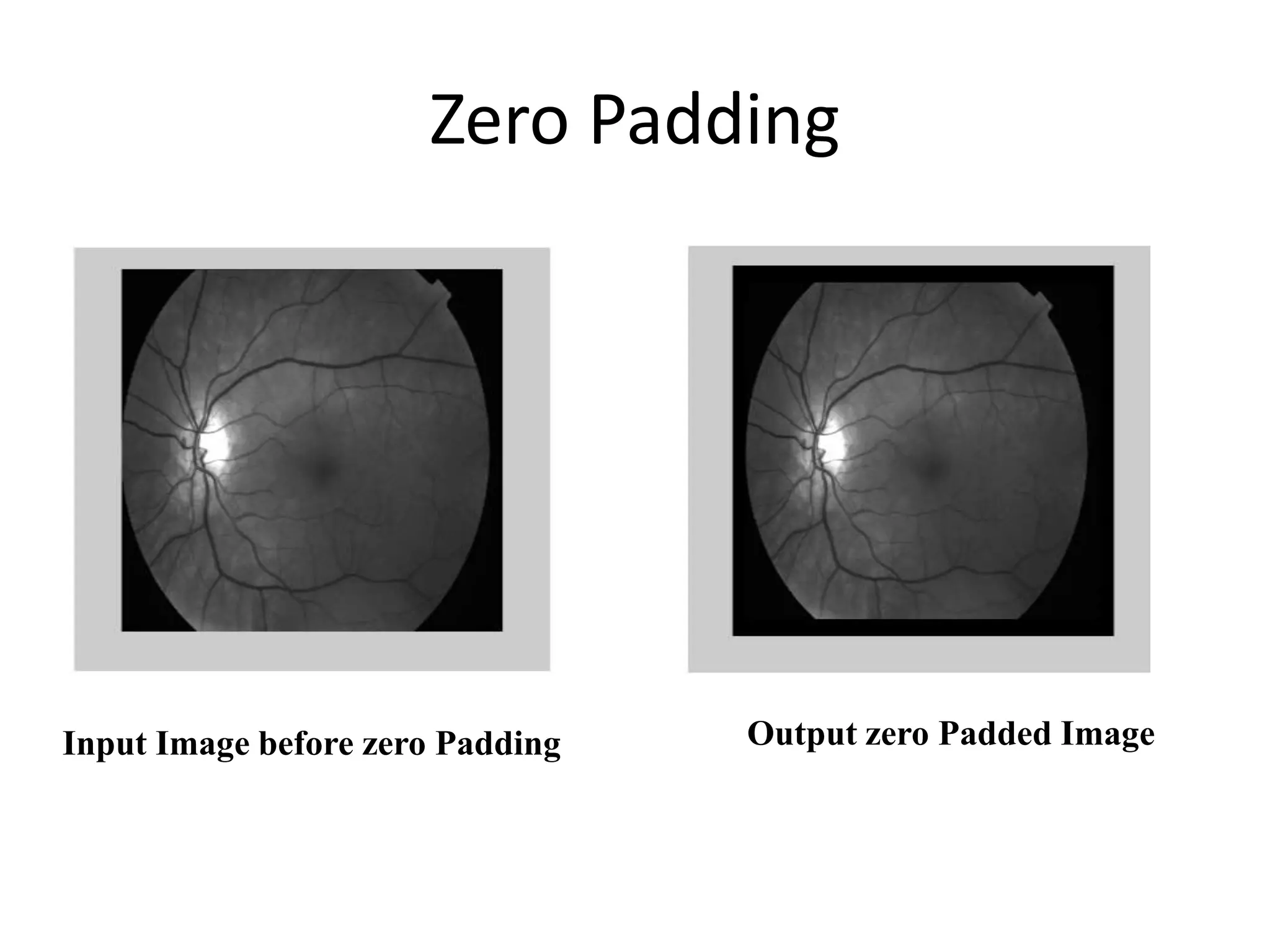
Zero Padding
Input Image before zero Padding Output zero Padded Image
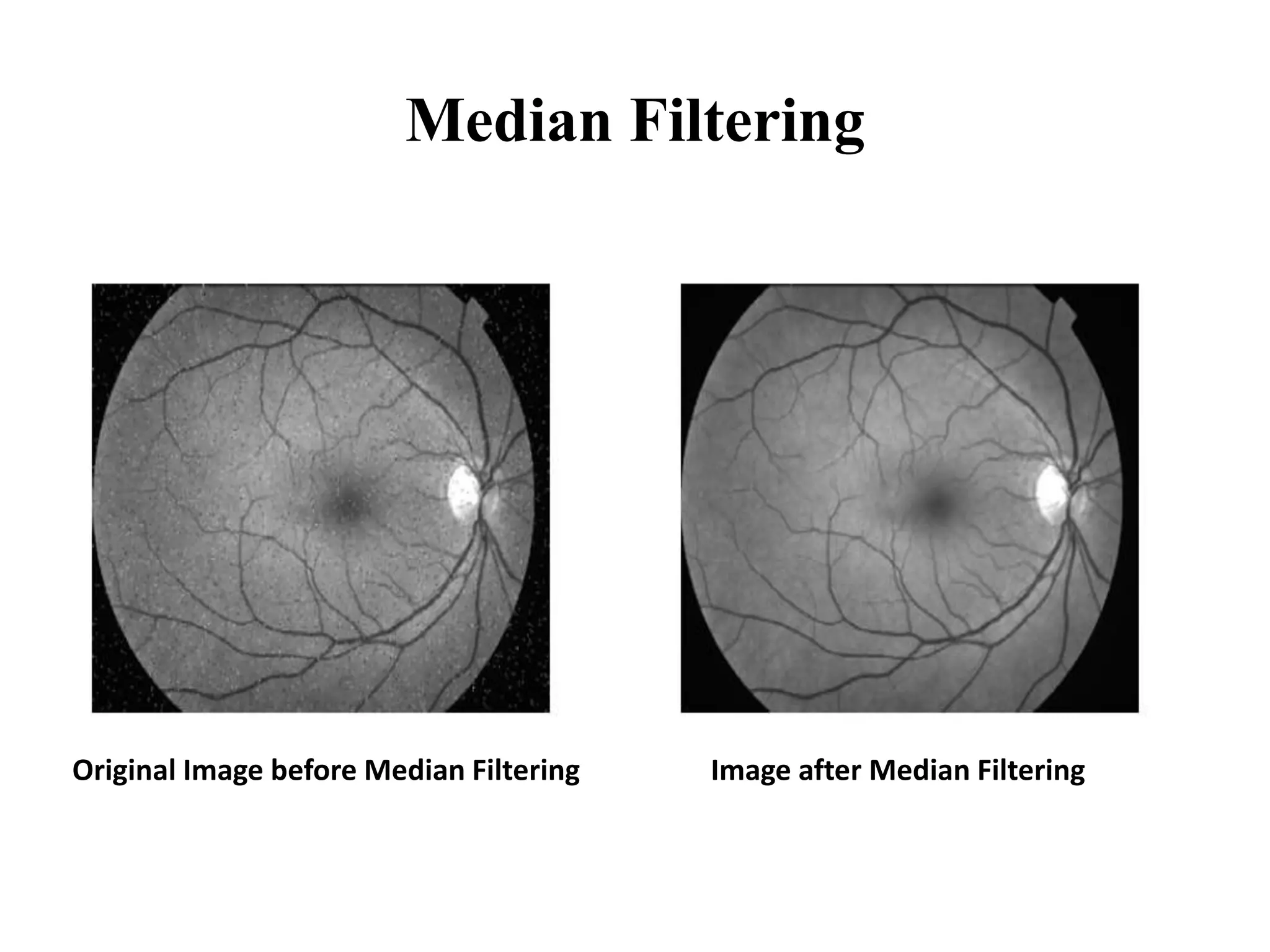
Median Filtering
Original Image before Median Filtering Image after Median Filtering
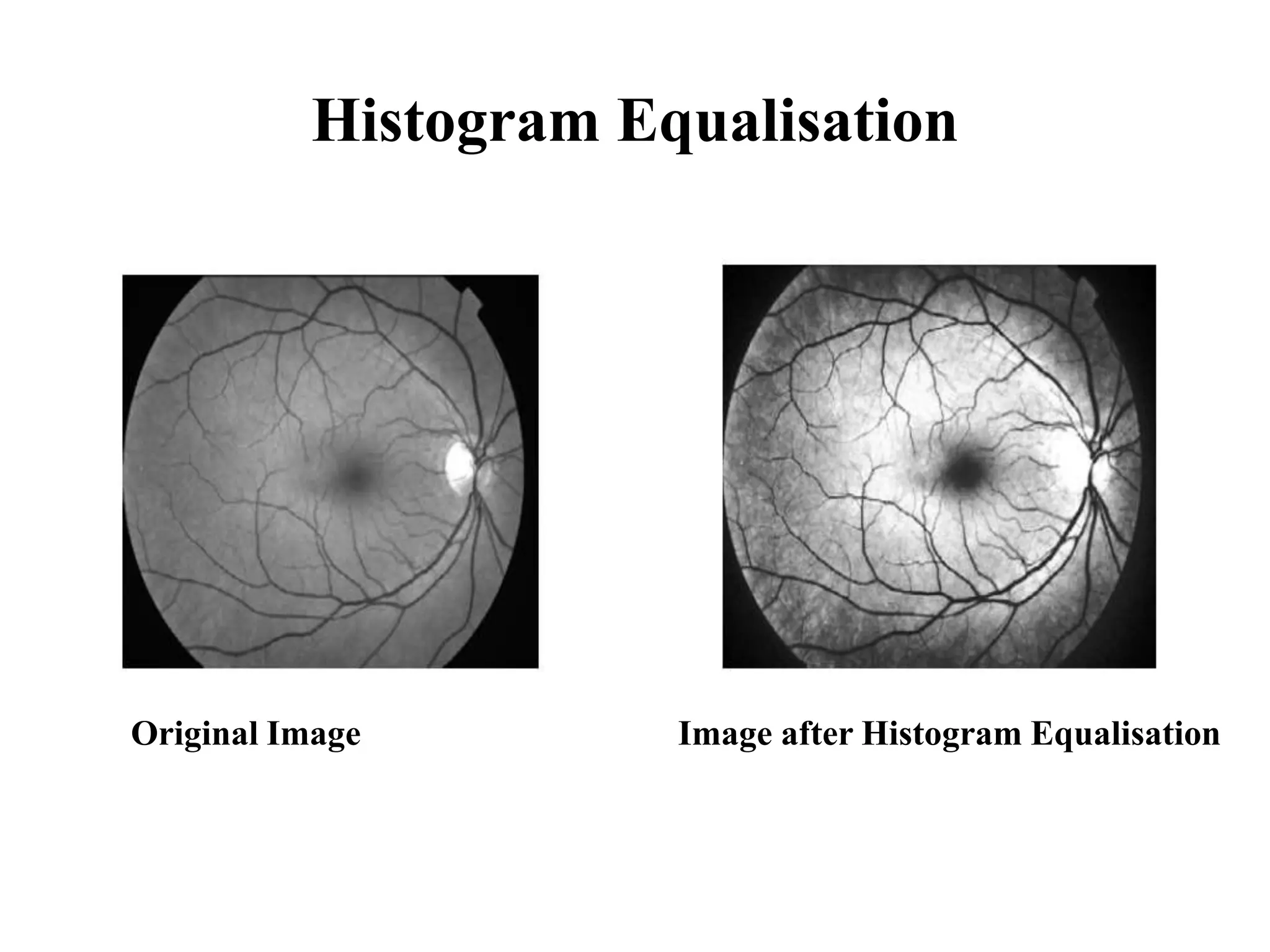
Histogram Equalisation
Original Image Image after Histogram Equalisation
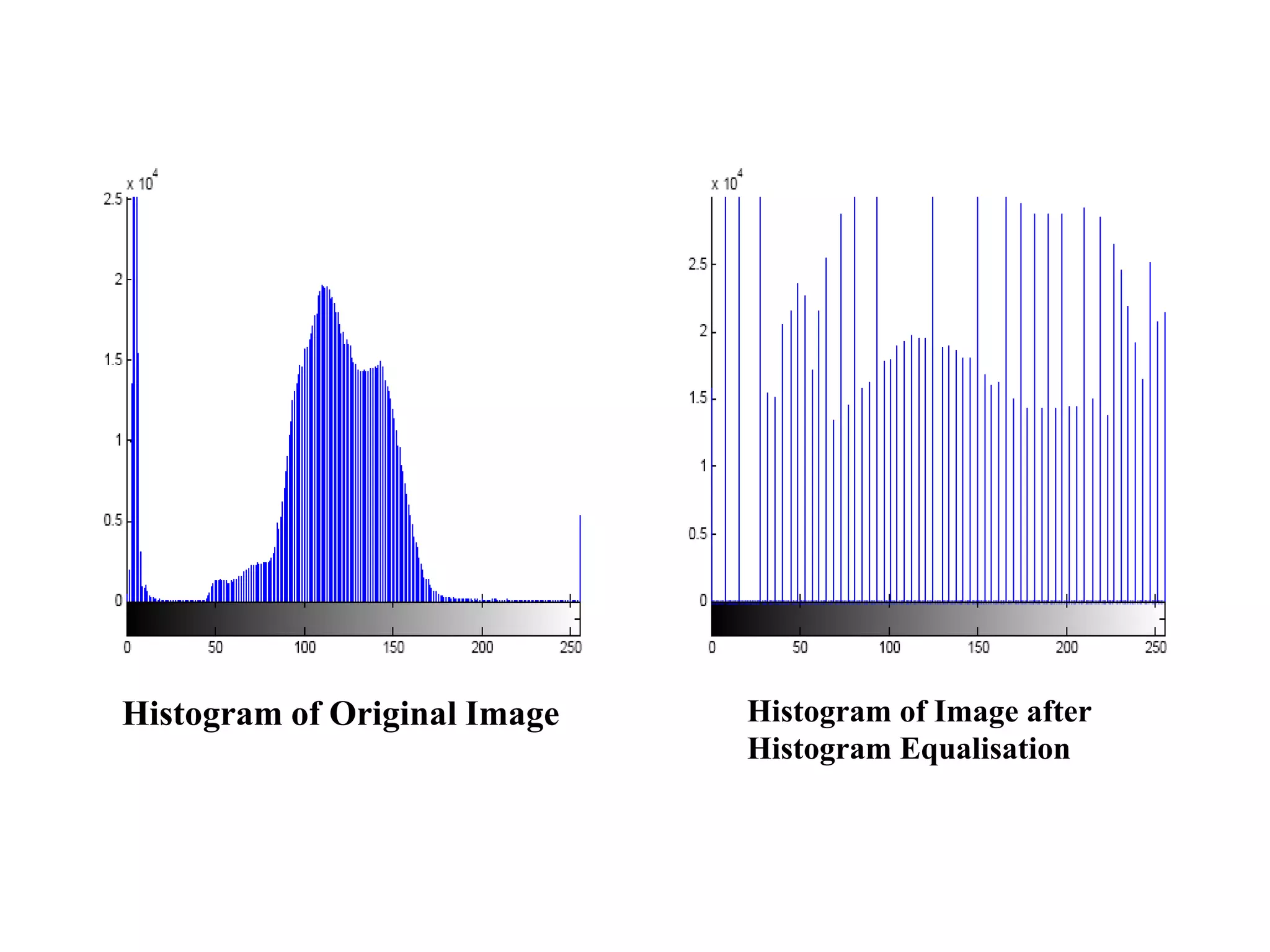
Histogram of Original Image Histogram of Image after
Histogram Equalisation
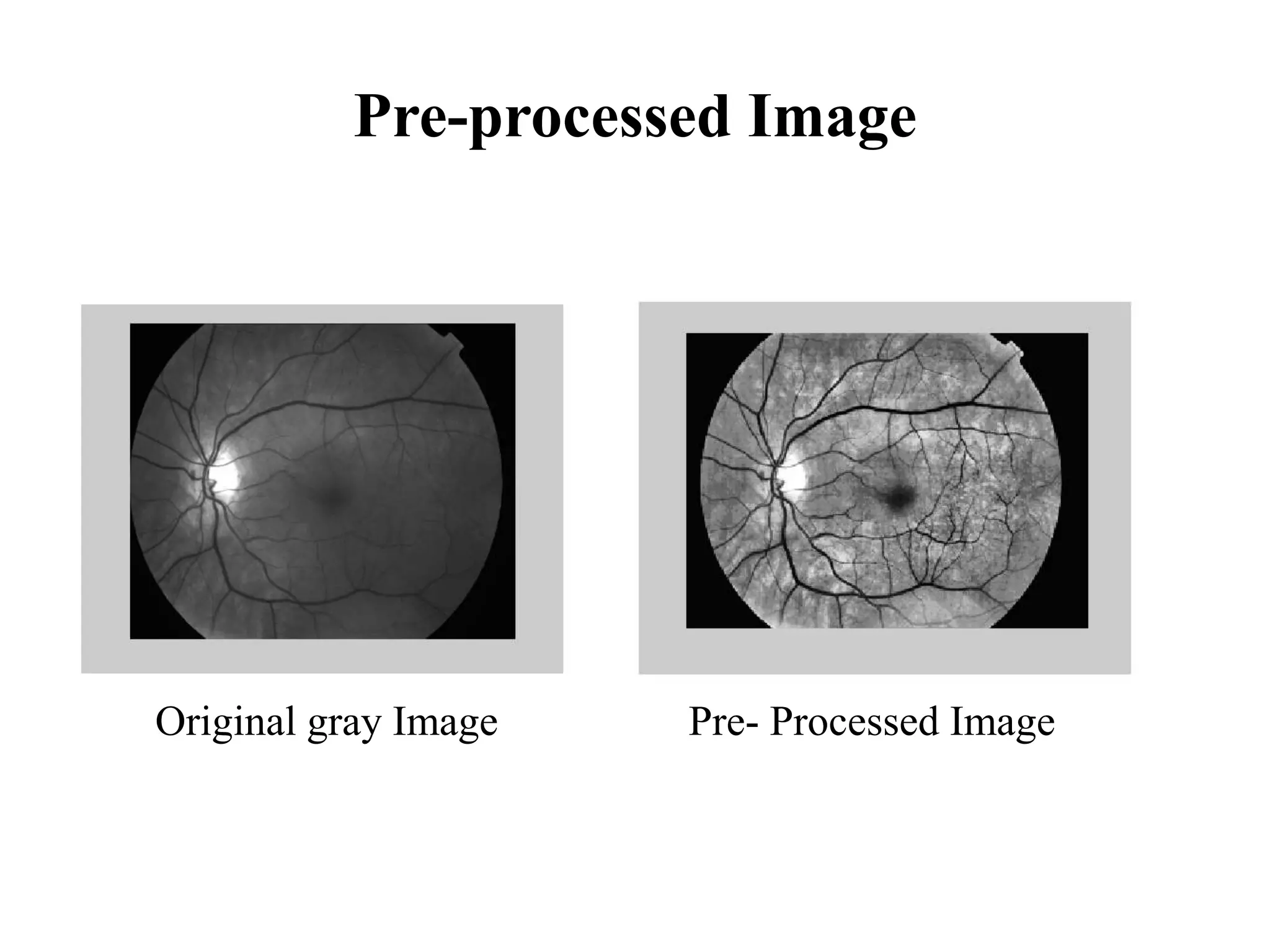
Pre-processed Image
Original gray Image Pre- Processed Image
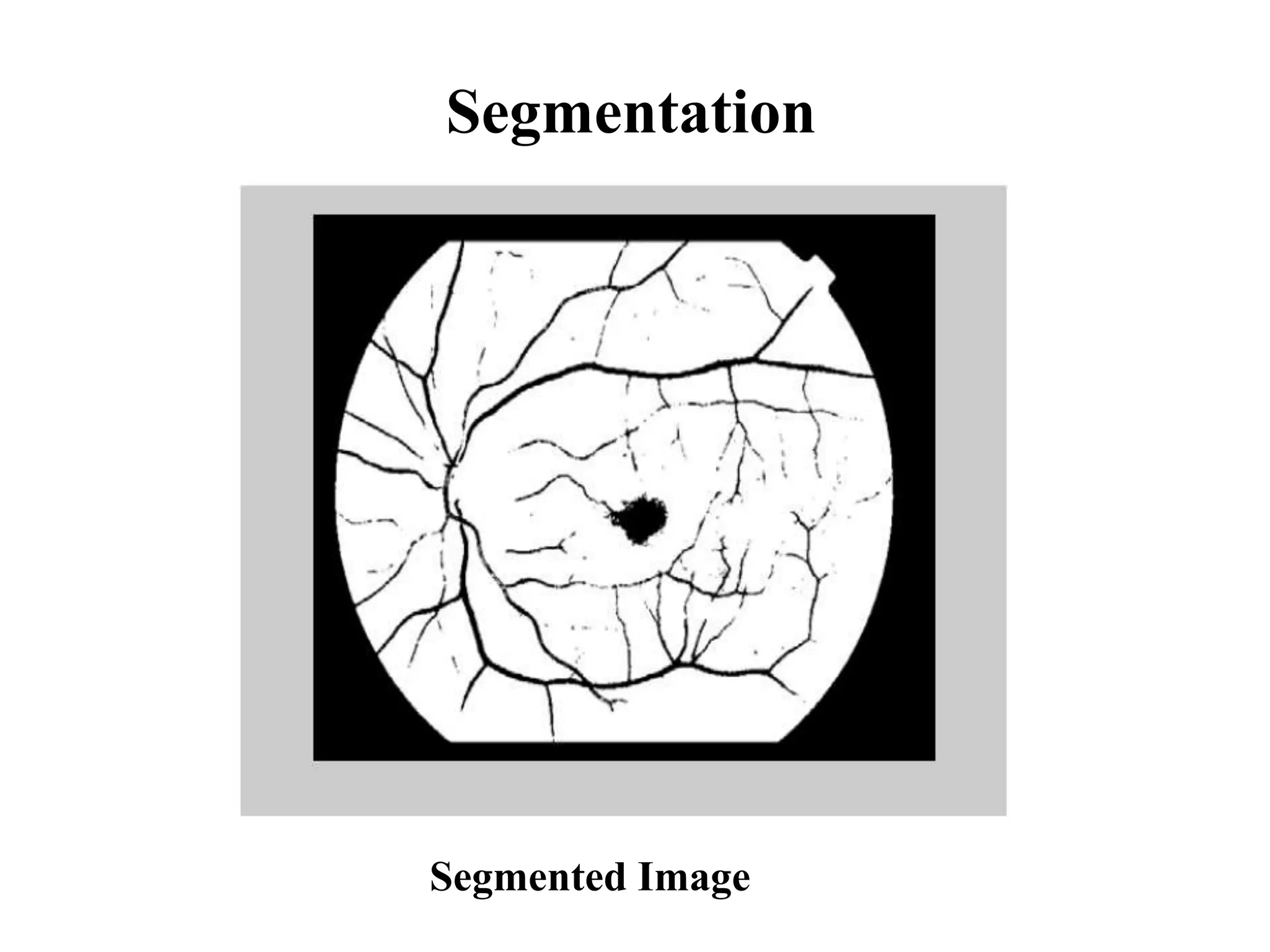
Segmentation
Segmented Image
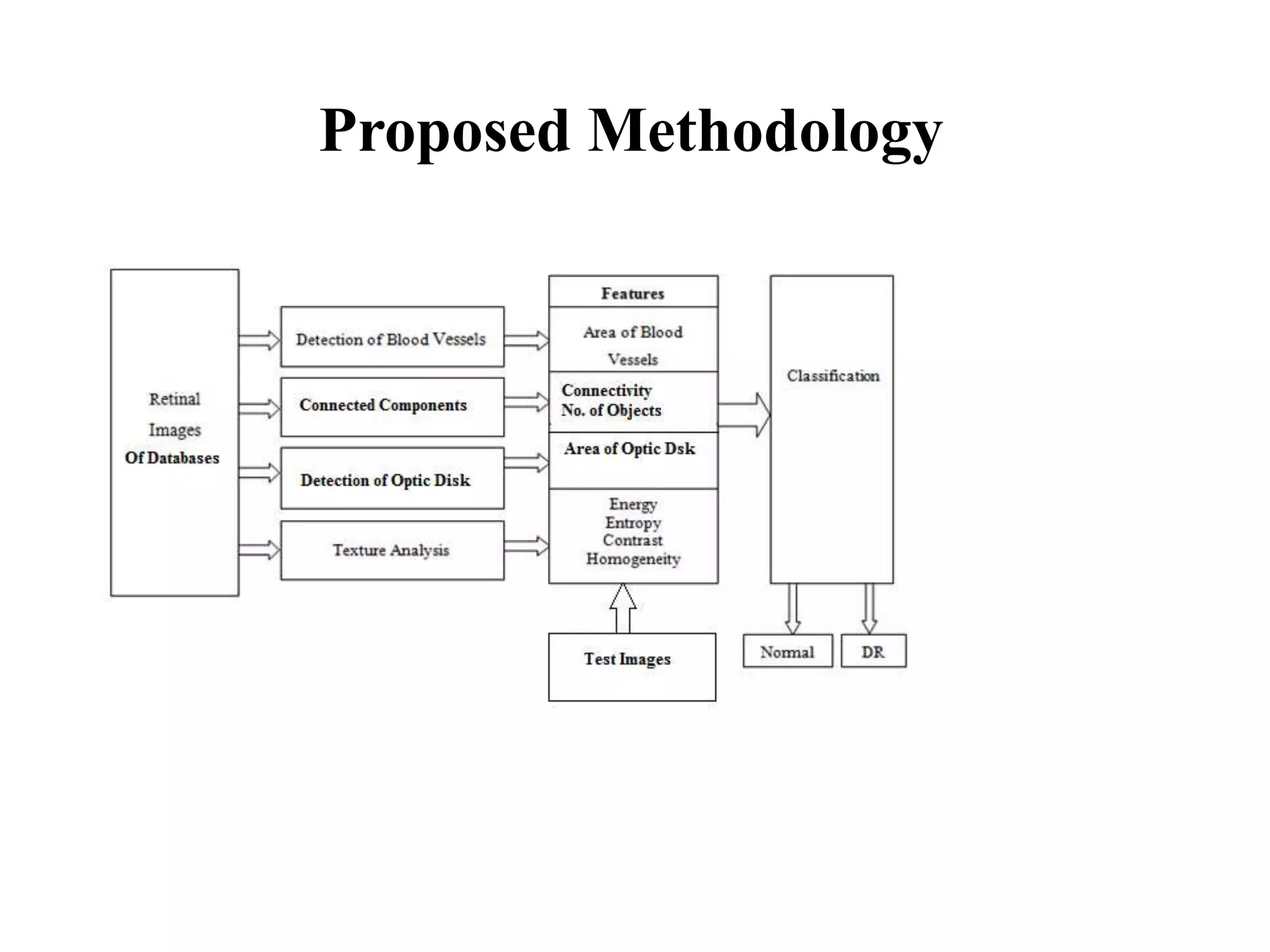
Proposed Methodology
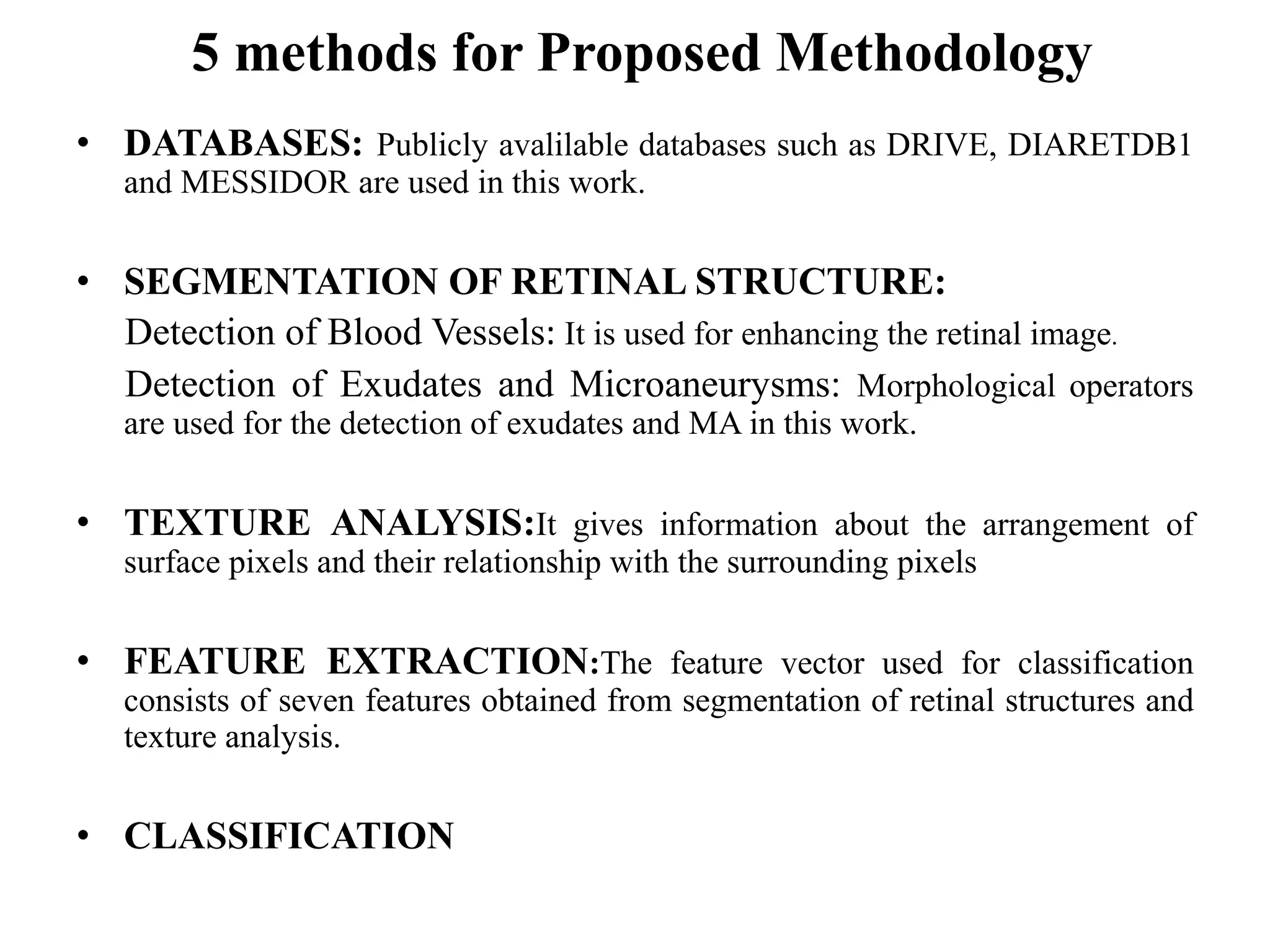
5 methods for Proposed Methodology
• DATABASES: Publicly avalilable databases such as DRIVE, DIARETDB1
and MESSIDOR are used in this work.
• SEGMENTATION OF RETINAL STRUCTURE:
Detection of Blood Vessels: It is used for enhancing the retinal image.
Detection of Exudates and Microaneurysms: Morphological operators
are used for the detection of exudates and MA in this work.
• TEXTURE ANALYSIS:It gives information about the arrangement of
surface pixels and their relationship with the surrounding pixels
• FEATURE EXTRACTION:The feature vector used for classification
consists of seven features obtained from segmentation of retinal structures and
texture analysis.
• CLASSIFICATION
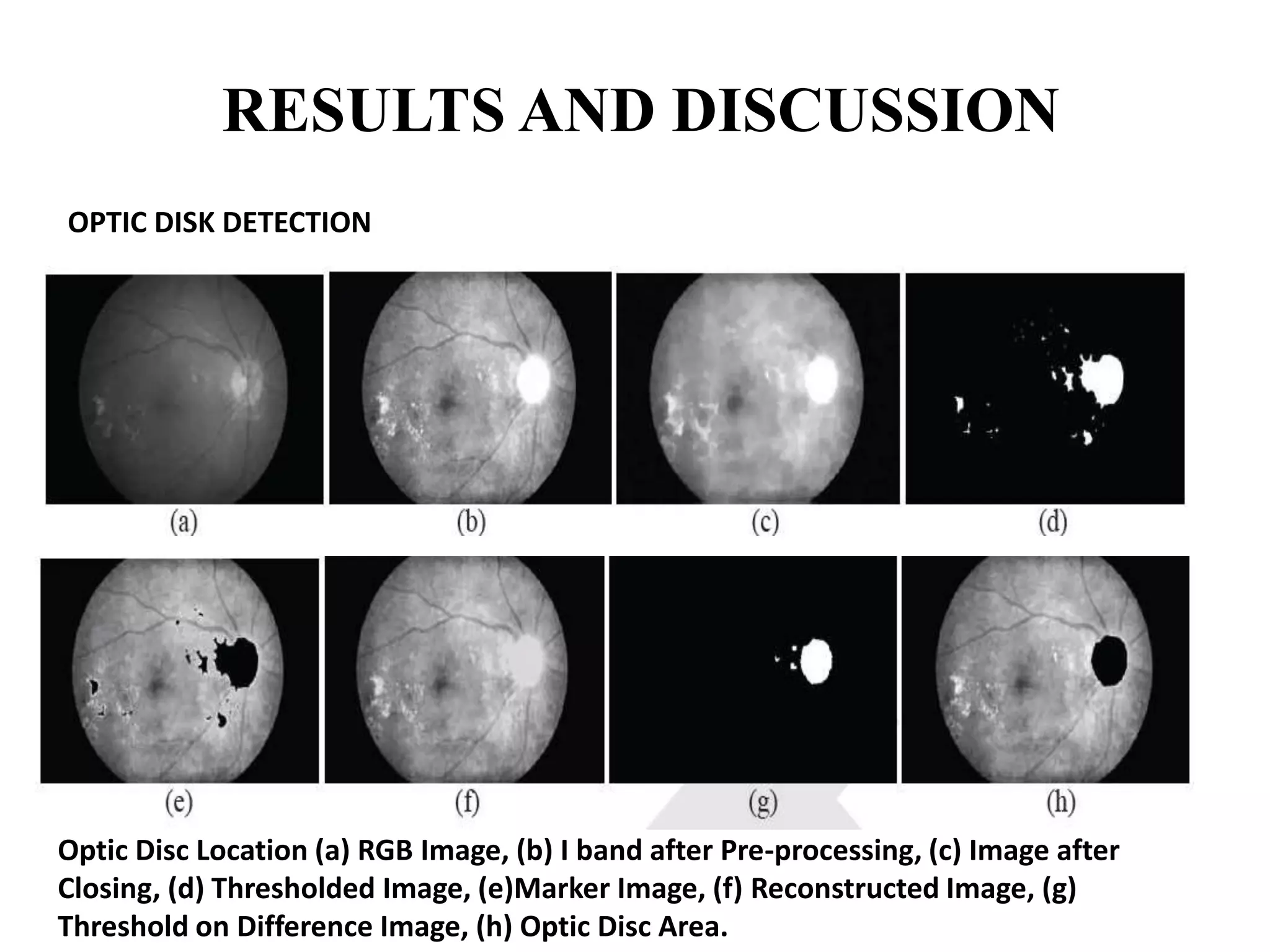
RESULTS AND DISCUSSION
OPTIC DISK DETECTION
Optic Disc Location (a) RGB Image, (b) I band after Pre-processing, (c) Image after
Closing, (d) Thresholded Image, (e)Marker Image, (f) Reconstructed Image, (g)
Threshold on Difference Image, (h) Optic Disc Area.
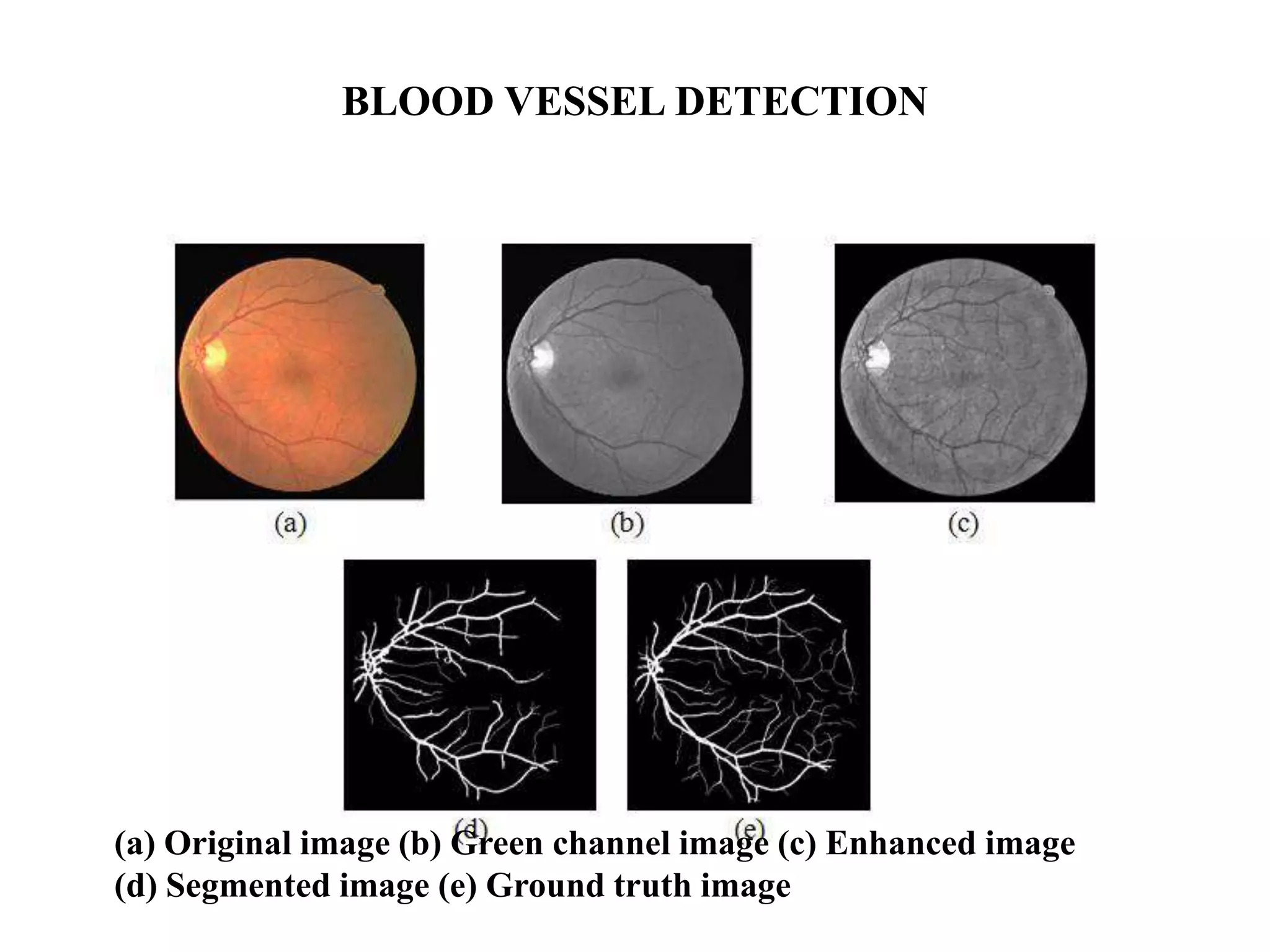
BLOOD VESSEL DETECTION
(a) Original image (b) Green channel image (c) Enhanced image
(d) Segmented image (e) Ground truth image
RETINAL IMAGES ENTROPY CONTRAST HOMOGENITY
6.652 [0.3241 0.3396] [0.8751 0.8754]
6.8912 [0.1504 0.1527] [0.9308 0.9344]
6.1124 [0.1268 0.1470] [0.9377 0.9324]
TEXTURE ANALYSIS RESULTS
RETINAL IMAGES ENTROPY CONTRAST HOMOGENITY
6.5160 [0.5008 0.4678] [0.8519 0.8600]
7.228 [0.3114 0.2509] [0.8853 0.8988]
6.409 [0.4226 0.5190] [0.8487 0.8466]
Conclusion and Future work
• Development of a system that will be able
to identify patients with BDR and PDR from
either color image or grey level fundus
image
• Develop techniques for not only better
detection of vessel edges,
• More anatomically exacting regarding
medical image standards.
• Extraction of Minute blood vessels.
REFERENCES
• DRIVE Database: http://www.isi.uu.nl/Research/Database/DRIVE
• Selvathi D, Neethi Balagopal (2012) Detection of Retinal Blood
Vessels using Curvelet Transform. IEEE International Conference on
devices, Circuits and Systems 325-329. doi:
10.1109/ICDCSyst.2012.6188730
• Pierre Soille (2002) Morphological Image Analysis, Principles and
Applications. 2nd Edition. Springer
• Bevilacqua,V., Cambò,S., Cariello,L., Mastronardi, G., ‘A combined
method to detect Retinal Fundus Features’, Conference on EACDA,
Italy, September, 2005.
• Martin M. and Tosunoglu S., 2000, “Image Processing Techniques
for Machine Vision”,Conference on Recent Advances in Robotics,
Florida, pp. 1-9.
THANK YOU
ANY QUESTIONS

Diabetic Retinopathy Analysis using Fundus Image

  • 1.
    CONTENTS •INTRODUCTION •AIMS & OBJECTIVE •DEFINITIONOF DIABETIC RETINOPATHY •STAGES OF DR •SYMPTOMS OF DR •ANALYSIS OF RETINA •ABNORMILITIES ASSOCIATED WITH EYE •RELATED WORK •MORPHOLOGICAL OPERATORS •DIABETIC RETINOPATHY DIAGNOSIS •PRE-PROCESSING STEPS •PROPOSED METHODOLOGY •RESULTS •CONCLUSION •REFERENCES
  • 2.
    Introduction • The Devastation –Diabetic retinopathy – 4.1 million US Adults • National Health Interview Survey and US Census Population – Glaucoma – 2 million individuals in the US. • Ophthalmologic images – Important structures – Blood Vessels – Help detect and treat Eye Diseases affecting blood vessels • Retina vessel map segmentation is very important to medical applications, such as diabetic retinopathy, aging related retina analysis etc.
  • 3.
    Introduction • Damaged bloodvessels indicate retinal disease. Blood clots indicate diabetic retinopathy. Narrow blood vessels indicate Central Retinal Artery Occlusion. • Observation of blood vessels in retinal images – Shows presence of disease – Helps prevent vision loss by early detection
  • 4.
    Aims and Objective •The primary aim of this project is to develop a system that will be able to identify patients with BDR and PDR from either colour image or grey level image obtained from the retina of the patient. • The secondary aim includes developing a MATLAB based Graphic User Interface (GUI) tool to be used by the ophthalmologist in marking fundus images.
  • 5.
    Definition of DiabeticRetinopathy • Diabetic retinopathy is a complication of diabetes and a leading cause of blindness. • It occurs when diabetes damages the tiny blood vessels inside the retina, the light-sensitive tissue at the back of the eye. Healthy Retina Diabetic retinopathy
  • 6.
    Stages of DiabeticRetinopathy 1. Mild Nonproliferative Retinopathy 2. Moderate Nonproliferative Retinopathy 3. Severe Nonproliferative Retinopathy 4. Proliferative Retinopathy
  • 7.
    Stages of DiabeticRetinopathy (a) normal (b) mild DR (c) moderate DR (d) severe DR (e)prolific DR
  • 8.
    Risk & CauseVision Loss of DR • All people with diabetes—both type 1 and type 2—are at risk. That's why everyone with diabetes should get a comprehensive dilated eye exam at least once a year. • Blood vessels damaged from diabetic retinopathy can cause vision loss in two ways: 1. proliferative retinopathy 2. macular edema. Normal vision Same scene viewed by a person with DR
  • 9.
    Diabetic Retinopathy Symptoms •Blurred vision • Floaters • Fluctuating vision • Distorted vision • Dark areas in the vision • Poor night vision • Impaired color vision • Partial or total loss of vision
  • 10.
    Retinal Diagnostic Tests •FundusPhotography •Fluorescein Angiography (FA) •Optical Coherence Tomography (OCT) •Ocular Ultrasonography •Electroretinography (ERG)
  • 11.
  • 12.
  • 13.
    Abnormalities Associated withthe eye Microaneurysms Haemorrhages
  • 14.
  • 15.
    Related Work • Akaraet. al discussed about the set of optimally adjusted morphological operators used for exudates detection for thai patients. • Selvathi et. al uses fundus images are segmented & they are classified as normal or DR images by extracting features from these structures & GLCM
  • 16.
    Morphological Operations 1. Dilation 2.Erosion 3. Opening and Closing 4. Skeletonization
  • 17.
  • 18.
    Block diagram ofPre-Processing
  • 19.
    Colour Space Conversion Originalimage Gray scale image
  • 20.
    Zero Padding Input Imagebefore zero Padding Output zero Padded Image
  • 21.
    Median Filtering Original Imagebefore Median Filtering Image after Median Filtering
  • 22.
    Histogram Equalisation Original ImageImage after Histogram Equalisation
  • 23.
    Histogram of OriginalImage Histogram of Image after Histogram Equalisation
  • 24.
    Pre-processed Image Original grayImage Pre- Processed Image
  • 25.
  • 26.
  • 27.
    5 methods forProposed Methodology • DATABASES: Publicly avalilable databases such as DRIVE, DIARETDB1 and MESSIDOR are used in this work. • SEGMENTATION OF RETINAL STRUCTURE: Detection of Blood Vessels: It is used for enhancing the retinal image. Detection of Exudates and Microaneurysms: Morphological operators are used for the detection of exudates and MA in this work. • TEXTURE ANALYSIS:It gives information about the arrangement of surface pixels and their relationship with the surrounding pixels • FEATURE EXTRACTION:The feature vector used for classification consists of seven features obtained from segmentation of retinal structures and texture analysis. • CLASSIFICATION
  • 28.
    RESULTS AND DISCUSSION OPTICDISK DETECTION Optic Disc Location (a) RGB Image, (b) I band after Pre-processing, (c) Image after Closing, (d) Thresholded Image, (e)Marker Image, (f) Reconstructed Image, (g) Threshold on Difference Image, (h) Optic Disc Area.
  • 29.
    BLOOD VESSEL DETECTION (a)Original image (b) Green channel image (c) Enhanced image (d) Segmented image (e) Ground truth image
  • 30.
    RETINAL IMAGES ENTROPYCONTRAST HOMOGENITY 6.652 [0.3241 0.3396] [0.8751 0.8754] 6.8912 [0.1504 0.1527] [0.9308 0.9344] 6.1124 [0.1268 0.1470] [0.9377 0.9324] TEXTURE ANALYSIS RESULTS
  • 31.
    RETINAL IMAGES ENTROPYCONTRAST HOMOGENITY 6.5160 [0.5008 0.4678] [0.8519 0.8600] 7.228 [0.3114 0.2509] [0.8853 0.8988] 6.409 [0.4226 0.5190] [0.8487 0.8466]
  • 32.
    Conclusion and Futurework • Development of a system that will be able to identify patients with BDR and PDR from either color image or grey level fundus image • Develop techniques for not only better detection of vessel edges, • More anatomically exacting regarding medical image standards. • Extraction of Minute blood vessels.
  • 33.
    REFERENCES • DRIVE Database:http://www.isi.uu.nl/Research/Database/DRIVE • Selvathi D, Neethi Balagopal (2012) Detection of Retinal Blood Vessels using Curvelet Transform. IEEE International Conference on devices, Circuits and Systems 325-329. doi: 10.1109/ICDCSyst.2012.6188730 • Pierre Soille (2002) Morphological Image Analysis, Principles and Applications. 2nd Edition. Springer • Bevilacqua,V., Cambò,S., Cariello,L., Mastronardi, G., ‘A combined method to detect Retinal Fundus Features’, Conference on EACDA, Italy, September, 2005. • Martin M. and Tosunoglu S., 2000, “Image Processing Techniques for Machine Vision”,Conference on Recent Advances in Robotics, Florida, pp. 1-9.
  • 34.
  • 35.