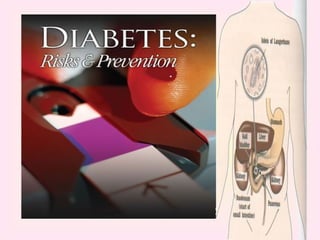
Introduction This presentation will help you  better understand and manage your diabetes.  It covers the three main forms of diabetes, type 1 and type 2, as well as gestational diabetes.  how your body metabolizes sugar,  How to control diabetes the fundamentals of nutrition and exercise.  up-to-date information about recent innovations in treatment and  most importantly, you'll see that it's not just possible to live with diabetes; it's possible to live well. Dr. Sunita Gupta
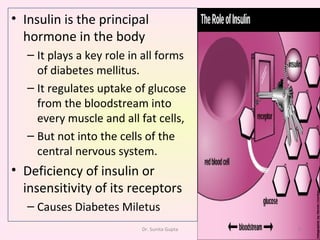
Insulin is the principal hormone in the body  It plays a key role in all forms of diabetes mellitus. It regulates uptake of glucose from the bloodstream into every muscle and all fat cells,  But not into the cells of the central nervous system.  Deficiency of insulin or insensitivity of its receptors  Causes Diabetes Miletus Dr. Sunita Gupta
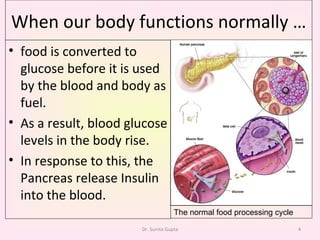
When our body functions normally … The normal food processing cycle food is converted to glucose before it is used by the blood and body as fuel.  As a result, blood glucose levels in the body rise.  In response to this, the Pancreas release Insulin into the blood.  Dr. Sunita Gupta
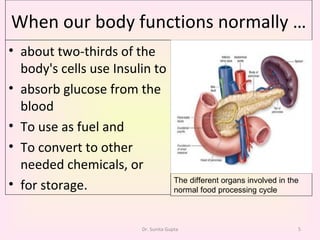
When our body functions normally … The different organs involved in the normal food processing cycle about two-thirds of the body's cells use Insulin to  absorb glucose from the blood To use as fuel and  To convert to other needed chemicals, or  for storage.  Dr. Sunita Gupta
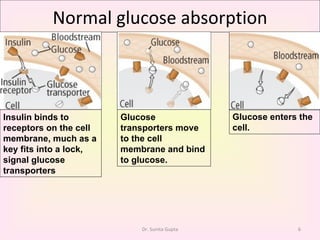
Normal glucose absorption Insulin binds to receptors on the cell membrane, much as a key fits into a lock, signal glucose transporters Glucose transporters move to the cell membrane and bind to glucose. Glucose enters the cell.  Dr. Sunita Gupta
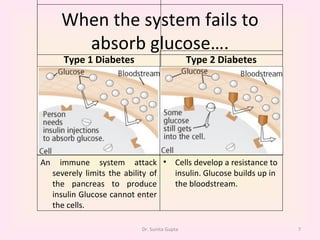
When the system fails to absorb glucose…. Type 1 Diabetes Type 2 Diabetes Dr. Sunita Gupta An immune system attack severely limits the ability of the pancreas to produce insulin Glucose cannot enter the cells.  Cells develop a resistance to insulin. Glucose builds up in the bloodstream.
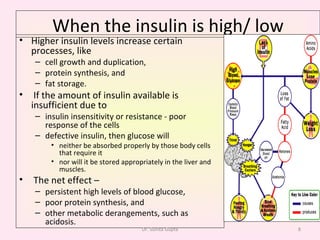
When the insulin is high/ low Higher insulin levels increase certain processes, like cell growth and duplication,  protein synthesis, and  fat storage. If the amount of insulin available is insufficient due to  insulin insensitivity or resistance - poor response of the cells defective insulin, then glucose will  neither be absorbed properly by those body cells that require it  nor will it be stored appropriately in the liver and muscles. The net effect –  persistent high levels of blood glucose,  poor protein synthesis, and  other metabolic derangements, such as acidosis. Dr. Sunita Gupta
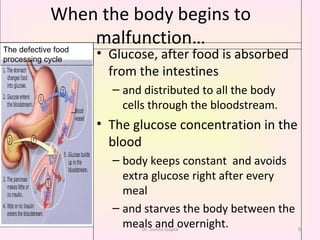
When the body begins to malfunction… Glucose, after food is absorbed from the intestines and distributed to all the body cells through the bloodstream.  The glucose concentration in the blood  body keeps constant  and avoids extra glucose right after every meal and starves the body between the meals and overnight.  The defective food  processing cycle Dr. Sunita Gupta
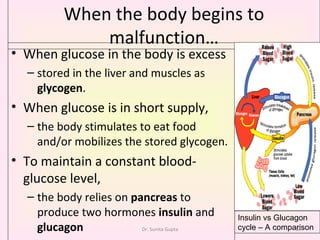
When the body begins to malfunction… When glucose in the body is excess  stored in the liver and muscles as  glycogen .  When glucose is in short supply,  the body stimulates to eat food and/or mobilizes the stored glycogen.  To maintain a constant blood-glucose level, the body relies on  pancreas  to produce two hormones  insulin  and  glucagon Insulin vs Glucagon cycle – A comparison Dr. Sunita Gupta
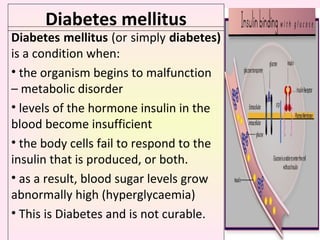
Diabetes mellitus Diabetes mellitus  (or simply  diabetes)  is a condition when:  the organism begins to malfunction – metabolic disorder levels of the hormone insulin in the blood become insufficient the body cells fail to respond to the insulin that is produced, or both.  as a result, blood sugar levels grow abnormally high (hyperglycaemia) This is  Diabetes and is not curable.
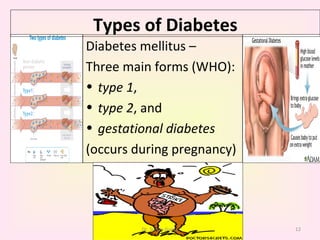
Types of  Diabetes Diabetes mellitus –  Three main forms (WHO):  type 1 ,  type 2 , and  gestational diabetes   (occurs during pregnancy) Dr. Sunita Gupta
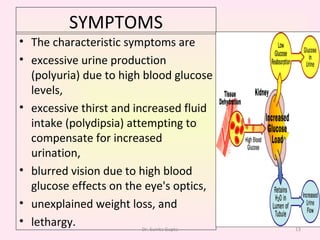
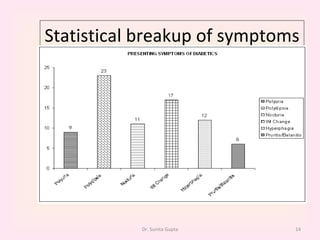
SYMPTOMS The characteristic symptoms are  excessive urine production (polyuria) due to high blood glucose levels,  excessive thirst and increased fluid intake (polydipsia) attempting to compensate for increased urination,  blurred vision due to high blood glucose effects on the eye's optics,  unexplained weight loss, and  lethargy. Dr. Sunita Gupta
Statistical breakup of symptoms Dr. Sunita Gupta
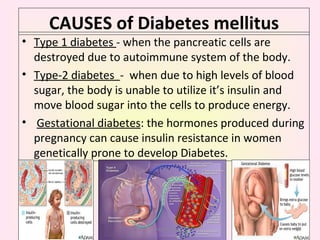
CAUSES of  Diabetes mellitus Type 1 diabetes  - when the pancreatic cells are destroyed due to autoimmune system of the body. Type-2 diabetes  -  when due to high levels of blood sugar, the body is unable to utilize it’s insulin and move blood sugar into the cells to produce energy. Gestational diabetes : the hormones produced during pregnancy can cause insulin resistance in women genetically prone to develop Diabetes. Dr. Sunita Gupta
Diabetes - a genetic source? Partly inheritance - Both type 1 and type 2 diabetes.  At least 10 genes found - links to the causes of Type-2 diabetes.  Dr. Sunita Gupta
How genes influence Diabetes? Type 1 diabetes is triggered by some (mainly viral) infections, by stress or environmental exposure (such as exposure to certain chemicals or drugs).  Type 2 diabetes - a stronger inheritance pattern. If first relatives have type 2 diabetes risk of developing type 2 diabetes is much higher.  This risk increases with increase in number of relatives with diabetes.  Dr. Sunita Gupta
diagnosis Recurrent or persistent hyperglycaemia during Diabetes mellitus is diagnosed by any one of the following methods: fasting plasma glucose level  at or above 126 mg/dL (7.0 mmol/l).  plasma glucose  at or above 200 mg/dL (11.1 mmol/l) two hours after a 75 g oral glucose load.  random plasma glucose  at or above 200 mg/dL (11.1 mmol/l).  Dr. Sunita Gupta
Diabetes screening Diabetes screening is recommended at various stages of life, and  For those with any of several risk factors.  Diabetes screening could be  a random blood glucose test,  a fasting blood glucose test,  a blood glucose test two hours after 75 g of glucose, or  a more formal glucose tolerance test.  Dr. Sunita Gupta
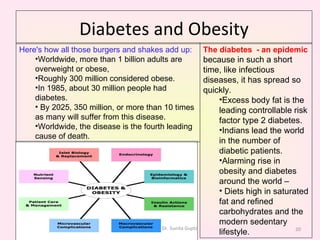
Diabetes and Obesity The diabetes  - an epidemic because in such a short time, like infectious diseases, it has spread so quickly.  Excess body fat is the leading controllable risk factor type 2 diabetes.  Indians lead the world in the number of diabetic patients.  Alarming rise in obesity and diabetes around the world – Diets high in saturated fat and refined carbohydrates and the modern sedentary lifestyle.  Dr. Sunita Gupta Here's how all those burgers and shakes add up: Worldwide, more than 1 billion adults are overweight or obese,  Roughly 300 million considered obese. In 1985, about 30 million people had diabetes.  By 2025, 350 million, or more than 10 times as many will suffer from this disease. Worldwide, the disease is the fourth leading cause of death.

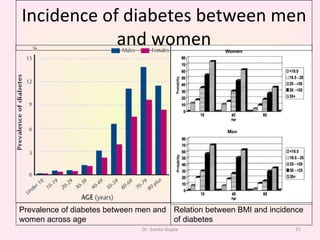
Incidence of diabetes between men and women Relation between BMI and incidence of diabetes Prevalence of diabetes between men and women across age Dr. Sunita Gupta
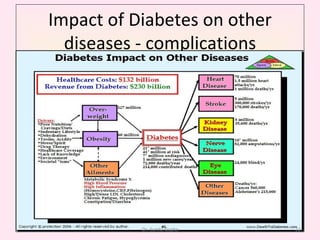
Impact of Diabetes on other diseases - complications Dr. Sunita Gupta
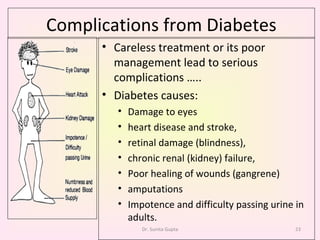
Complications from Diabetes Careless treatment or its poor management lead to serious complications ….. Diabetes causes:  Damage to eyes heart disease and stroke,  retinal damage (blindness),  chronic renal (kidney) failure,  Poor healing of wounds (gangrene) amputations Impotence and difficulty passing urine in adults. Dr. Sunita Gupta
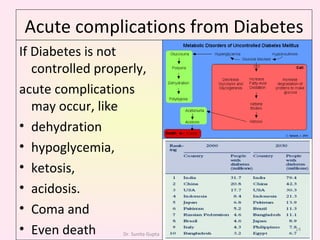
Acute complications from Diabetes If Diabetes is not controlled properly, acute complications may occur, like dehydration hypoglycemia,  ketosis,  acidosis. Coma and  Even death Dr. Sunita Gupta
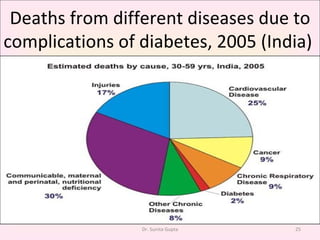
Deaths from different diseases due to complications of diabetes, 2005 (India)  Dr. Sunita Gupta
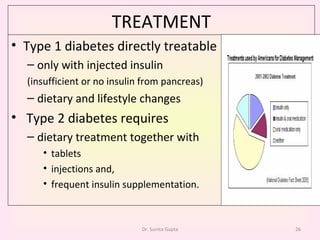
TREATMENT Type 1 diabetes directly treatable  only with injected insulin  (insufficient or no insulin from pancreas)  dietary and lifestyle changes Type 2 diabetes requires dietary treatment together with  tablets  injections and,  frequent insulin supplementation. Dr. Sunita Gupta
Prevention Other health problems that accelerate the toxic effects of diabetes are obesity,  high blood pressure, and  lack of regular exercise. elevated cholesterol levels,  smoking,  Women with high bp must be careful. They have a threefold greater risk of developing diabetes.  For people with well-controlled blood sugar levels, the complications of diabetes are far less common and less severe,  it is vital that for prevention of diabetes to organize Patient education,  His understanding of the disease, and  His participation in treatment. Dr. Sunita Gupta
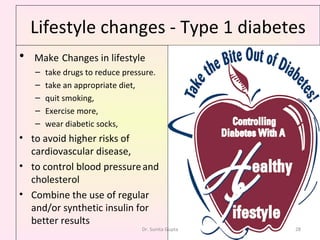
Lifestyle changes - Type 1 diabetes Make   Changes in lifestyle take drugs to reduce pressure.  take an appropriate diet,  quit smoking,  Exercise more,  wear diabetic socks,  to avoid higher risks of cardiovascular disease, to control blood pressure   and cholesterol  Combine the use of regular and/or synthetic insulin for better results Dr. Sunita Gupta
Lifestyle changes - Type 2 diabetes Reduce the risk of long term complications: This is achievable by combining  diet,  exercise and  weight loss (type 2),  various oral diabetic drugs (type 2 only), and insulin use – when not responding to oral medications (more for type 2 than type 1). Dr. Sunita Gupta
Life-style dietary changes Dr. Sunita Gupta Smaller helpings Bigger helpings Moderate helpings
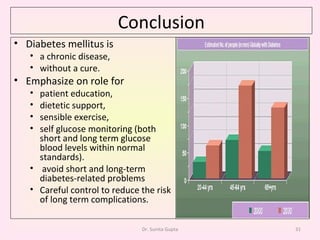
Conclusion Diabetes mellitus is  a chronic disease,  without a cure. Emphasize on role for  patient education,  dietetic support,  sensible exercise,  self glucose monitoring (both short and long term glucose blood levels within normal standards). avoid short and long-term diabetes-related problems Careful control to reduce the risk of long term complications.  Dr. Sunita Gupta
Some tips for avoiding complications Keep blood sugar levels as close to normal as possible Keep blood pressure under 130/80 mm Hg. Aim to keep LDL (unhealthy) cholesterol levels under 100 mg/dl,  Aim to keep HDL (healthy) cholesterol levels over 40 mg/dl,  Aim to keep triglyceride levels under 150 mg/dl. Practice good foot care (see "Damage to the feet and legs"). Regularly visit your doctor to assess overall health Check for ways to reduce your risk and avoid any complications. Exercise and walk daily. Dr. Sunita Gupta
Possible solutions Dr. Sunita Gupta
Any questions? Dr. Sunita Gupta
Thank You  for listening Dr. Sunita Gupta
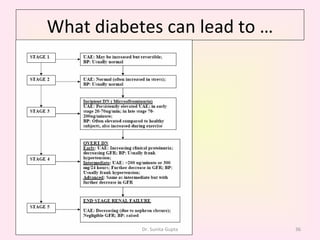
What diabetes can lead to … Dr. Sunita Gupta
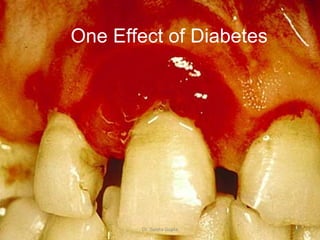
One Effect of Diabetes Dr. Sunita Gupta
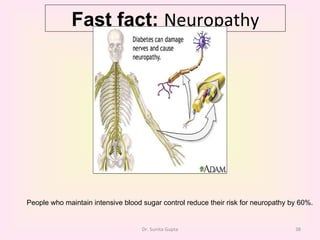
Fast fact:  Neuropathy Dr. Sunita Gupta People who maintain intensive blood sugar control reduce their risk for neuropathy by 60%.

Diabetes

  • 1.
  • 2.
    Introduction This presentationwill help you better understand and manage your diabetes. It covers the three main forms of diabetes, type 1 and type 2, as well as gestational diabetes. how your body metabolizes sugar, How to control diabetes the fundamentals of nutrition and exercise. up-to-date information about recent innovations in treatment and most importantly, you'll see that it's not just possible to live with diabetes; it's possible to live well. Dr. Sunita Gupta
  • 3.
    Insulin is theprincipal hormone in the body It plays a key role in all forms of diabetes mellitus. It regulates uptake of glucose from the bloodstream into every muscle and all fat cells, But not into the cells of the central nervous system. Deficiency of insulin or insensitivity of its receptors Causes Diabetes Miletus Dr. Sunita Gupta
  • 4.
    When our bodyfunctions normally … The normal food processing cycle food is converted to glucose before it is used by the blood and body as fuel. As a result, blood glucose levels in the body rise. In response to this, the Pancreas release Insulin into the blood. Dr. Sunita Gupta
  • 5.
    When our bodyfunctions normally … The different organs involved in the normal food processing cycle about two-thirds of the body's cells use Insulin to absorb glucose from the blood To use as fuel and To convert to other needed chemicals, or for storage. Dr. Sunita Gupta
  • 6.
    Normal glucose absorptionInsulin binds to receptors on the cell membrane, much as a key fits into a lock, signal glucose transporters Glucose transporters move to the cell membrane and bind to glucose. Glucose enters the cell. Dr. Sunita Gupta
  • 7.
    When the systemfails to absorb glucose…. Type 1 Diabetes Type 2 Diabetes Dr. Sunita Gupta An immune system attack severely limits the ability of the pancreas to produce insulin Glucose cannot enter the cells. Cells develop a resistance to insulin. Glucose builds up in the bloodstream.
  • 8.
    When the insulinis high/ low Higher insulin levels increase certain processes, like cell growth and duplication, protein synthesis, and fat storage. If the amount of insulin available is insufficient due to insulin insensitivity or resistance - poor response of the cells defective insulin, then glucose will neither be absorbed properly by those body cells that require it nor will it be stored appropriately in the liver and muscles. The net effect – persistent high levels of blood glucose, poor protein synthesis, and other metabolic derangements, such as acidosis. Dr. Sunita Gupta
  • 9.
    When the bodybegins to malfunction… Glucose, after food is absorbed from the intestines and distributed to all the body cells through the bloodstream. The glucose concentration in the blood body keeps constant and avoids extra glucose right after every meal and starves the body between the meals and overnight. The defective food processing cycle Dr. Sunita Gupta
  • 10.
    When the bodybegins to malfunction… When glucose in the body is excess stored in the liver and muscles as glycogen . When glucose is in short supply, the body stimulates to eat food and/or mobilizes the stored glycogen. To maintain a constant blood-glucose level, the body relies on pancreas to produce two hormones insulin and glucagon Insulin vs Glucagon cycle – A comparison Dr. Sunita Gupta
  • 11.
    Diabetes mellitus Diabetesmellitus (or simply diabetes) is a condition when: the organism begins to malfunction – metabolic disorder levels of the hormone insulin in the blood become insufficient the body cells fail to respond to the insulin that is produced, or both. as a result, blood sugar levels grow abnormally high (hyperglycaemia) This is Diabetes and is not curable.
  • 12.
    Types of Diabetes Diabetes mellitus – Three main forms (WHO): type 1 , type 2 , and gestational diabetes (occurs during pregnancy) Dr. Sunita Gupta
  • 13.
    SYMPTOMS The characteristicsymptoms are excessive urine production (polyuria) due to high blood glucose levels, excessive thirst and increased fluid intake (polydipsia) attempting to compensate for increased urination, blurred vision due to high blood glucose effects on the eye's optics, unexplained weight loss, and lethargy. Dr. Sunita Gupta
  • 14.
    Statistical breakup ofsymptoms Dr. Sunita Gupta
  • 15.
    CAUSES of Diabetes mellitus Type 1 diabetes - when the pancreatic cells are destroyed due to autoimmune system of the body. Type-2 diabetes - when due to high levels of blood sugar, the body is unable to utilize it’s insulin and move blood sugar into the cells to produce energy. Gestational diabetes : the hormones produced during pregnancy can cause insulin resistance in women genetically prone to develop Diabetes. Dr. Sunita Gupta
  • 16.
    Diabetes - agenetic source? Partly inheritance - Both type 1 and type 2 diabetes. At least 10 genes found - links to the causes of Type-2 diabetes. Dr. Sunita Gupta
  • 17.
    How genes influenceDiabetes? Type 1 diabetes is triggered by some (mainly viral) infections, by stress or environmental exposure (such as exposure to certain chemicals or drugs). Type 2 diabetes - a stronger inheritance pattern. If first relatives have type 2 diabetes risk of developing type 2 diabetes is much higher. This risk increases with increase in number of relatives with diabetes. Dr. Sunita Gupta
  • 18.
    diagnosis Recurrent orpersistent hyperglycaemia during Diabetes mellitus is diagnosed by any one of the following methods: fasting plasma glucose level at or above 126 mg/dL (7.0 mmol/l). plasma glucose at or above 200 mg/dL (11.1 mmol/l) two hours after a 75 g oral glucose load. random plasma glucose at or above 200 mg/dL (11.1 mmol/l). Dr. Sunita Gupta
  • 19.
    Diabetes screening Diabetesscreening is recommended at various stages of life, and For those with any of several risk factors. Diabetes screening could be a random blood glucose test, a fasting blood glucose test, a blood glucose test two hours after 75 g of glucose, or a more formal glucose tolerance test. Dr. Sunita Gupta
  • 20.
    Diabetes and ObesityThe diabetes - an epidemic because in such a short time, like infectious diseases, it has spread so quickly. Excess body fat is the leading controllable risk factor type 2 diabetes. Indians lead the world in the number of diabetic patients. Alarming rise in obesity and diabetes around the world – Diets high in saturated fat and refined carbohydrates and the modern sedentary lifestyle. Dr. Sunita Gupta Here's how all those burgers and shakes add up: Worldwide, more than 1 billion adults are overweight or obese, Roughly 300 million considered obese. In 1985, about 30 million people had diabetes. By 2025, 350 million, or more than 10 times as many will suffer from this disease. Worldwide, the disease is the fourth leading cause of death.

  • 21.
    Incidence of diabetesbetween men and women Relation between BMI and incidence of diabetes Prevalence of diabetes between men and women across age Dr. Sunita Gupta
  • 22.
    Impact of Diabeteson other diseases - complications Dr. Sunita Gupta
  • 23.
    Complications from DiabetesCareless treatment or its poor management lead to serious complications ….. Diabetes causes: Damage to eyes heart disease and stroke, retinal damage (blindness), chronic renal (kidney) failure, Poor healing of wounds (gangrene) amputations Impotence and difficulty passing urine in adults. Dr. Sunita Gupta
  • 24.
    Acute complications fromDiabetes If Diabetes is not controlled properly, acute complications may occur, like dehydration hypoglycemia, ketosis, acidosis. Coma and Even death Dr. Sunita Gupta
  • 25.
    Deaths from differentdiseases due to complications of diabetes, 2005 (India) Dr. Sunita Gupta
  • 26.
    TREATMENT Type 1 diabetesdirectly treatable only with injected insulin (insufficient or no insulin from pancreas) dietary and lifestyle changes Type 2 diabetes requires dietary treatment together with tablets injections and, frequent insulin supplementation. Dr. Sunita Gupta
  • 27.
    Prevention Other healthproblems that accelerate the toxic effects of diabetes are obesity, high blood pressure, and lack of regular exercise. elevated cholesterol levels, smoking, Women with high bp must be careful. They have a threefold greater risk of developing diabetes. For people with well-controlled blood sugar levels, the complications of diabetes are far less common and less severe, it is vital that for prevention of diabetes to organize Patient education, His understanding of the disease, and His participation in treatment. Dr. Sunita Gupta
  • 28.
    Lifestyle changes -Type 1 diabetes Make Changes in lifestyle take drugs to reduce pressure. take an appropriate diet, quit smoking, Exercise more, wear diabetic socks, to avoid higher risks of cardiovascular disease, to control blood pressure and cholesterol Combine the use of regular and/or synthetic insulin for better results Dr. Sunita Gupta
  • 29.
    Lifestyle changes -Type 2 diabetes Reduce the risk of long term complications: This is achievable by combining diet, exercise and weight loss (type 2), various oral diabetic drugs (type 2 only), and insulin use – when not responding to oral medications (more for type 2 than type 1). Dr. Sunita Gupta
  • 30.
    Life-style dietary changesDr. Sunita Gupta Smaller helpings Bigger helpings Moderate helpings
  • 31.
    Conclusion Diabetes mellitusis a chronic disease, without a cure. Emphasize on role for patient education, dietetic support, sensible exercise, self glucose monitoring (both short and long term glucose blood levels within normal standards). avoid short and long-term diabetes-related problems Careful control to reduce the risk of long term complications. Dr. Sunita Gupta
  • 32.
    Some tips foravoiding complications Keep blood sugar levels as close to normal as possible Keep blood pressure under 130/80 mm Hg. Aim to keep LDL (unhealthy) cholesterol levels under 100 mg/dl, Aim to keep HDL (healthy) cholesterol levels over 40 mg/dl, Aim to keep triglyceride levels under 150 mg/dl. Practice good foot care (see "Damage to the feet and legs"). Regularly visit your doctor to assess overall health Check for ways to reduce your risk and avoid any complications. Exercise and walk daily. Dr. Sunita Gupta
  • 33.
  • 34.
    Any questions? Dr.Sunita Gupta
  • 35.
    Thank You for listening Dr. Sunita Gupta
  • 36.
    What diabetes canlead to … Dr. Sunita Gupta
  • 37.
    One Effect ofDiabetes Dr. Sunita Gupta
  • 38.
    Fast fact: Neuropathy Dr. Sunita Gupta People who maintain intensive blood sugar control reduce their risk for neuropathy by 60%.