DIABETIC
    MELLITUS
H O T   E N G I N E E R I N G   &   C O N S T R C U T I O N   C O .   K . S . C . C .
.
     At the end of the session each participant will be able
        to:

     Know what is diabetic .
     Understand the normal and abnormal blood sugar
        level.
       Identify the causes of diabetic mellitus.
       Know how to prevent high blood sugar.
       Understand the significance of blood sugar (glucose )
        in health promotion and disease prevention.
       Discuss the importance of lifestyle changes in the
        management of blood sugar under control.
       Understand the risks of untreated diabetic .

                                                                                            3
    H O T   E N G I N E E R I N G   &   C O N S T R C U T I O N   C O .   K . S . C . C .
WHAT IS DIABETIC OR HIGH
             BLOOD SUGAR?


H O T   E N G I N E E R I N G   &   C O N S T R C U T I O N   C O .   K . S . C . C .
                                                                                        4
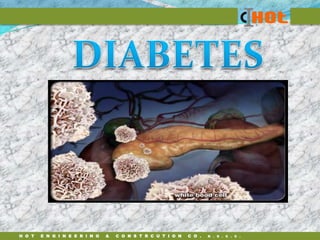
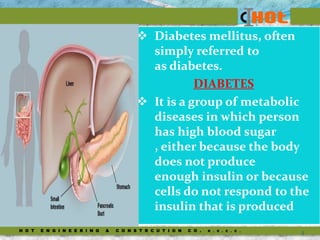
 Diabetes mellitus, often
                                             simply referred to
                                             as diabetes.
                                                      DIABETES
                                            It is a group of metabolic
                                             diseases in which person
                                             has high blood sugar
                                             , either because the body
                                             does not produce
                                             enough insulin or because
                                             cells do not respond to the
                                             insulin that is produced
H O T   E N G I N E E R I N G   &   C O N S T R C U T I O N   C O .   K . S . C . C .
                                                                                        5
BLOOD SUGAR VALUES


H O T   E N G I N E E R I N G   &   C O N S T R C U T I O N   C O .   K . S . C . C .
                                                                                        6
TYPES OF DIABETES

Two types mainly
 Type 1 diabetes can occur at any
    age, but it is most often diagnosed in
    children, teens, or young adults.
o    In this disease, the body makes little or
    no insulin. Daily injections of insulin
    are needed.
o    The exact cause is unknown.
      Type 2 diabetes makes up most of
    diabetes cases.
o    It most often occurs in adulthood, but
    teens and young adults are now being
    diagnosed with it because of high
    obesity rates.
o    Many people with type 2 diabetes do
    not know they have it.
    H O T   E N G I N E E R I N G   &   C O N S T R C U T I O N   C O .   K . S . C . C .
                                                                                            7
Complications of diabetes


 Diabetic foot
 Your feet and skin can
 develop sores and
 infections. After a long
 time, your foot or leg
 may need to be
 removed. Infection can
 also cause pain and
 itching in other parts of
 the body.


H O T   E N G I N E E R I N G   &   C O N S T R C U T I O N   C O .   K . S . C . C .
                                                                                        8
Damage: Arteries
 diabetes are likely to
 develop plaque in
 their arteries,
 reducing blood flow
 and increasing risk
 of clots. This
 hardening of the
 arteries
 (atherosclerosis)
 raises the risk of
 heart attack and
 stroke.


H O T   E N G I N E E R I N G   &   C O N S T R C U T I O N   C O .   K . S . C . C .
                                                                                        9
Vision problems
 You could have eye
 problems, including
 trouble seeing
 (especially at night)
 and light sensitivity.
 You could become
 blind.


H O T   E N G I N E E R I N G   &   C O N S T R C U T I O N   C O .   K . S . C . C .
                                                                                        10
kidney damage
 High blood sugar
 and other
 problems can lead
 to kidney damage.
 The kidneys might
 not work as well,
 and they may even
 stop working


                                                                                        11
H O T   E N G I N E E R I N G   &   C O N S T R C U T I O N   C O .   K . S . C . C .
IMPORTANT SINGS OF DIABETES


H O T   E N G I N E E R I N G   &   C O N S T R C U T I O N   C O .   K . S . C . C .
                                                                                        12
OTHER SIGNS & SYMPTOMS


H O T   E N G I N E E R I N G   &   C O N S T R C U T I O N   C O .   K . S . C . C .
                                                                                        13
How can we control our blood sugar?


                                                                                        14
H O T   E N G I N E E R I N G   &   C O N S T R C U T I O N   C O .   K . S . C . C .
Follow the healthy
                                                              eating plan that
                                                              controls blood
                                                              sugar. Eg: habits
                                                              like drinking tea
                                                              with out sugar.

                                                                                        15
H O T   E N G I N E E R I N G   &   C O N S T R C U T I O N   C O .   K . S . C . C .
Be active a total of 30
                                           minutes most days. Ask
                                           your doctor what
                                           activities are best for
                                           you. Before you going to
                                           start any exercise .

                                                                                        16
H O T   E N G I N E E R I N G   &   C O N S T R C U T I O N   C O .   K . S . C . C .
Take your medicines as
                                                    directed by doctor .
                                                    Never skip a dose with
                                                    out permission .
                                                                                        17
H O T   E N G I N E E R I N G   &   C O N S T R C U T I O N   C O .   K . S . C . C .
Check your blood
                                                    glucose . Each time you
                                                    check your blood
                                                    glucose, write the
                                                    number in your record
                                                    book.


                                                                                        18
H O T   E N G I N E E R I N G   &   C O N S T R C U T I O N   C O .   K . S . C . C .
Check your feet every
                                               day for
                                               cuts, blisters, sores, swell
                                               ing, redness, or sore
                                               toenails
                                                                                        19
H O T   E N G I N E E R I N G   &   C O N S T R C U T I O N   C O .   K . S . C . C .
Control your
                                                              blood pressure
                                                              and cholesterol.
                                                              Keep both values
                                                              are in normal
                                                              range .


H O T   E N G I N E E R I N G   &   C O N S T R C U T I O N   C O .   K . S . C . C .   20
Don't smoke.


                                                                                        21
H O T   E N G I N E E R I N G   &   C O N S T R C U T I O N   C O .   K . S . C . C .
Living With diabetes

                                                • Ddiabetes is often a life-long
                                                  condition .
                                                • It's important to take your
                                                  medications and continue to
                                                  monitor your blood sugar.
                                                • If you keep it under control,
                                                  you can live longer


                                                                                          22
  H O T   E N G I N E E R I N G   &   C O N S T R C U T I O N   C O .   K . S . C . C .
Type – I Diabetes
This condition results from lack of enough Insulin production, and
requires supplementation by Insulin, hence also called Insulin
Dependent Diabetes or IDDM. It generally affects the affected
person at a younger age, often below thirty, hence also called
Juvenile Diabetes. It is believed to occur due to damage to Insulin
producing beta cells of Islet of Langerhans in Pancreas. The cause is
not fully understood, but in a large number of cases, it may be due to
abnormal immune reaction of the body that is precipitated by
certain virus infection. Coxsackie B4 virus has been implicated in
many studies. Genetic predisposition of the individual may also
make the person vulnerable to the occurrence of Type I Diabetes. It
often leads to weight loss in spite of a very healthy appetite. This
happens because the glucose absorbed from intestines is neither
taken up by cells for use, nor is it converted into fat by the fat cells.
Type I Diabetes affects around 10% of all diabetic patients.

                                                                                           23
   H O T   E N G I N E E R I N G   &   C O N S T R C U T I O N   C O .   K . S . C . C .
Type – II Diabetes
This is the far more common variety of Diabetes, affecting nearly 90% of all
Diabetics, and is usually diagnosed in the latter part of life, leading to the
term Adult Onset Diabetes Mellitus (AODM). The primary defect in this
condition lies in the inadequate responsiveness of the body cells to Insulin. Every
cell has numerous ‘receptors’ with which Insulin present in blood binds to bring
about its impact. In Type II Diabetes, these receptors are defective because of
which the body does not respond to Insulin, a condition also termed Insulin
Resistance. As time goes by, the body attempts to overcome the defect by
producing more and more of Insulin and gradually a phase of Insulin depletion
sets in, worsening the condition even further. The exact cause of this condition is
also not known, but there are many factors that increase the risk of its
development. Most important of them is body weight, and hence reducing weight
is one of the best ways to prevent or control Diabetes. There is a very strong role of
genetic predisposition here too, perhaps even more than Type I variety. The
treatment strategy of this type is different from Type I Diabetes, and primarily
involves weight reduction, dietary control, exercise and oral hypoglycemic
medicines. Only If Diabetes is not controlled with them, then Insulin may need to
be given. Hence it is also called Non Insulin Dependent Diabetes
Mellitus or NIDDM.
                                                                                            24
    H O T   E N G I N E E R I N G   &   C O N S T R C U T I O N   C O .   K . S . C . C .
H O T   E N G I N E E R I N G   &   C O N S T R C U T I O N   C O .   K . S . C . C .
                                                                                        25

Diabetes power point_presentation

  • 1.
    DIABETIC MELLITUS H O T E N G I N E E R I N G & C O N S T R C U T I O N C O . K . S . C . C .
  • 2.
    H O T E N G I N E E R I N G & C O N S T R C U T I O N C O . K . S . C . C .
  • 3.
    .  At the end of the session each participant will be able to:  Know what is diabetic .  Understand the normal and abnormal blood sugar level.  Identify the causes of diabetic mellitus.  Know how to prevent high blood sugar.  Understand the significance of blood sugar (glucose ) in health promotion and disease prevention.  Discuss the importance of lifestyle changes in the management of blood sugar under control.  Understand the risks of untreated diabetic . 3 H O T E N G I N E E R I N G & C O N S T R C U T I O N C O . K . S . C . C .
  • 4.
    WHAT IS DIABETICOR HIGH BLOOD SUGAR? H O T E N G I N E E R I N G & C O N S T R C U T I O N C O . K . S . C . C . 4
  • 5.
     Diabetes mellitus,often simply referred to as diabetes. DIABETES  It is a group of metabolic diseases in which person has high blood sugar , either because the body does not produce enough insulin or because cells do not respond to the insulin that is produced H O T E N G I N E E R I N G & C O N S T R C U T I O N C O . K . S . C . C . 5
  • 6.
    BLOOD SUGAR VALUES HO T E N G I N E E R I N G & C O N S T R C U T I O N C O . K . S . C . C . 6
  • 7.
    TYPES OF DIABETES Twotypes mainly Type 1 diabetes can occur at any age, but it is most often diagnosed in children, teens, or young adults. o In this disease, the body makes little or no insulin. Daily injections of insulin are needed. o The exact cause is unknown. Type 2 diabetes makes up most of diabetes cases. o It most often occurs in adulthood, but teens and young adults are now being diagnosed with it because of high obesity rates. o Many people with type 2 diabetes do not know they have it. H O T E N G I N E E R I N G & C O N S T R C U T I O N C O . K . S . C . C . 7
  • 8.
    Complications of diabetes Diabetic foot Your feet and skin can develop sores and infections. After a long time, your foot or leg may need to be removed. Infection can also cause pain and itching in other parts of the body. H O T E N G I N E E R I N G & C O N S T R C U T I O N C O . K . S . C . C . 8
  • 9.
    Damage: Arteries diabetesare likely to develop plaque in their arteries, reducing blood flow and increasing risk of clots. This hardening of the arteries (atherosclerosis) raises the risk of heart attack and stroke. H O T E N G I N E E R I N G & C O N S T R C U T I O N C O . K . S . C . C . 9
  • 10.
    Vision problems Youcould have eye problems, including trouble seeing (especially at night) and light sensitivity. You could become blind. H O T E N G I N E E R I N G & C O N S T R C U T I O N C O . K . S . C . C . 10
  • 11.
    kidney damage Highblood sugar and other problems can lead to kidney damage. The kidneys might not work as well, and they may even stop working 11 H O T E N G I N E E R I N G & C O N S T R C U T I O N C O . K . S . C . C .
  • 12.
    IMPORTANT SINGS OFDIABETES H O T E N G I N E E R I N G & C O N S T R C U T I O N C O . K . S . C . C . 12
  • 13.
    OTHER SIGNS &SYMPTOMS H O T E N G I N E E R I N G & C O N S T R C U T I O N C O . K . S . C . C . 13
  • 14.
    How can wecontrol our blood sugar? 14 H O T E N G I N E E R I N G & C O N S T R C U T I O N C O . K . S . C . C .
  • 15.
    Follow the healthy eating plan that controls blood sugar. Eg: habits like drinking tea with out sugar. 15 H O T E N G I N E E R I N G & C O N S T R C U T I O N C O . K . S . C . C .
  • 16.
    Be active atotal of 30 minutes most days. Ask your doctor what activities are best for you. Before you going to start any exercise . 16 H O T E N G I N E E R I N G & C O N S T R C U T I O N C O . K . S . C . C .
  • 17.
    Take your medicinesas directed by doctor . Never skip a dose with out permission . 17 H O T E N G I N E E R I N G & C O N S T R C U T I O N C O . K . S . C . C .
  • 18.
    Check your blood glucose . Each time you check your blood glucose, write the number in your record book. 18 H O T E N G I N E E R I N G & C O N S T R C U T I O N C O . K . S . C . C .
  • 19.
    Check your feetevery day for cuts, blisters, sores, swell ing, redness, or sore toenails 19 H O T E N G I N E E R I N G & C O N S T R C U T I O N C O . K . S . C . C .
  • 20.
    Control your blood pressure and cholesterol. Keep both values are in normal range . H O T E N G I N E E R I N G & C O N S T R C U T I O N C O . K . S . C . C . 20
  • 21.
    Don't smoke. 21 H O T E N G I N E E R I N G & C O N S T R C U T I O N C O . K . S . C . C .
  • 22.
    Living With diabetes • Ddiabetes is often a life-long condition . • It's important to take your medications and continue to monitor your blood sugar. • If you keep it under control, you can live longer 22 H O T E N G I N E E R I N G & C O N S T R C U T I O N C O . K . S . C . C .
  • 23.
    Type – IDiabetes This condition results from lack of enough Insulin production, and requires supplementation by Insulin, hence also called Insulin Dependent Diabetes or IDDM. It generally affects the affected person at a younger age, often below thirty, hence also called Juvenile Diabetes. It is believed to occur due to damage to Insulin producing beta cells of Islet of Langerhans in Pancreas. The cause is not fully understood, but in a large number of cases, it may be due to abnormal immune reaction of the body that is precipitated by certain virus infection. Coxsackie B4 virus has been implicated in many studies. Genetic predisposition of the individual may also make the person vulnerable to the occurrence of Type I Diabetes. It often leads to weight loss in spite of a very healthy appetite. This happens because the glucose absorbed from intestines is neither taken up by cells for use, nor is it converted into fat by the fat cells. Type I Diabetes affects around 10% of all diabetic patients. 23 H O T E N G I N E E R I N G & C O N S T R C U T I O N C O . K . S . C . C .
  • 24.
    Type – IIDiabetes This is the far more common variety of Diabetes, affecting nearly 90% of all Diabetics, and is usually diagnosed in the latter part of life, leading to the term Adult Onset Diabetes Mellitus (AODM). The primary defect in this condition lies in the inadequate responsiveness of the body cells to Insulin. Every cell has numerous ‘receptors’ with which Insulin present in blood binds to bring about its impact. In Type II Diabetes, these receptors are defective because of which the body does not respond to Insulin, a condition also termed Insulin Resistance. As time goes by, the body attempts to overcome the defect by producing more and more of Insulin and gradually a phase of Insulin depletion sets in, worsening the condition even further. The exact cause of this condition is also not known, but there are many factors that increase the risk of its development. Most important of them is body weight, and hence reducing weight is one of the best ways to prevent or control Diabetes. There is a very strong role of genetic predisposition here too, perhaps even more than Type I variety. The treatment strategy of this type is different from Type I Diabetes, and primarily involves weight reduction, dietary control, exercise and oral hypoglycemic medicines. Only If Diabetes is not controlled with them, then Insulin may need to be given. Hence it is also called Non Insulin Dependent Diabetes Mellitus or NIDDM. 24 H O T E N G I N E E R I N G & C O N S T R C U T I O N C O . K . S . C . C .
  • 25.
    H O T E N G I N E E R I N G & C O N S T R C U T I O N C O . K . S . C . C . 25