Marielle Leveillard
Chronicle Disease and Compliance
Dr. Lisa Price-Stevens
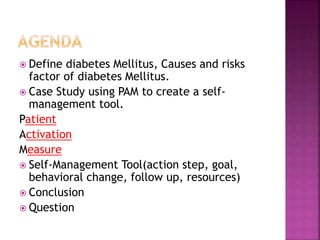
 Define diabetes Mellitus, Causes and risks
factor of diabetes Mellitus.
 Case Study using PAM to create a self-
management tool.
Patient
Activation
Measure
 Self-Management Tool(action step, goal,
behavioral change, follow up, resources)
 Conclusion
 Question
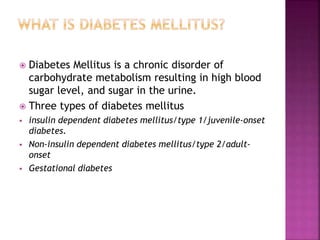
 Diabetes Mellitus is a chronic disorder of
carbohydrate metabolism resulting in high blood
sugar level, and sugar in the urine.
 Three types of diabetes mellitus
ď‚§ insulin dependent diabetes mellitus/type 1/juvenile-onset
diabetes.
ď‚§ Non-insulin dependent diabetes mellitus/type 2/adult-
onset
ď‚§ Gestational diabetes
 Risk Factors for Type 1 Diabetes: Family history,
Diseases of the pancreas, Infection or illness.
 Risk Factors for Type 2 Diabetes: Obesity or being
overweight, Ethnic background, High blood pressure,
cholesterol and high triglyceride levels.
 Kate is a 21 year-old beauty queen who was just diagnosed with Type 1
Diabetes Mellitus. She knew that something was wrong when she begin to
unintentionally lose weight, have increased thirst and urination.
 Kate decided to learn everything she could about her disorder. She
changed her diet, decided to use the insulin pump. For the first year of
her diagnosis she was doing well.
 So well that she begin to drift away from her usual routine. She did not
always put her pump on , especially if she was feeling good. She begin to
hang out with other beauty queens and they would often go out for
Martinis quite often.
 She went to see her endocrinologist because she was having some blurred
vision. He physician advised her that her blood glucose was high. He was
concerned that she was losing her way. She told him she was tired of
being a diabetic and wanted to be like normal young adults.
 Her provider was concerned because she had not been to her eye
provider since she was diagnosed, even though he recommended it. She
was also gain weight and was getting frequent infections.
 He ask you, the office educator, to see her before she leaves. You meet
with you and administer the Patient Activation Measure. Her level was 3.
You begin to work with her to develop a Self Management Tool.
 Increasing level of activation: there are 4
levels. Level(starting to take a role), level2(
building knowledge and confident),
level3(taking action), and level4(maintaining
behaviors).
 My patient, Kate is level3, Kate is begging to
take action and start helping herself.
 As Kate health educator my job is to provide
her with encouragement, coaching her and
giving her more confident.
 Understand Kate situation
 Educating Kate about diabetes Mellitus,
 Patient Opinion: diet, physical activities,
medical history, diet pill.
 Accomplishment: what is it she want to gain
from all this.
 Solution: help the patient develop a follow
up plan.
 Action plan: develop a confident grading
plan, assure the patient is on board.
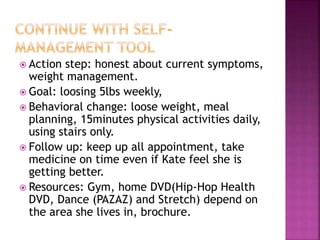
 Action step: honest about current symptoms,
weight management.
 Goal: loosing 5lbs weekly,
 Behavioral change: loose weight, meal
planning, 15minutes physical activities daily,
using stairs only.
 Follow up: keep up all appointment, take
medicine on time even if Kate feel she is
getting better.
 Resources: Gym, home DVD(Hip-Hop Health
DVD, Dance (PAZAZ) and Stretch) depend on
the area she lives in, brochure.
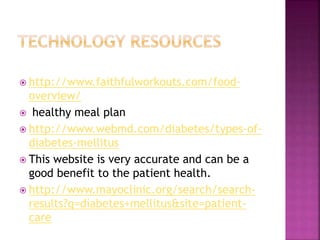
 http://www.faithfulworkouts.com/food-
overview/
 healthy meal plan
 http://www.webmd.com/diabetes/types-of-
diabetes-mellitus
 This website is very accurate and can be a
good benefit to the patient health.
 http://www.mayoclinic.org/search/search-
results?q=diabetes+mellitus&site=patient-
care
 http://www.webmd.com/diabetes/risk-
factors-for-diabetes#1
 http://e-patients.net/archives/2011/10/the-
patient-activation-measure-pam-a-
framework-for-developing-patient-
engagement.html

diabetes mellitus project

  • 1.
    Marielle Leveillard Chronicle Diseaseand Compliance Dr. Lisa Price-Stevens
  • 2.
     Define diabetesMellitus, Causes and risks factor of diabetes Mellitus.  Case Study using PAM to create a self- management tool. Patient Activation Measure  Self-Management Tool(action step, goal, behavioral change, follow up, resources)  Conclusion  Question
  • 3.
     Diabetes Mellitusis a chronic disorder of carbohydrate metabolism resulting in high blood sugar level, and sugar in the urine.  Three types of diabetes mellitus  insulin dependent diabetes mellitus/type 1/juvenile-onset diabetes.  Non-insulin dependent diabetes mellitus/type 2/adult- onset  Gestational diabetes
  • 4.
     Risk Factorsfor Type 1 Diabetes: Family history, Diseases of the pancreas, Infection or illness.  Risk Factors for Type 2 Diabetes: Obesity or being overweight, Ethnic background, High blood pressure, cholesterol and high triglyceride levels.
  • 5.
     Kate isa 21 year-old beauty queen who was just diagnosed with Type 1 Diabetes Mellitus. She knew that something was wrong when she begin to unintentionally lose weight, have increased thirst and urination.  Kate decided to learn everything she could about her disorder. She changed her diet, decided to use the insulin pump. For the first year of her diagnosis she was doing well.  So well that she begin to drift away from her usual routine. She did not always put her pump on , especially if she was feeling good. She begin to hang out with other beauty queens and they would often go out for Martinis quite often.  She went to see her endocrinologist because she was having some blurred vision. He physician advised her that her blood glucose was high. He was concerned that she was losing her way. She told him she was tired of being a diabetic and wanted to be like normal young adults.  Her provider was concerned because she had not been to her eye provider since she was diagnosed, even though he recommended it. She was also gain weight and was getting frequent infections.  He ask you, the office educator, to see her before she leaves. You meet with you and administer the Patient Activation Measure. Her level was 3. You begin to work with her to develop a Self Management Tool.
  • 6.
     Increasing levelof activation: there are 4 levels. Level(starting to take a role), level2( building knowledge and confident), level3(taking action), and level4(maintaining behaviors).  My patient, Kate is level3, Kate is begging to take action and start helping herself.  As Kate health educator my job is to provide her with encouragement, coaching her and giving her more confident.  Understand Kate situation
  • 7.
     Educating Kateabout diabetes Mellitus,  Patient Opinion: diet, physical activities, medical history, diet pill.  Accomplishment: what is it she want to gain from all this.  Solution: help the patient develop a follow up plan.  Action plan: develop a confident grading plan, assure the patient is on board.
  • 8.
     Action step:honest about current symptoms, weight management.  Goal: loosing 5lbs weekly,  Behavioral change: loose weight, meal planning, 15minutes physical activities daily, using stairs only.  Follow up: keep up all appointment, take medicine on time even if Kate feel she is getting better.  Resources: Gym, home DVD(Hip-Hop Health DVD, Dance (PAZAZ) and Stretch) depend on the area she lives in, brochure.
  • 9.
     http://www.faithfulworkouts.com/food- overview/  healthymeal plan  http://www.webmd.com/diabetes/types-of- diabetes-mellitus  This website is very accurate and can be a good benefit to the patient health.  http://www.mayoclinic.org/search/search- results?q=diabetes+mellitus&site=patient- care
  • 10.

Editor's Notes

  • #4 Type 1 develop early in life when the pancreas stop producing insulin/ juvenile-onset diabetes because it often begging in childhood. Type 2 develop later the pancreas produce normal to high level of insulin, therefore the cell fail to respond to the insulin. adult-onset diabetes because adult use develop it, but with obesity, overweight in kid more teenager are now developing type 2 diabetes mellitus.
  • #5 Diseases of the pancreas. Injury or diseases of the pancreas can inhibit its ability to produce insulin and lead to type 1 diabetes. Infection or illness. A range of relatively rare infections and illnesses can damage the pancreas and cause type 1 diabetes
  • #7 Does not yet believe they have active/important role Lack confidence and knowledge to take action Beginning to take action Maintaining behavior over time