DIABETES
ITS CAUSES AND IMPLICATIONS
PRESENTED BY:
JAYENDRA JHA
OPTOMETRIST
C. L GUPTA EYE INSTITUTE
MORADABAD (U.P)
DIABETES: THINGS TO CONSIDER…
• What is Diabetes? What are the statistics?
• What are the different types of Diabetes?
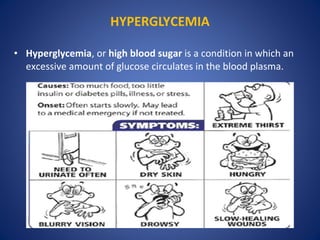
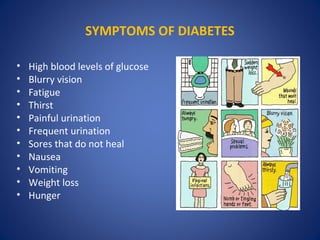
• What are the symptoms?
• How does it transmit?
• How do I get tested for diabetes?
• How can I prevent or control diabetes?
• What parts of the body does diabetes affect?
• Can diabetes be cured?
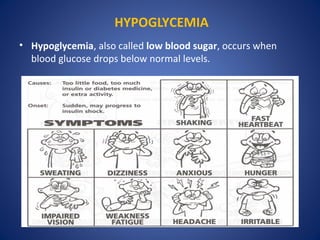
• Hypoglycemia, also called low blood sugar, occurs when
blood glucose drops below normal levels.
HYPOGLYCEMIA
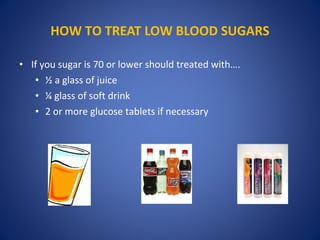
• If you sugar is 70 or lower should treated with….
• ½ a glass of juice
• ¼ glass of soft drink
• 2 or more glucose tablets if necessary
HOW TO TREAT LOW BLOOD SUGARS
• Hyperglycemia, or high blood sugar is a condition in which an
excessive amount of glucose circulates in the blood plasma.
HYPERGLYCEMIA
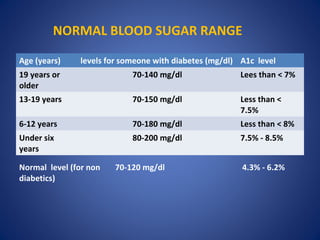
NORMAL BLOOD SUGAR RANGE
Age (years) levels for someone with diabetes (mg/dl) A1c level
19 years or
older
70-140 mg/dl Lees than < 7%
13-19 years 70-150 mg/dl Less than <
7.5%
6-12 years 70-180 mg/dl Less than < 8%
Under six
years
80-200 mg/dl 7.5% - 8.5%
Normal level (for non
diabetics)
70-120 mg/dl 4.3% - 6.2%
DIABETES
• Globally, an estimated 422 million
adults are living with diabetes mellitus
according to the 2016 data from
the World Health Organization (WHO).
• Diabetes currently affects more than 62
million Indians, 7.1% of the adult
population. The average age on onset is
42.5 years. Nearly 1 million Indians die
due to diabetes every year.
• Diabetes can be referred to as a chronic
disease characterized by high levels of
sugar(glucose) in the blood
HOW DOES THIS HAPPENS
• Glucose enters the bloodstream from food we eat. This is
later used for fuel in the body. Our pancreas located
near the stomach makes insulin, which plays a role in
moving glucose to muscles, liver cells, and fat.
• The pancreas then fails to make enough insulin.
• Fat or liver cells fail to respond to the insulin properly.
• As a result, our body’s cells are starving for energy and
over time, high blood glucose levels change our overall
health damaging the kidney, heart, eyes, and nerves
TYPES OF DIABETES
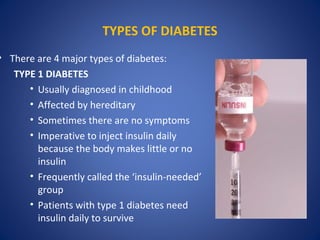
• There are 4 major types of diabetes:
TYPE 1 DIABETES
• Usually diagnosed in childhood
• Affected by hereditary
• Sometimes there are no symptoms
• Imperative to inject insulin daily
because the body makes little or no
insulin
• Frequently called the ‘insulin-needed’
group
• Patients with type 1 diabetes need
insulin daily to survive
TYPES OF DIABETES (CONT.…)
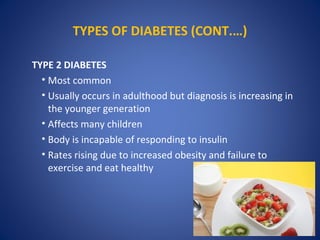
TYPE 2 DIABETES
• Most common
• Usually occurs in adulthood but diagnosis is increasing in
the younger generation
• Affects many children
• Body is incapable of responding to insulin
• Rates rising due to increased obesity and failure to
exercise and eat healthy
TYPES OF DIABETES (CONT.…)
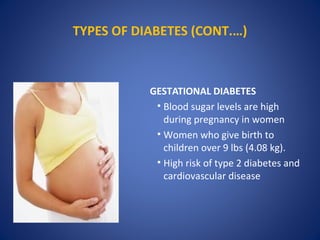
GESTATIONAL DIABETES
• Blood sugar levels are high
during pregnancy in women
• Women who give birth to
children over 9 lbs (4.08 kg).
• High risk of type 2 diabetes and
cardiovascular disease
TYPES OF DIABETES (CONT.…)
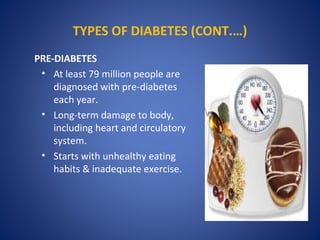
PRE-DIABETES
• At least 79 million people are
diagnosed with pre-diabetes
each year.
• Long-term damage to body,
including heart and circulatory
system.
• Starts with unhealthy eating
habits & inadequate exercise.
SYMPTOMS OF DIABETES
• High blood levels of glucose
• Blurry vision
• Fatigue
• Thirst
• Painful urination
• Frequent urination
• Sores that do not heal
• Nausea
• Vomiting
• Weight loss
• Hunger
HOW DOES DIABETES TRANSMIT
• Genetically (type 1 diabetes, pre-
diabetes, gestational)
• Can develop due to poor diet &
inadequate exercise.
• Develops due to following factors
–Overweight
–High blood pressure
–High cholesterol
–Family history of diabetes
–Family history of gestational
diabetes
TESTING FOR DIABETES
FPG (Fasting Plasma Glucose Test)
• Patient must fast for eight hours
• Doctor draws blood
• Doctor will mix blood with other liquids to determine the
amount of sugar or glucose in the blood
• This is measured in mg/dl
• Blood glucose range for pre-diabetics will be in the 100-
125 mg/dl range.
• Type 2 diabetes will have blood sugar results in the range
of 126 mg/dl and above
• These levels can increase the risk of heart disease and
stroke
TESTING FOR DIABETES
OGTT (Oral Glucose Tolerance Test)
• Doctor measures how well your body reacts to average
dose of sugar.
• Patient will be drawn blood two hours before and after
he/she drinks pre-mixed beverage with the sugar.
• Blood glucose levels are measured to see how the body
reacted.
• Blood glucose range for pre-diabetics will be between
140-199 mg/dl.
• For those with type 2 diabetes, the range will start at
200 mg/dl and continue to peak
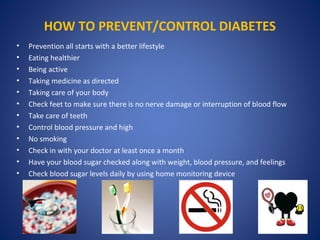
HOW TO PREVENT/CONTROL DIABETES
• Prevention all starts with a better lifestyle
• Eating healthier
• Being active
• Taking medicine as directed
• Taking care of your body
• Check feet to make sure there is no nerve damage or interruption of blood flow
• Take care of teeth
• Control blood pressure and high
• No smoking
• Check in with your doctor at least once a month
• Have your blood sugar checked along with weight, blood pressure, and feelings
• Check blood sugar levels daily by using home monitoring device
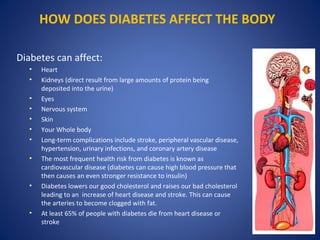
HOW DOES DIABETES AFFECT THE BODY
Diabetes can affect:
• Heart
• Kidneys (direct result from large amounts of protein being
deposited into the urine)
• Eyes
• Nervous system
• Skin
• Your Whole body
• Long-term complications include stroke, peripheral vascular disease,
hypertension, urinary infections, and coronary artery disease
• The most frequent health risk from diabetes is known as
cardiovascular disease (diabetes can cause high blood pressure that
then causes an even stronger resistance to insulin)
• Diabetes lowers our good cholesterol and raises our bad cholesterol
leading to an increase of heart disease and stroke. This can cause
the arteries to become clogged with fat.
• At least 65% of people with diabetes die from heart disease or
stroke
CAN DIABETES BE CURED
• Unfortunately, there is not yet a cure for diabetes
• There are always new facts and discoveries being made every
day.
• Doctors are providing treatment that can lower symptoms of
diabetes of all types, which can reduce pain.
• By following a good diet and exercise plan, body may be able to
use insulin minimally, or none at all in cases besides type 1
REFRENCES
• Wikipedia
• Comprehensive Ophthalmology by A.K Khurana
• Ross and Wilson’s Anatomy and Physiology
“Diabetes can be controlled and does not have to keep people from
achieving their dreams”
Michael Hunter
World’s only insulin-dependent air show stunt pilot
-
First diabetic person to receive the
Federal Aviation Administration
Low altitude airshow license
REMEMBER..TAKE CONTROL OF YOUR LIFE!
DON’T LET DIABETES CONTROL YOU!

Diabetes

  • 1.
    DIABETES ITS CAUSES ANDIMPLICATIONS PRESENTED BY: JAYENDRA JHA OPTOMETRIST C. L GUPTA EYE INSTITUTE MORADABAD (U.P)
  • 2.
    DIABETES: THINGS TOCONSIDER… • What is Diabetes? What are the statistics? • What are the different types of Diabetes? • What are the symptoms? • How does it transmit? • How do I get tested for diabetes? • How can I prevent or control diabetes? • What parts of the body does diabetes affect? • Can diabetes be cured?
  • 3.
    • Hypoglycemia, alsocalled low blood sugar, occurs when blood glucose drops below normal levels. HYPOGLYCEMIA
  • 4.
    • If yousugar is 70 or lower should treated with…. • ½ a glass of juice • ¼ glass of soft drink • 2 or more glucose tablets if necessary HOW TO TREAT LOW BLOOD SUGARS
  • 5.
    • Hyperglycemia, orhigh blood sugar is a condition in which an excessive amount of glucose circulates in the blood plasma. HYPERGLYCEMIA
  • 6.
    NORMAL BLOOD SUGARRANGE Age (years) levels for someone with diabetes (mg/dl) A1c level 19 years or older 70-140 mg/dl Lees than < 7% 13-19 years 70-150 mg/dl Less than < 7.5% 6-12 years 70-180 mg/dl Less than < 8% Under six years 80-200 mg/dl 7.5% - 8.5% Normal level (for non diabetics) 70-120 mg/dl 4.3% - 6.2%
  • 7.
    DIABETES • Globally, anestimated 422 million adults are living with diabetes mellitus according to the 2016 data from the World Health Organization (WHO). • Diabetes currently affects more than 62 million Indians, 7.1% of the adult population. The average age on onset is 42.5 years. Nearly 1 million Indians die due to diabetes every year. • Diabetes can be referred to as a chronic disease characterized by high levels of sugar(glucose) in the blood
  • 8.
    HOW DOES THISHAPPENS • Glucose enters the bloodstream from food we eat. This is later used for fuel in the body. Our pancreas located near the stomach makes insulin, which plays a role in moving glucose to muscles, liver cells, and fat. • The pancreas then fails to make enough insulin. • Fat or liver cells fail to respond to the insulin properly. • As a result, our body’s cells are starving for energy and over time, high blood glucose levels change our overall health damaging the kidney, heart, eyes, and nerves
  • 9.
    TYPES OF DIABETES •There are 4 major types of diabetes: TYPE 1 DIABETES • Usually diagnosed in childhood • Affected by hereditary • Sometimes there are no symptoms • Imperative to inject insulin daily because the body makes little or no insulin • Frequently called the ‘insulin-needed’ group • Patients with type 1 diabetes need insulin daily to survive
  • 10.
    TYPES OF DIABETES(CONT.…) TYPE 2 DIABETES • Most common • Usually occurs in adulthood but diagnosis is increasing in the younger generation • Affects many children • Body is incapable of responding to insulin • Rates rising due to increased obesity and failure to exercise and eat healthy
  • 11.
    TYPES OF DIABETES(CONT.…) GESTATIONAL DIABETES • Blood sugar levels are high during pregnancy in women • Women who give birth to children over 9 lbs (4.08 kg). • High risk of type 2 diabetes and cardiovascular disease
  • 12.
    TYPES OF DIABETES(CONT.…) PRE-DIABETES • At least 79 million people are diagnosed with pre-diabetes each year. • Long-term damage to body, including heart and circulatory system. • Starts with unhealthy eating habits & inadequate exercise.
  • 13.
    SYMPTOMS OF DIABETES •High blood levels of glucose • Blurry vision • Fatigue • Thirst • Painful urination • Frequent urination • Sores that do not heal • Nausea • Vomiting • Weight loss • Hunger
  • 14.
    HOW DOES DIABETESTRANSMIT • Genetically (type 1 diabetes, pre- diabetes, gestational) • Can develop due to poor diet & inadequate exercise. • Develops due to following factors –Overweight –High blood pressure –High cholesterol –Family history of diabetes –Family history of gestational diabetes
  • 15.
    TESTING FOR DIABETES FPG(Fasting Plasma Glucose Test) • Patient must fast for eight hours • Doctor draws blood • Doctor will mix blood with other liquids to determine the amount of sugar or glucose in the blood • This is measured in mg/dl • Blood glucose range for pre-diabetics will be in the 100- 125 mg/dl range. • Type 2 diabetes will have blood sugar results in the range of 126 mg/dl and above • These levels can increase the risk of heart disease and stroke
  • 16.
    TESTING FOR DIABETES OGTT(Oral Glucose Tolerance Test) • Doctor measures how well your body reacts to average dose of sugar. • Patient will be drawn blood two hours before and after he/she drinks pre-mixed beverage with the sugar. • Blood glucose levels are measured to see how the body reacted. • Blood glucose range for pre-diabetics will be between 140-199 mg/dl. • For those with type 2 diabetes, the range will start at 200 mg/dl and continue to peak
  • 17.
    HOW TO PREVENT/CONTROLDIABETES • Prevention all starts with a better lifestyle • Eating healthier • Being active • Taking medicine as directed • Taking care of your body • Check feet to make sure there is no nerve damage or interruption of blood flow • Take care of teeth • Control blood pressure and high • No smoking • Check in with your doctor at least once a month • Have your blood sugar checked along with weight, blood pressure, and feelings • Check blood sugar levels daily by using home monitoring device
  • 18.
    HOW DOES DIABETESAFFECT THE BODY Diabetes can affect: • Heart • Kidneys (direct result from large amounts of protein being deposited into the urine) • Eyes • Nervous system • Skin • Your Whole body • Long-term complications include stroke, peripheral vascular disease, hypertension, urinary infections, and coronary artery disease • The most frequent health risk from diabetes is known as cardiovascular disease (diabetes can cause high blood pressure that then causes an even stronger resistance to insulin) • Diabetes lowers our good cholesterol and raises our bad cholesterol leading to an increase of heart disease and stroke. This can cause the arteries to become clogged with fat. • At least 65% of people with diabetes die from heart disease or stroke
  • 19.
    CAN DIABETES BECURED • Unfortunately, there is not yet a cure for diabetes • There are always new facts and discoveries being made every day. • Doctors are providing treatment that can lower symptoms of diabetes of all types, which can reduce pain. • By following a good diet and exercise plan, body may be able to use insulin minimally, or none at all in cases besides type 1
  • 20.
    REFRENCES • Wikipedia • ComprehensiveOphthalmology by A.K Khurana • Ross and Wilson’s Anatomy and Physiology
  • 21.
    “Diabetes can becontrolled and does not have to keep people from achieving their dreams” Michael Hunter World’s only insulin-dependent air show stunt pilot - First diabetic person to receive the Federal Aviation Administration Low altitude airshow license REMEMBER..TAKE CONTROL OF YOUR LIFE! DON’T LET DIABETES CONTROL YOU!