Resistors in series and in parallel
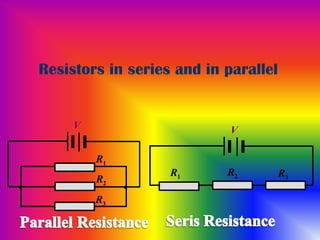
R1
R2
R3
V
• •
R1 R2 R3
V
Warm-up
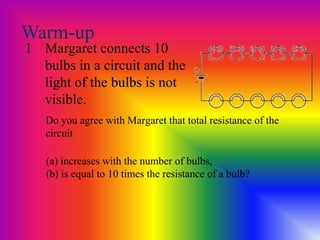
1 Margaret connects 10
bulbs in a circuit and the
light of the bulbs is not
visible.
(a) increases with the number of bulbs,
(b) is equal to 10 times the resistance of a bulb?
Do you agree with Margaret that total resistance of the
circuit
Warm-up
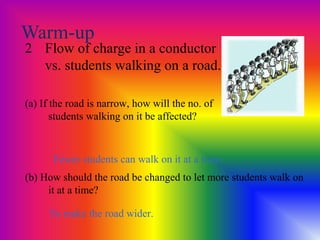
2 Flow of charge in a conductor
vs. students walking on a road.
(a) If the road is narrow, how will the no. of
students walking on it be affected?
Fewer students can walk on it at a time.
To make the road wider.
(b) How should the road be changed to let more students walk on
it at a time?
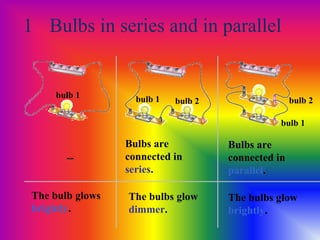
1 Bulbs in series and in parallel
The bulb glows
brightly.
bulb 1
bulb 2
The bulbs glow
dimmer.
The bulbs glow
brightly.
bulb 1 bulb 2
Bulbs are
connected in
series.
Bulbs are
connected in
parallel.
bulb 1
--
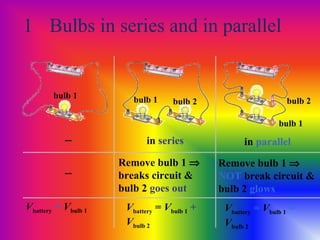
1 Bulbs in series and in parallel
bulb 1
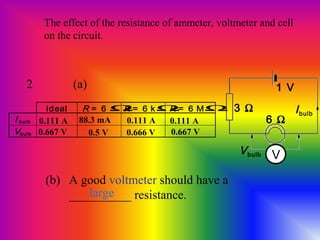
bulb 2
Vbattery = Vbulb 1 =
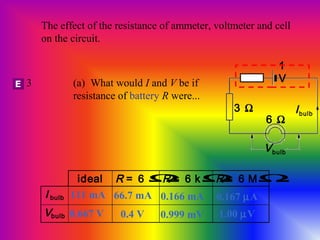
Vbulb 2
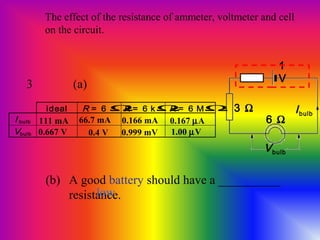
bulb 1 bulb 2
Remove bulb 1 ⇒
breaks circuit &
bulb 2 goes out
bulb 1
Remove bulb 1 ⇒
NOT break circuit &
bulb 2 glows
--
Vbattery = Vbulb 1 Vbattery = Vbulb 1 +
Vbulb 2
in series in parallel--
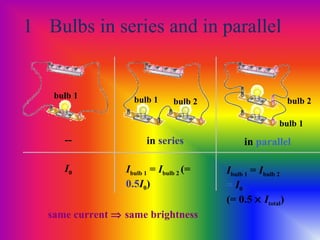
1 Bulbs in series and in parallel
bulb 1
bulb 2bulb 1 bulb 2
bulb 1
Ibulb 1 = Ibulb 2 (=
0.5I0)
I0 Ibulb 1 = Ibulb 2
= I0
(= 0.5 × Itotal)
in series in parallel--
same current ⇒ same brightness
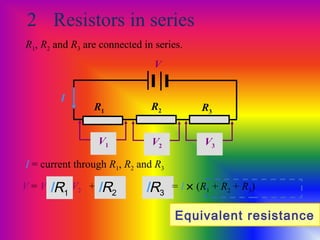
2 Resistors in series
R1, R2 and R3 are connected in series.
R1 R2 R3
V
I = current through R1, R2 and R3
I
V = V1 + V2 + V3
V1
IR1
V2
IR2 IR3
V3
= I × (R1 + R2 + R3)
Equivalent resistance
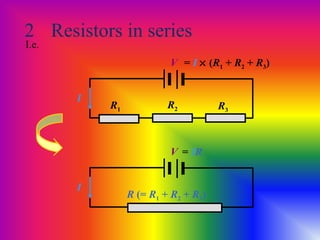
2 Resistors in series
R1 R2 R3
V
I.e.
I
R (= R1 + R2 + R3)
V
I
= I × (R1 + R2 + R3)
= IR
2 Resistors in series
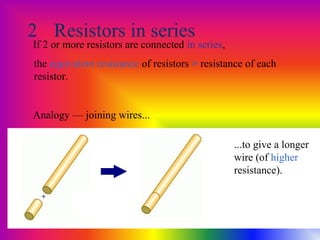
If 2 or more resistors are connected in series,
the equivalent resistance of resistors > resistance of each
resistor.
Analogy — joining wires...
...to give a longer
wire (of higher
resistance).
3 Resistors in parallel
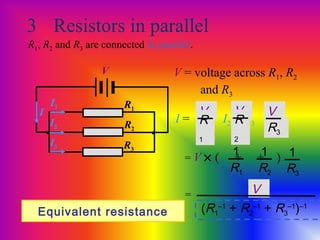
R1, R2 and R3 are connected in parallel.
R1
R2
R3
V
• •
V = voltage across R1, R2
and R3
I1
I2
I3
1
R1
1
R2
1
R3
= V × ( + + )
I = I1 + I2 + I3
V
R
1
V
R
2
V
R3
I
Equivalent resistance
= V
(R1
–1
+ R2
–1
+ R3
–1
)–1
3 Resistors in parallel
I.e.
R1
R2
R3
V
• •
I1
I2
I3
I
R [= (R1
–1
+ R2
–1
+ R3
–1
)–1
]
V
I =
= I1 + I2 + I3
V
R
3 Resistors in parallel
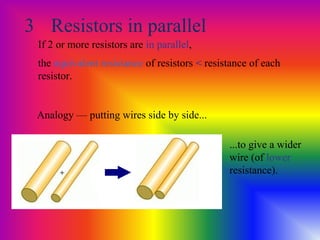
If 2 or more resistors are in parallel,
the equivalent resistance of resistors < resistance of each
resistor.
Analogy — putting wires side by side...
...to give a wider
wire (of lower
resistance).
Example 4
Equivalent resistance
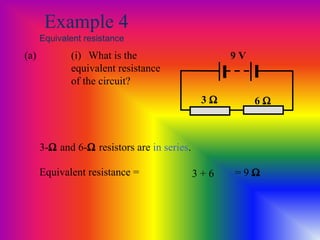
(a) (i) What is the
equivalent resistance
of the circuit?
3-Ω and 6-Ω resistors are in series.
Equivalent resistance = 3 + 6 = 9 Ω
3 Ω
9 V
6 Ω
Example 4
Equivalent resistance
3 Ω
9 V
6 Ω
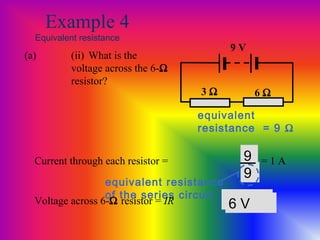
(a) (ii) What is the
voltage across the 6-Ω
resistor?
Current through each resistor = V
R
9
9
equivalent resistance
of the series circuit
equivalent
resistance = 9 Ω
= 1 A
Voltage across 6-Ω resistor = IR 1 × 66 V
Example 4
Equivalent resistance
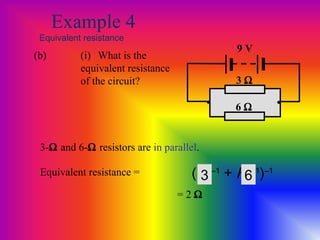
(b) (i) What is the
equivalent resistance
of the circuit?
9 V
• •
3 Ω
6 Ω
3-Ω and 6-Ω resistors are in parallel.
Equivalent resistance = (R1
–1
+ R2
–1
)–1
3 6
= 2 Ω
Example 4
Equivalent resistance
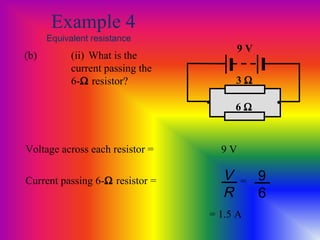
(b) (ii) What is the
current passing the
6-Ω resistor?
9 V
• •
3 Ω
6 Ω
Voltage across each resistor = 9 V
Current passing 6-Ω resistor = V
R
9
6
=
= 1.5 A
Example 4
Equivalent resistance
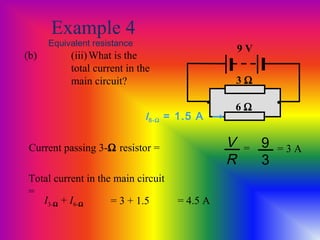
(b) (iii)What is the
total current in the
main circuit?
9 V
• •
3 Ω
6 Ω
I6-Ω = 1.5 A
Current passing 3-Ω resistor = V
R
9
3
= = 3 A
Total current in the main circuit
=
I3-Ω + I6-Ω = 3 + 1.5 = 4.5 A
Example 5
Circuit analysis
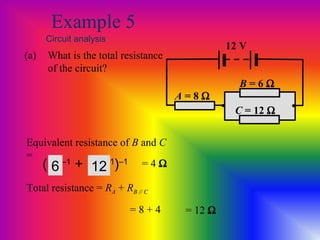
(a) What is the total resistance
of the circuit?
Equivalent resistance of B and C
=
Total resistance = RA + RB // C
= 8 + 4
= 4 Ω
A = 8 Ω
12 V
• •
B = 6 Ω
C = 12 Ω
(R1
–1
+ R2
–1
)–1
6 12
= 12 Ω
Example 5
Circuit analysis
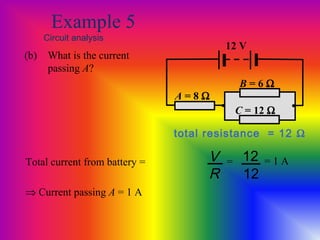
(b) What is the current
passing A?
A = 8 Ω
12 V
• •
B = 6 Ω
C = 12 Ω
total resistance = 12 Ω
Total current from battery = V
R
12
12
= = 1 A
⇒ Current passing A = 1 A
Example 5
Circuit analysis
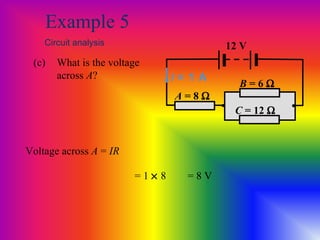
(c) What is the voltage
across A?
A = 8 Ω
12 V
• •
B = 6 Ω
C = 12 Ω
Voltage across A = IR
I = 1 A
= 1 × 8 = 8 V
Example 5
Circuit analysis
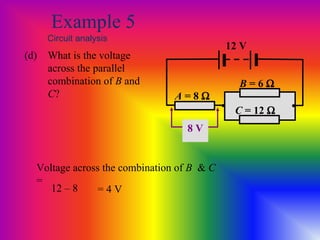
(d) What is the voltage
across the parallel
combination of B and
C? A = 8 Ω
12 V
• •
B = 6 Ω
C = 12 Ω
Voltage across the combination of B & C
=
= 4 V12 – 8
8 V
Example 5
Circuit analysis
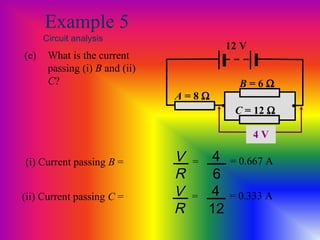
(e) What is the current
passing (i) B and (ii)
C?
A = 8 Ω
12 V
• •
B = 6 Ω
C = 12 Ω
4 V
(i) Current passing B = V
R
= = 0.667 A4
6
(ii) Current passing C = V
R
= = 0.333 A4
12
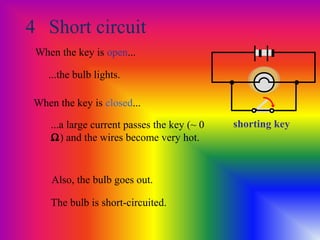
4 Short circuit
When the key is open...
...the bulb lights.
• •
shorting key
When the key is closed...
Also, the bulb goes out.
...a large current passes the key (~ 0
Ω) and the wires become very hot.
The bulb is short-circuited.
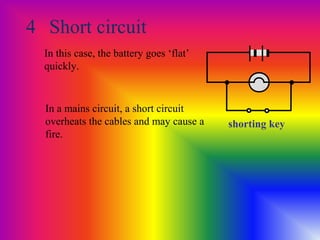
4 Short circuit
shorting key
In this case, the battery goes ‘flat’
quickly.
In a mains circuit, a short circuit
overheats the cables and may cause a
fire.
• •
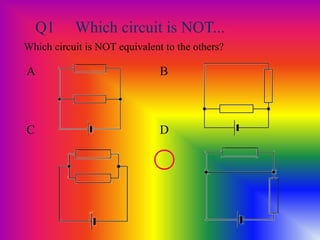
Q1 Which circuit is NOT...
Which circuit is NOT equivalent to the others?
A B
C D
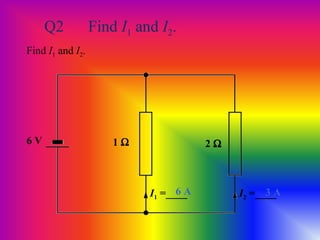
Q2 Find I1 and I2.
Find I1 and I2.
6 V 1 Ω 2 Ω
I1 =____ I2 =____6 A 3 A
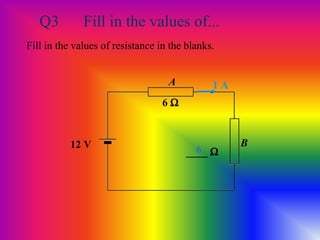
Q3 Fill in the values of...
Fill in the values of resistance in the blanks.
12 V
6 Ω
____ Ω
A
B
6
1 A
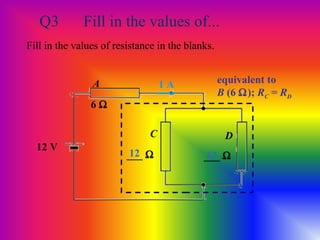
Q3 Fill in the values of...
Fill in the values of resistance in the blanks.
12 V
6 Ω
A
C D
___ Ω ___ Ω1212
1 A equivalent to
B (6 Ω); RC = RD
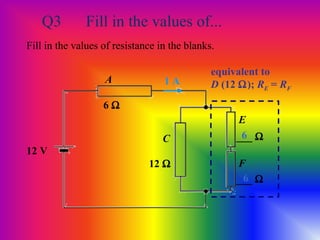
Q3 Fill in the values of...
Fill in the values of resistance in the blanks.
12 V
6 Ω
A
C
E
12 Ω
1 A
___ Ω
___ Ω6
6
equivalent to
D (12 Ω); RE = RF
F
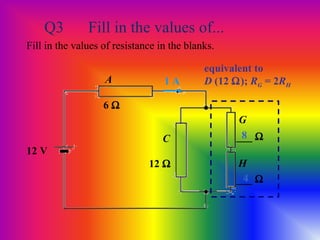
Q3 Fill in the values of...
Fill in the values of resistance in the blanks.
12 V
6 Ω
A
C
G
12 Ω
1 A
___ Ω
___ Ω4
8
equivalent to
D (12 Ω); RG = 2RH
H
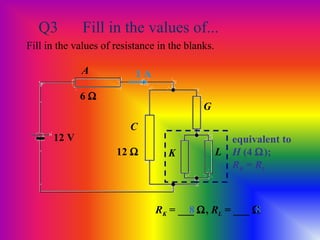
Q3 Fill in the values of...
Fill in the values of resistance in the blanks.
12 V
6 Ω
A
C
G
12 Ω
1 A
RK = ___ Ω, RL = ___ Ω88
equivalent to
H (4 Ω);
RK = RL
LK
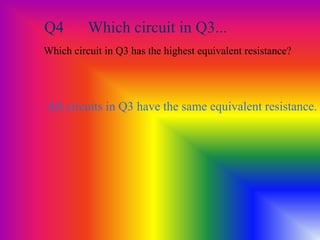
Q4 Which circuit in Q3...
Which circuit in Q3 has the highest equivalent resistance?
All circuits in Q3 have the same equivalent resistance.
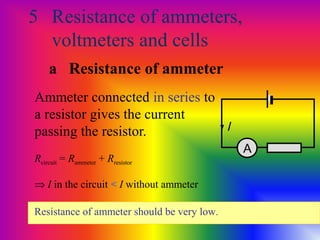
5 Resistance of ammeters,
voltmeters and cells
Ammeter connected in series to
a resistor gives the current
passing the resistor.
Rcircuit = Rammeter + Rresistor
A
⇒ I in the circuit < I without ammeter
Resistance of ammeter should be very low.
a Resistance of ammeter
I
5 Resistance of ammeters,
voltmeters and cells
b Resistance of voltmeter
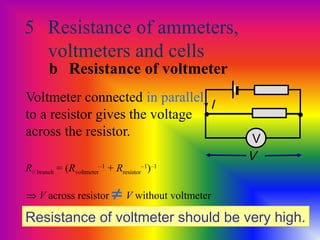
Voltmeter connected in parallel
to a resistor gives the voltage
across the resistor.
V
• •
R// branch = (Rvoltmeter
–1
+ Rresistor
–1
)–1
⇒ V across resistor ≠ V without voltmeter
Resistance of voltmeter should be very high.
I
V
5 Resistance of ammeters,
voltmeters and cells
c Resistance of cells
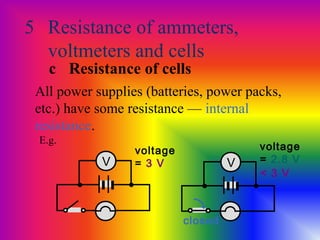
All power supplies (batteries, power packs,
etc.) have some resistance — internal
resistance.
• •
V
voltage
= 3 V
voltage
= 2.8 V
E.g.
• •
V
closed
< 3 V
5 Resistance of ammeters,
voltmeters and cells
c Resistance of cells
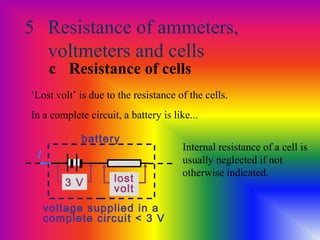
‘Lost volt’ is due to the resistance of the cells.
In a complete circuit, a battery is like...
3 V lost
volt
battery
voltage supplied in a
complete circuit < 3 V
Internal resistance of a cell is
usually neglected if not
otherwise indicated.
I
Example 6
Applying Ohm’s law
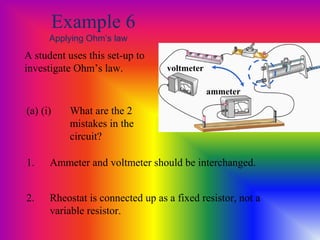
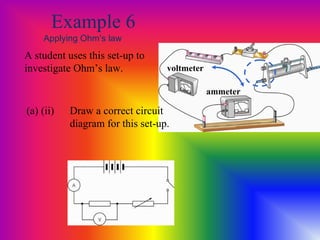
A student uses this set-up to
investigate Ohm’s law.
1. Ammeter and voltmeter should be interchanged.
2. Rheostat is connected up as a fixed resistor, not a
variable resistor.
(a) (i) What are the 2
mistakes in the
circuit?
ammeter
voltmeter
A student uses this set-up to
investigate Ohm’s law.
(a) (ii) Draw a correct circuit
diagram for this set-up.
ammeter
voltmeter
Example 6
Applying Ohm’s law
Example 6
Applying Ohm’s law
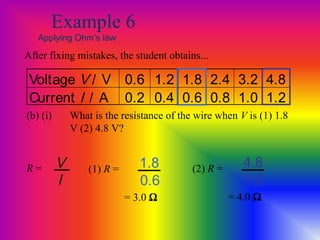
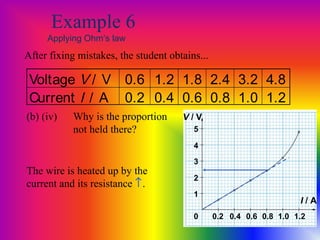
After fixing mistakes, the student obtains...
(b) (i) What is the resistance of the wire when V is (1) 1.8
V (2) 4.8 V?
Voltage V / V 0.6 1.2 1.8 2.4 3.2 4.8
Current I / A 0.2 0.4 0.6 0.8 1.0 1.2
V
I
R = (1) R = 1.8
0.6
= 3.0 Ω
(2) R = 4.8
1.2
= 4.0 Ω
Example 6
Applying Ohm’s law
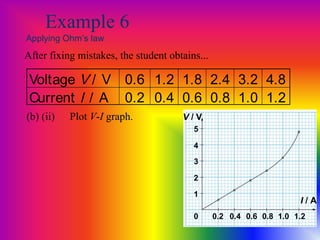
After fixing mistakes, the student obtains...
(b) (ii) Plot V-I graph. V / V
I / A
0 0.2 0.4 0.6 0.8 1.0 1.2
1
2
3
4
5
Voltage V / V 0.6 1.2 1.8 2.4 3.2 4.8
Current I / A 0.2 0.4 0.6 0.8 1.0 1.2
V / V
I / A
0 0.2 0.4 0.6 0.8 1.0 1.2
1
2
3
4
5
Example 6
Applying Ohm’s law
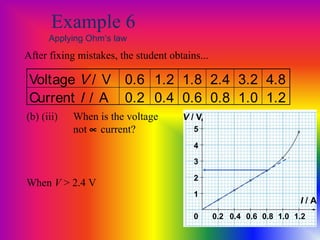
After fixing mistakes, the student obtains...
(b) (iii) When is the voltage
not ∝ current?
Voltage V / V 0.6 1.2 1.8 2.4 3.2 4.8
Current I / A 0.2 0.4 0.6 0.8 1.0 1.2
When V > 2.4 V
V / V
I / A
0 0.2 0.4 0.6 0.8 1.0 1.2
1
2
3
4
5
Example 6
Applying Ohm’s law
After fixing mistakes, the student obtains...
(b) (iv) Why is the proportion
not held there?
Voltage V / V 0.6 1.2 1.8 2.4 3.2 4.8
Current I / A 0.2 0.4 0.6 0.8 1.0 1.2
The wire is heated up by the
current and its resistance ↑.
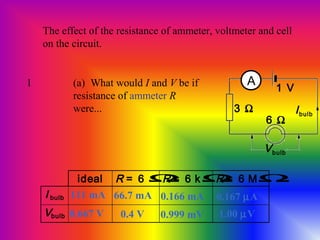
1 (a) What would I and V be if
resistance of ammeter R
were...
1 V
3 Ω
6 Ω
Vbulb
Ibulb
The effect of the resistance of ammeter, voltmeter and cell
on the circuit.
ideal R = 6 ΩR = 6 kΩR = 6 MΩ
I bulb
Vbulb
111 mA
0.667 V
66.7 mA 0.166 mA 0.167 µA
0.4 V 0.999 mV 1.00 µV
A
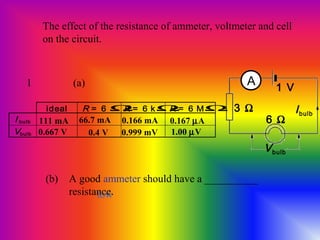
1 (a) 1 V
3 Ω
6 Ω
Vbulb
Ibulb
The effect of the resistance of ammeter, voltmeter and cell
on the circuit.
ideal R = 6 ΩR = 6 kΩR = 6 MΩ
I bulb
Vbulb
111 mA
0.667 V
66.7 mA 0.166 mA 0.167 µA
0.4 V 0.999 mV 1.00 µV
(b) A good ammeter should have a __________
resistance.low
A
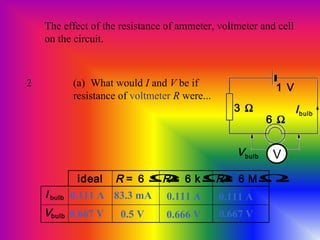
2 (a) What would I and V be if
resistance of voltmeter R were...
The effect of the resistance of ammeter, voltmeter and cell
on the circuit.
1 V
3 Ω
6 Ω
Vbulb
Ibulb
ideal R = 6 ΩR = 6 kΩR = 6 MΩ
I bulb
Vbulb
0.111 A
0.667 V
83.3 mA 0.111 A 0.111 A
0.5 V 0.666 V 0.667 V
V
2 (a)
The effect of the resistance of ammeter, voltmeter and cell
on the circuit.
1 V
3 Ω
6 Ω
Vbulb
Ibulb
ideal R = 6 ΩR = 6 kΩR = 6 MΩ
I bulb
Vbulb
0.111 A
0.667 V
88.3 mA 0.111 A
0.5 V 0.666 V
0.111 A
0.667 V
(b) A good voltmeter should have a
__________ resistance.large
V
3 (a) What would I and V be if
resistance of battery R were...
The effect of the resistance of ammeter, voltmeter and cell
on the circuit.
EE
1
V
3 Ω
6 Ω
Vbulb
Ibulb
ideal R = 6 ΩR = 6 kΩR = 6 MΩ
I bulb
Vbulb
111 mA
0.667 V
66.7 mA 0.166 mA 0.167 µA
0.4 V 0.999 mV 1.00 µV
3 (a)
3 Ω
6 Ω
Vbulb
Ibulb
The effect of the resistance of ammeter, voltmeter and cell
on the circuit.
ideal R = 6 ΩR = 6 kΩR = 6 MΩ
I bulb
Vbulb
111 mA
0.667 V
66.7 mA 0.166 mA 0.167 µA
0.4 V 0.999 mV 1.00 µV
(b) A good battery should have a __________
resistance.low
1
V
Dhiman debnath rollno1023

Dhiman debnath rollno1023

  • 2.
    Resistors in seriesand in parallel R1 R2 R3 V • • R1 R2 R3 V
  • 3.
    Warm-up 1 Margaret connects10 bulbs in a circuit and the light of the bulbs is not visible. (a) increases with the number of bulbs, (b) is equal to 10 times the resistance of a bulb? Do you agree with Margaret that total resistance of the circuit
  • 4.
    Warm-up 2 Flow ofcharge in a conductor vs. students walking on a road. (a) If the road is narrow, how will the no. of students walking on it be affected? Fewer students can walk on it at a time. To make the road wider. (b) How should the road be changed to let more students walk on it at a time?
  • 5.
    1 Bulbs inseries and in parallel The bulb glows brightly. bulb 1 bulb 2 The bulbs glow dimmer. The bulbs glow brightly. bulb 1 bulb 2 Bulbs are connected in series. Bulbs are connected in parallel. bulb 1 --
  • 6.
    1 Bulbs inseries and in parallel bulb 1 bulb 2 Vbattery = Vbulb 1 = Vbulb 2 bulb 1 bulb 2 Remove bulb 1 ⇒ breaks circuit & bulb 2 goes out bulb 1 Remove bulb 1 ⇒ NOT break circuit & bulb 2 glows -- Vbattery = Vbulb 1 Vbattery = Vbulb 1 + Vbulb 2 in series in parallel--
  • 7.
    1 Bulbs inseries and in parallel bulb 1 bulb 2bulb 1 bulb 2 bulb 1 Ibulb 1 = Ibulb 2 (= 0.5I0) I0 Ibulb 1 = Ibulb 2 = I0 (= 0.5 × Itotal) in series in parallel-- same current ⇒ same brightness
  • 8.
    2 Resistors inseries R1, R2 and R3 are connected in series. R1 R2 R3 V I = current through R1, R2 and R3 I V = V1 + V2 + V3 V1 IR1 V2 IR2 IR3 V3 = I × (R1 + R2 + R3) Equivalent resistance
  • 9.
    2 Resistors inseries R1 R2 R3 V I.e. I R (= R1 + R2 + R3) V I = I × (R1 + R2 + R3) = IR
  • 10.
    2 Resistors inseries If 2 or more resistors are connected in series, the equivalent resistance of resistors > resistance of each resistor. Analogy — joining wires... ...to give a longer wire (of higher resistance).
  • 11.
    3 Resistors inparallel R1, R2 and R3 are connected in parallel. R1 R2 R3 V • • V = voltage across R1, R2 and R3 I1 I2 I3 1 R1 1 R2 1 R3 = V × ( + + ) I = I1 + I2 + I3 V R 1 V R 2 V R3 I Equivalent resistance = V (R1 –1 + R2 –1 + R3 –1 )–1
  • 12.
    3 Resistors inparallel I.e. R1 R2 R3 V • • I1 I2 I3 I R [= (R1 –1 + R2 –1 + R3 –1 )–1 ] V I = = I1 + I2 + I3 V R
  • 13.
    3 Resistors inparallel If 2 or more resistors are in parallel, the equivalent resistance of resistors < resistance of each resistor. Analogy — putting wires side by side... ...to give a wider wire (of lower resistance).
  • 14.
    Example 4 Equivalent resistance (a)(i) What is the equivalent resistance of the circuit? 3-Ω and 6-Ω resistors are in series. Equivalent resistance = 3 + 6 = 9 Ω 3 Ω 9 V 6 Ω
  • 15.
    Example 4 Equivalent resistance 3Ω 9 V 6 Ω (a) (ii) What is the voltage across the 6-Ω resistor? Current through each resistor = V R 9 9 equivalent resistance of the series circuit equivalent resistance = 9 Ω = 1 A Voltage across 6-Ω resistor = IR 1 × 66 V
  • 16.
    Example 4 Equivalent resistance (b)(i) What is the equivalent resistance of the circuit? 9 V • • 3 Ω 6 Ω 3-Ω and 6-Ω resistors are in parallel. Equivalent resistance = (R1 –1 + R2 –1 )–1 3 6 = 2 Ω
  • 17.
    Example 4 Equivalent resistance (b)(ii) What is the current passing the 6-Ω resistor? 9 V • • 3 Ω 6 Ω Voltage across each resistor = 9 V Current passing 6-Ω resistor = V R 9 6 = = 1.5 A
  • 18.
    Example 4 Equivalent resistance (b)(iii)What is the total current in the main circuit? 9 V • • 3 Ω 6 Ω I6-Ω = 1.5 A Current passing 3-Ω resistor = V R 9 3 = = 3 A Total current in the main circuit = I3-Ω + I6-Ω = 3 + 1.5 = 4.5 A
  • 19.
    Example 5 Circuit analysis (a)What is the total resistance of the circuit? Equivalent resistance of B and C = Total resistance = RA + RB // C = 8 + 4 = 4 Ω A = 8 Ω 12 V • • B = 6 Ω C = 12 Ω (R1 –1 + R2 –1 )–1 6 12 = 12 Ω
  • 20.
    Example 5 Circuit analysis (b)What is the current passing A? A = 8 Ω 12 V • • B = 6 Ω C = 12 Ω total resistance = 12 Ω Total current from battery = V R 12 12 = = 1 A ⇒ Current passing A = 1 A
  • 21.
    Example 5 Circuit analysis (c)What is the voltage across A? A = 8 Ω 12 V • • B = 6 Ω C = 12 Ω Voltage across A = IR I = 1 A = 1 × 8 = 8 V
  • 22.
    Example 5 Circuit analysis (d)What is the voltage across the parallel combination of B and C? A = 8 Ω 12 V • • B = 6 Ω C = 12 Ω Voltage across the combination of B & C = = 4 V12 – 8 8 V
  • 23.
    Example 5 Circuit analysis (e)What is the current passing (i) B and (ii) C? A = 8 Ω 12 V • • B = 6 Ω C = 12 Ω 4 V (i) Current passing B = V R = = 0.667 A4 6 (ii) Current passing C = V R = = 0.333 A4 12
  • 24.
    4 Short circuit Whenthe key is open... ...the bulb lights. • • shorting key When the key is closed... Also, the bulb goes out. ...a large current passes the key (~ 0 Ω) and the wires become very hot. The bulb is short-circuited.
  • 25.
    4 Short circuit shortingkey In this case, the battery goes ‘flat’ quickly. In a mains circuit, a short circuit overheats the cables and may cause a fire. • •
  • 26.
    Q1 Which circuitis NOT... Which circuit is NOT equivalent to the others? A B C D
  • 27.
    Q2 Find I1and I2. Find I1 and I2. 6 V 1 Ω 2 Ω I1 =____ I2 =____6 A 3 A
  • 28.
    Q3 Fill inthe values of... Fill in the values of resistance in the blanks. 12 V 6 Ω ____ Ω A B 6 1 A
  • 29.
    Q3 Fill inthe values of... Fill in the values of resistance in the blanks. 12 V 6 Ω A C D ___ Ω ___ Ω1212 1 A equivalent to B (6 Ω); RC = RD
  • 30.
    Q3 Fill inthe values of... Fill in the values of resistance in the blanks. 12 V 6 Ω A C E 12 Ω 1 A ___ Ω ___ Ω6 6 equivalent to D (12 Ω); RE = RF F
  • 31.
    Q3 Fill inthe values of... Fill in the values of resistance in the blanks. 12 V 6 Ω A C G 12 Ω 1 A ___ Ω ___ Ω4 8 equivalent to D (12 Ω); RG = 2RH H
  • 32.
    Q3 Fill inthe values of... Fill in the values of resistance in the blanks. 12 V 6 Ω A C G 12 Ω 1 A RK = ___ Ω, RL = ___ Ω88 equivalent to H (4 Ω); RK = RL LK
  • 33.
    Q4 Which circuitin Q3... Which circuit in Q3 has the highest equivalent resistance? All circuits in Q3 have the same equivalent resistance.
  • 34.
    5 Resistance ofammeters, voltmeters and cells Ammeter connected in series to a resistor gives the current passing the resistor. Rcircuit = Rammeter + Rresistor A ⇒ I in the circuit < I without ammeter Resistance of ammeter should be very low. a Resistance of ammeter I
  • 35.
    5 Resistance ofammeters, voltmeters and cells b Resistance of voltmeter Voltmeter connected in parallel to a resistor gives the voltage across the resistor. V • • R// branch = (Rvoltmeter –1 + Rresistor –1 )–1 ⇒ V across resistor ≠ V without voltmeter Resistance of voltmeter should be very high. I V
  • 36.
    5 Resistance ofammeters, voltmeters and cells c Resistance of cells All power supplies (batteries, power packs, etc.) have some resistance — internal resistance. • • V voltage = 3 V voltage = 2.8 V E.g. • • V closed < 3 V
  • 37.
    5 Resistance ofammeters, voltmeters and cells c Resistance of cells ‘Lost volt’ is due to the resistance of the cells. In a complete circuit, a battery is like... 3 V lost volt battery voltage supplied in a complete circuit < 3 V Internal resistance of a cell is usually neglected if not otherwise indicated. I
  • 38.
    Example 6 Applying Ohm’slaw A student uses this set-up to investigate Ohm’s law. 1. Ammeter and voltmeter should be interchanged. 2. Rheostat is connected up as a fixed resistor, not a variable resistor. (a) (i) What are the 2 mistakes in the circuit? ammeter voltmeter
  • 39.
    A student usesthis set-up to investigate Ohm’s law. (a) (ii) Draw a correct circuit diagram for this set-up. ammeter voltmeter Example 6 Applying Ohm’s law
  • 40.
    Example 6 Applying Ohm’slaw After fixing mistakes, the student obtains... (b) (i) What is the resistance of the wire when V is (1) 1.8 V (2) 4.8 V? Voltage V / V 0.6 1.2 1.8 2.4 3.2 4.8 Current I / A 0.2 0.4 0.6 0.8 1.0 1.2 V I R = (1) R = 1.8 0.6 = 3.0 Ω (2) R = 4.8 1.2 = 4.0 Ω
  • 41.
    Example 6 Applying Ohm’slaw After fixing mistakes, the student obtains... (b) (ii) Plot V-I graph. V / V I / A 0 0.2 0.4 0.6 0.8 1.0 1.2 1 2 3 4 5 Voltage V / V 0.6 1.2 1.8 2.4 3.2 4.8 Current I / A 0.2 0.4 0.6 0.8 1.0 1.2
  • 42.
    V / V I/ A 0 0.2 0.4 0.6 0.8 1.0 1.2 1 2 3 4 5 Example 6 Applying Ohm’s law After fixing mistakes, the student obtains... (b) (iii) When is the voltage not ∝ current? Voltage V / V 0.6 1.2 1.8 2.4 3.2 4.8 Current I / A 0.2 0.4 0.6 0.8 1.0 1.2 When V > 2.4 V
  • 43.
    V / V I/ A 0 0.2 0.4 0.6 0.8 1.0 1.2 1 2 3 4 5 Example 6 Applying Ohm’s law After fixing mistakes, the student obtains... (b) (iv) Why is the proportion not held there? Voltage V / V 0.6 1.2 1.8 2.4 3.2 4.8 Current I / A 0.2 0.4 0.6 0.8 1.0 1.2 The wire is heated up by the current and its resistance ↑.
  • 44.
    1 (a) Whatwould I and V be if resistance of ammeter R were... 1 V 3 Ω 6 Ω Vbulb Ibulb The effect of the resistance of ammeter, voltmeter and cell on the circuit. ideal R = 6 ΩR = 6 kΩR = 6 MΩ I bulb Vbulb 111 mA 0.667 V 66.7 mA 0.166 mA 0.167 µA 0.4 V 0.999 mV 1.00 µV A
  • 45.
    1 (a) 1V 3 Ω 6 Ω Vbulb Ibulb The effect of the resistance of ammeter, voltmeter and cell on the circuit. ideal R = 6 ΩR = 6 kΩR = 6 MΩ I bulb Vbulb 111 mA 0.667 V 66.7 mA 0.166 mA 0.167 µA 0.4 V 0.999 mV 1.00 µV (b) A good ammeter should have a __________ resistance.low A
  • 46.
    2 (a) Whatwould I and V be if resistance of voltmeter R were... The effect of the resistance of ammeter, voltmeter and cell on the circuit. 1 V 3 Ω 6 Ω Vbulb Ibulb ideal R = 6 ΩR = 6 kΩR = 6 MΩ I bulb Vbulb 0.111 A 0.667 V 83.3 mA 0.111 A 0.111 A 0.5 V 0.666 V 0.667 V V
  • 47.
    2 (a) The effectof the resistance of ammeter, voltmeter and cell on the circuit. 1 V 3 Ω 6 Ω Vbulb Ibulb ideal R = 6 ΩR = 6 kΩR = 6 MΩ I bulb Vbulb 0.111 A 0.667 V 88.3 mA 0.111 A 0.5 V 0.666 V 0.111 A 0.667 V (b) A good voltmeter should have a __________ resistance.large V
  • 48.
    3 (a) Whatwould I and V be if resistance of battery R were... The effect of the resistance of ammeter, voltmeter and cell on the circuit. EE 1 V 3 Ω 6 Ω Vbulb Ibulb ideal R = 6 ΩR = 6 kΩR = 6 MΩ I bulb Vbulb 111 mA 0.667 V 66.7 mA 0.166 mA 0.167 µA 0.4 V 0.999 mV 1.00 µV
  • 49.
    3 (a) 3 Ω 6Ω Vbulb Ibulb The effect of the resistance of ammeter, voltmeter and cell on the circuit. ideal R = 6 ΩR = 6 kΩR = 6 MΩ I bulb Vbulb 111 mA 0.667 V 66.7 mA 0.166 mA 0.167 µA 0.4 V 0.999 mV 1.00 µV (b) A good battery should have a __________ resistance.low 1 V