Current Electricity MCQ Class XII
By
Dr M. Arunachalam
Head, Department of Physics (Rtd.)
Sri SRNM College, Sattur
(TN State Board MCQs with explanation)
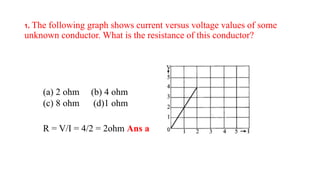
1. The following graph shows current versus voltage values of some
unknown conductor. What is the resistance of this conductor?
(a) 2 ohm (b) 4 ohm
(c) 8 ohm (d)1 ohm
R = V/I = 4/2 = 2ohm Ans a
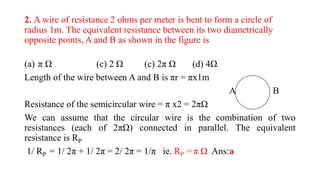
2. A wire of resistance 2 ohms per meter is bent to form a circle of
radius 1m. The equivalent resistance between its two diametrically
opposite points, A and B as shown in the figure is
(a) π Ω (c) 2 Ω (c) 2π Ω (d) 4Ω
Length of the wire between A and B is πr = πx1m
A B
Resistance of the semicircular wire = π x2 = 2πΩ
We can assume that the circular wire is the combination of two
resistances (each of 2πΩ) connected in parallel. The equivalent
resistance is RP
1/ RP = 1/ 2π + 1/ 2π = 2/ 2π = 1/π ie. RP = π Ω Ans:a
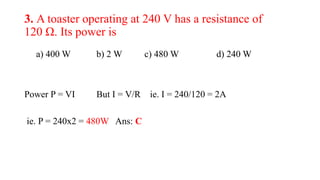
3. A toaster operating at 240 V has a resistance of
120 Ω. Its power is
a) 400 W b) 2 W c) 480 W d) 240 W
Power P = VI But I = V/R ie. I = 240/120 = 2A
ie. P = 240x2 = 480W Ans: C
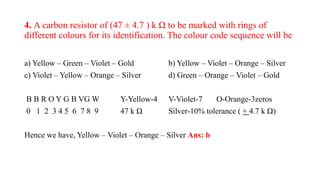
4. A carbon resistor of (47 ± 4.7 ) k Ω to be marked with rings of
different colours for its identification. The colour code sequence will be
a) Yellow – Green – Violet – Gold b) Yellow – Violet – Orange – Silver
c) Violet – Yellow – Orange – Silver d) Green – Orange – Violet – Gold
B B R O Y G B VG W Y-Yellow-4 V-Violet-7 O-Orange-3zeros
0 1 2 3 4 5 6 7 8 9 47 k Ω Silver-10% tolerance ( + 4.7 k Ω)
Hence we have, Yellow – Violet – Orange – Silver Ans: b
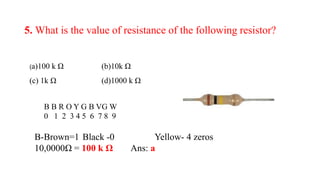
5. What is the value of resistance of the following resistor?
(a)100 k Ω (b)10k Ω
(c) 1k Ω (d)1000 k Ω
B-Brown=1 Black -0 Yellow- 4 zeros
10,0000Ω = 100 k Ω Ans: a
B B R O Y G B VG W
0 1 2 3 4 5 6 7 8 9
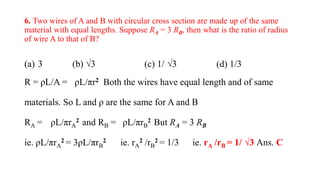
6. Two wires of A and B with circular cross section are made up of the same
material with equal lengths. Suppose RA = 3 RB, then what is the ratio of radius
of wire A to that of B?
(a) 3 (b) √3 (c) 1/ √3 (d) 1/3
R = ρL/A = ρL/πr2 Both the wires have equal length and of same
materials. So L and ρ are the same for A and B
RA = ρL/πrA
2 and RB = ρL/πrB
2 But RA = 3 RB
ie. ρL/πrA
2 = 3ρL/πrB
2 ie. rA
2 /rB
2 = 1/3 ie. rA /rB = 1/ √3 Ans. C
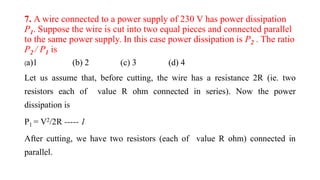
7. A wire connected to a power supply of 230 V has power dissipation
P1. Suppose the wire is cut into two equal pieces and connected parallel
to the same power supply. In this case power dissipation is P2 . The ratio
P2 / P1 is
(a)1 (b) 2 (c) 3 (d) 4
Let us assume that, before cutting, the wire has a resistance 2R (ie. two
resistors each of value R ohm connected in series). Now the power
dissipation is
P1 = V2/2R ----- 1
After cutting, we have two resistors (each of value R ohm) connected in
parallel.
Contd…
Now we have,
1/RP= 1/R + 1/R = 2/R ie RP = R/2
Power dissipation
P2 = V2/ R/2 ----- 2 Dividing equation 2 by equation 1 we get
P2 / P1 = [V2/ (R/2)] x (2R/V2 ) = (2V2 / R) x (2R/V2 ) = 4
ie. P2 / P1 = 4 Ans: d
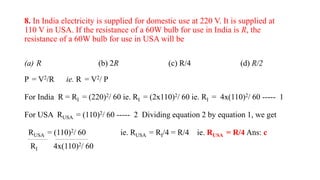
8. In India electricity is supplied for domestic use at 220 V. It is supplied at
110 V in USA. If the resistance of a 60W bulb for use in India is R, the
resistance of a 60W bulb for use in USA will be
(a) R (b) 2R (c) R/4 (d) R/2
P = V2/R ie. R = V2/ P
For India R = RI = (220)2/ 60 ie. RI = (2x110)2/ 60 ie. RI = 4x(110)2/ 60 ----- 1
For USA RUSA = (110)2/ 60 ----- 2 Dividing equation 2 by equation 1, we get
RUSA = (110)2/ 60 ie. RUSA = RI/4 = R/4 ie. RUSA = R/4 Ans: c
RI 4x(110)2/ 60
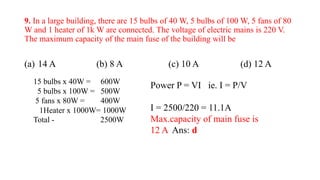
9. In a large building, there are 15 bulbs of 40 W, 5 bulbs of 100 W, 5 fans of 80
W and 1 heater of 1k W are connected. The voltage of electric mains is 220 V.
The maximum capacity of the main fuse of the building will be
(a) 14 A (b) 8 A (c) 10 A (d) 12 A
Power P = VI ie. I = P/V
I = 2500/220 = 11.1A
Max.capacity of main fuse is
12 A Ans: d
15 bulbs x 40W = 600W
5 bulbs x 100W = 500W
5 fans x 80W = 400W
1Heater x 1000W= 1000W
Total - 2500W
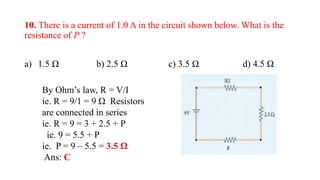
10. There is a current of 1.0 A in the circuit shown below. What is the
resistance of P ?
a) 1.5 Ω b) 2.5 Ω c) 3.5 Ω d) 4.5 Ω
By Ohm’s law, R = V/I
ie. R = 9/1 = 9 Ω Resistors
are connected in series
ie. R = 9 = 3 + 2.5 + P
ie. 9 = 5.5 + P
ie. P = 9 – 5.5 = 3.5 Ω
Ans: C
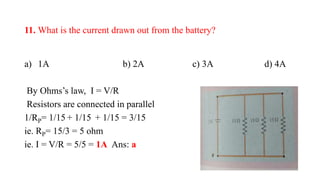
11. What is the current drawn out from the battery?
a) 1A b) 2A c) 3A d) 4A
By Ohms’s law, I = V/R
Resistors are connected in parallel
1/RP= 1/15 + 1/15 + 1/15 = 3/15
ie. RP= 15/3 = 5 ohm
ie. I = V/R = 5/5 = 1A Ans: a
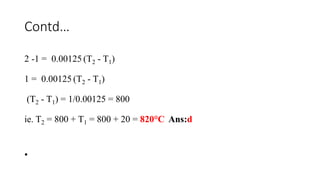
12. The temperature coefficient of resistance of a wire is 0.00125 per °C. At
20°C, its resistance is 1 Ω. The resistance of the wire will be 2 Ω at
a) 800 °C b) 700 °C c) 850 °C d) 820 °C
R2 = R1[1+ α (T2 - T1)]
R1 = Resistance at temperature T1(20 °C) = 1 Ω
R2 = Resistance at temperature T2 = 2 Ω
α – Temperature coefficient of resistance = 0.00125 per °C
2 = 1[1+ 0.00125 (T2 - T1)]
ie. 2 = 1+ 0.00125 (T2 - T1)
Contd…
2 -1 = 0.00125 (T2 - T1)
1 = 0.00125 (T2 - T1)
(T2 - T1) = 1/0.00125 = 800
ie. T2 = 800 + T1 = 800 + 20 = 820°C Ans:d
•
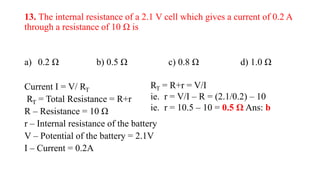
13. The internal resistance of a 2.1 V cell which gives a current of 0.2 A
through a resistance of 10 Ω is
a) 0.2 Ω b) 0.5 Ω c) 0.8 Ω d) 1.0 Ω
Current I = V/ RT
RT = Total Resistance = R+r
R – Resistance = 10 Ω
r – Internal resistance of the battery
V – Potential of the battery = 2.1V
I – Current = 0.2A
RT = R+r = V/I
ie. r = V/I – R = (2.1/0.2) – 10
ie. r = 10.5 – 10 = 0.5 Ω Ans: b
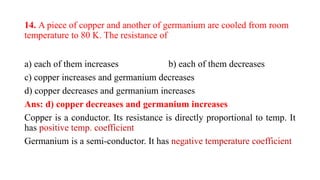
14. A piece of copper and another of germanium are cooled from room
temperature to 80 K. The resistance of
a) each of them increases b) each of them decreases
c) copper increases and germanium decreases
d) copper decreases and germanium increases
Ans: d) copper decreases and germanium increases
Copper is a conductor. Its resistance is directly proportional to temp. It
has positive temp. coefficient
Germanium is a semi-conductor. It has negative temperature coefficient
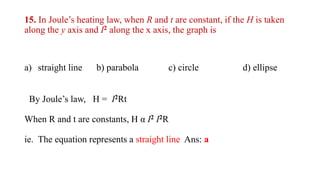
15. In Joule’s heating law, when R and t are constant, if the H is taken
along the y axis and I2 along the x axis, the graph is
a) straight line b) parabola c) circle d) ellipse
By Joule’s law, H = I2Rt
When R and t are constants, H α I2 I2R
ie. The equation represents a straight line Ans: a
Thank You

Current Electricity MCQ Class XII. Physics pptx

  • 1.
    Current Electricity MCQClass XII By Dr M. Arunachalam Head, Department of Physics (Rtd.) Sri SRNM College, Sattur (TN State Board MCQs with explanation)
  • 2.
    1. The followinggraph shows current versus voltage values of some unknown conductor. What is the resistance of this conductor? (a) 2 ohm (b) 4 ohm (c) 8 ohm (d)1 ohm R = V/I = 4/2 = 2ohm Ans a
  • 3.
    2. A wireof resistance 2 ohms per meter is bent to form a circle of radius 1m. The equivalent resistance between its two diametrically opposite points, A and B as shown in the figure is (a) π Ω (c) 2 Ω (c) 2π Ω (d) 4Ω Length of the wire between A and B is πr = πx1m A B Resistance of the semicircular wire = π x2 = 2πΩ We can assume that the circular wire is the combination of two resistances (each of 2πΩ) connected in parallel. The equivalent resistance is RP 1/ RP = 1/ 2π + 1/ 2π = 2/ 2π = 1/π ie. RP = π Ω Ans:a
  • 4.
    3. A toasteroperating at 240 V has a resistance of 120 Ω. Its power is a) 400 W b) 2 W c) 480 W d) 240 W Power P = VI But I = V/R ie. I = 240/120 = 2A ie. P = 240x2 = 480W Ans: C
  • 5.
    4. A carbonresistor of (47 ± 4.7 ) k Ω to be marked with rings of different colours for its identification. The colour code sequence will be a) Yellow – Green – Violet – Gold b) Yellow – Violet – Orange – Silver c) Violet – Yellow – Orange – Silver d) Green – Orange – Violet – Gold B B R O Y G B VG W Y-Yellow-4 V-Violet-7 O-Orange-3zeros 0 1 2 3 4 5 6 7 8 9 47 k Ω Silver-10% tolerance ( + 4.7 k Ω) Hence we have, Yellow – Violet – Orange – Silver Ans: b
  • 6.
    5. What isthe value of resistance of the following resistor? (a)100 k Ω (b)10k Ω (c) 1k Ω (d)1000 k Ω B-Brown=1 Black -0 Yellow- 4 zeros 10,0000Ω = 100 k Ω Ans: a B B R O Y G B VG W 0 1 2 3 4 5 6 7 8 9
  • 7.
    6. Two wiresof A and B with circular cross section are made up of the same material with equal lengths. Suppose RA = 3 RB, then what is the ratio of radius of wire A to that of B? (a) 3 (b) √3 (c) 1/ √3 (d) 1/3 R = ρL/A = ρL/πr2 Both the wires have equal length and of same materials. So L and ρ are the same for A and B RA = ρL/πrA 2 and RB = ρL/πrB 2 But RA = 3 RB ie. ρL/πrA 2 = 3ρL/πrB 2 ie. rA 2 /rB 2 = 1/3 ie. rA /rB = 1/ √3 Ans. C
  • 8.
    7. A wireconnected to a power supply of 230 V has power dissipation P1. Suppose the wire is cut into two equal pieces and connected parallel to the same power supply. In this case power dissipation is P2 . The ratio P2 / P1 is (a)1 (b) 2 (c) 3 (d) 4 Let us assume that, before cutting, the wire has a resistance 2R (ie. two resistors each of value R ohm connected in series). Now the power dissipation is P1 = V2/2R ----- 1 After cutting, we have two resistors (each of value R ohm) connected in parallel.
  • 9.
    Contd… Now we have, 1/RP=1/R + 1/R = 2/R ie RP = R/2 Power dissipation P2 = V2/ R/2 ----- 2 Dividing equation 2 by equation 1 we get P2 / P1 = [V2/ (R/2)] x (2R/V2 ) = (2V2 / R) x (2R/V2 ) = 4 ie. P2 / P1 = 4 Ans: d
  • 10.
    8. In Indiaelectricity is supplied for domestic use at 220 V. It is supplied at 110 V in USA. If the resistance of a 60W bulb for use in India is R, the resistance of a 60W bulb for use in USA will be (a) R (b) 2R (c) R/4 (d) R/2 P = V2/R ie. R = V2/ P For India R = RI = (220)2/ 60 ie. RI = (2x110)2/ 60 ie. RI = 4x(110)2/ 60 ----- 1 For USA RUSA = (110)2/ 60 ----- 2 Dividing equation 2 by equation 1, we get RUSA = (110)2/ 60 ie. RUSA = RI/4 = R/4 ie. RUSA = R/4 Ans: c RI 4x(110)2/ 60
  • 11.
    9. In alarge building, there are 15 bulbs of 40 W, 5 bulbs of 100 W, 5 fans of 80 W and 1 heater of 1k W are connected. The voltage of electric mains is 220 V. The maximum capacity of the main fuse of the building will be (a) 14 A (b) 8 A (c) 10 A (d) 12 A Power P = VI ie. I = P/V I = 2500/220 = 11.1A Max.capacity of main fuse is 12 A Ans: d 15 bulbs x 40W = 600W 5 bulbs x 100W = 500W 5 fans x 80W = 400W 1Heater x 1000W= 1000W Total - 2500W
  • 12.
    10. There isa current of 1.0 A in the circuit shown below. What is the resistance of P ? a) 1.5 Ω b) 2.5 Ω c) 3.5 Ω d) 4.5 Ω By Ohm’s law, R = V/I ie. R = 9/1 = 9 Ω Resistors are connected in series ie. R = 9 = 3 + 2.5 + P ie. 9 = 5.5 + P ie. P = 9 – 5.5 = 3.5 Ω Ans: C
  • 13.
    11. What isthe current drawn out from the battery? a) 1A b) 2A c) 3A d) 4A By Ohms’s law, I = V/R Resistors are connected in parallel 1/RP= 1/15 + 1/15 + 1/15 = 3/15 ie. RP= 15/3 = 5 ohm ie. I = V/R = 5/5 = 1A Ans: a
  • 14.
    12. The temperaturecoefficient of resistance of a wire is 0.00125 per °C. At 20°C, its resistance is 1 Ω. The resistance of the wire will be 2 Ω at a) 800 °C b) 700 °C c) 850 °C d) 820 °C R2 = R1[1+ α (T2 - T1)] R1 = Resistance at temperature T1(20 °C) = 1 Ω R2 = Resistance at temperature T2 = 2 Ω α – Temperature coefficient of resistance = 0.00125 per °C 2 = 1[1+ 0.00125 (T2 - T1)] ie. 2 = 1+ 0.00125 (T2 - T1)
  • 15.
    Contd… 2 -1 =0.00125 (T2 - T1) 1 = 0.00125 (T2 - T1) (T2 - T1) = 1/0.00125 = 800 ie. T2 = 800 + T1 = 800 + 20 = 820°C Ans:d •
  • 16.
    13. The internalresistance of a 2.1 V cell which gives a current of 0.2 A through a resistance of 10 Ω is a) 0.2 Ω b) 0.5 Ω c) 0.8 Ω d) 1.0 Ω Current I = V/ RT RT = Total Resistance = R+r R – Resistance = 10 Ω r – Internal resistance of the battery V – Potential of the battery = 2.1V I – Current = 0.2A RT = R+r = V/I ie. r = V/I – R = (2.1/0.2) – 10 ie. r = 10.5 – 10 = 0.5 Ω Ans: b
  • 17.
    14. A pieceof copper and another of germanium are cooled from room temperature to 80 K. The resistance of a) each of them increases b) each of them decreases c) copper increases and germanium decreases d) copper decreases and germanium increases Ans: d) copper decreases and germanium increases Copper is a conductor. Its resistance is directly proportional to temp. It has positive temp. coefficient Germanium is a semi-conductor. It has negative temperature coefficient
  • 18.
    15. In Joule’sheating law, when R and t are constant, if the H is taken along the y axis and I2 along the x axis, the graph is a) straight line b) parabola c) circle d) ellipse By Joule’s law, H = I2Rt When R and t are constants, H α I2 I2R ie. The equation represents a straight line Ans: a
  • 19.