


How to (not) become a digital Enterprise
Jakob Freund
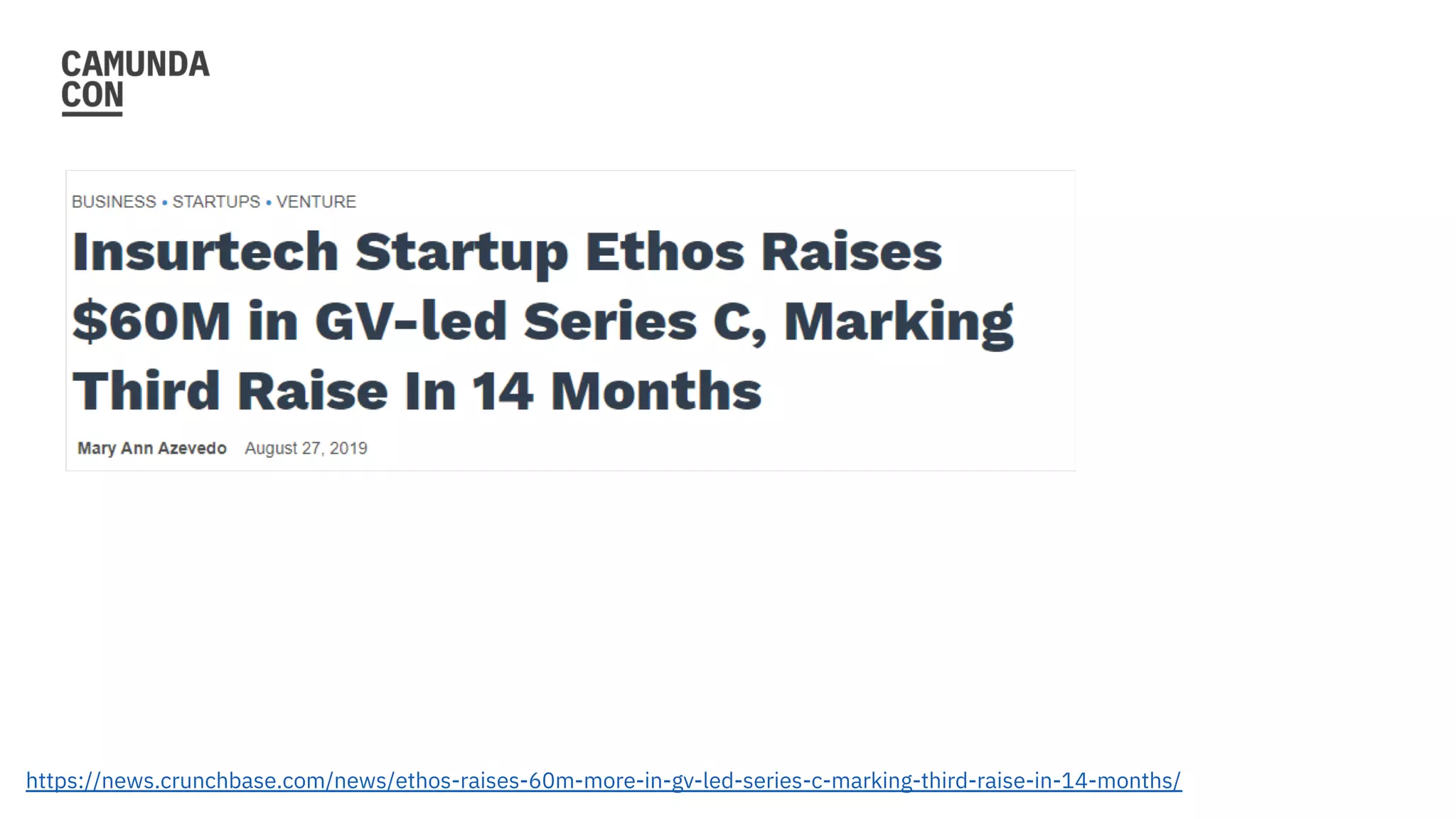
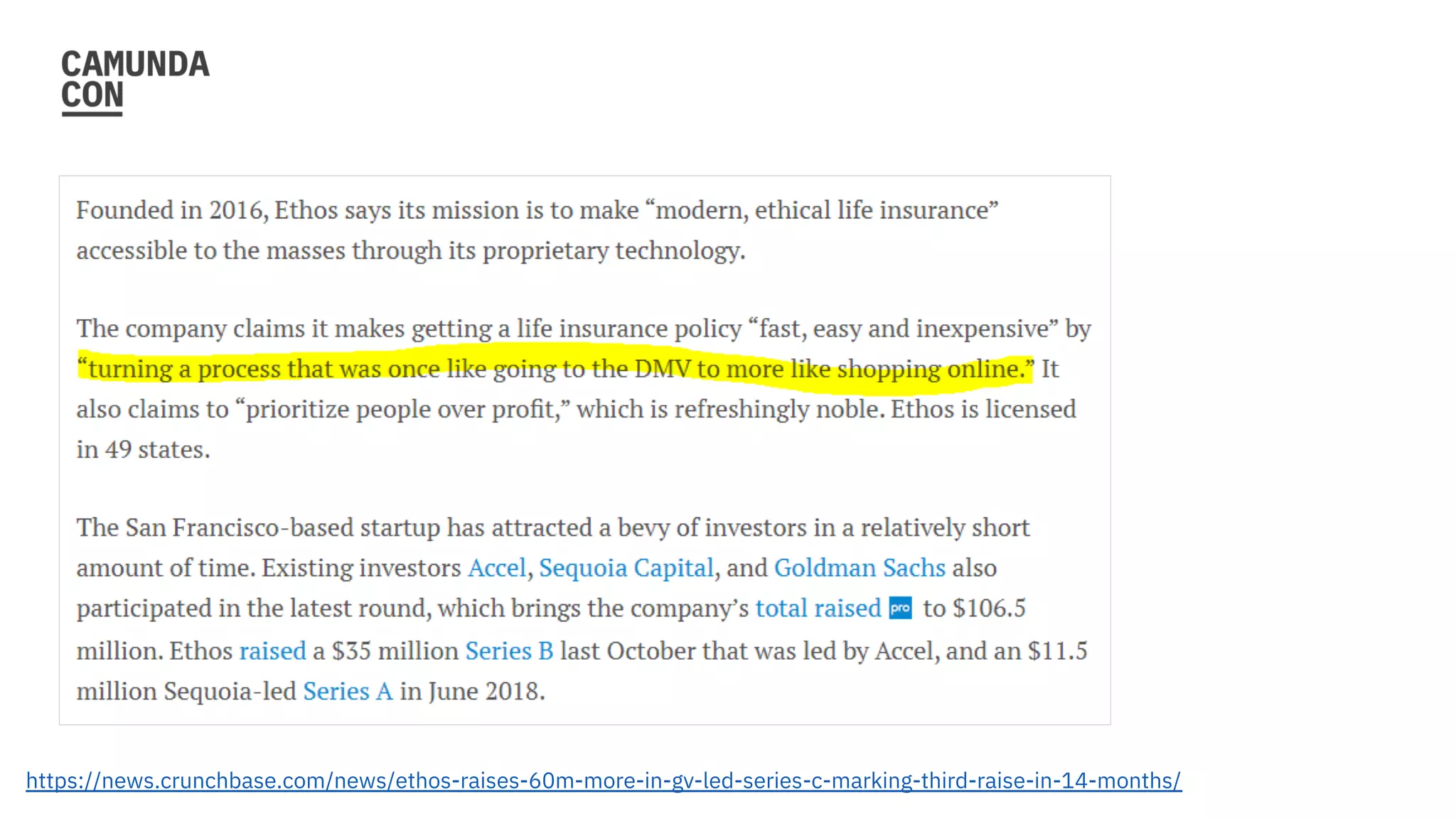
https://news.crunchbase.com/news/ethos-raises-60m-more-in-gv-led-series-c-marking-third-raise-in-14-months/
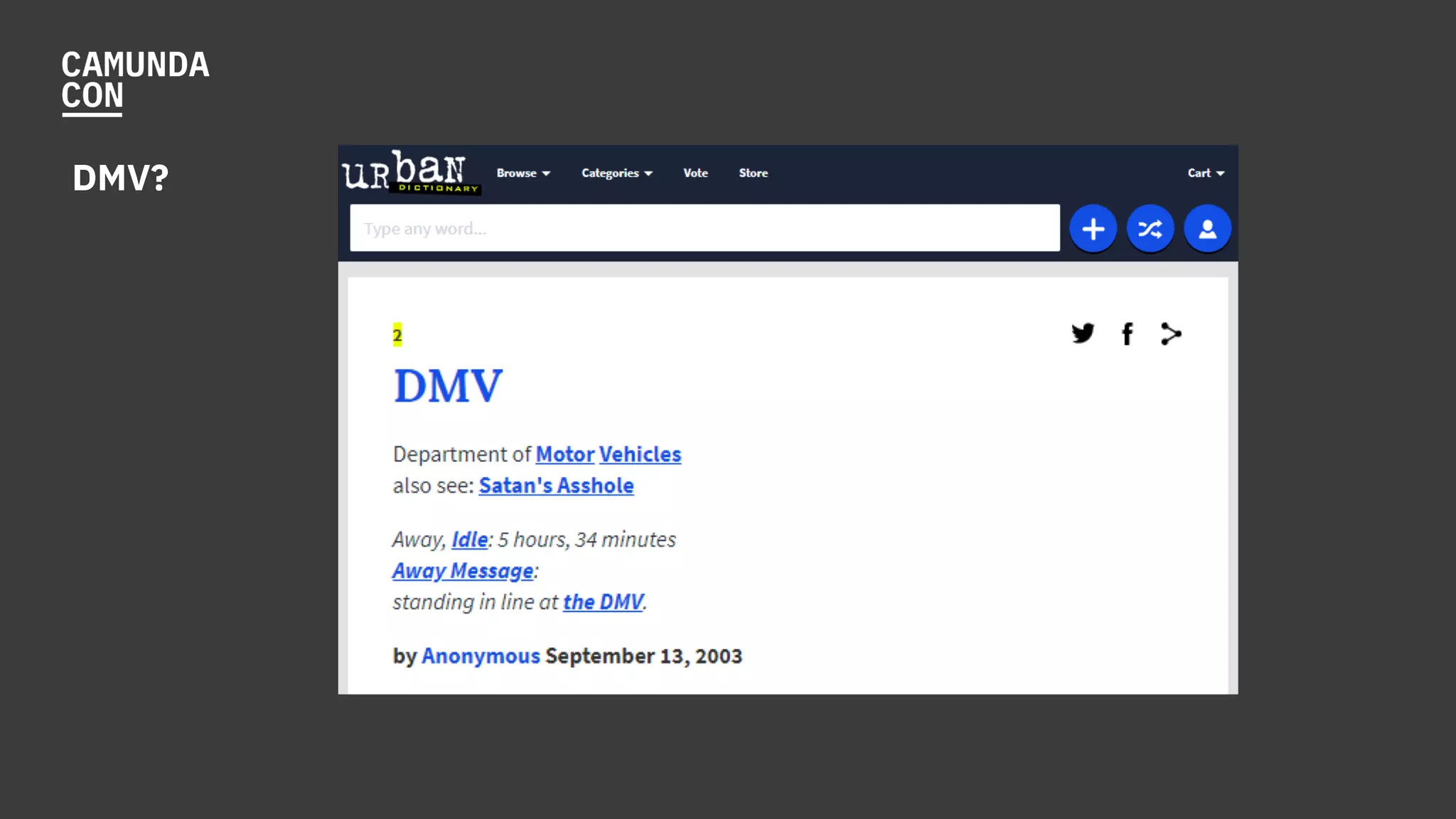
DMV?
If you ask senior executives in the insurance
industry - who are currently driving digital
transformation projects - about their main
objective, the usual answer is: “Getting an
insurance needs to be as simple as buying a
product on Amazon.com”
https://www.sueddeutsche.de/wirtschaft/digitalisierung-versichertvon-amazon-1.3747260
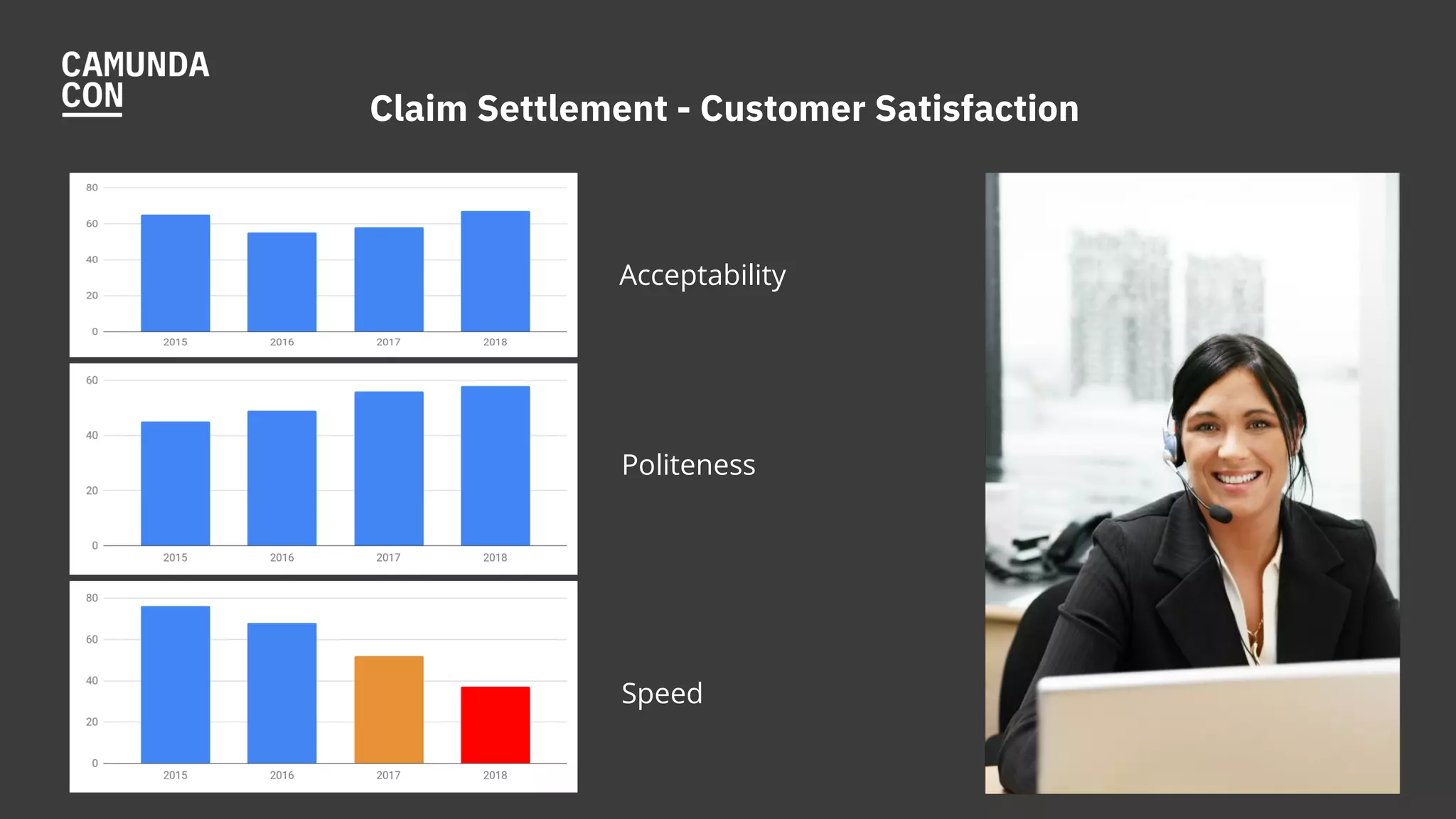
Claim Settlement - Customer Satisfaction
Acceptability
Politeness
Speed
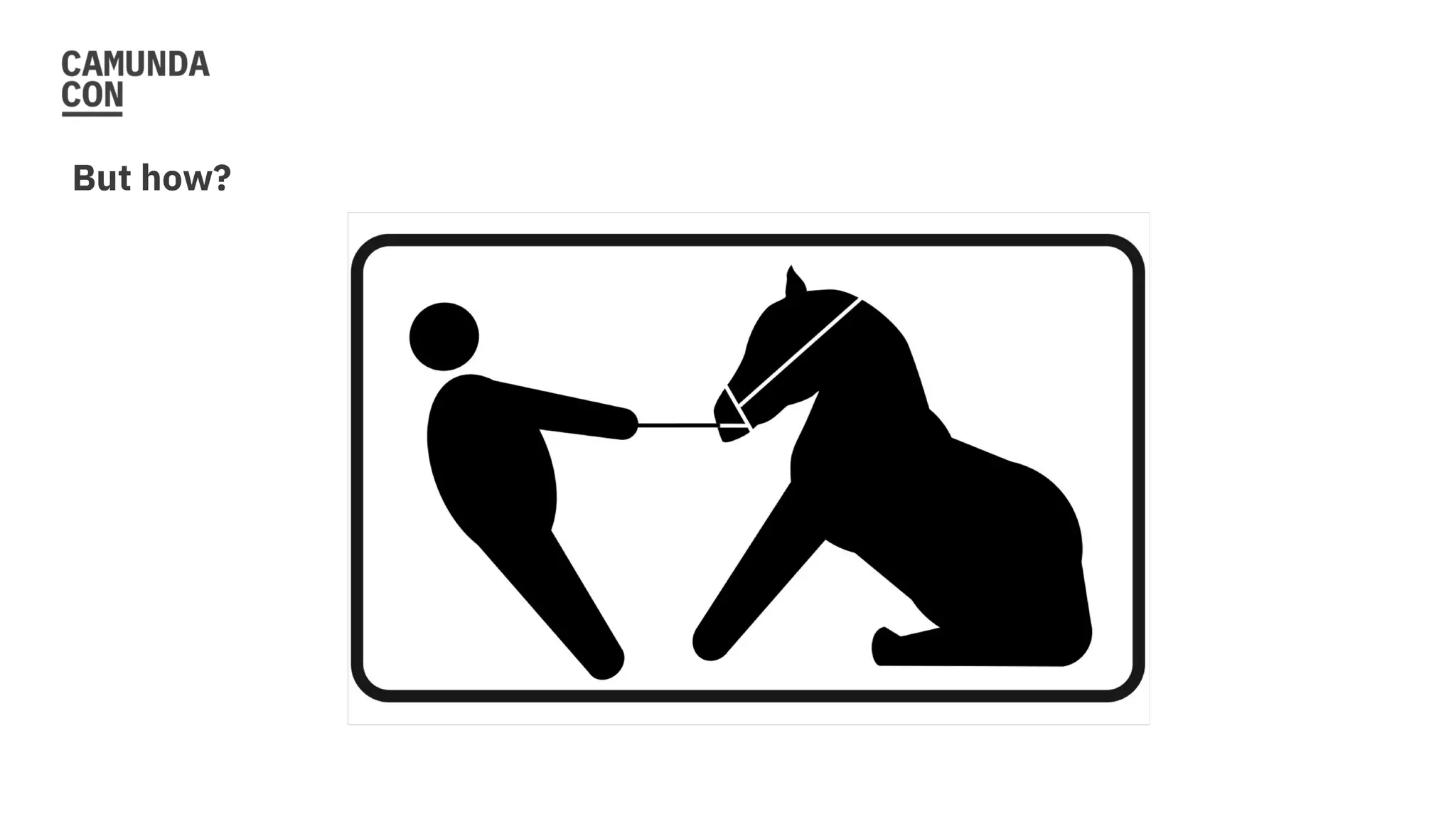
But how?
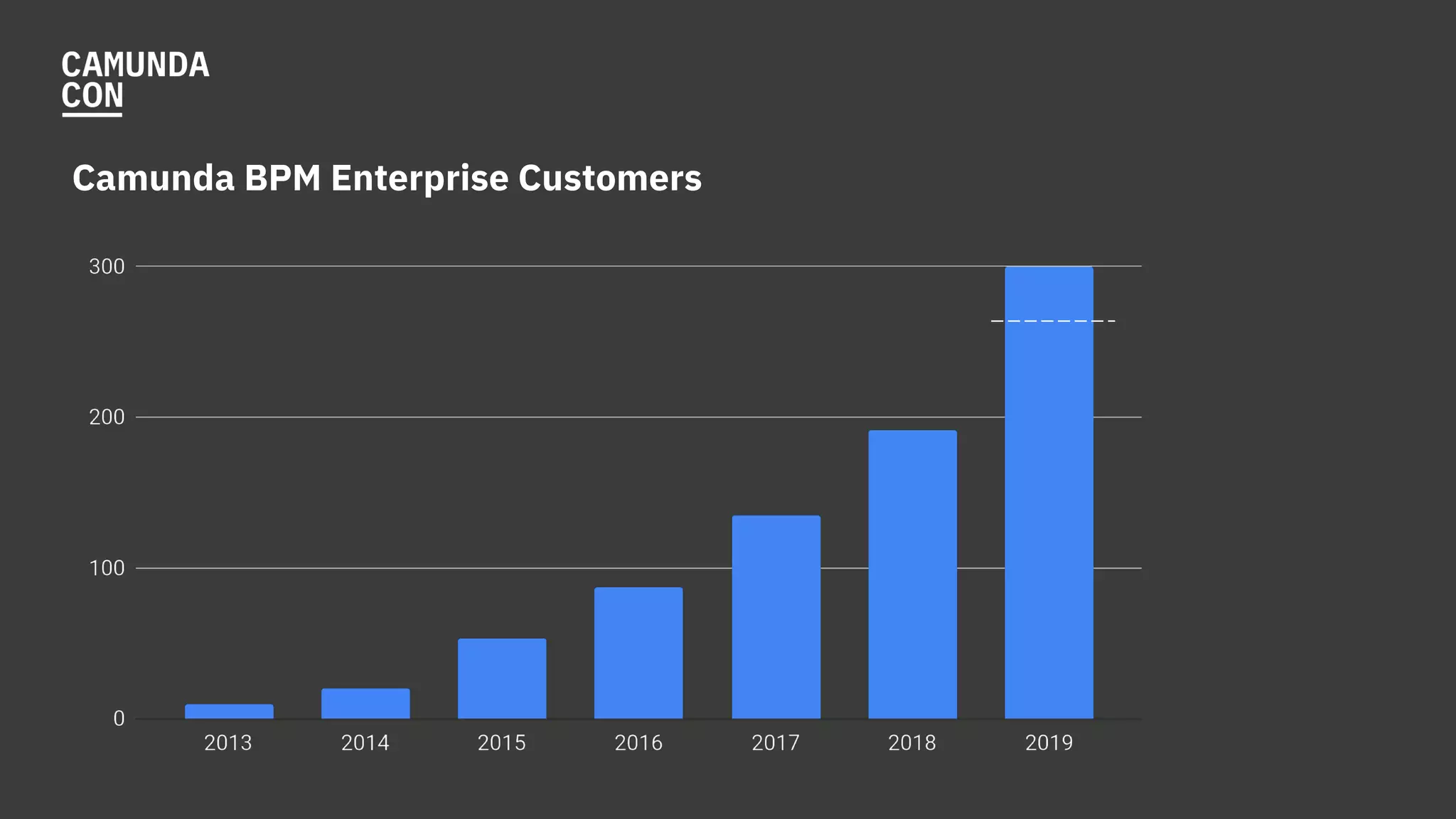
Camunda BPM Enterprise Customers
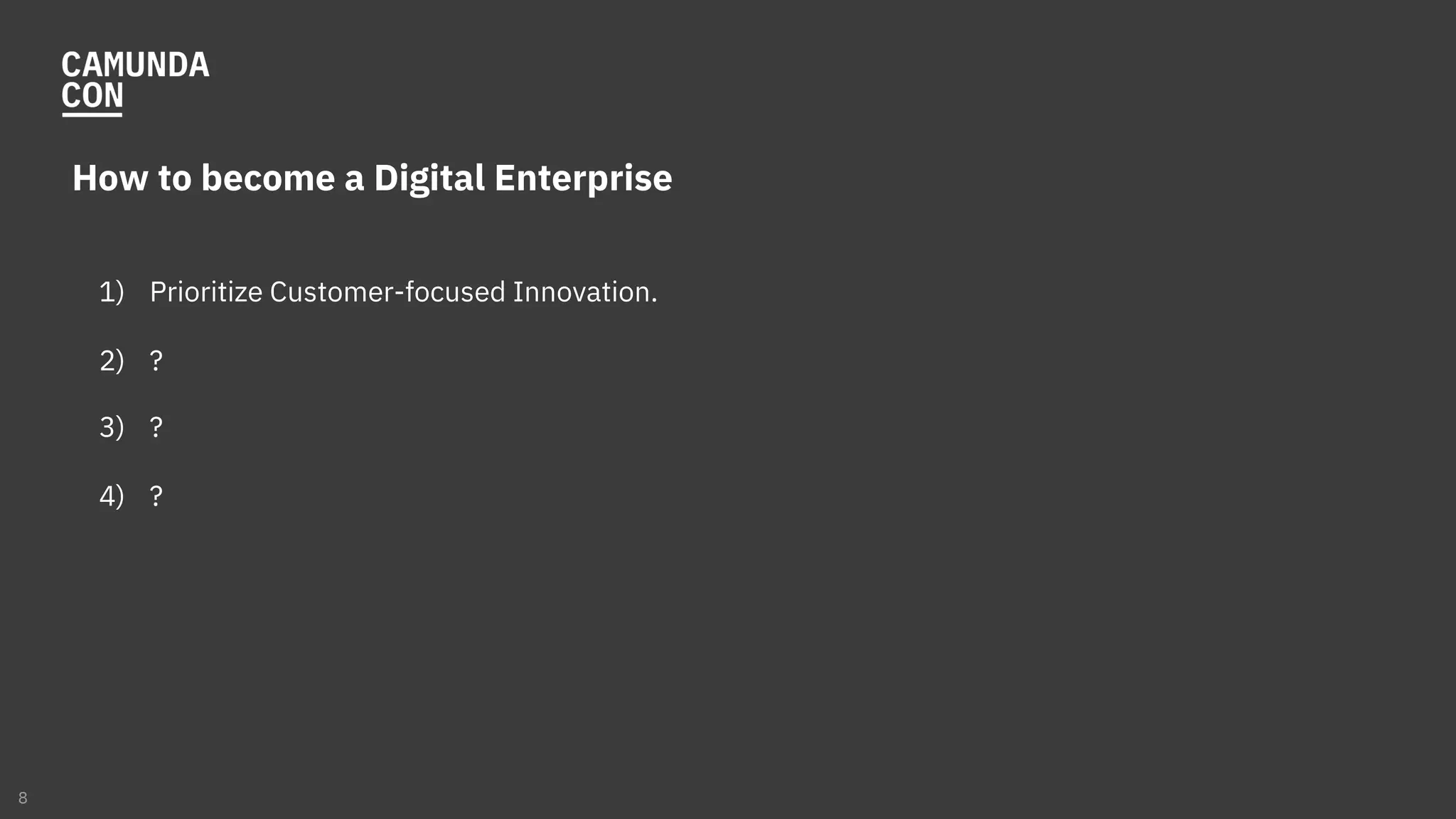
How to become a Digital Enterprise
1) ?
2) ?
3) ?
4) ?
6
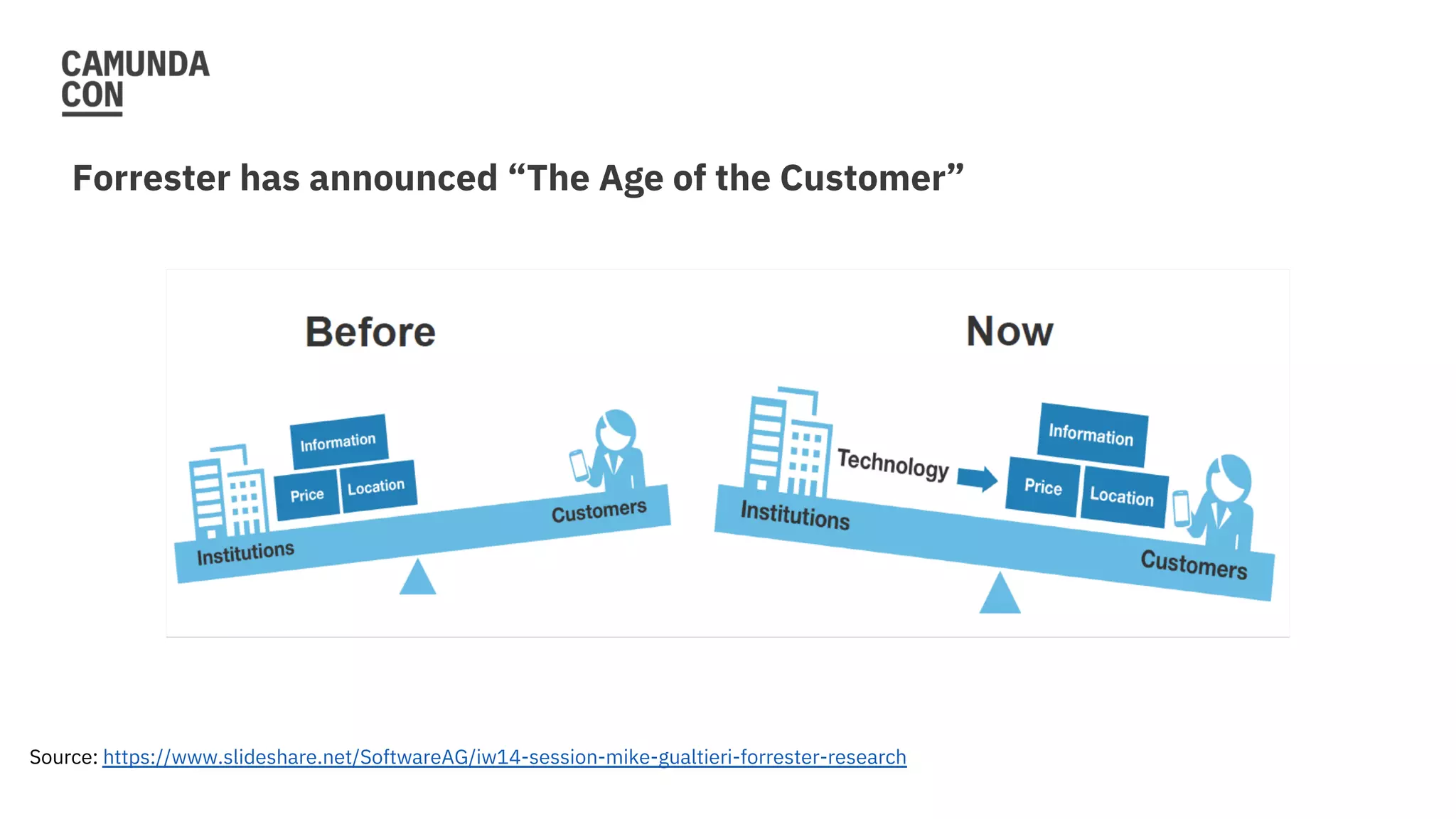
Forrester has announced “The Age of the Customer”
Source: https://www.slideshare.net/SoftwareAG/iw14-session-mike-gualtieri-forrester-research
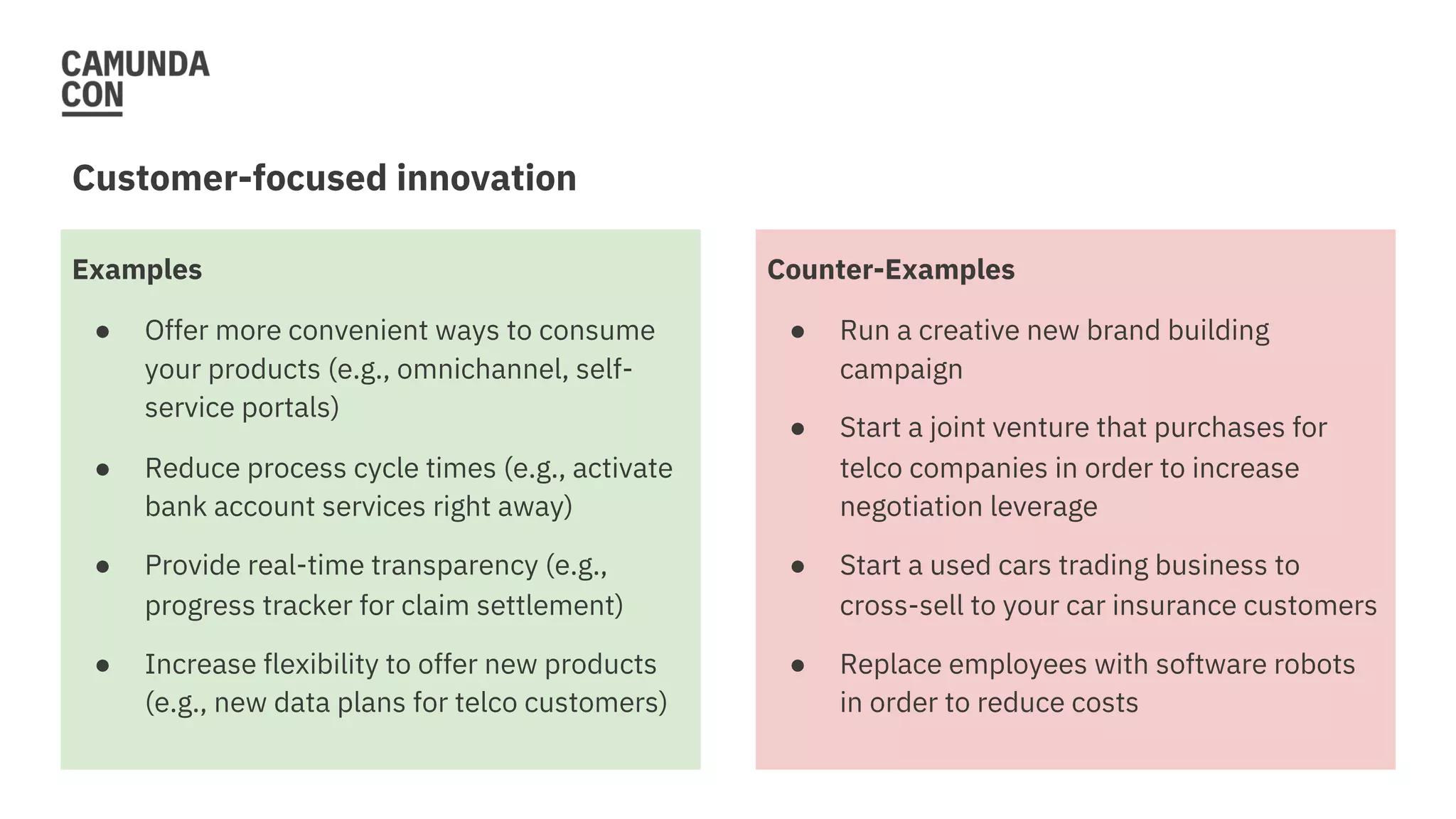
Examples
● Offer more convenient ways to consume
your products (e.g., omnichannel, self-
service portals)
● Reduce process cycle times (e.g., activate
bank account services right away)
● Provide real-time transparency (e.g.,
progress tracker for claim settlement)
● Increase flexibility to offer new products
(e.g., new data plans for telco customers)
Customer-focused innovation
Counter-Examples
● Run a creative new brand building
campaign
● Start a joint venture that purchases for
telco companies in order to increase
negotiation leverage
● Start a used cars trading business to
cross-sell to your car insurance customers
● Replace employees with software robots
in order to reduce costs
How to become a Digital Enterprise
1) Prioritize Customer-focused Innovation.
2) ?
3) ?
4) ?
8
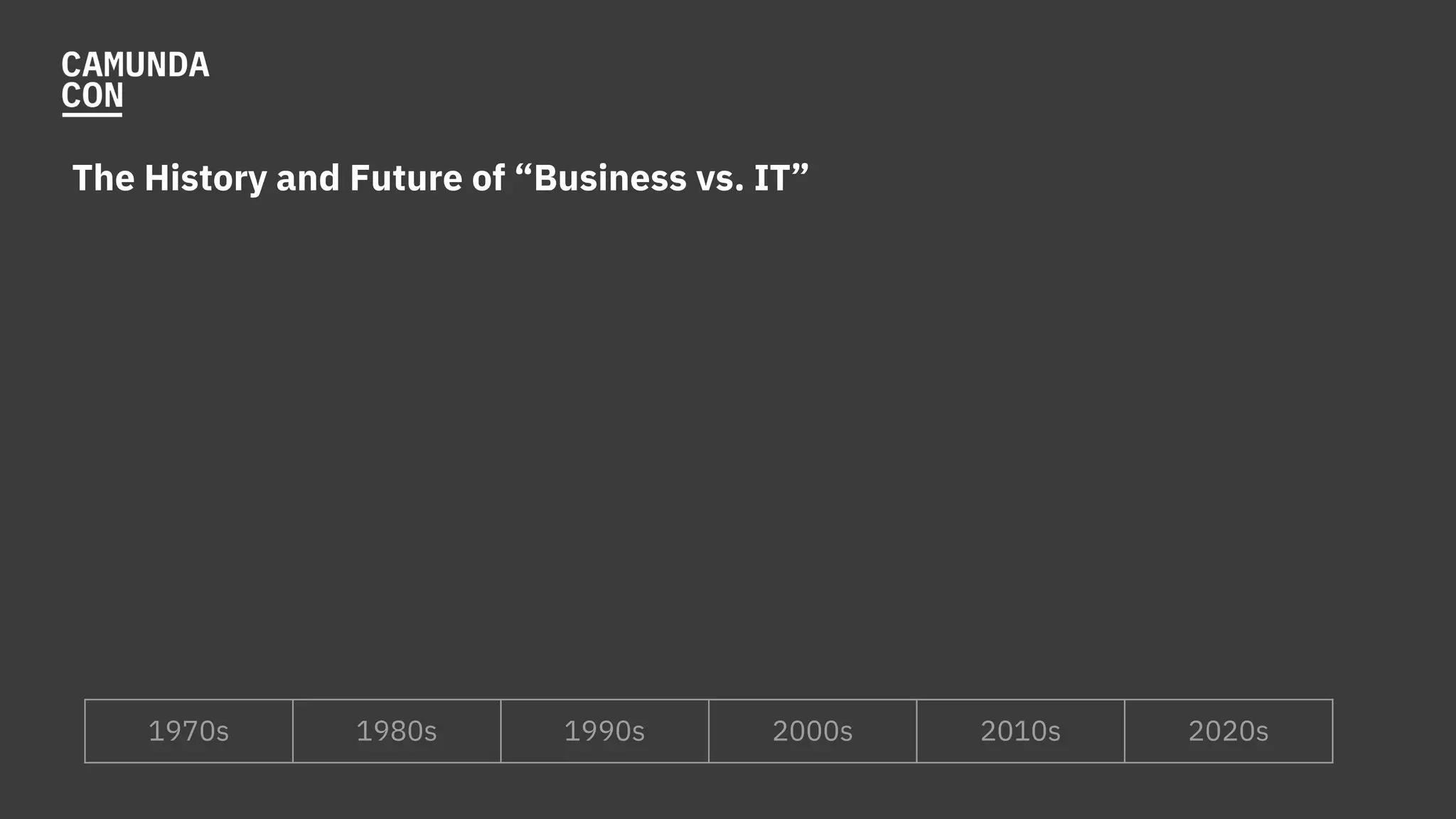
The History and Future of “Business vs. IT”
1970s 1980s 1990s 2000s 2010s 2020s
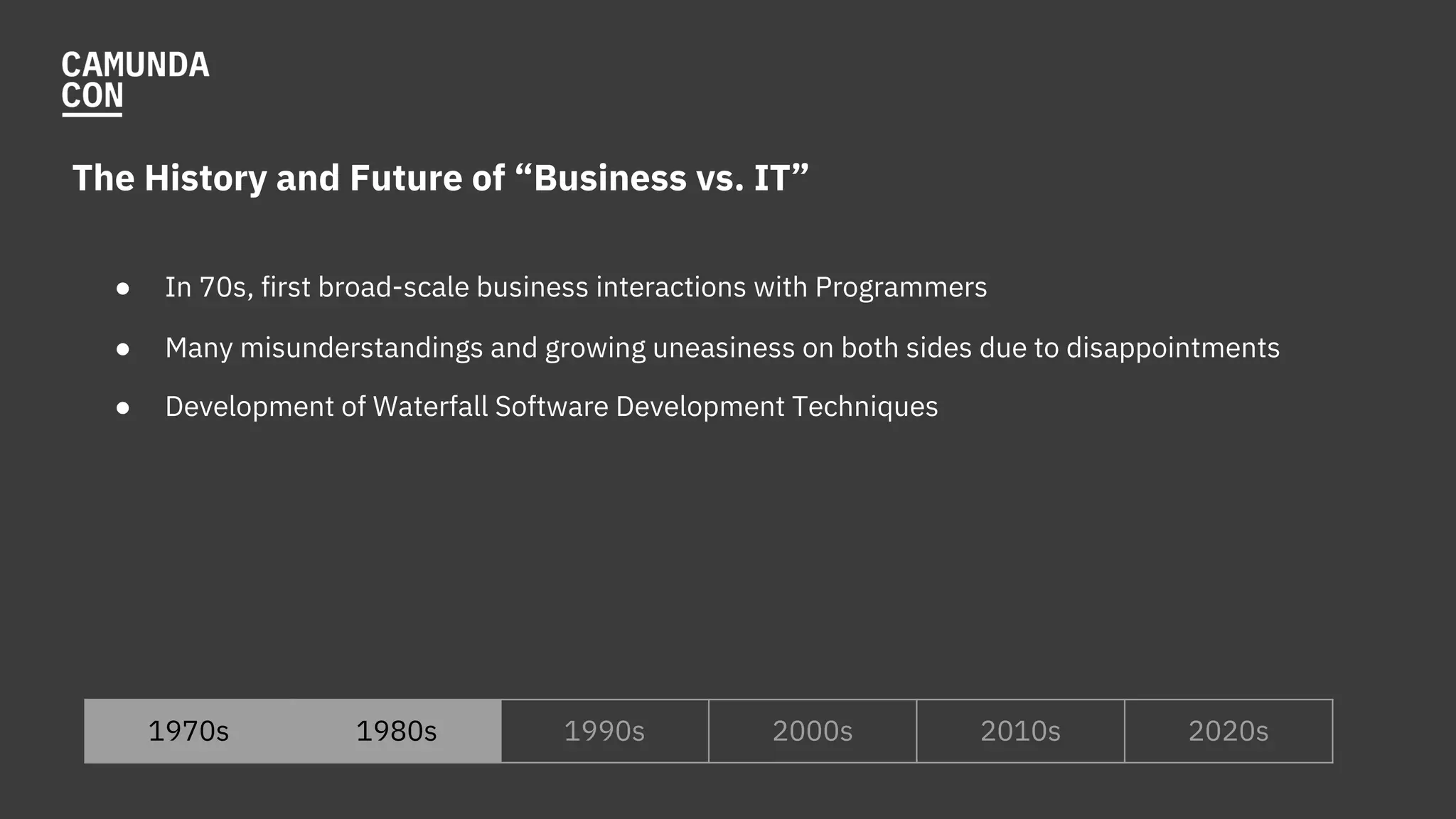
The History and Future of “Business vs. IT”
● In 70s, first broad-scale business interactions with Programmers
● Many misunderstandings and growing uneasiness on both sides due to disappointments
● Development of Waterfall Software Development Techniques
1970s 1980s 1990s 2000s 2010s 2020s
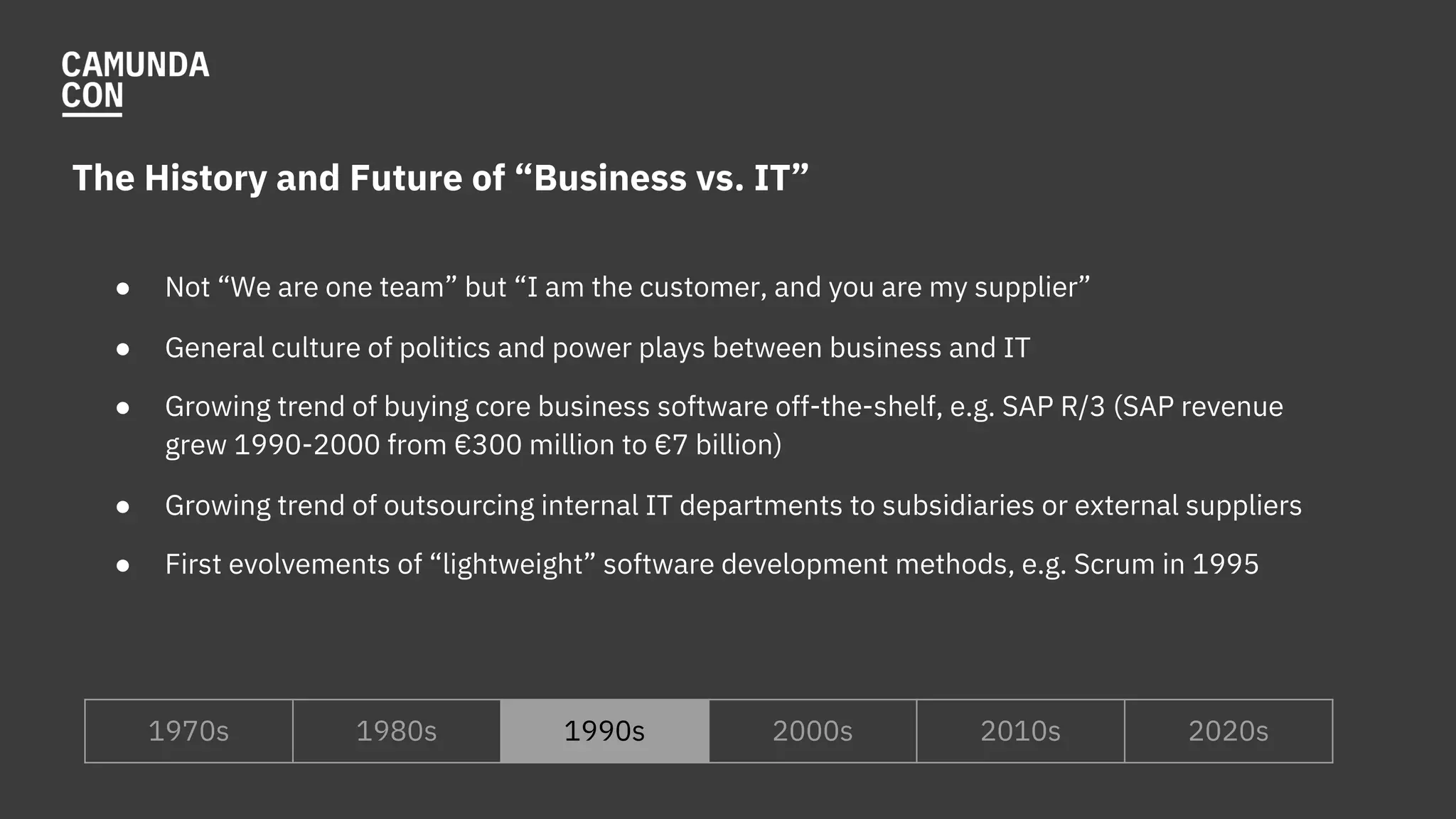
The History and Future of “Business vs. IT”
● Not “We are one team” but “I am the customer, and you are my supplier”
● General culture of politics and power plays between business and IT
● Growing trend of buying core business software off-the-shelf, e.g. SAP R/3 (SAP revenue
grew 1990-2000 from €300 million to €7 billion)
● Growing trend of outsourcing internal IT departments to subsidiaries or external suppliers
● First evolvements of “lightweight” software development methods, e.g. Scrum in 1995
1970s 1980s 1990s 2000s 2010s 2020s
The History and Future of “Business vs. IT”
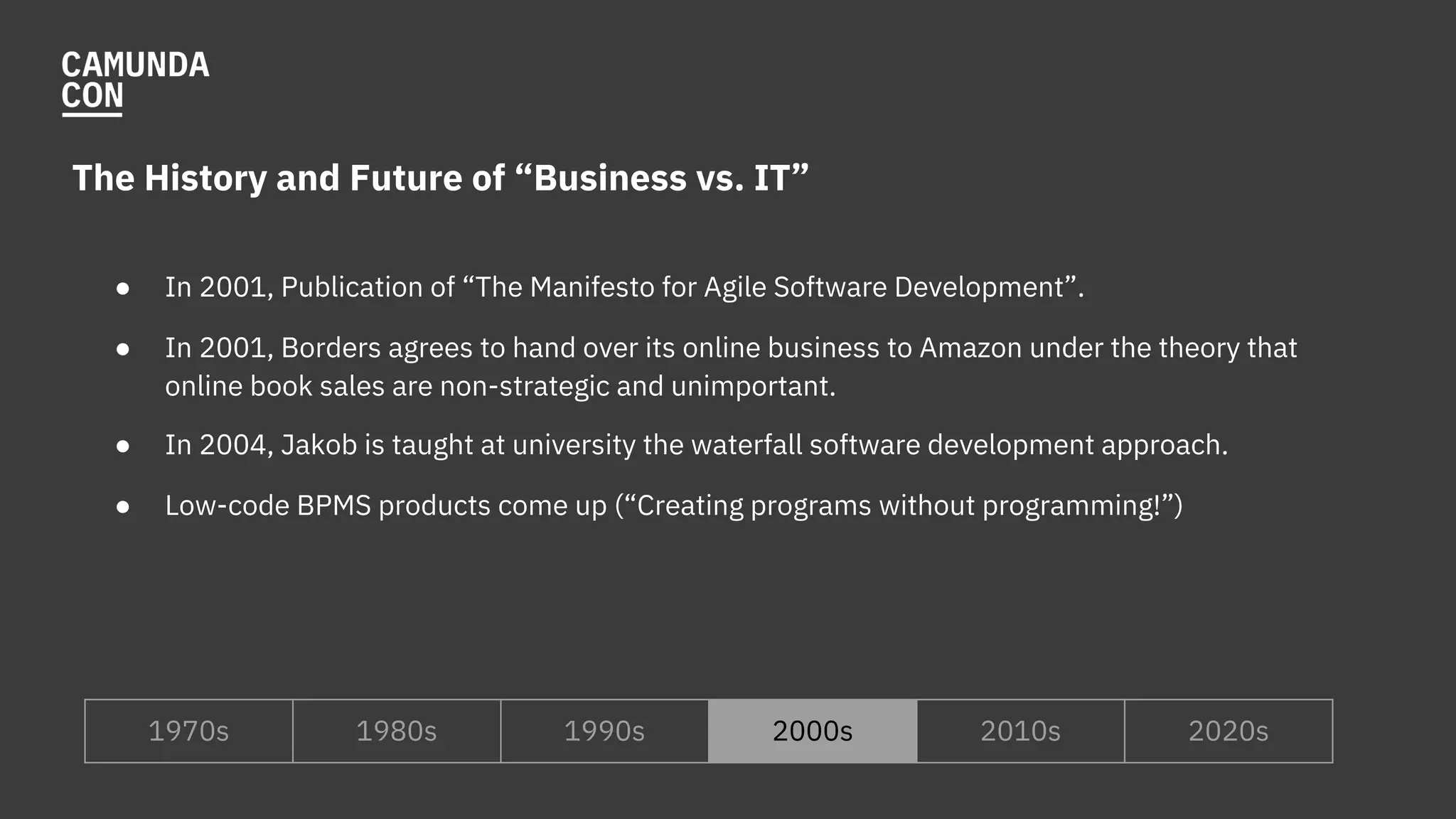
● In 2001, Publication of “The Manifesto for Agile Software Development”.
● In 2001, Borders agrees to hand over its online business to Amazon under the theory that
online book sales are non-strategic and unimportant.
● In 2004, Jakob is taught at university the waterfall software development approach.
● Low-code BPMS products come up (“Creating programs without programming!”)
1970s 1980s 1990s 2000s 2010s 2020s
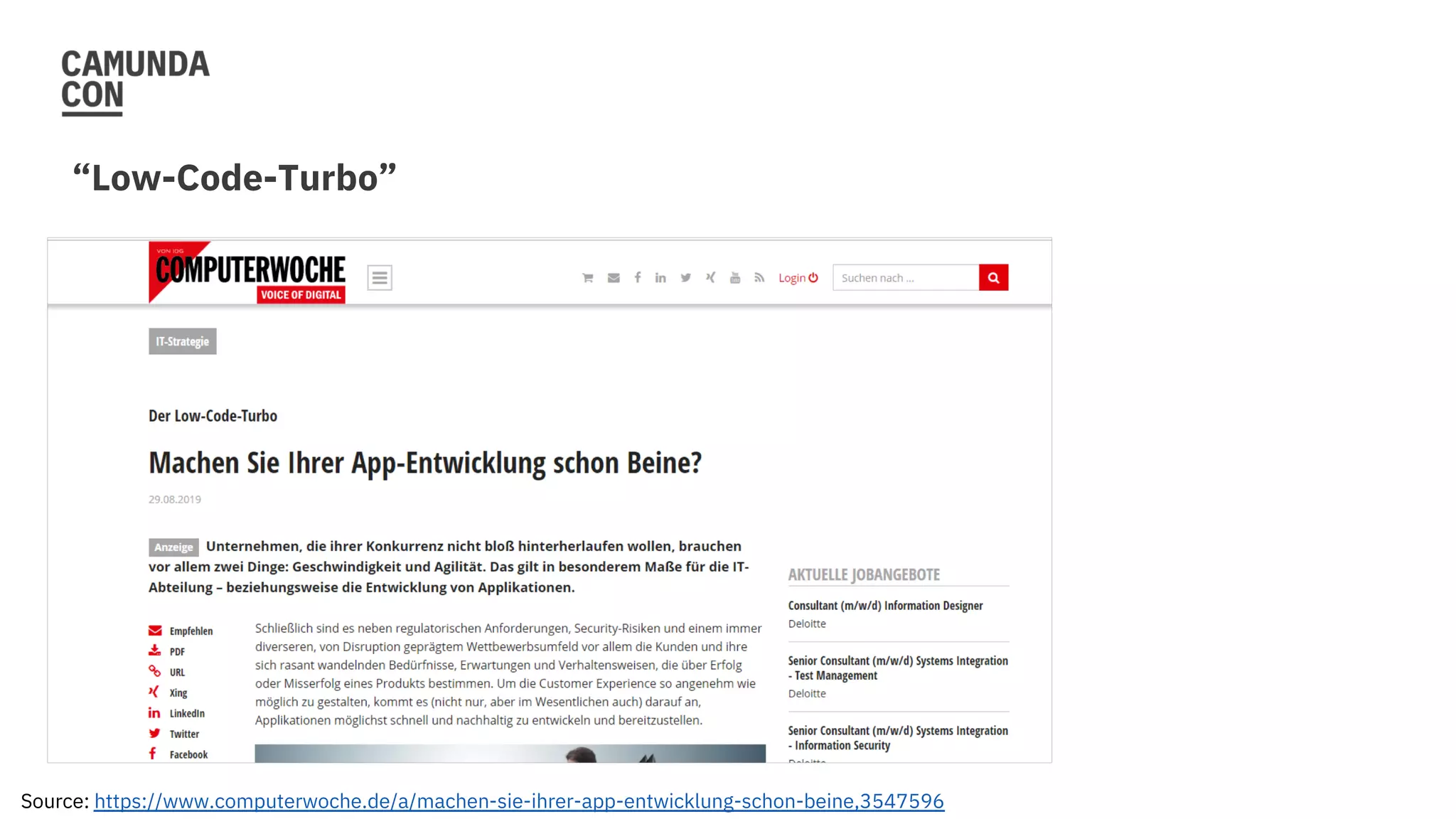
“Low-Code-Turbo”
Source: https://www.computerwoche.de/a/machen-sie-ihrer-app-entwicklung-schon-beine,3547596
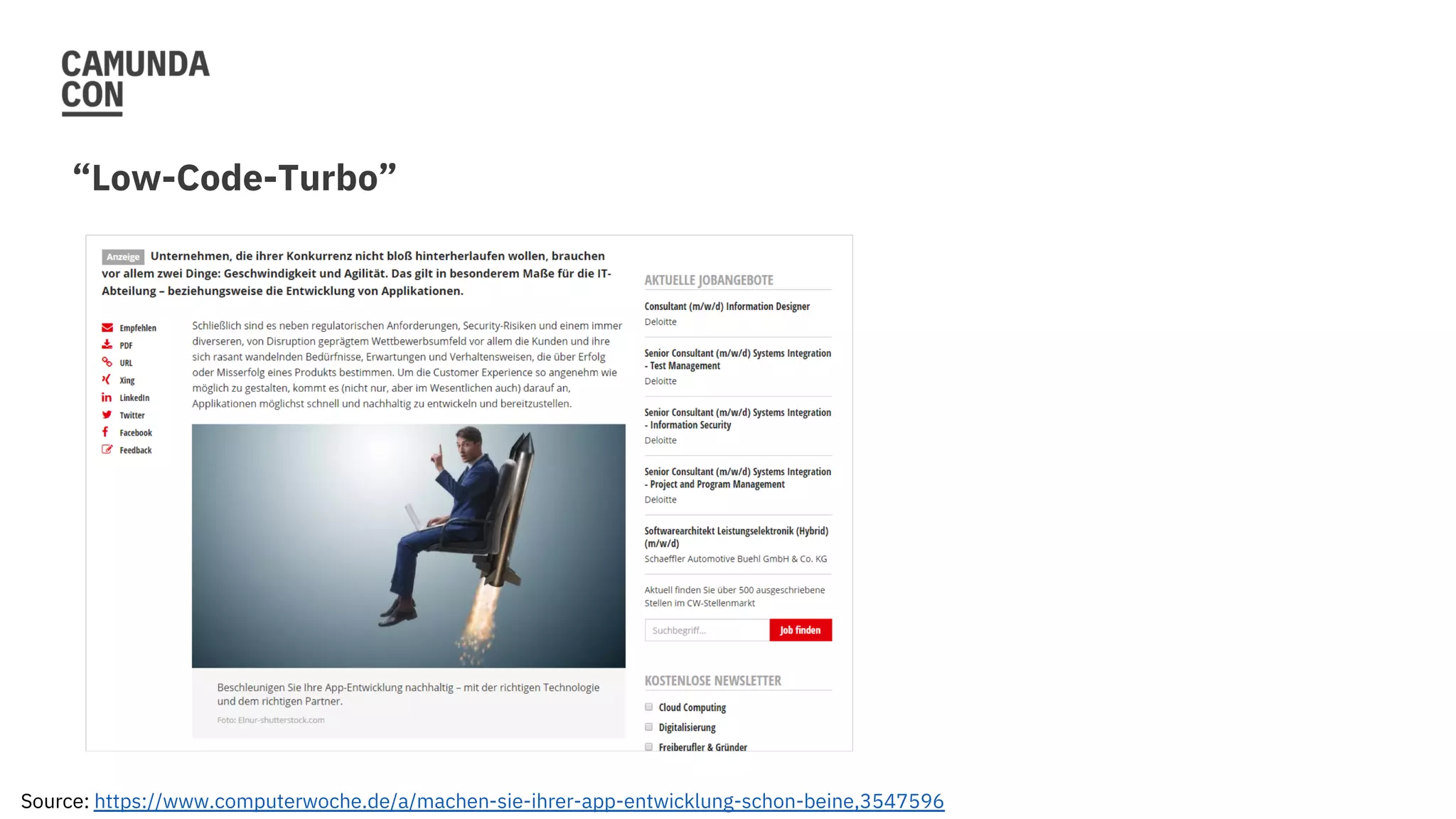
“Low-Code-Turbo”
Source: https://www.computerwoche.de/a/machen-sie-ihrer-app-entwicklung-schon-beine,3547596
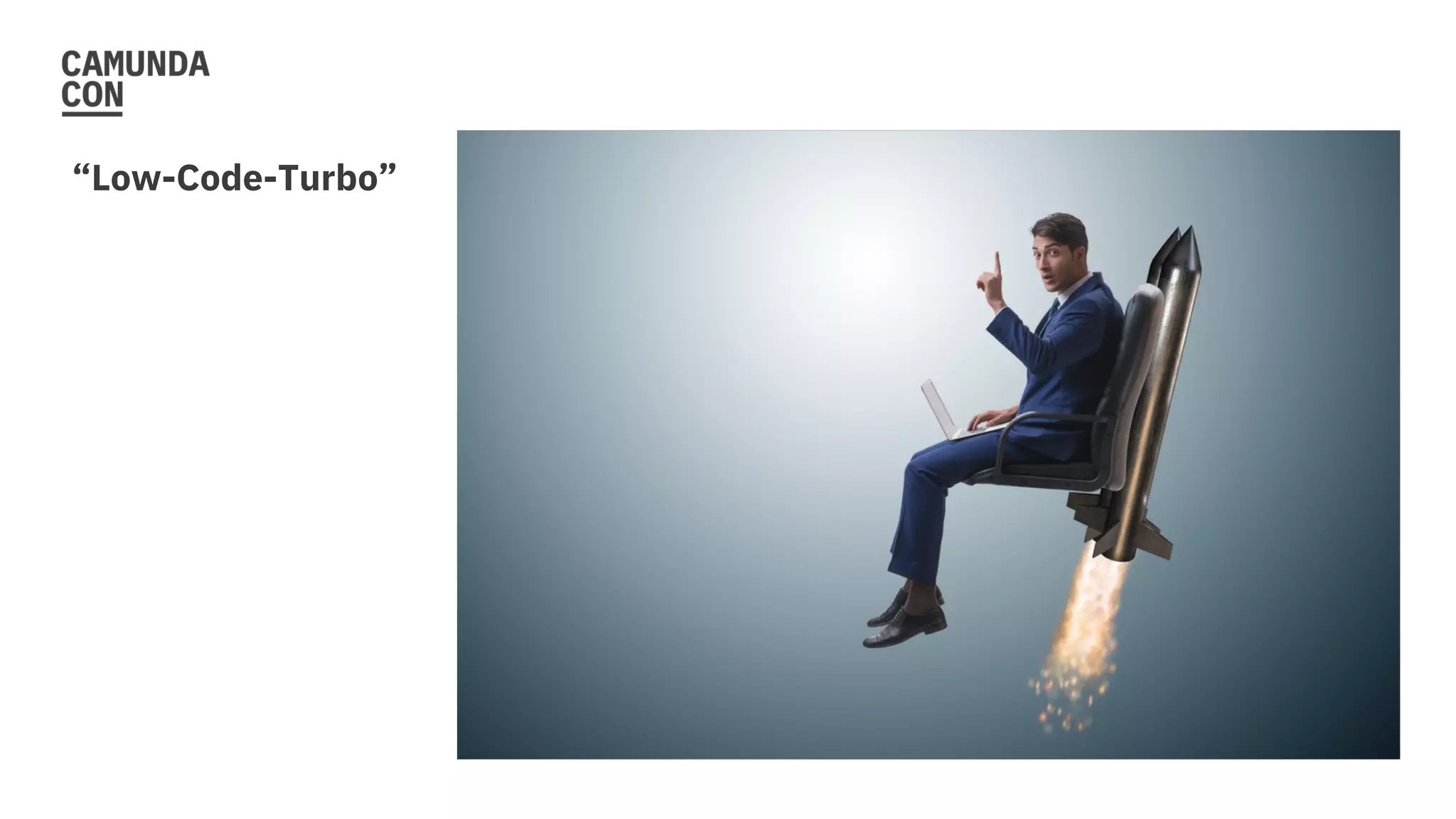
“Low-Code-Turbo”
“Low-Code-Turbo”
“Low-Code-Turbo”
“Low-Code-Turbo”
The History and Future of “Business vs. IT”
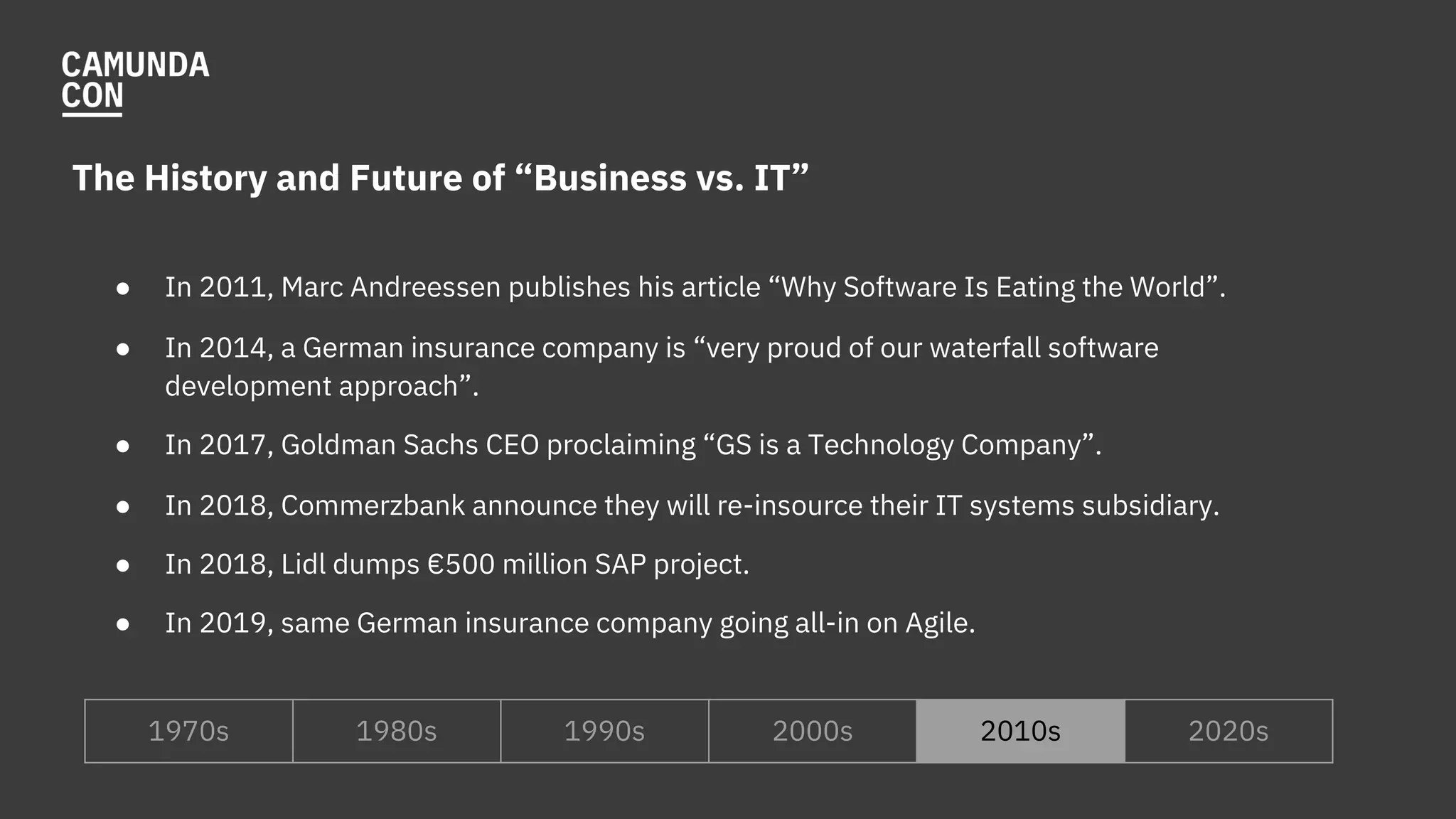
● In 2011, Marc Andreessen publishes his article “Why Software Is Eating the World”.
● In 2014, a German insurance company is “very proud of our waterfall software
development approach”.
● In 2017, Goldman Sachs CEO proclaiming “GS is a Technology Company”.
● In 2018, Commerzbank announce they will re-insource their IT systems subsidiary.
● In 2018, Lidl dumps €500 million SAP project.
● In 2019, same German insurance company going all-in on Agile.
1970s 1980s 1990s 2000s 2010s 2020s
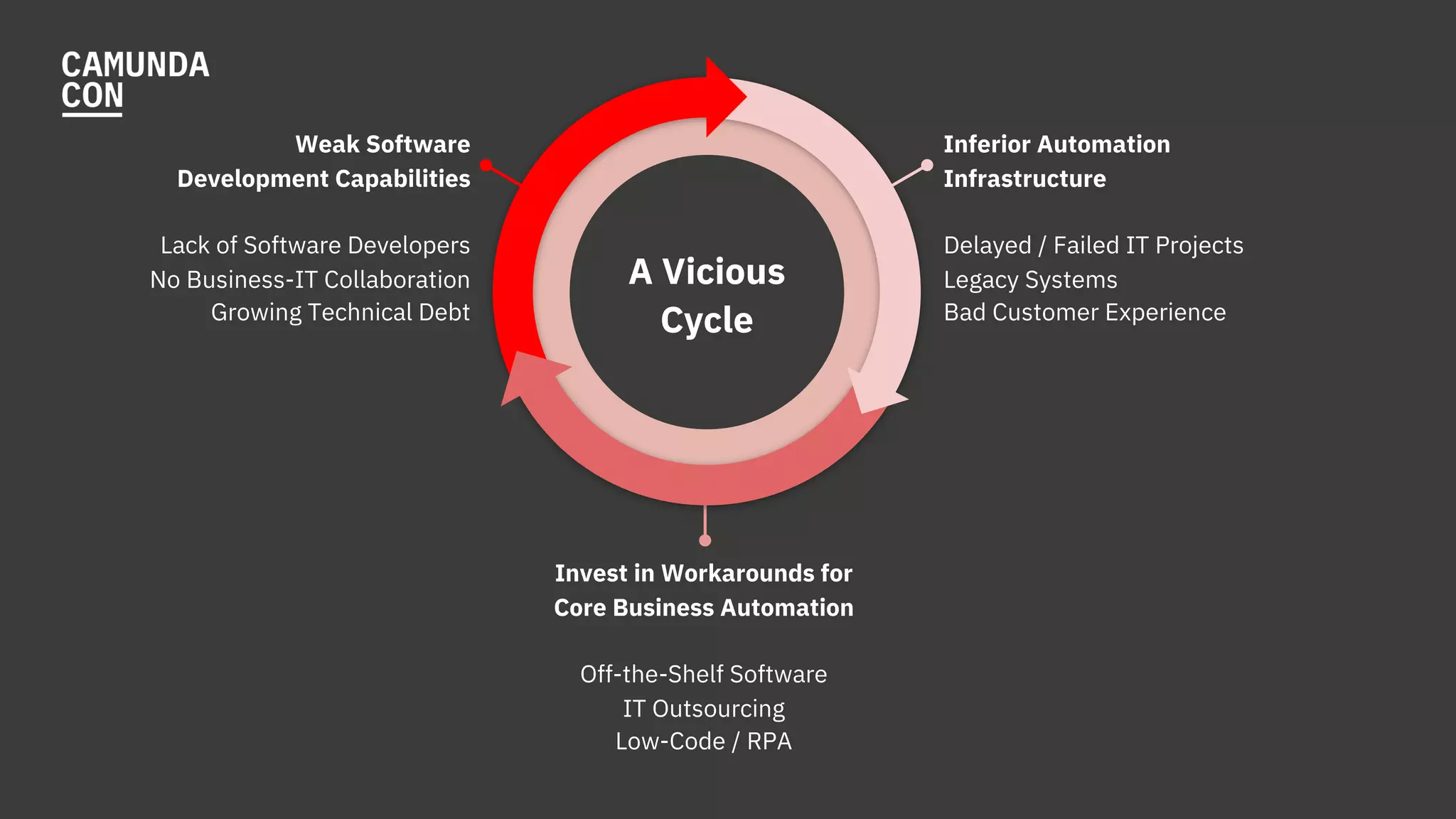
A Vicious
Cycle
Invest in Workarounds for
Core Business Automation
Off-the-Shelf Software
IT Outsourcing
Low-Code / RPA
Inferior Automation
Infrastructure
Delayed / Failed IT Projects
Legacy Systems
Bad Customer Experience
Weak Software
Development Capabilities
Lack of Software Developers
No Business-IT Collaboration
Growing Technical Debt
The History and Future of “Business vs. IT”
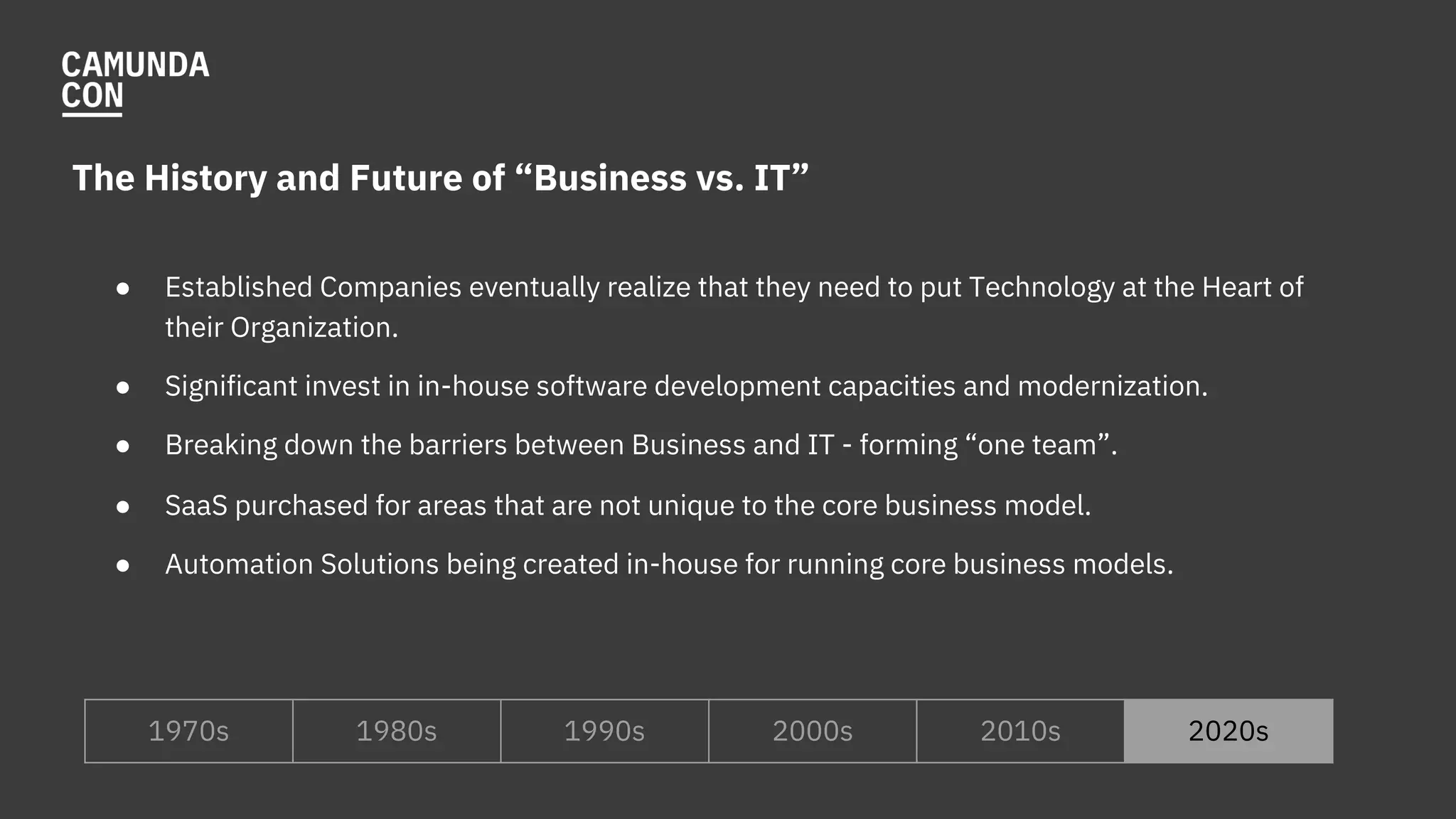
● Established Companies eventually realize that they need to put Technology at the Heart of
their Organization.
● Significant invest in in-house software development capacities and modernization.
● Breaking down the barriers between Business and IT - forming “one team”.
● SaaS purchased for areas that are not unique to the core business model.
● Automation Solutions being created in-house for running core business models.
1970s 1980s 1990s 2000s 2010s 2020s
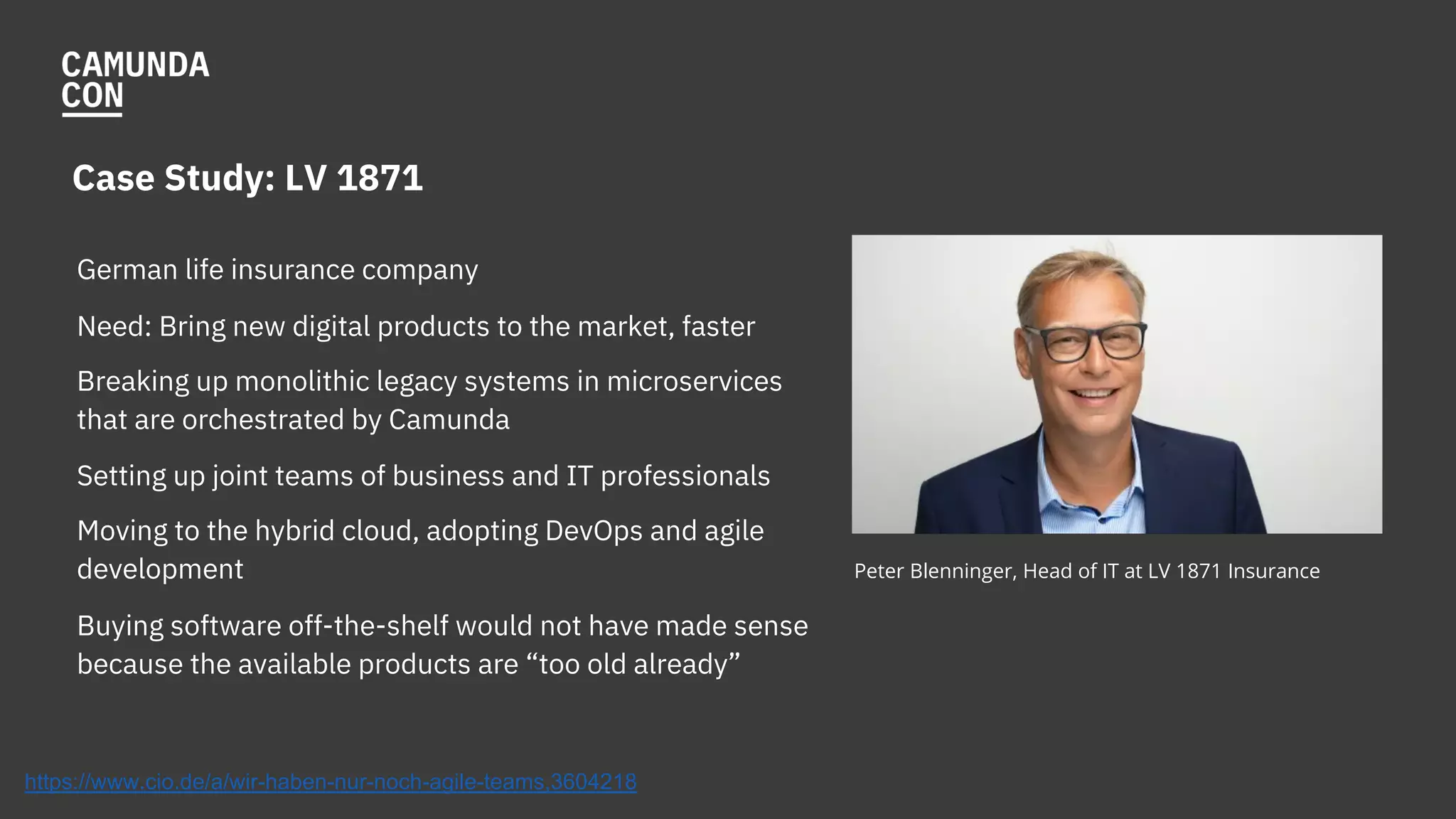
Case Study: LV 1871
German life insurance company
Need: Bring new digital products to the market, faster
Breaking up monolithic legacy systems in microservices
that are orchestrated by Camunda
Setting up joint teams of business and IT professionals
Moving to the hybrid cloud, adopting DevOps and agile
development
Buying software off-the-shelf would not have made sense
because the available products are “too old already”
Peter Blenninger, Head of IT at LV 1871 Insurance
https://www.cio.de/a/wir-haben-nur-noch-agile-teams,3604218
How to become a Digital Enterprise
1) Prioritize Customer-focused Innovation.
2) Bring Technology to the Heart of your Company.
3) ?
4) ?
17
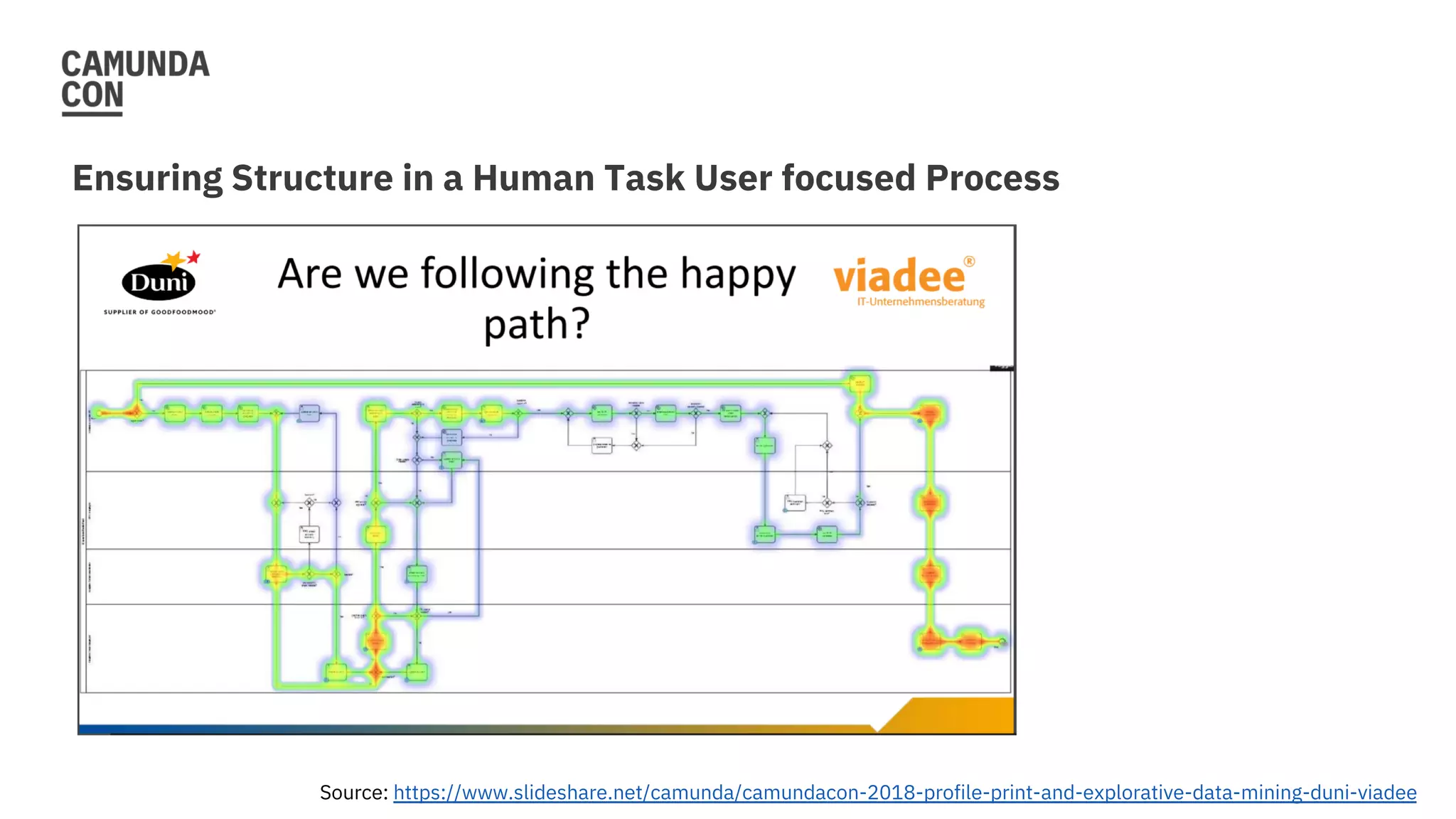
Ensuring Structure in a Human Task User focused Process
Source: https://www.slideshare.net/camunda/camundacon-2018-profile-print-and-explorative-data-mining-duni-viadee
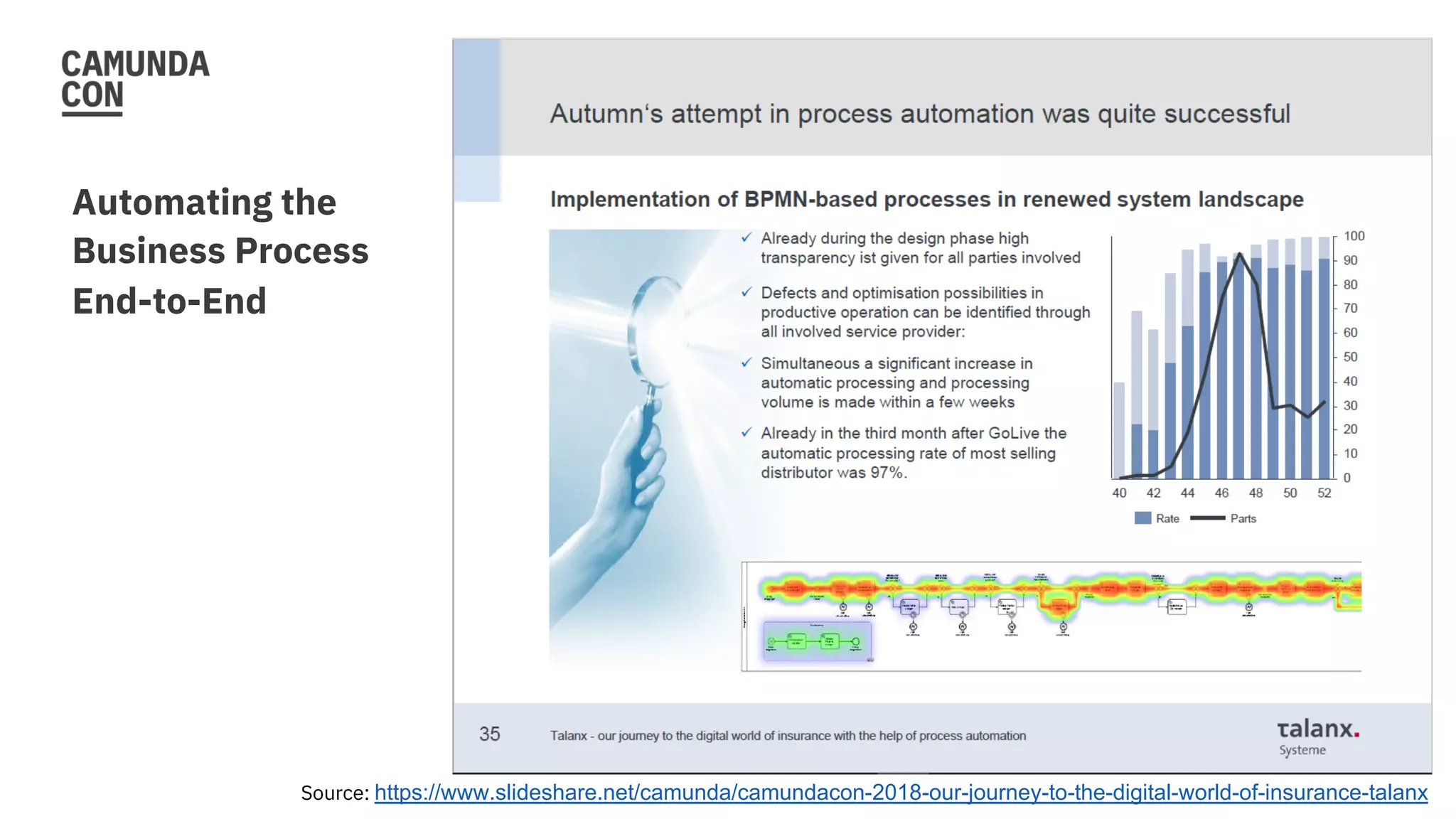
Automating the
Business Process
End-to-End
Source: https://www.slideshare.net/camunda/camundacon-2018-our-journey-to-the-digital-world-of-insurance-talanx
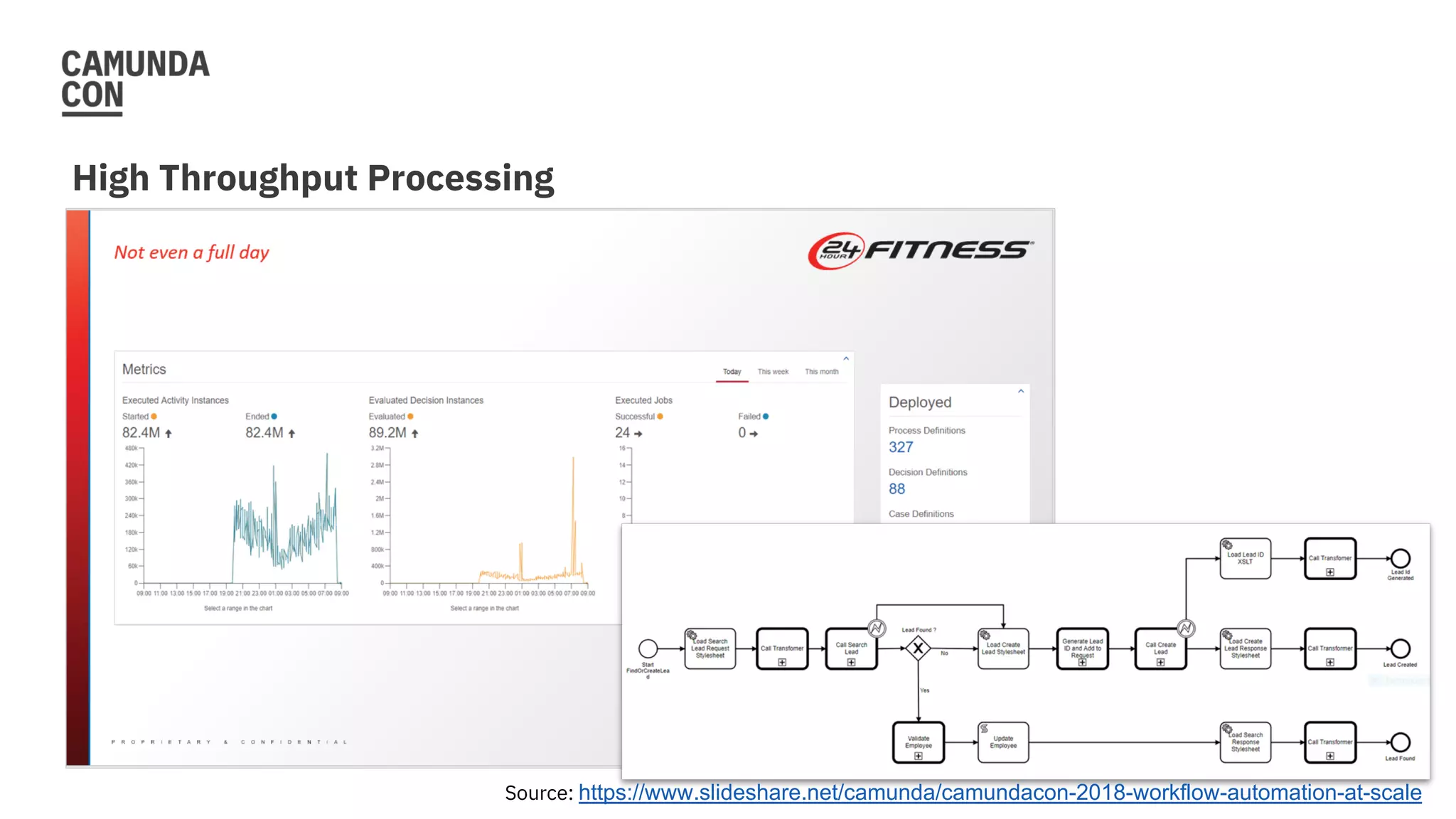
High Throughput Processing
Source: https://www.slideshare.net/camunda/camundacon-2018-workflow-automation-at-scale
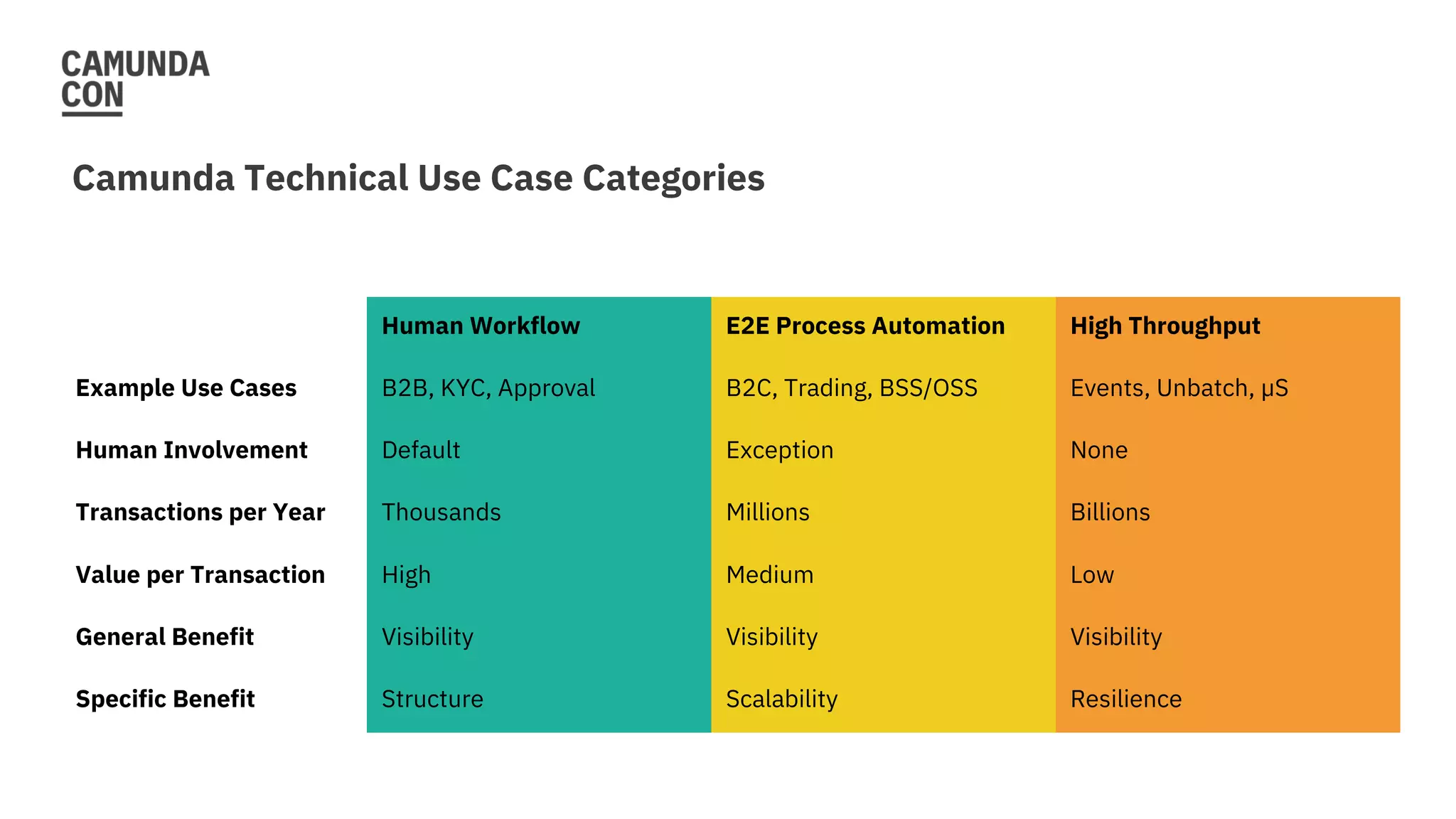
Camunda Technical Use Case Categories
Human Workflow E2E Process Automation High Throughput
Example Use Cases B2B, KYC, Approval B2C, Trading, BSS/OSS Events, Unbatch, µS
Human Involvement Default Exception None
Transactions per Year Thousands Millions Billions
Value per Transaction High Medium Low
General Benefit Visibility Visibility Visibility
Specific Benefit Structure Scalability Resilience
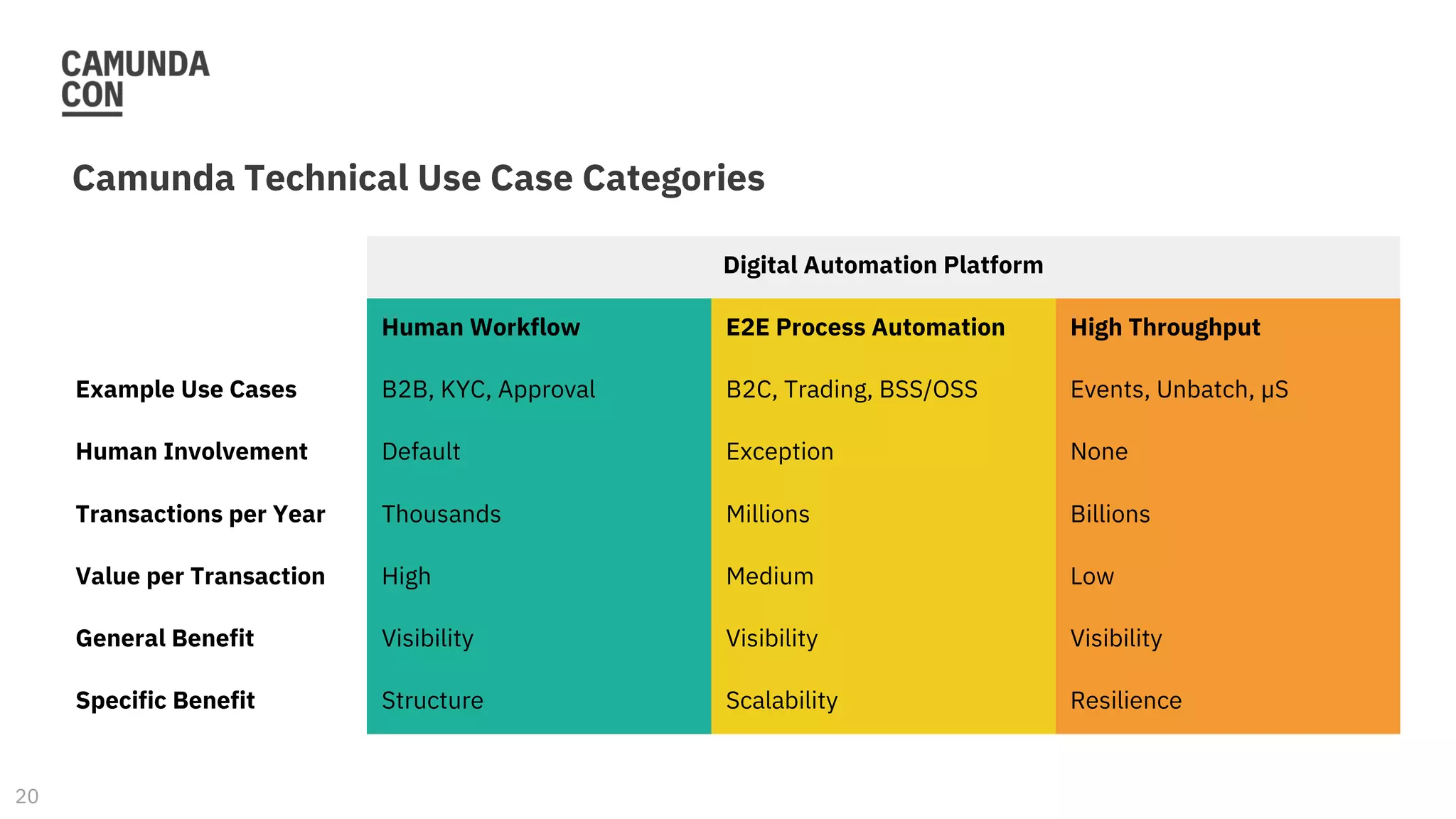
Camunda Technical Use Case Categories
Digital Automation Platform
Human Workflow E2E Process Automation High Throughput
Example Use Cases B2B, KYC, Approval B2C, Trading, BSS/OSS Events, Unbatch, µS
Human Involvement Default Exception None
Transactions per Year Thousands Millions Billions
Value per Transaction High Medium Low
General Benefit Visibility Visibility Visibility
Specific Benefit Structure Scalability Resilience
20
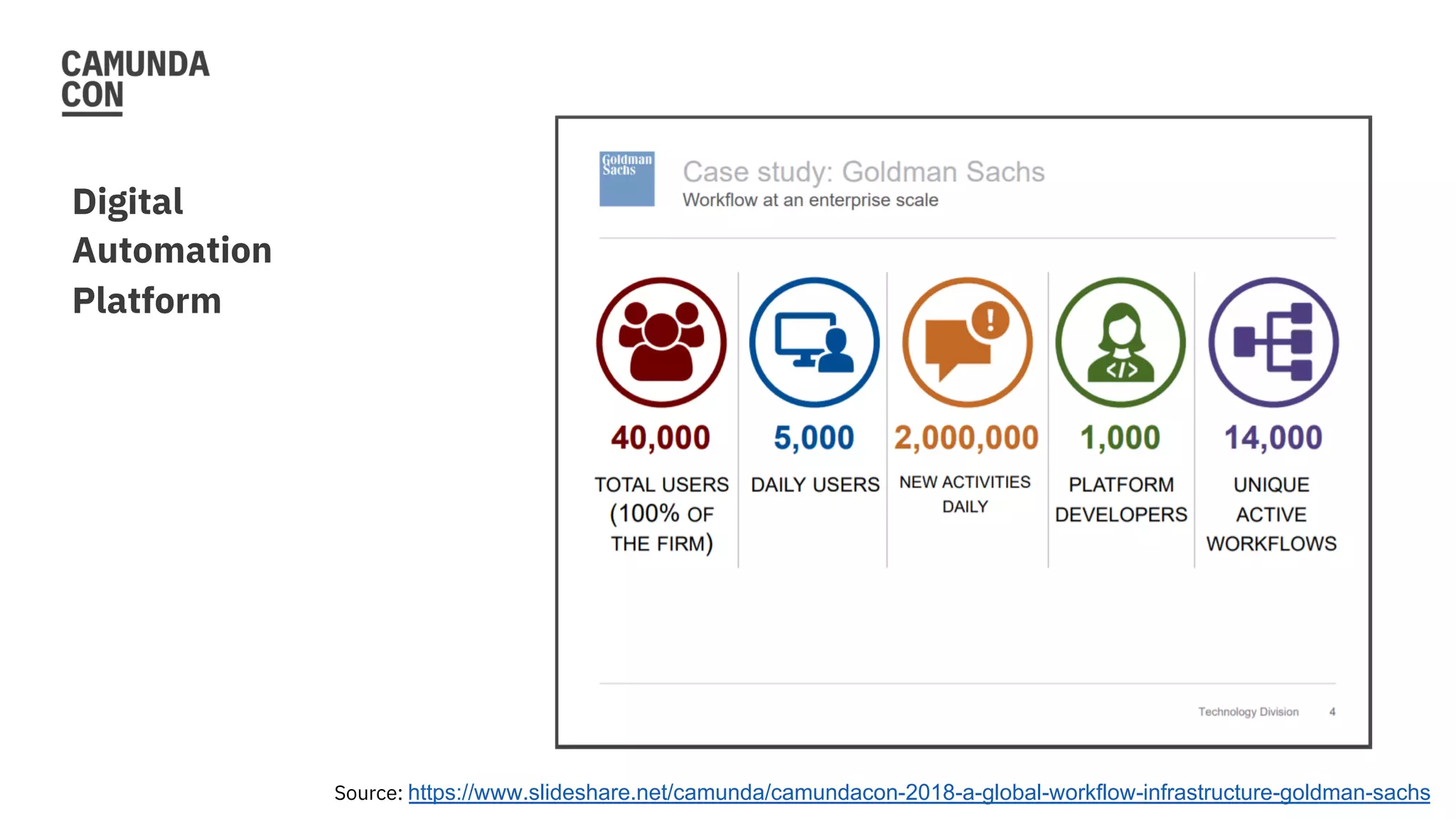
Digital
Automation
Platform
Source: https://www.slideshare.net/camunda/camundacon-2018-a-global-workflow-infrastructure-goldman-sachs
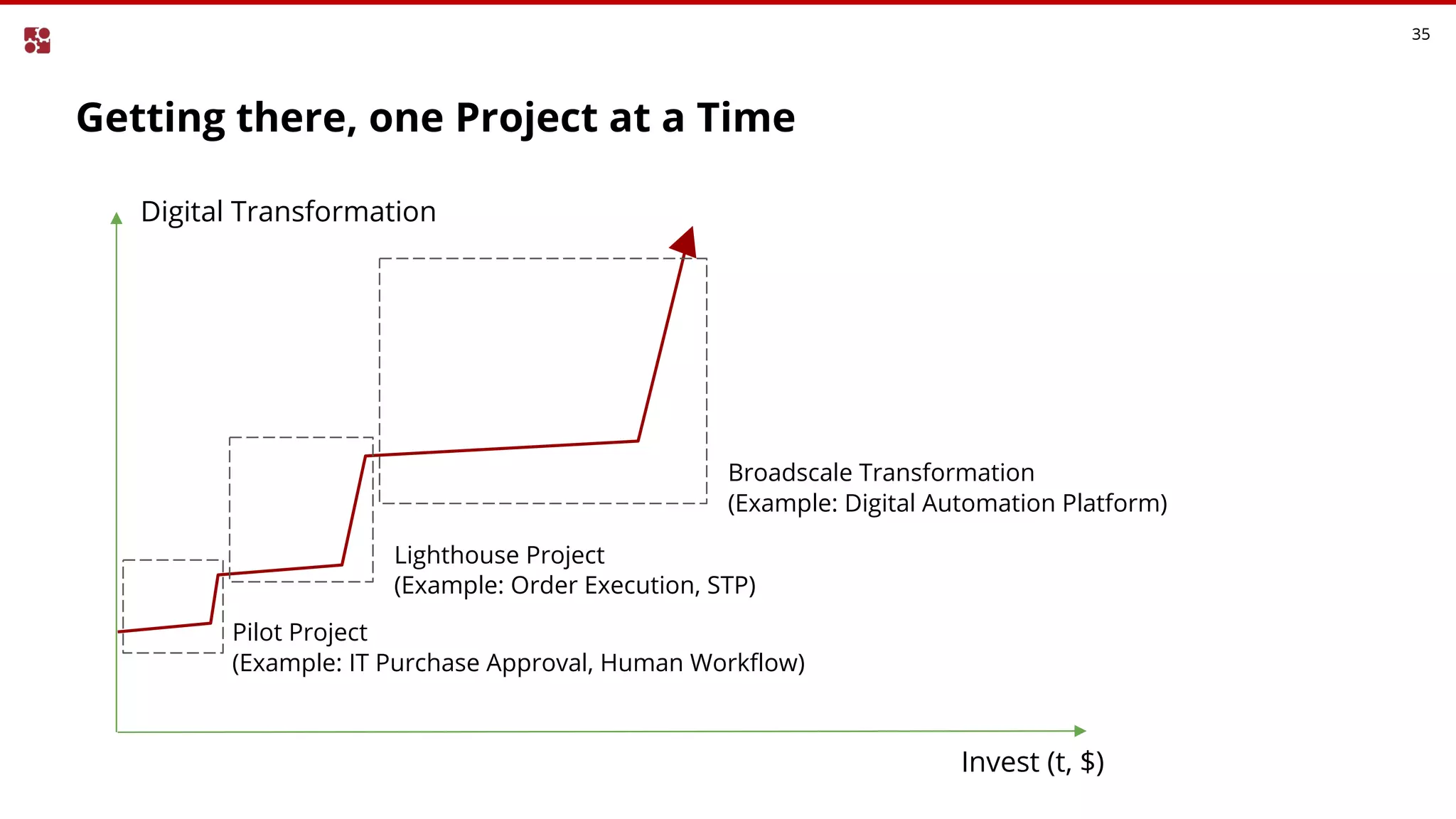
Getting there, one Project at a Time
35
Digital Transformation
Invest (t, $)
Pilot Project
(Example: IT Purchase Approval, Human Workflow)
Lighthouse Project
(Example: Order Execution, STP)
Broadscale Transformation
(Example: Digital Automation Platform)
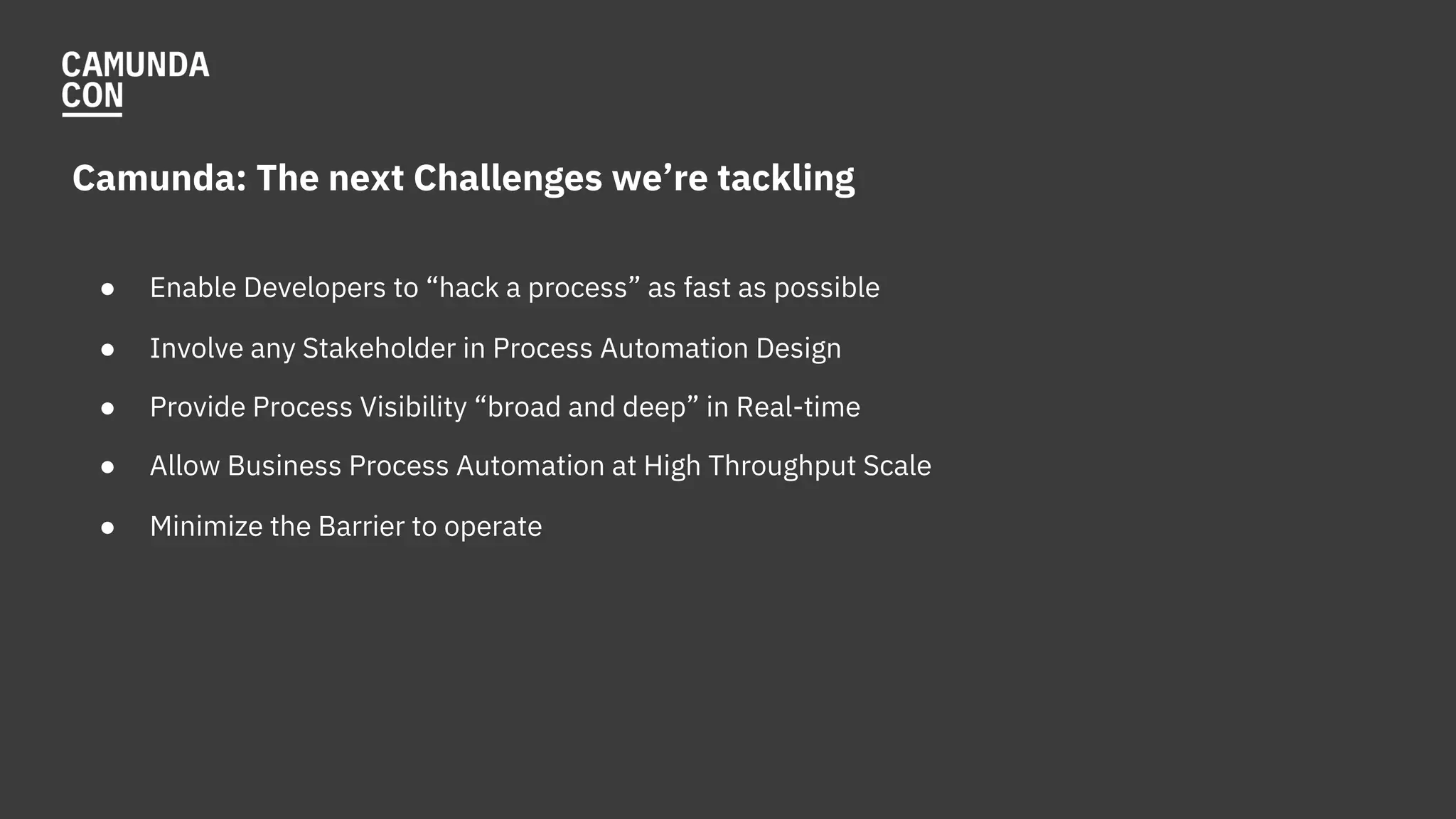
Camunda: The next Challenges we’re tackling
● Enable Developers to “hack a process” as fast as possible
● Involve any Stakeholder in Process Automation Design
● Provide Process Visibility “broad and deep” in Real-time
● Allow Business Process Automation at High Throughput Scale
● Minimize the Barrier to operate
How to become a Digital Enterprise
1) Prioritize Customer-focused Innovation.
2) Bring Technology to the Heart of your Company.
3) Automate your Business, one Project at a Time.
4) ?
22
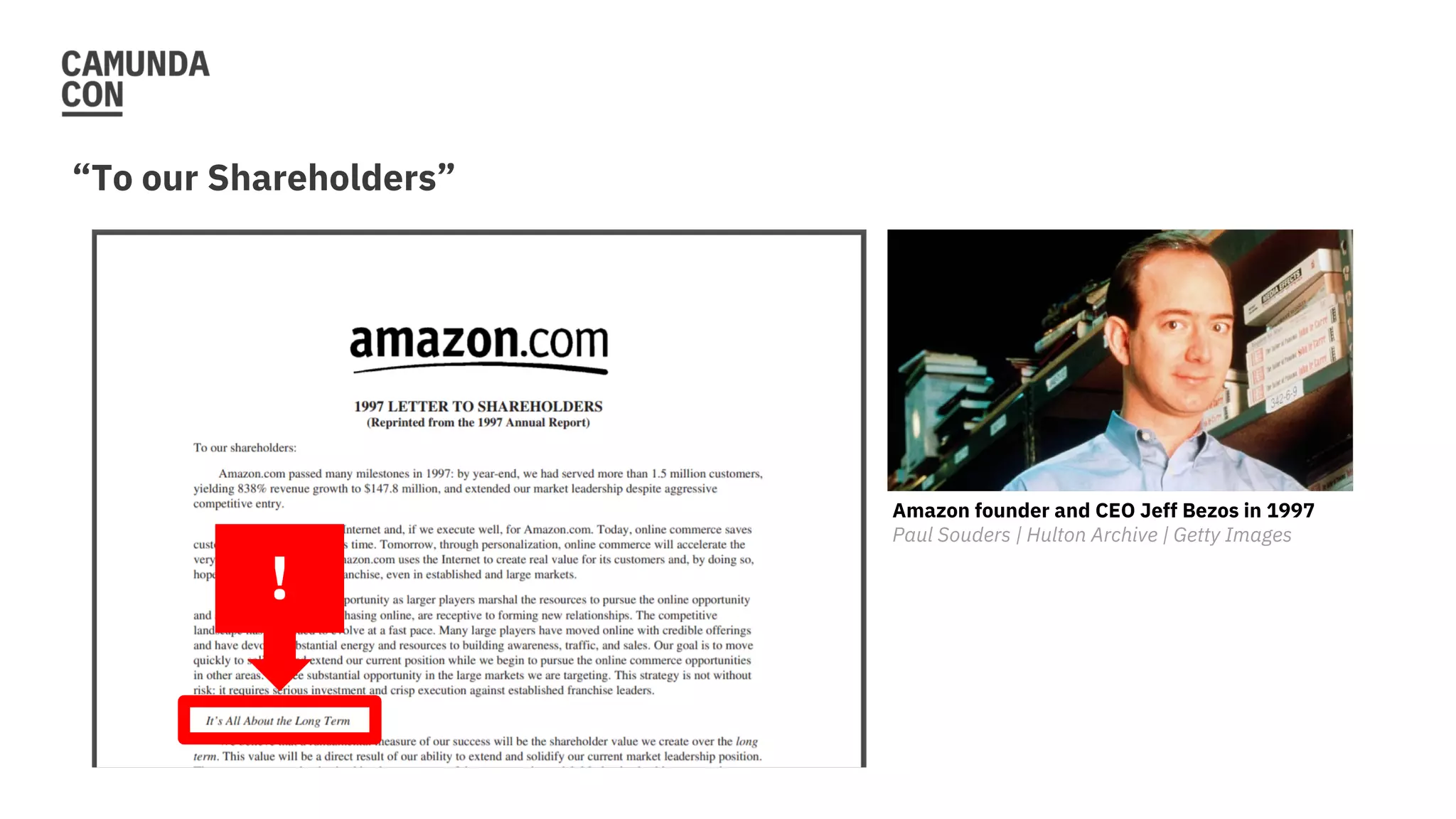
“To our Shareholders”
Amazon founder and CEO Jeff Bezos in 1997
Paul Souders | Hulton Archive | Getty Images
!
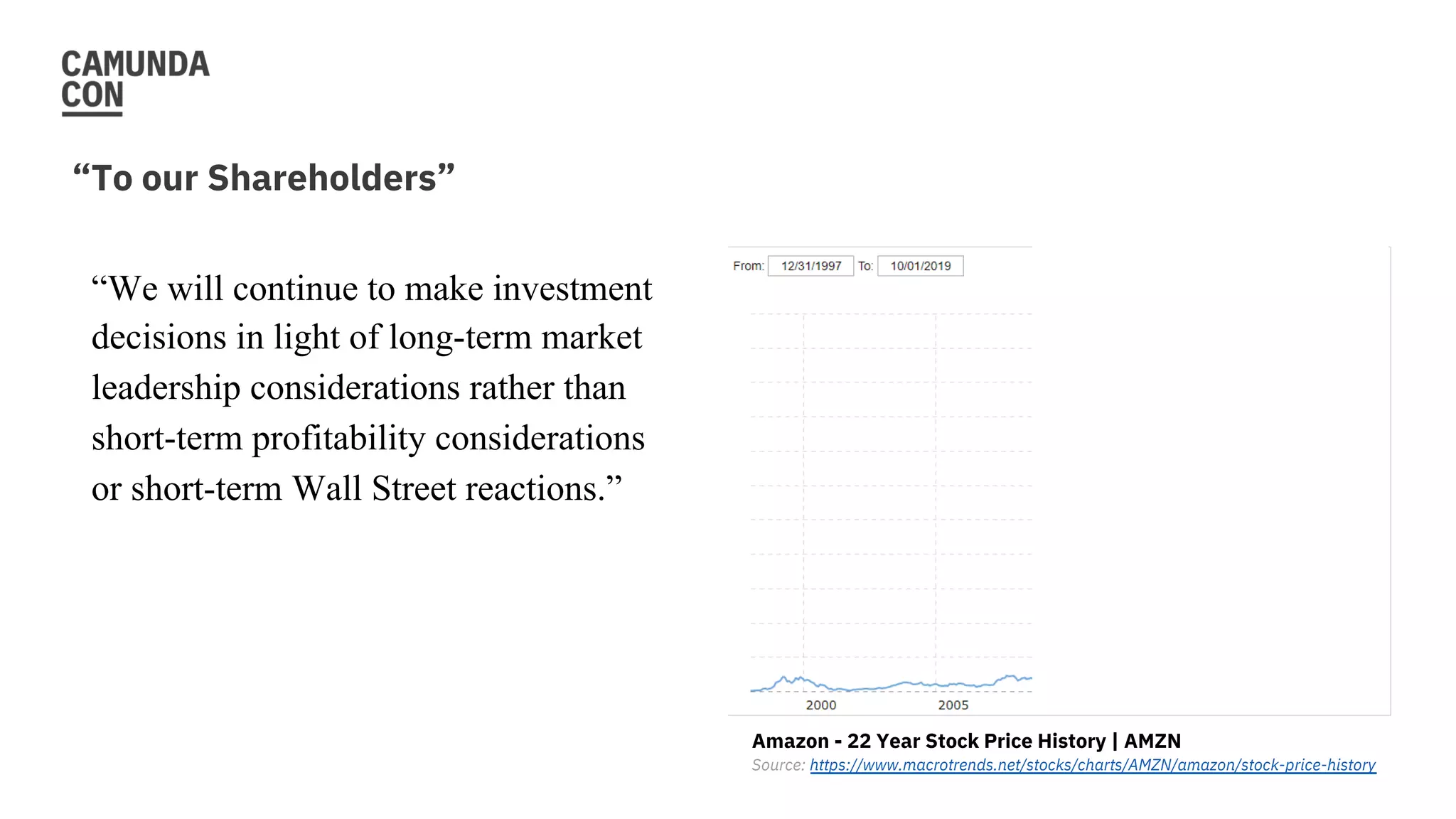
“To our Shareholders”
Amazon - 22 Year Stock Price History | AMZN
Source: https://www.macrotrends.net/stocks/charts/AMZN/amazon/stock-price-history
“We will continue to make investment
decisions in light of long-term market
leadership considerations rather than
short-term profitability considerations
or short-term Wall Street reactions.”
“The Age of the Employee”
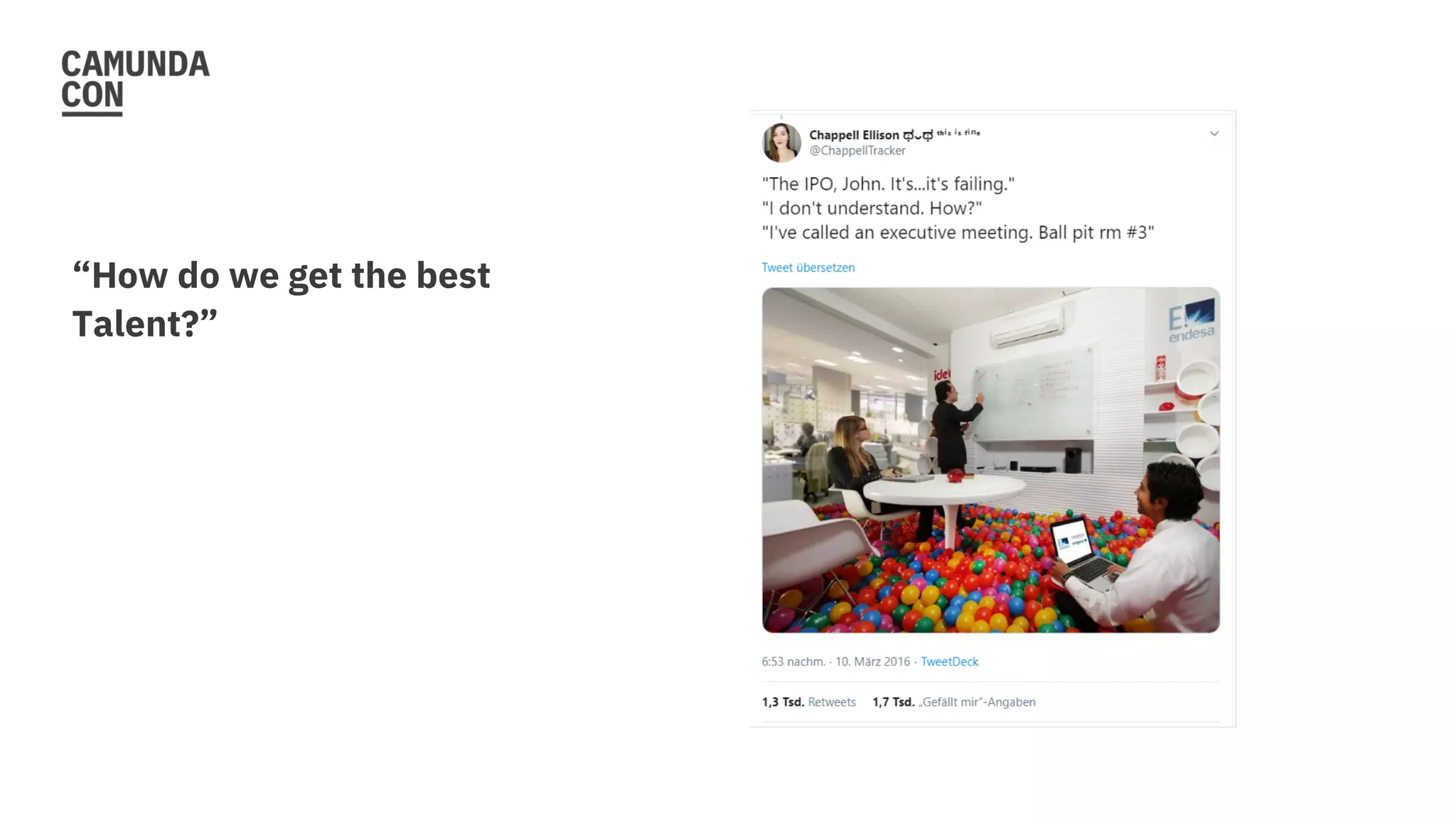
“How do we get the best
Talent?”
Leadership is not about being in charge.
Leadership is about taking care of those in your
charge.
Simon Sinek
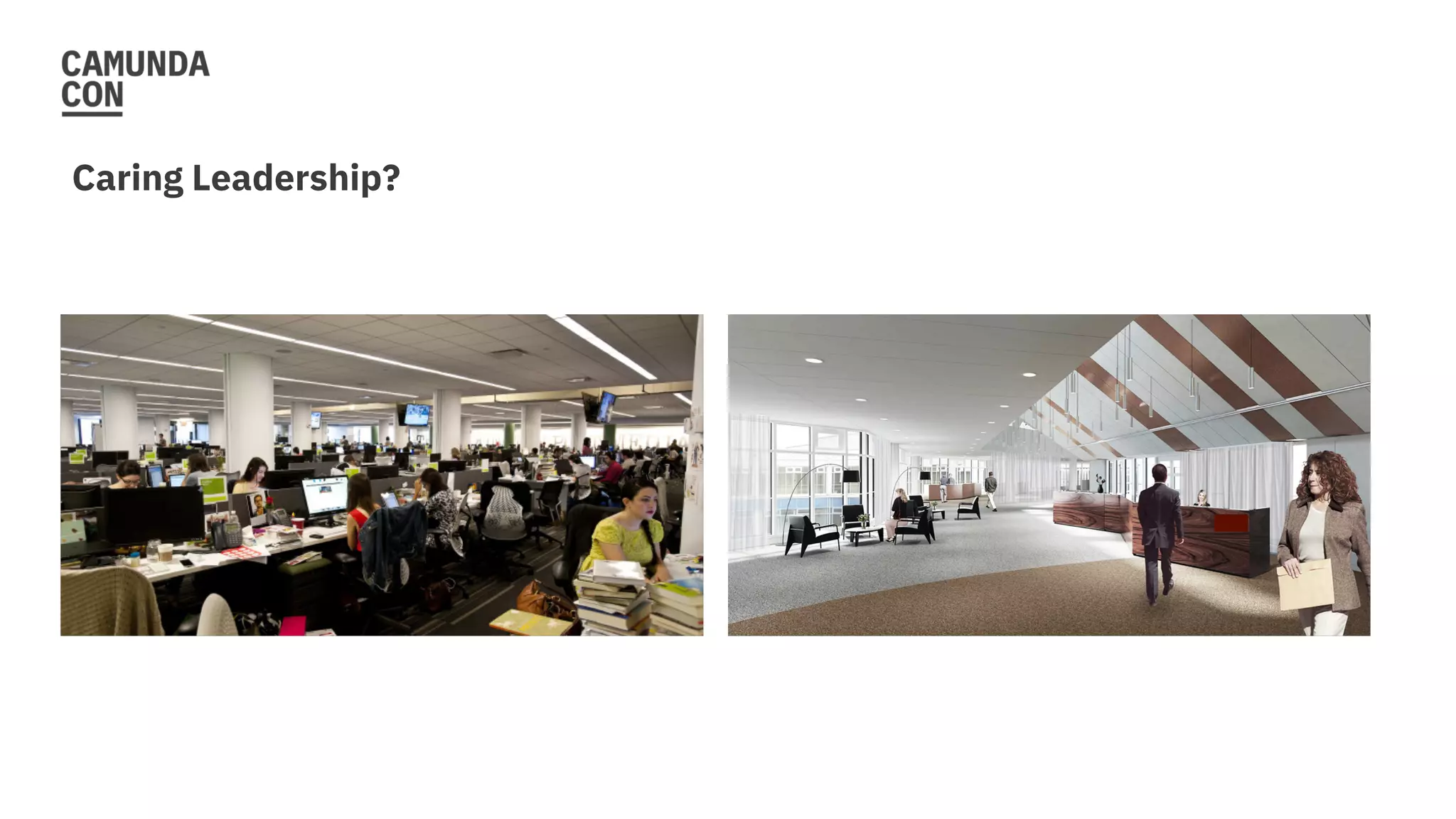
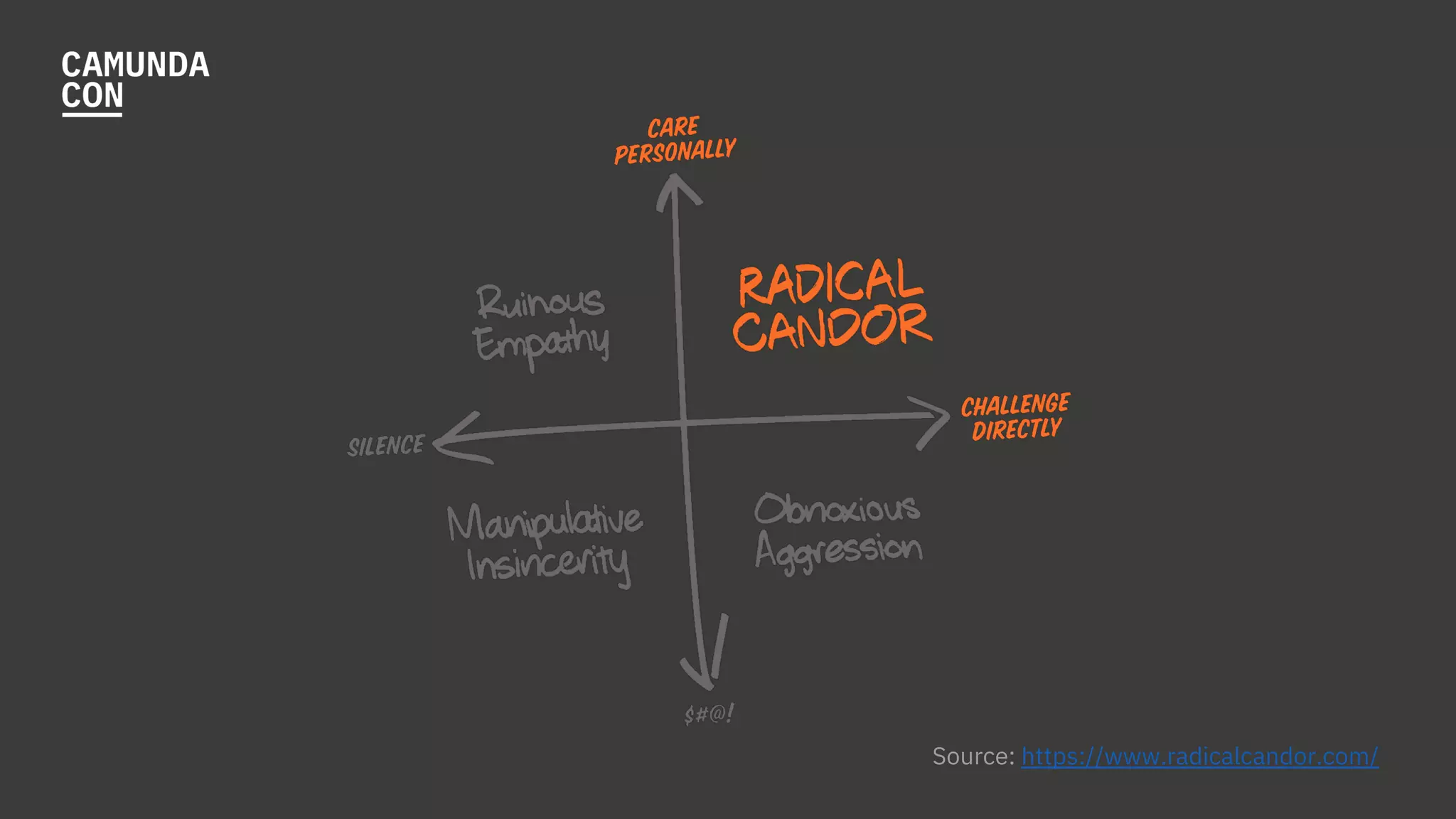
Caring Leadership?
Source: https://www.radicalcandor.com/
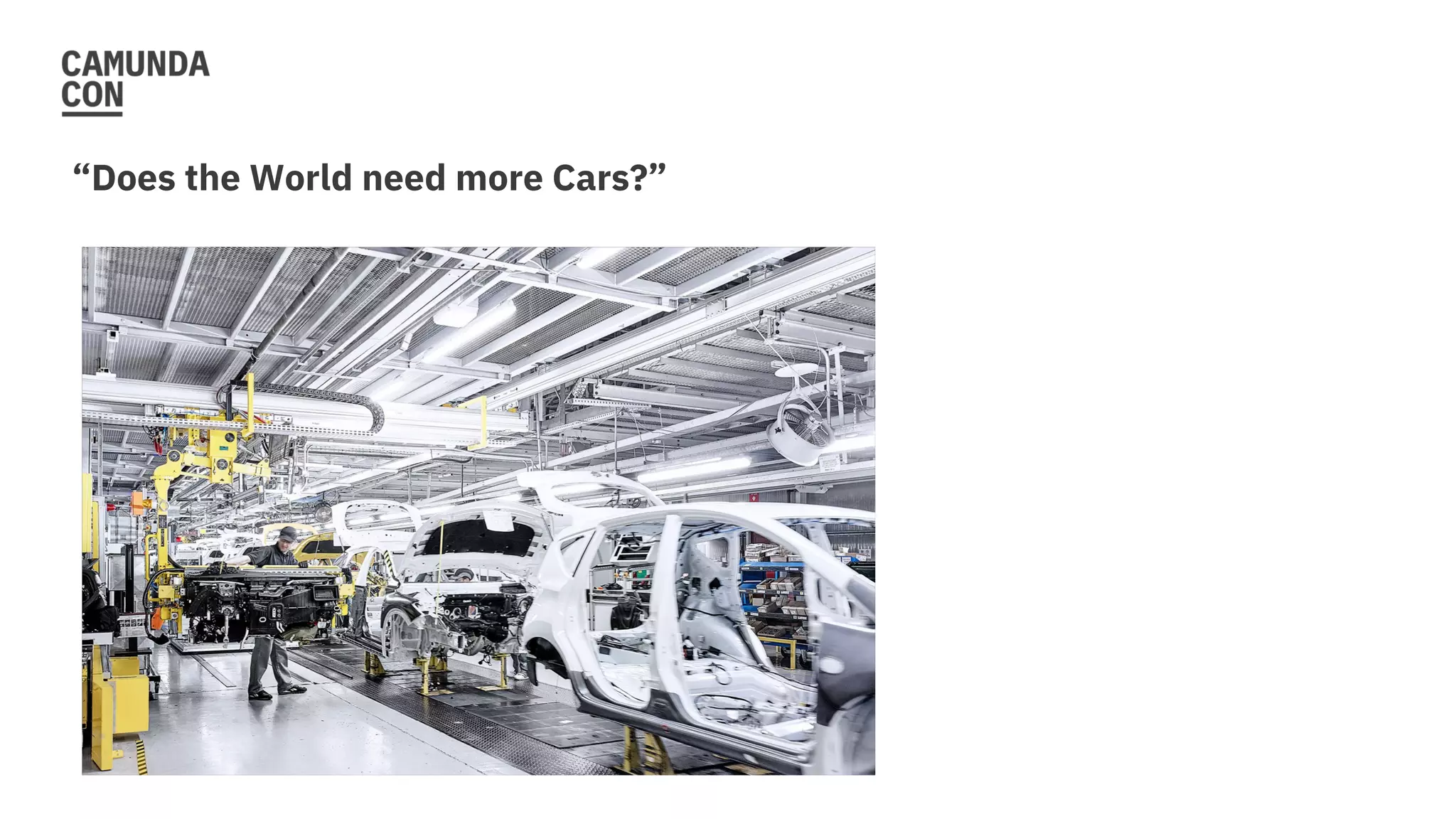
“Does the World need more Cars?”
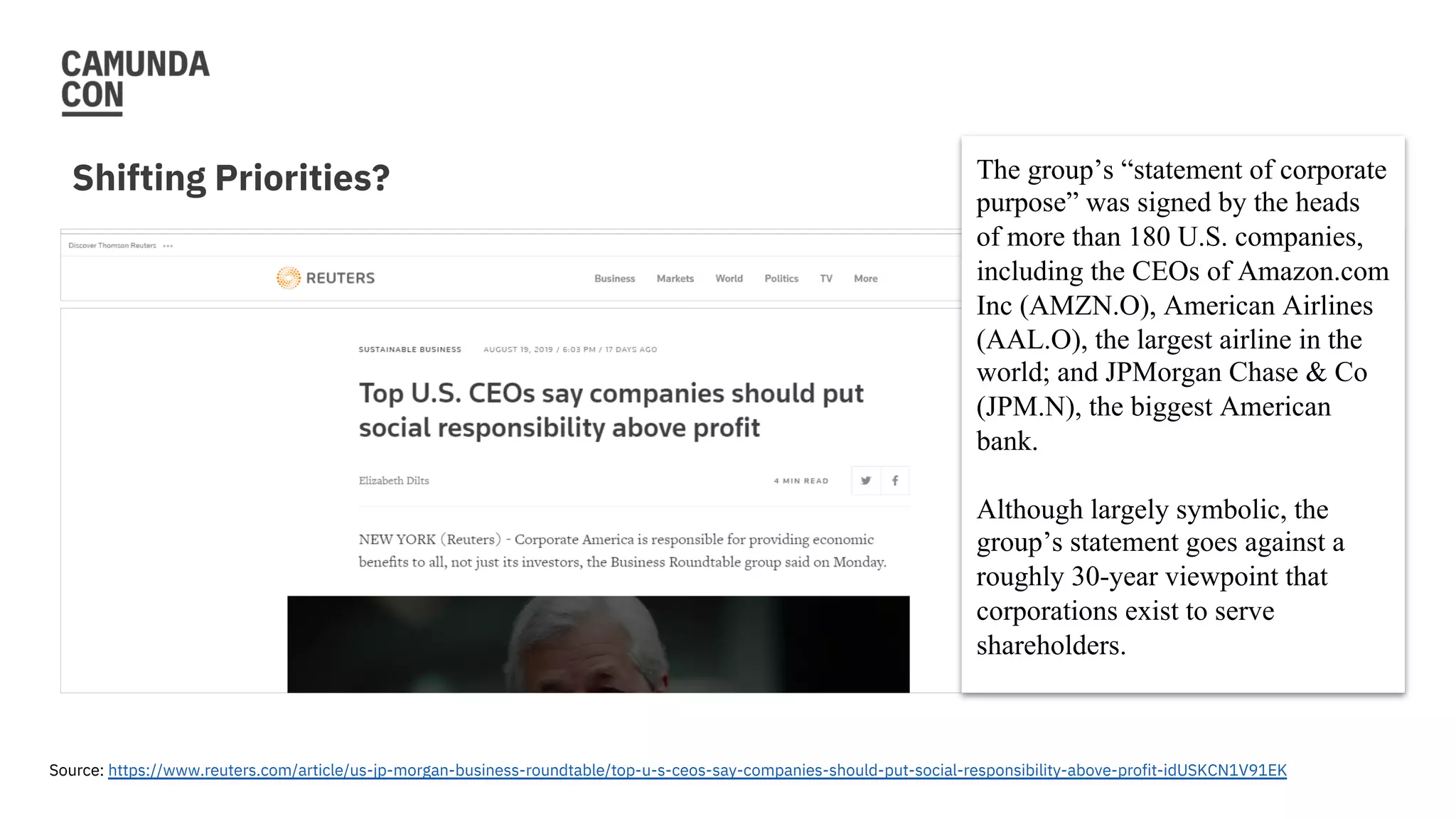
Shifting Priorities?
Source: https://www.reuters.com/article/us-jp-morgan-business-roundtable/top-u-s-ceos-say-companies-should-put-social-responsibility-above-profit-idUSKCN1V91EK
The group’s “statement of corporate
purpose” was signed by the heads
of more than 180 U.S. companies,
including the CEOs of Amazon.com
Inc (AMZN.O), American Airlines
(AAL.O), the largest airline in the
world; and JPMorgan Chase & Co
(JPM.N), the biggest American
bank.
Although largely symbolic, the
group’s statement goes against a
roughly 30-year viewpoint that
corporations exist to serve
shareholders.
How to become a Digital Enterprise
1) Prioritize Customer-focused Innovation.
2) Bring Technology to the Heart of your Company.
3) Automate your Business, one Project at a Time.
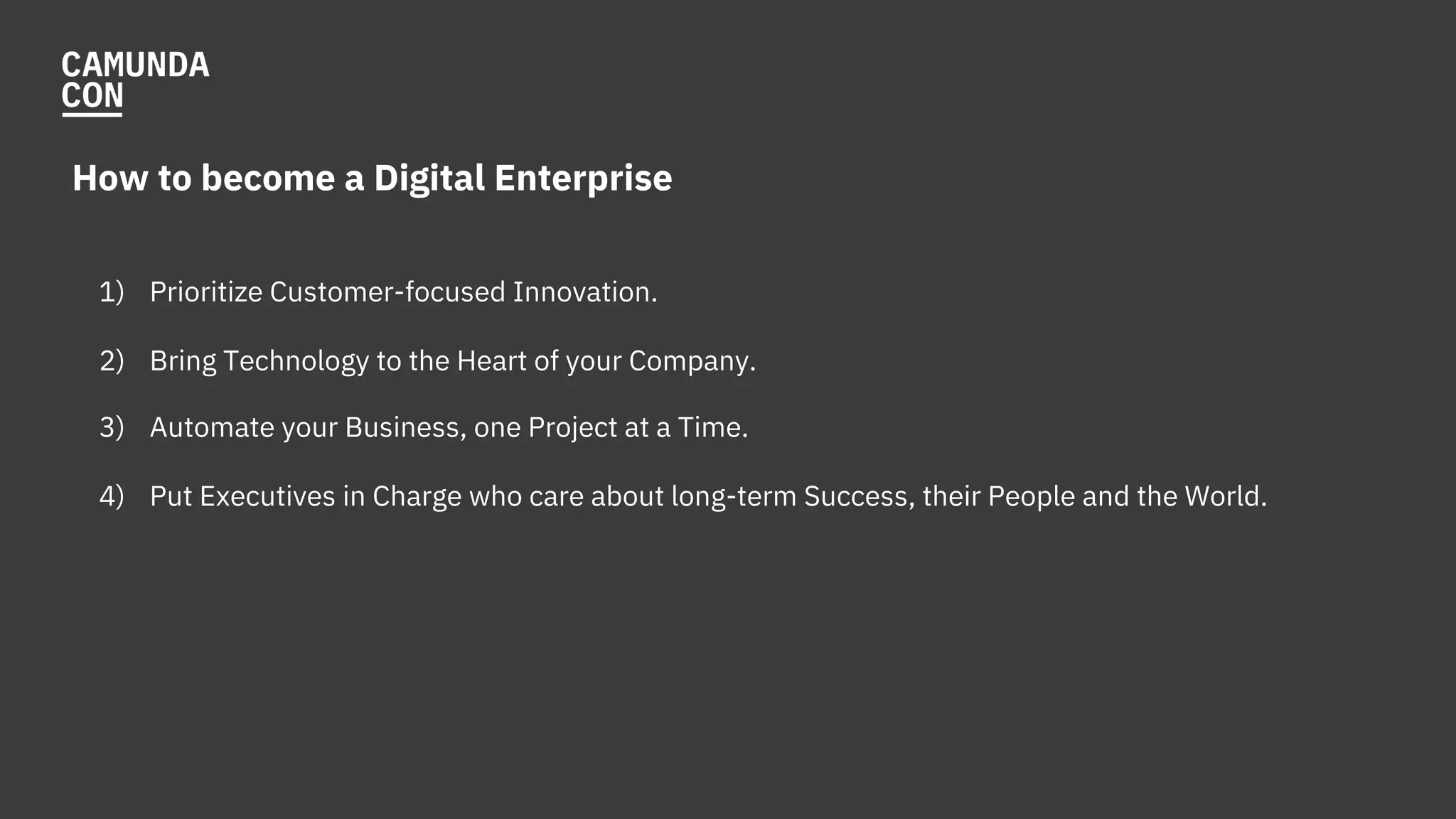
4) Put Executives in Charge who care about long-term Success, their People and the World.
We help you to become a Digital Enterprise.
Our Mission
We help the Startup that disrupts your Business.
Our other Mission
We help you to become a Digital Enterprise.
Our Mission
Enjoy CamundaCon!
Thank you

How to (not) become a Digital Enterprise by Jakob Freund

  • 1.
    How to (not)become a digital Enterprise Jakob Freund
  • 2.
  • 3.
  • 4.
  • 5.
    If you asksenior executives in the insurance industry - who are currently driving digital transformation projects - about their main objective, the usual answer is: “Getting an insurance needs to be as simple as buying a product on Amazon.com” https://www.sueddeutsche.de/wirtschaft/digitalisierung-versichertvon-amazon-1.3747260
  • 6.
    Claim Settlement -Customer Satisfaction Acceptability Politeness Speed
  • 7.
  • 8.
  • 10.
    How to becomea Digital Enterprise 1) ? 2) ? 3) ? 4) ? 6
  • 11.
    Forrester has announced“The Age of the Customer” Source: https://www.slideshare.net/SoftwareAG/iw14-session-mike-gualtieri-forrester-research
  • 12.
    Examples ● Offer moreconvenient ways to consume your products (e.g., omnichannel, self- service portals) ● Reduce process cycle times (e.g., activate bank account services right away) ● Provide real-time transparency (e.g., progress tracker for claim settlement) ● Increase flexibility to offer new products (e.g., new data plans for telco customers) Customer-focused innovation Counter-Examples ● Run a creative new brand building campaign ● Start a joint venture that purchases for telco companies in order to increase negotiation leverage ● Start a used cars trading business to cross-sell to your car insurance customers ● Replace employees with software robots in order to reduce costs
  • 13.
    How to becomea Digital Enterprise 1) Prioritize Customer-focused Innovation. 2) ? 3) ? 4) ? 8
  • 14.
    The History andFuture of “Business vs. IT” 1970s 1980s 1990s 2000s 2010s 2020s
  • 15.
    The History andFuture of “Business vs. IT” ● In 70s, first broad-scale business interactions with Programmers ● Many misunderstandings and growing uneasiness on both sides due to disappointments ● Development of Waterfall Software Development Techniques 1970s 1980s 1990s 2000s 2010s 2020s
  • 16.
    The History andFuture of “Business vs. IT” ● Not “We are one team” but “I am the customer, and you are my supplier” ● General culture of politics and power plays between business and IT ● Growing trend of buying core business software off-the-shelf, e.g. SAP R/3 (SAP revenue grew 1990-2000 from €300 million to €7 billion) ● Growing trend of outsourcing internal IT departments to subsidiaries or external suppliers ● First evolvements of “lightweight” software development methods, e.g. Scrum in 1995 1970s 1980s 1990s 2000s 2010s 2020s
  • 17.
    The History andFuture of “Business vs. IT” ● In 2001, Publication of “The Manifesto for Agile Software Development”. ● In 2001, Borders agrees to hand over its online business to Amazon under the theory that online book sales are non-strategic and unimportant. ● In 2004, Jakob is taught at university the waterfall software development approach. ● Low-code BPMS products come up (“Creating programs without programming!”) 1970s 1980s 1990s 2000s 2010s 2020s
  • 18.
  • 19.
  • 20.
  • 21.
  • 22.
  • 23.
  • 24.
    The History andFuture of “Business vs. IT” ● In 2011, Marc Andreessen publishes his article “Why Software Is Eating the World”. ● In 2014, a German insurance company is “very proud of our waterfall software development approach”. ● In 2017, Goldman Sachs CEO proclaiming “GS is a Technology Company”. ● In 2018, Commerzbank announce they will re-insource their IT systems subsidiary. ● In 2018, Lidl dumps €500 million SAP project. ● In 2019, same German insurance company going all-in on Agile. 1970s 1980s 1990s 2000s 2010s 2020s
  • 25.
    A Vicious Cycle Invest inWorkarounds for Core Business Automation Off-the-Shelf Software IT Outsourcing Low-Code / RPA Inferior Automation Infrastructure Delayed / Failed IT Projects Legacy Systems Bad Customer Experience Weak Software Development Capabilities Lack of Software Developers No Business-IT Collaboration Growing Technical Debt
  • 26.
    The History andFuture of “Business vs. IT” ● Established Companies eventually realize that they need to put Technology at the Heart of their Organization. ● Significant invest in in-house software development capacities and modernization. ● Breaking down the barriers between Business and IT - forming “one team”. ● SaaS purchased for areas that are not unique to the core business model. ● Automation Solutions being created in-house for running core business models. 1970s 1980s 1990s 2000s 2010s 2020s
  • 27.
    Case Study: LV1871 German life insurance company Need: Bring new digital products to the market, faster Breaking up monolithic legacy systems in microservices that are orchestrated by Camunda Setting up joint teams of business and IT professionals Moving to the hybrid cloud, adopting DevOps and agile development Buying software off-the-shelf would not have made sense because the available products are “too old already” Peter Blenninger, Head of IT at LV 1871 Insurance https://www.cio.de/a/wir-haben-nur-noch-agile-teams,3604218
  • 28.
    How to becomea Digital Enterprise 1) Prioritize Customer-focused Innovation. 2) Bring Technology to the Heart of your Company. 3) ? 4) ? 17
  • 29.
    Ensuring Structure ina Human Task User focused Process Source: https://www.slideshare.net/camunda/camundacon-2018-profile-print-and-explorative-data-mining-duni-viadee
  • 30.
    Automating the Business Process End-to-End Source:https://www.slideshare.net/camunda/camundacon-2018-our-journey-to-the-digital-world-of-insurance-talanx
  • 31.
    High Throughput Processing Source:https://www.slideshare.net/camunda/camundacon-2018-workflow-automation-at-scale
  • 32.
    Camunda Technical UseCase Categories Human Workflow E2E Process Automation High Throughput Example Use Cases B2B, KYC, Approval B2C, Trading, BSS/OSS Events, Unbatch, µS Human Involvement Default Exception None Transactions per Year Thousands Millions Billions Value per Transaction High Medium Low General Benefit Visibility Visibility Visibility Specific Benefit Structure Scalability Resilience
  • 33.
    Camunda Technical UseCase Categories Digital Automation Platform Human Workflow E2E Process Automation High Throughput Example Use Cases B2B, KYC, Approval B2C, Trading, BSS/OSS Events, Unbatch, µS Human Involvement Default Exception None Transactions per Year Thousands Millions Billions Value per Transaction High Medium Low General Benefit Visibility Visibility Visibility Specific Benefit Structure Scalability Resilience 20
  • 34.
  • 35.
    Getting there, oneProject at a Time 35 Digital Transformation Invest (t, $) Pilot Project (Example: IT Purchase Approval, Human Workflow) Lighthouse Project (Example: Order Execution, STP) Broadscale Transformation (Example: Digital Automation Platform)
  • 36.
    Camunda: The nextChallenges we’re tackling ● Enable Developers to “hack a process” as fast as possible ● Involve any Stakeholder in Process Automation Design ● Provide Process Visibility “broad and deep” in Real-time ● Allow Business Process Automation at High Throughput Scale ● Minimize the Barrier to operate
  • 37.
    How to becomea Digital Enterprise 1) Prioritize Customer-focused Innovation. 2) Bring Technology to the Heart of your Company. 3) Automate your Business, one Project at a Time. 4) ? 22
  • 38.
    “To our Shareholders” Amazonfounder and CEO Jeff Bezos in 1997 Paul Souders | Hulton Archive | Getty Images !
  • 39.
    “To our Shareholders” Amazon- 22 Year Stock Price History | AMZN Source: https://www.macrotrends.net/stocks/charts/AMZN/amazon/stock-price-history “We will continue to make investment decisions in light of long-term market leadership considerations rather than short-term profitability considerations or short-term Wall Street reactions.”
  • 40.
    “The Age ofthe Employee”
  • 41.
    “How do weget the best Talent?”
  • 42.
    Leadership is notabout being in charge. Leadership is about taking care of those in your charge. Simon Sinek
  • 43.
  • 44.
  • 45.
    “Does the Worldneed more Cars?”
  • 46.
    Shifting Priorities? Source: https://www.reuters.com/article/us-jp-morgan-business-roundtable/top-u-s-ceos-say-companies-should-put-social-responsibility-above-profit-idUSKCN1V91EK Thegroup’s “statement of corporate purpose” was signed by the heads of more than 180 U.S. companies, including the CEOs of Amazon.com Inc (AMZN.O), American Airlines (AAL.O), the largest airline in the world; and JPMorgan Chase & Co (JPM.N), the biggest American bank. Although largely symbolic, the group’s statement goes against a roughly 30-year viewpoint that corporations exist to serve shareholders.
  • 47.
    How to becomea Digital Enterprise 1) Prioritize Customer-focused Innovation. 2) Bring Technology to the Heart of your Company. 3) Automate your Business, one Project at a Time. 4) Put Executives in Charge who care about long-term Success, their People and the World.
  • 48.
    We help youto become a Digital Enterprise. Our Mission
  • 49.
    We help theStartup that disrupts your Business. Our other Mission
  • 50.
    We help youto become a Digital Enterprise. Our Mission
  • 51.