



Agile Series by Nishanth
introducing
DevOps
Agenda
• What is DevOps
• Why DevOps?
• Addressing Delivery Challenges
• Agile and DevOps – How is it connected?
• DevOps vs. Release Management
• When to adopt and when not to
What is DevOps?
What is DevOps?
What is DevOps?
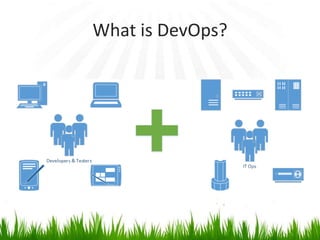
• DevOps (a combination of development and
operations) is a software development
method that stresses communication,
collaboration and integration between
software developers and information
technology(IT) professionals thereby
– Enable rapid evolution of products or services
– Reduce risk, improve quality across portfolio, and
reduce costs
What is DevOps?
• DevOps integration targets product delivery, quality testing,
feature development and maintenance releases in order to
improve reliability and security and faster development and
deployment cycles.
• The adoption of DevOps is being driven by factors such as:
• Use of agile and other development processes and
methodologies
• Demand for an increased rate of production releases from
application and business stakeholders
• Wide availability of virtualized and cloud infrastructure
from internal and external providers
• Increased usage of data center automation and
configuration management tools
Principles of DevOps
• Develop and test in an environment similar to
production
• Deploy builds frequently
• Validate operation quality continuously
Why DevOps?
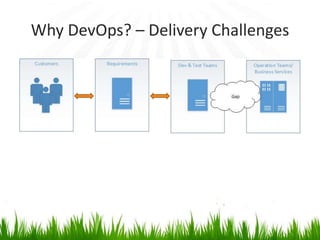
Why DevOps? – Delivery Challenges
Why Gaps?
Dev View:
• Mostly delivers features after testing in
development systems
• Dev systems may not be same as production
system
• Developers will have faster turn around time w.r.t
features
• Not much concerned about the infrastructural as
well as deployment impact because of the code
changes
Why Gaps?
Ops View:
• Worries more about PSR
• Rewarded mainly for uptime
• Lesser turn around time w.r.t feature
deployment and testing due to large number
of dev builds coming their way
• Very much concerned about the
infrastructural as well as deployment impact
because of the code changes
Dev and Ops
• Developers work with Ops to understand the impact of
code changes
• Developers now work more closely with production-
equivalent systems
• Developers focuses on metrics required by Ops team
like PSR
• Ops now have more clarity on infrastructure needs
• More automation on deployment
• Closely monitors the Dev – Test – Prod pipeline for
each deployment with immediate feedback
• Better collaboration and communication
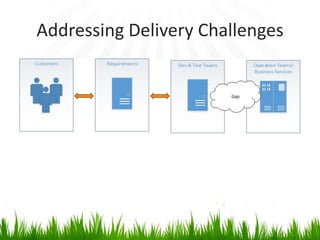
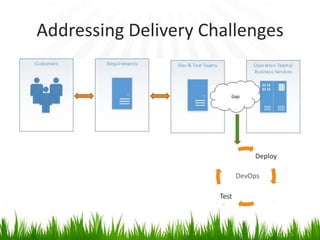
Addressing Delivery Challenges
Top 3 delivery challenges
• Release management
– Better understanding of risks, dependencies,
compliance issues
• Release/Deployment coordination
– Better tracking of discrete activities, faster escalation
of issues, documented process control and granular
reporting
• Release/Deployment Automation
– Usually have existing automation but want to flexibly
manage and drive this automation that can be invoked
by non-operations resources in specific non-
production environments
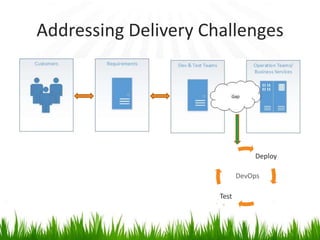
Addressing Delivery Challenges
Deploy
Test
DevOps
Agile and DevOps
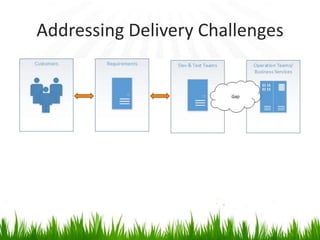
Addressing Delivery Challenges
Deploy
Test
DevOps
DevOps vs. Release
Management
Agile and DevOps
Agile and DevOps
Deploy
Test
Build
TestPrioritise
Design
DevOpsAgile
Agile and DevOps
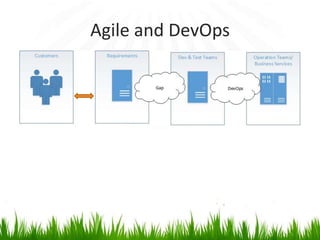
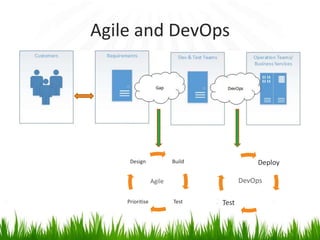
• Agile Development
– Addresses the gap between customer requirements and
dev + testing teams
– Cross-functional teams to design, develop, and test
features/stories prioritised by the PO (Customer)
– Focuses more on functional and non-functional readiness
• DevOps
– Addresses the gap between dev + testing and Ops
– Automated release management
– Focuses on functional and non-functional plus operational
and business readiness
– Intensifies reusability and automation
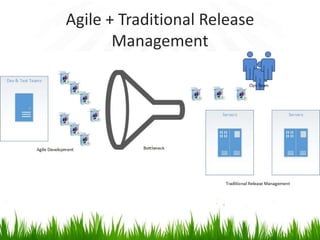
Agile + Traditional Release
Management
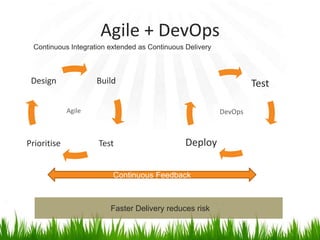
Agile + DevOps
Test
Deploy
DevOps
Build
TestPrioritise
Design
Agile
Continuous Feedback
Faster Delivery reduces risk
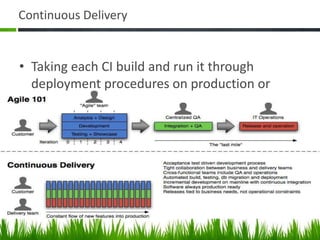
Continuous Integration extended as Continuous Delivery
Continuous Integration and
Continuous Delivery
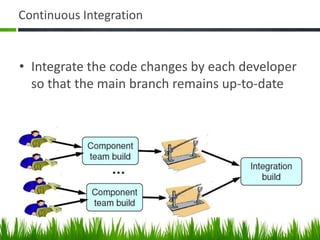
Continuous Integration
• Integrate the code changes by each developer
so that the main branch remains up-to-date
Continuous Delivery
• Taking each CI build and run it through
deployment procedures on production or
production-equivalent environments
When to adopt and When not to
When to adopt and when not to
When to Adopt:
• For eCommerce and other web site projects
(Amazon, Flickr, Groupon,etc)
• Cloud platform (IaaS and PaaS)
When not to Adopt:
• Mission critical applications (Banks, Power
Systems, etc)
Thanks!
Exciting new transitions

Introducing DevOps

  • 1.
    Agile Series byNishanth introducing DevOps
  • 2.
    Agenda • What isDevOps • Why DevOps? • Addressing Delivery Challenges • Agile and DevOps – How is it connected? • DevOps vs. Release Management • When to adopt and when not to
  • 3.
  • 4.
  • 5.
    What is DevOps? •DevOps (a combination of development and operations) is a software development method that stresses communication, collaboration and integration between software developers and information technology(IT) professionals thereby – Enable rapid evolution of products or services – Reduce risk, improve quality across portfolio, and reduce costs
  • 6.
    What is DevOps? •DevOps integration targets product delivery, quality testing, feature development and maintenance releases in order to improve reliability and security and faster development and deployment cycles. • The adoption of DevOps is being driven by factors such as: • Use of agile and other development processes and methodologies • Demand for an increased rate of production releases from application and business stakeholders • Wide availability of virtualized and cloud infrastructure from internal and external providers • Increased usage of data center automation and configuration management tools
  • 7.
    Principles of DevOps •Develop and test in an environment similar to production • Deploy builds frequently • Validate operation quality continuously
  • 8.
  • 9.
    Why DevOps? –Delivery Challenges
  • 10.
    Why Gaps? Dev View: •Mostly delivers features after testing in development systems • Dev systems may not be same as production system • Developers will have faster turn around time w.r.t features • Not much concerned about the infrastructural as well as deployment impact because of the code changes
  • 11.
    Why Gaps? Ops View: •Worries more about PSR • Rewarded mainly for uptime • Lesser turn around time w.r.t feature deployment and testing due to large number of dev builds coming their way • Very much concerned about the infrastructural as well as deployment impact because of the code changes
  • 12.
    Dev and Ops •Developers work with Ops to understand the impact of code changes • Developers now work more closely with production- equivalent systems • Developers focuses on metrics required by Ops team like PSR • Ops now have more clarity on infrastructure needs • More automation on deployment • Closely monitors the Dev – Test – Prod pipeline for each deployment with immediate feedback • Better collaboration and communication
  • 13.
  • 14.
    Top 3 deliverychallenges • Release management – Better understanding of risks, dependencies, compliance issues • Release/Deployment coordination – Better tracking of discrete activities, faster escalation of issues, documented process control and granular reporting • Release/Deployment Automation – Usually have existing automation but want to flexibly manage and drive this automation that can be invoked by non-operations resources in specific non- production environments
  • 15.
  • 16.
  • 17.
  • 18.
  • 19.
  • 20.
  • 21.
  • 22.
  • 23.
    Agile and DevOps •Agile Development – Addresses the gap between customer requirements and dev + testing teams – Cross-functional teams to design, develop, and test features/stories prioritised by the PO (Customer) – Focuses more on functional and non-functional readiness • DevOps – Addresses the gap between dev + testing and Ops – Automated release management – Focuses on functional and non-functional plus operational and business readiness – Intensifies reusability and automation
  • 24.
    Agile + TraditionalRelease Management
  • 25.
    Agile + DevOps Test Deploy DevOps Build TestPrioritise Design Agile ContinuousFeedback Faster Delivery reduces risk Continuous Integration extended as Continuous Delivery
  • 26.
  • 27.
    Continuous Integration • Integratethe code changes by each developer so that the main branch remains up-to-date
  • 28.
    Continuous Delivery • Takingeach CI build and run it through deployment procedures on production or production-equivalent environments
  • 29.
    When to adoptand When not to
  • 30.
    When to adoptand when not to When to Adopt: • For eCommerce and other web site projects (Amazon, Flickr, Groupon,etc) • Cloud platform (IaaS and PaaS) When not to Adopt: • Mission critical applications (Banks, Power Systems, etc)
  • 31.

Editor's Notes

  • #2 This presentation tries to impart very basic information about DevOps.This presentation may contain materials that are procured from external sources.Please reach out to me in case you find any material that is been used infringes upon someone’s copyrights.
  • #5 Keeps the daily scrum on taskTracks story/task status throughout the sprintRaises team concerns and roadblocks to product ownerCan be a manager or peer; peers are a great way to startRemoves impediments so the team can focus on the work at hand
  • #6 Keeps the daily scrum on taskTracks story/task status throughout the sprintRaises team concerns and roadblocks to product ownerCan be a manager or peer; peers are a great way to startRemoves impediments so the team can focus on the work at hand
  • #7 Small teams (7 +/- 2)Self-organizing to achieve product goalsAssists in all levels of agile planningDemonstrates work to product stakeholders (payday for developers)!Team members check their ego at the door as they wear multiple hats on an agile teamOrganize and assign their own workHas the right to do everything within the project boundaries to reach the goal
  • #10 Small teams (7 +/- 2)Self-organizing to achieve product goalsAssists in all levels of agile planningDemonstrates work to product stakeholders (payday for developers)!Team members check their ego at the door as they wear multiple hats on an agile teamOrganize and assign their own workHas the right to do everything within the project boundaries to reach the goal
  • #11 Small teams (7 +/- 2)Self-organizing to achieve product goalsAssists in all levels of agile planningDemonstrates work to product stakeholders (payday for developers)!Team members check their ego at the door as they wear multiple hats on an agile teamOrganize and assign their own workHas the right to do everything within the project boundaries to reach the goal
  • #12 Small teams (7 +/- 2)Self-organizing to achieve product goalsAssists in all levels of agile planningDemonstrates work to product stakeholders (payday for developers)!Team members check their ego at the door as they wear multiple hats on an agile teamOrganize and assign their own workHas the right to do everything within the project boundaries to reach the goal
  • #13 Small teams (7 +/- 2)Self-organizing to achieve product goalsAssists in all levels of agile planningDemonstrates work to product stakeholders (payday for developers)!Team members check their ego at the door as they wear multiple hats on an agile teamOrganize and assign their own workHas the right to do everything within the project boundaries to reach the goal
  • #15 Small teams (7 +/- 2)Self-organizing to achieve product goalsAssists in all levels of agile planningDemonstrates work to product stakeholders (payday for developers)!Team members check their ego at the door as they wear multiple hats on an agile teamOrganize and assign their own workHas the right to do everything within the project boundaries to reach the goal
  • #16 Small teams (7 +/- 2)Self-organizing to achieve product goalsAssists in all levels of agile planningDemonstrates work to product stakeholders (payday for developers)!Team members check their ego at the door as they wear multiple hats on an agile teamOrganize and assign their own workHas the right to do everything within the project boundaries to reach the goal
  • #17 Small teams (7 +/- 2)Self-organizing to achieve product goalsAssists in all levels of agile planningDemonstrates work to product stakeholders (payday for developers)!Team members check their ego at the door as they wear multiple hats on an agile teamOrganize and assign their own workHas the right to do everything within the project boundaries to reach the goal
  • #19 Small teams (7 +/- 2)Self-organizing to achieve product goalsAssists in all levels of agile planningDemonstrates work to product stakeholders (payday for developers)!Team members check their ego at the door as they wear multiple hats on an agile teamOrganize and assign their own workHas the right to do everything within the project boundaries to reach the goal
  • #20 Small teams (7 +/- 2)Self-organizing to achieve product goalsAssists in all levels of agile planningDemonstrates work to product stakeholders (payday for developers)!Team members check their ego at the door as they wear multiple hats on an agile teamOrganize and assign their own workHas the right to do everything within the project boundaries to reach the goal
  • #22 Small teams (7 +/- 2)Self-organizing to achieve product goalsAssists in all levels of agile planningDemonstrates work to product stakeholders (payday for developers)!Team members check their ego at the door as they wear multiple hats on an agile teamOrganize and assign their own workHas the right to do everything within the project boundaries to reach the goal
  • #23 Small teams (7 +/- 2)Self-organizing to achieve product goalsAssists in all levels of agile planningDemonstrates work to product stakeholders (payday for developers)!Team members check their ego at the door as they wear multiple hats on an agile teamOrganize and assign their own workHas the right to do everything within the project boundaries to reach the goal
  • #24 Small teams (7 +/- 2)Self-organizing to achieve product goalsAssists in all levels of agile planningDemonstrates work to product stakeholders (payday for developers)!Team members check their ego at the door as they wear multiple hats on an agile teamOrganize and assign their own workHas the right to do everything within the project boundaries to reach the goal
  • #25 Small teams (7 +/- 2)Self-organizing to achieve product goalsAssists in all levels of agile planningDemonstrates work to product stakeholders (payday for developers)!Team members check their ego at the door as they wear multiple hats on an agile teamOrganize and assign their own workHas the right to do everything within the project boundaries to reach the goal
  • #28 Small teams (7 +/- 2)Self-organizing to achieve product goalsAssists in all levels of agile planningDemonstrates work to product stakeholders (payday for developers)!Team members check their ego at the door as they wear multiple hats on an agile teamOrganize and assign their own workHas the right to do everything within the project boundaries to reach the goal
  • #29 Small teams (7 +/- 2)Self-organizing to achieve product goalsAssists in all levels of agile planningDemonstrates work to product stakeholders (payday for developers)!Team members check their ego at the door as they wear multiple hats on an agile teamOrganize and assign their own workHas the right to do everything within the project boundaries to reach the goal