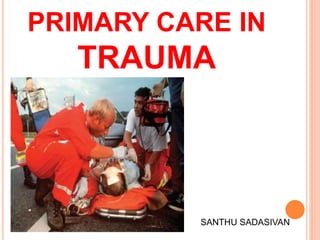
PRIMARY CARE IN
TRAUMA
SANTHU SADASIVAN
CONTENTS
 Introduction
 Trimodial death distribution
 Concept of ATLS
 Initial assessment and management
 Preparation
 Pre hospital phase
 Hospital phase
 Triage
 Primary survey
 Special populations
 ABCDE
 Secondary survey
 Definitive care
 Conclusion
 Bibliography
INTRODUCTION
 The treatment of seriously injured patients
requires the rapid assessment of injuries and
institution of life-preserving therapy.
 Because timing is crucial, a systematic approach
that can be rapidly and accurately applied is
essential
 Of all the deaths and disabilities resulting from
violences , road traffic accidents remain the major
cause of mortality
 Kerala has a high risk status in India for RTA
TRAUMA TEAM
TRIMODIAL DEATH DISTRIBUTION
 Described in 1982
 Death due to injury occurs in one of three periods
or peaks
 FIRST PEAK occurs within seconds to minutes of
injury
 Deaths result from apnea due to severe brain or
high spinal cord injury or rupture of heart , aorta,
large blood vessels
10
 SECOND PEAK / GOLDEN HOUR
 occurs within minutes to several hours following
injury
 Deaths that occur during this period are usually due
to subdural and epidural hematomas,
hemopneumothorax, ruptured spleen,
 lacerations of the liver, pelvic fractures, and/or
multiple other injuries associated with significant
blood loss.
 need for rapid assessment and resuscitation, which
are the fundamental principles of Advanced Trauma
Life Support.
 The THIRD PEAK, which occurs several days to
weeks after the initial injury, is most often due to
sepsis and multiple organ system dysfunction.
ATLS( advanced trauma life support )
 A new approach to the provision of care for
individuals who suffer major, life-threatening injury
premiered in 1978, the year of the first ATLS
course.
 today the ATLS method is accepted as a standard
for the “first hour” of trauma care
 in India the ATLS program was conducted under
Association for Trauma Care of India
CONCEPT OF ATLS
1.Treat the greatest threat to life first.
2. The lack of a definitive diagnosis should never
impede the application of an indicated treatment.
3. A detailed history is not essential to begin the
evaluation of a patient with acute injuries.
The result was the development of ABCDE approach
ABCDE
 Airway with cervical spine protection
 Breathing
 Circulation, stop the bleeding
 Disability or neurologic status
 Exposure (undress) and Environment
(temperature control)
INITIAL ASSESSMENT
 Preparation
 • Prehospital Phase
 • Hospital Phase
 Triage
 • Multiple Casualties
 • Mass Casualties
 Primary Survey
 • Special Populations
 • Airway Maintenance with Cervical Spine
Protection
 • Breathing and Ventilation
 • Circulation with Hemorrhage Control
 • Disability (Neurologic Evaluation)
 • Exposure and Environmental Control
 Resuscitation
 • Airway
 • Breathing, Ventilation, and Oxygenation
 • Circulation and Hemorrhage Control
 Adjuncts to Primary Survey and Resuscitation
 • Electrocardiographic Monitoring
 • Urinary and Gastric Catheters
 • Other Monitoring
 • X-Ray Examinations and Diagnostic Studies
 Consider Need for Patient Transfer
 Secondary Survey
 • History
 • Physical Examination
 Adjuncts to the Secondary Survey
 Reevaluation
 Definitive Care
PREPARATION
 PRE HOSPITAL PHASE
 The prehospital system should be set up to notify
the receiving hospital before personnel transport
the patient from the scene.
 This allows for mobilization of the hospital’s trauma
team members so that all necessary personnel and
resources are present in the emergency
department (ED) at the time of the patient’s arrival.
 HOSPITAL PHASE
 Advance planning for the trauma patient’s arrival is
essential.
 A resuscitation area should be available for trauma
patients
 Properly functioning airway equipment
(e.g., laryngoscopes and tubes) should be organized,
tested, and strategically placed where it is
immediately accessible. Warmed intravenous
crystalloid solutions should be immediately
available for infusion
 All personnel who are likely to have contact with
the patient must wear standard precaution devices.
 Due to concerns about communicable diseases,
particularly hepatitis and acquired
immunodeficiency syndrome (AIDS),
 [water impervious apron and gloves ]
TRIAGE
 Triage involves the sorting of patients based on
their needs for treatment and the resources
available to provide that treatment
 also includes the sorting of patients in the field so
that a decision can be made regarding the
appropriate receiving medical facility.
 Multiple casualties : In multiple-casualty incidents,
although there is more than one patient, the
number of patients and the severity of their injuries
do not exceed the capability of the facility to render
care.
 In such situations, patients with life-threatening
problems and those sustaining multiple-system
injuries are treated first.
 Mass casualties : In mass-casualty events, the
number of patients and the severity of their injuries
exceed the capability of the facility and staff.
 In such situations, the patients having the greatest
chance of survival and requiring the least
expenditure of time, equipment, supplies, and
personnel, are treated first.
SPECIAL POPULATIONS
 Patient populations that warrant special
consideration are children, pregnant females, older
adults, athletes, and obese patients.
 Priorities for the care of pediatric patients are the
same as those for adults.
 Although the anatomic and physiologic differences
from the adult; the quantities of blood, fluids, and
medications; size of the child; degree and rapidity
of heat loss; and injury patterns may differ , the
assessment and management priorities are
identical.
 Priorities for the care of pregnant females are
similar to those for non pregnant females, but the
anatomic and physiologic changes of pregnancy
can modify the patient’s response to injury.
 Early recognition of pregnancy by palpation of the
abdomen for a gravid uterus and laboratory testing
(e.g., human chorionic gonadotropin, or hCG) and
early fetal assessment are important for maternal
and fetal survival
 The aging process diminishes the physiologic
reserve of elderly trauma patients , and chronic
cardiac, respiratory, and metabolic diseases can
impair their ability to respond to injury in the same
manner as younger patients
 In addition, the long-term use of medications can
alter the usual physiologic response to injury and
frequently leads to over-resuscitation or under-
resuscitation in this patient population
 Obese patients pose a particular challenge in the
trauma setting, as their anatomy can make
procedures such as intubation difficult and
hazardous.
 obese patients typically have cardiopulmonary
disease, which limits their ability to compensate for
injury and stress. Rapid fluid resuscitation may
exacerbate their underlying comorbidities.
 Athletes
 Because of their excellent conditioning, athletes
may not manifest early signs of shock, such as
tachycardia and tachypnea.
 They may also have normally low systolic and
diastolic blood pressure
AIRWAY MAINTENANCE
 This rapid assessment for signs of airway
obstruction should include suctioning and
inspection for foreign bodies and facial, mandibular
, or tracheal/laryngeal fractures that can result in
airway obstruction.
 Measures to establish a patent airway should be
instituted while protecting the cervical spine.
 Initially, the chin-lift or jaw-thrust method is
recommended to achieve airway patency.
 Patient’s head should not be hyper extended ,
hyper flexed or rotated
 Lateral c spine x ray
 patients with severe head injuries who have an
altered level of consciousness or a Glasgow Coma
Scale (GCS) score of 8 or less usually require the
placement of a definitive airway (i.e., cuffed,
secured tube In the trachea).
 Initially, protection of the patient’s spinal cord with
appropriate immobilization devices should be
accomplished and maintained.
CHIN LIFT
 The fingers of one hand are placed under the
mandible which is gently lifted upward to bring the
chin anterior .
 The thumb of the same hand lightly depresses the
lower lip to open the mouth and simultaneously the
chin gently lifted.
 Jaw thrust
 Grasp the angles of the lower jaw one hand on
each side and displace the mandible forward
 Clear the airway of foreign bodies
 Care must be taken to prevent neck extension.
 Insert an oropharyngeal airway ; the oral airway is
inserted into the mouth behind the tongue without
pushing the tongue backward and blocking the
airway .
 Do not use it in a conscious patient as it may cause
gagging, vomiting and aspiration
 Establish a Definitive airway
 Intubation
 Surgical cricothyroidotomy
Thyroid notch
Thyroid cartilage
Cricothyroid membrane
Cricoid cartilage
Trachea
 (A) Palpate the thyroid notch, cricothyroid
interval, and the sternal notch for orientation.
 (B) Make a transverse skin incision over
 the cricothyroid membrane and carefully incise
through the membrane transversely.
 (C) Insert hemostat or tracheal spreader into the
incision and rotate it 90 degrees to open the
airway.
 (D) Insert a proper-size, cuffed endotracheal
tube or tracheostomy
 tube into the cricothyroid membrane incision,
directing the tube distally into the trachea.
BREATHING AND VENTILATION
 Adequate gas exchange is required to maximize
oxygenation and carbon dioxide elimination.
 Ventilation requires adequate function of the lungs,
chest wall, and diaphragm.
 The patient’s neck and chest should be exposed to
adequately assess jugular venous distention,
position of the trachea, and chest wall excursion.
 Auscultation should be performed to ensure gas
flow in the lungs
 Injuries that severely impair ventilation in the short
term include tension pneumothorax, flail chest with
pulmonary contusion, massive hemothorax, and
open pneumothorax.
 Management
 Administer high concentration oxygen
 Ventilate with a bag mask device
 Alleviate tension pneumothorax
 Seal open pneumothorax
 Attach a CO2 monitoring device to the endotracheal
tube
 Attach a pulse oximeter to the patient
CIRCULATION WITH HEMORRHAGE CONTROL
 Circulatory compromise in trauma patients can
result from many different injuries. Blood volume,
cardiac output, and bleeding are major circulatory
issues to consider.
 Blood volume and cardiac output
 Hemorrhage is the predominant cause of
preventable deaths after injury
 Once tension pneumothorax has been eliminated
as a cause of shock, hypotension following injury
must be considered to be hypovolemic in origin until
proven otherwise.
 Rapid and accurate assessment of an injured
patient’s hemodynamic status is essential.
 Level of Consciousness
 When circulating blood volume is reduced, cerebral
perfusion may be critically impaired, resulting in
altered levels of consciousness.
 However, a conscious patient also may have lost a
significant amount of blood.
 Skin Color Skin color can be a helpful sign in
evaluating injured hypovolemic patients.
 A patient with pink skin, especially in the face and
extremities, rarely has critical hypovolemia after
injury.
 Conversely, the patient with hypovolemia may
have ashen, gray facial skin and pale extremities.
 Pulse The pulse, typically an easily accessible
central pulse (e.g., femoral or carotid artery), should
be assessed bilaterally for quality, rate, and
regularity.
 A rapid, thready pulse is typically a sign of
hypovolemia, but the condition may have other
causes.
 A normal pulse rate does not necessarily indicate
normovolemia, but an irregular pulse does warn of
potential cardiac dysfunction.
 Absent central pulses that are not attributable to
local factors signify the need for immediate
resuscitative action to restore depleted blood
volume and effective cardiac output.
 Bleeding
 The source of bleeding should be identified as
either external or internal.
 External hemorrhage is identified and controlled
during the primary survey.
 Rapid, external blood loss is managed by direct
manual pressure on the wound
 Tourniquets are effective in massive
exsanguination from an extremity, but carry a risk of
ischemic injury to that extremity and should only be
used when direct pressure is not effective.
 The use of hemostats can result in damage to
nerves and veins.
 The major areas of internal hemorrhage are the
chest, abdomen, retroperitoneum, pelvis, and long
bones.
 Management may include chest decompression,
pelvic binders, splint application, and surgical
intervention.
 Initiate IV fluid therapy with warmed crystalloid
solution and blood replacement
 Prevent hypothermia
DISABILITY (NEUROLOGIC EVALUATION )
 A rapid neurologic evaluation is performed at the
end of the primary survey.
 This neurologic evaluation establishes the patient’s
level of consciousness, pupillary size and reaction,
lateralizing signs, and spinal cord injury level.
 The GCS is a quick, simple method for determining
the level of consciousness that is predictive of
patient outcome, particularly the best motor
response
 AVPU can be done instead of GCS in primary
survey
 A – Alert
 V – Responds to VOCAL stimuli
 P – Responds to PAINFUL stimuli
 U – Unresponsive
EXPOSURE AND ENVIRONMENTAL CONTROL
 The patient should be completely undressed,
usually by cutting off his or her garments to
facilitate a thorough examination and assessment.
 After the patient’s clothing has been removed and
the assessment is completed, the patient should be
covered with warm blankets or an external warming
device to prevent hypothermia in the trauma
receiving area.
 Intravenous fluids should be warmed before being
infused, and a warm environment (i.e., room
temperature) should be maintained.
 The patient’s body temperature is more
important than the comfort of the healthcare
providers.
RESUSCITATION
 Resuscitation and the management of life-
threatening injuries as they are identified are
essential to maximize patient survival.
 Resuscitation also follows the ABC sequence and
occurs simultaneously with evaluation.
Airway
 Jaw thrust or chin lift
 Nasopharyngeal airway in conscious and
oropharyngeal airway in unconscious patients
without gag reflex
 C spine must be protected
 BREATHING, VENTILATION, AND
OXYGENATION
 Every injured patient should receive supplemental
oxygen.
 If not intubated, the patient should have oxygen
delivered by a mask-reservoir device to achieve
optimal oxygenation.
 The pulse oximeter should be used to monitor
adequacy of oxygen hemoglobin saturation.
 CIRCULATION AND HEMORRHAGE CONTROL
 Definitive bleeding control is essential along with
appropriate replacement of intravascular volume.
 IV fluid therapy with crystalloids should be initiated.
 A minimum of two large-caliber intravenous (IV)
catheters should be introduced.
 All IV solutions should be warmed either by storage
in a warm environment (i.e., 37°C to 40°C, or
98.6°F to 104°F) or fluid-warming devices.
 Shock associated with injury is most often
hypovolemic in origin.
 Adjuncts to primary survey and resuscitation
 include electrocardiographic monitoring; urinary and
gastric catheters; other monitoring, such as
ventilatory rate, arterial blood gas (ABG) levels,
pulse oximetry, blood pressure, and x-ray
examinations (e.g., chest and pelvis)
 ELECTROCARDIOGRAPHIC MONITORING
 Electrocardiographic (ECG) monitoring of all trauma
patients is important.
 Pulseless electrical activity (PEA) can indicate
cardiac tamponade, tension pneumothorax, and/or
profound hypovolemia.
 When bradycardia, aberrant conduction, and
premature beats are present, hypoxia and hypo-
perfusion should be suspected immediately
 Urinary catheter
 To prevent retention and empty the bladder
 Monitor urine output and thereby renal perfusion
 contraindicated in patients in whom urethral injury is
suspected. Urethral injury should be suspected in
the presence of one of the following:
 Blood at the urethral meatus
 Perineal ecchymosis
 High-riding or nonpalpable prostate
 Perineal and scrotal heamatoma
 Gastric Catheters
 A gastric tube is indicated to reduce stomach
distention, decrease the risk of aspiration, and
assess for upper gastrointestinal hemorrhage from
trauma.
 Other Monitoring
 Pulse oximetry
 The pulse oximeter measures the oxygen
saturation of hemoglobin colorimetrically, but it does
not measure the partial pressure of oxygen.
 It also does not measure the partial pressure of
carbon dioxide, which reflects the adequacy of
ventilation.
 A small sensor is placed on the finger, toe, earlobe,
or another convenient place. Most devices display
pulse rate and oxygen saturation continuously
 Blood Pressure
 The patient’s blood pressure should be measured,
although it may be a poor measure and late
indicator of actual tissue perfusion
 X-RAY EXAMINATIONS AND
 DIAGNOSTIC STUDIES
 X-ray examination should be used judiciously and
should not delay patient resuscitation.
 Anteroposterior (AP) chest and AP pelvic films
often provide information that can guide
resuscitation efforts of patients with blunt trauma.
 Chest x-rays can show potentially lifethreatening
injuries that require treatment
 FAST (focused assessment sonography in trauma )
and DPL are useful tools for the quick detection of
occult intraabdominal blood.
 Consider Need for Patient Transfer
 transfer process may be initiated immediately by
administrative personnel at the direction of the
examining doctor while additional evaluation and
resuscitative measures are being performed.
 Once the decision to transfer the patient has been
made, communication between the referring and
receiving doctors is essential
SECONDARY SURVEY
 The secondary survey does not begin until the
primary survey (ABCDEs) is completed,
resuscitative efforts are underway, and the
normalization of vital functions has been
demonstrated.
 The secondary survey is a head-to-toe evaluation
of the trauma patient, that is, a complete history
and physical examination, including reassessment
of all vital signs.
 Each region of the body is completely examined.
 During the secondary survey, a complete
neurologic examination is performed, including a
repeat GCS score determination.
HISTORY
 includes a history of the mechanism of injury
 Pre hospital personnel and family must be
consulted to obtain information
 The AMPLE history is a useful mnemonic for this
purpose:
 Allergies
 Medications currently used
 Past illnesses/Pregnancy
 Last meal
 Events/Environment related to the injury
 Injury usually is classified into two broad categories:
blunt and penetrating trauma.
 thermal injuries and those caused by hazardous
environments.
 PHYSICAL EXAMINATION
 Head
 The entire scalp and head should be examined for
lacerations, contusions, and evidence of fractures
 the eyes should be reevaluated for:
 Visual acuity, Pupillary size
 Hemorrhage of the conjunctiva and/or fundi
 Penetrating injury, Contact lenses (remove before
edema occurs)
 Dislocation of the lens, Ocular entrapment
 A quick visual-acuity examination of both eyes
 Maxillofacial Structures
 Examination of the face should include palpation of
all bony structures, assessment of occlusion,
intraoral examination, and assessment of soft
tissues.
 Maxillofacial trauma that is not associated with
airway obstruction or major bleeding should be
treated only after the patient is stabilized completely
and life threatening injuries have been managed
 Cervical spine and neck
 Patients with maxillofacial or head trauma should
be presumed to have an unstable cervical spine
injury (e.g., fracture and/or ligament injury), and the
neck should be immobilized until all aspects of the
cervical spine have been adequately studied and
an injury has been excluded.
 The absence of neurologic deficit does not exclude
injury to the cervical spine, and such injury should
be presumed until a complete cervical spine
radiographic series
 Examination of the neck includes inspection,
palpation, and auscultation.
 Cervical spine tenderness, subcutaneous
emphysema, tracheal deviation, and laryngeal
fracture can be discovered on a detailed
examination.
 The carotid arteries should be palpated and
auscultated for bruits.
 A common sign of potential injury is a seatbelt
mark.
 Occlusion or dissection of the carotid artery can
occur late in the injury process without antecedent
signs or symptoms.
 Angiography or duplex ultrasonography may be
required to exclude the possibility of major cervical
vascular injury when the mechanism of injury
suggests this possibility.
 Chest
 Significant chest injury can manifest with pain ,
dyspnea, and hypoxia.
 Evaluation includes auscultation of the chest and a
chest x-ray. Auscultation is conducted high on the
anterior chest wall for pneumothorax and at the
posterior bases for hemothorax.
 Decreased breath sounds, hyperresonance to
percussion, and shock may be the only indications
of tension pneumothorax and the need for
immediate chest decompression.
 Abdomen
 Close observation and frequent reevaluation of the
abdomen, preferably by the same observer, is
important in managing blunt abdominal trauma
 Perineum, Rectum, and Vagina
 The perineum should be examined for contusions,
hematomas, lacerations, and urethral bleeding
 Musculoskeletal System
 The extremities should be inspected for contusions
and deformities.
 Palpation of the bones and examination for
tenderness and abnormal movement aids in the
identification of occult fractures.
 Neurological System
 A comprehensive neurologic examination includes
not only motor and sensory evaluation of the
extremities, but reevaluation of the patient’s level of
consciousness and pupillary size and response.
 The GCS score facilitates detection of early
changes and trends in the neurologic status.
 Protection of the spinal cord is required at all times
until a spine injury is excluded.
 Early consultation with a neurosurgeon or
orthopedic surgeon is necessary if a spinal injury is
detected
 Adjuncts to the Secondary Survey
 Specialized diagnostic tests may be performed
during the secondary survey to identify specific
injuries.
 These include additional x-ray examinations of the
spine and extremities; CT scans of the head, chest,
abdomen, and spine; contrast urography and
angiography; transesophageal ultrasound;
bronchoscopy; esophagoscopy; and other
diagnostic procedures
REEVALUATION
 Trauma patients must be reevaluated constantly to
ensure that new findings are not overlooked and to
discover deterioration in previously noted findings
 Continuous monitoring of vital signs and urinary
output is essential
 Pulse oximetry on critically injured patients and
end-tidal carbon dioxide monitoring on intubated
patients should be initiated
 Opiates or anxiolytics should be used judiciously
and in small doses to achieve the desired level of
patient comfort and relief of anxiety, while avoiding
respiratory depression, the masking of subtle
injuries, and changes in the patient’s status.
DEFINITIVE CARE
 Transfer should be considered whenever the
patient’s treatment needs exceed the capability of
the receiving institution.
 criteria to determine whether the patient requires
transfer to a trauma center or the closest
appropriate hospital capable of providing more
specialized care.
 The closest appropriate local facility should be
chosen based on its overall capabilities to care for
the injured patient
RECORDS & LEGAL CONSIDERATIONS
 Meticulous record keeping during patient
assessment and management, including
documenting the time for all events, is very
important.
 Often more than one clinician cares for an
individual patient, and precise records are essential
for subsequent practitioners to evaluate the
patient’s needs and clinical status
 Medicolegal problems arise frequently, and precise
records are helpful for all individuals concerned
 CONSENT FOR TREATMENT
 Consent is sought before treatment, if possible.
 In life threatening emergencies, it is often not
possible to obtain such consent.
 In these cases, treatment should be provided first,
with formal consent obtained later.
 FORENSIC EVIDENCE
 If criminal activity is suspected in conjunction with a
patient’s injury, the personnel caring for the patient
must preserve the evidence.
 All items, such as clothing and bullets, must be
saved for law enforcement personnel.
 Laboratory determinations of blood alcohol
concentrations and other drugs may be particularly
pertinent and have substantial legal implications
CONCLUSION
 The Advanced Trauma Life Support (ATLS) course
provides its participants with a safe and reliable
method for the immediate treatment of injured
patients and the basic knowledge necessary to:
 1. Assess a patient’s condition rapidly and
accurately.
 2. Resuscitate and stabilize patients according
to priority.
 3. Determine whether a patient’s needs exceed a
facility’s resources and/or a doctor’s capabilities.
 4. Arrange appropriately for a patient’s
interhospital or intrahospital transfer (what, who,
when, and how).
 5. Ensure that optimal care is provided and that
 the level of care does not deteriorate at any point
during the evaluation, resuscitation, or transfer
processes.
 Injury is a disease . It has a host (patient) and
vector of transmission.
BIBLIOGRAPHY
Immediate trauma life support
course [ITLS] hand book
Trauma

Trauma

  • 1.
  • 2.
    CONTENTS  Introduction  Trimodialdeath distribution  Concept of ATLS  Initial assessment and management  Preparation  Pre hospital phase  Hospital phase  Triage  Primary survey  Special populations  ABCDE  Secondary survey  Definitive care  Conclusion  Bibliography
  • 3.
    INTRODUCTION  The treatmentof seriously injured patients requires the rapid assessment of injuries and institution of life-preserving therapy.  Because timing is crucial, a systematic approach that can be rapidly and accurately applied is essential  Of all the deaths and disabilities resulting from violences , road traffic accidents remain the major cause of mortality  Kerala has a high risk status in India for RTA
  • 4.
  • 5.
    TRIMODIAL DEATH DISTRIBUTION Described in 1982  Death due to injury occurs in one of three periods or peaks
  • 6.
     FIRST PEAKoccurs within seconds to minutes of injury  Deaths result from apnea due to severe brain or high spinal cord injury or rupture of heart , aorta, large blood vessels 10
  • 7.
     SECOND PEAK/ GOLDEN HOUR  occurs within minutes to several hours following injury  Deaths that occur during this period are usually due to subdural and epidural hematomas, hemopneumothorax, ruptured spleen,  lacerations of the liver, pelvic fractures, and/or multiple other injuries associated with significant blood loss.  need for rapid assessment and resuscitation, which are the fundamental principles of Advanced Trauma Life Support.
  • 8.
     The THIRDPEAK, which occurs several days to weeks after the initial injury, is most often due to sepsis and multiple organ system dysfunction. ATLS( advanced trauma life support )  A new approach to the provision of care for individuals who suffer major, life-threatening injury premiered in 1978, the year of the first ATLS course.  today the ATLS method is accepted as a standard for the “first hour” of trauma care  in India the ATLS program was conducted under Association for Trauma Care of India
  • 9.
    CONCEPT OF ATLS 1.Treatthe greatest threat to life first. 2. The lack of a definitive diagnosis should never impede the application of an indicated treatment. 3. A detailed history is not essential to begin the evaluation of a patient with acute injuries. The result was the development of ABCDE approach
  • 10.
    ABCDE  Airway withcervical spine protection  Breathing  Circulation, stop the bleeding  Disability or neurologic status  Exposure (undress) and Environment (temperature control)
  • 11.
    INITIAL ASSESSMENT  Preparation • Prehospital Phase  • Hospital Phase  Triage  • Multiple Casualties  • Mass Casualties
  • 12.
     Primary Survey • Special Populations  • Airway Maintenance with Cervical Spine Protection  • Breathing and Ventilation  • Circulation with Hemorrhage Control  • Disability (Neurologic Evaluation)  • Exposure and Environmental Control  Resuscitation  • Airway  • Breathing, Ventilation, and Oxygenation  • Circulation and Hemorrhage Control
  • 13.
     Adjuncts toPrimary Survey and Resuscitation  • Electrocardiographic Monitoring  • Urinary and Gastric Catheters  • Other Monitoring  • X-Ray Examinations and Diagnostic Studies  Consider Need for Patient Transfer  Secondary Survey  • History  • Physical Examination  Adjuncts to the Secondary Survey  Reevaluation  Definitive Care
  • 14.
    PREPARATION  PRE HOSPITALPHASE  The prehospital system should be set up to notify the receiving hospital before personnel transport the patient from the scene.  This allows for mobilization of the hospital’s trauma team members so that all necessary personnel and resources are present in the emergency department (ED) at the time of the patient’s arrival.
  • 15.
     HOSPITAL PHASE Advance planning for the trauma patient’s arrival is essential.  A resuscitation area should be available for trauma patients
  • 16.
     Properly functioningairway equipment (e.g., laryngoscopes and tubes) should be organized, tested, and strategically placed where it is immediately accessible. Warmed intravenous crystalloid solutions should be immediately available for infusion  All personnel who are likely to have contact with the patient must wear standard precaution devices.  Due to concerns about communicable diseases, particularly hepatitis and acquired immunodeficiency syndrome (AIDS),  [water impervious apron and gloves ]
  • 17.
    TRIAGE  Triage involvesthe sorting of patients based on their needs for treatment and the resources available to provide that treatment  also includes the sorting of patients in the field so that a decision can be made regarding the appropriate receiving medical facility.
  • 18.
     Multiple casualties: In multiple-casualty incidents, although there is more than one patient, the number of patients and the severity of their injuries do not exceed the capability of the facility to render care.  In such situations, patients with life-threatening problems and those sustaining multiple-system injuries are treated first.
  • 19.
     Mass casualties: In mass-casualty events, the number of patients and the severity of their injuries exceed the capability of the facility and staff.  In such situations, the patients having the greatest chance of survival and requiring the least expenditure of time, equipment, supplies, and personnel, are treated first.
  • 20.
    SPECIAL POPULATIONS  Patientpopulations that warrant special consideration are children, pregnant females, older adults, athletes, and obese patients.  Priorities for the care of pediatric patients are the same as those for adults.  Although the anatomic and physiologic differences from the adult; the quantities of blood, fluids, and medications; size of the child; degree and rapidity of heat loss; and injury patterns may differ , the assessment and management priorities are identical.
  • 21.
     Priorities forthe care of pregnant females are similar to those for non pregnant females, but the anatomic and physiologic changes of pregnancy can modify the patient’s response to injury.  Early recognition of pregnancy by palpation of the abdomen for a gravid uterus and laboratory testing (e.g., human chorionic gonadotropin, or hCG) and early fetal assessment are important for maternal and fetal survival
  • 22.
     The agingprocess diminishes the physiologic reserve of elderly trauma patients , and chronic cardiac, respiratory, and metabolic diseases can impair their ability to respond to injury in the same manner as younger patients  In addition, the long-term use of medications can alter the usual physiologic response to injury and frequently leads to over-resuscitation or under- resuscitation in this patient population
  • 23.
     Obese patientspose a particular challenge in the trauma setting, as their anatomy can make procedures such as intubation difficult and hazardous.  obese patients typically have cardiopulmonary disease, which limits their ability to compensate for injury and stress. Rapid fluid resuscitation may exacerbate their underlying comorbidities.
  • 24.
     Athletes  Becauseof their excellent conditioning, athletes may not manifest early signs of shock, such as tachycardia and tachypnea.  They may also have normally low systolic and diastolic blood pressure
  • 25.
    AIRWAY MAINTENANCE  Thisrapid assessment for signs of airway obstruction should include suctioning and inspection for foreign bodies and facial, mandibular , or tracheal/laryngeal fractures that can result in airway obstruction.  Measures to establish a patent airway should be instituted while protecting the cervical spine.  Initially, the chin-lift or jaw-thrust method is recommended to achieve airway patency.  Patient’s head should not be hyper extended , hyper flexed or rotated  Lateral c spine x ray
  • 26.
     patients withsevere head injuries who have an altered level of consciousness or a Glasgow Coma Scale (GCS) score of 8 or less usually require the placement of a definitive airway (i.e., cuffed, secured tube In the trachea).  Initially, protection of the patient’s spinal cord with appropriate immobilization devices should be accomplished and maintained.
  • 27.
    CHIN LIFT  Thefingers of one hand are placed under the mandible which is gently lifted upward to bring the chin anterior .  The thumb of the same hand lightly depresses the lower lip to open the mouth and simultaneously the chin gently lifted.
  • 28.
     Jaw thrust Grasp the angles of the lower jaw one hand on each side and displace the mandible forward  Clear the airway of foreign bodies  Care must be taken to prevent neck extension.
  • 29.
     Insert anoropharyngeal airway ; the oral airway is inserted into the mouth behind the tongue without pushing the tongue backward and blocking the airway .  Do not use it in a conscious patient as it may cause gagging, vomiting and aspiration
  • 30.
     Establish aDefinitive airway  Intubation
  • 31.
     Surgical cricothyroidotomy Thyroidnotch Thyroid cartilage Cricothyroid membrane Cricoid cartilage Trachea
  • 33.
     (A) Palpatethe thyroid notch, cricothyroid interval, and the sternal notch for orientation.  (B) Make a transverse skin incision over  the cricothyroid membrane and carefully incise through the membrane transversely.  (C) Insert hemostat or tracheal spreader into the incision and rotate it 90 degrees to open the airway.  (D) Insert a proper-size, cuffed endotracheal tube or tracheostomy  tube into the cricothyroid membrane incision, directing the tube distally into the trachea.
  • 35.
    BREATHING AND VENTILATION Adequate gas exchange is required to maximize oxygenation and carbon dioxide elimination.  Ventilation requires adequate function of the lungs, chest wall, and diaphragm.  The patient’s neck and chest should be exposed to adequately assess jugular venous distention, position of the trachea, and chest wall excursion.  Auscultation should be performed to ensure gas flow in the lungs  Injuries that severely impair ventilation in the short term include tension pneumothorax, flail chest with pulmonary contusion, massive hemothorax, and open pneumothorax.
  • 36.
     Management  Administerhigh concentration oxygen  Ventilate with a bag mask device  Alleviate tension pneumothorax  Seal open pneumothorax  Attach a CO2 monitoring device to the endotracheal tube  Attach a pulse oximeter to the patient
  • 37.
    CIRCULATION WITH HEMORRHAGECONTROL  Circulatory compromise in trauma patients can result from many different injuries. Blood volume, cardiac output, and bleeding are major circulatory issues to consider.  Blood volume and cardiac output  Hemorrhage is the predominant cause of preventable deaths after injury  Once tension pneumothorax has been eliminated as a cause of shock, hypotension following injury must be considered to be hypovolemic in origin until proven otherwise.  Rapid and accurate assessment of an injured patient’s hemodynamic status is essential.
  • 38.
     Level ofConsciousness  When circulating blood volume is reduced, cerebral perfusion may be critically impaired, resulting in altered levels of consciousness.  However, a conscious patient also may have lost a significant amount of blood.  Skin Color Skin color can be a helpful sign in evaluating injured hypovolemic patients.  A patient with pink skin, especially in the face and extremities, rarely has critical hypovolemia after injury.  Conversely, the patient with hypovolemia may have ashen, gray facial skin and pale extremities.
  • 39.
     Pulse Thepulse, typically an easily accessible central pulse (e.g., femoral or carotid artery), should be assessed bilaterally for quality, rate, and regularity.  A rapid, thready pulse is typically a sign of hypovolemia, but the condition may have other causes.  A normal pulse rate does not necessarily indicate normovolemia, but an irregular pulse does warn of potential cardiac dysfunction.  Absent central pulses that are not attributable to local factors signify the need for immediate resuscitative action to restore depleted blood volume and effective cardiac output.
  • 40.
     Bleeding  Thesource of bleeding should be identified as either external or internal.  External hemorrhage is identified and controlled during the primary survey.  Rapid, external blood loss is managed by direct manual pressure on the wound  Tourniquets are effective in massive exsanguination from an extremity, but carry a risk of ischemic injury to that extremity and should only be used when direct pressure is not effective.  The use of hemostats can result in damage to nerves and veins.
  • 41.
     The majorareas of internal hemorrhage are the chest, abdomen, retroperitoneum, pelvis, and long bones.  Management may include chest decompression, pelvic binders, splint application, and surgical intervention.  Initiate IV fluid therapy with warmed crystalloid solution and blood replacement  Prevent hypothermia
  • 42.
    DISABILITY (NEUROLOGIC EVALUATION)  A rapid neurologic evaluation is performed at the end of the primary survey.  This neurologic evaluation establishes the patient’s level of consciousness, pupillary size and reaction, lateralizing signs, and spinal cord injury level.  The GCS is a quick, simple method for determining the level of consciousness that is predictive of patient outcome, particularly the best motor response
  • 43.
     AVPU canbe done instead of GCS in primary survey  A – Alert  V – Responds to VOCAL stimuli  P – Responds to PAINFUL stimuli  U – Unresponsive
  • 44.
    EXPOSURE AND ENVIRONMENTALCONTROL  The patient should be completely undressed, usually by cutting off his or her garments to facilitate a thorough examination and assessment.
  • 45.
     After thepatient’s clothing has been removed and the assessment is completed, the patient should be covered with warm blankets or an external warming device to prevent hypothermia in the trauma receiving area.  Intravenous fluids should be warmed before being infused, and a warm environment (i.e., room temperature) should be maintained.  The patient’s body temperature is more important than the comfort of the healthcare providers.
  • 46.
    RESUSCITATION  Resuscitation andthe management of life- threatening injuries as they are identified are essential to maximize patient survival.  Resuscitation also follows the ABC sequence and occurs simultaneously with evaluation. Airway  Jaw thrust or chin lift  Nasopharyngeal airway in conscious and oropharyngeal airway in unconscious patients without gag reflex  C spine must be protected
  • 47.
     BREATHING, VENTILATION,AND OXYGENATION  Every injured patient should receive supplemental oxygen.  If not intubated, the patient should have oxygen delivered by a mask-reservoir device to achieve optimal oxygenation.  The pulse oximeter should be used to monitor adequacy of oxygen hemoglobin saturation.
  • 48.
     CIRCULATION ANDHEMORRHAGE CONTROL  Definitive bleeding control is essential along with appropriate replacement of intravascular volume.  IV fluid therapy with crystalloids should be initiated.  A minimum of two large-caliber intravenous (IV) catheters should be introduced.  All IV solutions should be warmed either by storage in a warm environment (i.e., 37°C to 40°C, or 98.6°F to 104°F) or fluid-warming devices.  Shock associated with injury is most often hypovolemic in origin.
  • 49.
     Adjuncts toprimary survey and resuscitation  include electrocardiographic monitoring; urinary and gastric catheters; other monitoring, such as ventilatory rate, arterial blood gas (ABG) levels, pulse oximetry, blood pressure, and x-ray examinations (e.g., chest and pelvis)
  • 50.
     ELECTROCARDIOGRAPHIC MONITORING Electrocardiographic (ECG) monitoring of all trauma patients is important.  Pulseless electrical activity (PEA) can indicate cardiac tamponade, tension pneumothorax, and/or profound hypovolemia.  When bradycardia, aberrant conduction, and premature beats are present, hypoxia and hypo- perfusion should be suspected immediately
  • 51.
     Urinary catheter To prevent retention and empty the bladder  Monitor urine output and thereby renal perfusion  contraindicated in patients in whom urethral injury is suspected. Urethral injury should be suspected in the presence of one of the following:  Blood at the urethral meatus  Perineal ecchymosis  High-riding or nonpalpable prostate  Perineal and scrotal heamatoma  Gastric Catheters  A gastric tube is indicated to reduce stomach distention, decrease the risk of aspiration, and assess for upper gastrointestinal hemorrhage from trauma.
  • 52.
     Other Monitoring Pulse oximetry  The pulse oximeter measures the oxygen saturation of hemoglobin colorimetrically, but it does not measure the partial pressure of oxygen.  It also does not measure the partial pressure of carbon dioxide, which reflects the adequacy of ventilation.  A small sensor is placed on the finger, toe, earlobe, or another convenient place. Most devices display pulse rate and oxygen saturation continuously
  • 53.
     Blood Pressure The patient’s blood pressure should be measured, although it may be a poor measure and late indicator of actual tissue perfusion  X-RAY EXAMINATIONS AND  DIAGNOSTIC STUDIES  X-ray examination should be used judiciously and should not delay patient resuscitation.  Anteroposterior (AP) chest and AP pelvic films often provide information that can guide resuscitation efforts of patients with blunt trauma.  Chest x-rays can show potentially lifethreatening injuries that require treatment
  • 54.
     FAST (focusedassessment sonography in trauma ) and DPL are useful tools for the quick detection of occult intraabdominal blood.  Consider Need for Patient Transfer  transfer process may be initiated immediately by administrative personnel at the direction of the examining doctor while additional evaluation and resuscitative measures are being performed.
  • 55.
     Once thedecision to transfer the patient has been made, communication between the referring and receiving doctors is essential
  • 56.
    SECONDARY SURVEY  Thesecondary survey does not begin until the primary survey (ABCDEs) is completed, resuscitative efforts are underway, and the normalization of vital functions has been demonstrated.  The secondary survey is a head-to-toe evaluation of the trauma patient, that is, a complete history and physical examination, including reassessment of all vital signs.  Each region of the body is completely examined.  During the secondary survey, a complete neurologic examination is performed, including a repeat GCS score determination.
  • 57.
    HISTORY  includes ahistory of the mechanism of injury  Pre hospital personnel and family must be consulted to obtain information  The AMPLE history is a useful mnemonic for this purpose:  Allergies  Medications currently used  Past illnesses/Pregnancy  Last meal  Events/Environment related to the injury
  • 58.
     Injury usuallyis classified into two broad categories: blunt and penetrating trauma.  thermal injuries and those caused by hazardous environments.  PHYSICAL EXAMINATION  Head  The entire scalp and head should be examined for lacerations, contusions, and evidence of fractures  the eyes should be reevaluated for:  Visual acuity, Pupillary size  Hemorrhage of the conjunctiva and/or fundi  Penetrating injury, Contact lenses (remove before edema occurs)  Dislocation of the lens, Ocular entrapment  A quick visual-acuity examination of both eyes
  • 59.
     Maxillofacial Structures Examination of the face should include palpation of all bony structures, assessment of occlusion, intraoral examination, and assessment of soft tissues.  Maxillofacial trauma that is not associated with airway obstruction or major bleeding should be treated only after the patient is stabilized completely and life threatening injuries have been managed
  • 60.
     Cervical spineand neck  Patients with maxillofacial or head trauma should be presumed to have an unstable cervical spine injury (e.g., fracture and/or ligament injury), and the neck should be immobilized until all aspects of the cervical spine have been adequately studied and an injury has been excluded.  The absence of neurologic deficit does not exclude injury to the cervical spine, and such injury should be presumed until a complete cervical spine radiographic series
  • 61.
     Examination ofthe neck includes inspection, palpation, and auscultation.  Cervical spine tenderness, subcutaneous emphysema, tracheal deviation, and laryngeal fracture can be discovered on a detailed examination.  The carotid arteries should be palpated and auscultated for bruits.  A common sign of potential injury is a seatbelt mark.  Occlusion or dissection of the carotid artery can occur late in the injury process without antecedent signs or symptoms.
  • 62.
     Angiography orduplex ultrasonography may be required to exclude the possibility of major cervical vascular injury when the mechanism of injury suggests this possibility.  Chest  Significant chest injury can manifest with pain , dyspnea, and hypoxia.  Evaluation includes auscultation of the chest and a chest x-ray. Auscultation is conducted high on the anterior chest wall for pneumothorax and at the posterior bases for hemothorax.  Decreased breath sounds, hyperresonance to percussion, and shock may be the only indications of tension pneumothorax and the need for immediate chest decompression.
  • 63.
     Abdomen  Closeobservation and frequent reevaluation of the abdomen, preferably by the same observer, is important in managing blunt abdominal trauma  Perineum, Rectum, and Vagina  The perineum should be examined for contusions, hematomas, lacerations, and urethral bleeding  Musculoskeletal System  The extremities should be inspected for contusions and deformities.  Palpation of the bones and examination for tenderness and abnormal movement aids in the identification of occult fractures.
  • 64.
     Neurological System A comprehensive neurologic examination includes not only motor and sensory evaluation of the extremities, but reevaluation of the patient’s level of consciousness and pupillary size and response.  The GCS score facilitates detection of early changes and trends in the neurologic status.  Protection of the spinal cord is required at all times until a spine injury is excluded.  Early consultation with a neurosurgeon or orthopedic surgeon is necessary if a spinal injury is detected
  • 65.
     Adjuncts tothe Secondary Survey  Specialized diagnostic tests may be performed during the secondary survey to identify specific injuries.  These include additional x-ray examinations of the spine and extremities; CT scans of the head, chest, abdomen, and spine; contrast urography and angiography; transesophageal ultrasound; bronchoscopy; esophagoscopy; and other diagnostic procedures
  • 66.
    REEVALUATION  Trauma patientsmust be reevaluated constantly to ensure that new findings are not overlooked and to discover deterioration in previously noted findings  Continuous monitoring of vital signs and urinary output is essential  Pulse oximetry on critically injured patients and end-tidal carbon dioxide monitoring on intubated patients should be initiated  Opiates or anxiolytics should be used judiciously and in small doses to achieve the desired level of patient comfort and relief of anxiety, while avoiding respiratory depression, the masking of subtle injuries, and changes in the patient’s status.
  • 67.
    DEFINITIVE CARE  Transfershould be considered whenever the patient’s treatment needs exceed the capability of the receiving institution.  criteria to determine whether the patient requires transfer to a trauma center or the closest appropriate hospital capable of providing more specialized care.  The closest appropriate local facility should be chosen based on its overall capabilities to care for the injured patient
  • 68.
    RECORDS & LEGALCONSIDERATIONS  Meticulous record keeping during patient assessment and management, including documenting the time for all events, is very important.  Often more than one clinician cares for an individual patient, and precise records are essential for subsequent practitioners to evaluate the patient’s needs and clinical status  Medicolegal problems arise frequently, and precise records are helpful for all individuals concerned
  • 69.
     CONSENT FORTREATMENT  Consent is sought before treatment, if possible.  In life threatening emergencies, it is often not possible to obtain such consent.  In these cases, treatment should be provided first, with formal consent obtained later.
  • 70.
     FORENSIC EVIDENCE If criminal activity is suspected in conjunction with a patient’s injury, the personnel caring for the patient must preserve the evidence.  All items, such as clothing and bullets, must be saved for law enforcement personnel.  Laboratory determinations of blood alcohol concentrations and other drugs may be particularly pertinent and have substantial legal implications
  • 71.
    CONCLUSION  The AdvancedTrauma Life Support (ATLS) course provides its participants with a safe and reliable method for the immediate treatment of injured patients and the basic knowledge necessary to:  1. Assess a patient’s condition rapidly and accurately.  2. Resuscitate and stabilize patients according to priority.  3. Determine whether a patient’s needs exceed a facility’s resources and/or a doctor’s capabilities.
  • 72.
     4. Arrangeappropriately for a patient’s interhospital or intrahospital transfer (what, who, when, and how).  5. Ensure that optimal care is provided and that  the level of care does not deteriorate at any point during the evaluation, resuscitation, or transfer processes.  Injury is a disease . It has a host (patient) and vector of transmission.
  • 73.
    BIBLIOGRAPHY Immediate trauma lifesupport course [ITLS] hand book