Developmental Anomalies Of
Oral & Para-oral Structures
Dr. Vardendra M
Reader
Dept of Oral Pathology
NDC, Raichur
Index
Introduction
Types of anomalies
Developmental anomalies of Oro-facial hard
tissues
Developmental anomalies of Oro-facial soft
tissues
Syndromes
Introduction
Malformation or defects resulting from
disturbance of growth & development are
known as Developmental Anomalies
Manifestation of defects are evident either at
birth or some times after birth
Types of anomalies
Congenital developmental anomalies
Hereditary developmental anomalies
Familial developmental anomalies
Acquired developmental anomalies
Hamartomatous developmental anomalies
Idiopathic developmental anomalies
Congenital Developmental
Anomalies
Defects which are present at birth or before birth
during the intra-uterine life as a result of either
heredity or environmental influences
E.g. - Cleft lip & palate
Hereditary Developmental Anomalies
Defects are genetically transmitted from the parents to
the offspring, where definite genetic location is identified
E.g.
Downs syndrome –Trisomy 21
Familial Developmental Anomalies
Defects are transmitted from the parents to the
offspring, where definite genetic location is not
identified
E.g. – Diabetes
Acquired Developmental Anomalies
Defects develop during intra-uterine life due to some
pathological environment condition
Can be Prenatal / neonatal / Postnatal
E.g.:
1. Congenital Syphilis
- Notched incisors
- Mulberry molars
2. Fluorides
- Enamel hypoplasia
Fluorosis
Notched incisors Mulberry molars
Hamartomatous Developmental Anomalies
Defects occuring due to hamartomatous change in the
tissues
Hamartoma:
Excessive focal proliferation of normal tissues which are
native to that particular location
E.g. – Odontome
Note:
Choristoma:
Excessive focal proliferation of normal tissues which are
not native to that particular location
E.g. – Gingival salivary gland choristoma
Teratoma:
Tumor arising from all the 3 germ layers
E.g. – Ovarian teratomas
Idiopathic developmental anomalies
Indicates the developmental anomalies were exact
cause is unknown
E.g. – Idiopathic enamel hypoplasia
Syndrome
The term syndrome derives from the Greek and means
literally "run together “
A group of symptoms that collectively indicate or
characterize a disease, a psychological disorder, or
another abnormal condition
Large number of syndromes occur in association with
many oral diseases
Early diagnosis of a syndrome is important since
severity of a disease can be much more when it is
occuring in association with a syndrome
E.g.
Gardner's syndrome
Multiple polyposis of large intestine
Osteomas of bone
Desmoid tumours
Multiple epidermoid cysts of skin
Multiple impacted supernumerary tooth
Developmental anomalies of
Oro-facial hard tissues
1. Developmental Anomalies affecting the teeth
2. Developmental Anomalies affecting the jaws
Anomalies of tooth occur either due to genetic /
environmental factors
Defects may occur during any of the
developmental stages of teeth, which are
manifested clinically in the later life once the
tooth is fully formed
Developmental Anomalies of
Teeth
Initiation - Anodontia/ hyperdontia
Proliferation - Microdontia
Histodifferentiation - Cysts / neoplasms
Morphodifferentation - teeth with abnormal
morphology or Odontome
Apposition - Hypoplastic tooth
Calcification - Hypocalcification
Eruption - Embedded tooth
E.g.
Structural
diffects
Classification
I. Those affecting the size
Microdontia
Macrodontia
Rhizomicri
Rhizomegaly
II. Those affecting the number
Anodontia
Supernumerary teeth
Pre-deciduous dentition
Post permanent dentition
III. Those affecting the shape
Gemination
Fusion
Concrescence
Talon’s cusp
Dens invaginatus
Dens evaginatus
Taurodontism
Dilaceration / Flexion
Supernumerary root
Extra cusps
Enamel pearl
Cervical enamel extension
IV. Those affecting the position
Ectopia
Rotation
Trans-position
Inversion
Trans-migration
V. Those affecting eruption
Premature eruption
Delayed eruption
Impacted tooth
Embedded tooth
Submerged tooth
Eruption sequestrum
VI. Those affecting the structure
Enamel
Enamel hypoplasia
Amelogenesis imperfecta
Dentin
Dentinogenesis imperfecta
Dentin dysplasia
Enamel + Dentin
Regional odontodysplasia
Cementum
Hypocementosis
Hypercementosis
Microdontia
Condition in which one or more teeth are smaller than
normal
More in females
Etiology
 Genetic factors
 Environmental factors
Types
1. Generalized microdontia (>14)
- True
- Relative
2. Focal microdontia (<14)
True generalized microdontia
All the teeth in both arches are well formed but, uniformly
smaller than normal
Associated with
- Pituitary dwarfism
- Down’s syndrome
- Congenital heart disease
Relative generalized microdontia
Large jaw size relative to the teeth makes the normal
teeth seem smaller resulting in spacing between teeth
Hereditary condition
True generalized microdontia
Relative generalized microdontia
Focal microdontia
One or more teeth are smaller than normal
More common than generalized microdontia
Frequently involved teeth are maxillary laterals &
maxillary 3rd molars
E.g. – Peg laterals
Focal microdontia
Macrodontia (Megadontia / Megalodontia)
Condition in which one or more teeth are larger than
normal
Common in males
Teeth are known as megadont / macrodont
Types
1. Generalized macrodontia
- True
- Relative
2. Localized macrodontia
Macrodontia
True generalized macrodontia
All the teeth in both arches are well formed & uniformly
larger than normal
Associated with
- Pituitary gigantism
Relative generalized macrodontia
Small jaw size relative to the teeth makes the normal
teeth seem larger resulting in crowding of teeth
Hereditary condition
Localized macrodontia
One or more teeth are larger than normal
Should not be confused with fusion
Associated with
- Facial hemi-hypertrophy
Localized macrodontia
Rhizomicri
It is a condition where root of the teeth are smaller than
normal
Teeth most commonly affected are maxillary laterals,
maxillary 3rd molars, maxillary & mandibular 1st
premolars
Clinical significance
• Involved tooth cannot be used as anchorage &
abutment
Rhizomegaly (Radiculomegaly)
Condition where in root of the teeth is larger than
normal
Most commonly affected teeth are maxillary &
mandibular cuspids
Clinical significance
- Extraction difficulties
- Oro-antral fistula
Rhizomicri
Rhizomegaly
Normal
Anodontia
Condition in which there is absence of teeth in the oral
cavity
Etiology:
- Hereditary factor
- Familial tendency
- Radiation injury to developing tooth germs
- Hereditary ectodermal dysplasia
- Mutation
Types
Pseudo anodontia
Pseudo anodontia
Condition in which teeth are present within the jaw
bones but are not erupted
E.g.
- Impacted tooth
- Embedded tooth
False anodontia
Condition in which the teeth are missing in oral cavity
due to extraction or exfoliation
True anodontia
Condition which occurs due to failure of development
of tooth in the jaw bones
Can be total or partial
Complete / Total anodontia
Congenital absence of all teeth
Extremely rare condition
Partial anodontia
Congenital absence of one or more teeth
Commonly seen in third molars, maxillary lateral
incisors and the second premolars
Hypodontia
Congenital absence of one or more teeth but less than 6
Oligodontia
Congenital absence of more than 6 teeth
Conditions & syndromes associated
Hereditary ectodermal dysplasia
Ehlers – Danlos syndrome
Rieger’s syndrome
Down syndrome
Book syndrome
Supernumerary teeth (Hyperdontia)
Presence of tooth in excess of the normal number in the
dental arch
Common in males
Etiology:
- Accessory tooth bud
- Splitting of the regular normal tooth bud
- Hereditary
- Atavism
Classification
I. Based on Number & Shape
Supernumerary
teeth
Single
Multiple
Conical
Complex
Tuberculate
Supplemental
Non-syndrome
associated
Syndrome associated
Compound
II. Based on location
Mesiodens
Distomolar / Destodens
Paramolar
Mesiodens
Most common type of supernumerary tooth
Located between the upper central incisors
Small conical in shape
Erupted / impacted / inverted
Mesiodens
Distomolar (Distodens)
Small rudimentary tooth
Located distal to 3rd molars in the dental arch
Paramolar
Small rudimentary tooth
Located on buccal / lingual aspect of the normal molars
Occurs most commonly in maxilla
Supplemental tooth
Distomolar
Clinical significance
Crowding, malocclusion & aesthetic problems
May lead to increased incidence of dental caries &
periodontal problems
Dentigerous cyst may develop from impacted
supernumerary tooth
Treatment:-
Extraction
Conditions & syndromes associated
Cleido cranial dysplasia
Apert syndrome
Gardner syndrome (multiple supernumerary teeth)
Ehlers Danlos syndrome
Down’s syndrome
Cleft lip & palate
Predeciduous dentition
Infants occasionally are born with structures which
appear to be erupted teeth
Earlier thought to arise from accessory bud from
accessory dental lamina & the concept is no more in
use
Now thought as hornified epithelial structures filled
with keratin occurring on gingiva on crest of ridge &
are termed as ‘dental lamina cyst of new born’
Postpermanent dentition
It is a condition in which several teeth erupt into oral
cavity after all permanent teeth are lost particularly
after the insertion of full denture
Earlier it was thought to be the third dentition
Now it is regarded as the delayed eruption of
embedded or impacted permanent teeth or it can be
eruption of multiple supernumerary unerupted teeth
Those affecting the shape
Gemination
It’s a developmental anomaly which refers to the
incomplete formation of 2 teeth resulting from an
attempt at division single tooth germ by an
invagination.
The result is formation of two completely or
incompletely separated crown that have single root
and root canal.
Affects both deciduous & permanent dentition
Commonly affects deciduous mandibular incisors &
permanent maxillary incisors
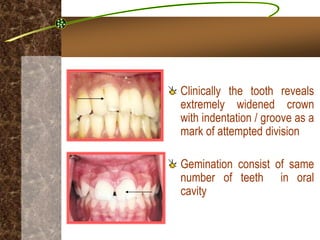
Clinically the tooth reveals
extremely widened crown
with indentation / groove as a
mark of attempted division
Gemination consist of same
number of teeth in oral
cavity
Twinning
It’s a developmental anomaly in which there is complete
& equal division of single tooth germ resulting in one
normal & one supernumerary tooth
Fusion
It is defined as the union of 2 adjacent normally
separated tooth germs
It results in one anomalous large crown in place of two
normal teeth. The teeth are fused at the level of dentin
If fusion occurs before the calcification begins
complete fusion with single crown and root develops
If it happens after crown completion resuting tooth will
have union of roots only
Affects both deciduous & permanent dentition
Incisor teeth are frequently affected
Fusion may be complete or incomplete.
Physical force or pressure produces the contact
between the adjacent tooth germs
Types
Fusion
Complete Incomplete
Fusion takes place before
calcification of tooth has
occurred
Fusion begins at
later stages of tooth
development & may
be limited to roots
only
Concrescence
Developmental anomaly where the roots of 2 or more adjoining
teeth have been united by cementum
It occurs after root formation of involved teeth are completed
Causes:
- Traumatic injury
- Crowding of teeth
- Hypercementosis associated with chronic inflammation
Occurs frequently between maxillary 2nd & 3rd molars
Clinical significance:-
– Difficulty in extraction
Dilaceration (Flexion)
Refers to a sharp bend / curve / angulation in
root or crown of tooth
Etiology:-
- Trauma
- Injury to deciduous tooth
- Idiopathic
Pathogenesis
Trauma
Partially calcified tooth germ
Displacement of hard calcified
crown portion of tooth
Uncalcified root portion develops
by forming an angle
More common in maxillary incisors
Curve may be present at apical / middle / cervical
portion of root depending on the portion which is
forming at the time of trauma
Clinical significance:-
Difficulties in extraction & RCT
Talon cusp
Anomalous projection or additional cusp arising lingually from
cingulum area & extends to the incisal edge as a prominent “T”
shaped projection
Common in permanent dentition & rare in deciduous dentition
Seen commonly on permanent maxillary incisors (more in
laterals) and less frequently on mandibular incisors
Forms a stucture resembles an eagle’s talon
Causes:-
- Local environmental factors
- Genetic factors
Clinical significance
Talon cusp consist of normally appearing enamel &
dentin. In few cases there can be presence of vital
pulp tissue
Usually asymptomatic
May interfere with occlusion
Susceptibility to caries (lingual pits)
Treatment:-
- Restoration of lingual pits to prevent dental caries
- Reduction of cusp if it interferes with occlusion
Syndromes associated:-
1. Rubinstein – Taybi syndrome
2. Sturge – Weber syndrome
3. Mohr syndrome
Dens invaginatus
Dens – in – Dente
Tooth – with in – Tooth
Pregnant tooth
Dilated composite odontome
Developmental morphologic variation characterized by
deep surface invagination of the crown / root
Presence of enamel lined cavity within tooth led the
early investigators to believe that a tooth with in a
tooth & hence the name “Dens – in – Dente”
The condition is most probably caused by an
invagination of enamel organ before calcification
Types
Based on occurrence
Coronal Radicular
Dens invaginatus
Invagination / infolding
occurs on crown portion
of the tooth
Invagination / infolding
occurs on root portion
of the tooth
Coronal dens invaginatus
Type I / Mild form
Invagination confined to crown within the CEJ
Type II / Intermediate form
Invagination extends below CEJ; may or may not
communicate with pulp
Type III / Extreme form
Invagination extend beyond the pulp through the root
& perforate the apical / lateral radicular area without
any communication with the pulp
Type I Type II Type III
More common is coronal type
Common in permanent maxillary teeth
Commonly affected teeth are maxillary laterals, central incisors
& premolars
Before eruption the invagination is filled with soft tissue which is
similar to dental follicle, which on eruption becomes necrotic
Radicular dens invaginatus
Rare condition
Thought to arise secondary to a proliferation of HERS,
with the formation of a strip of enamel that extends
along the root surface
The root reveals an invagination with the opening on the
lateral aspect of the root
Radiographic feature
Affected tooth demonstrates an enlargement with
deep pear shaped invagination lined by enamel
Clinical significance
The invagination is extremely prone to caries
Type III form of Dens invaginatus provides direct
communication between oral cavity & periapical
tissues leading to inflammatory lesions
Treatment:-
Early detection & prophylactic restoration
Dens Evaginatus
Leong’s premolar
Evaginated odontome
Occlusal tuberculated premolar
Occlusal enamel pearl
Central tubercle
Developmental anomaly of the tooth in which a focal
area of the crown shows a ‘globe’ or ‘nipple’ shaped
outward projection on the occlusal surface
Clinically appears as an extra cusp
Common in individuals of Mongolian origin & rare in
whites
Pathogenesis
Develops as a result of localized elongation &
proliferation of inner enamel epithelium as well as the
dental papilla into the dental organ
Clinical features
Primarily affects the premolars (Molars also)
Usually bilateral with mandibular predominance
Presents as an extra cusp located on the occlusal
surface between buccal & lingual cusps
Can interfere with tooth eruption
Causes occlusal disharmony
Sometimes, the extra cusp may contain vital pulp and
its attrition / facture may result in pulp exposure leading
to associated complications & pain
Note
Shovel shaped incisors
– Variant of Dens Evaginatus
– Prominent marginal ridges which creates a hollowed
lingual surface resembling a scoop of a shovel
Treatment
Asymptomatic – No treatment needed
Occlusal disharmony – Minor reduction
Pulp exposure – RCT
Taurodontism (Bull teeth)
Developmental anomaly in which the crown portion of the
tooth is enlarged at the expense of the roots.
Term coined by Sir Arthur Keith
Was found commonly in ancient neanderthal man
The overall shape resembles that of the molar teeth of cud-
chewing animals (Tauro = Bull, Dont = tooth)
There is altered crown-to-root ratio
Clinical & radiographic features
Affects permanent teeth more frequently than
deciduous teeth
Unilateral or bilateral
Molars are frequently involved
Teeth are usually rectangular in shape
Minimal constriction at cervical area
Elongated crown & enlarged pulp chamber
Apically placed furcation area
Exceedingly short roots
Types
1. Hypotaurodont (Mild)
Furcation area placed below normal but within
cervical 1/3rd of root
2. Mesotaurodont (Moderate)
Furcation area placed at middle 1/3rd of root
3. Hypertaurodont (Severe)
Furcation area placed at apical 1/3rd of root
Based on degree of apical displacement of
pulpal floor / furcation area (by Shaw)
Mild moderate severe
Normal
Syndromes associated
Klinefelter’s syndrome
Down syndrome
Poly X syndrome
Ectodermal dysplasia
Supernumerary root
Refers to the presence of one or more extra roots than
normal
Roots may be curved / straight / divergent
Affects both deciduous & permanent dentition
Commonly involved teeth are permanent molars,
mandibular cuspids & premolars
Clinical significance:-
Difficulties in extraction & RCT
Cervical enamel extensions
These are triangular extensions of enamel from CEJ
towards furcation area of molar teeth
Common in mandibular molars
Frequently involve bifurcation area on buccal surface
of roots
Classification
Type I
Coronal enamel projecting just below CEJ
Type II
Coronal enamel projecting below CEJ but not involving
the furcation area
Type III
Coronal enamel extending to involve the furcation area
Enamel extensions lead to loss of PDL attachment and
may predispose to development of:
1. Periodontal pocket
2. Buccal bifurcation cyst
Clinical significance
Disturbance in position
Ectopia
Trans position
Trans migration
Rotation
Ectopia
Remote location of a tooth away from its normal position
E.g:-
1. Maxillary canine erupting in nasal cavity / maxillary
sinus / at the inner canthus of eye
2. Mandibular 3rd molar erupting at angle of mandible /
lower border of mandible / through the skin of cheek
Transposition
Condition where in 2 teeth exchange position
E.g:-
1. Exchange of position between maxillary canine
& premolar
2. Exchange of position between mandibular canine
& lateral incisors
Rotation
Developmental anomaly where in a tooth turns
partially / completely
Commonly seen in,
Maxillary 2nd premolar (Complete rotation)
Maxillary central & 1st premolar (Partial rotation)
Disturbance in eruption and
exfoliation
Premature eruption
Delayed eruption
Unerupted teeth
Embedded or impacted teeth
Ankylosed teeth
Eruption cyst, eruption hematoma, & eruption
sequestrum
Premature exfoliation
Delayed eruption
Tooth erupts into oral cavity
much later than normal time of
eruption
Affects both deciduous &
permanent dentition
Premature eruption
Tooth erupts into oral cavity
much earlier than normal time
of eruption
Frequently involved tooth are
deciduous mandibular central
incisors
Types
Natal teeth
Erupted deciduous teeth present at the time of birth
Neonatal teeth
Deciduous teeth which erupt within first 30 days of life
Causes
Endocrinal disturbances
- Adreno-cortical syndrome
- Hyperthyroidism
Premature loss of deciduous teeth causes premature
eruption of permanent teeth
Systemic factors
- Rickets
- Cleidocranial dysplasia
- Cretinism
Local factors
- Fibromatosis gingivae
- Cleft lip & palate
- Retained deciduous tooth
Idiopathic
Causes
Impacted teeth
Teeth which are prevented from eruption into oral cavity
by some physical barrier in eruptive path or non
availability of space
Causes
- Micrognathia
- Retained deciduous teeth
- Supernumerary teeth
- Odontogenic cyst & tumors
- Cleft palate
- Syndrome associated
Classification
Completely impacted tooth
Impacted tooth is totally surrounded by bone
Partially impacted tooth
Impacted tooth is partly surrounded by bone & partly by soft
tissue
Mesioangular : Impacted tooth mesially inclined
Distoangular : Impacted tooth distally inclined
Vertical : Impacted tooth lies vertical
Horizontal : Impacted tooth lies horizontal
Complications
Crowding
Malocclusion
Pericoronitis
Radiating pain
Root resorption of adjacent erupted teeth
Caries
Food impaction & halitosis
Dentigerous cyst
Treatment:-
- Removal of cause
- Surgical removal
Embedded teeth
It refers to those teeth that are unerrupted due to lack
of eruptive forces
Submerged teeth
It refers to ankylosed deciduous teeth
Frequently involved teeth are deciduous molars
Occlusal table of the ankylosed deciduous tooth is
located below the occlusal plane of the rest of the
permanent teeth in the arch giving an submerged
appearance
In such cases the underlying permanent tooth may
become impacted or may erupt either buccally /
lingually
Disturbance in structure of teeth
ENAMEL HYPOPLASIA
Defect of enamel due to disturbance during its formative
process
During the formative stages of enamel, the ameloblast
cells are susceptible to various factors which can
disturb the process and the effect of which are reflected
on the surface enamel after the eruption of tooth
Types
Based on causative factors:
Enamel hypoplasia
Hereditary
(Amelogenesis Imperfecta)
Environmental
Focal
(Turners hypoplasia)
Generalized
Differences between hereditary &
environmental enamel hypoplasia
Hereditary
1. Both dentition affected
2. Only enamel is affected
3. Affected tooth shows
diffuse or vertical
orientation of defects
Environmental
1. Either one dentition
affected
2. Affects enamel and other
calcified structures
3. Affected tooth shows
defects, which are
horizontally arranged
Hereditary enamel hypoplasia
Amelogenesis imperfecta
Hereditary enamel dysplasia
Hereditary brown enamel
Hereditary brown opalescent tooth
Genetic defect
– with Enamelin gene ( ENAM)
- Gene coding amelogenin protein (AMELX)
Location of defective gene
– Autosomal form is less understood
– in X – linked AI defective gene is closely linked to
locus DXS85 at Xp 22 ( general location of gene for
amelogenin)
Types
Amelogenesis imperfecta may set in during any stage
of enamel formation . Based on that there are 4 types
1. Hypoplastic type - Defective matrix deposition
2. Hypocalcification type – Defective calcification
3. Hypomaturation type- Defective maturation
4. Hypomaturation-hypoplastic with taurodontism
Classification
by Witkop (1989)
TYPE I Hypoplastic type
IA Pitted, autosomal dominant
IB Local, autosomal dominant
IC Local, autosomal recessive
ID Smooth, autosomal dominant
IE Smooth, X- linked dominant
IF Rough, autosomal dominant
IG Enamel agenesis, autosomal recessive
TYPE II Hypomaturation type
IIA - Pigmented autosomal recessive
IIB - X- linked recessive
IIC - Snow capped tooth, Autosomal dominant
TYPE III Hypocalcification type
IIIA - Autosomal dominant
IIIA - Autosomal recessive
TYPE IV Hypomaturation-hypoplastic with
taurodontism
IVA - Hypomaturation-hypoplastic with
taurodontism, Autosomal Dominant
IVB - Hypoplastic-Hypomaturation with
taurodontism, Autosomal Dominant
Clinical features
Hypoplastic type
The disease affects the stage of matrix formation
Teeth exhibit complete absence of enamel or there may
be presence of enamel on some focal areas
Enamel thickness is usually below normal
Quantity is affected, but quality of formed enamel is
normal
Tooth appears as though prepared for receiving a
prosthetic crown
Radiological features
The thickness & radio density of enamel varies greatly
Hypoplastic type
Enamel may appear totally absent or as a thin line
Radiodensity of affected enamel is similar to that of normal
enamel (greater than dentin)
Hypocalcification type
Radiodensity of affected enamel is much lesser than that of
normal enamel
Hypomaturation type
Radiodensity of affected enamel is lesser than that of normal
enamel and is equivalent to normal dentin
Histopathology
Hypoplastic type
Lack of differentiation of ameloblast cells with little or no
matrix formation
Hypocalcification type
Abnormal matrix structure & mineral deposition
Hypomaturation type
Alteration in the enamel rod & rod sheath structures
Treatment
No definitive treatment
Veneering or capping of teeth to improve esthetics
Environmental enamel hypoplasia
Focal enamel hypoplasia
Also known as Turner’s hypoplasia
Most common form of enamel hypoplasia
Occurs due to trauma or infection to deciduous
teeth affecting the developing permanent tooth
Usually affects single tooth & is called as
Turners tooth
Hypoplasia ranges from a mild, brownish discolouration
to a severe pitting of enamel surface on the labial
aspect
Frequently involved teeth are permanent
maxillary/mandibular bicuspids & maxillary incisors
Severity of hypoplasia depends on severity of infection,
degree of tissue involvement and stage of tooth
formation
Pathogenesis
Deciduous teeth
Trauma Periapical Infection
Affect the ameloblastic layer
of permanent tooth
Disturb the enamel formation
Enamel defects
Clinical features
Affected area of tooth appear as a zone of white or
yellow brown discoloration & pitted areas
Causes
Prenatal
Infections (Rubella, Syphilis)
Malnutrition, Metabolic & Neurological disorders during pregnancy
Chromosomal abnormalities
Excess chemical intake (Tetracycline, Fluoride)
Natal
Birth injury
Premature delivery
Prolonged labor
Postnatal
Severe childhood infections
Congenital heart diseases
Nutritional deficiencies (Vit-B, Vit-D)
Endocrinal disorders
Dentinogenesis Imperfecta
A hereditary defect of dentin in the absence of any
systemic disorder, consisting of opalescent teeth,
composed of irregularly formed and undermineralized
dentin that obliterates the coronal and root portion of
pulp chamber.
Autosomal dominant mode of transmission
Also known as “Hereditary opalescent dentin” &
“Capdepont’s teeth”
Type I
– Deciduous teeth more severely affected.
Type II
– Both dentition affected
Type III
– Both dentition affected
– Multiple pulpal exposures in deciduous dentition
Radiological features
Radiologically type I & II are similar
Exhibit bulb-shaped or bell shaped crowns with
constricted CEJ
Thin & blunted roots
Early obliteration of root canals and pulp chamber
Cementum, PDL & bone appears normal
Type III exhibits great variability in deciduous teeth,
ranging from normal to those changes of type I & II.
Shell teeth
– Apparently normal enamel
– Extremely thin dentin (may involve entire tooth or
isolated to the root)
– Enormous pulp chambers (not as a result of resorption,
but due to insufficient dentin)
– Appear as shells of enamel & dentin surrounding
enormous pulp chambers and root canals.
Shell teeth
Histopathological features
Enamel & mantle dentin are normal
Remaining dentin is severely dysplastic & exhibits vast areas of
inter-globular dentin
Dentinal tubules are short, disoriented, irregular & widely spaced
Scanty odontoblasts line the pulp and they can be seen in the
defective dentin
The DEJ is Smooth
Treatment
Treatment is aimed at preventing excessive tooth
attrition & improving esthetics
Metal / Ceramic crowns & over dentures can be given
Dentin dysplasia
A hereditary defect characterized by defective dentin
formation & abnormal pulpal morphology
Autosomal dominant disorder
Types
Type I – Radicular dentin dysplasia
– Also known as “Rootless teeth”
Type II – Coronal dentin dysplasia
Mild
Severe
Treatment
No treatment
Prognosis depends on presence / absence of periapical
lesions
Regional odontodysplasia
It is an uncommon non-hereditary developmental
disturbances of tooth characterized by defective
formation of enamel & dentin with abnormal
calcifications of pulp & follicle
Also known as Ghost teeth / odontogenesis
imperfecta
Cause
– somatic mutation
– Slow virus residing in odontogenic epithelium
– Local ischemic change during odontogenesis
Clinical features
More common in permanent dentition
More common in maxilla
Affects several teeth in a single quadrant
Maxillary anterior teeth affected more
Failure of eruption or delayed eruption of affected teeth
Teeth are deformed, yellowish – brown in color with a
soft leathery surface
Radiological features
Marked decrease in radiodensity of teeth
Enamel & dentin are very thin & radiological distinction
not possible
Extremely large & open pulp chamber with pulp stones
Ghostly appearance of affected teeth
Histopathological features
Abnormal enamel & dentin
Marked reduction in amount of dentin, widening of
predentin layer, large areas of interglobular dentin and
an irregular pattern of dentin
Large pulp chamber with pulp stones
Calcification in follicular connective
Treatment
Extraction & artificial prosthesis
Developmental Anomalies affecting
the jaws
Agnathia
Micrognathia
Macrognathia
Facial hemihypertrophy
Facial hemiatrophy
Agnathia
Congenital absence of maxilla or mandible
Commonly, only a portion of one jaw is missing
– In maxilla
• Maxillary process
• Premaxilla
– In mandible
• Entire mandible
• Condyle
• Entire ramus
Micrognathia
A smaller jaw than normal
Involve either maxilla or mandible
Types
Apparent [Abnormal positioning/ relation of one jaw to the other or skull]
True
 Congenital
 Acquired
Congenital micrognathia
Etiology unknown
Associated with other congenital abnormalities like
congenital heart disease and pierre robin syndrome
Micrognathia of maxilla is due to a deficiency of the
premaxillary area
Micrognathia of mandible may be due to
– Small jaw
– Posterior positioning of mandible in relation to skull
– Steep mandibular angle
– Agenesis of condyles
Acquired micrognathia
Post natal in origin
Causes
– Ankylosis of joint as result of trauma/infection
Macrognathia
Condition of abnormally large jaws
Seen in
– Pagets disease of bone
– Enlarged maxilla
– Acromegaly
– Enlarged mandible
– Leontiasis ossea
– Enlarged maxilla

Developmental Disturbances.ppt

  • 1.
    Developmental Anomalies Of Oral& Para-oral Structures Dr. Vardendra M Reader Dept of Oral Pathology NDC, Raichur
  • 2.
    Index Introduction Types of anomalies Developmentalanomalies of Oro-facial hard tissues Developmental anomalies of Oro-facial soft tissues Syndromes
  • 3.
    Introduction Malformation or defectsresulting from disturbance of growth & development are known as Developmental Anomalies Manifestation of defects are evident either at birth or some times after birth
  • 4.
    Types of anomalies Congenitaldevelopmental anomalies Hereditary developmental anomalies Familial developmental anomalies Acquired developmental anomalies Hamartomatous developmental anomalies Idiopathic developmental anomalies
  • 5.
    Congenital Developmental Anomalies Defects whichare present at birth or before birth during the intra-uterine life as a result of either heredity or environmental influences E.g. - Cleft lip & palate
  • 6.
    Hereditary Developmental Anomalies Defectsare genetically transmitted from the parents to the offspring, where definite genetic location is identified E.g. Downs syndrome –Trisomy 21
  • 7.
    Familial Developmental Anomalies Defectsare transmitted from the parents to the offspring, where definite genetic location is not identified E.g. – Diabetes
  • 8.
    Acquired Developmental Anomalies Defectsdevelop during intra-uterine life due to some pathological environment condition Can be Prenatal / neonatal / Postnatal E.g.: 1. Congenital Syphilis - Notched incisors - Mulberry molars 2. Fluorides - Enamel hypoplasia
  • 9.
  • 10.
    Hamartomatous Developmental Anomalies Defectsoccuring due to hamartomatous change in the tissues Hamartoma: Excessive focal proliferation of normal tissues which are native to that particular location E.g. – Odontome
  • 12.
    Note: Choristoma: Excessive focal proliferationof normal tissues which are not native to that particular location E.g. – Gingival salivary gland choristoma Teratoma: Tumor arising from all the 3 germ layers E.g. – Ovarian teratomas
  • 13.
    Idiopathic developmental anomalies Indicatesthe developmental anomalies were exact cause is unknown E.g. – Idiopathic enamel hypoplasia
  • 14.
    Syndrome The term syndromederives from the Greek and means literally "run together “ A group of symptoms that collectively indicate or characterize a disease, a psychological disorder, or another abnormal condition Large number of syndromes occur in association with many oral diseases Early diagnosis of a syndrome is important since severity of a disease can be much more when it is occuring in association with a syndrome
  • 15.
    E.g. Gardner's syndrome Multiple polyposisof large intestine Osteomas of bone Desmoid tumours Multiple epidermoid cysts of skin Multiple impacted supernumerary tooth
  • 16.
  • 17.
    1. Developmental Anomaliesaffecting the teeth 2. Developmental Anomalies affecting the jaws
  • 18.
    Anomalies of toothoccur either due to genetic / environmental factors Defects may occur during any of the developmental stages of teeth, which are manifested clinically in the later life once the tooth is fully formed
  • 19.
  • 20.
    Initiation - Anodontia/hyperdontia Proliferation - Microdontia Histodifferentiation - Cysts / neoplasms Morphodifferentation - teeth with abnormal morphology or Odontome Apposition - Hypoplastic tooth Calcification - Hypocalcification Eruption - Embedded tooth E.g. Structural diffects
  • 21.
  • 22.
    I. Those affectingthe size Microdontia Macrodontia Rhizomicri Rhizomegaly
  • 23.
    II. Those affectingthe number Anodontia Supernumerary teeth Pre-deciduous dentition Post permanent dentition
  • 24.
    III. Those affectingthe shape Gemination Fusion Concrescence Talon’s cusp Dens invaginatus Dens evaginatus Taurodontism Dilaceration / Flexion Supernumerary root Extra cusps Enamel pearl Cervical enamel extension
  • 25.
    IV. Those affectingthe position Ectopia Rotation Trans-position Inversion Trans-migration
  • 26.
    V. Those affectingeruption Premature eruption Delayed eruption Impacted tooth Embedded tooth Submerged tooth Eruption sequestrum
  • 27.
    VI. Those affectingthe structure Enamel Enamel hypoplasia Amelogenesis imperfecta Dentin Dentinogenesis imperfecta Dentin dysplasia Enamel + Dentin Regional odontodysplasia Cementum Hypocementosis Hypercementosis
  • 28.
    Microdontia Condition in whichone or more teeth are smaller than normal More in females Etiology  Genetic factors  Environmental factors Types 1. Generalized microdontia (>14) - True - Relative 2. Focal microdontia (<14)
  • 29.
    True generalized microdontia Allthe teeth in both arches are well formed but, uniformly smaller than normal Associated with - Pituitary dwarfism - Down’s syndrome - Congenital heart disease
  • 30.
    Relative generalized microdontia Largejaw size relative to the teeth makes the normal teeth seem smaller resulting in spacing between teeth Hereditary condition
  • 31.
  • 32.
  • 33.
    Focal microdontia One ormore teeth are smaller than normal More common than generalized microdontia Frequently involved teeth are maxillary laterals & maxillary 3rd molars E.g. – Peg laterals
  • 34.
  • 35.
    Macrodontia (Megadontia /Megalodontia) Condition in which one or more teeth are larger than normal Common in males Teeth are known as megadont / macrodont Types 1. Generalized macrodontia - True - Relative 2. Localized macrodontia
  • 36.
  • 37.
    True generalized macrodontia Allthe teeth in both arches are well formed & uniformly larger than normal Associated with - Pituitary gigantism
  • 38.
    Relative generalized macrodontia Smalljaw size relative to the teeth makes the normal teeth seem larger resulting in crowding of teeth Hereditary condition
  • 39.
    Localized macrodontia One ormore teeth are larger than normal Should not be confused with fusion Associated with - Facial hemi-hypertrophy
  • 40.
  • 41.
    Rhizomicri It is acondition where root of the teeth are smaller than normal Teeth most commonly affected are maxillary laterals, maxillary 3rd molars, maxillary & mandibular 1st premolars Clinical significance • Involved tooth cannot be used as anchorage & abutment
  • 42.
    Rhizomegaly (Radiculomegaly) Condition wherein root of the teeth is larger than normal Most commonly affected teeth are maxillary & mandibular cuspids Clinical significance - Extraction difficulties - Oro-antral fistula
  • 43.
  • 44.
    Anodontia Condition in whichthere is absence of teeth in the oral cavity Etiology: - Hereditary factor - Familial tendency - Radiation injury to developing tooth germs - Hereditary ectodermal dysplasia - Mutation
  • 45.
  • 46.
    Pseudo anodontia Condition inwhich teeth are present within the jaw bones but are not erupted E.g. - Impacted tooth - Embedded tooth
  • 47.
    False anodontia Condition inwhich the teeth are missing in oral cavity due to extraction or exfoliation
  • 48.
    True anodontia Condition whichoccurs due to failure of development of tooth in the jaw bones Can be total or partial
  • 49.
    Complete / Totalanodontia Congenital absence of all teeth Extremely rare condition
  • 50.
    Partial anodontia Congenital absenceof one or more teeth Commonly seen in third molars, maxillary lateral incisors and the second premolars
  • 51.
    Hypodontia Congenital absence ofone or more teeth but less than 6
  • 52.
  • 53.
    Conditions & syndromesassociated Hereditary ectodermal dysplasia Ehlers – Danlos syndrome Rieger’s syndrome Down syndrome Book syndrome
  • 54.
    Supernumerary teeth (Hyperdontia) Presenceof tooth in excess of the normal number in the dental arch Common in males Etiology: - Accessory tooth bud - Splitting of the regular normal tooth bud - Hereditary - Atavism
  • 55.
    Classification I. Based onNumber & Shape Supernumerary teeth Single Multiple Conical Complex Tuberculate Supplemental Non-syndrome associated Syndrome associated Compound
  • 56.
    II. Based onlocation Mesiodens Distomolar / Destodens Paramolar
  • 57.
    Mesiodens Most common typeof supernumerary tooth Located between the upper central incisors Small conical in shape Erupted / impacted / inverted
  • 58.
  • 59.
    Distomolar (Distodens) Small rudimentarytooth Located distal to 3rd molars in the dental arch
  • 60.
    Paramolar Small rudimentary tooth Locatedon buccal / lingual aspect of the normal molars Occurs most commonly in maxilla
  • 61.
  • 62.
  • 65.
    Clinical significance Crowding, malocclusion& aesthetic problems May lead to increased incidence of dental caries & periodontal problems Dentigerous cyst may develop from impacted supernumerary tooth Treatment:- Extraction
  • 66.
    Conditions & syndromesassociated Cleido cranial dysplasia Apert syndrome Gardner syndrome (multiple supernumerary teeth) Ehlers Danlos syndrome Down’s syndrome Cleft lip & palate
  • 67.
    Predeciduous dentition Infants occasionallyare born with structures which appear to be erupted teeth Earlier thought to arise from accessory bud from accessory dental lamina & the concept is no more in use Now thought as hornified epithelial structures filled with keratin occurring on gingiva on crest of ridge & are termed as ‘dental lamina cyst of new born’
  • 68.
    Postpermanent dentition It isa condition in which several teeth erupt into oral cavity after all permanent teeth are lost particularly after the insertion of full denture Earlier it was thought to be the third dentition Now it is regarded as the delayed eruption of embedded or impacted permanent teeth or it can be eruption of multiple supernumerary unerupted teeth
  • 69.
  • 70.
    Gemination It’s a developmentalanomaly which refers to the incomplete formation of 2 teeth resulting from an attempt at division single tooth germ by an invagination. The result is formation of two completely or incompletely separated crown that have single root and root canal. Affects both deciduous & permanent dentition Commonly affects deciduous mandibular incisors & permanent maxillary incisors
  • 71.
    Clinically the toothreveals extremely widened crown with indentation / groove as a mark of attempted division Gemination consist of same number of teeth in oral cavity
  • 72.
    Twinning It’s a developmentalanomaly in which there is complete & equal division of single tooth germ resulting in one normal & one supernumerary tooth
  • 73.
    Fusion It is definedas the union of 2 adjacent normally separated tooth germs It results in one anomalous large crown in place of two normal teeth. The teeth are fused at the level of dentin If fusion occurs before the calcification begins complete fusion with single crown and root develops If it happens after crown completion resuting tooth will have union of roots only
  • 74.
    Affects both deciduous& permanent dentition Incisor teeth are frequently affected Fusion may be complete or incomplete. Physical force or pressure produces the contact between the adjacent tooth germs
  • 75.
    Types Fusion Complete Incomplete Fusion takesplace before calcification of tooth has occurred Fusion begins at later stages of tooth development & may be limited to roots only
  • 77.
    Concrescence Developmental anomaly wherethe roots of 2 or more adjoining teeth have been united by cementum It occurs after root formation of involved teeth are completed Causes: - Traumatic injury - Crowding of teeth - Hypercementosis associated with chronic inflammation
  • 78.
    Occurs frequently betweenmaxillary 2nd & 3rd molars Clinical significance:- – Difficulty in extraction
  • 80.
    Dilaceration (Flexion) Refers toa sharp bend / curve / angulation in root or crown of tooth Etiology:- - Trauma - Injury to deciduous tooth - Idiopathic
  • 81.
    Pathogenesis Trauma Partially calcified toothgerm Displacement of hard calcified crown portion of tooth Uncalcified root portion develops by forming an angle
  • 82.
    More common inmaxillary incisors Curve may be present at apical / middle / cervical portion of root depending on the portion which is forming at the time of trauma Clinical significance:- Difficulties in extraction & RCT
  • 84.
    Talon cusp Anomalous projectionor additional cusp arising lingually from cingulum area & extends to the incisal edge as a prominent “T” shaped projection Common in permanent dentition & rare in deciduous dentition Seen commonly on permanent maxillary incisors (more in laterals) and less frequently on mandibular incisors Forms a stucture resembles an eagle’s talon Causes:- - Local environmental factors - Genetic factors
  • 86.
    Clinical significance Talon cuspconsist of normally appearing enamel & dentin. In few cases there can be presence of vital pulp tissue Usually asymptomatic May interfere with occlusion Susceptibility to caries (lingual pits)
  • 87.
    Treatment:- - Restoration oflingual pits to prevent dental caries - Reduction of cusp if it interferes with occlusion Syndromes associated:- 1. Rubinstein – Taybi syndrome 2. Sturge – Weber syndrome 3. Mohr syndrome
  • 88.
    Dens invaginatus Dens –in – Dente Tooth – with in – Tooth Pregnant tooth Dilated composite odontome
  • 89.
    Developmental morphologic variationcharacterized by deep surface invagination of the crown / root Presence of enamel lined cavity within tooth led the early investigators to believe that a tooth with in a tooth & hence the name “Dens – in – Dente” The condition is most probably caused by an invagination of enamel organ before calcification
  • 90.
    Types Based on occurrence CoronalRadicular Dens invaginatus Invagination / infolding occurs on crown portion of the tooth Invagination / infolding occurs on root portion of the tooth
  • 91.
    Coronal dens invaginatus TypeI / Mild form Invagination confined to crown within the CEJ Type II / Intermediate form Invagination extends below CEJ; may or may not communicate with pulp Type III / Extreme form Invagination extend beyond the pulp through the root & perforate the apical / lateral radicular area without any communication with the pulp
  • 92.
    Type I TypeII Type III
  • 93.
    More common iscoronal type Common in permanent maxillary teeth Commonly affected teeth are maxillary laterals, central incisors & premolars Before eruption the invagination is filled with soft tissue which is similar to dental follicle, which on eruption becomes necrotic
  • 95.
    Radicular dens invaginatus Rarecondition Thought to arise secondary to a proliferation of HERS, with the formation of a strip of enamel that extends along the root surface The root reveals an invagination with the opening on the lateral aspect of the root
  • 97.
    Radiographic feature Affected toothdemonstrates an enlargement with deep pear shaped invagination lined by enamel
  • 99.
    Clinical significance The invaginationis extremely prone to caries Type III form of Dens invaginatus provides direct communication between oral cavity & periapical tissues leading to inflammatory lesions Treatment:- Early detection & prophylactic restoration
  • 100.
    Dens Evaginatus Leong’s premolar Evaginatedodontome Occlusal tuberculated premolar Occlusal enamel pearl Central tubercle
  • 101.
    Developmental anomaly ofthe tooth in which a focal area of the crown shows a ‘globe’ or ‘nipple’ shaped outward projection on the occlusal surface Clinically appears as an extra cusp Common in individuals of Mongolian origin & rare in whites
  • 102.
    Pathogenesis Develops as aresult of localized elongation & proliferation of inner enamel epithelium as well as the dental papilla into the dental organ
  • 103.
    Clinical features Primarily affectsthe premolars (Molars also) Usually bilateral with mandibular predominance Presents as an extra cusp located on the occlusal surface between buccal & lingual cusps Can interfere with tooth eruption Causes occlusal disharmony Sometimes, the extra cusp may contain vital pulp and its attrition / facture may result in pulp exposure leading to associated complications & pain
  • 105.
    Note Shovel shaped incisors –Variant of Dens Evaginatus – Prominent marginal ridges which creates a hollowed lingual surface resembling a scoop of a shovel
  • 106.
    Treatment Asymptomatic – Notreatment needed Occlusal disharmony – Minor reduction Pulp exposure – RCT
  • 107.
    Taurodontism (Bull teeth) Developmentalanomaly in which the crown portion of the tooth is enlarged at the expense of the roots. Term coined by Sir Arthur Keith Was found commonly in ancient neanderthal man The overall shape resembles that of the molar teeth of cud- chewing animals (Tauro = Bull, Dont = tooth) There is altered crown-to-root ratio
  • 109.
    Clinical & radiographicfeatures Affects permanent teeth more frequently than deciduous teeth Unilateral or bilateral Molars are frequently involved Teeth are usually rectangular in shape Minimal constriction at cervical area Elongated crown & enlarged pulp chamber Apically placed furcation area Exceedingly short roots
  • 110.
    Types 1. Hypotaurodont (Mild) Furcationarea placed below normal but within cervical 1/3rd of root 2. Mesotaurodont (Moderate) Furcation area placed at middle 1/3rd of root 3. Hypertaurodont (Severe) Furcation area placed at apical 1/3rd of root Based on degree of apical displacement of pulpal floor / furcation area (by Shaw)
  • 111.
  • 113.
    Syndromes associated Klinefelter’s syndrome Downsyndrome Poly X syndrome Ectodermal dysplasia
  • 114.
    Supernumerary root Refers tothe presence of one or more extra roots than normal Roots may be curved / straight / divergent Affects both deciduous & permanent dentition Commonly involved teeth are permanent molars, mandibular cuspids & premolars Clinical significance:- Difficulties in extraction & RCT
  • 116.
    Cervical enamel extensions Theseare triangular extensions of enamel from CEJ towards furcation area of molar teeth Common in mandibular molars Frequently involve bifurcation area on buccal surface of roots
  • 118.
    Classification Type I Coronal enamelprojecting just below CEJ Type II Coronal enamel projecting below CEJ but not involving the furcation area Type III Coronal enamel extending to involve the furcation area
  • 119.
    Enamel extensions leadto loss of PDL attachment and may predispose to development of: 1. Periodontal pocket 2. Buccal bifurcation cyst Clinical significance
  • 120.
    Disturbance in position Ectopia Transposition Trans migration Rotation
  • 121.
    Ectopia Remote location ofa tooth away from its normal position E.g:- 1. Maxillary canine erupting in nasal cavity / maxillary sinus / at the inner canthus of eye 2. Mandibular 3rd molar erupting at angle of mandible / lower border of mandible / through the skin of cheek
  • 123.
    Transposition Condition where in2 teeth exchange position E.g:- 1. Exchange of position between maxillary canine & premolar 2. Exchange of position between mandibular canine & lateral incisors
  • 125.
    Rotation Developmental anomaly wherein a tooth turns partially / completely Commonly seen in, Maxillary 2nd premolar (Complete rotation) Maxillary central & 1st premolar (Partial rotation)
  • 127.
    Disturbance in eruptionand exfoliation Premature eruption Delayed eruption Unerupted teeth Embedded or impacted teeth Ankylosed teeth Eruption cyst, eruption hematoma, & eruption sequestrum Premature exfoliation
  • 128.
    Delayed eruption Tooth eruptsinto oral cavity much later than normal time of eruption Affects both deciduous & permanent dentition
  • 129.
    Premature eruption Tooth eruptsinto oral cavity much earlier than normal time of eruption Frequently involved tooth are deciduous mandibular central incisors
  • 130.
    Types Natal teeth Erupted deciduousteeth present at the time of birth Neonatal teeth Deciduous teeth which erupt within first 30 days of life
  • 131.
    Causes Endocrinal disturbances - Adreno-corticalsyndrome - Hyperthyroidism Premature loss of deciduous teeth causes premature eruption of permanent teeth
  • 132.
    Systemic factors - Rickets -Cleidocranial dysplasia - Cretinism Local factors - Fibromatosis gingivae - Cleft lip & palate - Retained deciduous tooth Idiopathic Causes
  • 133.
    Impacted teeth Teeth whichare prevented from eruption into oral cavity by some physical barrier in eruptive path or non availability of space Causes - Micrognathia - Retained deciduous teeth - Supernumerary teeth - Odontogenic cyst & tumors - Cleft palate - Syndrome associated
  • 134.
    Classification Completely impacted tooth Impactedtooth is totally surrounded by bone Partially impacted tooth Impacted tooth is partly surrounded by bone & partly by soft tissue
  • 135.
    Mesioangular : Impactedtooth mesially inclined Distoangular : Impacted tooth distally inclined Vertical : Impacted tooth lies vertical Horizontal : Impacted tooth lies horizontal
  • 137.
    Complications Crowding Malocclusion Pericoronitis Radiating pain Root resorptionof adjacent erupted teeth Caries Food impaction & halitosis Dentigerous cyst Treatment:- - Removal of cause - Surgical removal
  • 138.
    Embedded teeth It refersto those teeth that are unerrupted due to lack of eruptive forces
  • 139.
    Submerged teeth It refersto ankylosed deciduous teeth Frequently involved teeth are deciduous molars Occlusal table of the ankylosed deciduous tooth is located below the occlusal plane of the rest of the permanent teeth in the arch giving an submerged appearance In such cases the underlying permanent tooth may become impacted or may erupt either buccally / lingually
  • 141.
  • 142.
    ENAMEL HYPOPLASIA Defect ofenamel due to disturbance during its formative process During the formative stages of enamel, the ameloblast cells are susceptible to various factors which can disturb the process and the effect of which are reflected on the surface enamel after the eruption of tooth
  • 143.
    Types Based on causativefactors: Enamel hypoplasia Hereditary (Amelogenesis Imperfecta) Environmental Focal (Turners hypoplasia) Generalized
  • 144.
    Differences between hereditary& environmental enamel hypoplasia Hereditary 1. Both dentition affected 2. Only enamel is affected 3. Affected tooth shows diffuse or vertical orientation of defects Environmental 1. Either one dentition affected 2. Affects enamel and other calcified structures 3. Affected tooth shows defects, which are horizontally arranged
  • 145.
  • 146.
    Amelogenesis imperfecta Hereditary enameldysplasia Hereditary brown enamel Hereditary brown opalescent tooth
  • 147.
    Genetic defect – withEnamelin gene ( ENAM) - Gene coding amelogenin protein (AMELX) Location of defective gene – Autosomal form is less understood – in X – linked AI defective gene is closely linked to locus DXS85 at Xp 22 ( general location of gene for amelogenin)
  • 148.
    Types Amelogenesis imperfecta mayset in during any stage of enamel formation . Based on that there are 4 types 1. Hypoplastic type - Defective matrix deposition 2. Hypocalcification type – Defective calcification 3. Hypomaturation type- Defective maturation 4. Hypomaturation-hypoplastic with taurodontism
  • 149.
    Classification by Witkop (1989) TYPEI Hypoplastic type IA Pitted, autosomal dominant IB Local, autosomal dominant IC Local, autosomal recessive ID Smooth, autosomal dominant IE Smooth, X- linked dominant IF Rough, autosomal dominant IG Enamel agenesis, autosomal recessive
  • 150.
    TYPE II Hypomaturationtype IIA - Pigmented autosomal recessive IIB - X- linked recessive IIC - Snow capped tooth, Autosomal dominant TYPE III Hypocalcification type IIIA - Autosomal dominant IIIA - Autosomal recessive
  • 151.
    TYPE IV Hypomaturation-hypoplasticwith taurodontism IVA - Hypomaturation-hypoplastic with taurodontism, Autosomal Dominant IVB - Hypoplastic-Hypomaturation with taurodontism, Autosomal Dominant
  • 152.
  • 153.
    Hypoplastic type The diseaseaffects the stage of matrix formation Teeth exhibit complete absence of enamel or there may be presence of enamel on some focal areas Enamel thickness is usually below normal Quantity is affected, but quality of formed enamel is normal Tooth appears as though prepared for receiving a prosthetic crown
  • 155.
    Radiological features The thickness& radio density of enamel varies greatly Hypoplastic type Enamel may appear totally absent or as a thin line Radiodensity of affected enamel is similar to that of normal enamel (greater than dentin) Hypocalcification type Radiodensity of affected enamel is much lesser than that of normal enamel Hypomaturation type Radiodensity of affected enamel is lesser than that of normal enamel and is equivalent to normal dentin
  • 157.
    Histopathology Hypoplastic type Lack ofdifferentiation of ameloblast cells with little or no matrix formation Hypocalcification type Abnormal matrix structure & mineral deposition Hypomaturation type Alteration in the enamel rod & rod sheath structures
  • 158.
    Treatment No definitive treatment Veneeringor capping of teeth to improve esthetics
  • 159.
  • 160.
    Focal enamel hypoplasia Alsoknown as Turner’s hypoplasia Most common form of enamel hypoplasia Occurs due to trauma or infection to deciduous teeth affecting the developing permanent tooth Usually affects single tooth & is called as Turners tooth
  • 161.
    Hypoplasia ranges froma mild, brownish discolouration to a severe pitting of enamel surface on the labial aspect Frequently involved teeth are permanent maxillary/mandibular bicuspids & maxillary incisors Severity of hypoplasia depends on severity of infection, degree of tissue involvement and stage of tooth formation
  • 162.
    Pathogenesis Deciduous teeth Trauma PeriapicalInfection Affect the ameloblastic layer of permanent tooth Disturb the enamel formation Enamel defects
  • 163.
    Clinical features Affected areaof tooth appear as a zone of white or yellow brown discoloration & pitted areas
  • 164.
    Causes Prenatal Infections (Rubella, Syphilis) Malnutrition,Metabolic & Neurological disorders during pregnancy Chromosomal abnormalities Excess chemical intake (Tetracycline, Fluoride) Natal Birth injury Premature delivery Prolonged labor Postnatal Severe childhood infections Congenital heart diseases Nutritional deficiencies (Vit-B, Vit-D) Endocrinal disorders
  • 165.
    Dentinogenesis Imperfecta A hereditarydefect of dentin in the absence of any systemic disorder, consisting of opalescent teeth, composed of irregularly formed and undermineralized dentin that obliterates the coronal and root portion of pulp chamber. Autosomal dominant mode of transmission Also known as “Hereditary opalescent dentin” & “Capdepont’s teeth”
  • 166.
    Type I – Deciduousteeth more severely affected. Type II – Both dentition affected Type III – Both dentition affected – Multiple pulpal exposures in deciduous dentition
  • 168.
    Radiological features Radiologically typeI & II are similar Exhibit bulb-shaped or bell shaped crowns with constricted CEJ Thin & blunted roots Early obliteration of root canals and pulp chamber Cementum, PDL & bone appears normal
  • 169.
    Type III exhibitsgreat variability in deciduous teeth, ranging from normal to those changes of type I & II. Shell teeth – Apparently normal enamel – Extremely thin dentin (may involve entire tooth or isolated to the root) – Enormous pulp chambers (not as a result of resorption, but due to insufficient dentin) – Appear as shells of enamel & dentin surrounding enormous pulp chambers and root canals.
  • 171.
  • 172.
    Histopathological features Enamel &mantle dentin are normal Remaining dentin is severely dysplastic & exhibits vast areas of inter-globular dentin Dentinal tubules are short, disoriented, irregular & widely spaced Scanty odontoblasts line the pulp and they can be seen in the defective dentin The DEJ is Smooth
  • 174.
    Treatment Treatment is aimedat preventing excessive tooth attrition & improving esthetics Metal / Ceramic crowns & over dentures can be given
  • 175.
    Dentin dysplasia A hereditarydefect characterized by defective dentin formation & abnormal pulpal morphology Autosomal dominant disorder
  • 176.
    Types Type I –Radicular dentin dysplasia – Also known as “Rootless teeth” Type II – Coronal dentin dysplasia Mild Severe
  • 178.
    Treatment No treatment Prognosis dependson presence / absence of periapical lesions
  • 179.
    Regional odontodysplasia It isan uncommon non-hereditary developmental disturbances of tooth characterized by defective formation of enamel & dentin with abnormal calcifications of pulp & follicle Also known as Ghost teeth / odontogenesis imperfecta Cause – somatic mutation – Slow virus residing in odontogenic epithelium – Local ischemic change during odontogenesis
  • 180.
    Clinical features More commonin permanent dentition More common in maxilla Affects several teeth in a single quadrant Maxillary anterior teeth affected more Failure of eruption or delayed eruption of affected teeth Teeth are deformed, yellowish – brown in color with a soft leathery surface
  • 181.
    Radiological features Marked decreasein radiodensity of teeth Enamel & dentin are very thin & radiological distinction not possible Extremely large & open pulp chamber with pulp stones Ghostly appearance of affected teeth
  • 183.
    Histopathological features Abnormal enamel& dentin Marked reduction in amount of dentin, widening of predentin layer, large areas of interglobular dentin and an irregular pattern of dentin Large pulp chamber with pulp stones Calcification in follicular connective
  • 184.
  • 185.
  • 186.
  • 187.
    Agnathia Congenital absence ofmaxilla or mandible Commonly, only a portion of one jaw is missing – In maxilla • Maxillary process • Premaxilla – In mandible • Entire mandible • Condyle • Entire ramus
  • 188.
    Micrognathia A smaller jawthan normal Involve either maxilla or mandible Types Apparent [Abnormal positioning/ relation of one jaw to the other or skull] True  Congenital  Acquired
  • 189.
    Congenital micrognathia Etiology unknown Associatedwith other congenital abnormalities like congenital heart disease and pierre robin syndrome Micrognathia of maxilla is due to a deficiency of the premaxillary area Micrognathia of mandible may be due to – Small jaw – Posterior positioning of mandible in relation to skull – Steep mandibular angle – Agenesis of condyles
  • 190.
    Acquired micrognathia Post natalin origin Causes – Ankylosis of joint as result of trauma/infection
  • 191.
    Macrognathia Condition of abnormallylarge jaws Seen in – Pagets disease of bone – Enlarged maxilla – Acromegaly – Enlarged mandible – Leontiasis ossea – Enlarged maxilla