Introduction to
Cleavage in Snail
Development
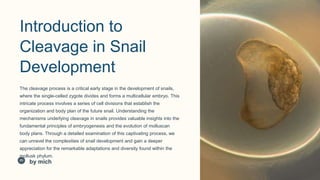
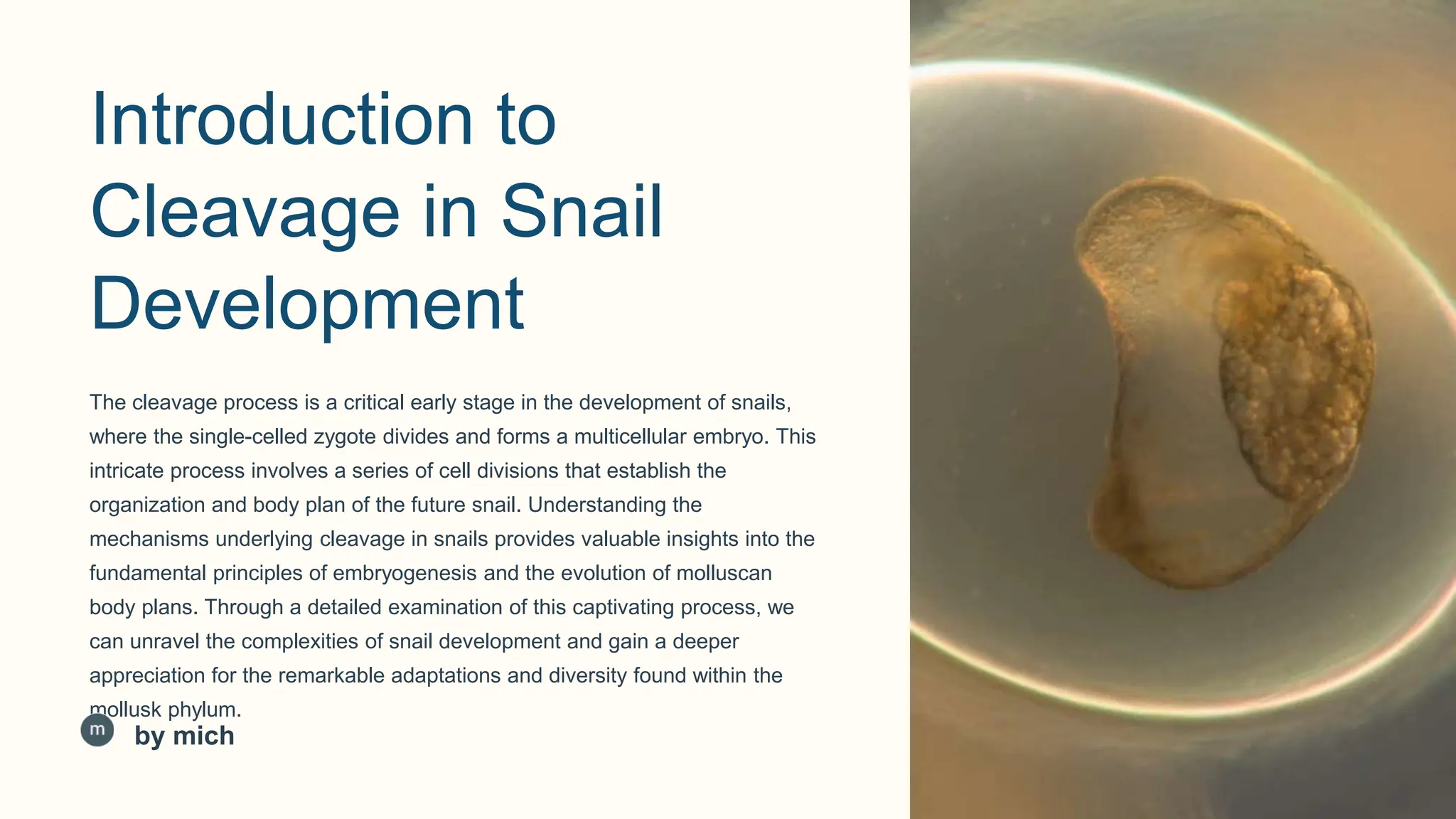
The cleavage process is a critical early stage in the development of snails,
where the single-celled zygote divides and forms a multicellular embryo. This
intricate process involves a series of cell divisions that establish the
organization and body plan of the future snail. Understanding the
mechanisms underlying cleavage in snails provides valuable insights into the
fundamental principles of embryogenesis and the evolution of molluscan
body plans. Through a detailed examination of this captivating process, we
can unravel the complexities of snail development and gain a deeper
appreciation for the remarkable adaptations and diversity found within the
mollusk phylum.
by mich
Importance of Cleavage in Snail
Embryogenesis
Cell Lineage
Determination
Cleavage is the initial
stage of embryonic
development in snails,
where a single fertilized
egg divides into multiple
cells. This process is
crucial for establishing the
cell lineages that will
ultimately give rise to the
different tissues and
organs of the adult snail.
The highly stereotyped and
asymmetric cleavage
patterns observed in snails
are thought to play a key
role in the specification of
cell fates, ensuring that
each cell is programmed to
Axis Patterning
The cleavage patterns in
snail embryos also
contribute to the
establishment of the
primary body axes, such
as the anterior-posterior
and dorsal-ventral axes.
The unequal division of
cells and the positioning of
the micromeres (smaller
cells) and macromeres
(larger cells) during
cleavage provide spatial
cues that help to orient the
developing embryo and
guide the formation of the
major body plan.
Embryonic Patterning
Cleavage events in snail
embryos are closely linked
to the deployment of
maternal determinants and
the initiation of zygotic
gene expression. The
precise timing and
positioning of the cleavage
furrows allow for the
unequal distribution of
these key developmental
regulators, which in turn
influence the subsequent
patterning of the embryo
and the establishment of
its overall organization.
Stages of Cleavage in Snail Embryos
The cleavage process in snail embryos involves a series of successive cell divisions that transform the
single-celled zygote into a multicellular embryo. This process is tightly regulated and follows a
characteristic pattern known as spiral cleavage. In the initial stage, the zygote undergoes a meridional
(vertical) cleavage, dividing it into two equal-sized blastomeres. The second cleavage is typically
latitudinal (horizontal), resulting in four blastomeres arranged in a flat plane. As the cleavage continues,
the blastomeres become smaller and more numerous, forming a spiral pattern. This spiral arrangement is
a hallmark of molluscan embryogenesis and is thought to be important for the establishment of the
animal's body plan. During the later stages of cleavage, the blastomeres exhibit an unequal division
pattern, with some cells being larger than others. This asymmetric division is crucial for the determination
of cell fate and the specification of different cell lineages within the developing embryo. The precise
timing and orientation of these cell divisions are regulated by a complex interplay of cytoskeletal
rearrangements, cell-cell interactions, and maternal factors.
Spiral Cleavage Pattern in Snails
1
Unequal Cell Division
The spiral cleavage pattern in snail
embryos is characterized by a series
of unequal cell divisions, where the
cells divide asymmetrically. This
results in the formation of cells of
different sizes, with the smaller cells
being the micromeres and the larger
ones being the macromeres. This
unequal division is crucial for the
establishment of the body plan and
the differentiation of various tissues
and organs in the developing snail
embryo.
2 Rotational Cleavage
During spiral cleavage, the mitotic
spindles of the dividing cells are
oriented at an oblique angle to the
primary embryonic axis. This causes
the daughter cells to rotate relative to
each other, giving the embryo a
distinctive spiral appearance. This
rotational cleavage pattern is a key
feature of spiral cleavage and is
observed in many marine
invertebrates, including snails,
annelids, and some mollusks.
3
Dorsoventral Axis Formation
The spiral cleavage pattern in snails
also plays a crucial role in the
establishment of the dorsoventral axis
of the embryo. The unequal division of
the cells and their subsequent
arrangement in a spiral pattern helps
to establish the overall body plan and
the positioning of the various organs
and structures within the developing
snail embryo. This is an essential
process in the early stages of snail
Unequal Cleavage and Cell
Fate Determination
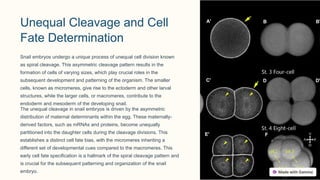
Snail embryos undergo a unique process of unequal cell division known
as spiral cleavage. This asymmetric cleavage pattern results in the
formation of cells of varying sizes, which play crucial roles in the
subsequent development and patterning of the organism. The smaller
cells, known as micromeres, give rise to the ectoderm and other larval
structures, while the larger cells, or macromeres, contribute to the
endoderm and mesoderm of the developing snail.
The unequal cleavage in snail embryos is driven by the asymmetric
distribution of maternal determinants within the egg. These maternally-
derived factors, such as mRNAs and proteins, become unequally
partitioned into the daughter cells during the cleavage divisions. This
establishes a distinct cell fate bias, with the micromeres inheriting a
different set of developmental cues compared to the macromeres. This
early cell fate specification is a hallmark of the spiral cleavage pattern and
is crucial for the subsequent patterning and organization of the snail
embryo.
Role of Cytoskeletal Rearrangements in
Cleavage
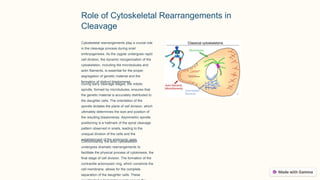
Cytoskeletal rearrangements play a crucial role
in the cleavage process during snail
embryogenesis. As the zygote undergoes rapid
cell division, the dynamic reorganization of the
cytoskeleton, including the microtubules and
actin filaments, is essential for the proper
segregation of genetic material and the
formation of distinct blastomeres.
During early cleavage stages, the mitotic
spindle, formed by microtubules, ensures that
the genetic material is accurately distributed to
the daughter cells. The orientation of the
spindle dictates the plane of cell division, which
ultimately determines the size and position of
the resulting blastomeres. Asymmetric spindle
positioning is a hallmark of the spiral cleavage
pattern observed in snails, leading to the
unequal division of the cells and the
establishment of the embryonic axes.
Concomitantly, the actin cytoskeleton
undergoes dramatic rearrangements to
facilitate the physical process of cytokinesis, the
final stage of cell division. The formation of the
contractile actomyosin ring, which constricts the
cell membrane, allows for the complete
separation of the daughter cells. These
Asymmetric Cell Division and Axis
Formation
Asymmetric Cell
Division
Cleavage in snail
embryos is
characterized by
asymmetric cell
divisions, where the
daughter cells differ
in size and
developmental
potential. This
unequal partitioning
of the cytoplasm and
organelles is crucial
for establishing the
primary body axes
and the diverse cell
lineages that will give
rise to the various
tissues and organs of
Axis Formation
The spiral cleavage
pattern in snails leads
to the formation of the
primary body axes -
the anterior-posterior
(head-foot) axis and
the dorsal-ventral
axis. The unequal cell
divisions and
differential
inheritance of
maternal
determinants result in
the specification of
the dorsal-ventral
axis, while the
animal-vegetal axis
established during
oogenesis is refined
Cytoskeletal
Rearrangements
The asymmetric cell
divisions that
characterize snail
cleavage are driven
by extensive
cytoskeletal
rearrangements. The
orientation and
positioning of the
mitotic spindle, as
well as the
distribution of the
cytokinetic contractile
ring, are precisely
regulated to ensure
the unequal
partitioning of the
cytoplasmic contents
Cell Fate
Determination
The asymmetric
nature of the
cleavage divisions in
snails is closely
linked to the
determination of the
embryonic cell
lineages and their
ultimate
developmental fates.
The unequal
distribution of
maternal
determinants and the
differential activation
of zygotic genes in
the daughter cells
lead to the
Regulation of Cleavage Patterns by
Maternal Factors
Maternal mRNA
and Proteins
The early
embryonic
development of
snails is largely
driven by
maternally-derived
factors stored in the
egg prior to
fertilization. These
maternal mRNAs
and proteins dictate
the initial cleavage
patterns and cell
fate decisions that
lay the foundation
for the developing
embryo. The
unequal distribution
of these maternal
determinants
during cleavage
divisions is a key
Localization of
Maternal
Factors
Specific maternal
mRNAs and
proteins are
asymmetrically
localized within the
unfertilized snail
egg. This polarized
distribution is
essential for
directing the
orientation of the
first cleavage plane
and ensuring the
unequal partitioning
of cytoplasmic
components into
the emerging
blastomeres.
Disruption of this
localization process
can lead to
Cytoskeletal
Rearrangement
s
The cleavage
patterns in snail
embryos are also
regulated by
dynamic
rearrangements of
the cytoskeleton,
which are directed
by maternal factors.
The orientation and
timing of these
cytoskeletal
changes, such as
the formation of the
mitotic spindle and
the positioning of
the cleavage
furrow, are crucial
for establishing the
characteristic spiral
cleavage program
Cell Cycle
Regulators
Maternal proteins
involved in cell
cycle regulation,
such as cyclin and
cyclin-dependent
kinase complexes,
play a vital role in
coordinating the
rapid and
synchronized
cleavage divisions
that occur in the
early snail embryo.
The differential
expression and
activity of these cell
cycle regulators
contribute to the
unequal size and
fate of the resulting
blastomeres during
the spiralian
Evolutionary Significance of Cleavage
Modes in Snails
1
Developmental Plasticity
Diverse cleavage patterns allow snails to adapt to a variety of
environmental conditions and ecological niches.
2
Cell Fate Determination
Unequal cleavage divisions establish distinct cell
lineages with specialized functions early in
development.
3
Evolutionary Innovations
Novel cleavage modes may have facilitated
major evolutionary transitions, such as the
emergence of spiral-cleaving molluscs.
The diverse cleavage modes observed in snail embryos have profound evolutionary significance. Spiral
cleavage, in particular, is a hallmark of many molluscan lineages and is thought to have conferred
significant developmental advantages. By establishing distinct cell fates and embryonic axes early on,
spiral cleavage patterns allow for a high degree of developmental plasticity, enabling snails to adapt to a
wide range of environmental conditions and ecological niches.
Moreover, the unequal cell divisions characteristic of spiral cleavage play a crucial role in cell fate
determination, ensuring that specialized cell types and tissues are properly established during
Implications of Cleavage Research in
Developmental Biology
1 1. Understanding Early
Embryonic Patterning
The study of cleavage patterns in snail
embryos has provided invaluable insights
into the fundamental mechanisms of early
embryonic patterning and cell fate
determination. By elucidating the spiral
cleavage patterns and the unequal
division of cells during cleavage,
researchers have gained a deeper
understanding of how the body plan and
axis formation are established in these
organisms. This knowledge can be
applied to other species, including
vertebrates, to uncover universal
principles of embryonic development.
2 2. Comparative Developmental
Biology
Cleavage research in snails has also
contributed to the field of comparative
developmental biology. By examining the
variations in cleavage patterns across
different species of snails, scientists can
identify the evolutionary adaptations and
developmental strategies that have
emerged in response to diverse
environmental and ecological pressures.
This comparative approach helps to
reveal the conserved and divergent
mechanisms that underlie embryonic
development, providing a broader
perspective on the evolutionary history of
life.
3 3. Stem Cell and Regeneration
Studies
The remarkable ability of some snail
species to regenerate lost body parts has
sparked interest in understanding the
cellular and molecular mechanisms that
govern this process. Cleavage research in
snails has the potential to shed light on
4 4. Model Organism for
Developmental Biology
Snails, particularly the marine gastropod
Ilyanassa, have emerged as valuable
model organisms in developmental
biology. Their relatively simple body plan,
well-characterized cleavage patterns, and
amenability to experimental manipulation

Introduction-to-Cleavage-in-Snail-Development (2).pptx

  • 1.
    Introduction to Cleavage inSnail Development The cleavage process is a critical early stage in the development of snails, where the single-celled zygote divides and forms a multicellular embryo. This intricate process involves a series of cell divisions that establish the organization and body plan of the future snail. Understanding the mechanisms underlying cleavage in snails provides valuable insights into the fundamental principles of embryogenesis and the evolution of molluscan body plans. Through a detailed examination of this captivating process, we can unravel the complexities of snail development and gain a deeper appreciation for the remarkable adaptations and diversity found within the mollusk phylum. by mich
  • 2.
    Importance of Cleavagein Snail Embryogenesis Cell Lineage Determination Cleavage is the initial stage of embryonic development in snails, where a single fertilized egg divides into multiple cells. This process is crucial for establishing the cell lineages that will ultimately give rise to the different tissues and organs of the adult snail. The highly stereotyped and asymmetric cleavage patterns observed in snails are thought to play a key role in the specification of cell fates, ensuring that each cell is programmed to Axis Patterning The cleavage patterns in snail embryos also contribute to the establishment of the primary body axes, such as the anterior-posterior and dorsal-ventral axes. The unequal division of cells and the positioning of the micromeres (smaller cells) and macromeres (larger cells) during cleavage provide spatial cues that help to orient the developing embryo and guide the formation of the major body plan. Embryonic Patterning Cleavage events in snail embryos are closely linked to the deployment of maternal determinants and the initiation of zygotic gene expression. The precise timing and positioning of the cleavage furrows allow for the unequal distribution of these key developmental regulators, which in turn influence the subsequent patterning of the embryo and the establishment of its overall organization.
  • 3.
    Stages of Cleavagein Snail Embryos The cleavage process in snail embryos involves a series of successive cell divisions that transform the single-celled zygote into a multicellular embryo. This process is tightly regulated and follows a characteristic pattern known as spiral cleavage. In the initial stage, the zygote undergoes a meridional (vertical) cleavage, dividing it into two equal-sized blastomeres. The second cleavage is typically latitudinal (horizontal), resulting in four blastomeres arranged in a flat plane. As the cleavage continues, the blastomeres become smaller and more numerous, forming a spiral pattern. This spiral arrangement is a hallmark of molluscan embryogenesis and is thought to be important for the establishment of the animal's body plan. During the later stages of cleavage, the blastomeres exhibit an unequal division pattern, with some cells being larger than others. This asymmetric division is crucial for the determination of cell fate and the specification of different cell lineages within the developing embryo. The precise timing and orientation of these cell divisions are regulated by a complex interplay of cytoskeletal rearrangements, cell-cell interactions, and maternal factors.
  • 4.
    Spiral Cleavage Patternin Snails 1 Unequal Cell Division The spiral cleavage pattern in snail embryos is characterized by a series of unequal cell divisions, where the cells divide asymmetrically. This results in the formation of cells of different sizes, with the smaller cells being the micromeres and the larger ones being the macromeres. This unequal division is crucial for the establishment of the body plan and the differentiation of various tissues and organs in the developing snail embryo. 2 Rotational Cleavage During spiral cleavage, the mitotic spindles of the dividing cells are oriented at an oblique angle to the primary embryonic axis. This causes the daughter cells to rotate relative to each other, giving the embryo a distinctive spiral appearance. This rotational cleavage pattern is a key feature of spiral cleavage and is observed in many marine invertebrates, including snails, annelids, and some mollusks. 3 Dorsoventral Axis Formation The spiral cleavage pattern in snails also plays a crucial role in the establishment of the dorsoventral axis of the embryo. The unequal division of the cells and their subsequent arrangement in a spiral pattern helps to establish the overall body plan and the positioning of the various organs and structures within the developing snail embryo. This is an essential process in the early stages of snail
  • 5.
    Unequal Cleavage andCell Fate Determination Snail embryos undergo a unique process of unequal cell division known as spiral cleavage. This asymmetric cleavage pattern results in the formation of cells of varying sizes, which play crucial roles in the subsequent development and patterning of the organism. The smaller cells, known as micromeres, give rise to the ectoderm and other larval structures, while the larger cells, or macromeres, contribute to the endoderm and mesoderm of the developing snail. The unequal cleavage in snail embryos is driven by the asymmetric distribution of maternal determinants within the egg. These maternally- derived factors, such as mRNAs and proteins, become unequally partitioned into the daughter cells during the cleavage divisions. This establishes a distinct cell fate bias, with the micromeres inheriting a different set of developmental cues compared to the macromeres. This early cell fate specification is a hallmark of the spiral cleavage pattern and is crucial for the subsequent patterning and organization of the snail embryo.
  • 6.
    Role of CytoskeletalRearrangements in Cleavage Cytoskeletal rearrangements play a crucial role in the cleavage process during snail embryogenesis. As the zygote undergoes rapid cell division, the dynamic reorganization of the cytoskeleton, including the microtubules and actin filaments, is essential for the proper segregation of genetic material and the formation of distinct blastomeres. During early cleavage stages, the mitotic spindle, formed by microtubules, ensures that the genetic material is accurately distributed to the daughter cells. The orientation of the spindle dictates the plane of cell division, which ultimately determines the size and position of the resulting blastomeres. Asymmetric spindle positioning is a hallmark of the spiral cleavage pattern observed in snails, leading to the unequal division of the cells and the establishment of the embryonic axes. Concomitantly, the actin cytoskeleton undergoes dramatic rearrangements to facilitate the physical process of cytokinesis, the final stage of cell division. The formation of the contractile actomyosin ring, which constricts the cell membrane, allows for the complete separation of the daughter cells. These
  • 7.
    Asymmetric Cell Divisionand Axis Formation Asymmetric Cell Division Cleavage in snail embryos is characterized by asymmetric cell divisions, where the daughter cells differ in size and developmental potential. This unequal partitioning of the cytoplasm and organelles is crucial for establishing the primary body axes and the diverse cell lineages that will give rise to the various tissues and organs of Axis Formation The spiral cleavage pattern in snails leads to the formation of the primary body axes - the anterior-posterior (head-foot) axis and the dorsal-ventral axis. The unequal cell divisions and differential inheritance of maternal determinants result in the specification of the dorsal-ventral axis, while the animal-vegetal axis established during oogenesis is refined Cytoskeletal Rearrangements The asymmetric cell divisions that characterize snail cleavage are driven by extensive cytoskeletal rearrangements. The orientation and positioning of the mitotic spindle, as well as the distribution of the cytokinetic contractile ring, are precisely regulated to ensure the unequal partitioning of the cytoplasmic contents Cell Fate Determination The asymmetric nature of the cleavage divisions in snails is closely linked to the determination of the embryonic cell lineages and their ultimate developmental fates. The unequal distribution of maternal determinants and the differential activation of zygotic genes in the daughter cells lead to the
  • 8.
    Regulation of CleavagePatterns by Maternal Factors Maternal mRNA and Proteins The early embryonic development of snails is largely driven by maternally-derived factors stored in the egg prior to fertilization. These maternal mRNAs and proteins dictate the initial cleavage patterns and cell fate decisions that lay the foundation for the developing embryo. The unequal distribution of these maternal determinants during cleavage divisions is a key Localization of Maternal Factors Specific maternal mRNAs and proteins are asymmetrically localized within the unfertilized snail egg. This polarized distribution is essential for directing the orientation of the first cleavage plane and ensuring the unequal partitioning of cytoplasmic components into the emerging blastomeres. Disruption of this localization process can lead to Cytoskeletal Rearrangement s The cleavage patterns in snail embryos are also regulated by dynamic rearrangements of the cytoskeleton, which are directed by maternal factors. The orientation and timing of these cytoskeletal changes, such as the formation of the mitotic spindle and the positioning of the cleavage furrow, are crucial for establishing the characteristic spiral cleavage program Cell Cycle Regulators Maternal proteins involved in cell cycle regulation, such as cyclin and cyclin-dependent kinase complexes, play a vital role in coordinating the rapid and synchronized cleavage divisions that occur in the early snail embryo. The differential expression and activity of these cell cycle regulators contribute to the unequal size and fate of the resulting blastomeres during the spiralian
  • 9.
    Evolutionary Significance ofCleavage Modes in Snails 1 Developmental Plasticity Diverse cleavage patterns allow snails to adapt to a variety of environmental conditions and ecological niches. 2 Cell Fate Determination Unequal cleavage divisions establish distinct cell lineages with specialized functions early in development. 3 Evolutionary Innovations Novel cleavage modes may have facilitated major evolutionary transitions, such as the emergence of spiral-cleaving molluscs. The diverse cleavage modes observed in snail embryos have profound evolutionary significance. Spiral cleavage, in particular, is a hallmark of many molluscan lineages and is thought to have conferred significant developmental advantages. By establishing distinct cell fates and embryonic axes early on, spiral cleavage patterns allow for a high degree of developmental plasticity, enabling snails to adapt to a wide range of environmental conditions and ecological niches. Moreover, the unequal cell divisions characteristic of spiral cleavage play a crucial role in cell fate determination, ensuring that specialized cell types and tissues are properly established during
  • 10.
    Implications of CleavageResearch in Developmental Biology 1 1. Understanding Early Embryonic Patterning The study of cleavage patterns in snail embryos has provided invaluable insights into the fundamental mechanisms of early embryonic patterning and cell fate determination. By elucidating the spiral cleavage patterns and the unequal division of cells during cleavage, researchers have gained a deeper understanding of how the body plan and axis formation are established in these organisms. This knowledge can be applied to other species, including vertebrates, to uncover universal principles of embryonic development. 2 2. Comparative Developmental Biology Cleavage research in snails has also contributed to the field of comparative developmental biology. By examining the variations in cleavage patterns across different species of snails, scientists can identify the evolutionary adaptations and developmental strategies that have emerged in response to diverse environmental and ecological pressures. This comparative approach helps to reveal the conserved and divergent mechanisms that underlie embryonic development, providing a broader perspective on the evolutionary history of life. 3 3. Stem Cell and Regeneration Studies The remarkable ability of some snail species to regenerate lost body parts has sparked interest in understanding the cellular and molecular mechanisms that govern this process. Cleavage research in snails has the potential to shed light on 4 4. Model Organism for Developmental Biology Snails, particularly the marine gastropod Ilyanassa, have emerged as valuable model organisms in developmental biology. Their relatively simple body plan, well-characterized cleavage patterns, and amenability to experimental manipulation