ACOELOMATE
Lacking a
 fluid filled
 body cavity


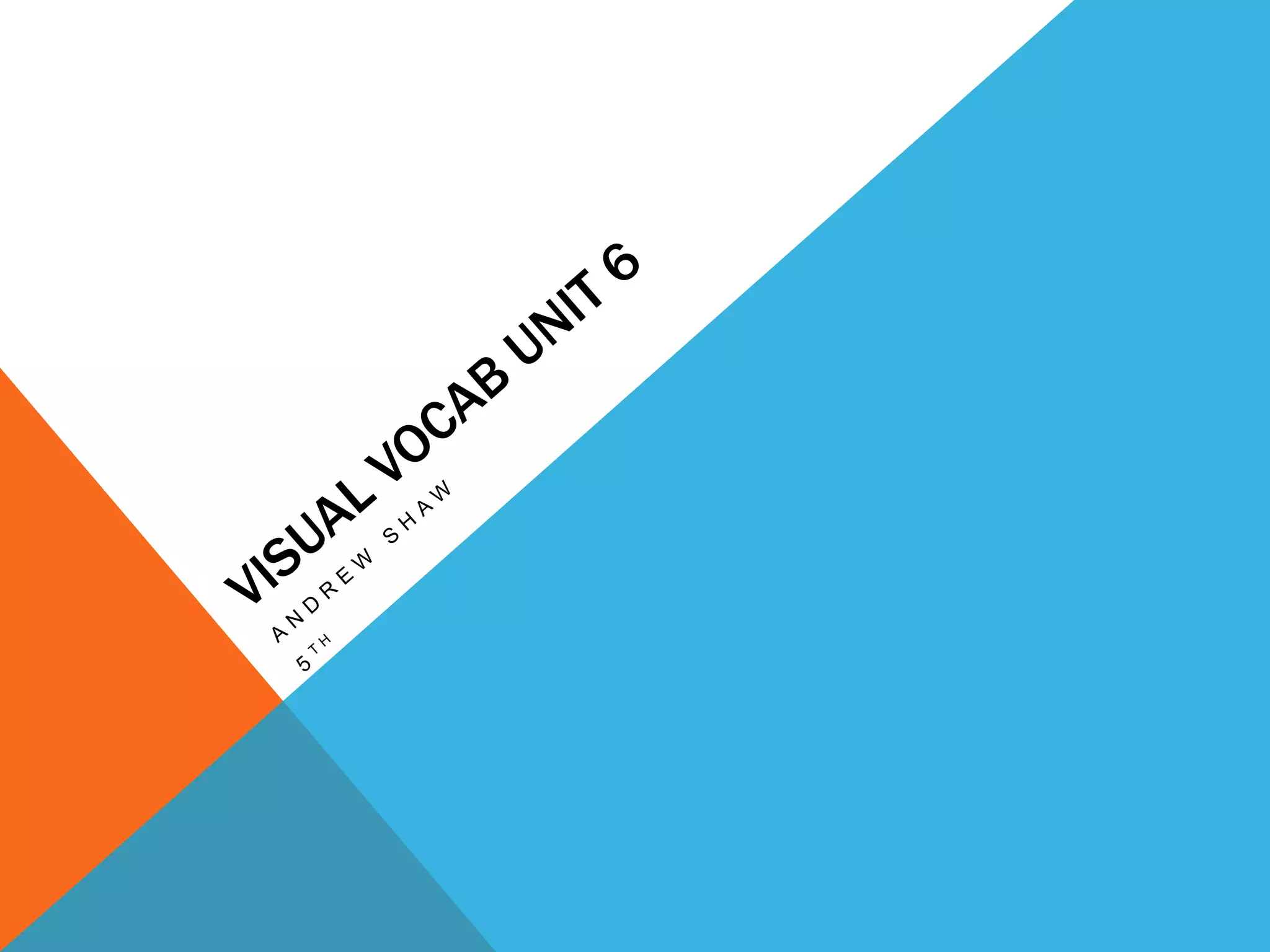
                Organisms showing
                  acoelomate formation
                  include the platyhelminthes
                  (flatworms, tapeworms etc.),
                  the cnidarians (jellyfish and
                  allies), and the ctenophores
                  (comb jellies)
BILATERAL SYMMETRY
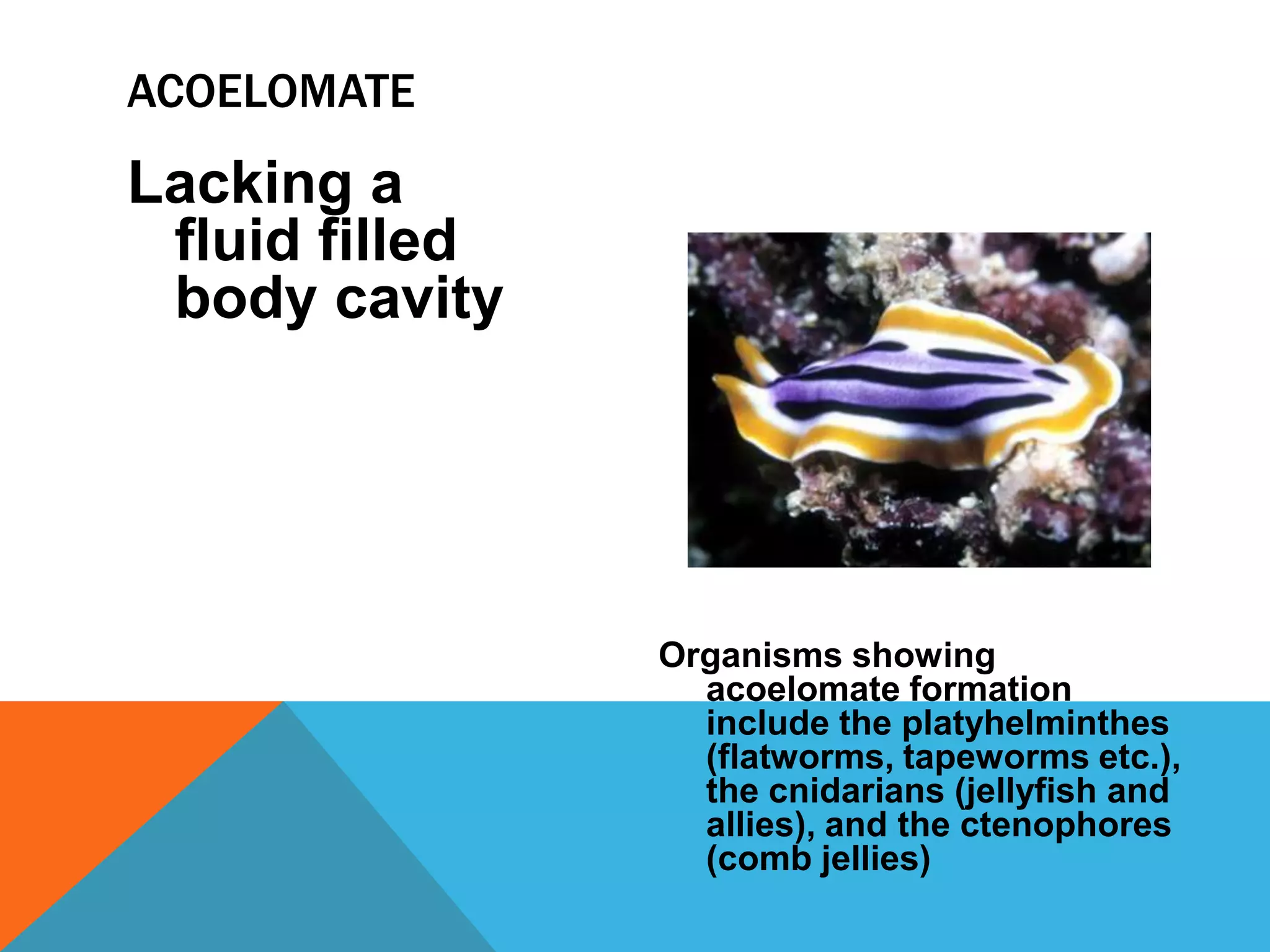
n bilateral
  symmetry (also
  called plane
  symmetry), only
  one plane, called
  the sagittal
  plane, will divide
  an organism into
  roughly mirror
  image halves
BLASTOPORE

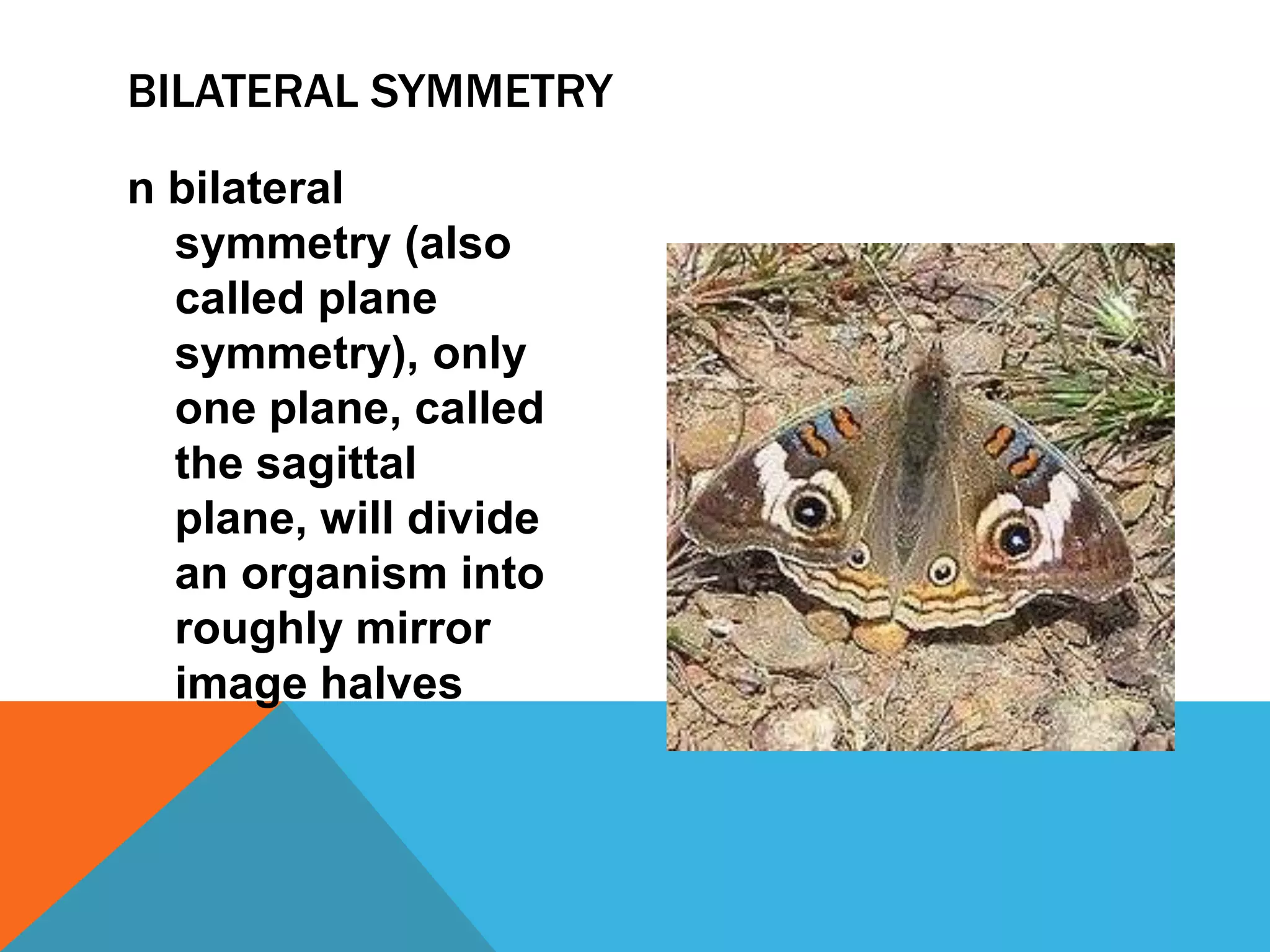
an opening into
  the
  archenteron
  during the
  embryonic
  stages of an
  organism.
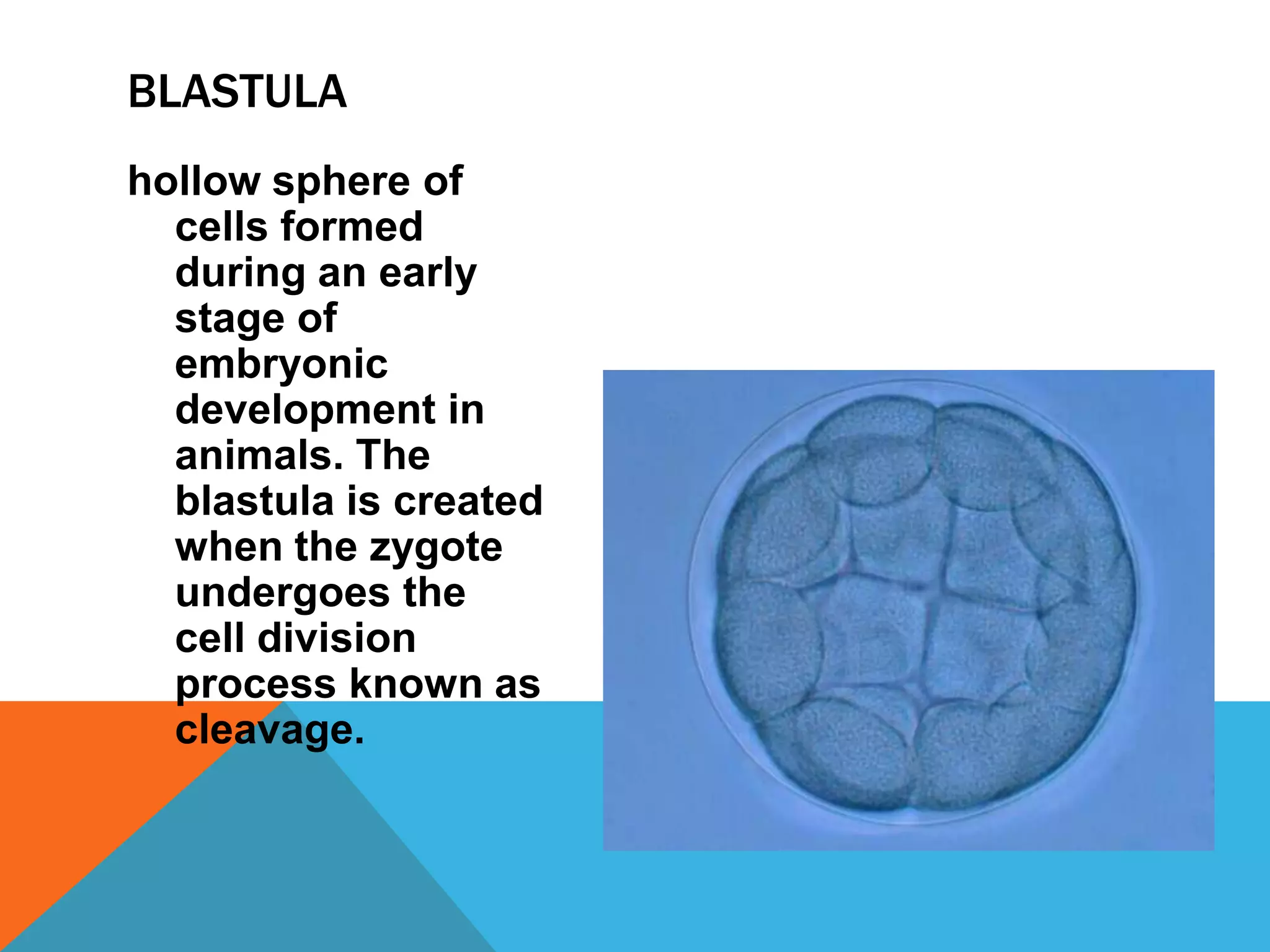
BLASTULA
hollow sphere of
  cells formed
  during an early
  stage of
  embryonic
  development in
  animals. The
  blastula is created
  when the zygote
  undergoes the
  cell division
  process known as
  cleavage.
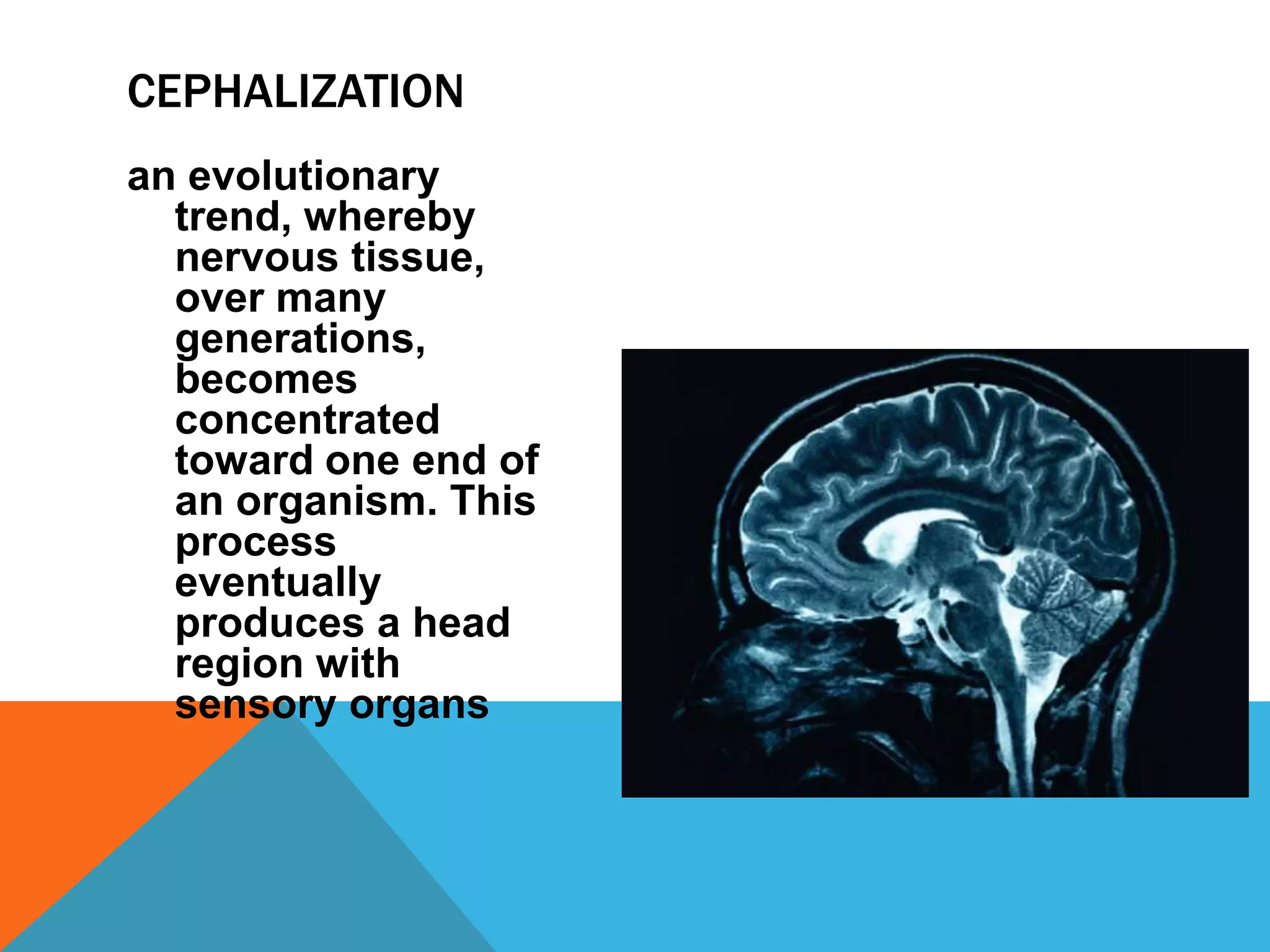
CEPHALIZATION
an evolutionary
  trend, whereby
  nervous tissue,
  over many
  generations,
  becomes
  concentrated
  toward one end of
  an organism. This
  process
  eventually
  produces a head
  region with
  sensory organs
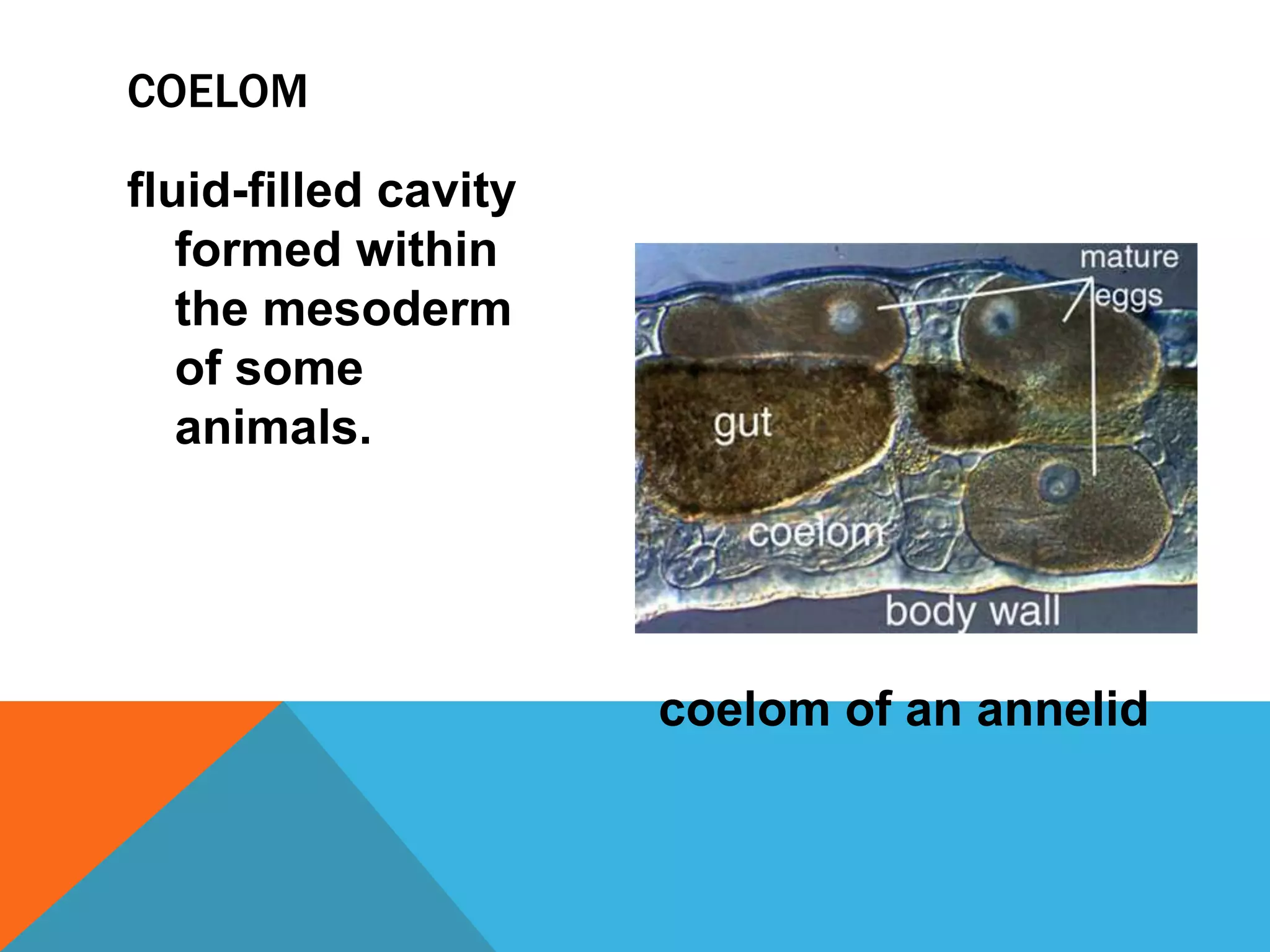
COELOM

fluid-filled cavity
   formed within
   the mesoderm
   of some
   animals.


                      coelom of an annelid
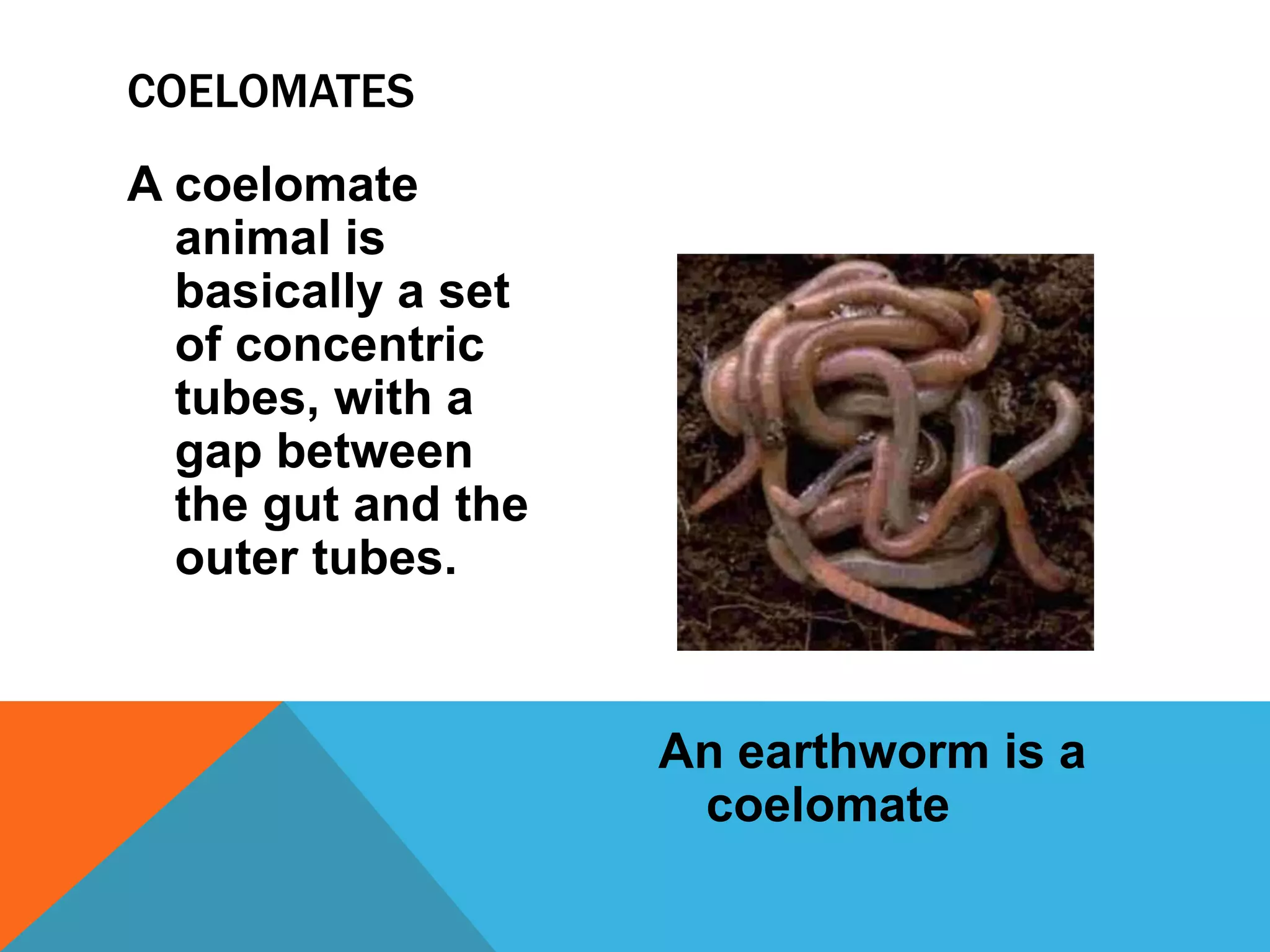
COELOMATES
A coelomate
  animal is
  basically a set
  of concentric
  tubes, with a
  gap between
  the gut and the
  outer tubes.


                    An earthworm is a
                     coelomate
DETERMINATE CLEAVAGE
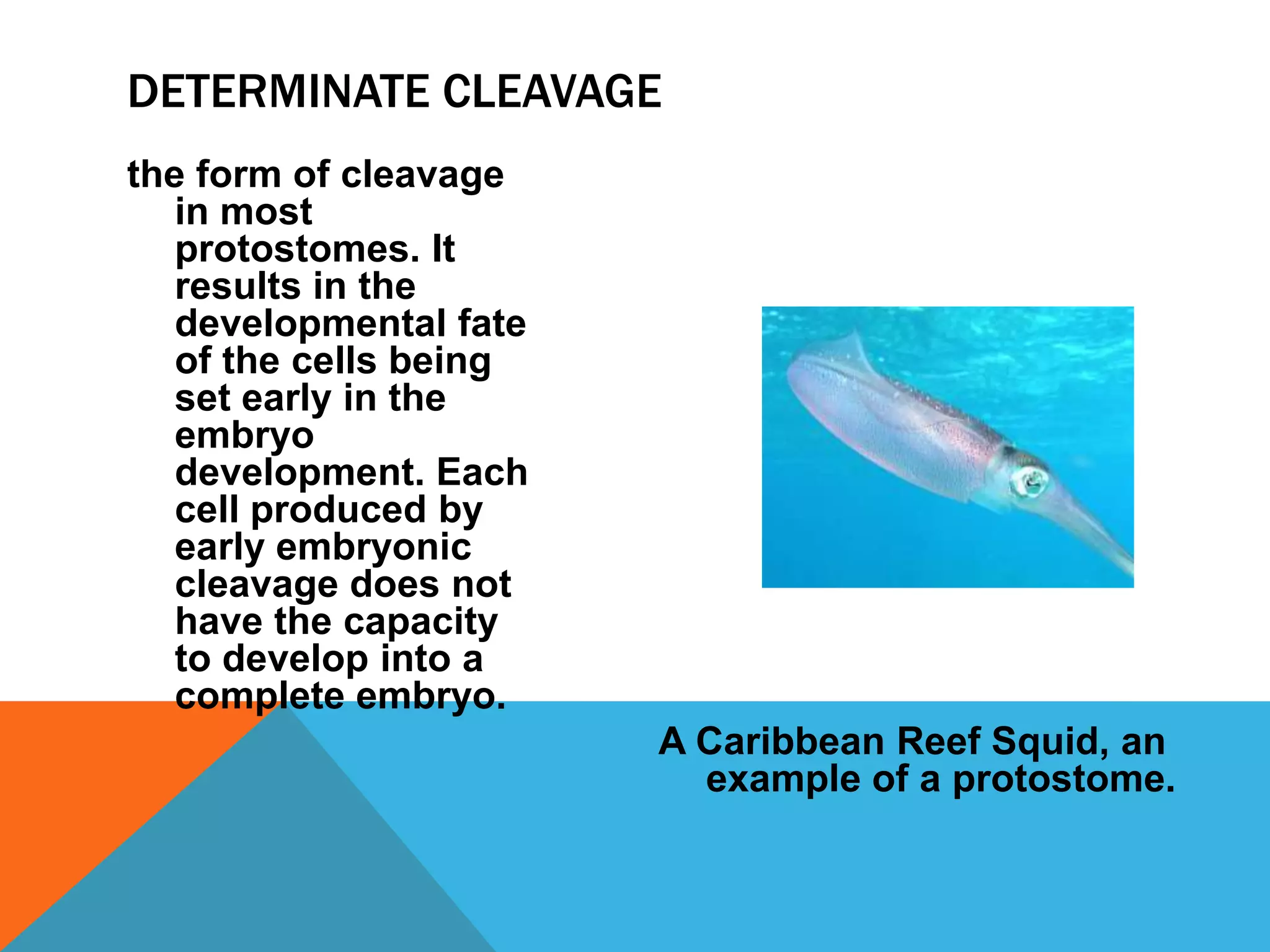
the form of cleavage
   in most
   protostomes. It
   results in the
   developmental fate
   of the cells being
   set early in the
   embryo
   development. Each
   cell produced by
   early embryonic
   cleavage does not
   have the capacity
   to develop into a
   complete embryo.
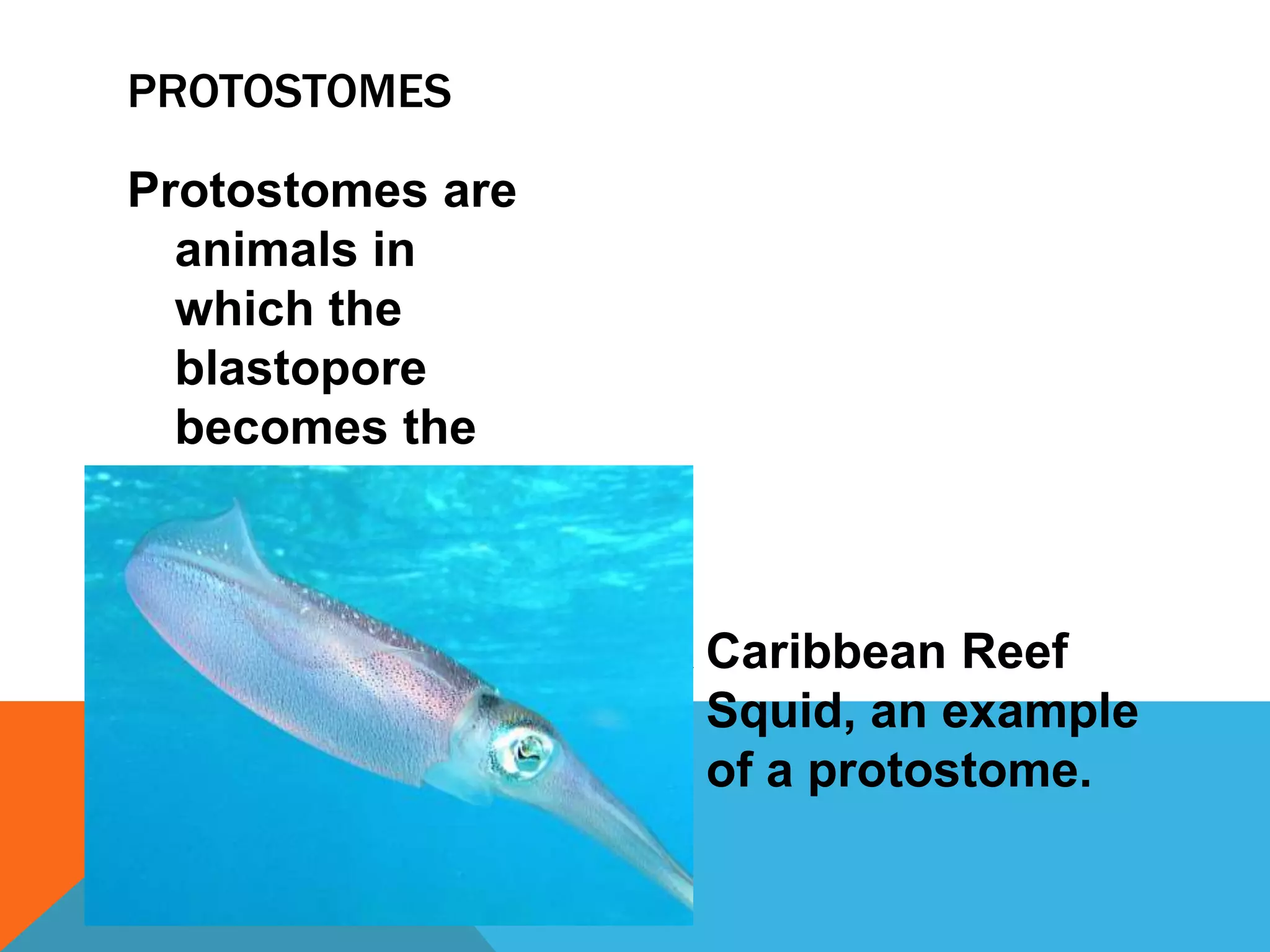
                        A Caribbean Reef Squid, an
                          example of a protostome.
DEUTEROSTOMES
Deuterostomes
 are
 distinguished
 by their
 embryonic
 development;
 in
 deuterostomes,
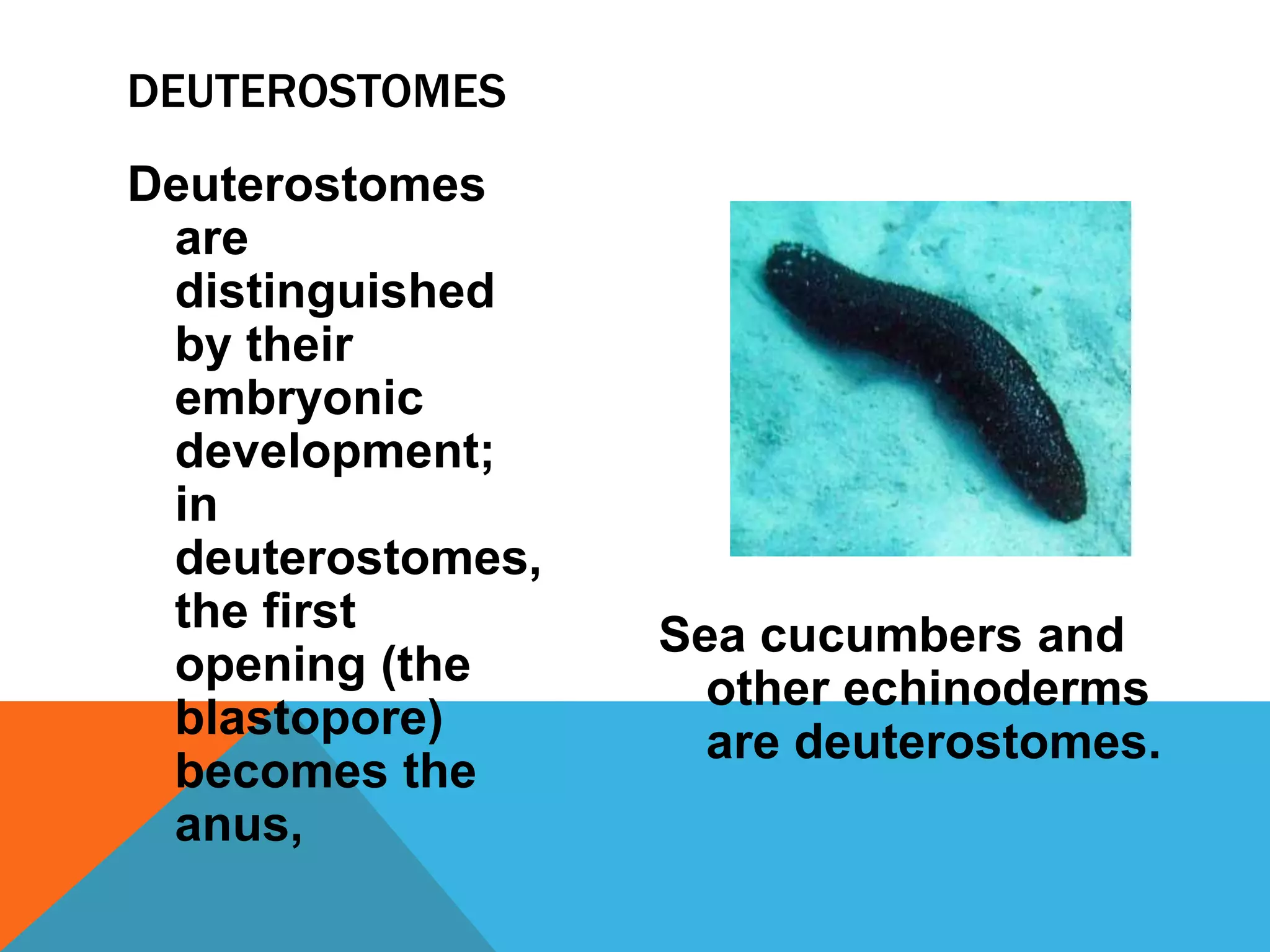
 the first        Sea cucumbers and
 opening (the       other echinoderms
 blastopore)        are deuterostomes.
 becomes the
 anus,
DIPLOBLASTIC

Pertaining to a
  condition in
  which there are
  two primary
  germ layers,
  such as
  ectoderm and
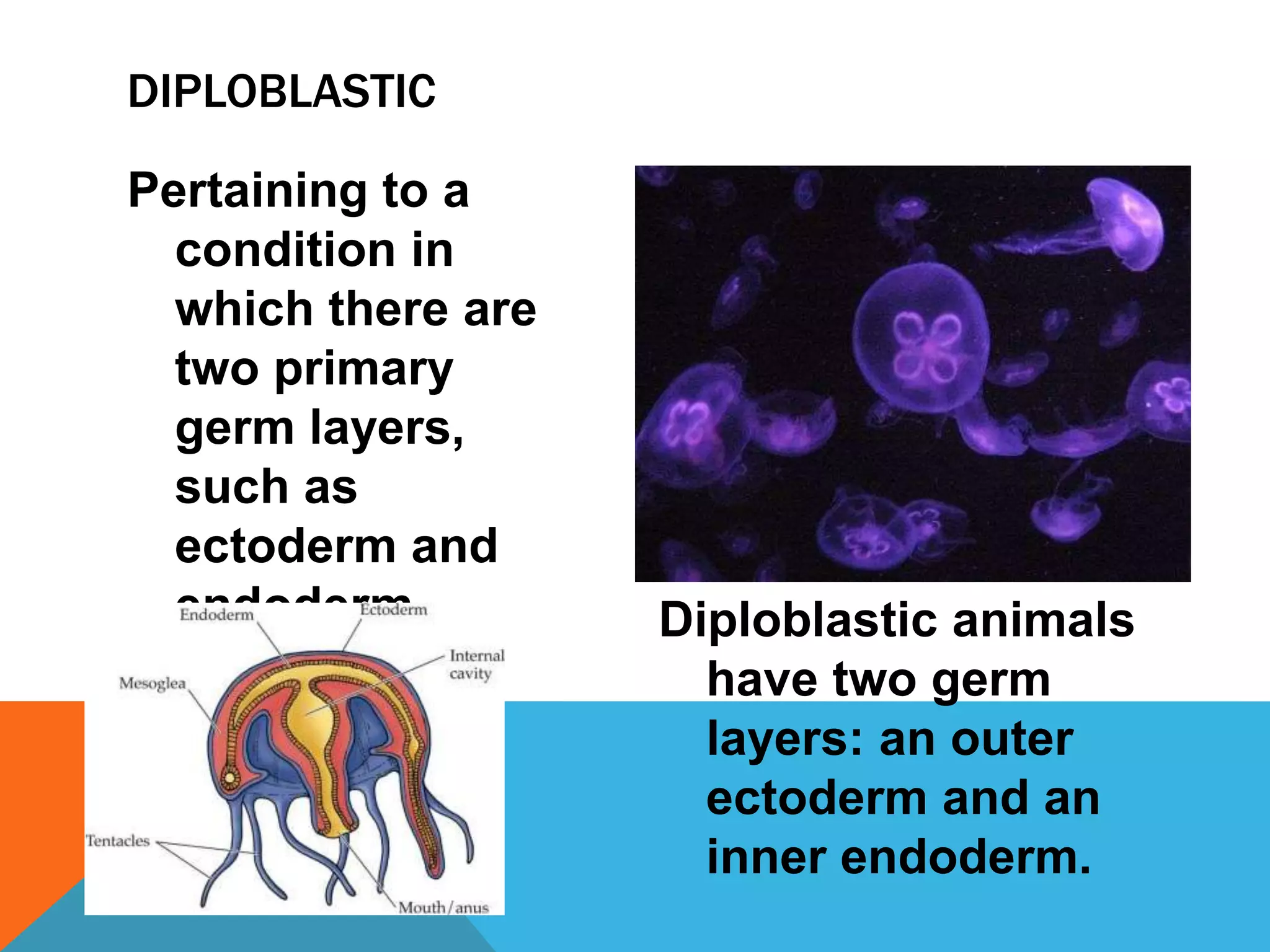
  endoderm.         Diploblastic animals
                      have two germ
                      layers: an outer
                      ectoderm and an
                      inner endoderm.
ECTODERM

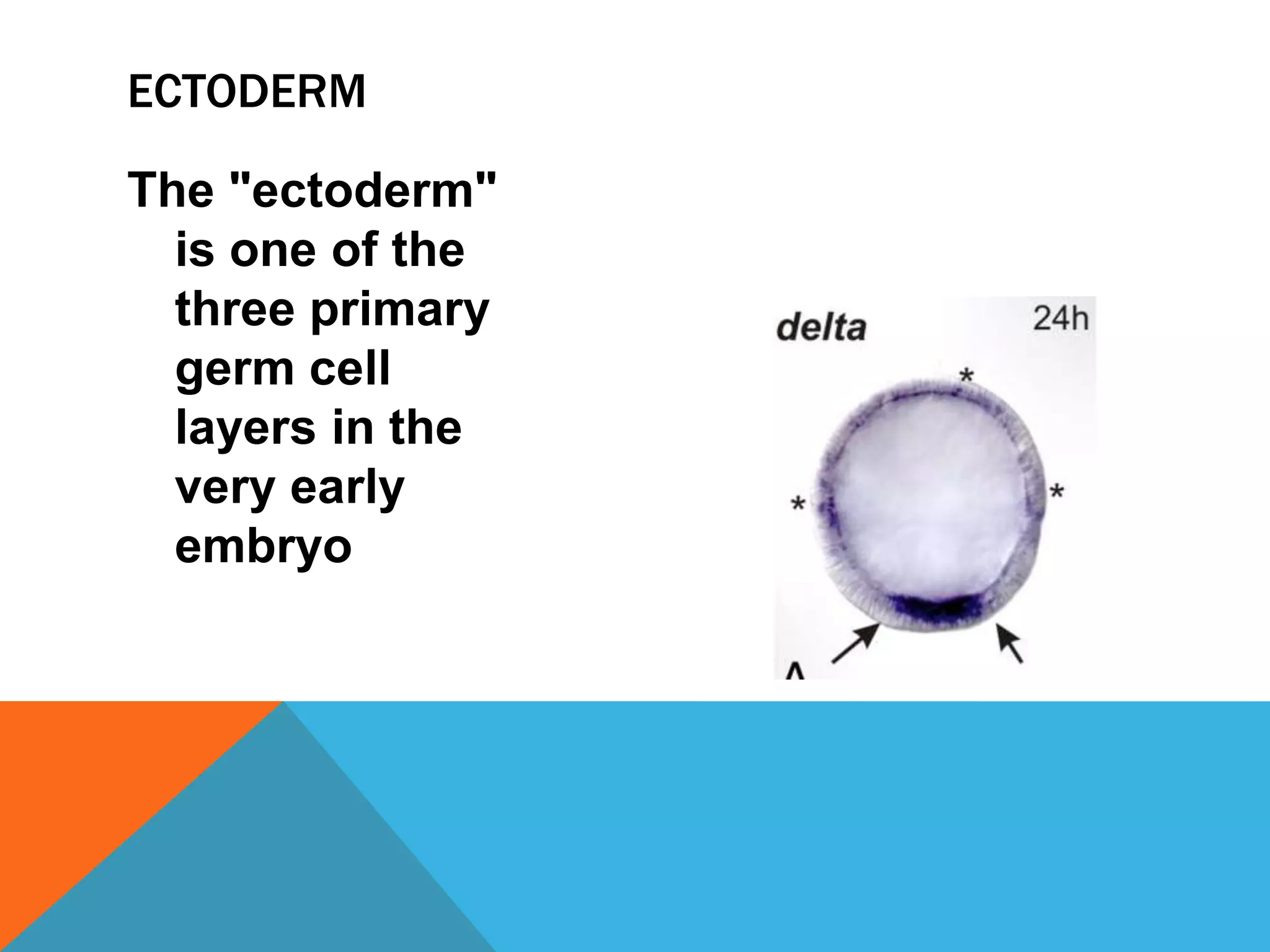
The "ectoderm"
  is one of the
  three primary
  germ cell
  layers in the
  very early
  embryo
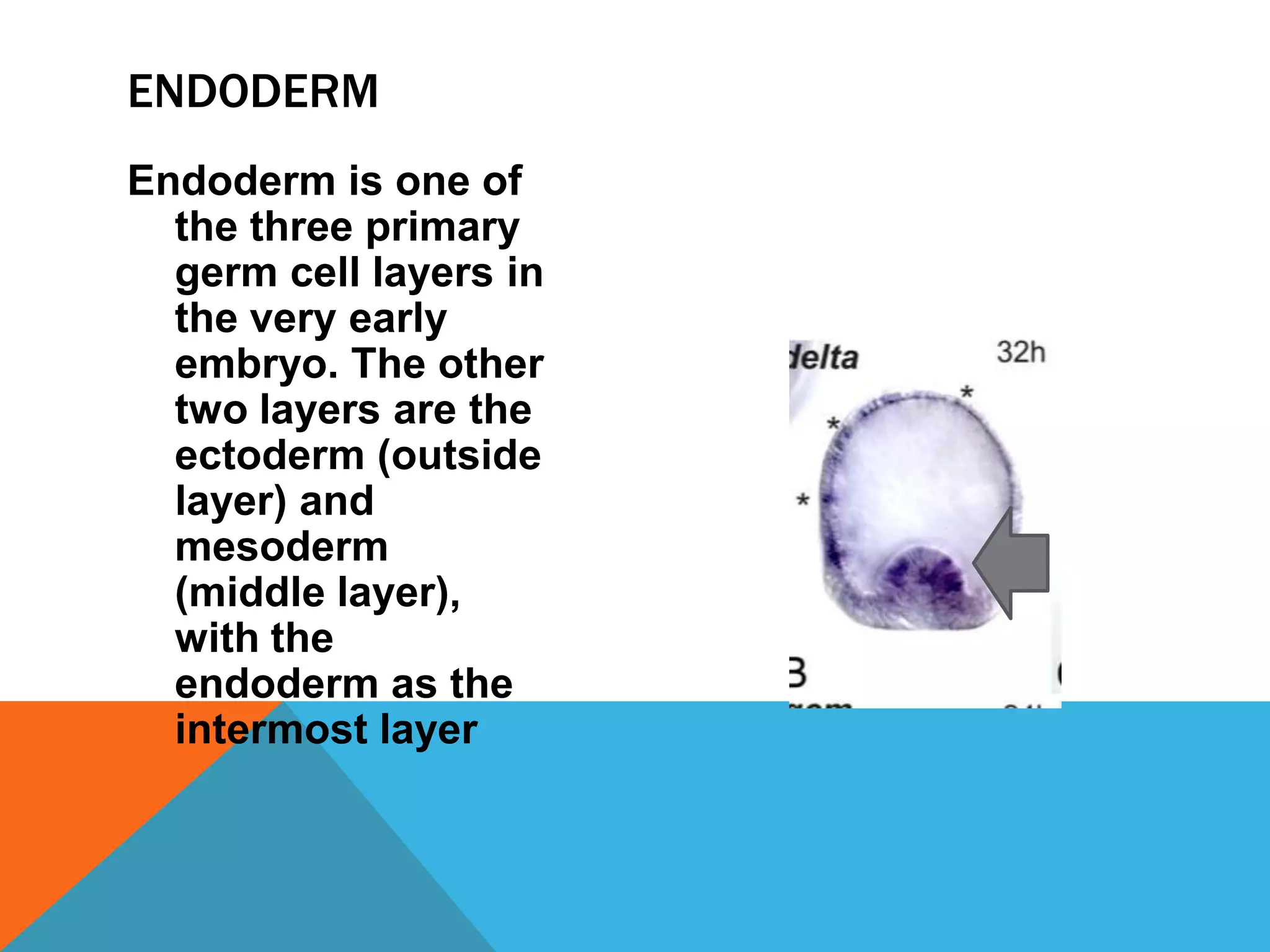
ENDODERM
Endoderm is one of
  the three primary
  germ cell layers in
  the very early
  embryo. The other
  two layers are the
  ectoderm (outside
  layer) and
  mesoderm
  (middle layer),
  with the
  endoderm as the
  intermost layer
EUMETAZOAN

a clade comprising all
  major animal groups
  except sponges


                         Anything but sponges
                          are eumetazoan
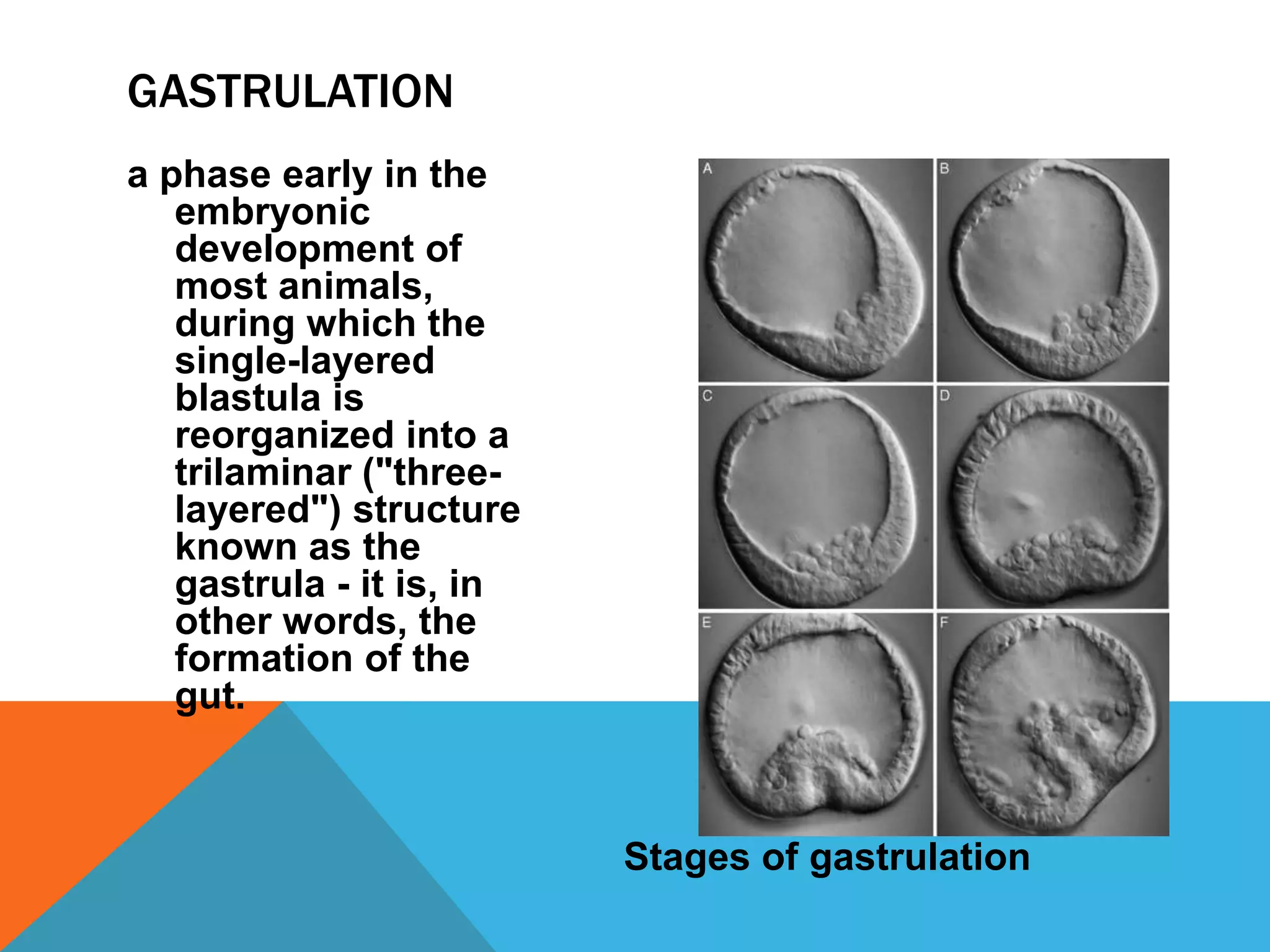
GASTRULATION
a phase early in the
   embryonic
   development of
   most animals,
   during which the
   single-layered
   blastula is
   reorganized into a
   trilaminar ("three-
   layered") structure
   known as the
   gastrula - it is, in
   other words, the
   formation of the
   gut.


                          Stages of gastrulation
GERM LAYERS
a group of cells,
  formed during
  animal
  embryogenesis


      Germ layers are particularly
       pronounced in the vertebrates;
       however, all animals more complex
       than sponges (eumetazoans and
       agnotozoans) produce two or three
       primary tissue layers
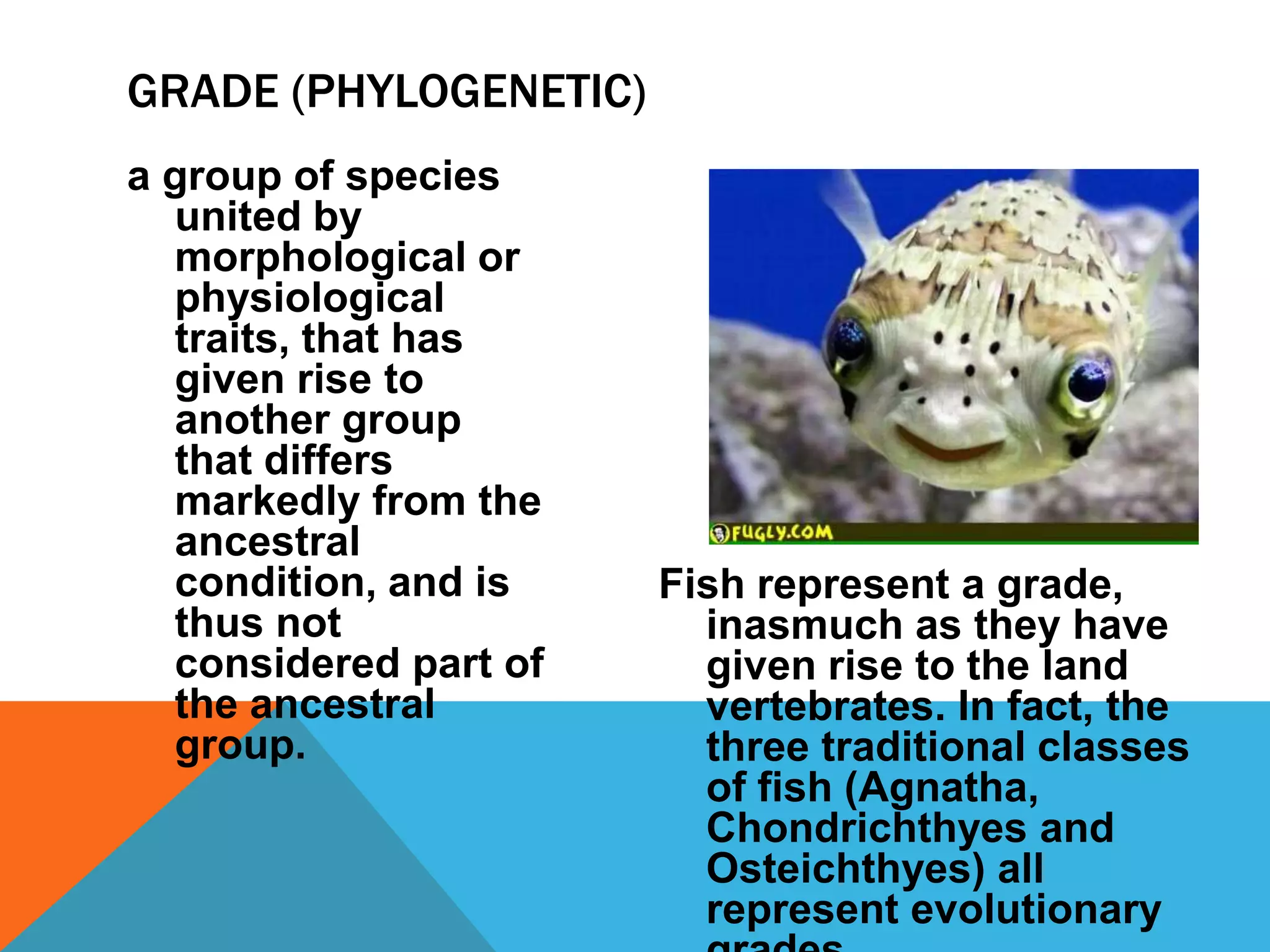
GRADE (PHYLOGENETIC)
a group of species
  united by
  morphological or
  physiological
  traits, that has
  given rise to
  another group
  that differs
  markedly from the
  ancestral
  condition, and is    Fish represent a grade,
  thus not               inasmuch as they have
  considered part of     given rise to the land
  the ancestral          vertebrates. In fact, the
  group.                 three traditional classes
                         of fish (Agnatha,
                         Chondrichthyes and
                         Osteichthyes) all
                         represent evolutionary
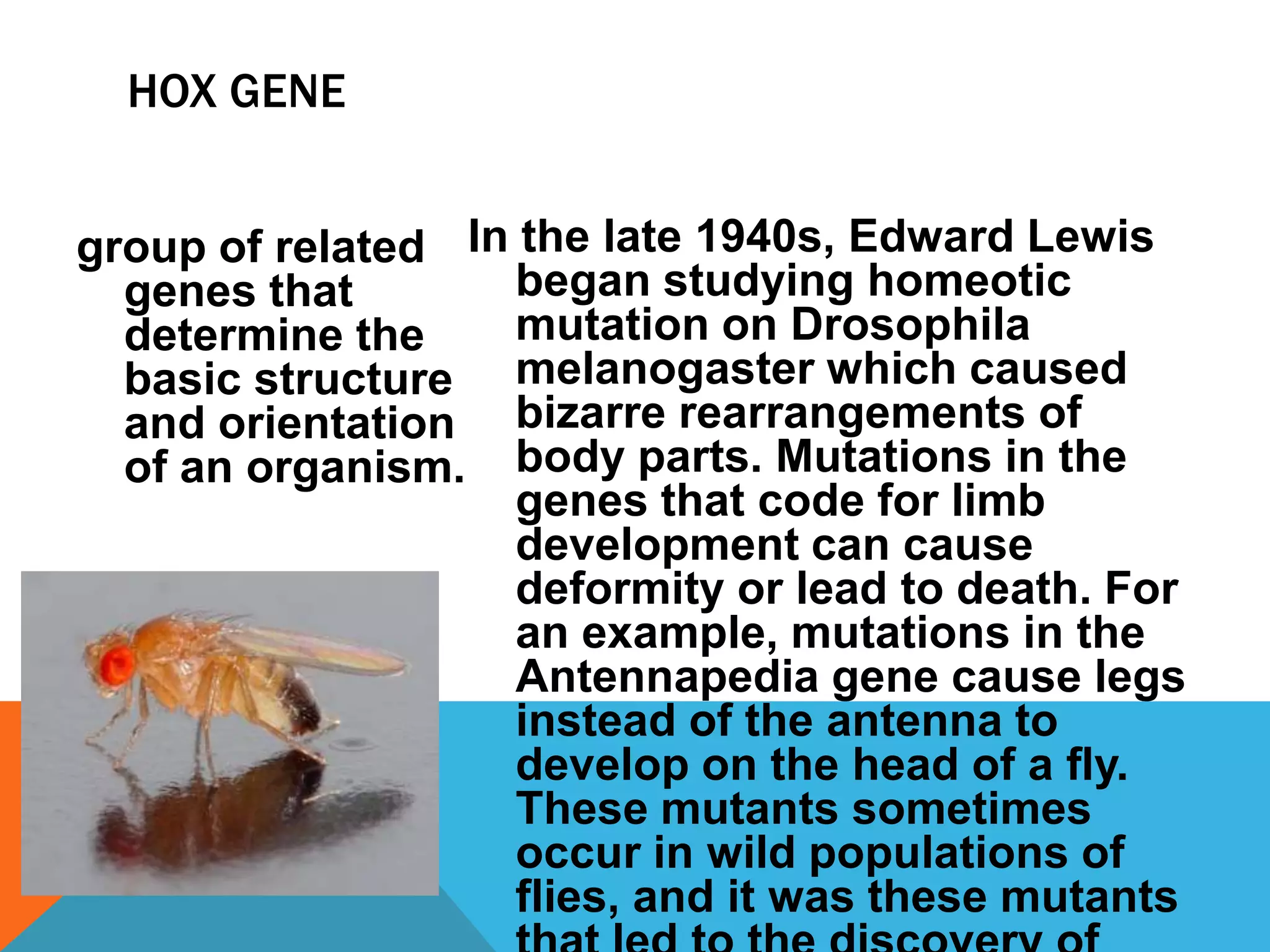
HOX GENE


group of related In the late 1940s, Edward Lewis
  genes that        began studying homeotic
  determine the     mutation on Drosophila
  basic structure melanogaster which caused
  and orientation bizarre rearrangements of
  of an organism. body parts. Mutations in the
                    genes that code for limb
                    development can cause
                    deformity or lead to death. For
                    an example, mutations in the
                    Antennapedia gene cause legs
                    instead of the antenna to
                    develop on the head of a fly.
                    These mutants sometimes
                    occur in wild populations of
                    flies, and it was these mutants
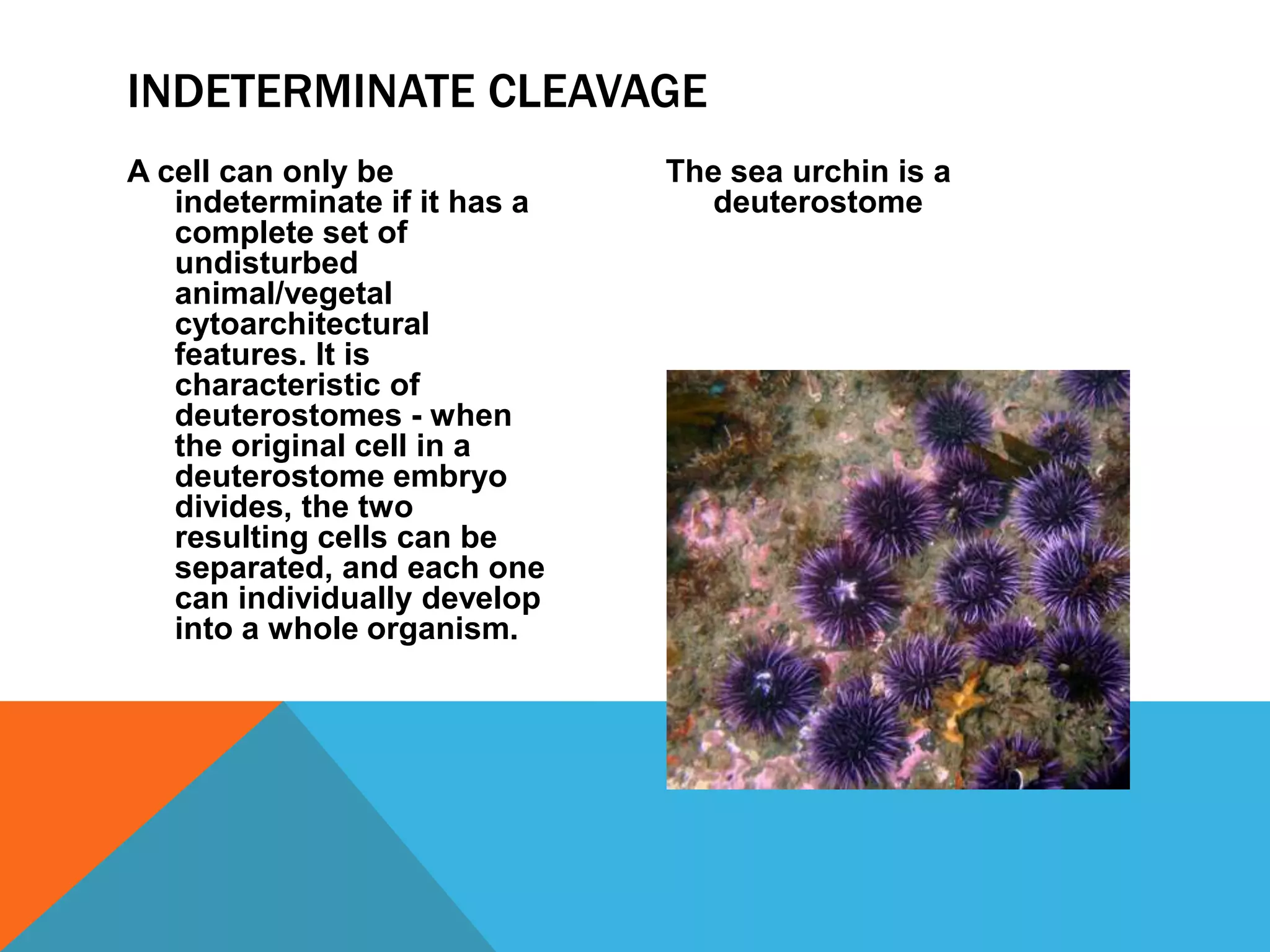
INDETERMINATE CLEAVAGE
A cell can only be             The sea urchin is a
   indeterminate if it has a     deuterostome
   complete set of
   undisturbed
   animal/vegetal
   cytoarchitectural
   features. It is
   characteristic of
   deuterostomes - when
   the original cell in a
   deuterostome embryo
   divides, the two
   resulting cells can be
   separated, and each one
   can individually develop
   into a whole organism.
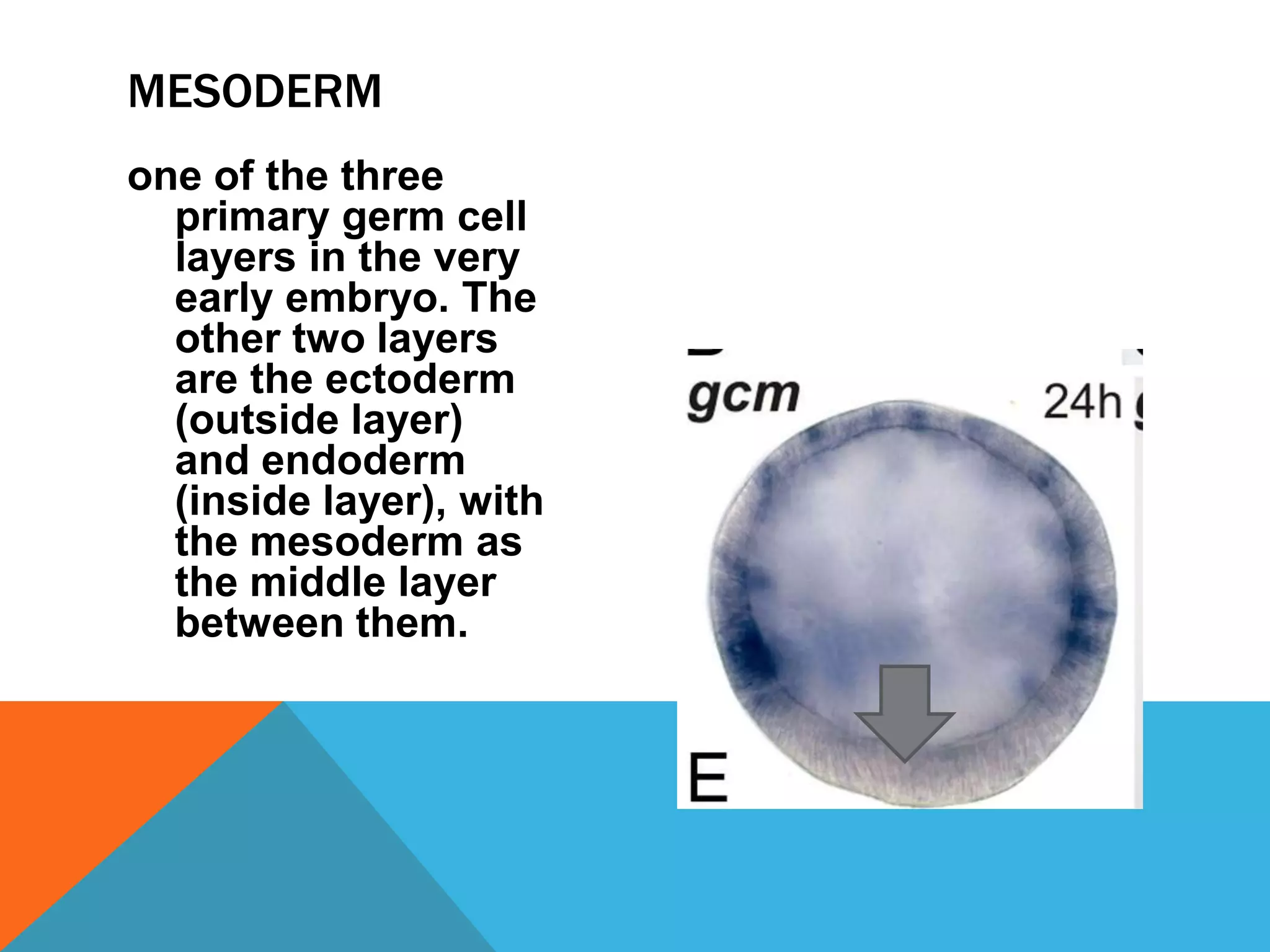
MESODERM
one of the three
  primary germ cell
  layers in the very
  early embryo. The
  other two layers
  are the ectoderm
  (outside layer)
  and endoderm
  (inside layer), with
  the mesoderm as
  the middle layer
  between them.
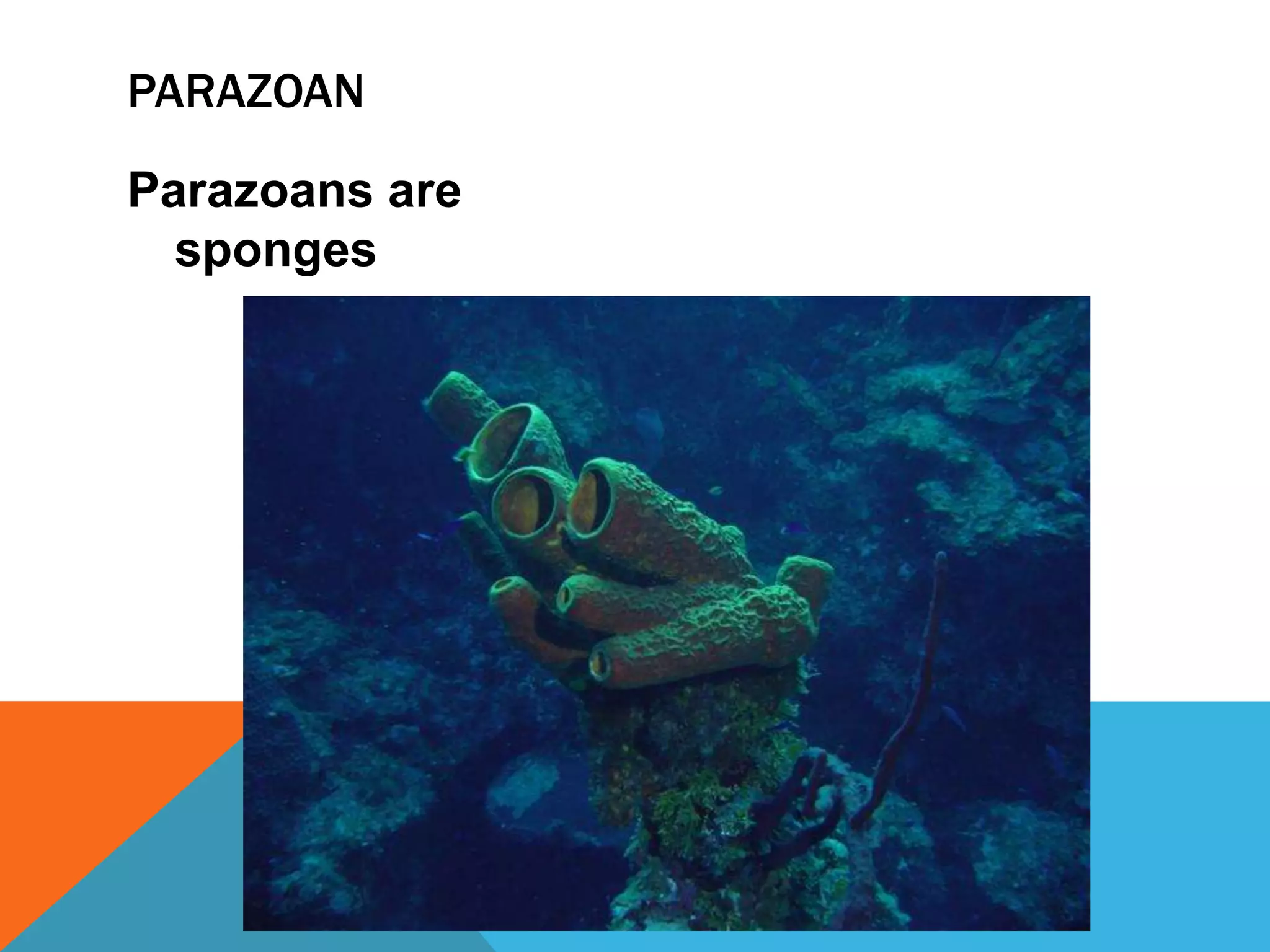
PARAZOAN

Parazoans are
  sponges
PROTOSTOMES

Protostomes are
  animals in
  which the
  blastopore
  becomes the
  mouth


                  A Caribbean Reef
                    Squid, an example
                    of a protostome.
PSEUDOCOELOMATES
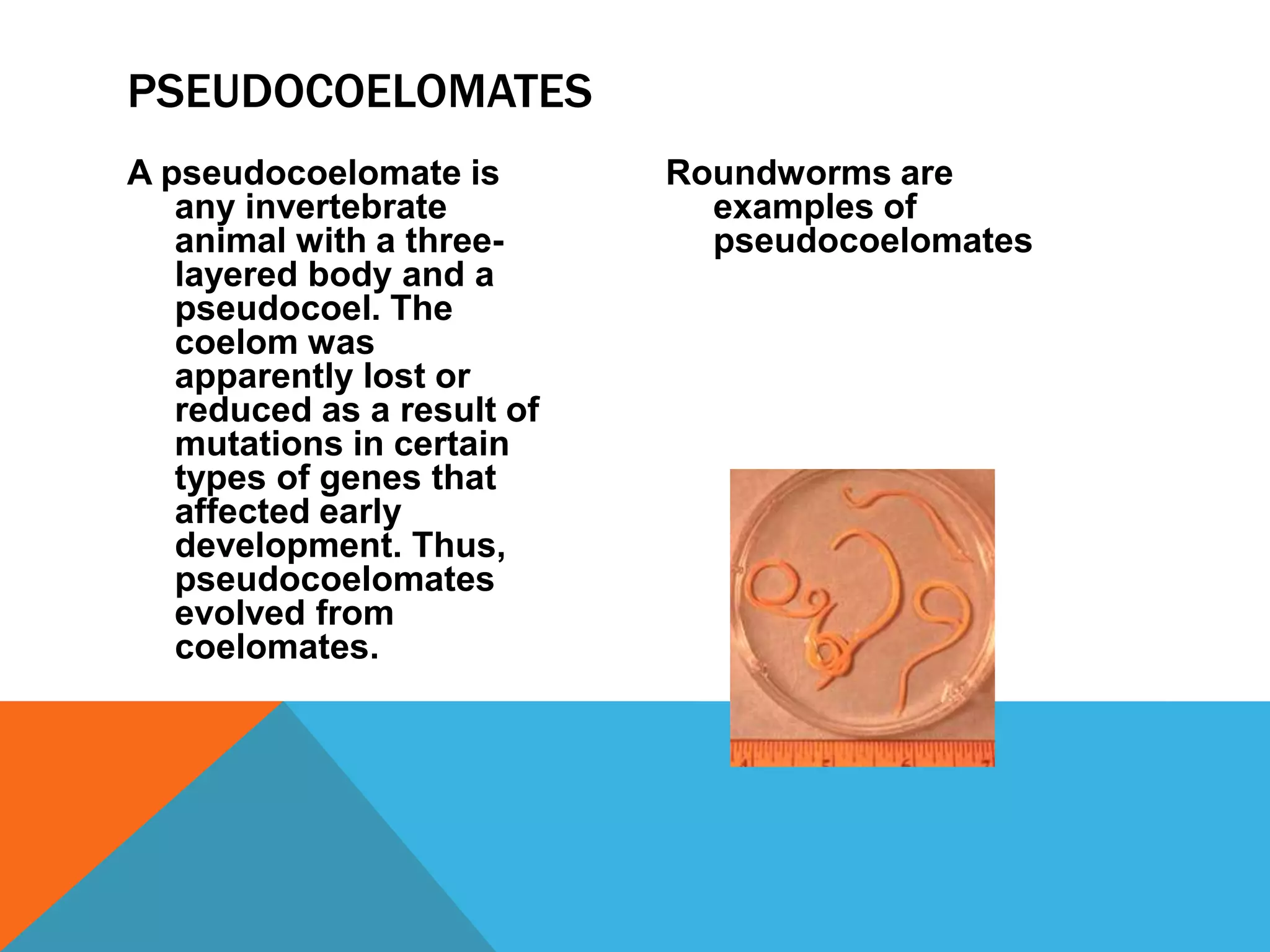
A pseudocoelomate is        Roundworms are
   any invertebrate           examples of
   animal with a three-       pseudocoelomates
   layered body and a
   pseudocoel. The
   coelom was
   apparently lost or
   reduced as a result of
   mutations in certain
   types of genes that
   affected early
   development. Thus,
   pseudocoelomates
   evolved from
   coelomates.
RADIAL CLEAVAGE
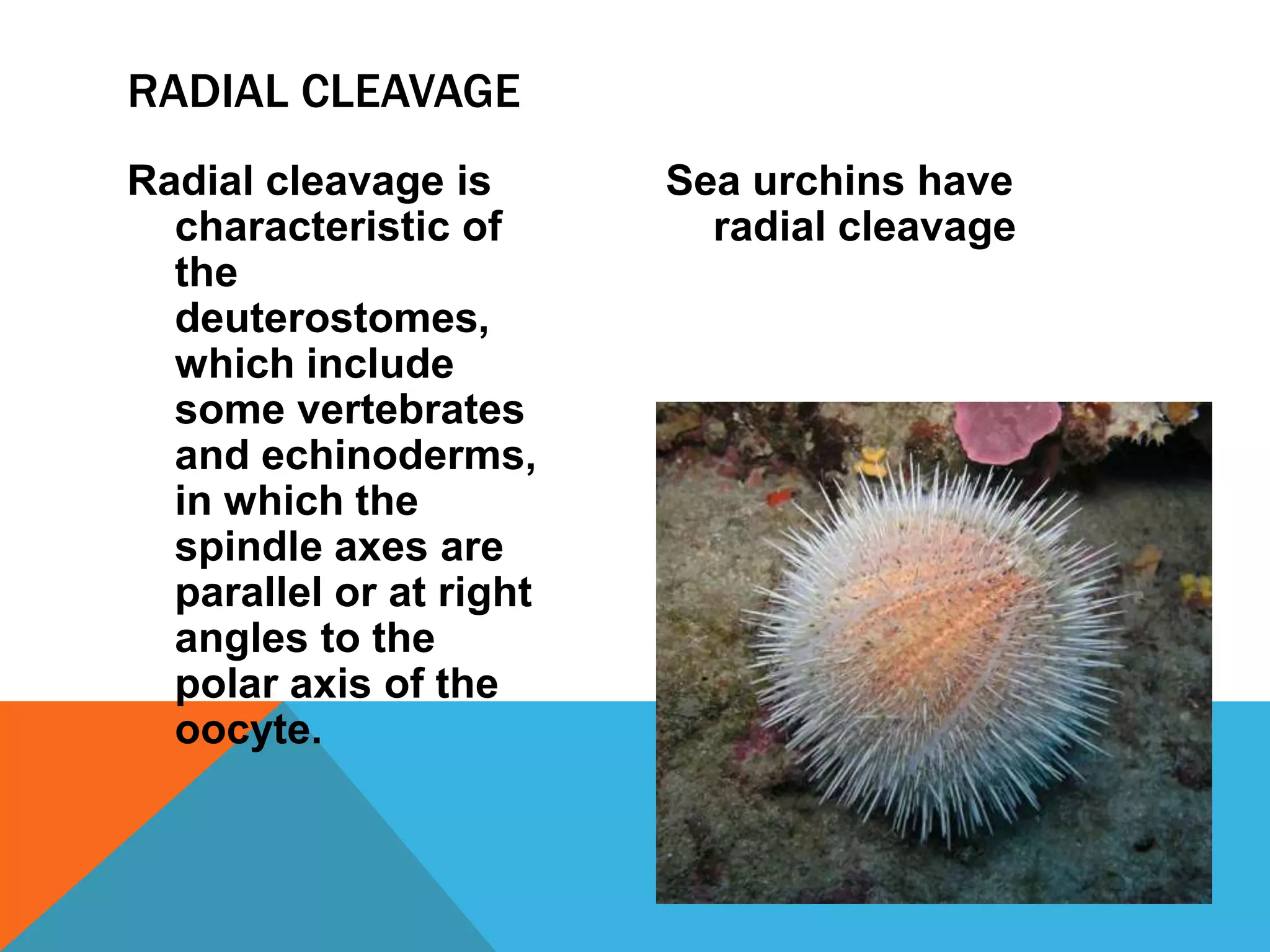
Radial cleavage is       Sea urchins have
  characteristic of        radial cleavage
  the
  deuterostomes,
  which include
  some vertebrates
  and echinoderms,
  in which the
  spindle axes are
  parallel or at right
  angles to the
  polar axis of the
  oocyte.
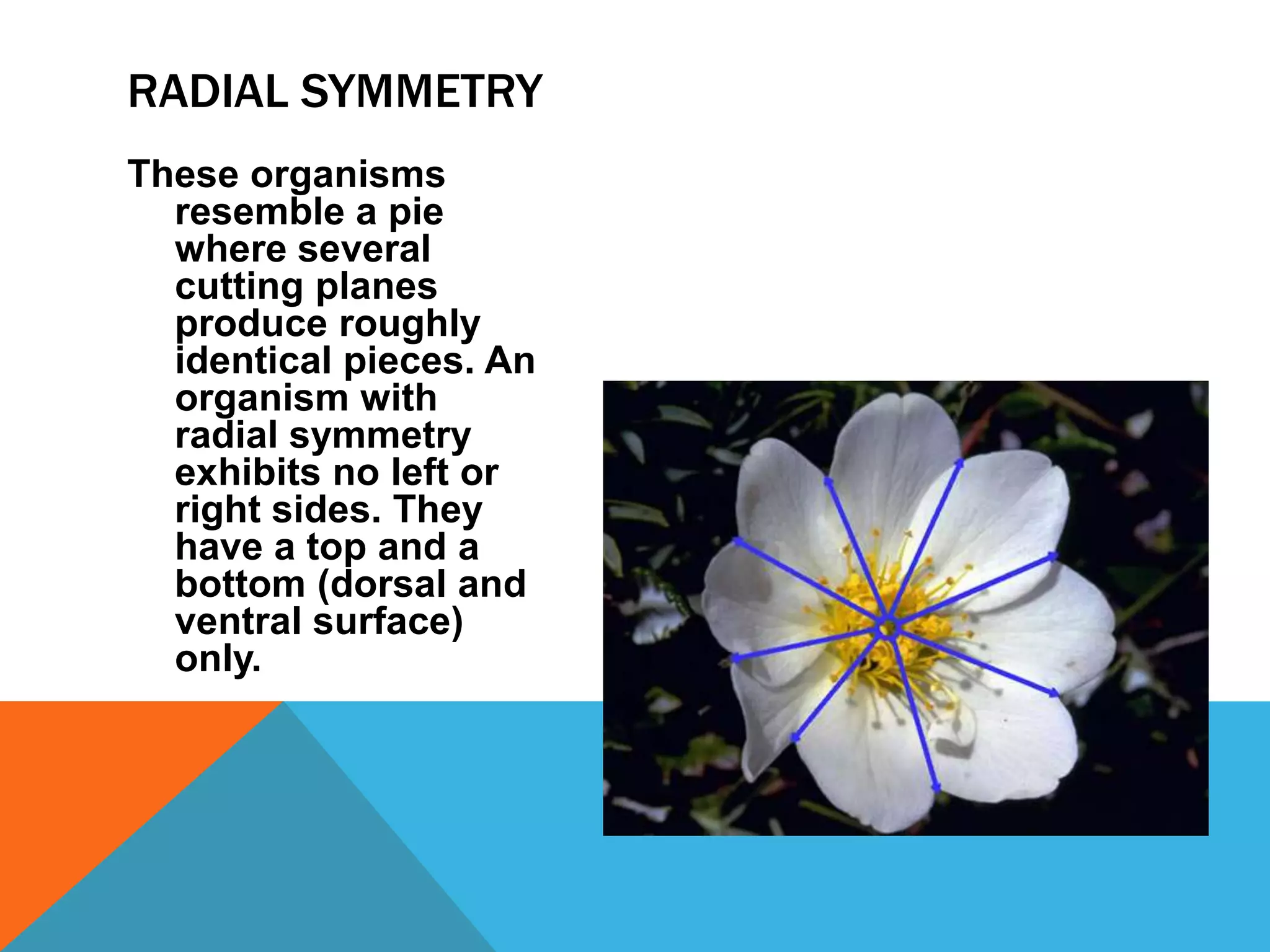
RADIAL SYMMETRY
These organisms
  resemble a pie
  where several
  cutting planes
  produce roughly
  identical pieces. An
  organism with
  radial symmetry
  exhibits no left or
  right sides. They
  have a top and a
  bottom (dorsal and
  ventral surface)
  only.
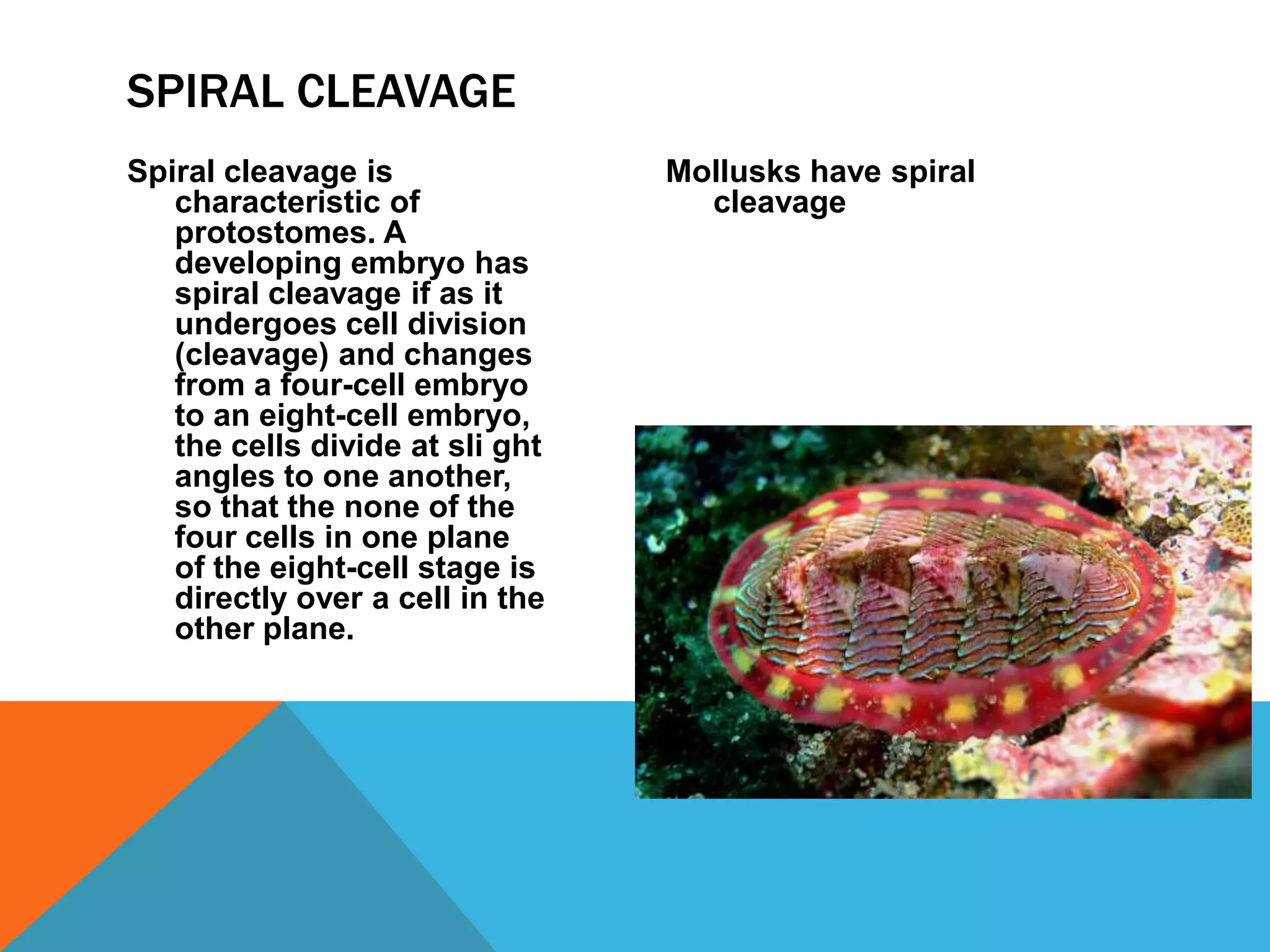
SPIRAL CLEAVAGE
Spiral cleavage is               Mollusks have spiral
   characteristic of               cleavage
   protostomes. A
   developing embryo has
   spiral cleavage if as it
   undergoes cell division
   (cleavage) and changes
   from a four-cell embryo
   to an eight-cell embryo,
   the cells divide at sli ght
   angles to one another,
   so that the none of the
   four cells in one plane
   of the eight-cell stage is
   directly over a cell in the
   other plane.
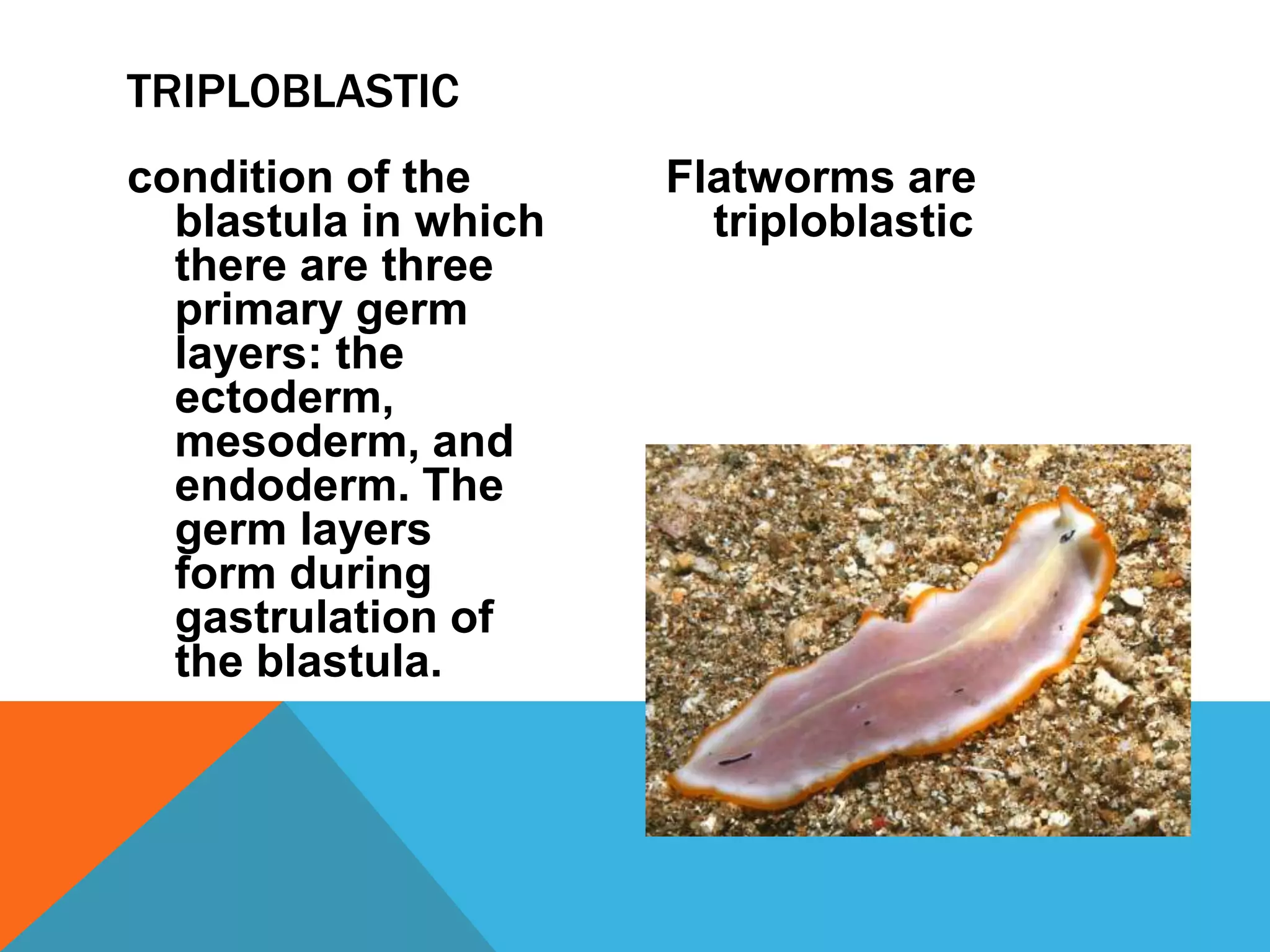
TRIPLOBLASTIC
condition of the      Flatworms are
  blastula in which     triploblastic
  there are three
  primary germ
  layers: the
  ectoderm,
  mesoderm, and
  endoderm. The
  germ layers
  form during
  gastrulation of
  the blastula.

Visual vocab unit 6

  • 2.
    ACOELOMATE Lacking a fluidfilled body cavity Organisms showing acoelomate formation include the platyhelminthes (flatworms, tapeworms etc.), the cnidarians (jellyfish and allies), and the ctenophores (comb jellies)
  • 3.
    BILATERAL SYMMETRY n bilateral symmetry (also called plane symmetry), only one plane, called the sagittal plane, will divide an organism into roughly mirror image halves
  • 4.
    BLASTOPORE an opening into the archenteron during the embryonic stages of an organism.
  • 5.
    BLASTULA hollow sphere of cells formed during an early stage of embryonic development in animals. The blastula is created when the zygote undergoes the cell division process known as cleavage.
  • 6.
    CEPHALIZATION an evolutionary trend, whereby nervous tissue, over many generations, becomes concentrated toward one end of an organism. This process eventually produces a head region with sensory organs
  • 7.
    COELOM fluid-filled cavity formed within the mesoderm of some animals. coelom of an annelid
  • 8.
    COELOMATES A coelomate animal is basically a set of concentric tubes, with a gap between the gut and the outer tubes. An earthworm is a coelomate
  • 9.
    DETERMINATE CLEAVAGE the formof cleavage in most protostomes. It results in the developmental fate of the cells being set early in the embryo development. Each cell produced by early embryonic cleavage does not have the capacity to develop into a complete embryo. A Caribbean Reef Squid, an example of a protostome.
  • 10.
    DEUTEROSTOMES Deuterostomes are distinguished by their embryonic development; in deuterostomes, the first Sea cucumbers and opening (the other echinoderms blastopore) are deuterostomes. becomes the anus,
  • 11.
    DIPLOBLASTIC Pertaining to a condition in which there are two primary germ layers, such as ectoderm and endoderm. Diploblastic animals have two germ layers: an outer ectoderm and an inner endoderm.
  • 12.
    ECTODERM The "ectoderm" is one of the three primary germ cell layers in the very early embryo
  • 13.
    ENDODERM Endoderm is oneof the three primary germ cell layers in the very early embryo. The other two layers are the ectoderm (outside layer) and mesoderm (middle layer), with the endoderm as the intermost layer
  • 14.
    EUMETAZOAN a clade comprisingall major animal groups except sponges Anything but sponges are eumetazoan
  • 15.
    GASTRULATION a phase earlyin the embryonic development of most animals, during which the single-layered blastula is reorganized into a trilaminar ("three- layered") structure known as the gastrula - it is, in other words, the formation of the gut. Stages of gastrulation
  • 16.
    GERM LAYERS a groupof cells, formed during animal embryogenesis Germ layers are particularly pronounced in the vertebrates; however, all animals more complex than sponges (eumetazoans and agnotozoans) produce two or three primary tissue layers
  • 17.
    GRADE (PHYLOGENETIC) a groupof species united by morphological or physiological traits, that has given rise to another group that differs markedly from the ancestral condition, and is Fish represent a grade, thus not inasmuch as they have considered part of given rise to the land the ancestral vertebrates. In fact, the group. three traditional classes of fish (Agnatha, Chondrichthyes and Osteichthyes) all represent evolutionary
  • 18.
    HOX GENE group ofrelated In the late 1940s, Edward Lewis genes that began studying homeotic determine the mutation on Drosophila basic structure melanogaster which caused and orientation bizarre rearrangements of of an organism. body parts. Mutations in the genes that code for limb development can cause deformity or lead to death. For an example, mutations in the Antennapedia gene cause legs instead of the antenna to develop on the head of a fly. These mutants sometimes occur in wild populations of flies, and it was these mutants
  • 19.
    INDETERMINATE CLEAVAGE A cellcan only be The sea urchin is a indeterminate if it has a deuterostome complete set of undisturbed animal/vegetal cytoarchitectural features. It is characteristic of deuterostomes - when the original cell in a deuterostome embryo divides, the two resulting cells can be separated, and each one can individually develop into a whole organism.
  • 20.
    MESODERM one of thethree primary germ cell layers in the very early embryo. The other two layers are the ectoderm (outside layer) and endoderm (inside layer), with the mesoderm as the middle layer between them.
  • 21.
  • 22.
    PROTOSTOMES Protostomes are animals in which the blastopore becomes the mouth A Caribbean Reef Squid, an example of a protostome.
  • 23.
    PSEUDOCOELOMATES A pseudocoelomate is Roundworms are any invertebrate examples of animal with a three- pseudocoelomates layered body and a pseudocoel. The coelom was apparently lost or reduced as a result of mutations in certain types of genes that affected early development. Thus, pseudocoelomates evolved from coelomates.
  • 24.
    RADIAL CLEAVAGE Radial cleavageis Sea urchins have characteristic of radial cleavage the deuterostomes, which include some vertebrates and echinoderms, in which the spindle axes are parallel or at right angles to the polar axis of the oocyte.
  • 25.
    RADIAL SYMMETRY These organisms resemble a pie where several cutting planes produce roughly identical pieces. An organism with radial symmetry exhibits no left or right sides. They have a top and a bottom (dorsal and ventral surface) only.
  • 26.
    SPIRAL CLEAVAGE Spiral cleavageis Mollusks have spiral characteristic of cleavage protostomes. A developing embryo has spiral cleavage if as it undergoes cell division (cleavage) and changes from a four-cell embryo to an eight-cell embryo, the cells divide at sli ght angles to one another, so that the none of the four cells in one plane of the eight-cell stage is directly over a cell in the other plane.
  • 27.
    TRIPLOBLASTIC condition of the Flatworms are blastula in which triploblastic there are three primary germ layers: the ectoderm, mesoderm, and endoderm. The germ layers form during gastrulation of the blastula.