Development of Skin
Handout for Medical Students
Prepared by: Melaku Geletu (M.Sc. in Anatomy)
Development of Skin
• Epidermis is derived from surface ectoderm
• Dermis is derived from mesodermal
mesenchyme
Epidermis
• Primordium of the epidermis is
a layer of surface ectodermal
cells
• These cells proliferate and
form:
– Periderm—a layer of squamous
epithelium
– A basal (germinative) layer
Epidermis
• Peridermal cells
– Continually undergo keratinization and
desquamation
– Replaced by cells arising from the basal layer
– Form part of the white greasy substance-vernix
caseosa
Epidermis
• Vernix caseosa
– Covers the fetal skin
– It contains epidermal cells, lanugo hair and sebum
– Protects the developing skin from constant
exposure to amniotic fluid
– It also facilitates birth of the fetus
Epidermis
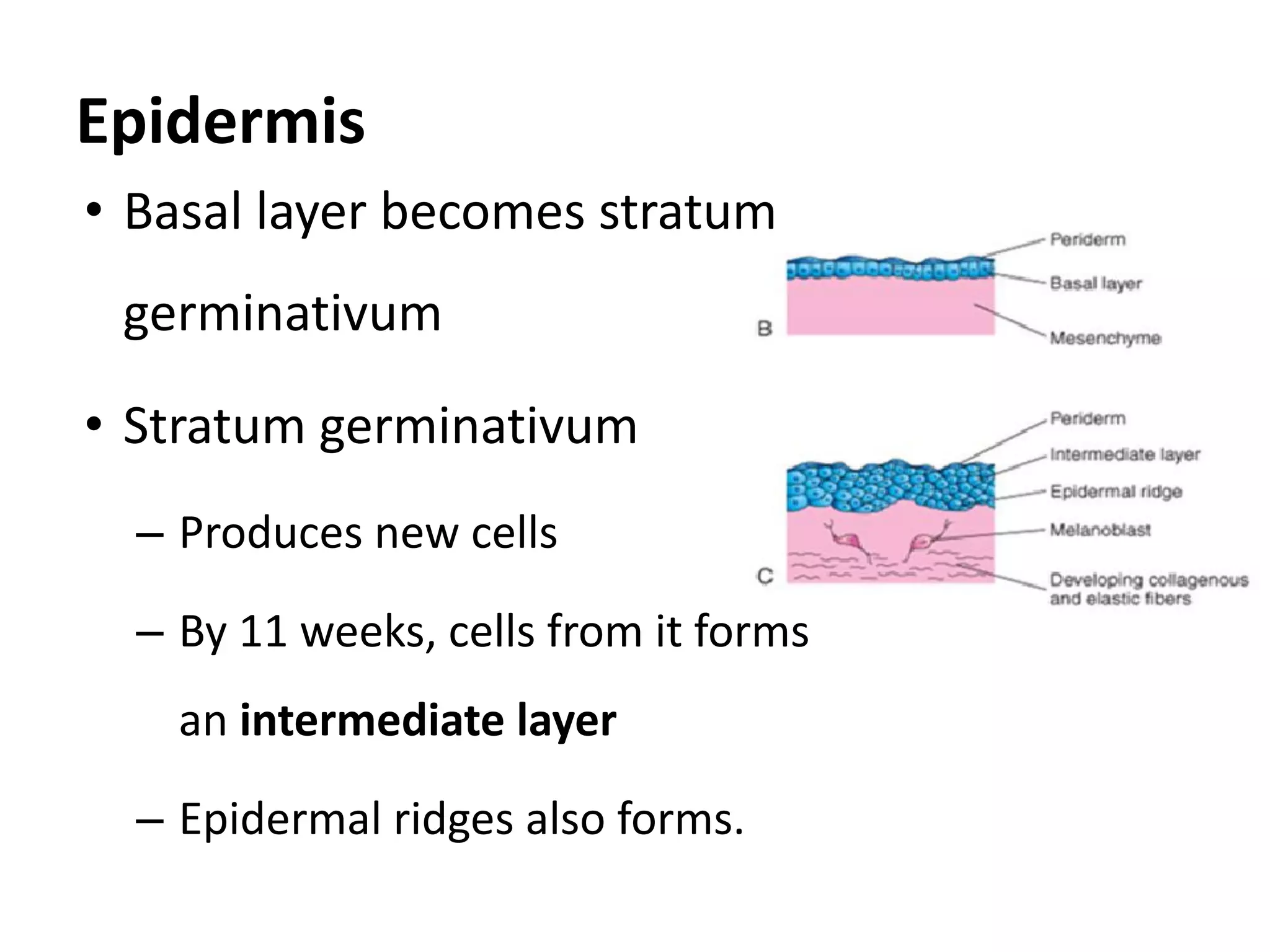
• Basal layer becomes stratum
germinativum
• Stratum germinativum
– Produces new cells
– By 11 weeks, cells from it forms
an intermediate layer
– Epidermal ridges also forms.
Epidermis
• The type of pattern of epidermal ridges that
develops is determined genetically
• Abnormal chromosome complements affect
its development patterns
– E.g. Down syndrome
Epidermis
• Periderm disappears and the stratum
corneum forms at 21st
week
Epidermis
• Neural crest cells migrate into the developing
dermis and differentiate into melanoblasts
• Later melanoblasts migrate to the
dermo-epidermal junction and differentiate
into melanocytes
– This differentiation involves the formation of
pigment granules
Epidermis
• Melanin
– Begins to be produced and distributed before birth
by melanocytes
– Its amount increases in response to ultraviolet light
– Its relative content is responsible for different skin
colors
– Pigment formation can be observed prenatally in
epidermis
Epidermis
• Development of epidermis need inductive
interactions of dermis
• Skin is classified as thick or thin based on the
thickness of the epidermis
Dermis
• It develops from mesenchyme, which is derived from
the mesoderm
• Origin of the mesenchyme for the development of
dermis:
– Most from somatic layer of lateral mesoderm
– Some from dermatomes of the somites
Dermis
• Dermal ridges
– Formed by the projection of dermis into the
epidermis
– Capillary loops develop in some of it
– Sensory nerve endings form in others
Anomalies of the skin
Congenital Ectodermal Dysplasia
• A group of hereditary disorders involving
tissues that are ectodermal in origin
• Teeth are completely or partially absent
• Often the hairs, nails, and skin are also
severely affected
Anomalies of the skin
Ectrodactyly-Ectodermal Dysplasia-Clefting Syndrome
• It is a congenital skin condition that is inherited as an
autosomal dominant trait
• It involves both ectodermal and mesodermal tissues
• Consists of ectodermal dysplasia
Anomalies of the skin
Ectrodactyly-Ectodermal Dysplasia-Clefting Syndrome
• Associated with:
– Hypopigmentation of skin and hair
– Scanty hair and eyebrows
– Absence of eyelashes
– Nail dystrophy
– Hypodontia and microdontia
– Cleft lip and palate

Development of Skin.pptx.pdf

  • 1.
    Development of Skin Handoutfor Medical Students Prepared by: Melaku Geletu (M.Sc. in Anatomy)
  • 2.
    Development of Skin •Epidermis is derived from surface ectoderm • Dermis is derived from mesodermal mesenchyme
  • 4.
    Epidermis • Primordium ofthe epidermis is a layer of surface ectodermal cells • These cells proliferate and form: – Periderm—a layer of squamous epithelium – A basal (germinative) layer
  • 5.
    Epidermis • Peridermal cells –Continually undergo keratinization and desquamation – Replaced by cells arising from the basal layer – Form part of the white greasy substance-vernix caseosa
  • 6.
    Epidermis • Vernix caseosa –Covers the fetal skin – It contains epidermal cells, lanugo hair and sebum – Protects the developing skin from constant exposure to amniotic fluid – It also facilitates birth of the fetus
  • 7.
    Epidermis • Basal layerbecomes stratum germinativum • Stratum germinativum – Produces new cells – By 11 weeks, cells from it forms an intermediate layer – Epidermal ridges also forms.
  • 8.
    Epidermis • The typeof pattern of epidermal ridges that develops is determined genetically • Abnormal chromosome complements affect its development patterns – E.g. Down syndrome
  • 9.
    Epidermis • Periderm disappearsand the stratum corneum forms at 21st week
  • 10.
    Epidermis • Neural crestcells migrate into the developing dermis and differentiate into melanoblasts • Later melanoblasts migrate to the dermo-epidermal junction and differentiate into melanocytes – This differentiation involves the formation of pigment granules
  • 11.
    Epidermis • Melanin – Beginsto be produced and distributed before birth by melanocytes – Its amount increases in response to ultraviolet light – Its relative content is responsible for different skin colors – Pigment formation can be observed prenatally in epidermis
  • 12.
    Epidermis • Development ofepidermis need inductive interactions of dermis • Skin is classified as thick or thin based on the thickness of the epidermis
  • 13.
    Dermis • It developsfrom mesenchyme, which is derived from the mesoderm • Origin of the mesenchyme for the development of dermis: – Most from somatic layer of lateral mesoderm – Some from dermatomes of the somites
  • 14.
    Dermis • Dermal ridges –Formed by the projection of dermis into the epidermis – Capillary loops develop in some of it – Sensory nerve endings form in others
  • 15.
    Anomalies of theskin Congenital Ectodermal Dysplasia • A group of hereditary disorders involving tissues that are ectodermal in origin • Teeth are completely or partially absent • Often the hairs, nails, and skin are also severely affected
  • 16.
    Anomalies of theskin Ectrodactyly-Ectodermal Dysplasia-Clefting Syndrome • It is a congenital skin condition that is inherited as an autosomal dominant trait • It involves both ectodermal and mesodermal tissues • Consists of ectodermal dysplasia
  • 17.
    Anomalies of theskin Ectrodactyly-Ectodermal Dysplasia-Clefting Syndrome • Associated with: – Hypopigmentation of skin and hair – Scanty hair and eyebrows – Absence of eyelashes – Nail dystrophy – Hypodontia and microdontia – Cleft lip and palate