Jai Kumar Pillai
KIMS, Bangalore
1
DESMOSOMES
EPIDERMAL ADHESION
 Epidermal integrity is required for protection
against mechanical , physical & microbial insults
 The major cellular structures involved in
maintaining this cell-cell adhesion are the
desmosomes
2
Other epidermal attachment
complexes
 Adherens junction
 Tight junction
 Gap junction
3
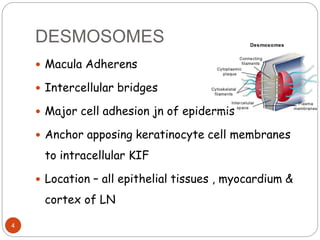
DESMOSOMES
 Macula Adherens
 Intercellular bridges
 Major cell adhesion jn of epidermis
 Anchor apposing keratinocyte cell membranes
to intracellular KIF
 Location – all epithelial tissues , myocardium &
cortex of LN
4
5
C/S: symmetric, consists of 2 apposing
dense plaques inside membranes
Intercellular centre-Desmoglea, 30nm
Thin electron dense midline in centre(formed
by amino terminus of desmosomal cadherins)
Inner dense plaque & outer dense plaque
6
ULTRASTRUCTURE
7
Biochemical Characterisation
3 Major Gene Families
Plakins ( desmoplakin )
Armadillo proteins( plakoglobins & plakophilins)
Desmosomal cadherins( desmogleins & desmocollins)
Additional proteins- perp, ninein, kazrin &
corneodesmosin8
Outer dense plaque
 10-20nm from plasma
membrane
 Contains desmosomal
cadherins cytoplasmic tails,
plakoglobin, plakophilin, amino
terminus of desmoplakin
Inner dense plaque
 40-50nm from PM
 Carboxy terminus of
desmoplakin interacting with
KIF
9
DESMOPLAKIN
 Major inner plaque component
 Exists as 1 & 2
 Family includes
BPAG1, Plectin
plaque proteins of HD
envoplakin & periplakin
10
 Modular protein
 Rod like centre
 C terminus binds to KF , Amino terminus binds to
plakoglobin
 Major link b/w KIF & desmosomal plaque
 Also play role in development of epithelium
11
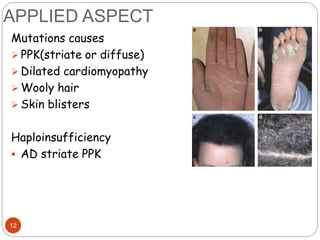
APPLIED ASPECT
Mutations causes
 PPK(striate or diffuse)
 Dilated cardiomyopathy
 Wooly hair
 Skin blisters
Haploinsufficiency
 AD striate PPK
12
Non-sense mutation affecting
desmoplakin1
 Naxos like syndrome-
PPK, Wooly hair & ARVC
Compound heterozygous mutation
 Lethal acantholytic epidermolysis
bullosa
widespread epidermolysis
generalized alopecia
anonychia
neonatal teeth
Total skin denudement
Absent toe nails
Total alopecia
Single row of
BK13
PLAKOGLOBIN
 γ-catenin
 2nd major protein in desmosomal
plaques
 Ubiquitously present in all epithelia
 Can also localise to nucleus & modulate
gene transcription
 Link between desmogleins &
desmocollin to desmoplakins
14
APPLIED
ASPECT
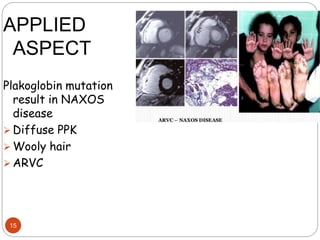
Plakoglobin mutation
result in NAXOS
disease
 Diffuse PPK
 Wooly hair
 ARVC
15
PLAKOPHILIN
 Binds to desmoplakin & desmosomal cadherins
 Aids in clustering & stability of plaque
 Localise to nucleus where it regulates translation &
cell proliferation
16
APPLIED ASPECT
Plakophilin1- mutation causes Ectodermal dysplasia
skin fragility syndrome
Sparse hair, skin
erosions Perioral erosions Intraepidermal clefting
17
 Plakophilin2- mutation are mcc of AD
arrythmogenic RV cardiomyopathy
18
DESMOSOMAL CADHERINS
 link between the intracellular
plaque &
the extracellular desmoglea
 Ca2+ dependent adhesion
 Desmogleins-4
isoforms(1,2,3,4)
 Desmocollins 3 isoforms-1,2,3
 Key role in initiating
desmosomal assembly19
 Desmoglein 1 & 3 – predominant in epidermis &
mucous membranes, thymic epithelial cells
 Dsg2- major isoform in most simple & transitional
epithelia , cardiac myocytes
 Dsg4- more in hair follicle, testes & prostate
 Dsg3- expressed in SCC, molecular target for
therapy
20
DESMOCOLLINS
3 isoforms-1,2,3
 Dsc 3- expressed in stratified squamous
epithelia of skin & oropharynx
 Dsc2-only isoform present in cardiac tissue
21
Mechanism of intercellular
adhesion
 Amino terminal tryptophan of 1
cadherin molecule
 Interacts with a hydrophobic acceptor
of another cadherin molecule in
adjacent cells
 Forms trans-adhesive interphase
 Interactions are homophilic(Dsg-Dsg) &
heterophilic(Dsg-Dsc)22
Applied Aspects
Dsg1-target of proteolytic cleavage in
 Bullous Impetigo
 SSSS
 Inherited Icthyosis a/w Netherton syndrome
23
 SSSS- cleavage of Dsg1 by staphylococcal
exfoliative toxin , occurs between extracellular
domains 3&4
Extensive areas
of desquamation
Perioral crusting, fissuring
24
Pathogenic antibodies to Dsg1
 Pemphigus foliaceus
 MC pemphigus vulgaris
 Paraneoplastic pemphigus
25
 AD mutations causing Haploinsufficiency of Dsg1-
--Palmoplantar Keratoderma
26
DESMOGLEIN 2 & DESMOCOLLIN
2
 Implicated in CVD as a cause of AD arrythmogenic
RV cardiomyopathy
27
DESMOGLEIN 3
Target of autoabs in
 Mucosal & MC pemphigus vulgaris
 Paraneoplastic pemphigus
Target-Amino terminal extracellular
domains of Dsg3
28
DESMOGLEIN 4 & DESMOCOLLIN 3
Mutations lead to
 AR forms of hypotrichosis & monilethrix
Beaded appearance of hair
29
DESMOCOLLIN 1
 Target of autoAbs in Subcorneal Pustular
Dermatosis of IgA Pemphigus
Flacid pustules, erythematous skin
Circinate pattern
Neutrophil infiltrate
30
Desmoglein Compensation
Theory
31
Dsg3 compensates
for Dsg1
Dsg3>Dsg1
Dsg1
compensates
for Dsg3
Low Dsg1
OTHER DESMOSOMAL
PROTEINS
Envoplakin & Periplakin
 Expressed in superficial layer of epidermis
 Incorporate into corneodesmosomes of SC
 Paraneoplastic pemphigus: Autoantibodies to these
proteins are characteristic
32
Corneodesmosin
 Secreted gp
 Incorporates into corneodesmosomes
 Expressed in inner root sheath of hair follicle
Mutation
AD hypotrichosis simplex of scalp
Scalp biopsy- loss of cohesion in inner root sheath &
aggregates of corneodesmosin around hair follicle
33
FUNCTIONS
 Major- cell adhesion
 Development & differentiation of epidermis
 May mediate signal transduction( armadillo family B-
catenin, plakophilins)
 B-catenin—wnt signaling pathway
Translocates to nucleus to form a transcription
factor
34
ADHERENS JUNCTION
 Electron dense , transmembrane
structures, engage with actin
skeleton
 Functions
epithelial assembly, barrier
formation
cell motility, changes in cell
shape
35
U/S: characterised by 2 opposing membranes
 Seperated by gap of 20nm & 0.2-0.5um in diam
 Comprises of 2 basic adhesive units
nectin–afadin complex and the classical cadherin
complex
36
37
 Cadherins form a complex with the catenins (α-,
β-, and p120 catenin) & help mediate adhesion and
signalling
 Nectins form a structural link to the actin
cytoskeleton via afadin (AF-6)
38
Applied Aspects
 P-cadherin(CDH3) mutations result in AR
hypotrichosis with juvenile macular dystrophy
39
TIGHT JUNCTIONS
 Zonula occludens
 Major regulators of
permeability in epithelia
 Skin barrier integrity &
maintaining cell polarity
 Function: regulate the
paracellular flux of water-
soluble molecules between
adjacent cells
40
 Structural components-
 Claudin(24 subtypes)—main is 1&4
 IgG-like family of junctional adhesion molecules
(JAMs)
 Occludin
 claudins and occludins can bind to the intracellular
zonula occudens proteins ZO-1, ZO-2, ZO-3
 Can interact with actin-direct link with cytoskeleton
41
42
 Tight jn , adherens jn & desmosomes form the
apical junctional complex in ep cells
43
Applied Aspects
 Claudin 1 –AR diffuse ichthyosis with large scales,
hypotrichosis, scarring alopecia & sclerosing
cholangitis
 claudin 16(paracellin-1)-familial hypomagnesaemia
with hypercalciuria and nephrocalcinosis
 claudin 14 - AR deafness disorder
 ZO-2 - familial hypercholanaemia
44
GAP JUNCTIONS
 Comprise clusters of intercellular channels, known as
connexons
 1 connexon formed by assembly of 6 connexin subunits
within Golgi
 At PM, adjacent connexons associate to from Gap
junction
 Stability of Gap jn regulated by PKC, Src kinase, Ca2+,
calmodulin and pH
45
 Connexins (α, β and γ) – forms homotypic or
heterotypic connnexons
46
Functions
 Sharing low-molecular-mass metabolites (<1000 Da) &
ion exchange between neighbouring cells
 cell synchronization, differentiation, cell growth and
metabolic coordination of avascular organs, including
epidermis.
47
APPLIED ASPECT
Mutations
Cx26-
Bart pumphrey syndr
Palmoplantar keratoderma with
deafness
48
 30- Cloustons syndrome
Atrichia of scalp
nail dystrophy
diffuse plantar
keratoderma
 30.3 & 31
Erythrokeratoderma
variabilis
Oval red scaly plaques-joind-map like49
REFERENCES
 ROOKS 8th edition
 FITZPATRICKS 8th edition
 BOLOGNIA 3rd edition
 IADVL 4th edition
 LEVER’S histopathology 10th edition
50
THANK YOU
51

Desmosomes

  • 1.
    Jai Kumar Pillai KIMS,Bangalore 1 DESMOSOMES
  • 2.
    EPIDERMAL ADHESION  Epidermalintegrity is required for protection against mechanical , physical & microbial insults  The major cellular structures involved in maintaining this cell-cell adhesion are the desmosomes 2
  • 3.
    Other epidermal attachment complexes Adherens junction  Tight junction  Gap junction 3
  • 4.
    DESMOSOMES  Macula Adherens Intercellular bridges  Major cell adhesion jn of epidermis  Anchor apposing keratinocyte cell membranes to intracellular KIF  Location – all epithelial tissues , myocardium & cortex of LN 4
  • 5.
  • 6.
    C/S: symmetric, consistsof 2 apposing dense plaques inside membranes Intercellular centre-Desmoglea, 30nm Thin electron dense midline in centre(formed by amino terminus of desmosomal cadherins) Inner dense plaque & outer dense plaque 6 ULTRASTRUCTURE
  • 7.
  • 8.
    Biochemical Characterisation 3 MajorGene Families Plakins ( desmoplakin ) Armadillo proteins( plakoglobins & plakophilins) Desmosomal cadherins( desmogleins & desmocollins) Additional proteins- perp, ninein, kazrin & corneodesmosin8
  • 9.
    Outer dense plaque 10-20nm from plasma membrane  Contains desmosomal cadherins cytoplasmic tails, plakoglobin, plakophilin, amino terminus of desmoplakin Inner dense plaque  40-50nm from PM  Carboxy terminus of desmoplakin interacting with KIF 9
  • 10.
    DESMOPLAKIN  Major innerplaque component  Exists as 1 & 2  Family includes BPAG1, Plectin plaque proteins of HD envoplakin & periplakin 10
  • 11.
     Modular protein Rod like centre  C terminus binds to KF , Amino terminus binds to plakoglobin  Major link b/w KIF & desmosomal plaque  Also play role in development of epithelium 11
  • 12.
    APPLIED ASPECT Mutations causes PPK(striate or diffuse)  Dilated cardiomyopathy  Wooly hair  Skin blisters Haploinsufficiency  AD striate PPK 12
  • 13.
    Non-sense mutation affecting desmoplakin1 Naxos like syndrome- PPK, Wooly hair & ARVC Compound heterozygous mutation  Lethal acantholytic epidermolysis bullosa widespread epidermolysis generalized alopecia anonychia neonatal teeth Total skin denudement Absent toe nails Total alopecia Single row of BK13
  • 14.
    PLAKOGLOBIN  γ-catenin  2ndmajor protein in desmosomal plaques  Ubiquitously present in all epithelia  Can also localise to nucleus & modulate gene transcription  Link between desmogleins & desmocollin to desmoplakins 14
  • 15.
    APPLIED ASPECT Plakoglobin mutation result inNAXOS disease  Diffuse PPK  Wooly hair  ARVC 15
  • 16.
    PLAKOPHILIN  Binds todesmoplakin & desmosomal cadherins  Aids in clustering & stability of plaque  Localise to nucleus where it regulates translation & cell proliferation 16
  • 17.
    APPLIED ASPECT Plakophilin1- mutationcauses Ectodermal dysplasia skin fragility syndrome Sparse hair, skin erosions Perioral erosions Intraepidermal clefting 17
  • 18.
     Plakophilin2- mutationare mcc of AD arrythmogenic RV cardiomyopathy 18
  • 19.
    DESMOSOMAL CADHERINS  linkbetween the intracellular plaque & the extracellular desmoglea  Ca2+ dependent adhesion  Desmogleins-4 isoforms(1,2,3,4)  Desmocollins 3 isoforms-1,2,3  Key role in initiating desmosomal assembly19
  • 20.
     Desmoglein 1& 3 – predominant in epidermis & mucous membranes, thymic epithelial cells  Dsg2- major isoform in most simple & transitional epithelia , cardiac myocytes  Dsg4- more in hair follicle, testes & prostate  Dsg3- expressed in SCC, molecular target for therapy 20
  • 21.
    DESMOCOLLINS 3 isoforms-1,2,3  Dsc3- expressed in stratified squamous epithelia of skin & oropharynx  Dsc2-only isoform present in cardiac tissue 21
  • 22.
    Mechanism of intercellular adhesion Amino terminal tryptophan of 1 cadherin molecule  Interacts with a hydrophobic acceptor of another cadherin molecule in adjacent cells  Forms trans-adhesive interphase  Interactions are homophilic(Dsg-Dsg) & heterophilic(Dsg-Dsc)22
  • 23.
    Applied Aspects Dsg1-target ofproteolytic cleavage in  Bullous Impetigo  SSSS  Inherited Icthyosis a/w Netherton syndrome 23
  • 24.
     SSSS- cleavageof Dsg1 by staphylococcal exfoliative toxin , occurs between extracellular domains 3&4 Extensive areas of desquamation Perioral crusting, fissuring 24
  • 25.
    Pathogenic antibodies toDsg1  Pemphigus foliaceus  MC pemphigus vulgaris  Paraneoplastic pemphigus 25
  • 26.
     AD mutationscausing Haploinsufficiency of Dsg1- --Palmoplantar Keratoderma 26
  • 27.
    DESMOGLEIN 2 &DESMOCOLLIN 2  Implicated in CVD as a cause of AD arrythmogenic RV cardiomyopathy 27
  • 28.
    DESMOGLEIN 3 Target ofautoabs in  Mucosal & MC pemphigus vulgaris  Paraneoplastic pemphigus Target-Amino terminal extracellular domains of Dsg3 28
  • 29.
    DESMOGLEIN 4 &DESMOCOLLIN 3 Mutations lead to  AR forms of hypotrichosis & monilethrix Beaded appearance of hair 29
  • 30.
    DESMOCOLLIN 1  Targetof autoAbs in Subcorneal Pustular Dermatosis of IgA Pemphigus Flacid pustules, erythematous skin Circinate pattern Neutrophil infiltrate 30
  • 31.
    Desmoglein Compensation Theory 31 Dsg3 compensates forDsg1 Dsg3>Dsg1 Dsg1 compensates for Dsg3 Low Dsg1
  • 32.
    OTHER DESMOSOMAL PROTEINS Envoplakin &Periplakin  Expressed in superficial layer of epidermis  Incorporate into corneodesmosomes of SC  Paraneoplastic pemphigus: Autoantibodies to these proteins are characteristic 32
  • 33.
    Corneodesmosin  Secreted gp Incorporates into corneodesmosomes  Expressed in inner root sheath of hair follicle Mutation AD hypotrichosis simplex of scalp Scalp biopsy- loss of cohesion in inner root sheath & aggregates of corneodesmosin around hair follicle 33
  • 34.
    FUNCTIONS  Major- celladhesion  Development & differentiation of epidermis  May mediate signal transduction( armadillo family B- catenin, plakophilins)  B-catenin—wnt signaling pathway Translocates to nucleus to form a transcription factor 34
  • 35.
    ADHERENS JUNCTION  Electrondense , transmembrane structures, engage with actin skeleton  Functions epithelial assembly, barrier formation cell motility, changes in cell shape 35
  • 36.
    U/S: characterised by2 opposing membranes  Seperated by gap of 20nm & 0.2-0.5um in diam  Comprises of 2 basic adhesive units nectin–afadin complex and the classical cadherin complex 36
  • 37.
  • 38.
     Cadherins forma complex with the catenins (α-, β-, and p120 catenin) & help mediate adhesion and signalling  Nectins form a structural link to the actin cytoskeleton via afadin (AF-6) 38
  • 39.
    Applied Aspects  P-cadherin(CDH3)mutations result in AR hypotrichosis with juvenile macular dystrophy 39
  • 40.
    TIGHT JUNCTIONS  Zonulaoccludens  Major regulators of permeability in epithelia  Skin barrier integrity & maintaining cell polarity  Function: regulate the paracellular flux of water- soluble molecules between adjacent cells 40
  • 41.
     Structural components- Claudin(24 subtypes)—main is 1&4  IgG-like family of junctional adhesion molecules (JAMs)  Occludin  claudins and occludins can bind to the intracellular zonula occudens proteins ZO-1, ZO-2, ZO-3  Can interact with actin-direct link with cytoskeleton 41
  • 42.
  • 43.
     Tight jn, adherens jn & desmosomes form the apical junctional complex in ep cells 43
  • 44.
    Applied Aspects  Claudin1 –AR diffuse ichthyosis with large scales, hypotrichosis, scarring alopecia & sclerosing cholangitis  claudin 16(paracellin-1)-familial hypomagnesaemia with hypercalciuria and nephrocalcinosis  claudin 14 - AR deafness disorder  ZO-2 - familial hypercholanaemia 44
  • 45.
    GAP JUNCTIONS  Compriseclusters of intercellular channels, known as connexons  1 connexon formed by assembly of 6 connexin subunits within Golgi  At PM, adjacent connexons associate to from Gap junction  Stability of Gap jn regulated by PKC, Src kinase, Ca2+, calmodulin and pH 45
  • 46.
     Connexins (α,β and γ) – forms homotypic or heterotypic connnexons 46
  • 47.
    Functions  Sharing low-molecular-massmetabolites (<1000 Da) & ion exchange between neighbouring cells  cell synchronization, differentiation, cell growth and metabolic coordination of avascular organs, including epidermis. 47
  • 48.
    APPLIED ASPECT Mutations Cx26- Bart pumphreysyndr Palmoplantar keratoderma with deafness 48
  • 49.
     30- Cloustonssyndrome Atrichia of scalp nail dystrophy diffuse plantar keratoderma  30.3 & 31 Erythrokeratoderma variabilis Oval red scaly plaques-joind-map like49
  • 50.
    REFERENCES  ROOKS 8thedition  FITZPATRICKS 8th edition  BOLOGNIA 3rd edition  IADVL 4th edition  LEVER’S histopathology 10th edition 50
  • 51.