Journal of Education and Practice www.iiste.org
ISSN 2222-1735 (Paper) ISSN 2222-288X (Online)
Vol.4, No.15, 2013
27
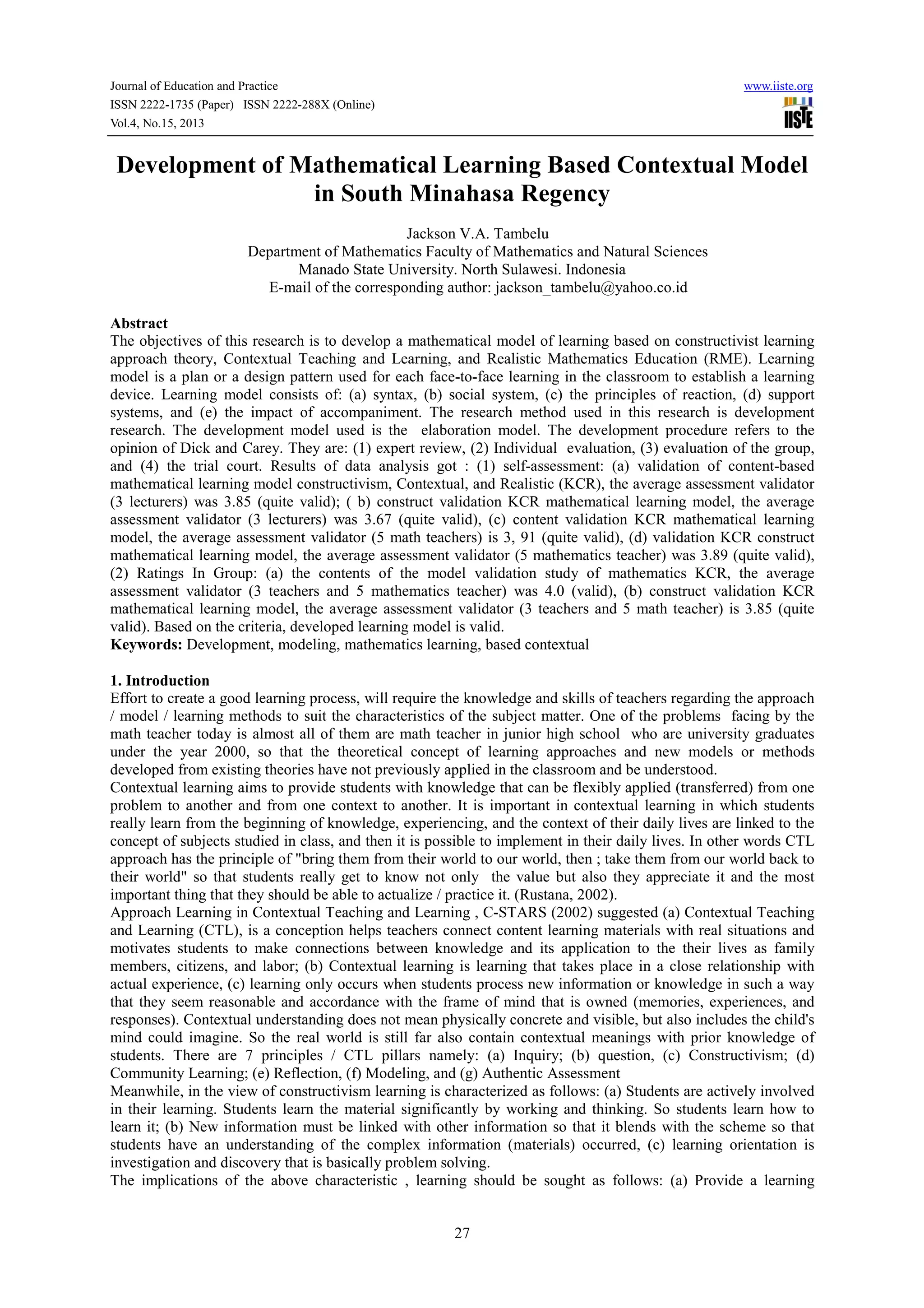
Development of Mathematical Learning Based Contextual Model
in South Minahasa Regency
Jackson V.A. Tambelu
Department of Mathematics Faculty of Mathematics and Natural Sciences
Manado State University. North Sulawesi. Indonesia
E-mail of the corresponding author: jackson_tambelu@yahoo.co.id
Abstract
The objectives of this research is to develop a mathematical model of learning based on constructivist learning
approach theory, Contextual Teaching and Learning, and Realistic Mathematics Education (RME). Learning
model is a plan or a design pattern used for each face-to-face learning in the classroom to establish a learning
device. Learning model consists of: (a) syntax, (b) social system, (c) the principles of reaction, (d) support
systems, and (e) the impact of accompaniment. The research method used in this research is development
research. The development model used is the elaboration model. The development procedure refers to the
opinion of Dick and Carey. They are: (1) expert review, (2) Individual evaluation, (3) evaluation of the group,
and (4) the trial court. Results of data analysis got : (1) self-assessment: (a) validation of content-based
mathematical learning model constructivism, Contextual, and Realistic (KCR), the average assessment validator
(3 lecturers) was 3.85 (quite valid); ( b) construct validation KCR mathematical learning model, the average
assessment validator (3 lecturers) was 3.67 (quite valid), (c) content validation KCR mathematical learning
model, the average assessment validator (5 math teachers) is 3, 91 (quite valid), (d) validation KCR construct
mathematical learning model, the average assessment validator (5 mathematics teacher) was 3.89 (quite valid),
(2) Ratings In Group: (a) the contents of the model validation study of mathematics KCR, the average
assessment validator (3 teachers and 5 mathematics teacher) was 4.0 (valid), (b) construct validation KCR
mathematical learning model, the average assessment validator (3 teachers and 5 math teacher) is 3.85 (quite
valid). Based on the criteria, developed learning model is valid.
Keywords: Development, modeling, mathematics learning, based contextual
1. Introduction
Effort to create a good learning process, will require the knowledge and skills of teachers regarding the approach
/ model / learning methods to suit the characteristics of the subject matter. One of the problems facing by the
math teacher today is almost all of them are math teacher in junior high school who are university graduates
under the year 2000, so that the theoretical concept of learning approaches and new models or methods
developed from existing theories have not previously applied in the classroom and be understood.
Contextual learning aims to provide students with knowledge that can be flexibly applied (transferred) from one
problem to another and from one context to another. It is important in contextual learning in which students
really learn from the beginning of knowledge, experiencing, and the context of their daily lives are linked to the
concept of subjects studied in class, and then it is possible to implement in their daily lives. In other words CTL
approach has the principle of "bring them from their world to our world, then ; take them from our world back to
their world" so that students really get to know not only the value but also they appreciate it and the most
important thing that they should be able to actualize / practice it. (Rustana, 2002).
Approach Learning in Contextual Teaching and Learning , C-STARS (2002) suggested (a) Contextual Teaching
and Learning (CTL), is a conception helps teachers connect content learning materials with real situations and
motivates students to make connections between knowledge and its application to the their lives as family
members, citizens, and labor; (b) Contextual learning is learning that takes place in a close relationship with
actual experience, (c) learning only occurs when students process new information or knowledge in such a way
that they seem reasonable and accordance with the frame of mind that is owned (memories, experiences, and
responses). Contextual understanding does not mean physically concrete and visible, but also includes the child's
mind could imagine. So the real world is still far also contain contextual meanings with prior knowledge of
students. There are 7 principles / CTL pillars namely: (a) Inquiry; (b) question, (c) Constructivism; (d)
Community Learning; (e) Reflection, (f) Modeling, and (g) Authentic Assessment
Meanwhile, in the view of constructivism learning is characterized as follows: (a) Students are actively involved
in their learning. Students learn the material significantly by working and thinking. So students learn how to
learn it; (b) New information must be linked with other information so that it blends with the scheme so that
students have an understanding of the complex information (materials) occurred, (c) learning orientation is
investigation and discovery that is basically problem solving.
The implications of the above characteristic , learning should be sought as follows: (a) Provide a learning
Journal of Education and Practice www.iiste.org
ISSN 2222-1735 (Paper) ISSN 2222-288X (Online)
Vol.4, No.15, 2013
28
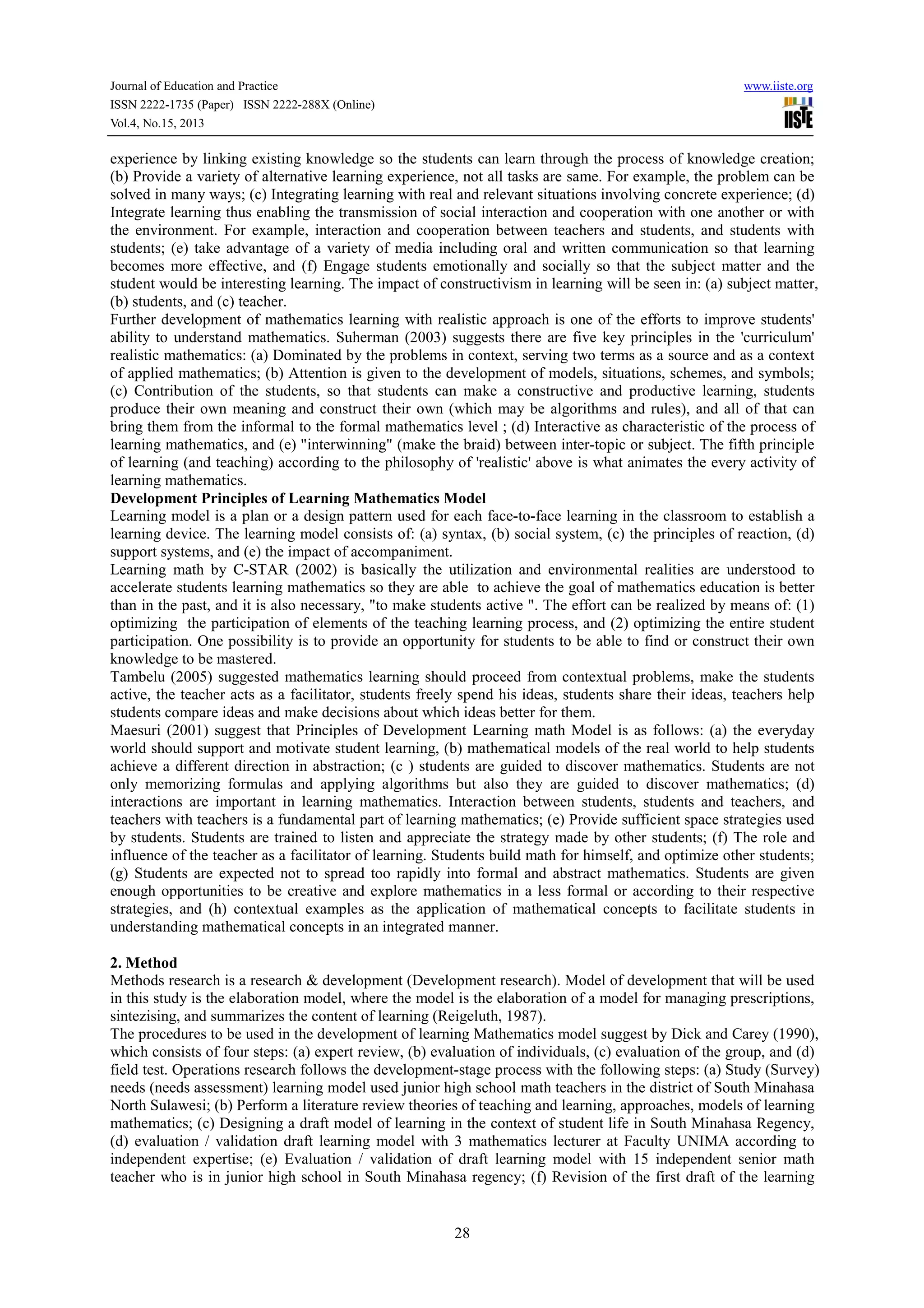
experience by linking existing knowledge so the students can learn through the process of knowledge creation;
(b) Provide a variety of alternative learning experience, not all tasks are same. For example, the problem can be
solved in many ways; (c) Integrating learning with real and relevant situations involving concrete experience; (d)
Integrate learning thus enabling the transmission of social interaction and cooperation with one another or with
the environment. For example, interaction and cooperation between teachers and students, and students with
students; (e) take advantage of a variety of media including oral and written communication so that learning
becomes more effective, and (f) Engage students emotionally and socially so that the subject matter and the
student would be interesting learning. The impact of constructivism in learning will be seen in: (a) subject matter,
(b) students, and (c) teacher.
Further development of mathematics learning with realistic approach is one of the efforts to improve students'
ability to understand mathematics. Suherman (2003) suggests there are five key principles in the 'curriculum'
realistic mathematics: (a) Dominated by the problems in context, serving two terms as a source and as a context
of applied mathematics; (b) Attention is given to the development of models, situations, schemes, and symbols;
(c) Contribution of the students, so that students can make a constructive and productive learning, students
produce their own meaning and construct their own (which may be algorithms and rules), and all of that can
bring them from the informal to the formal mathematics level ; (d) Interactive as characteristic of the process of
learning mathematics, and (e) "interwinning" (make the braid) between inter-topic or subject. The fifth principle
of learning (and teaching) according to the philosophy of 'realistic' above is what animates the every activity of
learning mathematics.
Development Principles of Learning Mathematics Model
Learning model is a plan or a design pattern used for each face-to-face learning in the classroom to establish a
learning device. The learning model consists of: (a) syntax, (b) social system, (c) the principles of reaction, (d)
support systems, and (e) the impact of accompaniment.
Learning math by C-STAR (2002) is basically the utilization and environmental realities are understood to
accelerate students learning mathematics so they are able to achieve the goal of mathematics education is better
than in the past, and it is also necessary, "to make students active ". The effort can be realized by means of: (1)
optimizing the participation of elements of the teaching learning process, and (2) optimizing the entire student
participation. One possibility is to provide an opportunity for students to be able to find or construct their own
knowledge to be mastered.
Tambelu (2005) suggested mathematics learning should proceed from contextual problems, make the students
active, the teacher acts as a facilitator, students freely spend his ideas, students share their ideas, teachers help
students compare ideas and make decisions about which ideas better for them.
Maesuri (2001) suggest that Principles of Development Learning math Model is as follows: (a) the everyday
world should support and motivate student learning, (b) mathematical models of the real world to help students
achieve a different direction in abstraction; (c ) students are guided to discover mathematics. Students are not
only memorizing formulas and applying algorithms but also they are guided to discover mathematics; (d)
interactions are important in learning mathematics. Interaction between students, students and teachers, and
teachers with teachers is a fundamental part of learning mathematics; (e) Provide sufficient space strategies used
by students. Students are trained to listen and appreciate the strategy made by other students; (f) The role and
influence of the teacher as a facilitator of learning. Students build math for himself, and optimize other students;
(g) Students are expected not to spread too rapidly into formal and abstract mathematics. Students are given
enough opportunities to be creative and explore mathematics in a less formal or according to their respective
strategies, and (h) contextual examples as the application of mathematical concepts to facilitate students in
understanding mathematical concepts in an integrated manner.
2. Method
Methods research is a research & development (Development research). Model of development that will be used
in this study is the elaboration model, where the model is the elaboration of a model for managing prescriptions,
sintezising, and summarizes the content of learning (Reigeluth, 1987).
The procedures to be used in the development of learning Mathematics model suggest by Dick and Carey (1990),
which consists of four steps: (a) expert review, (b) evaluation of individuals, (c) evaluation of the group, and (d)
field test. Operations research follows the development-stage process with the following steps: (a) Study (Survey)
needs (needs assessment) learning model used junior high school math teachers in the district of South Minahasa
North Sulawesi; (b) Perform a literature review theories of teaching and learning, approaches, models of learning
mathematics; (c) Designing a draft model of learning in the context of student life in South Minahasa Regency,
(d) evaluation / validation draft learning model with 3 mathematics lecturer at Faculty UNIMA according to
independent expertise; (e) Evaluation / validation of draft learning model with 15 independent senior math
teacher who is in junior high school in South Minahasa regency; (f) Revision of the first draft of the learning
Journal of Education and Practice www.iiste.org
ISSN 2222-1735 (Paper) ISSN 2222-288X (Online)
Vol.4, No.15, 2013
29
model validation results; (g) Evaluation / validation 3 draft learning model with mathematics lecturer at the
faculty of UNIMA range of expertise in the group; (h) Evaluation / validation of draft learning model with 1
group of senior math teacher every group of 10 people; (i) Revision II draft learning model validation results,
and (j) Finalization of draft learning model is developed.
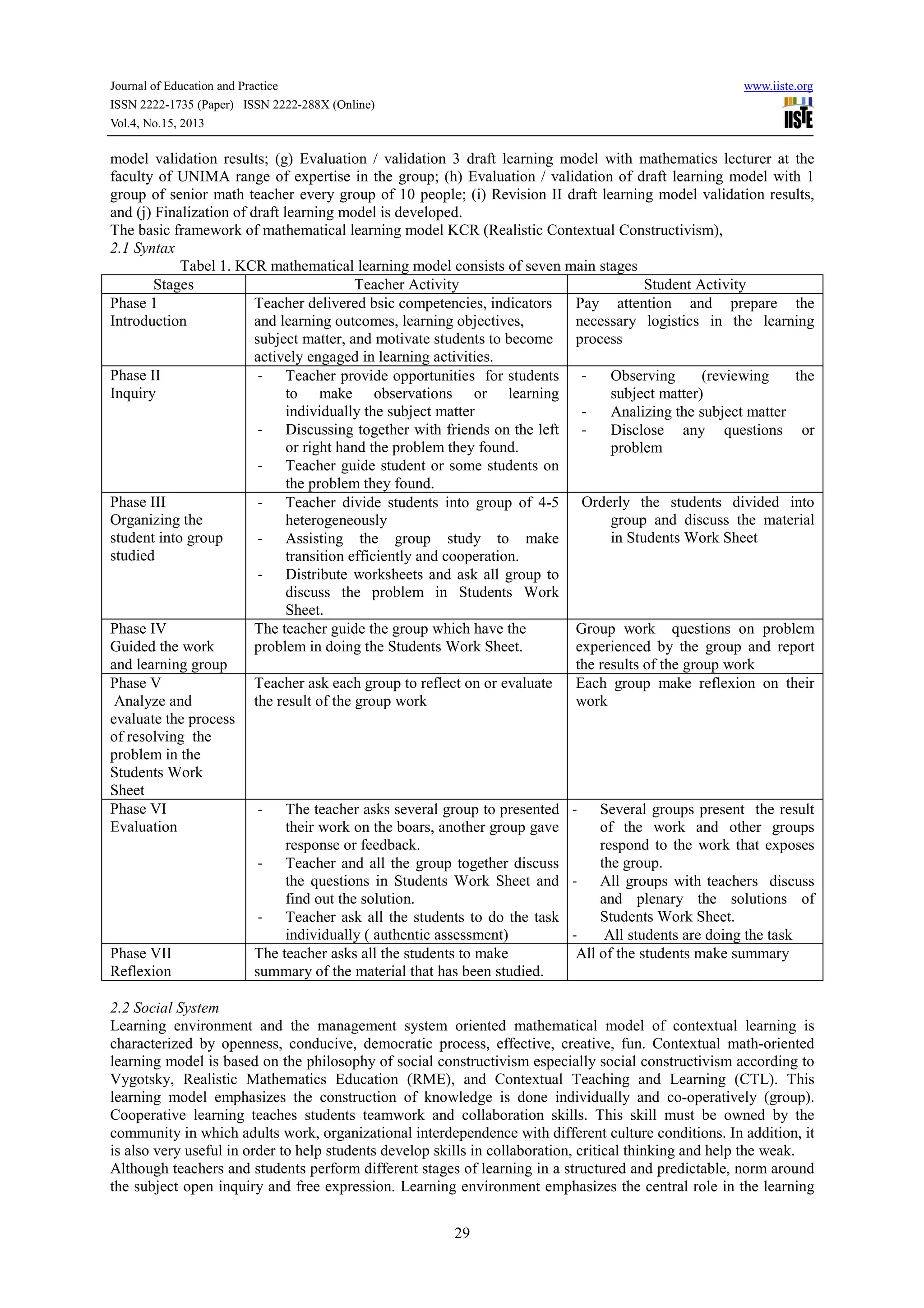
The basic framework of mathematical learning model KCR (Realistic Contextual Constructivism),
2.1 Syntax
Tabel 1. KCR mathematical learning model consists of seven main stages
Stages Teacher Activity Student Activity
Phase 1
Introduction
Teacher delivered bsic competencies, indicators
and learning outcomes, learning objectives,
subject matter, and motivate students to become
actively engaged in learning activities.
Pay attention and prepare the
necessary logistics in the learning
process
Phase II
Inquiry
- Teacher provide opportunities for students
to make observations or learning
individually the subject matter
- Discussing together with friends on the left
or right hand the problem they found.
- Teacher guide student or some students on
the problem they found.
- Observing (reviewing the
subject matter)
- Analizing the subject matter
- Disclose any questions or
problem
Phase III
Organizing the
student into group
studied
- Teacher divide students into group of 4-5
heterogeneously
- Assisting the group study to make
transition efficiently and cooperation.
- Distribute worksheets and ask all group to
discuss the problem in Students Work
Sheet.
Orderly the students divided into
group and discuss the material
in Students Work Sheet
Phase IV
Guided the work
and learning group
The teacher guide the group which have the
problem in doing the Students Work Sheet.
Group work questions on problem
experienced by the group and report
the results of the group work
Phase V
Analyze and
evaluate the process
of resolving the
problem in the
Students Work
Sheet
Teacher ask each group to reflect on or evaluate
the result of the group work
Each group make reflexion on their
work
Phase VI
Evaluation
- The teacher asks several group to presented
their work on the boars, another group gave
response or feedback.
- Teacher and all the group together discuss
the questions in Students Work Sheet and
find out the solution.
- Teacher ask all the students to do the task
individually ( authentic assessment)
- Several groups present the result
of the work and other groups
respond to the work that exposes
the group.
- All groups with teachers discuss
and plenary the solutions of
Students Work Sheet.
- All students are doing the task
Phase VII
Reflexion
The teacher asks all the students to make
summary of the material that has been studied.
All of the students make summary
2.2 Social System
Learning environment and the management system oriented mathematical model of contextual learning is
characterized by openness, conducive, democratic process, effective, creative, fun. Contextual math-oriented
learning model is based on the philosophy of social constructivism especially social constructivism according to
Vygotsky, Realistic Mathematics Education (RME), and Contextual Teaching and Learning (CTL). This
learning model emphasizes the construction of knowledge is done individually and co-operatively (group).
Cooperative learning teaches students teamwork and collaboration skills. This skill must be owned by the
community in which adults work, organizational interdependence with different culture conditions. In addition, it
is also very useful in order to help students develop skills in collaboration, critical thinking and help the weak.
Although teachers and students perform different stages of learning in a structured and predictable, norm around
the subject open inquiry and free expression. Learning environment emphasizes the central role in the learning
Journal of Education and Practice www.iiste.org
ISSN 2222-1735 (Paper) ISSN 2222-288X (Online)
Vol.4, No.15, 2013
30
process.
2.3 Reaction Principle
During the learning process, teachers should act as facilitators and mentors, which provides assistance to
students / groups who have difficulty in solving problems. Some important things to be done in the function of
teachers as facilitators and mentors are students mindset examine differences related to the process of resolving
questions / issues that do and coaching is done on the troubled group by asking inverse (the Leading Question,
Guiding Question, or Clarifying Question).
2.4 Support System
Learning model is supported by: (1) math teachers trained, (2) a collection of mathematics themes , (3) theories
of learning and teaching and contextual math problems, (4) lesson plans, (5) Students Work Sheet that contains
contextual math problems, and (6) achievement learning test instrument.
2.5 Impact of Instructional and Accompaniment
Learning model developed in this study have instructional for students. Instructional impact of this form of
mathematical competence among other achievements include:
(1) Understand the concepts of mathematics as well as its association with one another
(2) Understand the usefulness of mathematical concepts
(3) Select and make the process of problem solving strategies / issues
(4) Identify and look back at the reasons why solutions and procedures to the right solution.
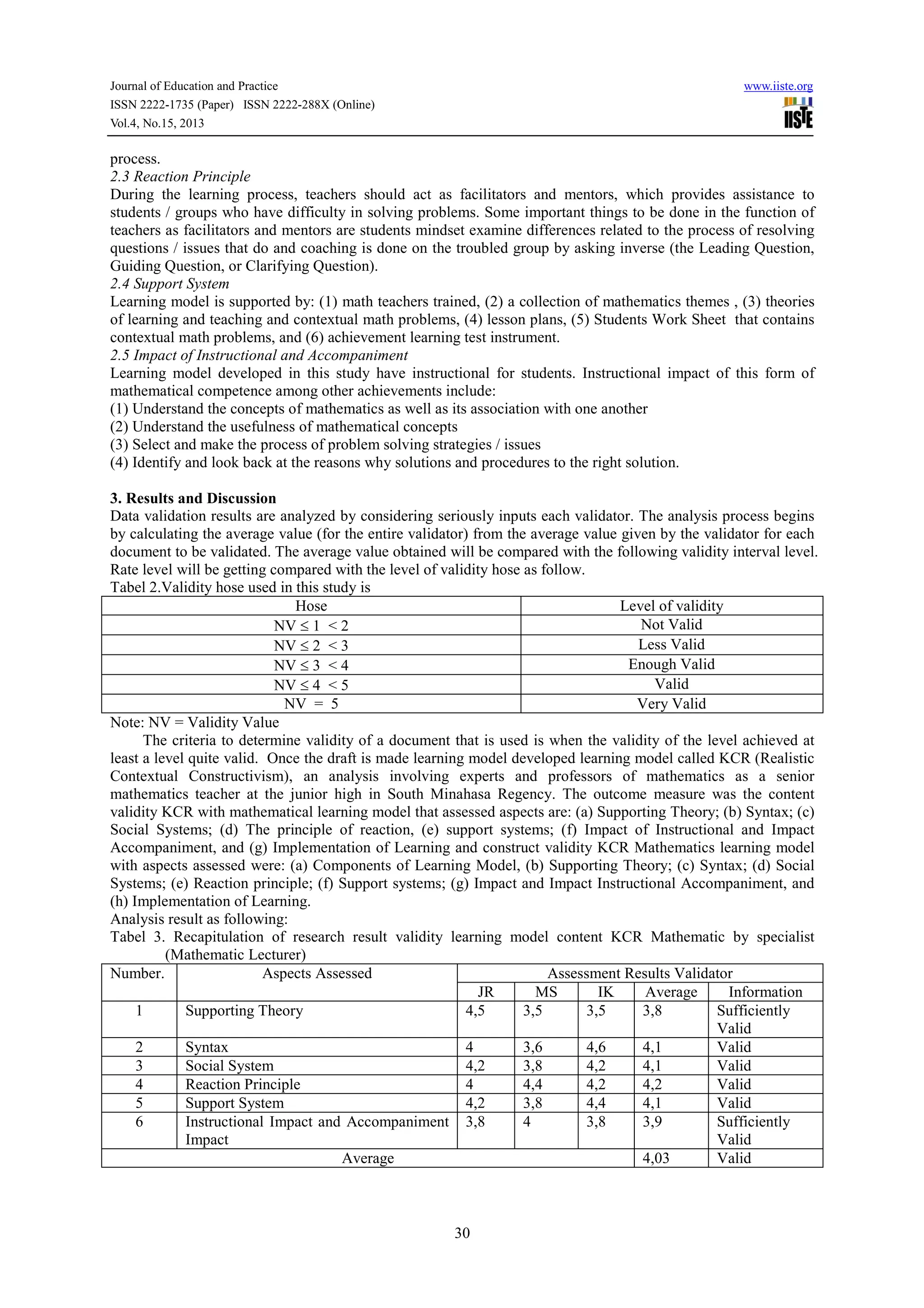
3. Results and Discussion
Data validation results are analyzed by considering seriously inputs each validator. The analysis process begins
by calculating the average value (for the entire validator) from the average value given by the validator for each
document to be validated. The average value obtained will be compared with the following validity interval level.
Rate level will be getting compared with the level of validity hose as follow.
Tabel 2.Validity hose used in this study is
Hose Level of validity
NV ≤ 1 < 2 Not Valid
NV ≤ 2 < 3 Less Valid
NV ≤ 3 < 4 Enough Valid
NV ≤ 4 < 5 Valid
NV = 5 Very Valid
Note: NV = Validity Value
The criteria to determine validity of a document that is used is when the validity of the level achieved at
least a level quite valid. Once the draft is made learning model developed learning model called KCR (Realistic
Contextual Constructivism), an analysis involving experts and professors of mathematics as a senior
mathematics teacher at the junior high in South Minahasa Regency. The outcome measure was the content
validity KCR with mathematical learning model that assessed aspects are: (a) Supporting Theory; (b) Syntax; (c)
Social Systems; (d) The principle of reaction, (e) support systems; (f) Impact of Instructional and Impact
Accompaniment, and (g) Implementation of Learning and construct validity KCR Mathematics learning model
with aspects assessed were: (a) Components of Learning Model, (b) Supporting Theory; (c) Syntax; (d) Social
Systems; (e) Reaction principle; (f) Support systems; (g) Impact and Impact Instructional Accompaniment, and
(h) Implementation of Learning.
Analysis result as following:
Tabel 3. Recapitulation of research result validity learning model content KCR Mathematic by specialist
(Mathematic Lecturer)
Number. Aspects Assessed Assessment Results Validator
JR MS IK Average Information
1 Supporting Theory 4,5 3,5 3,5 3,8 Sufficiently
Valid
2 Syntax 4 3,6 4,6 4,1 Valid
3 Social System 4,2 3,8 4,2 4,1 Valid
4 Reaction Principle 4 4,4 4,2 4,2 Valid
5 Support System 4,2 3,8 4,4 4,1 Valid
6 Instructional Impact and Accompaniment
Impact
3,8 4 3,8 3,9 Sufficiently
Valid
Average 4,03 Valid
Journal of Education and Practice www.iiste.org
ISSN 2222-1735 (Paper) ISSN 2222-288X (Online)
Vol.4, No.15, 2013
31
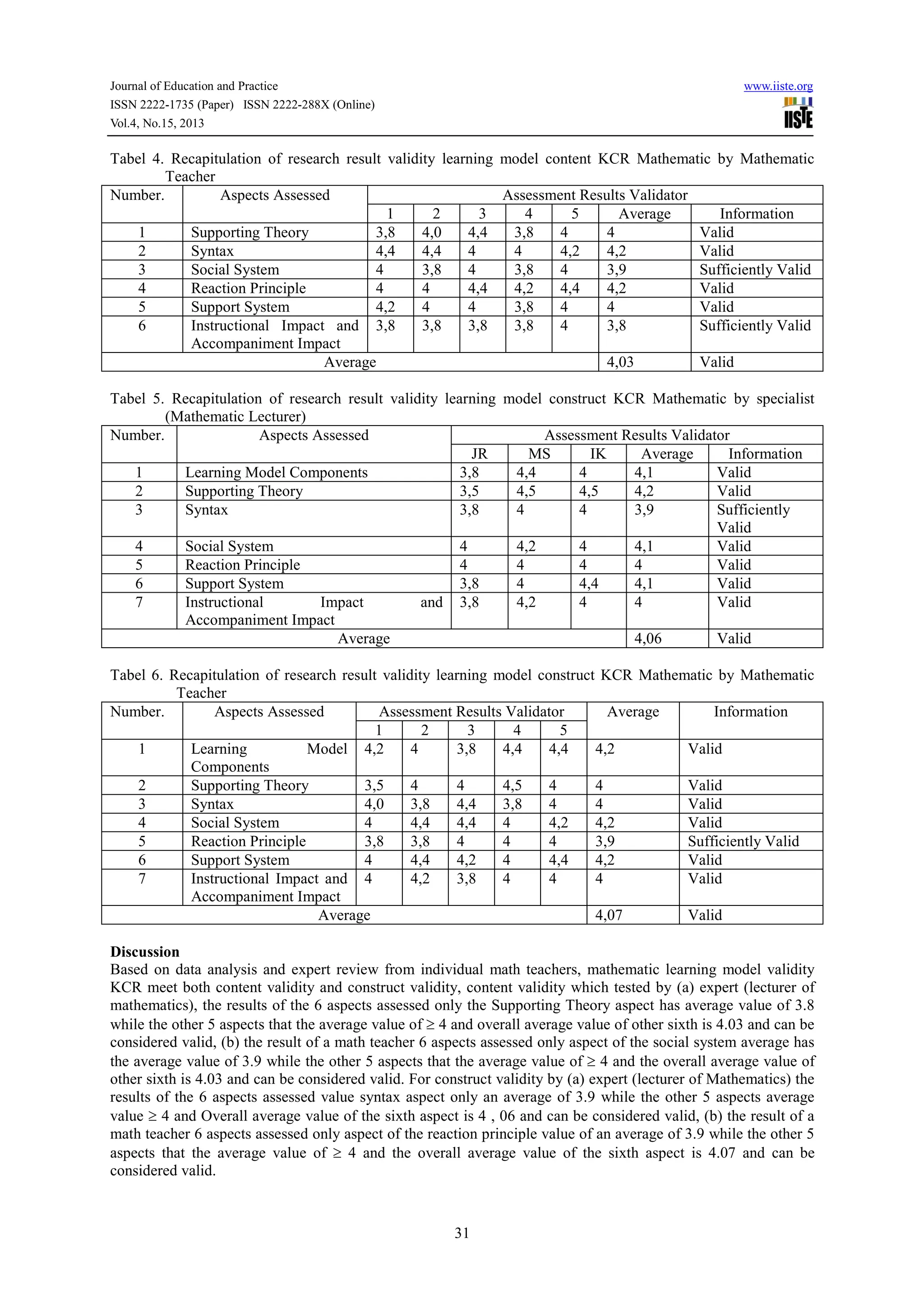
Tabel 4. Recapitulation of research result validity learning model content KCR Mathematic by Mathematic
Teacher
Number. Aspects Assessed Assessment Results Validator
1 2 3 4 5 Average Information
1 Supporting Theory 3,8 4,0 4,4 3,8 4 4 Valid
2 Syntax 4,4 4,4 4 4 4,2 4,2 Valid
3 Social System 4 3,8 4 3,8 4 3,9 Sufficiently Valid
4 Reaction Principle 4 4 4,4 4,2 4,4 4,2 Valid
5 Support System 4,2 4 4 3,8 4 4 Valid
6 Instructional Impact and
Accompaniment Impact
3,8 3,8 3,8 3,8 4 3,8 Sufficiently Valid
Average 4,03 Valid
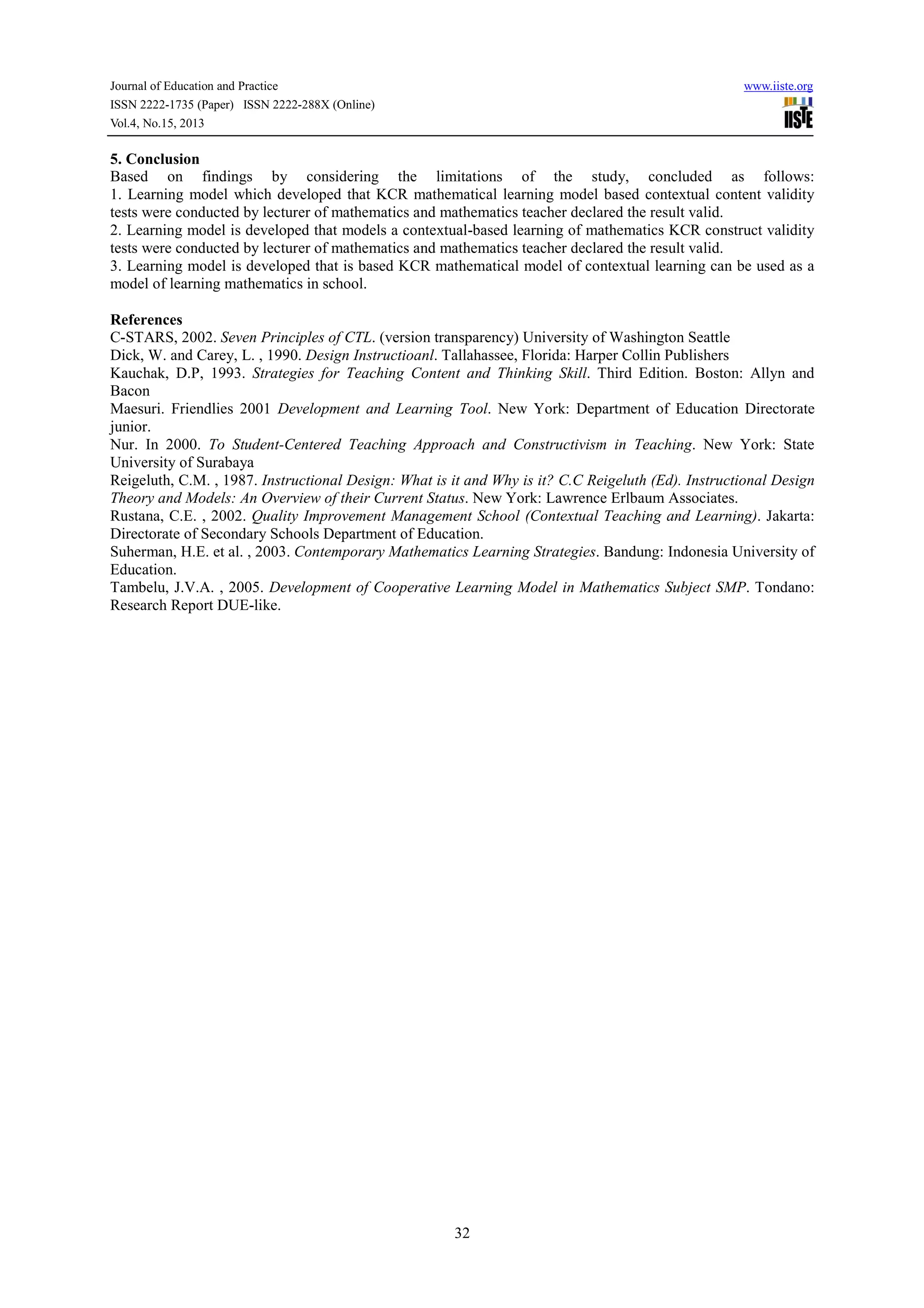
Tabel 5. Recapitulation of research result validity learning model construct KCR Mathematic by specialist
(Mathematic Lecturer)
Number. Aspects Assessed Assessment Results Validator
JR MS IK Average Information
1 Learning Model Components 3,8 4,4 4 4,1 Valid
2 Supporting Theory 3,5 4,5 4,5 4,2 Valid
3 Syntax 3,8 4 4 3,9 Sufficiently
Valid
4 Social System 4 4,2 4 4,1 Valid
5 Reaction Principle 4 4 4 4 Valid
6 Support System 3,8 4 4,4 4,1 Valid
7 Instructional Impact and
Accompaniment Impact
3,8 4,2 4 4 Valid
Average 4,06 Valid
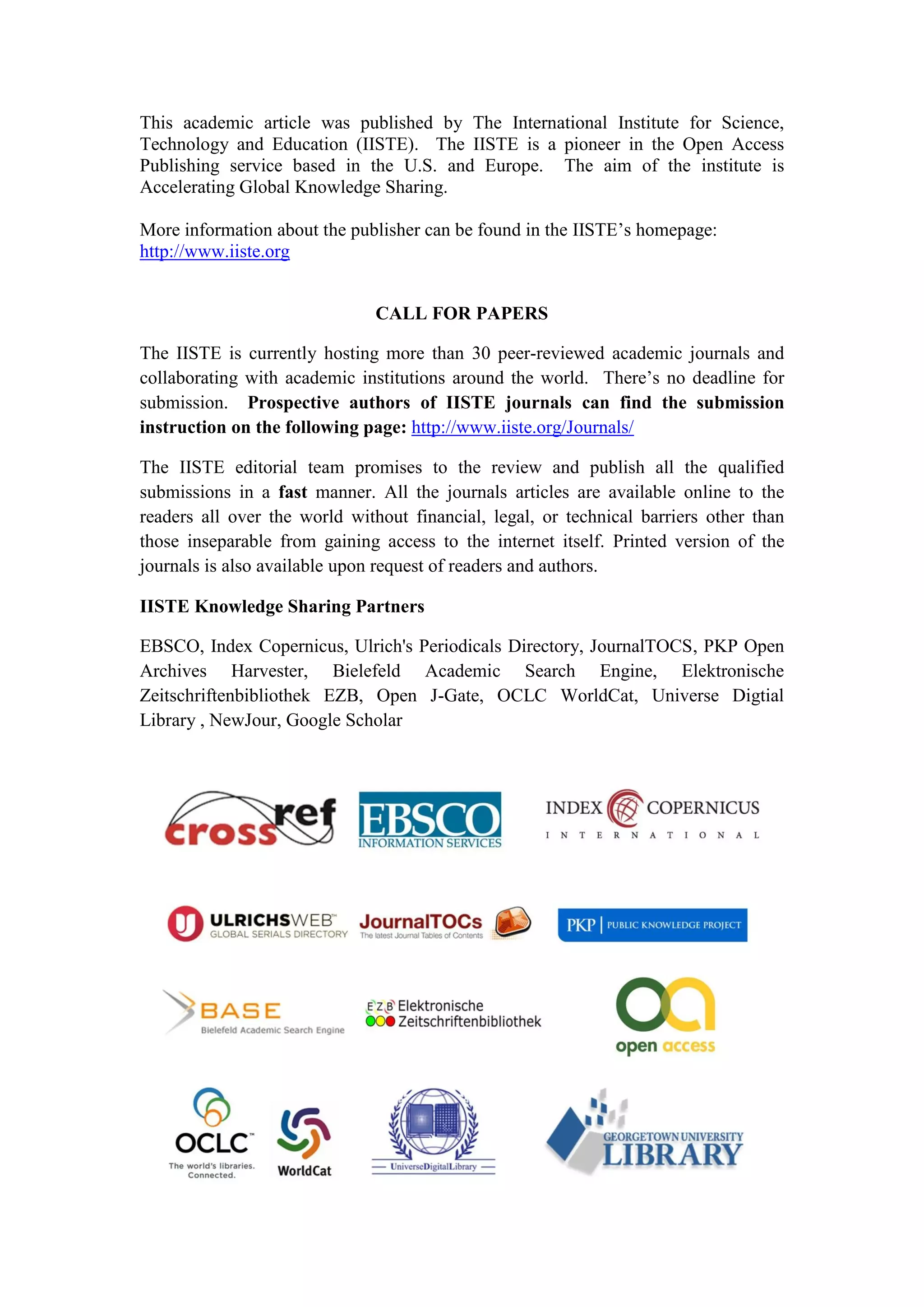
Tabel 6. Recapitulation of research result validity learning model construct KCR Mathematic by Mathematic
Teacher
Number. Aspects Assessed Assessment Results Validator Average Information
1 2 3 4 5
1 Learning Model
Components
4,2 4 3,8 4,4 4,4 4,2 Valid
2 Supporting Theory 3,5 4 4 4,5 4 4 Valid
3 Syntax 4,0 3,8 4,4 3,8 4 4 Valid
4 Social System 4 4,4 4,4 4 4,2 4,2 Valid
5 Reaction Principle 3,8 3,8 4 4 4 3,9 Sufficiently Valid
6 Support System 4 4,4 4,2 4 4,4 4,2 Valid
7 Instructional Impact and
Accompaniment Impact
4 4,2 3,8 4 4 4 Valid
Average 4,07 Valid
Discussion
Based on data analysis and expert review from individual math teachers, mathematic learning model validity
KCR meet both content validity and construct validity, content validity which tested by (a) expert (lecturer of
mathematics), the results of the 6 aspects assessed only the Supporting Theory aspect has average value of 3.8
while the other 5 aspects that the average value of ≥ 4 and overall average value of other sixth is 4.03 and can be
considered valid, (b) the result of a math teacher 6 aspects assessed only aspect of the social system average has
the average value of 3.9 while the other 5 aspects that the average value of ≥ 4 and the overall average value of
other sixth is 4.03 and can be considered valid. For construct validity by (a) expert (lecturer of Mathematics) the
results of the 6 aspects assessed value syntax aspect only an average of 3.9 while the other 5 aspects average
value ≥ 4 and Overall average value of the sixth aspect is 4 , 06 and can be considered valid, (b) the result of a
math teacher 6 aspects assessed only aspect of the reaction principle value of an average of 3.9 while the other 5
aspects that the average value of ≥ 4 and the overall average value of the sixth aspect is 4.07 and can be
considered valid.
Journal of Education and Practice www.iiste.org
ISSN 2222-1735 (Paper) ISSN 2222-288X (Online)
Vol.4, No.15, 2013
32
5. Conclusion
Based on findings by considering the limitations of the study, concluded as follows:
1. Learning model which developed that KCR mathematical learning model based contextual content validity
tests were conducted by lecturer of mathematics and mathematics teacher declared the result valid.
2. Learning model is developed that models a contextual-based learning of mathematics KCR construct validity
tests were conducted by lecturer of mathematics and mathematics teacher declared the result valid.
3. Learning model is developed that is based KCR mathematical model of contextual learning can be used as a
model of learning mathematics in school.
References
C-STARS, 2002. Seven Principles of CTL. (version transparency) University of Washington Seattle
Dick, W. and Carey, L. , 1990. Design Instructioanl. Tallahassee, Florida: Harper Collin Publishers
Kauchak, D.P, 1993. Strategies for Teaching Content and Thinking Skill. Third Edition. Boston: Allyn and
Bacon
Maesuri. Friendlies 2001 Development and Learning Tool. New York: Department of Education Directorate
junior.
Nur. In 2000. To Student-Centered Teaching Approach and Constructivism in Teaching. New York: State
University of Surabaya
Reigeluth, C.M. , 1987. Instructional Design: What is it and Why is it? C.C Reigeluth (Ed). Instructional Design
Theory and Models: An Overview of their Current Status. New York: Lawrence Erlbaum Associates.
Rustana, C.E. , 2002. Quality Improvement Management School (Contextual Teaching and Learning). Jakarta:
Directorate of Secondary Schools Department of Education.
Suherman, H.E. et al. , 2003. Contemporary Mathematics Learning Strategies. Bandung: Indonesia University of
Education.
Tambelu, J.V.A. , 2005. Development of Cooperative Learning Model in Mathematics Subject SMP. Tondano:
Research Report DUE-like.
This academic article was published by The International Institute for Science,
Technology and Education (IISTE). The IISTE is a pioneer in the Open Access
Publishing service based in the U.S. and Europe. The aim of the institute is
Accelerating Global Knowledge Sharing.
More information about the publisher can be found in the IISTE’s homepage:
http://www.iiste.org
CALL FOR PAPERS
The IISTE is currently hosting more than 30 peer-reviewed academic journals and
collaborating with academic institutions around the world. There’s no deadline for
submission. Prospective authors of IISTE journals can find the submission
instruction on the following page: http://www.iiste.org/Journals/
The IISTE editorial team promises to the review and publish all the qualified
submissions in a fast manner. All the journals articles are available online to the
readers all over the world without financial, legal, or technical barriers other than
those inseparable from gaining access to the internet itself. Printed version of the
journals is also available upon request of readers and authors.
IISTE Knowledge Sharing Partners
EBSCO, Index Copernicus, Ulrich's Periodicals Directory, JournalTOCS, PKP Open
Archives Harvester, Bielefeld Academic Search Engine, Elektronische
Zeitschriftenbibliothek EZB, Open J-Gate, OCLC WorldCat, Universe Digtial
Library , NewJour, Google Scholar

Development of mathematical learning based contextual model in south minahasa regency

  • 1.
    Journal of Educationand Practice www.iiste.org ISSN 2222-1735 (Paper) ISSN 2222-288X (Online) Vol.4, No.15, 2013 27 Development of Mathematical Learning Based Contextual Model in South Minahasa Regency Jackson V.A. Tambelu Department of Mathematics Faculty of Mathematics and Natural Sciences Manado State University. North Sulawesi. Indonesia E-mail of the corresponding author: jackson_tambelu@yahoo.co.id Abstract The objectives of this research is to develop a mathematical model of learning based on constructivist learning approach theory, Contextual Teaching and Learning, and Realistic Mathematics Education (RME). Learning model is a plan or a design pattern used for each face-to-face learning in the classroom to establish a learning device. Learning model consists of: (a) syntax, (b) social system, (c) the principles of reaction, (d) support systems, and (e) the impact of accompaniment. The research method used in this research is development research. The development model used is the elaboration model. The development procedure refers to the opinion of Dick and Carey. They are: (1) expert review, (2) Individual evaluation, (3) evaluation of the group, and (4) the trial court. Results of data analysis got : (1) self-assessment: (a) validation of content-based mathematical learning model constructivism, Contextual, and Realistic (KCR), the average assessment validator (3 lecturers) was 3.85 (quite valid); ( b) construct validation KCR mathematical learning model, the average assessment validator (3 lecturers) was 3.67 (quite valid), (c) content validation KCR mathematical learning model, the average assessment validator (5 math teachers) is 3, 91 (quite valid), (d) validation KCR construct mathematical learning model, the average assessment validator (5 mathematics teacher) was 3.89 (quite valid), (2) Ratings In Group: (a) the contents of the model validation study of mathematics KCR, the average assessment validator (3 teachers and 5 mathematics teacher) was 4.0 (valid), (b) construct validation KCR mathematical learning model, the average assessment validator (3 teachers and 5 math teacher) is 3.85 (quite valid). Based on the criteria, developed learning model is valid. Keywords: Development, modeling, mathematics learning, based contextual 1. Introduction Effort to create a good learning process, will require the knowledge and skills of teachers regarding the approach / model / learning methods to suit the characteristics of the subject matter. One of the problems facing by the math teacher today is almost all of them are math teacher in junior high school who are university graduates under the year 2000, so that the theoretical concept of learning approaches and new models or methods developed from existing theories have not previously applied in the classroom and be understood. Contextual learning aims to provide students with knowledge that can be flexibly applied (transferred) from one problem to another and from one context to another. It is important in contextual learning in which students really learn from the beginning of knowledge, experiencing, and the context of their daily lives are linked to the concept of subjects studied in class, and then it is possible to implement in their daily lives. In other words CTL approach has the principle of "bring them from their world to our world, then ; take them from our world back to their world" so that students really get to know not only the value but also they appreciate it and the most important thing that they should be able to actualize / practice it. (Rustana, 2002). Approach Learning in Contextual Teaching and Learning , C-STARS (2002) suggested (a) Contextual Teaching and Learning (CTL), is a conception helps teachers connect content learning materials with real situations and motivates students to make connections between knowledge and its application to the their lives as family members, citizens, and labor; (b) Contextual learning is learning that takes place in a close relationship with actual experience, (c) learning only occurs when students process new information or knowledge in such a way that they seem reasonable and accordance with the frame of mind that is owned (memories, experiences, and responses). Contextual understanding does not mean physically concrete and visible, but also includes the child's mind could imagine. So the real world is still far also contain contextual meanings with prior knowledge of students. There are 7 principles / CTL pillars namely: (a) Inquiry; (b) question, (c) Constructivism; (d) Community Learning; (e) Reflection, (f) Modeling, and (g) Authentic Assessment Meanwhile, in the view of constructivism learning is characterized as follows: (a) Students are actively involved in their learning. Students learn the material significantly by working and thinking. So students learn how to learn it; (b) New information must be linked with other information so that it blends with the scheme so that students have an understanding of the complex information (materials) occurred, (c) learning orientation is investigation and discovery that is basically problem solving. The implications of the above characteristic , learning should be sought as follows: (a) Provide a learning
  • 2.
    Journal of Educationand Practice www.iiste.org ISSN 2222-1735 (Paper) ISSN 2222-288X (Online) Vol.4, No.15, 2013 28 experience by linking existing knowledge so the students can learn through the process of knowledge creation; (b) Provide a variety of alternative learning experience, not all tasks are same. For example, the problem can be solved in many ways; (c) Integrating learning with real and relevant situations involving concrete experience; (d) Integrate learning thus enabling the transmission of social interaction and cooperation with one another or with the environment. For example, interaction and cooperation between teachers and students, and students with students; (e) take advantage of a variety of media including oral and written communication so that learning becomes more effective, and (f) Engage students emotionally and socially so that the subject matter and the student would be interesting learning. The impact of constructivism in learning will be seen in: (a) subject matter, (b) students, and (c) teacher. Further development of mathematics learning with realistic approach is one of the efforts to improve students' ability to understand mathematics. Suherman (2003) suggests there are five key principles in the 'curriculum' realistic mathematics: (a) Dominated by the problems in context, serving two terms as a source and as a context of applied mathematics; (b) Attention is given to the development of models, situations, schemes, and symbols; (c) Contribution of the students, so that students can make a constructive and productive learning, students produce their own meaning and construct their own (which may be algorithms and rules), and all of that can bring them from the informal to the formal mathematics level ; (d) Interactive as characteristic of the process of learning mathematics, and (e) "interwinning" (make the braid) between inter-topic or subject. The fifth principle of learning (and teaching) according to the philosophy of 'realistic' above is what animates the every activity of learning mathematics. Development Principles of Learning Mathematics Model Learning model is a plan or a design pattern used for each face-to-face learning in the classroom to establish a learning device. The learning model consists of: (a) syntax, (b) social system, (c) the principles of reaction, (d) support systems, and (e) the impact of accompaniment. Learning math by C-STAR (2002) is basically the utilization and environmental realities are understood to accelerate students learning mathematics so they are able to achieve the goal of mathematics education is better than in the past, and it is also necessary, "to make students active ". The effort can be realized by means of: (1) optimizing the participation of elements of the teaching learning process, and (2) optimizing the entire student participation. One possibility is to provide an opportunity for students to be able to find or construct their own knowledge to be mastered. Tambelu (2005) suggested mathematics learning should proceed from contextual problems, make the students active, the teacher acts as a facilitator, students freely spend his ideas, students share their ideas, teachers help students compare ideas and make decisions about which ideas better for them. Maesuri (2001) suggest that Principles of Development Learning math Model is as follows: (a) the everyday world should support and motivate student learning, (b) mathematical models of the real world to help students achieve a different direction in abstraction; (c ) students are guided to discover mathematics. Students are not only memorizing formulas and applying algorithms but also they are guided to discover mathematics; (d) interactions are important in learning mathematics. Interaction between students, students and teachers, and teachers with teachers is a fundamental part of learning mathematics; (e) Provide sufficient space strategies used by students. Students are trained to listen and appreciate the strategy made by other students; (f) The role and influence of the teacher as a facilitator of learning. Students build math for himself, and optimize other students; (g) Students are expected not to spread too rapidly into formal and abstract mathematics. Students are given enough opportunities to be creative and explore mathematics in a less formal or according to their respective strategies, and (h) contextual examples as the application of mathematical concepts to facilitate students in understanding mathematical concepts in an integrated manner. 2. Method Methods research is a research & development (Development research). Model of development that will be used in this study is the elaboration model, where the model is the elaboration of a model for managing prescriptions, sintezising, and summarizes the content of learning (Reigeluth, 1987). The procedures to be used in the development of learning Mathematics model suggest by Dick and Carey (1990), which consists of four steps: (a) expert review, (b) evaluation of individuals, (c) evaluation of the group, and (d) field test. Operations research follows the development-stage process with the following steps: (a) Study (Survey) needs (needs assessment) learning model used junior high school math teachers in the district of South Minahasa North Sulawesi; (b) Perform a literature review theories of teaching and learning, approaches, models of learning mathematics; (c) Designing a draft model of learning in the context of student life in South Minahasa Regency, (d) evaluation / validation draft learning model with 3 mathematics lecturer at Faculty UNIMA according to independent expertise; (e) Evaluation / validation of draft learning model with 15 independent senior math teacher who is in junior high school in South Minahasa regency; (f) Revision of the first draft of the learning
  • 3.
    Journal of Educationand Practice www.iiste.org ISSN 2222-1735 (Paper) ISSN 2222-288X (Online) Vol.4, No.15, 2013 29 model validation results; (g) Evaluation / validation 3 draft learning model with mathematics lecturer at the faculty of UNIMA range of expertise in the group; (h) Evaluation / validation of draft learning model with 1 group of senior math teacher every group of 10 people; (i) Revision II draft learning model validation results, and (j) Finalization of draft learning model is developed. The basic framework of mathematical learning model KCR (Realistic Contextual Constructivism), 2.1 Syntax Tabel 1. KCR mathematical learning model consists of seven main stages Stages Teacher Activity Student Activity Phase 1 Introduction Teacher delivered bsic competencies, indicators and learning outcomes, learning objectives, subject matter, and motivate students to become actively engaged in learning activities. Pay attention and prepare the necessary logistics in the learning process Phase II Inquiry - Teacher provide opportunities for students to make observations or learning individually the subject matter - Discussing together with friends on the left or right hand the problem they found. - Teacher guide student or some students on the problem they found. - Observing (reviewing the subject matter) - Analizing the subject matter - Disclose any questions or problem Phase III Organizing the student into group studied - Teacher divide students into group of 4-5 heterogeneously - Assisting the group study to make transition efficiently and cooperation. - Distribute worksheets and ask all group to discuss the problem in Students Work Sheet. Orderly the students divided into group and discuss the material in Students Work Sheet Phase IV Guided the work and learning group The teacher guide the group which have the problem in doing the Students Work Sheet. Group work questions on problem experienced by the group and report the results of the group work Phase V Analyze and evaluate the process of resolving the problem in the Students Work Sheet Teacher ask each group to reflect on or evaluate the result of the group work Each group make reflexion on their work Phase VI Evaluation - The teacher asks several group to presented their work on the boars, another group gave response or feedback. - Teacher and all the group together discuss the questions in Students Work Sheet and find out the solution. - Teacher ask all the students to do the task individually ( authentic assessment) - Several groups present the result of the work and other groups respond to the work that exposes the group. - All groups with teachers discuss and plenary the solutions of Students Work Sheet. - All students are doing the task Phase VII Reflexion The teacher asks all the students to make summary of the material that has been studied. All of the students make summary 2.2 Social System Learning environment and the management system oriented mathematical model of contextual learning is characterized by openness, conducive, democratic process, effective, creative, fun. Contextual math-oriented learning model is based on the philosophy of social constructivism especially social constructivism according to Vygotsky, Realistic Mathematics Education (RME), and Contextual Teaching and Learning (CTL). This learning model emphasizes the construction of knowledge is done individually and co-operatively (group). Cooperative learning teaches students teamwork and collaboration skills. This skill must be owned by the community in which adults work, organizational interdependence with different culture conditions. In addition, it is also very useful in order to help students develop skills in collaboration, critical thinking and help the weak. Although teachers and students perform different stages of learning in a structured and predictable, norm around the subject open inquiry and free expression. Learning environment emphasizes the central role in the learning
  • 4.
    Journal of Educationand Practice www.iiste.org ISSN 2222-1735 (Paper) ISSN 2222-288X (Online) Vol.4, No.15, 2013 30 process. 2.3 Reaction Principle During the learning process, teachers should act as facilitators and mentors, which provides assistance to students / groups who have difficulty in solving problems. Some important things to be done in the function of teachers as facilitators and mentors are students mindset examine differences related to the process of resolving questions / issues that do and coaching is done on the troubled group by asking inverse (the Leading Question, Guiding Question, or Clarifying Question). 2.4 Support System Learning model is supported by: (1) math teachers trained, (2) a collection of mathematics themes , (3) theories of learning and teaching and contextual math problems, (4) lesson plans, (5) Students Work Sheet that contains contextual math problems, and (6) achievement learning test instrument. 2.5 Impact of Instructional and Accompaniment Learning model developed in this study have instructional for students. Instructional impact of this form of mathematical competence among other achievements include: (1) Understand the concepts of mathematics as well as its association with one another (2) Understand the usefulness of mathematical concepts (3) Select and make the process of problem solving strategies / issues (4) Identify and look back at the reasons why solutions and procedures to the right solution. 3. Results and Discussion Data validation results are analyzed by considering seriously inputs each validator. The analysis process begins by calculating the average value (for the entire validator) from the average value given by the validator for each document to be validated. The average value obtained will be compared with the following validity interval level. Rate level will be getting compared with the level of validity hose as follow. Tabel 2.Validity hose used in this study is Hose Level of validity NV ≤ 1 < 2 Not Valid NV ≤ 2 < 3 Less Valid NV ≤ 3 < 4 Enough Valid NV ≤ 4 < 5 Valid NV = 5 Very Valid Note: NV = Validity Value The criteria to determine validity of a document that is used is when the validity of the level achieved at least a level quite valid. Once the draft is made learning model developed learning model called KCR (Realistic Contextual Constructivism), an analysis involving experts and professors of mathematics as a senior mathematics teacher at the junior high in South Minahasa Regency. The outcome measure was the content validity KCR with mathematical learning model that assessed aspects are: (a) Supporting Theory; (b) Syntax; (c) Social Systems; (d) The principle of reaction, (e) support systems; (f) Impact of Instructional and Impact Accompaniment, and (g) Implementation of Learning and construct validity KCR Mathematics learning model with aspects assessed were: (a) Components of Learning Model, (b) Supporting Theory; (c) Syntax; (d) Social Systems; (e) Reaction principle; (f) Support systems; (g) Impact and Impact Instructional Accompaniment, and (h) Implementation of Learning. Analysis result as following: Tabel 3. Recapitulation of research result validity learning model content KCR Mathematic by specialist (Mathematic Lecturer) Number. Aspects Assessed Assessment Results Validator JR MS IK Average Information 1 Supporting Theory 4,5 3,5 3,5 3,8 Sufficiently Valid 2 Syntax 4 3,6 4,6 4,1 Valid 3 Social System 4,2 3,8 4,2 4,1 Valid 4 Reaction Principle 4 4,4 4,2 4,2 Valid 5 Support System 4,2 3,8 4,4 4,1 Valid 6 Instructional Impact and Accompaniment Impact 3,8 4 3,8 3,9 Sufficiently Valid Average 4,03 Valid
  • 5.
    Journal of Educationand Practice www.iiste.org ISSN 2222-1735 (Paper) ISSN 2222-288X (Online) Vol.4, No.15, 2013 31 Tabel 4. Recapitulation of research result validity learning model content KCR Mathematic by Mathematic Teacher Number. Aspects Assessed Assessment Results Validator 1 2 3 4 5 Average Information 1 Supporting Theory 3,8 4,0 4,4 3,8 4 4 Valid 2 Syntax 4,4 4,4 4 4 4,2 4,2 Valid 3 Social System 4 3,8 4 3,8 4 3,9 Sufficiently Valid 4 Reaction Principle 4 4 4,4 4,2 4,4 4,2 Valid 5 Support System 4,2 4 4 3,8 4 4 Valid 6 Instructional Impact and Accompaniment Impact 3,8 3,8 3,8 3,8 4 3,8 Sufficiently Valid Average 4,03 Valid Tabel 5. Recapitulation of research result validity learning model construct KCR Mathematic by specialist (Mathematic Lecturer) Number. Aspects Assessed Assessment Results Validator JR MS IK Average Information 1 Learning Model Components 3,8 4,4 4 4,1 Valid 2 Supporting Theory 3,5 4,5 4,5 4,2 Valid 3 Syntax 3,8 4 4 3,9 Sufficiently Valid 4 Social System 4 4,2 4 4,1 Valid 5 Reaction Principle 4 4 4 4 Valid 6 Support System 3,8 4 4,4 4,1 Valid 7 Instructional Impact and Accompaniment Impact 3,8 4,2 4 4 Valid Average 4,06 Valid Tabel 6. Recapitulation of research result validity learning model construct KCR Mathematic by Mathematic Teacher Number. Aspects Assessed Assessment Results Validator Average Information 1 2 3 4 5 1 Learning Model Components 4,2 4 3,8 4,4 4,4 4,2 Valid 2 Supporting Theory 3,5 4 4 4,5 4 4 Valid 3 Syntax 4,0 3,8 4,4 3,8 4 4 Valid 4 Social System 4 4,4 4,4 4 4,2 4,2 Valid 5 Reaction Principle 3,8 3,8 4 4 4 3,9 Sufficiently Valid 6 Support System 4 4,4 4,2 4 4,4 4,2 Valid 7 Instructional Impact and Accompaniment Impact 4 4,2 3,8 4 4 4 Valid Average 4,07 Valid Discussion Based on data analysis and expert review from individual math teachers, mathematic learning model validity KCR meet both content validity and construct validity, content validity which tested by (a) expert (lecturer of mathematics), the results of the 6 aspects assessed only the Supporting Theory aspect has average value of 3.8 while the other 5 aspects that the average value of ≥ 4 and overall average value of other sixth is 4.03 and can be considered valid, (b) the result of a math teacher 6 aspects assessed only aspect of the social system average has the average value of 3.9 while the other 5 aspects that the average value of ≥ 4 and the overall average value of other sixth is 4.03 and can be considered valid. For construct validity by (a) expert (lecturer of Mathematics) the results of the 6 aspects assessed value syntax aspect only an average of 3.9 while the other 5 aspects average value ≥ 4 and Overall average value of the sixth aspect is 4 , 06 and can be considered valid, (b) the result of a math teacher 6 aspects assessed only aspect of the reaction principle value of an average of 3.9 while the other 5 aspects that the average value of ≥ 4 and the overall average value of the sixth aspect is 4.07 and can be considered valid.
  • 6.
    Journal of Educationand Practice www.iiste.org ISSN 2222-1735 (Paper) ISSN 2222-288X (Online) Vol.4, No.15, 2013 32 5. Conclusion Based on findings by considering the limitations of the study, concluded as follows: 1. Learning model which developed that KCR mathematical learning model based contextual content validity tests were conducted by lecturer of mathematics and mathematics teacher declared the result valid. 2. Learning model is developed that models a contextual-based learning of mathematics KCR construct validity tests were conducted by lecturer of mathematics and mathematics teacher declared the result valid. 3. Learning model is developed that is based KCR mathematical model of contextual learning can be used as a model of learning mathematics in school. References C-STARS, 2002. Seven Principles of CTL. (version transparency) University of Washington Seattle Dick, W. and Carey, L. , 1990. Design Instructioanl. Tallahassee, Florida: Harper Collin Publishers Kauchak, D.P, 1993. Strategies for Teaching Content and Thinking Skill. Third Edition. Boston: Allyn and Bacon Maesuri. Friendlies 2001 Development and Learning Tool. New York: Department of Education Directorate junior. Nur. In 2000. To Student-Centered Teaching Approach and Constructivism in Teaching. New York: State University of Surabaya Reigeluth, C.M. , 1987. Instructional Design: What is it and Why is it? C.C Reigeluth (Ed). Instructional Design Theory and Models: An Overview of their Current Status. New York: Lawrence Erlbaum Associates. Rustana, C.E. , 2002. Quality Improvement Management School (Contextual Teaching and Learning). Jakarta: Directorate of Secondary Schools Department of Education. Suherman, H.E. et al. , 2003. Contemporary Mathematics Learning Strategies. Bandung: Indonesia University of Education. Tambelu, J.V.A. , 2005. Development of Cooperative Learning Model in Mathematics Subject SMP. Tondano: Research Report DUE-like.
  • 7.
    This academic articlewas published by The International Institute for Science, Technology and Education (IISTE). The IISTE is a pioneer in the Open Access Publishing service based in the U.S. and Europe. The aim of the institute is Accelerating Global Knowledge Sharing. More information about the publisher can be found in the IISTE’s homepage: http://www.iiste.org CALL FOR PAPERS The IISTE is currently hosting more than 30 peer-reviewed academic journals and collaborating with academic institutions around the world. There’s no deadline for submission. Prospective authors of IISTE journals can find the submission instruction on the following page: http://www.iiste.org/Journals/ The IISTE editorial team promises to the review and publish all the qualified submissions in a fast manner. All the journals articles are available online to the readers all over the world without financial, legal, or technical barriers other than those inseparable from gaining access to the internet itself. Printed version of the journals is also available upon request of readers and authors. IISTE Knowledge Sharing Partners EBSCO, Index Copernicus, Ulrich's Periodicals Directory, JournalTOCS, PKP Open Archives Harvester, Bielefeld Academic Search Engine, Elektronische Zeitschriftenbibliothek EZB, Open J-Gate, OCLC WorldCat, Universe Digtial Library , NewJour, Google Scholar