Journal of Nusantara Studies 2017, Vol 2(2) 29-43
Universiti Sultan Zainal Abidin
ISSN 0127-9386 (Online)
Journal of Nusantara
Studies (JONUS)
29
SELF-EFFICACY, SCIENTIFIC REASONING, AND LEARNING ACHIEVEMENT
IN THE STEM PROJECT-BASED LEARNING LITERATURE
*1
Seyedh Mahboobeh Jamali, 1
Ahmad Nurulazam Md Zain, 1
Mohd Ali Samsudin &
2
Nader Ale Ebrahim
1
School of Educational Studies, Universiti Sains Malaysia (USM), 11800, Penang, Malaysia.
2
Centre for Research Services, IPPP, University of Malaya, 50603 Kuala Lumpur, Malaysia.
*Corresponding author: mahjamali@gmail.com
ABSTRACT
The main goal of education is to prepare students for future job opportunities and civic responsibilities,
and this is one of the biggest challenges in the 21st century. Science, Technology, Engineering, and
Mathematics (STEM) Project-Based Learning (PjBL) prepare students to master their new role as a
global citizen with greater responsibilities. This systematic review analyzed 265 papers that are related
to the STEM PjBL. The papers were collected from well-known databases such as Web of Science®
and SCOPUS by using the quality assessment and relevant criteria. This study inspected the top 48
distinguished papers by covering three dimensions, Search result, Subject, and Research methodology.
STEM and PjBL come together, due to the natural overlap between the fields of Science, Technology,
Engineering, Mathematics and PjBL. The fully integrated STEM with PjBL can increase the
effectiveness of teaching. Nonetheless, this inspection uncovered that previous research has not fully
integrated STEM with PjBL. Thus, despite the wealth of existing research, there are still significant
opportunities for future research on STEM PjBL in high schools to prepare students for 21st century
challenges.
Keywords: Enhanced teaching and learning, 21st
century skills, project-based learning STEM,
systematic literature reviews
1.0 INTRODUCTION
Science, technology, engineering, and mathematics (STEM) is an interdisciplinary approach to
learning where rigorous academic concepts are coupled with real world lessons (Bruce-Davis
et al., 2014; Gerlach, 2012). STEM incorporates teamwork and solves problems by using a
questioning and answering technique that is incorporated with research, and students are
engaged in processes of inquiry, design, and/or investigation. STEM is particularly suited for
PjBL because of the natural overlap between the fields of science, technology, engineering and
mathematics (Capraro & Jones, 2013). So, STEM and project-based learning match each other.
Project-Based Learning (PjBL) has been described as an innovative approach to learning that
teaches a multitude of strategies critical for success in the 21st century comparing to the
conventional model (Cervantes, Hemmer, & Kouzekanani, 2015). STEM project-based
learning can further develop the affective domain of creativity, including adventurousness,
Journal of Nusantara Studies 2017, Vol 2(2) 29-43 ISSN 0127-9386 (Online)
30
curiosity, imagination and challenge (Lou et al., 2017). The PjBL is different from the
conventional model in that students drives their own learning through inquiry, as well as work
collaboratively to research and create projects that reflect their knowledge (Bell, 2010;
Cervantes, 2013; McGrath, 2004). If we are serious about reaching 21st century educational
goals, Project-Based Learning must be at the center of 21st century instruction (Clark, 2014;
Larmer & Mergendoller, 2010).
Schwalm and Tylek (2012) defined that Project-Based Learning (PjBL) is an approach to
instruction that presents students with real-world, multidisciplinary problems that demand
critical thinking, engagement, and collaboration (Grant, 2009). In PjBL, students go through
an extended process of inquiry in response to a complex question, problem, or challenge.
Rigorous projects help students learn key academic content and practice 21st century skills
such as collaboration, communication and critical thinking (Department of Education, 2015).
STEM PjBL is defined as a learner-centered instructional model (Hou, Chang, & Sung, 2007)
and tend to model “real-world” situations, with a focus on group work and hands-on
experiences (Pleiss, Perry, & Zastavker, 2012). Hands-on experiences are essential for the 21st
century employees. In STEM PjBL students are engaged in activities that are designed to either
answer a question or solve a problem with appropriate solutions (Gardiner, 2014; Vega,
Jiménez, & Villalobos, 2013).
Bandura (1997) has argued that self-efficacy leads to higher goals being set. Achieving
higher goals are increasing the positive effects of self-efficacy by providing an evaluative
context to aid self-regulation. As Pintrich and de Groot (1990) reported students with high self-
efficacy tend to persist more toward achieving their goals. Besides the self-efficacy students
should have scientific reasoning skills as well, if they want to prepare themselves for 21st
century challenges. Scientific reasoning, referred to as ‘formal reasoning’ (Piaget, 1970) and
‘critical thinking’ (Hawkins & Pea, 1987; Pea, 2004). Bao et al. (2009) mentioned that the
development of general scientific abilities is critical to enable students of science, technology,
engineering, and mathematics (STEM) to successfully handle open-ended real-world tasks in
future careers. Scientific-reasoning skills can be developed through training and can be
transferred (Adey, Shayer, & Shayer, 2006). These two self-efficacy, and scientific reasoning
skills, leads students to gain better achievements in the high school and the life. Generally,
project-based learning improves students’ achievement, and authentic problem-solving
opportunities (Cakici & Turkmen, 2013; Gulbahar & Tinmaz, 2006).
Few systematic literature reviews have been done on the STEM PjBL and its effect on self-
efficacy, scientific reasoning, and learning achievement. Strobel and Van Barneveld (2009)
done a meta-synthesis of meta-analyses comparing problem-based learning to conventional
classrooms. In another study, Ritz and Fan (2014) conducted an international review to
determine the state-of-the-art of the application of technology education within the STEM
approach to educational reform. Kramer, Walker, and Brill (2007) explored the barriers
associated with teachers implementing PjBL methods in the information and communication
technology assisted learning method. Two more literature reviews on the STEM PjBL topics
had been done recently and investigated the popularity of project-based learning (Duke,
Halvorsen, & Strachan, 2016) and educating STEM students among young first-generation
female Mexican-Americans (Jessica et al., 2011). None of the above mentioned review papers
analyzed the effects of STEM PjBL on the three variables (self-efficacy, scientific reasoning,
and learning achievement). Therefore, this systematic literature review attempts to cover the
research gap and analysis literatures on the topics of STEM PjBL, self-efficacy, scientific
reasoning, and learning achievement.
Journal of Nusantara Studies 2017, Vol 2(2) 29-43 ISSN 0127-9386 (Online)
31
2.0 LITERATURE REVIEW
Science, technology, engineering and mathematics (STEM) education is well placed to teach
skills that are relevant in the information-rich modern economy. STEM skills include problem-
solving and rigorous analysis of evidence. The investigative nature of STEM fields also makes
them ideal training grounds for developing objective and critical ways of thinking (West,
2012). According to Turner (2013) STEM education is not just an area of study, but it is also a
way of teaching and learning that is project-based, collaborative, and focused on solving real-
world problems. STEM programs educate the whole student, emphasizing innovation, problem
solving, critical thinking, and creativity. STEM professionals impact our daily lives with the
resources and technological advances they have come to depend upon. STEM is our future
(Turner, 2013). Research tells us that students learn best when encouraged to construct their
own knowledge of the world around them (Laboy-Rush, 2011; Satchwell & Loepp, 2002). In
the STEM PjBL lessons, students gained higher scores in the statewide assessment only if
teachers showed higher fidelity in implementing STEM PjBL. Students, who were provided
lower quality STEM PjBL lessons, showed a negative growth rate (Capraro et al., 2016; Han,
Yalvac, Capraro, & Capraro, 2015). Variables used in this study are defined and explained in
the following sections.
2.1 Science, Technology, Engineering, and Mathematics (STEM)
In the 1990s, the National Science Foundation (NSF) began using “SMET” as shorthand for
“science, mathematics, engineering, and technology”. When an NSF program officer
complained that “SMET” sounded too much like “smut”, the “STEM” acronym was born
(Sanders, 2009). Schools with a strong emphasis on STEM education often integrate science,
technology, engineering, and mathematics into the entire curriculum (Barakos, Lujan, &
Strang, 2012). One view of STEM focuses on exposing students to authentic experiences and
applying rigorous content to solving real world problems. Hundreds of reports and programs
have been commissioned in the United States regarding STEM Education–all having three
parallel concerns: the future need for more scientists, technicians, engineers, and
mathematicians, the necessity for more innovative workers trained in science, technology,
engineering and mathematics; and recommendations for what schools should do to solve the
shortage (Zollman, 2012). United States is not alone in pursuing this direction in STEM
education. Different countries are exploring STEM because of political and economic pressures
and because some believe it is a means to improve the delivery of this knowledge.
Deslauriers, Schelew, and Wieman (2011) recommended that teachers adopt a variety of
methods of instruction, including one in which the students are actively engaged in the learning
process like STEM. While literature has reported several characteristics of STEM, the
following are the most common ones. First, it is integrated. Using a curriculum centered on
principles from science, technology and engineering, and mathematics, students learn to apply
previously obtained information to creatively address a problem they have never before
encountered. Second, STEM education is inquiry-based. Distinct from the conventional
classroom, which is typically lecture-based, a STEM classroom asks students to work together
to solve problems by using, questioning and answering techniques incorporated with research.
Third, STEM incorporates teamwork and instruction in the “soft skills” needed for business
and industry. Asking students to practice these skills promotes confidence and gives them
insight into their own character as they become aware of personal traits they may not have
realized they had, such as leadership skills. Fourth, STEM is appealing. Students enjoy
Journal of Nusantara Studies 2017, Vol 2(2) 29-43 ISSN 0127-9386 (Online)
32
classroom discussion and participation to solve a meaningful problem. Fifth, STEM education
is fulfilling. Teachers are able to perceive themselves as facilitators of the learning process and
not merely instructors (Roberts, 2012).
2.2 Project-Based Learning (PjBL)
Project-Based Learning (PjBL), was developed based on the theory of constructivism. It is a
type of active learning that engages students in “relatively long-term, problem-focused, and
meaningful units of instruction that integrate concepts from a number of disciplines or fields
of study (Blumenfeld et al., 1991). According to Holbrook, Rannikmae, and Valdmann (2014),
project-based learning has been defined as a model for classroom activity where the focus on
the teacher is diminished, and the focus on student activity is increased with a greater emphasis
on long-term interdisciplinary and integrated addressing of real-world issues in a practice-
based format. Project-Based Learning (PjBL) has been described as an innovative approach to
learning that teaches a multitude of strategies critical for success in the 21st century compared
to the conventional model (Barron & Darling-Hammond, 2008; Bell, 2010; Blumenfeld et al.,
1991; Cervantes et al., 2015).
STEM PjBL is an interdisciplinary teaching and learning approach leading students to
explore ill-defined problems across subjects within a constrained environment. An
interdisciplinary approach, hands-on activities, collaboration, team communication,
knowledge construction, and formative assessment have been indicated as primary components
of STEM PjBL (Barron et al., 1998; Han, 2013b; Slough & Milam, 2013; Thomas, 2000). As
STEM literally stands for four subjects, STEM PjBL combines disciplines from science,
technology, engineering, and mathematics (Capraro & Jones, 2013; Lou et al., 2011). STEM
Project-Based Learning (STEM PjBL) also places students in realistic, contextualized problem
solving environments. Project can serve a bridge between phenomena in the classroom and real
life experience (Blumenfeld et al., 1991; Holubova, 2008; Slough & Milam, 2013). Tseng et
al. (2013) concluded that combining PjBL with STEM can increase effectiveness, generate
meaningful learning and influence student attitudes in future career pursuit.
2.3 Self-Efficacy
Bandura (1977) in an attempt to offer a theoretical explanation for human behavior change
fixed the framework of self-efficacy. He defined self-efficacy as one’s own ability to perform
a particular task, emphasizing the specificity of the task. The self-efficacy literature also links
student’s science self-efficacy to persistence in science majors and career choices in science
(Britner & Pajares, 2006; Dalgety & Coll, 2006), and achievement in science for high school
students (Bøe et al., 2011; Lau & Roeser, 2002). These studies indicate that development of
self-efficacy that occur in STEM PjBL, can lead to perform better problem solver.
2.4 Scientific Reasoning
Scientific reasoning is also referred to as “formal reasoning” (Piaget, 1970) and “critical
thinking” (Hawkins & Pea, 1987; Pea, 2004). Scientific reasoning delineates the skills needed
to conduct scientific inquiry, such as argumentation, drawing inferences from data, and
engaging in experimentation (Soyyilmaz et al., 2017; Zimmerman, 2007). Scientific reasoning,
in early studies, represents the ability to systematically explore a problem, formulate and test
hypotheses, control and manipulate variables, and evaluate experimental outcomes (Bao et al.,
Journal of Nusantara Studies 2017, Vol 2(2) 29-43 ISSN 0127-9386 (Online)
33
2009; Zimmerman, 2007). It represents a set of general skills involved in science inquiry
supporting the experimentation, evidence evaluation, and argumentation that lead to formation
and modification of concepts and theories about the natural and social world (Han, 2013a).
Scientific reasoning has been widely accepted as the core component of STEM education.
Since scientific reasoning represents a set of skills and abilities that are necessary for
successfully conducting science inquiry tasks, it has also been widely emphasized in science
education standards and curriculum. Much research has been conducted to understand how
scientific reasoning interacts with other areas of learning. For instance, research has shown that
scientific reasoning skills have a long-term impact on student academic achievement
(Georghiades, 2000). Researchers have found positive correlations between student scientific
reasoning abilities and measures of learning gains in science content (Coletta & Phillips, 2005;
Lawson, 2000).
2.5 Learning Achievement
Learning achievement indicates learning quality and competences of teacher and teaching
methods, which could be measured by examination scores (Somnuek, 2014). The learning
achievement evaluated by students’ oral and artifact reports, the feedback they give to others,
and their academic examination scores (Shih, Chuang, & Hwang, 2010). There are many
studies investigating the effect of PjBL on learning achievement (Ayan, 2012; Filippatou &
Kaldi, 2010; Kizkapan & Bektas, 2017). The relationship between self-efficacy and scientific
reasoning with students’ achievement is declared in the previous studies. For instance, research
has shown that scientific reasoning skills have a long-term impact on student academic
achievement (Georghiades, 2000). Self-efficacy literature also links student’s science self-
efficacy to their achievement in science for high school students (Bøe et al., 2011; Lau &
Roeser, 2002). Cheng (2013) showed that self-efficacy has a positive effect on learning
achievement.
3.0 RESEARCH DESIGN
This systematic literature review study analyzed 265 papers relevant to the STEM PjBL. A
systematic review allows discovering the consistency and variation within studies in one filed
and provides an exhaustive summary (Carbonell et al., 2014; Davies, 2000). The papers were
collected from well-known databases such as Web of Science® (WoS) and SCOPUS by using
the quality assessment and relevancy criteria (Jamali et al., 2015). The search of “STEM” in
the title AND “Project-based learning” in the topic of documents in the WoS database retrieved
120 papers, consist of one review article (search date was 23 June 2017). The reverse search of
“Project-based learning” in the title AND “STEM” in the topic of documents in the WoS
database retrieved 28 papers. However, the same research results from the SCOPUS database
retrieved 212 documents, including two review papers. The reverse search on the SCOPUS
database retrieved 65 documents. Additional papers were collected from Web of Science®
(WoS) and SCOPUS by looking for the three variables self-efficacy, scientific reasoning, and
learning achievement in the title or topic of papers AND STEM or PjBL in the other way
around. By compiling all documents and delete the duplicated items and remove irrelevant
papers 265 papers remained.
Journal of Nusantara Studies 2017, Vol 2(2) 29-43 ISSN 0127-9386 (Online)
34
The total number of paper which used for literature review were 265 papers categories in
three differs passes for reading. These three steps were chosen according to a paper entitled
“How to read a paper," written by Keshav (2007). The first pass is a quick scan to get birds-
eye view of the paper. The researcher makes a decision whether to do any more passes, in the
first pass. In the second pass, the researcher reads the paper with grater care, but ignores details
such as proofs. It helps to jot down the key points, or make comments and decide to keep the
paper for next pass. The third pass is to attempt to virtually re-implement and re-create the
paper. The researcher can identify the paper’s innovations and its hidden assumptions by
comparing this re-creation with the actual paper (Keshav, 2007). The study inspect the top 48
distinguished papers by covering three dimensions, Search result, Subject, and Research
methodology. These 48 papers passed all three passes. The key to the third pass is to fully
understand the paper, pinpoint implicit assumptions, missing citations to relevant work and
potential issues with experimental or analytical techniques (Keshav, 2007).
4.0 ANALYSIS AND DISCUSSION
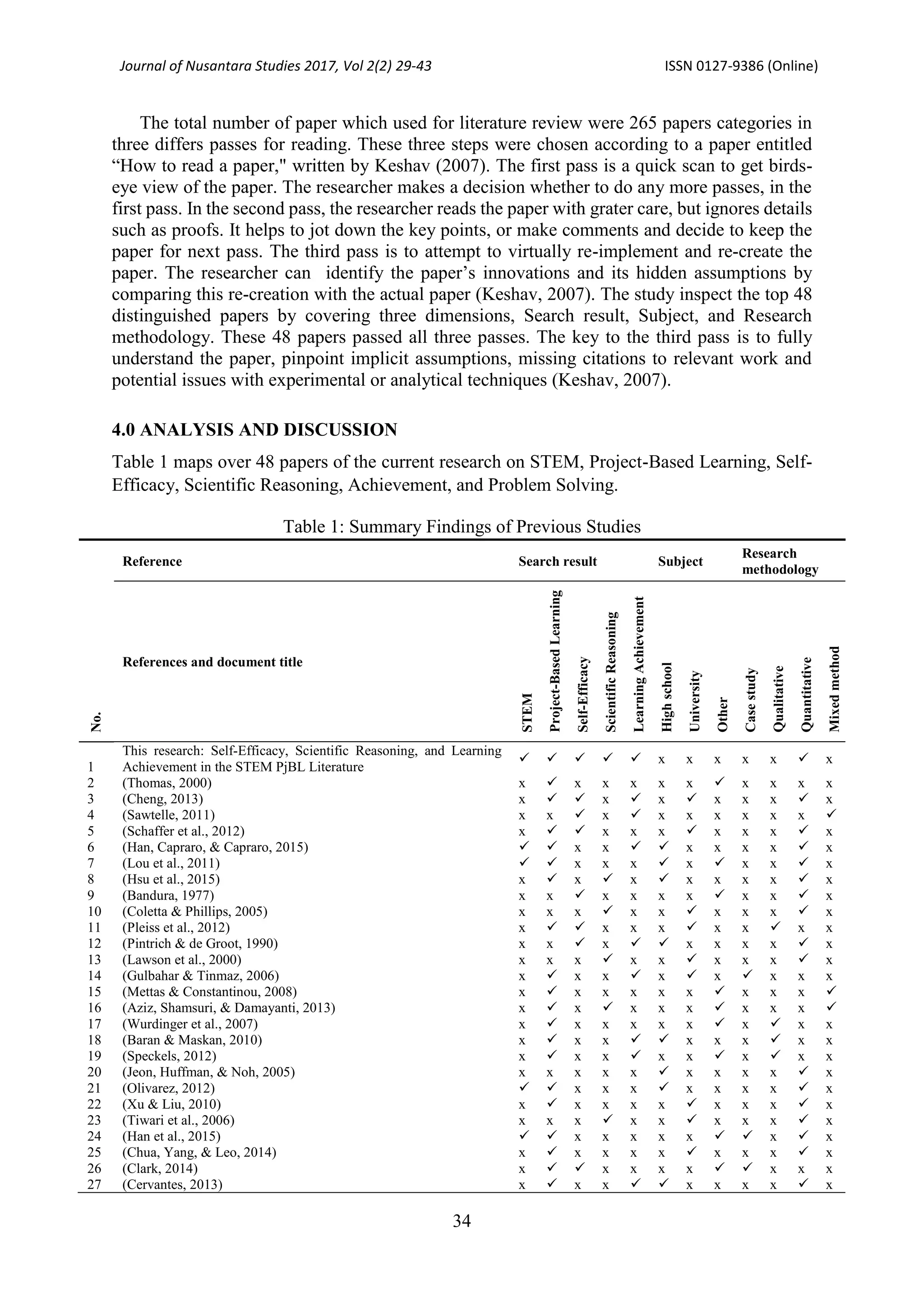
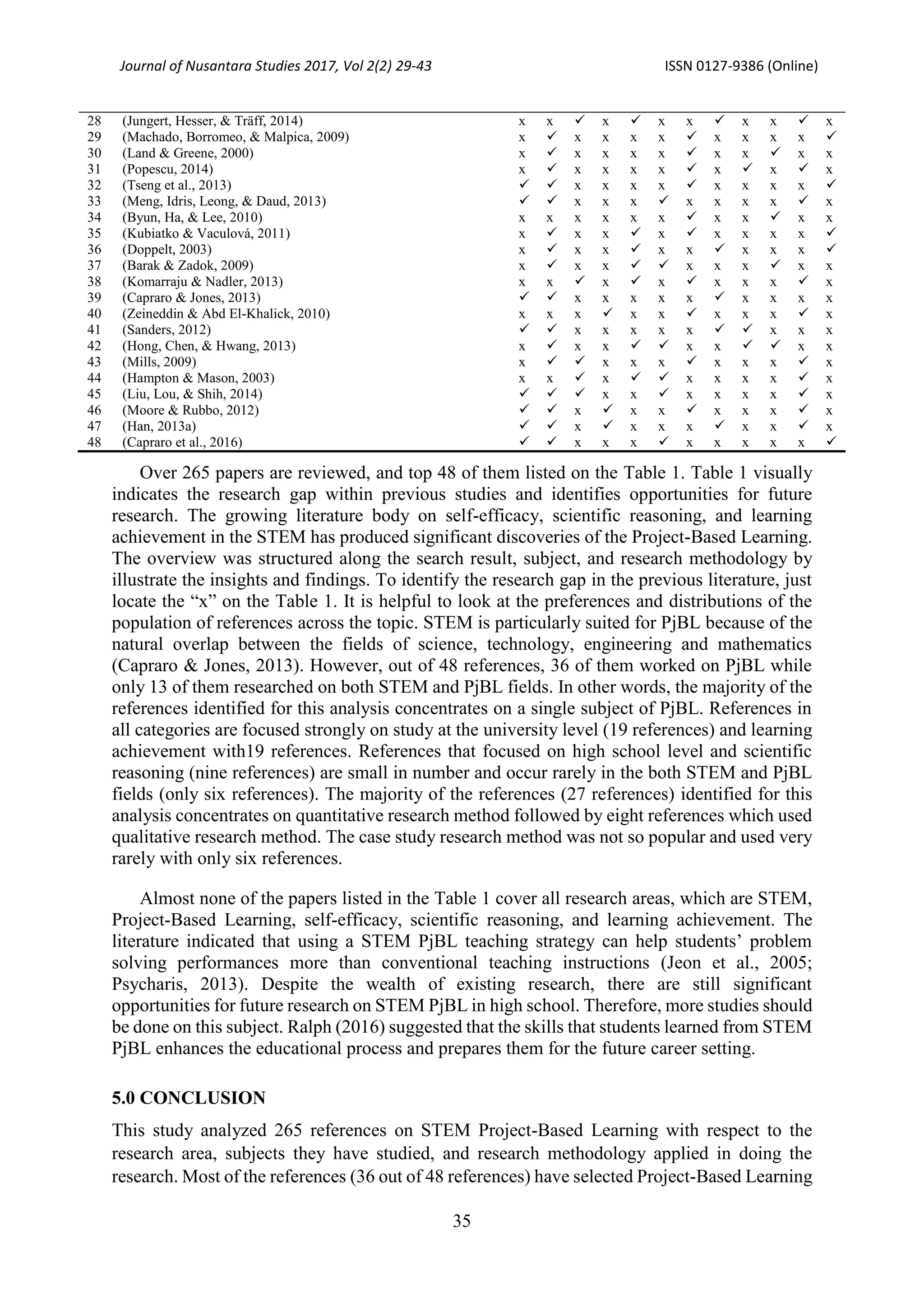
Table 1 maps over 48 papers of the current research on STEM, Project-Based Learning, Self-
Efficacy, Scientific Reasoning, Achievement, and Problem Solving.
Table 1: Summary Findings of Previous Studies
Reference Search result Subject
Research
methodology
No.
References and document title
STEM
Project-BasedLearning
Self-Efficacy
ScientificReasoning
LearningAchievement
Highschool
University
Other
Casestudy
Qualitative
Quantitative
Mixedmethod
1
This research: Self-Efficacy, Scientific Reasoning, and Learning
Achievement in the STEM PjBL Literature
     x x x x x  x
2 (Thomas, 2000) x  x x x x x  x x x x
3 (Cheng, 2013) x   x  x  x x x  x
4 (Sawtelle, 2011) x x  x  x x x x x x 
5 (Schaffer et al., 2012) x   x x x  x x x  x
6 (Han, Capraro, & Capraro, 2015)   x x   x x x x  x
7 (Lou et al., 2011)   x x x  x  x x  x
8 (Hsu et al., 2015) x  x  x  x x x x  x
9 (Bandura, 1977) x x  x x x x  x x  x
10 (Coletta & Phillips, 2005) x x x  x x  x x x  x
11 (Pleiss et al., 2012) x   x x x  x x  x x
12 (Pintrich & de Groot, 1990) x x  x   x x x x  x
13 (Lawson et al., 2000) x x x  x x  x x x  x
14 (Gulbahar & Tinmaz, 2006) x  x x  x  x  x x x
15 (Mettas & Constantinou, 2008) x  x x x x x  x x x 
16 (Aziz, Shamsuri, & Damayanti, 2013) x  x  x x x  x x x 
17 (Wurdinger et al., 2007) x  x x x x x  x  x x
18 (Baran & Maskan, 2010) x  x x   x x x  x x
19 (Speckels, 2012) x  x x  x x  x  x x
20 (Jeon, Huffman, & Noh, 2005) x x x x x  x x x x  x
21 (Olivarez, 2012)   x x x  x x x x  x
22 (Xu & Liu, 2010) x  x x x x  x x x  x
23 (Tiwari et al., 2006) x x x  x x  x x x  x
24 (Han et al., 2015)   x x x x x   x  x
25 (Chua, Yang, & Leo, 2014) x  x x x x  x x x  x
26 (Clark, 2014) x   x x x x   x x x
27 (Cervantes, 2013) x  x x   x x x x  x
Journal of Nusantara Studies 2017, Vol 2(2) 29-43 ISSN 0127-9386 (Online)
35
28 (Jungert, Hesser, & Träff, 2014) x x  x  x x  x x  x
29 (Machado, Borromeo, & Malpica, 2009) x  x x x x  x x x x 
30 (Land & Greene, 2000) x  x x x x  x x  x x
31 (Popescu, 2014) x  x x x x  x  x  x
32 (Tseng et al., 2013)   x x x x  x x x x 
33 (Meng, Idris, Leong, & Daud, 2013)   x x x  x x x x  x
34 (Byun, Ha, & Lee, 2010) x x x x x x  x x  x x
35 (Kubiatko & Vaculová, 2011) x  x x  x  x x x x 
36 (Doppelt, 2003) x  x x  x x  x x x 
37 (Barak & Zadok, 2009) x  x x   x x x  x x
38 (Komarraju & Nadler, 2013) x x  x  x  x x x  x
39 (Capraro & Jones, 2013)   x x x x x  x x x x
40 (Zeineddin & Abd El-Khalick, 2010) x x x  x x  x x x  x
41 (Sanders, 2012)   x x x x x   x x x
42 (Hong, Chen, & Hwang, 2013) x  x x   x x   x x
43 (Mills, 2009) x   x x x  x x x  x
44 (Hampton & Mason, 2003) x x  x   x x x x  x
45 (Liu, Lou, & Shih, 2014)    x x  x x x x  x
46 (Moore & Rubbo, 2012)   x  x x  x x x  x
47 (Han, 2013a)   x  x x x  x x  x
48 (Capraro et al., 2016)   x x x  x x x x x 
Over 265 papers are reviewed, and top 48 of them listed on the Table 1. Table 1 visually
indicates the research gap within previous studies and identifies opportunities for future
research. The growing literature body on self-efficacy, scientific reasoning, and learning
achievement in the STEM has produced significant discoveries of the Project-Based Learning.
The overview was structured along the search result, subject, and research methodology by
illustrate the insights and findings. To identify the research gap in the previous literature, just
locate the “x” on the Table 1. It is helpful to look at the preferences and distributions of the
population of references across the topic. STEM is particularly suited for PjBL because of the
natural overlap between the fields of science, technology, engineering and mathematics
(Capraro & Jones, 2013). However, out of 48 references, 36 of them worked on PjBL while
only 13 of them researched on both STEM and PjBL fields. In other words, the majority of the
references identified for this analysis concentrates on a single subject of PjBL. References in
all categories are focused strongly on study at the university level (19 references) and learning
achievement with19 references. References that focused on high school level and scientific
reasoning (nine references) are small in number and occur rarely in the both STEM and PjBL
fields (only six references). The majority of the references (27 references) identified for this
analysis concentrates on quantitative research method followed by eight references which used
qualitative research method. The case study research method was not so popular and used very
rarely with only six references.
Almost none of the papers listed in the Table 1 cover all research areas, which are STEM,
Project-Based Learning, self-efficacy, scientific reasoning, and learning achievement. The
literature indicated that using a STEM PjBL teaching strategy can help students’ problem
solving performances more than conventional teaching instructions (Jeon et al., 2005;
Psycharis, 2013). Despite the wealth of existing research, there are still significant
opportunities for future research on STEM PjBL in high school. Therefore, more studies should
be done on this subject. Ralph (2016) suggested that the skills that students learned from STEM
PjBL enhances the educational process and prepares them for the future career setting.
5.0 CONCLUSION
This study analyzed 265 references on STEM Project-Based Learning with respect to the
research area, subjects they have studied, and research methodology applied in doing the
research. Most of the references (36 out of 48 references) have selected Project-Based Learning
Journal of Nusantara Studies 2017, Vol 2(2) 29-43 ISSN 0127-9386 (Online)
36
as their focus followed by 13 references on STEM. References that focused on high school
level and self-efficacy, scientific reasoning, and learning achievement are very small in number
(only one in the self-efficacy and learning achievement) and occur really in the both STEM
and PjBL fields. The literature inspected in this review study revealed that more research need
to be performed on STEM project based learning in high school. Therefore, future studies
should cover the effect of STEM PjBL teaching method in the high school on preparing
students for 21st century challenges. STEM PjBL was perceived to be important for future
education and careers. Although there were many researches about the relationship between
self-efficacy, scientific reasoning, and achievement, few of them compared the effect of STEM
PjBL teaching method with conventional teaching method among high school. So it is
necessary to do deep research on the comparisons of STEM PjBL with conventional teaching
methods on self-efficacy, scientific reasoning, and achievement in high school.
ACKNOWLEDGEMENT
An earlier version of this paper was presented at the International Postgraduate Conference on
Research in Education (IPCoRE 2017), USM, Penang. We would like to thank scientific
committee members of the IPCoRE 2017. Moreover, the authors are indebted to the Guest
Editor of JONUS, Associate Professor Norizan binti Esa and the two anonymous referees for
helpful comments on earlier drafts of this paper.
REFERENCES
Adey, P., Shayer, M., & Shayer, M. (2006). Really raising standards: Cognitive intervention
and academic achievement. New Fetter Lane, London: Routledge.
Ayan, M. (2012). Proje Tabanli Öğrenme Yaklaşiminin İlköğretim Öğrencilerinin Fen Bilgisi
Dersi Akademik Başari Düzeyine Etkisi. Journal of Turkish Educational Sciences, 10(1),
167-183.
Aziz, Z., Shamsuri, S.M., & Damayanti, L. (2013). Project-based learning to pose reasoning
skills for year 1 pupil. Review of European Studies, 5(4), 82-87.
Bandura, A. (1977). Self-efficacy: Toward a unifying theory of behavioral change.
Psychological Review, 84(2), 191-215.
Bandura, A. (1997). Self-efficacy: The exercise of control (1st ed.). New York: Macmillan.
Bao, L., Cai, T., Koenig, K., Fang, K., Han, J., & Wang, J. (2009). Learning and scientific
reasoning. Science, 323(5914), 586-587.
Barak, M. & Zadok, Y. (2009). Robotics projects and learning concepts in science, technology
and problem solving. International Journal of Technology and Design Education, 19(3),
289-307.
Barakos, L., Lujan, V., & Strang, C. (2012). Science, Technology, Engineering, Mathematics
(STEM): Catalyzing change amid the confusion. Portsmouth, NH: RMC Research
Corporation.
Baran, M. & Maskan, A. (2010). The effect of project-based learning on pre-service physics
teachers electrostatic achievements. Cypriot Journal of Educational Sciences, 5(4), 243-
257.
Journal of Nusantara Studies 2017, Vol 2(2) 29-43 ISSN 0127-9386 (Online)
37
Barron, B. & Darling-Hammond, L. (2008). Teaching for meaningful learning: A review of
research on inquiry-based and cooperative learning. San Francisco, CA: John Wiley &
Sons Inc.
Barron, B.J., Schwartz, D.L., Vye, N.J., Moore, A., Petrosino, A., & Zech, L. (1998). Doing
with understanding: Lessons from research on problem and project-based learning.
Journal of the Learning Sciences, 7(3), 271-311.
Bell, S. (2010). Project-based learning for the 21st century: Skills for the future. The Clearing
House, 83(2), 39-43.
Blumenfeld, P.C., Soloway, E., Marx, R.W., Krajcik, J.S., Guzdial, M., & Palincsar, A. (1991).
Motivating project-based learning: Sustaining the doing, supporting the learning.
Educational psychologist, 26(3), 369-398.
Bøe, M.V., Henriksen, E.K., Lyons, T., & Schreiner, C. (2011). Participation in science and
technology: Young people’s achievement‐related choices in late‐modern societies. Studies
in Science Education, 47(1), 37-72.
Britner, S.L. & Pajares, F. (2006). Sources of science self‐efficacy beliefs of middle school
students. Journal of Research in Science Teaching, 43(5), 485-499.
Bruce-Davis, M.N., Gubbins, E.J., Gilson, C.M., Villanueva, M., Foreman, J.L., & Rubenstein,
L.D. (2014). STEM high school administrators’, teachers’, and students’ perceptions of
curricular and instructional strategies and practices. Journal of Advanced Academics,
25(3), 272-306.
Byun, T., Ha, S., & Lee, G. (2010). Toward understanding student difficulty in upper-level
mechanics problem-solving. The SNU Journal of Education Research, 19(6), 145-165.
Cakici, Y. & Turkmen, N. (2013). An investigation of the effect of project-based learning
approach on children's achievement and attitude in science. The Online Journal of Science
and Technology, 3(2), 9-13.
Capraro, M.M. & Jones, M. (2013). Interdisciplinary STEM project-based learning STEM.
Rotterdam: SensePublishers, Springer.
Capraro, R., Capraro, M., Scheurich, J., Jones, M., Morgan, J., & Huggins, K. (2016). Impact
of sustained professional development in STEM PBL on outcome measures in a diverse
urban district. Journal of Educational Research, 109(2), 1-16.
Carbonell, K.B., Stalmeijer, R.E., Konings, K.D., Seger, M., & van Merrienboer, J.J.G. (2014).
How experts deal with novel situations: A review of adaptive expertise. Educational
Research Review, 12(1), 14-29.
Cervantes, B., Hemmer, L., & Kouzekanani, K. (2015). The impact of project-based learning
on minority student achievement: Implications for school redesign. NCPEA Education
Leadership Review of Doctoral Research, 2(2), 1-50.
Cervantes, B.M. (2013). The impact of project-based learning on mathematics and reading
achievement of 7th and 8th grade students in a south Texas school district. (Published
doctoral dissertation). University of Texas, Austin.
Journal of Nusantara Studies 2017, Vol 2(2) 29-43 ISSN 0127-9386 (Online)
38
Cheng, S. (2013). An empirical investigation of the effectiveness of project-based course
learning within hospitality programs: The mediating role of cognitive engagement.
Journal of Hospitality Leisure Sport & Tourism Education, 13(1), 213-225.
Chua, K.J., Yang, W.M., & Leo, H.L. (2014). Enhanced and conventional project-based
learning in an engineering design module. International Journal of Technology and
Design Education, 24(4), 437-458.
Clark, C.J. (2014). Self and collective efficacy perceptions during project-based learning
implementation. (Published doctoral dissertation). Ashland University, Ashland, OH,
USA.
Coletta, V.P. & Phillips, J.A. (2005). Interpreting FCI scores: Normalized gain, preinstruction
scores, and scientific reasoning ability. American Journal of Physics, 73(12), 1172-1182.
Dalgety, J. & Coll, R.K. (2006). Exploring first-year science students' chemistry self-efficacy.
International journal of science and mathematics education, 4(1), 97-116.
Davies, P. (2000). The relevance of systematic reviews to educational policy and practice.
Oxford Review of Education, 26(3), 365-378.
Department of Education, U.S. (2015). Project based learning at Harmony Public Schools.
U.S.: District Reform Support Network.
Deslauriers, L., Schelew, E., & Wieman, C. (2011). Improved learning in a large-enrollment
physics class. Science, 332(6031), 862-864.
Doppelt, Y. (2003). Implementation and assessment of project-based learning in a flexible
environment. International Journal of Technology and Design Education, 13(3), 255-272.
Duke, N.K., Halvorsen, A.L., & Strachan, S.L. (2016). Project-based learning not just for
STEM anymore. Phi Delta Kappan, 98(1), 14-19.
Filippatou, D. & Kaldi, S. (2010). The effectiveness of project-based learning on pupils with
learning difficulties regarding academic performance, group work and motivation.
International Journal of Special Education, 25(1), 17-26.
Gardiner, K.M. (2014). Professional education for the 21st century workforce. Paper presented
at the Conference of the American Society for Engineering Education - "Engineering
Education: Industry Involvement and Interdisciplinary Trends", Bridgeport, Connecticut,
U.S.A, 3-5 April 2014 (pp. 1-7). Retrieved from
https://mse.lehigh.edu/sites/mse.lehigh.edu/files/2Proceedings%20of%202014%20Zone
%201%20Conference%20of%20the%20American%20Society%20for%20Engineering%
20Education.pdf
Georghiades, P. (2000). Beyond conceptual change learning in science education: Focusing on
transfer, durability and metacognition. Educational Research, 42(2), 119-139.
Gerlach, J. (2012). STEM: Defying a simple definition. Retrieved from
http://www.nsta.org/publications/news/story.aspx?id=59305
Grant, M. (2009). Understanding projects in projectbased learning: A student’s perspective.
Paper presented at the Annual Meeting of the American Educational Research
Association, San Diego, CA, 16 April 2009 (pp. 1-21). Retrieved from
http://www.bie.org/images/uploads/general/c4bb5291b8135c6ba582d053833a16e2.pdf
Journal of Nusantara Studies 2017, Vol 2(2) 29-43 ISSN 0127-9386 (Online)
39
Gulbahar, Y. & Tinmaz, H. (2006). Implementing project-based learning and E-portfolio
assessment in an undergraduate course. Journal of Research on Technology in Education,
38(3), 309-327.
Hampton, N.Z. & Mason, E. (2003). Learning disabilities, gender, sources of efficacy, self-
efficacy beliefs, and academic achievement in high school students. Journal of School
Psychology, 41(2), 101-112.
Han, J. (2013a). Scientific reasoning: Research, development, and assessment. (Published
doctoral thesis). The Ohio State University, Columbus, OH.
Han, S., Capraro, R., & Capraro, M.M. (2015). How Science, Technology, Engineering, and
Mathematics (stem) project-based learning (PBL) affects high, middle, and low achievers
differently: The impact of student factors on achievement. International Journal of
Science and Mathematics Education, 13(5), 1089-1113.
Han, S., Yalvac, B., Capraro, M.M., & Capraro, R.M. (2015). In-service teachers’
implementation and understanding of STEM project-based learning. Eurasia Journal of
Mathematics, Science & Technology Education, 11(1), 63-76.
Han, S.Y. (2013b). The impact of STEM PBL teacher professional development on student
Mathematics achievement in high schools. (Published doctoral dissertation). Texas A&M
University.
Hawkins, J. & Pea, R.D. (1987). Tools for bridging the cultures of everyday and scientific
thinking. Journal of Research in Science Teaching, 24(4), 291-307.
Holbrook, J., Rannikmae, M., & Valdmann, A. (2014). Identifying teacher needs for promoting
education through Science as a paradigm shift in Science education. Science Education
International, 25(2), 4-42.
Holubova, R. (2008). Effective teaching methods: Project-based learning in Physics. Online
Submission, 5(12), 27-36.
Hong, J.C., Chen, M.Y., & Hwang, M.Y. (2013). Vitalizing creative learning in science and
technology through an extracurricular club: A perspective based on activity theory.
Thinking Skills and Creativity, 8(1), 45-55.
Hou, H.T., Chang, K.E., & Sung, Y.T. (2007). Analysis of time-management pattern of
interactive behaviors during online project-based learning. Paper presented at the 7th
IEEE International Conference on Advanced Learning Technologies, Proceedings, Los
Alamitos, 18-20 July 2007. Retrieved from
http://ieeexplore.ieee.org/document/4281000/?part=1
Hsu, P.S., Van Dyke, M., Chen, Y., & Smith, T.J. (2015). The effect of a graph-oriented
computer-assisted project-based learning environment on argumentation skills. Journal of
Computer Assisted Learning, 31(1), 32-58.
Jamali, S.M., Nurulazam Md Zain, A., Samsudin, M.A., & Ale Ebrahim, N. (2015). Publication
trends in Physics education: A bibliometric study. Journal of Educational Research, 35(1),
19-36.
Journal of Nusantara Studies 2017, Vol 2(2) 29-43 ISSN 0127-9386 (Online)
40
Jeon, K., Huffman, D., & Noh, T. (2005). The effects of thinking aloud pair problem solving
on high school students' chemistry problem-solving performance and verbal interactions.
Journal of Chemical Education, 82(10), 1558-1564.
Jessica, G.J., Laura, R.L., Pal, R., Gardea-Torresdey, J.L., & Narayan, M. (2011). From
folklore to molecular pharmacophores: Cultivating STEM students among young, first-
generation female Mexican-Americans. Journal of Chemical Education, 88(1), 41-43.
Jungert, T., Hesser, H., & Träff, U. (2014). Contrasting two models of academic self-efficacy-
domain-specific versus cross-domain-in children receiving and not receiving special
instruction in mathematics. Scandinavian Journal of Psychology, 55(5), 440-447.
Keshav, S. (2007). How to read a paper. ACM SIGCOMM Computer Communication Review,
37(3), 83-84.
Kizkapan, O. & Bektas, O. (2017). The effect of project-based learning on seventh grade
students' academic achievement. International Journal of Instruction, 10(1), 37-54.
Komarraju, M. & Nadler, D. (2013). Self-efficacy and academic achievement: Why do implicit
beliefs, goals, and effort regulation matter? Learning and Individual Differences, 25(1),
67-72.
Kramer, B.S., Walker, A.E., & Brill, J.M. (2007). The underutilization of information and
communication technology-assisted collaborative project-based learning among
international educators: A Delphi study. Etr&D-Educational Technology Research and
Development, 55(5), 527-543.
Kubiatko, M. & Vaculová, I. (2011). Project-based learning: Characteristic and the experiences
with application in the science subjects. Energy Education Science and Technology Part
B: Social and Educational Studies, 3(1), 65-74.
Laboy-Rush, D. (2011). Integrated STEM education through project-based learning. Boston,
MA: Learning.com.
Land, S.M. & Greene, B.A. (2000). Project-based learning with the world wide web: A
qualitative study of resource integration. Educational Technology Research and
Development, 48(1), 45-67.
Larmer, J. & Mergendoller, J.R. (2010). The main course, not dessert, how are students
reaching 21st century goals? With 21st century project-based learning. Novato, CA: Buck
Institute for Education.
Lau, S. & Roeser, R.W. (2002). Cognitive abilities and motivational processes in high school
students' situational engagement and achievement in science. Educational Assessment,
8(2), 139-162.
Lawson, A.E. (2000). The generality of hypothetico-deductive reasoning: Making scientific
thinking explicit. The American Biology Teacher, 62(7), 482-495.
Lawson, A.E., Clark, B., Cramer-Meldrum, E., Falconer, K.A., Sequist, J.M., & Kwon, Y.J.
(2000). Development of scientific reasoning in college biology: Do two levels of general
hypothesis-testing skills exist? Journal of Research in Science Teaching, 37(1), 81-101.
Journal of Nusantara Studies 2017, Vol 2(2) 29-43 ISSN 0127-9386 (Online)
41
Liu, Y.H., Lou, S.J., & Shih, R.C. (2014). The investigation of STEM self-efficacy and
professional commitment to engineering among female high school students. South
African Journal of Education, 34(2), 1-15.
Lou, S.-J., Liu, Y.-H., Shih, R.-C., Chuang, S.-Y., & Tseng, K.-H. (2011). Effectiveness of on-
line STEM project-based learning for female senior high school students. The
International Journal of Engineering Education, 27(2), 399-410.
Lou, S.J., Chou, Y.C., Shih, R.C., & Chung, C.C. (2017). A study of creativity in CaC2
steamship-derived STEM project-based learning. Eurasia Journal of Mathematics Science
and Technology Education, 13(6), 2387-2404.
Lou, S.J., Liu, Y.H., Shih, R.C., & Tseng, K.H. (2011). The senior high school students'
learning behavioral model of STEM in PBL. International Journal of Technology and
Design Education, 21(2), 161-183.
Machado, F., Borromeo, S., & Malpica, N. (2009). Project-based learning experience in VHDL
digital electronic circuit design. Paper presented at the 2009 Ieee International
Conference on Microelectronic Systems Education, New York, 25-27 July 2009. Retrieved
from http://ieeexplore.ieee.org/document/5270831/
McGrath, D. (2004). Strengthening collaborative work: Go beyond the obvious with tools for
technology-enhanced collaboration. Learning & Leading with Technology, 31(5), 30-33.
Meng, C.C., Idris, N., Leong, K.E., & Daud, M.F. (2013). Secondary school assessment
practices in Science, Technology and Mathematics (STEM) related subjects. Journal of
Mathematics Education, 6(2), 58-69.
Mettas, A.C. & Constantinou, C.C. (2008). The technology fair: A project-based learning
approach for enhancing problem solving skills and interest in design and technology
education. International Journal of Technology and Design Education, 18(1), 79-100.
Mills, N. (2009). A guide du routard simulation: Increasing self-efficacy in the standards
through project-based learning. Foreign Language Annals, 42(4), 607-639.
Moore, J.C. & Rubbo, L.J. (2012). Scientific reasoning abilities of nonscience majors in
physics-based courses. Physical Review Special Topics-Physics Education Research, 8(1),
1-18.
Olivarez, N. (2012). The impact of a STEM program on academic achievement of eighth grade
students in a south Texas middle school. (Published doctoral dissertation). Texas A & M
University, Corpus Christi, Texas.
Pea, R.D. (2004). The social and technological dimensions of scaffolding and related
theoretical concepts for learning, education, and human activity. Journal of the Learning
Sciences, 13(3), 423-451.
Piaget, J. (1970). Science of education and the psychology of the child. New York: Orion.
Pintrich, P.R. & de Groot, E.V. (1990). Motivational and self-regulated learning components
of classroom academic performance. Journal of Educational Psychology, 82(1), 33-40.
Pleiss, G., Perry, M., & Zastavker, Y.V. (2012). Student self-efficacy in introductory project-
based learning courses. Paper presented at the 42nd Annual Frontiers in Education
Journal of Nusantara Studies 2017, Vol 2(2) 29-43 ISSN 0127-9386 (Online)
42
Conference, FIE 2012, Seattle, WA, 3-6 October 2012. Retrieved from
http://ieeexplore.ieee.org/document/6462457/
Popescu, E. (2014). Using wikis to support project-based learning: A case study. Paper
presented at the 14th IEEE International Conference on Advanced Learning Technologies,
ICALT 2014, Athens, Greece, 7-10 July 2014 (pp. 305-309). Retrieved from
http://ieeexplore.ieee.org/document/6901466/
Psycharis, S. (2013). Examining the effect of the computational models on learning
performance, scientific reasoning, epistemic beliefs and argumentation: An implication
for the STEM agenda. Computers & Education, 68(1), 253-265.
Ralph, R.A. (2016). Post secondary project-based learning in science, technology, engineering
and mathematics. Journal of Technology and Science Education, 6(1), 26-35.
Ritz, J.M. & Fan, S.C. (2014). STEM and technology education: International state-of-the-art.
International Journal of Technology and Design Education, 25(4), 429-451.
Roberts, A. (2012). A justification for STEM education. Technology and Engineering Teacher,
70(1), 30-35.
Sanders, M. (2009). STEM, STEM education, STEMmania. The Technology Teacher, 68(4),
20-26.
Sanders, M.E. (2012). Integrative stem education as “best practice”. Paper presented at the 7th
Biennial International Technology Education Research Conference, Queensland,
Australia, 6 December 2012 (pp. 103-117). Retrieved from
http://hdl.handle.net/10919/19076
Satchwell, R.E. & Loepp, F.L. (2002). Designing and implementing an integrated
Mathematics, Science, and Technology Curriculum for the middle school. Journal of
Industrial Teacher Education, 39(3), 41-66.
Sawtelle, V. (2011). A gender study investigating physics self-efficacy. (Published doctoral
dissertation). Florida International University.
Schaffer, S.P., Chen, X.J., Zhu, X.M., & Oakes, W.C. (2012). Self-efficacy for cross-
disciplinary learning in project-based teams. Journal of Engineering Education, 101(1),
82-94.
Schwalm, J. & Tylek, K.S. (2012). Systemwide implementation of project-based learning: The
Philadelphia approach. Retrieved from
https://www.niost.org/pdf/afterschoolmatters/asm_2012_15_spring/asm_2012_spring_1.
pdf
Shih, J.-L., Chuang, C.-W., & Hwang, G.-J. (2010). An inquiry-based mobile learning
approach to enhancing social science learning effectiveness. Educational Technology &
Society, 13(4), 50-62.
Slough, S.W. & Milam, J.O. (2013). Theoretical framework for the design of STEM project-
based learning. Rotterdam: Sense Publishers.
Somnuek, P. (2014). The development of teaching and learning innovation by using
instructional media for enhancement of learning achievement towards tourism product
knowledge in tourism marketing class. Ubon Ratchathani, Thailand: EDP Sciences.
Journal of Nusantara Studies 2017, Vol 2(2) 29-43 ISSN 0127-9386 (Online)
43
Soyyilmaz, D., Griffin, L.M., Martin, M.H., Kucharsky, S., Peycheva, E.D., & Vaupotic, N.
(2017). Formal and informal learning and first-year psychology students' development of
scientific thinking: A two-wave panel study. Frontiers in Psychology, 8(133), 1-11.
Speckels, H.F. (2012). The impact of project-based learning on academic achievement for
students with academic challenges at K--5 grade levels: A grounded theory revelation.
(Published doctoral dissertation). Jones International University.
Strobel, J. & Van Barneveld, A. (2009). When is PBL more effective? A meta-synthesis of
meta-analyses comparing PBL to conventional classrooms. Interdisciplinary Journal of
Problem-based Learning, 3(1), 44-58.
Thomas, J.W. (2000). A review of research on project-based learning. California: San Rafael,
The Autodesk Foundation.
Tiwari, A., Lai, P., So, M., & Yuen, K. (2006). A comparison of the effects of problem-based
learning and lecturing on the development of students' critical thinking. Medical
Education, 40(6), 547-554.
Tseng, K.H., Chang, C.C., Lou, S.J., & Chen, W.P. (2013). Attitudes towards science,
technology, engineering and mathematics (STEM) in a project-based learning (PjBL)
environment. International Journal of Technology and Design Education, 23(1), 87-102.
Turner, K. (2013). Northeast Tennessee educators’ perception of STEM education
implementation. (Published doctoral dissertation). East Tennessee State University.
Vega, C., Jiménez, C., & Villalobos, J. (2013). A scalable and incremental project-based
learning approach for CS1/CS2 courses. Education and Information Technologies, 18(2),
309-329.
West, M. (2012). STEM education and the workplace. Retrieved from
http://www.chiefscientist.gov.au/wp-content/uploads/OPS4-
STEMEducationAndTheWorkplace-web.pdf
Wurdinger, S., Haar, J., Hugg, R., & Bezon, J. (2007). A qualitative study using project-based
learning in a mainstream middle school. Improving Schools, 10(2), 150-161.
Xu, Y.Y. & Liu, W.Q. (2010). A project-based learning approach: A case study in China. Asia
Pacific Education Review, 11(3), 363-370.
Zeineddin, A. & Abd El-Khalick, F. (2010). Scientific reasoning and epistemological
commitments: Coordination of theory and evidence among college science students.
Journal of Research in Science Teaching, 47(9), 1064-1093.
Zimmerman, C. (2007). The development of scientific thinking skills in elementary and middle
school. Developmental Review, 27(2), 172-223.
Zollman, A. (2012). Learning for STEM literacy: STEM literacy for learning. School Science
and Mathematics, 112(1), 12-19.

Self-Efficacy, Scientific Reasoning, and Learning Achievement in the STEM Project-Based Learning Literature

  • 1.
    Journal of NusantaraStudies 2017, Vol 2(2) 29-43 Universiti Sultan Zainal Abidin ISSN 0127-9386 (Online) Journal of Nusantara Studies (JONUS) 29 SELF-EFFICACY, SCIENTIFIC REASONING, AND LEARNING ACHIEVEMENT IN THE STEM PROJECT-BASED LEARNING LITERATURE *1 Seyedh Mahboobeh Jamali, 1 Ahmad Nurulazam Md Zain, 1 Mohd Ali Samsudin & 2 Nader Ale Ebrahim 1 School of Educational Studies, Universiti Sains Malaysia (USM), 11800, Penang, Malaysia. 2 Centre for Research Services, IPPP, University of Malaya, 50603 Kuala Lumpur, Malaysia. *Corresponding author: mahjamali@gmail.com ABSTRACT The main goal of education is to prepare students for future job opportunities and civic responsibilities, and this is one of the biggest challenges in the 21st century. Science, Technology, Engineering, and Mathematics (STEM) Project-Based Learning (PjBL) prepare students to master their new role as a global citizen with greater responsibilities. This systematic review analyzed 265 papers that are related to the STEM PjBL. The papers were collected from well-known databases such as Web of Science® and SCOPUS by using the quality assessment and relevant criteria. This study inspected the top 48 distinguished papers by covering three dimensions, Search result, Subject, and Research methodology. STEM and PjBL come together, due to the natural overlap between the fields of Science, Technology, Engineering, Mathematics and PjBL. The fully integrated STEM with PjBL can increase the effectiveness of teaching. Nonetheless, this inspection uncovered that previous research has not fully integrated STEM with PjBL. Thus, despite the wealth of existing research, there are still significant opportunities for future research on STEM PjBL in high schools to prepare students for 21st century challenges. Keywords: Enhanced teaching and learning, 21st century skills, project-based learning STEM, systematic literature reviews 1.0 INTRODUCTION Science, technology, engineering, and mathematics (STEM) is an interdisciplinary approach to learning where rigorous academic concepts are coupled with real world lessons (Bruce-Davis et al., 2014; Gerlach, 2012). STEM incorporates teamwork and solves problems by using a questioning and answering technique that is incorporated with research, and students are engaged in processes of inquiry, design, and/or investigation. STEM is particularly suited for PjBL because of the natural overlap between the fields of science, technology, engineering and mathematics (Capraro & Jones, 2013). So, STEM and project-based learning match each other. Project-Based Learning (PjBL) has been described as an innovative approach to learning that teaches a multitude of strategies critical for success in the 21st century comparing to the conventional model (Cervantes, Hemmer, & Kouzekanani, 2015). STEM project-based learning can further develop the affective domain of creativity, including adventurousness,
  • 2.
    Journal of NusantaraStudies 2017, Vol 2(2) 29-43 ISSN 0127-9386 (Online) 30 curiosity, imagination and challenge (Lou et al., 2017). The PjBL is different from the conventional model in that students drives their own learning through inquiry, as well as work collaboratively to research and create projects that reflect their knowledge (Bell, 2010; Cervantes, 2013; McGrath, 2004). If we are serious about reaching 21st century educational goals, Project-Based Learning must be at the center of 21st century instruction (Clark, 2014; Larmer & Mergendoller, 2010). Schwalm and Tylek (2012) defined that Project-Based Learning (PjBL) is an approach to instruction that presents students with real-world, multidisciplinary problems that demand critical thinking, engagement, and collaboration (Grant, 2009). In PjBL, students go through an extended process of inquiry in response to a complex question, problem, or challenge. Rigorous projects help students learn key academic content and practice 21st century skills such as collaboration, communication and critical thinking (Department of Education, 2015). STEM PjBL is defined as a learner-centered instructional model (Hou, Chang, & Sung, 2007) and tend to model “real-world” situations, with a focus on group work and hands-on experiences (Pleiss, Perry, & Zastavker, 2012). Hands-on experiences are essential for the 21st century employees. In STEM PjBL students are engaged in activities that are designed to either answer a question or solve a problem with appropriate solutions (Gardiner, 2014; Vega, Jiménez, & Villalobos, 2013). Bandura (1997) has argued that self-efficacy leads to higher goals being set. Achieving higher goals are increasing the positive effects of self-efficacy by providing an evaluative context to aid self-regulation. As Pintrich and de Groot (1990) reported students with high self- efficacy tend to persist more toward achieving their goals. Besides the self-efficacy students should have scientific reasoning skills as well, if they want to prepare themselves for 21st century challenges. Scientific reasoning, referred to as ‘formal reasoning’ (Piaget, 1970) and ‘critical thinking’ (Hawkins & Pea, 1987; Pea, 2004). Bao et al. (2009) mentioned that the development of general scientific abilities is critical to enable students of science, technology, engineering, and mathematics (STEM) to successfully handle open-ended real-world tasks in future careers. Scientific-reasoning skills can be developed through training and can be transferred (Adey, Shayer, & Shayer, 2006). These two self-efficacy, and scientific reasoning skills, leads students to gain better achievements in the high school and the life. Generally, project-based learning improves students’ achievement, and authentic problem-solving opportunities (Cakici & Turkmen, 2013; Gulbahar & Tinmaz, 2006). Few systematic literature reviews have been done on the STEM PjBL and its effect on self- efficacy, scientific reasoning, and learning achievement. Strobel and Van Barneveld (2009) done a meta-synthesis of meta-analyses comparing problem-based learning to conventional classrooms. In another study, Ritz and Fan (2014) conducted an international review to determine the state-of-the-art of the application of technology education within the STEM approach to educational reform. Kramer, Walker, and Brill (2007) explored the barriers associated with teachers implementing PjBL methods in the information and communication technology assisted learning method. Two more literature reviews on the STEM PjBL topics had been done recently and investigated the popularity of project-based learning (Duke, Halvorsen, & Strachan, 2016) and educating STEM students among young first-generation female Mexican-Americans (Jessica et al., 2011). None of the above mentioned review papers analyzed the effects of STEM PjBL on the three variables (self-efficacy, scientific reasoning, and learning achievement). Therefore, this systematic literature review attempts to cover the research gap and analysis literatures on the topics of STEM PjBL, self-efficacy, scientific reasoning, and learning achievement.
  • 3.
    Journal of NusantaraStudies 2017, Vol 2(2) 29-43 ISSN 0127-9386 (Online) 31 2.0 LITERATURE REVIEW Science, technology, engineering and mathematics (STEM) education is well placed to teach skills that are relevant in the information-rich modern economy. STEM skills include problem- solving and rigorous analysis of evidence. The investigative nature of STEM fields also makes them ideal training grounds for developing objective and critical ways of thinking (West, 2012). According to Turner (2013) STEM education is not just an area of study, but it is also a way of teaching and learning that is project-based, collaborative, and focused on solving real- world problems. STEM programs educate the whole student, emphasizing innovation, problem solving, critical thinking, and creativity. STEM professionals impact our daily lives with the resources and technological advances they have come to depend upon. STEM is our future (Turner, 2013). Research tells us that students learn best when encouraged to construct their own knowledge of the world around them (Laboy-Rush, 2011; Satchwell & Loepp, 2002). In the STEM PjBL lessons, students gained higher scores in the statewide assessment only if teachers showed higher fidelity in implementing STEM PjBL. Students, who were provided lower quality STEM PjBL lessons, showed a negative growth rate (Capraro et al., 2016; Han, Yalvac, Capraro, & Capraro, 2015). Variables used in this study are defined and explained in the following sections. 2.1 Science, Technology, Engineering, and Mathematics (STEM) In the 1990s, the National Science Foundation (NSF) began using “SMET” as shorthand for “science, mathematics, engineering, and technology”. When an NSF program officer complained that “SMET” sounded too much like “smut”, the “STEM” acronym was born (Sanders, 2009). Schools with a strong emphasis on STEM education often integrate science, technology, engineering, and mathematics into the entire curriculum (Barakos, Lujan, & Strang, 2012). One view of STEM focuses on exposing students to authentic experiences and applying rigorous content to solving real world problems. Hundreds of reports and programs have been commissioned in the United States regarding STEM Education–all having three parallel concerns: the future need for more scientists, technicians, engineers, and mathematicians, the necessity for more innovative workers trained in science, technology, engineering and mathematics; and recommendations for what schools should do to solve the shortage (Zollman, 2012). United States is not alone in pursuing this direction in STEM education. Different countries are exploring STEM because of political and economic pressures and because some believe it is a means to improve the delivery of this knowledge. Deslauriers, Schelew, and Wieman (2011) recommended that teachers adopt a variety of methods of instruction, including one in which the students are actively engaged in the learning process like STEM. While literature has reported several characteristics of STEM, the following are the most common ones. First, it is integrated. Using a curriculum centered on principles from science, technology and engineering, and mathematics, students learn to apply previously obtained information to creatively address a problem they have never before encountered. Second, STEM education is inquiry-based. Distinct from the conventional classroom, which is typically lecture-based, a STEM classroom asks students to work together to solve problems by using, questioning and answering techniques incorporated with research. Third, STEM incorporates teamwork and instruction in the “soft skills” needed for business and industry. Asking students to practice these skills promotes confidence and gives them insight into their own character as they become aware of personal traits they may not have realized they had, such as leadership skills. Fourth, STEM is appealing. Students enjoy
  • 4.
    Journal of NusantaraStudies 2017, Vol 2(2) 29-43 ISSN 0127-9386 (Online) 32 classroom discussion and participation to solve a meaningful problem. Fifth, STEM education is fulfilling. Teachers are able to perceive themselves as facilitators of the learning process and not merely instructors (Roberts, 2012). 2.2 Project-Based Learning (PjBL) Project-Based Learning (PjBL), was developed based on the theory of constructivism. It is a type of active learning that engages students in “relatively long-term, problem-focused, and meaningful units of instruction that integrate concepts from a number of disciplines or fields of study (Blumenfeld et al., 1991). According to Holbrook, Rannikmae, and Valdmann (2014), project-based learning has been defined as a model for classroom activity where the focus on the teacher is diminished, and the focus on student activity is increased with a greater emphasis on long-term interdisciplinary and integrated addressing of real-world issues in a practice- based format. Project-Based Learning (PjBL) has been described as an innovative approach to learning that teaches a multitude of strategies critical for success in the 21st century compared to the conventional model (Barron & Darling-Hammond, 2008; Bell, 2010; Blumenfeld et al., 1991; Cervantes et al., 2015). STEM PjBL is an interdisciplinary teaching and learning approach leading students to explore ill-defined problems across subjects within a constrained environment. An interdisciplinary approach, hands-on activities, collaboration, team communication, knowledge construction, and formative assessment have been indicated as primary components of STEM PjBL (Barron et al., 1998; Han, 2013b; Slough & Milam, 2013; Thomas, 2000). As STEM literally stands for four subjects, STEM PjBL combines disciplines from science, technology, engineering, and mathematics (Capraro & Jones, 2013; Lou et al., 2011). STEM Project-Based Learning (STEM PjBL) also places students in realistic, contextualized problem solving environments. Project can serve a bridge between phenomena in the classroom and real life experience (Blumenfeld et al., 1991; Holubova, 2008; Slough & Milam, 2013). Tseng et al. (2013) concluded that combining PjBL with STEM can increase effectiveness, generate meaningful learning and influence student attitudes in future career pursuit. 2.3 Self-Efficacy Bandura (1977) in an attempt to offer a theoretical explanation for human behavior change fixed the framework of self-efficacy. He defined self-efficacy as one’s own ability to perform a particular task, emphasizing the specificity of the task. The self-efficacy literature also links student’s science self-efficacy to persistence in science majors and career choices in science (Britner & Pajares, 2006; Dalgety & Coll, 2006), and achievement in science for high school students (Bøe et al., 2011; Lau & Roeser, 2002). These studies indicate that development of self-efficacy that occur in STEM PjBL, can lead to perform better problem solver. 2.4 Scientific Reasoning Scientific reasoning is also referred to as “formal reasoning” (Piaget, 1970) and “critical thinking” (Hawkins & Pea, 1987; Pea, 2004). Scientific reasoning delineates the skills needed to conduct scientific inquiry, such as argumentation, drawing inferences from data, and engaging in experimentation (Soyyilmaz et al., 2017; Zimmerman, 2007). Scientific reasoning, in early studies, represents the ability to systematically explore a problem, formulate and test hypotheses, control and manipulate variables, and evaluate experimental outcomes (Bao et al.,
  • 5.
    Journal of NusantaraStudies 2017, Vol 2(2) 29-43 ISSN 0127-9386 (Online) 33 2009; Zimmerman, 2007). It represents a set of general skills involved in science inquiry supporting the experimentation, evidence evaluation, and argumentation that lead to formation and modification of concepts and theories about the natural and social world (Han, 2013a). Scientific reasoning has been widely accepted as the core component of STEM education. Since scientific reasoning represents a set of skills and abilities that are necessary for successfully conducting science inquiry tasks, it has also been widely emphasized in science education standards and curriculum. Much research has been conducted to understand how scientific reasoning interacts with other areas of learning. For instance, research has shown that scientific reasoning skills have a long-term impact on student academic achievement (Georghiades, 2000). Researchers have found positive correlations between student scientific reasoning abilities and measures of learning gains in science content (Coletta & Phillips, 2005; Lawson, 2000). 2.5 Learning Achievement Learning achievement indicates learning quality and competences of teacher and teaching methods, which could be measured by examination scores (Somnuek, 2014). The learning achievement evaluated by students’ oral and artifact reports, the feedback they give to others, and their academic examination scores (Shih, Chuang, & Hwang, 2010). There are many studies investigating the effect of PjBL on learning achievement (Ayan, 2012; Filippatou & Kaldi, 2010; Kizkapan & Bektas, 2017). The relationship between self-efficacy and scientific reasoning with students’ achievement is declared in the previous studies. For instance, research has shown that scientific reasoning skills have a long-term impact on student academic achievement (Georghiades, 2000). Self-efficacy literature also links student’s science self- efficacy to their achievement in science for high school students (Bøe et al., 2011; Lau & Roeser, 2002). Cheng (2013) showed that self-efficacy has a positive effect on learning achievement. 3.0 RESEARCH DESIGN This systematic literature review study analyzed 265 papers relevant to the STEM PjBL. A systematic review allows discovering the consistency and variation within studies in one filed and provides an exhaustive summary (Carbonell et al., 2014; Davies, 2000). The papers were collected from well-known databases such as Web of Science® (WoS) and SCOPUS by using the quality assessment and relevancy criteria (Jamali et al., 2015). The search of “STEM” in the title AND “Project-based learning” in the topic of documents in the WoS database retrieved 120 papers, consist of one review article (search date was 23 June 2017). The reverse search of “Project-based learning” in the title AND “STEM” in the topic of documents in the WoS database retrieved 28 papers. However, the same research results from the SCOPUS database retrieved 212 documents, including two review papers. The reverse search on the SCOPUS database retrieved 65 documents. Additional papers were collected from Web of Science® (WoS) and SCOPUS by looking for the three variables self-efficacy, scientific reasoning, and learning achievement in the title or topic of papers AND STEM or PjBL in the other way around. By compiling all documents and delete the duplicated items and remove irrelevant papers 265 papers remained.
  • 6.
    Journal of NusantaraStudies 2017, Vol 2(2) 29-43 ISSN 0127-9386 (Online) 34 The total number of paper which used for literature review were 265 papers categories in three differs passes for reading. These three steps were chosen according to a paper entitled “How to read a paper," written by Keshav (2007). The first pass is a quick scan to get birds- eye view of the paper. The researcher makes a decision whether to do any more passes, in the first pass. In the second pass, the researcher reads the paper with grater care, but ignores details such as proofs. It helps to jot down the key points, or make comments and decide to keep the paper for next pass. The third pass is to attempt to virtually re-implement and re-create the paper. The researcher can identify the paper’s innovations and its hidden assumptions by comparing this re-creation with the actual paper (Keshav, 2007). The study inspect the top 48 distinguished papers by covering three dimensions, Search result, Subject, and Research methodology. These 48 papers passed all three passes. The key to the third pass is to fully understand the paper, pinpoint implicit assumptions, missing citations to relevant work and potential issues with experimental or analytical techniques (Keshav, 2007). 4.0 ANALYSIS AND DISCUSSION Table 1 maps over 48 papers of the current research on STEM, Project-Based Learning, Self- Efficacy, Scientific Reasoning, Achievement, and Problem Solving. Table 1: Summary Findings of Previous Studies Reference Search result Subject Research methodology No. References and document title STEM Project-BasedLearning Self-Efficacy ScientificReasoning LearningAchievement Highschool University Other Casestudy Qualitative Quantitative Mixedmethod 1 This research: Self-Efficacy, Scientific Reasoning, and Learning Achievement in the STEM PjBL Literature      x x x x x  x 2 (Thomas, 2000) x  x x x x x  x x x x 3 (Cheng, 2013) x   x  x  x x x  x 4 (Sawtelle, 2011) x x  x  x x x x x x  5 (Schaffer et al., 2012) x   x x x  x x x  x 6 (Han, Capraro, & Capraro, 2015)   x x   x x x x  x 7 (Lou et al., 2011)   x x x  x  x x  x 8 (Hsu et al., 2015) x  x  x  x x x x  x 9 (Bandura, 1977) x x  x x x x  x x  x 10 (Coletta & Phillips, 2005) x x x  x x  x x x  x 11 (Pleiss et al., 2012) x   x x x  x x  x x 12 (Pintrich & de Groot, 1990) x x  x   x x x x  x 13 (Lawson et al., 2000) x x x  x x  x x x  x 14 (Gulbahar & Tinmaz, 2006) x  x x  x  x  x x x 15 (Mettas & Constantinou, 2008) x  x x x x x  x x x  16 (Aziz, Shamsuri, & Damayanti, 2013) x  x  x x x  x x x  17 (Wurdinger et al., 2007) x  x x x x x  x  x x 18 (Baran & Maskan, 2010) x  x x   x x x  x x 19 (Speckels, 2012) x  x x  x x  x  x x 20 (Jeon, Huffman, & Noh, 2005) x x x x x  x x x x  x 21 (Olivarez, 2012)   x x x  x x x x  x 22 (Xu & Liu, 2010) x  x x x x  x x x  x 23 (Tiwari et al., 2006) x x x  x x  x x x  x 24 (Han et al., 2015)   x x x x x   x  x 25 (Chua, Yang, & Leo, 2014) x  x x x x  x x x  x 26 (Clark, 2014) x   x x x x   x x x 27 (Cervantes, 2013) x  x x   x x x x  x
  • 7.
    Journal of NusantaraStudies 2017, Vol 2(2) 29-43 ISSN 0127-9386 (Online) 35 28 (Jungert, Hesser, & Träff, 2014) x x  x  x x  x x  x 29 (Machado, Borromeo, & Malpica, 2009) x  x x x x  x x x x  30 (Land & Greene, 2000) x  x x x x  x x  x x 31 (Popescu, 2014) x  x x x x  x  x  x 32 (Tseng et al., 2013)   x x x x  x x x x  33 (Meng, Idris, Leong, & Daud, 2013)   x x x  x x x x  x 34 (Byun, Ha, & Lee, 2010) x x x x x x  x x  x x 35 (Kubiatko & Vaculová, 2011) x  x x  x  x x x x  36 (Doppelt, 2003) x  x x  x x  x x x  37 (Barak & Zadok, 2009) x  x x   x x x  x x 38 (Komarraju & Nadler, 2013) x x  x  x  x x x  x 39 (Capraro & Jones, 2013)   x x x x x  x x x x 40 (Zeineddin & Abd El-Khalick, 2010) x x x  x x  x x x  x 41 (Sanders, 2012)   x x x x x   x x x 42 (Hong, Chen, & Hwang, 2013) x  x x   x x   x x 43 (Mills, 2009) x   x x x  x x x  x 44 (Hampton & Mason, 2003) x x  x   x x x x  x 45 (Liu, Lou, & Shih, 2014)    x x  x x x x  x 46 (Moore & Rubbo, 2012)   x  x x  x x x  x 47 (Han, 2013a)   x  x x x  x x  x 48 (Capraro et al., 2016)   x x x  x x x x x  Over 265 papers are reviewed, and top 48 of them listed on the Table 1. Table 1 visually indicates the research gap within previous studies and identifies opportunities for future research. The growing literature body on self-efficacy, scientific reasoning, and learning achievement in the STEM has produced significant discoveries of the Project-Based Learning. The overview was structured along the search result, subject, and research methodology by illustrate the insights and findings. To identify the research gap in the previous literature, just locate the “x” on the Table 1. It is helpful to look at the preferences and distributions of the population of references across the topic. STEM is particularly suited for PjBL because of the natural overlap between the fields of science, technology, engineering and mathematics (Capraro & Jones, 2013). However, out of 48 references, 36 of them worked on PjBL while only 13 of them researched on both STEM and PjBL fields. In other words, the majority of the references identified for this analysis concentrates on a single subject of PjBL. References in all categories are focused strongly on study at the university level (19 references) and learning achievement with19 references. References that focused on high school level and scientific reasoning (nine references) are small in number and occur rarely in the both STEM and PjBL fields (only six references). The majority of the references (27 references) identified for this analysis concentrates on quantitative research method followed by eight references which used qualitative research method. The case study research method was not so popular and used very rarely with only six references. Almost none of the papers listed in the Table 1 cover all research areas, which are STEM, Project-Based Learning, self-efficacy, scientific reasoning, and learning achievement. The literature indicated that using a STEM PjBL teaching strategy can help students’ problem solving performances more than conventional teaching instructions (Jeon et al., 2005; Psycharis, 2013). Despite the wealth of existing research, there are still significant opportunities for future research on STEM PjBL in high school. Therefore, more studies should be done on this subject. Ralph (2016) suggested that the skills that students learned from STEM PjBL enhances the educational process and prepares them for the future career setting. 5.0 CONCLUSION This study analyzed 265 references on STEM Project-Based Learning with respect to the research area, subjects they have studied, and research methodology applied in doing the research. Most of the references (36 out of 48 references) have selected Project-Based Learning
  • 8.
    Journal of NusantaraStudies 2017, Vol 2(2) 29-43 ISSN 0127-9386 (Online) 36 as their focus followed by 13 references on STEM. References that focused on high school level and self-efficacy, scientific reasoning, and learning achievement are very small in number (only one in the self-efficacy and learning achievement) and occur really in the both STEM and PjBL fields. The literature inspected in this review study revealed that more research need to be performed on STEM project based learning in high school. Therefore, future studies should cover the effect of STEM PjBL teaching method in the high school on preparing students for 21st century challenges. STEM PjBL was perceived to be important for future education and careers. Although there were many researches about the relationship between self-efficacy, scientific reasoning, and achievement, few of them compared the effect of STEM PjBL teaching method with conventional teaching method among high school. So it is necessary to do deep research on the comparisons of STEM PjBL with conventional teaching methods on self-efficacy, scientific reasoning, and achievement in high school. ACKNOWLEDGEMENT An earlier version of this paper was presented at the International Postgraduate Conference on Research in Education (IPCoRE 2017), USM, Penang. We would like to thank scientific committee members of the IPCoRE 2017. Moreover, the authors are indebted to the Guest Editor of JONUS, Associate Professor Norizan binti Esa and the two anonymous referees for helpful comments on earlier drafts of this paper. REFERENCES Adey, P., Shayer, M., & Shayer, M. (2006). Really raising standards: Cognitive intervention and academic achievement. New Fetter Lane, London: Routledge. Ayan, M. (2012). Proje Tabanli Öğrenme Yaklaşiminin İlköğretim Öğrencilerinin Fen Bilgisi Dersi Akademik Başari Düzeyine Etkisi. Journal of Turkish Educational Sciences, 10(1), 167-183. Aziz, Z., Shamsuri, S.M., & Damayanti, L. (2013). Project-based learning to pose reasoning skills for year 1 pupil. Review of European Studies, 5(4), 82-87. Bandura, A. (1977). Self-efficacy: Toward a unifying theory of behavioral change. Psychological Review, 84(2), 191-215. Bandura, A. (1997). Self-efficacy: The exercise of control (1st ed.). New York: Macmillan. Bao, L., Cai, T., Koenig, K., Fang, K., Han, J., & Wang, J. (2009). Learning and scientific reasoning. Science, 323(5914), 586-587. Barak, M. & Zadok, Y. (2009). Robotics projects and learning concepts in science, technology and problem solving. International Journal of Technology and Design Education, 19(3), 289-307. Barakos, L., Lujan, V., & Strang, C. (2012). Science, Technology, Engineering, Mathematics (STEM): Catalyzing change amid the confusion. Portsmouth, NH: RMC Research Corporation. Baran, M. & Maskan, A. (2010). The effect of project-based learning on pre-service physics teachers electrostatic achievements. Cypriot Journal of Educational Sciences, 5(4), 243- 257.
  • 9.
    Journal of NusantaraStudies 2017, Vol 2(2) 29-43 ISSN 0127-9386 (Online) 37 Barron, B. & Darling-Hammond, L. (2008). Teaching for meaningful learning: A review of research on inquiry-based and cooperative learning. San Francisco, CA: John Wiley & Sons Inc. Barron, B.J., Schwartz, D.L., Vye, N.J., Moore, A., Petrosino, A., & Zech, L. (1998). Doing with understanding: Lessons from research on problem and project-based learning. Journal of the Learning Sciences, 7(3), 271-311. Bell, S. (2010). Project-based learning for the 21st century: Skills for the future. The Clearing House, 83(2), 39-43. Blumenfeld, P.C., Soloway, E., Marx, R.W., Krajcik, J.S., Guzdial, M., & Palincsar, A. (1991). Motivating project-based learning: Sustaining the doing, supporting the learning. Educational psychologist, 26(3), 369-398. Bøe, M.V., Henriksen, E.K., Lyons, T., & Schreiner, C. (2011). Participation in science and technology: Young people’s achievement‐related choices in late‐modern societies. Studies in Science Education, 47(1), 37-72. Britner, S.L. & Pajares, F. (2006). Sources of science self‐efficacy beliefs of middle school students. Journal of Research in Science Teaching, 43(5), 485-499. Bruce-Davis, M.N., Gubbins, E.J., Gilson, C.M., Villanueva, M., Foreman, J.L., & Rubenstein, L.D. (2014). STEM high school administrators’, teachers’, and students’ perceptions of curricular and instructional strategies and practices. Journal of Advanced Academics, 25(3), 272-306. Byun, T., Ha, S., & Lee, G. (2010). Toward understanding student difficulty in upper-level mechanics problem-solving. The SNU Journal of Education Research, 19(6), 145-165. Cakici, Y. & Turkmen, N. (2013). An investigation of the effect of project-based learning approach on children's achievement and attitude in science. The Online Journal of Science and Technology, 3(2), 9-13. Capraro, M.M. & Jones, M. (2013). Interdisciplinary STEM project-based learning STEM. Rotterdam: SensePublishers, Springer. Capraro, R., Capraro, M., Scheurich, J., Jones, M., Morgan, J., & Huggins, K. (2016). Impact of sustained professional development in STEM PBL on outcome measures in a diverse urban district. Journal of Educational Research, 109(2), 1-16. Carbonell, K.B., Stalmeijer, R.E., Konings, K.D., Seger, M., & van Merrienboer, J.J.G. (2014). How experts deal with novel situations: A review of adaptive expertise. Educational Research Review, 12(1), 14-29. Cervantes, B., Hemmer, L., & Kouzekanani, K. (2015). The impact of project-based learning on minority student achievement: Implications for school redesign. NCPEA Education Leadership Review of Doctoral Research, 2(2), 1-50. Cervantes, B.M. (2013). The impact of project-based learning on mathematics and reading achievement of 7th and 8th grade students in a south Texas school district. (Published doctoral dissertation). University of Texas, Austin.
  • 10.
    Journal of NusantaraStudies 2017, Vol 2(2) 29-43 ISSN 0127-9386 (Online) 38 Cheng, S. (2013). An empirical investigation of the effectiveness of project-based course learning within hospitality programs: The mediating role of cognitive engagement. Journal of Hospitality Leisure Sport & Tourism Education, 13(1), 213-225. Chua, K.J., Yang, W.M., & Leo, H.L. (2014). Enhanced and conventional project-based learning in an engineering design module. International Journal of Technology and Design Education, 24(4), 437-458. Clark, C.J. (2014). Self and collective efficacy perceptions during project-based learning implementation. (Published doctoral dissertation). Ashland University, Ashland, OH, USA. Coletta, V.P. & Phillips, J.A. (2005). Interpreting FCI scores: Normalized gain, preinstruction scores, and scientific reasoning ability. American Journal of Physics, 73(12), 1172-1182. Dalgety, J. & Coll, R.K. (2006). Exploring first-year science students' chemistry self-efficacy. International journal of science and mathematics education, 4(1), 97-116. Davies, P. (2000). The relevance of systematic reviews to educational policy and practice. Oxford Review of Education, 26(3), 365-378. Department of Education, U.S. (2015). Project based learning at Harmony Public Schools. U.S.: District Reform Support Network. Deslauriers, L., Schelew, E., & Wieman, C. (2011). Improved learning in a large-enrollment physics class. Science, 332(6031), 862-864. Doppelt, Y. (2003). Implementation and assessment of project-based learning in a flexible environment. International Journal of Technology and Design Education, 13(3), 255-272. Duke, N.K., Halvorsen, A.L., & Strachan, S.L. (2016). Project-based learning not just for STEM anymore. Phi Delta Kappan, 98(1), 14-19. Filippatou, D. & Kaldi, S. (2010). The effectiveness of project-based learning on pupils with learning difficulties regarding academic performance, group work and motivation. International Journal of Special Education, 25(1), 17-26. Gardiner, K.M. (2014). Professional education for the 21st century workforce. Paper presented at the Conference of the American Society for Engineering Education - "Engineering Education: Industry Involvement and Interdisciplinary Trends", Bridgeport, Connecticut, U.S.A, 3-5 April 2014 (pp. 1-7). Retrieved from https://mse.lehigh.edu/sites/mse.lehigh.edu/files/2Proceedings%20of%202014%20Zone %201%20Conference%20of%20the%20American%20Society%20for%20Engineering% 20Education.pdf Georghiades, P. (2000). Beyond conceptual change learning in science education: Focusing on transfer, durability and metacognition. Educational Research, 42(2), 119-139. Gerlach, J. (2012). STEM: Defying a simple definition. Retrieved from http://www.nsta.org/publications/news/story.aspx?id=59305 Grant, M. (2009). Understanding projects in projectbased learning: A student’s perspective. Paper presented at the Annual Meeting of the American Educational Research Association, San Diego, CA, 16 April 2009 (pp. 1-21). Retrieved from http://www.bie.org/images/uploads/general/c4bb5291b8135c6ba582d053833a16e2.pdf
  • 11.
    Journal of NusantaraStudies 2017, Vol 2(2) 29-43 ISSN 0127-9386 (Online) 39 Gulbahar, Y. & Tinmaz, H. (2006). Implementing project-based learning and E-portfolio assessment in an undergraduate course. Journal of Research on Technology in Education, 38(3), 309-327. Hampton, N.Z. & Mason, E. (2003). Learning disabilities, gender, sources of efficacy, self- efficacy beliefs, and academic achievement in high school students. Journal of School Psychology, 41(2), 101-112. Han, J. (2013a). Scientific reasoning: Research, development, and assessment. (Published doctoral thesis). The Ohio State University, Columbus, OH. Han, S., Capraro, R., & Capraro, M.M. (2015). How Science, Technology, Engineering, and Mathematics (stem) project-based learning (PBL) affects high, middle, and low achievers differently: The impact of student factors on achievement. International Journal of Science and Mathematics Education, 13(5), 1089-1113. Han, S., Yalvac, B., Capraro, M.M., & Capraro, R.M. (2015). In-service teachers’ implementation and understanding of STEM project-based learning. Eurasia Journal of Mathematics, Science & Technology Education, 11(1), 63-76. Han, S.Y. (2013b). The impact of STEM PBL teacher professional development on student Mathematics achievement in high schools. (Published doctoral dissertation). Texas A&M University. Hawkins, J. & Pea, R.D. (1987). Tools for bridging the cultures of everyday and scientific thinking. Journal of Research in Science Teaching, 24(4), 291-307. Holbrook, J., Rannikmae, M., & Valdmann, A. (2014). Identifying teacher needs for promoting education through Science as a paradigm shift in Science education. Science Education International, 25(2), 4-42. Holubova, R. (2008). Effective teaching methods: Project-based learning in Physics. Online Submission, 5(12), 27-36. Hong, J.C., Chen, M.Y., & Hwang, M.Y. (2013). Vitalizing creative learning in science and technology through an extracurricular club: A perspective based on activity theory. Thinking Skills and Creativity, 8(1), 45-55. Hou, H.T., Chang, K.E., & Sung, Y.T. (2007). Analysis of time-management pattern of interactive behaviors during online project-based learning. Paper presented at the 7th IEEE International Conference on Advanced Learning Technologies, Proceedings, Los Alamitos, 18-20 July 2007. Retrieved from http://ieeexplore.ieee.org/document/4281000/?part=1 Hsu, P.S., Van Dyke, M., Chen, Y., & Smith, T.J. (2015). The effect of a graph-oriented computer-assisted project-based learning environment on argumentation skills. Journal of Computer Assisted Learning, 31(1), 32-58. Jamali, S.M., Nurulazam Md Zain, A., Samsudin, M.A., & Ale Ebrahim, N. (2015). Publication trends in Physics education: A bibliometric study. Journal of Educational Research, 35(1), 19-36.
  • 12.
    Journal of NusantaraStudies 2017, Vol 2(2) 29-43 ISSN 0127-9386 (Online) 40 Jeon, K., Huffman, D., & Noh, T. (2005). The effects of thinking aloud pair problem solving on high school students' chemistry problem-solving performance and verbal interactions. Journal of Chemical Education, 82(10), 1558-1564. Jessica, G.J., Laura, R.L., Pal, R., Gardea-Torresdey, J.L., & Narayan, M. (2011). From folklore to molecular pharmacophores: Cultivating STEM students among young, first- generation female Mexican-Americans. Journal of Chemical Education, 88(1), 41-43. Jungert, T., Hesser, H., & Träff, U. (2014). Contrasting two models of academic self-efficacy- domain-specific versus cross-domain-in children receiving and not receiving special instruction in mathematics. Scandinavian Journal of Psychology, 55(5), 440-447. Keshav, S. (2007). How to read a paper. ACM SIGCOMM Computer Communication Review, 37(3), 83-84. Kizkapan, O. & Bektas, O. (2017). The effect of project-based learning on seventh grade students' academic achievement. International Journal of Instruction, 10(1), 37-54. Komarraju, M. & Nadler, D. (2013). Self-efficacy and academic achievement: Why do implicit beliefs, goals, and effort regulation matter? Learning and Individual Differences, 25(1), 67-72. Kramer, B.S., Walker, A.E., & Brill, J.M. (2007). The underutilization of information and communication technology-assisted collaborative project-based learning among international educators: A Delphi study. Etr&D-Educational Technology Research and Development, 55(5), 527-543. Kubiatko, M. & Vaculová, I. (2011). Project-based learning: Characteristic and the experiences with application in the science subjects. Energy Education Science and Technology Part B: Social and Educational Studies, 3(1), 65-74. Laboy-Rush, D. (2011). Integrated STEM education through project-based learning. Boston, MA: Learning.com. Land, S.M. & Greene, B.A. (2000). Project-based learning with the world wide web: A qualitative study of resource integration. Educational Technology Research and Development, 48(1), 45-67. Larmer, J. & Mergendoller, J.R. (2010). The main course, not dessert, how are students reaching 21st century goals? With 21st century project-based learning. Novato, CA: Buck Institute for Education. Lau, S. & Roeser, R.W. (2002). Cognitive abilities and motivational processes in high school students' situational engagement and achievement in science. Educational Assessment, 8(2), 139-162. Lawson, A.E. (2000). The generality of hypothetico-deductive reasoning: Making scientific thinking explicit. The American Biology Teacher, 62(7), 482-495. Lawson, A.E., Clark, B., Cramer-Meldrum, E., Falconer, K.A., Sequist, J.M., & Kwon, Y.J. (2000). Development of scientific reasoning in college biology: Do two levels of general hypothesis-testing skills exist? Journal of Research in Science Teaching, 37(1), 81-101.
  • 13.
    Journal of NusantaraStudies 2017, Vol 2(2) 29-43 ISSN 0127-9386 (Online) 41 Liu, Y.H., Lou, S.J., & Shih, R.C. (2014). The investigation of STEM self-efficacy and professional commitment to engineering among female high school students. South African Journal of Education, 34(2), 1-15. Lou, S.-J., Liu, Y.-H., Shih, R.-C., Chuang, S.-Y., & Tseng, K.-H. (2011). Effectiveness of on- line STEM project-based learning for female senior high school students. The International Journal of Engineering Education, 27(2), 399-410. Lou, S.J., Chou, Y.C., Shih, R.C., & Chung, C.C. (2017). A study of creativity in CaC2 steamship-derived STEM project-based learning. Eurasia Journal of Mathematics Science and Technology Education, 13(6), 2387-2404. Lou, S.J., Liu, Y.H., Shih, R.C., & Tseng, K.H. (2011). The senior high school students' learning behavioral model of STEM in PBL. International Journal of Technology and Design Education, 21(2), 161-183. Machado, F., Borromeo, S., & Malpica, N. (2009). Project-based learning experience in VHDL digital electronic circuit design. Paper presented at the 2009 Ieee International Conference on Microelectronic Systems Education, New York, 25-27 July 2009. Retrieved from http://ieeexplore.ieee.org/document/5270831/ McGrath, D. (2004). Strengthening collaborative work: Go beyond the obvious with tools for technology-enhanced collaboration. Learning & Leading with Technology, 31(5), 30-33. Meng, C.C., Idris, N., Leong, K.E., & Daud, M.F. (2013). Secondary school assessment practices in Science, Technology and Mathematics (STEM) related subjects. Journal of Mathematics Education, 6(2), 58-69. Mettas, A.C. & Constantinou, C.C. (2008). The technology fair: A project-based learning approach for enhancing problem solving skills and interest in design and technology education. International Journal of Technology and Design Education, 18(1), 79-100. Mills, N. (2009). A guide du routard simulation: Increasing self-efficacy in the standards through project-based learning. Foreign Language Annals, 42(4), 607-639. Moore, J.C. & Rubbo, L.J. (2012). Scientific reasoning abilities of nonscience majors in physics-based courses. Physical Review Special Topics-Physics Education Research, 8(1), 1-18. Olivarez, N. (2012). The impact of a STEM program on academic achievement of eighth grade students in a south Texas middle school. (Published doctoral dissertation). Texas A & M University, Corpus Christi, Texas. Pea, R.D. (2004). The social and technological dimensions of scaffolding and related theoretical concepts for learning, education, and human activity. Journal of the Learning Sciences, 13(3), 423-451. Piaget, J. (1970). Science of education and the psychology of the child. New York: Orion. Pintrich, P.R. & de Groot, E.V. (1990). Motivational and self-regulated learning components of classroom academic performance. Journal of Educational Psychology, 82(1), 33-40. Pleiss, G., Perry, M., & Zastavker, Y.V. (2012). Student self-efficacy in introductory project- based learning courses. Paper presented at the 42nd Annual Frontiers in Education
  • 14.
    Journal of NusantaraStudies 2017, Vol 2(2) 29-43 ISSN 0127-9386 (Online) 42 Conference, FIE 2012, Seattle, WA, 3-6 October 2012. Retrieved from http://ieeexplore.ieee.org/document/6462457/ Popescu, E. (2014). Using wikis to support project-based learning: A case study. Paper presented at the 14th IEEE International Conference on Advanced Learning Technologies, ICALT 2014, Athens, Greece, 7-10 July 2014 (pp. 305-309). Retrieved from http://ieeexplore.ieee.org/document/6901466/ Psycharis, S. (2013). Examining the effect of the computational models on learning performance, scientific reasoning, epistemic beliefs and argumentation: An implication for the STEM agenda. Computers & Education, 68(1), 253-265. Ralph, R.A. (2016). Post secondary project-based learning in science, technology, engineering and mathematics. Journal of Technology and Science Education, 6(1), 26-35. Ritz, J.M. & Fan, S.C. (2014). STEM and technology education: International state-of-the-art. International Journal of Technology and Design Education, 25(4), 429-451. Roberts, A. (2012). A justification for STEM education. Technology and Engineering Teacher, 70(1), 30-35. Sanders, M. (2009). STEM, STEM education, STEMmania. The Technology Teacher, 68(4), 20-26. Sanders, M.E. (2012). Integrative stem education as “best practice”. Paper presented at the 7th Biennial International Technology Education Research Conference, Queensland, Australia, 6 December 2012 (pp. 103-117). Retrieved from http://hdl.handle.net/10919/19076 Satchwell, R.E. & Loepp, F.L. (2002). Designing and implementing an integrated Mathematics, Science, and Technology Curriculum for the middle school. Journal of Industrial Teacher Education, 39(3), 41-66. Sawtelle, V. (2011). A gender study investigating physics self-efficacy. (Published doctoral dissertation). Florida International University. Schaffer, S.P., Chen, X.J., Zhu, X.M., & Oakes, W.C. (2012). Self-efficacy for cross- disciplinary learning in project-based teams. Journal of Engineering Education, 101(1), 82-94. Schwalm, J. & Tylek, K.S. (2012). Systemwide implementation of project-based learning: The Philadelphia approach. Retrieved from https://www.niost.org/pdf/afterschoolmatters/asm_2012_15_spring/asm_2012_spring_1. pdf Shih, J.-L., Chuang, C.-W., & Hwang, G.-J. (2010). An inquiry-based mobile learning approach to enhancing social science learning effectiveness. Educational Technology & Society, 13(4), 50-62. Slough, S.W. & Milam, J.O. (2013). Theoretical framework for the design of STEM project- based learning. Rotterdam: Sense Publishers. Somnuek, P. (2014). The development of teaching and learning innovation by using instructional media for enhancement of learning achievement towards tourism product knowledge in tourism marketing class. Ubon Ratchathani, Thailand: EDP Sciences.
  • 15.
    Journal of NusantaraStudies 2017, Vol 2(2) 29-43 ISSN 0127-9386 (Online) 43 Soyyilmaz, D., Griffin, L.M., Martin, M.H., Kucharsky, S., Peycheva, E.D., & Vaupotic, N. (2017). Formal and informal learning and first-year psychology students' development of scientific thinking: A two-wave panel study. Frontiers in Psychology, 8(133), 1-11. Speckels, H.F. (2012). The impact of project-based learning on academic achievement for students with academic challenges at K--5 grade levels: A grounded theory revelation. (Published doctoral dissertation). Jones International University. Strobel, J. & Van Barneveld, A. (2009). When is PBL more effective? A meta-synthesis of meta-analyses comparing PBL to conventional classrooms. Interdisciplinary Journal of Problem-based Learning, 3(1), 44-58. Thomas, J.W. (2000). A review of research on project-based learning. California: San Rafael, The Autodesk Foundation. Tiwari, A., Lai, P., So, M., & Yuen, K. (2006). A comparison of the effects of problem-based learning and lecturing on the development of students' critical thinking. Medical Education, 40(6), 547-554. Tseng, K.H., Chang, C.C., Lou, S.J., & Chen, W.P. (2013). Attitudes towards science, technology, engineering and mathematics (STEM) in a project-based learning (PjBL) environment. International Journal of Technology and Design Education, 23(1), 87-102. Turner, K. (2013). Northeast Tennessee educators’ perception of STEM education implementation. (Published doctoral dissertation). East Tennessee State University. Vega, C., Jiménez, C., & Villalobos, J. (2013). A scalable and incremental project-based learning approach for CS1/CS2 courses. Education and Information Technologies, 18(2), 309-329. West, M. (2012). STEM education and the workplace. Retrieved from http://www.chiefscientist.gov.au/wp-content/uploads/OPS4- STEMEducationAndTheWorkplace-web.pdf Wurdinger, S., Haar, J., Hugg, R., & Bezon, J. (2007). A qualitative study using project-based learning in a mainstream middle school. Improving Schools, 10(2), 150-161. Xu, Y.Y. & Liu, W.Q. (2010). A project-based learning approach: A case study in China. Asia Pacific Education Review, 11(3), 363-370. Zeineddin, A. & Abd El-Khalick, F. (2010). Scientific reasoning and epistemological commitments: Coordination of theory and evidence among college science students. Journal of Research in Science Teaching, 47(9), 1064-1093. Zimmerman, C. (2007). The development of scientific thinking skills in elementary and middle school. Developmental Review, 27(2), 172-223. Zollman, A. (2012). Learning for STEM literacy: STEM literacy for learning. School Science and Mathematics, 112(1), 12-19.